 Скачать презентацию Individual versus Collective responsibility Moral responsibility is associated
Responsibility and the Environment.pptx
- Количество слайдов: 21



Individual versus Collective responsibility Moral responsibility is associated with actions for which the person responsible can be either blamed or praised. Until recently, moral responsibility was associated solely with individuals. Philosophers reasoned that, although humans share many similarities with other living beings, the distinct feature of humans is their status as morally responsible agents. This status is based upon the supposition that humans have a special kind of control that only they can exercise – they have some distinct agency. • They possess the general capacity to evaluate reasons for acting. They have intent, and aim, a purpose. • To be held responsible for an action, they have to have performed it freely.

Individual versus Collective responsibility Twentieth century brought more reflection on why terrible things happened which involved collective action/inaction e. g. Wars, pollution problems, climate change, world hunger, catastrophic accidents, corruption, financial crises. . . Why do they happen? Where does responsibility lie? Disagreement among philosophers about conceptions of collective responsibility. Some say only individuals can be morally responsible, conducting actions with intent. Crowds, for example in a riot, are not capable of collective intentional outcomes.
Collective responsibility If we have no working conception of collective responsibility, how will we address the social problems we face today? Individually we may believe we cannot make a difference, leading to the following attitude: “If I can’t make a difference, I’m cannot be blamed for not doing anything”. But many improvements in our own lives can be achieved only along with others. If we accept the concept of collective responsibility, it opens up more possibilities for effective change. We need to explore the connection between individual and collective responsibility For further reading on this see: Isaacs , T. (2011) Moral Responsibility in Collective Contexts, Chapter 1, Oxford: Oxford University Press (Available online from the Forum Library)
Business responsibility Can companies be considered morally responsible? 'Did you ever expect a corporation to have a conscience, when it has no soul to be damned, and no body to be kicked? ' Edward, First Baron Thurlow (1731 -1806), Lord Chancellor of England. One school of thought argues that companies do have capacity for moral agency. Capable of planning and taking decisions through internal decision structures - structures result in shared intent. Another school of thought questions whether companies are fixed structures in which can plot cause and effect relationships. Business structures are complex so difficult to assign moral responsibility to the organisation. Also what happens to individual moral agency?
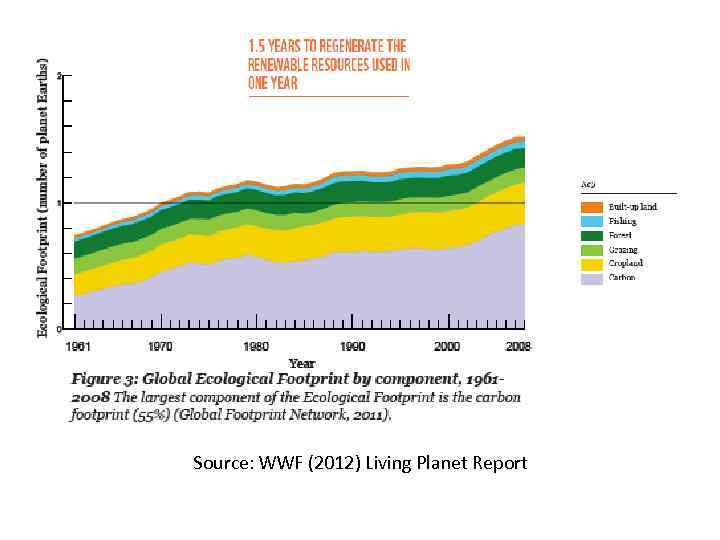
Source: WWF (2012) Living Planet Report
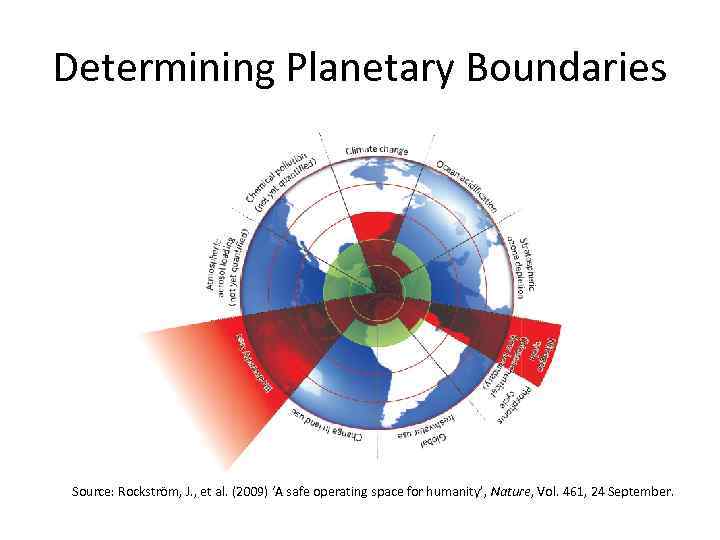
Determining Planetary Boundaries Source: Rockström, J. , et al. (2009) ‘A safe operating space for humanity’, Nature, Vol. 461, 24 September.
Relationship with Nature • Ambiguous relationship with nature • Attempted to secure ourselves from its vagaries by using fossil fuel and other non-organic resources. • But now we are experiencing feedback effects • Recognition that need to work with nature “We still talk in terms of conquest. I think we're challenged, as mankind has never been challenged before, to prove our maturity and our mastery, not of nature but of ourselves. ” Rachel Carson author of the influential book published in 1962 ‘Silent Spring’
Tragedy of the commons Common property resources— resources that: – No one owns – Everyone can use – Absence of a price for use of the resource causes overuse (“tragedy of the commons”) – Inefficiency/market failure Garret Hardin (1968) Biologist writing on resource use When there is common land, there is a tendency for overgrazing. Each herdsmen sees a gain to adding another animal to the land as reaps the benefit but cost is shared by all, the amount grass per animal is lower. Bred for of more animal products. He adds another and another. . . but so do the other herdsmen. Therein is the tragedy. Hardin’s solution is that need to either (a) establish property rights, or (b) Have government regulation to correct for this market failure.
The non-tragedy of the commons But Elinor Ostrom won the Nobel prize in Economics in 2009 for her work that refutes Hardin’s pessimistic conclusion. Her empirical work finds many examples that commons do not need to be ‘privatised’ of subject to government regulation. Commons can be managed by decentralised decision-making, by the users of the resource However, can Ostrom’s findings be applied to global commons such as the atmosphere, the oceans, when there are so many users, and a tangled web of relationships? Ostrom recognises that this is more challenging but not necessarily Impossible. See Ostrom (1999) –on module website
Business and the Environment Over the last 40 years, a sea change in expectations of business responsibility towards the environment. From solely legal responsibility, to moral responsibility. To be proactive rather than just reactive. Why? § Multiplicity of environmental issues § Globalisation § Power and capabilities § Pressure from NGOs to be accountable
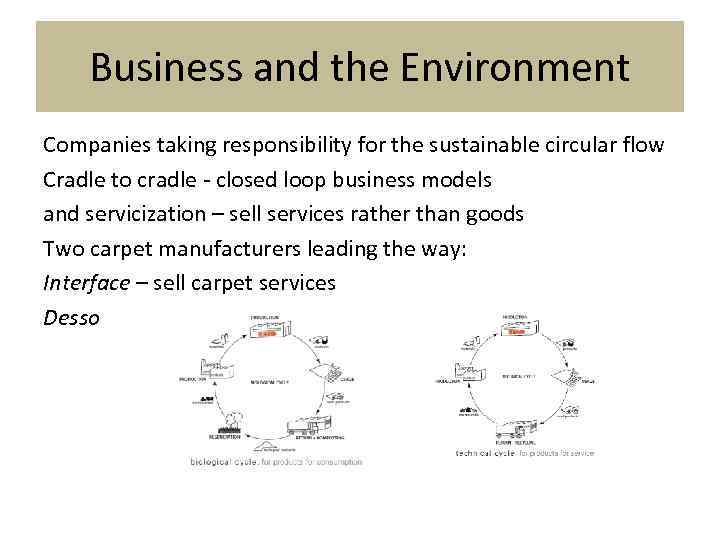
Business and the Environment Companies taking responsibility for the sustainable circular flow Cradle to cradle - closed loop business models and servicization – sell services rather than goods Two carpet manufacturers leading the way: Interface – sell carpet services Desso
Business and Climate Change ‘Climate changes your business’ Businesses need to respond to: (1) physical climate change (2) climate change policy – regulations & carbon price (3) the expectations of NGOs, customers, investors. (see Levis Climate Change Strategy on ELE) http: //levistrauss. com/blogs/cotton-and-climate-change)
“Recent extreme weather and natural events have tested companies’ business resilience and increased their level of understanding of the timeframes of the physical risks they associate with climate change. Physical risks are viewed as tangible and present, impacting companies’ operations, supply chains and business planning. The majority of companies (81%) report physical risks and the percentage of companies that view these risks as current has nearly quadrupled from 10% in 2010 to 37% in 2012. Insurance company Allianz reports that in 2011 it processed $2. 2 billion in natural catastrophe (including non-weather related) claims, the largest sum for natural catastrophes in its history. ” CDP Global 500 Climate Change Report 2012 (CDP – Climate Disclosure Project)
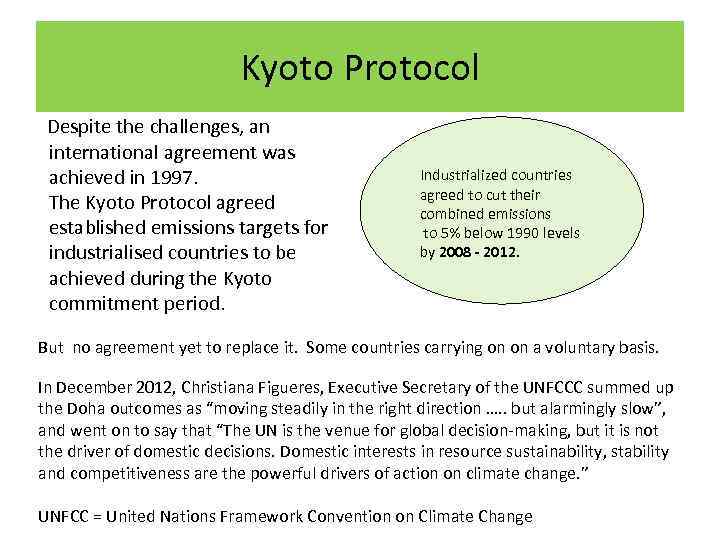
Kyoto Protocol Despite the challenges, an international agreement was achieved in 1997. The Kyoto Protocol agreed established emissions targets for industrialised countries to be achieved during the Kyoto commitment period. Industrialized countries agreed to cut their combined emissions to 5% below 1990 levels by 2008 - 2012. But no agreement yet to replace it. Some countries carrying on on a voluntary basis. In December 2012, Christiana Figueres, Executive Secretary of the UNFCCC summed up the Doha outcomes as “moving steadily in the right direction …. . but alarmingly slow”, and went on to say that “The UN is the venue for global decision-making, but it is not the driver of domestic decisions. Domestic interests in resource sustainability, stability and competitiveness are the powerful drivers of action on climate change. ” UNFCC = United Nations Framework Convention on Climate Change
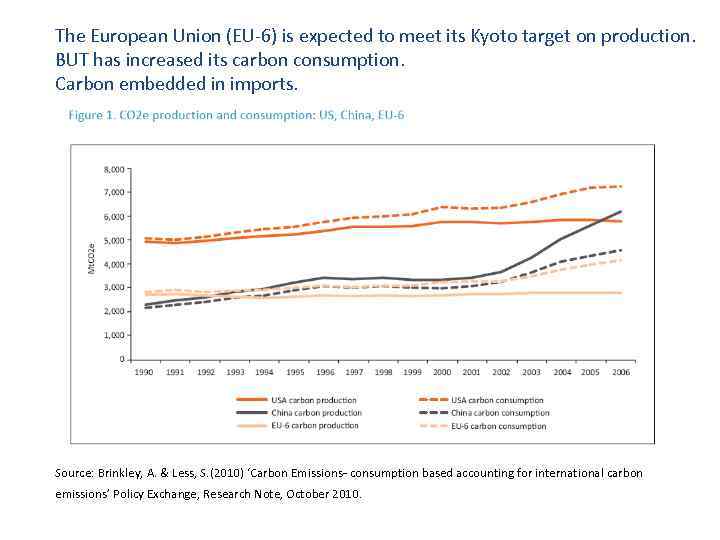
The European Union (EU-6) is expected to meet its Kyoto target on production. BUT has increased its carbon consumption. Carbon embedded in imports. Source: Brinkley, A. & Less, S. (2010) ‘Carbon Emissions- consumption based accounting for international carbon emissions’ Policy Exchange, Research Note, October 2010.
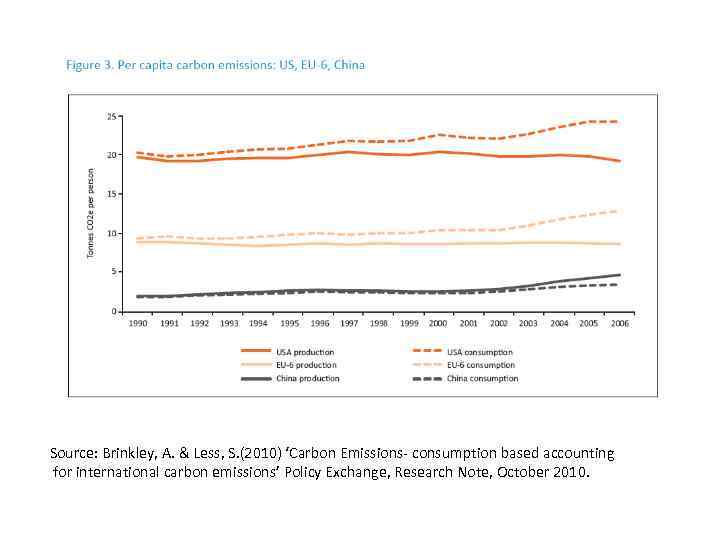
Source: Brinkley, A. & Less, S. (2010) ‘Carbon Emissions- consumption based accounting for international carbon emissions’ Policy Exchange, Research Note, October 2010.
Is there an alternative to International agreement on Climate Change? Ostrom (2009) argues ‘while many of the effects of climate change are global, the causes of climate change are the actions undertaken by individuals, families, firms, and actors at a much smaller scale. . . To solve climate change in the long run, the day-to-day activities of individuals, families, firms, communities, and governments at multiple levels—particularly those in the more developed world—will need to change substantially’. “Think Globally but Act Locally” Policies adopted only at a global scale are unlikely to generate sufficient trust among citizens and firms to permit collective action to take place in a comprehensive and transparent manner that effectively reduces global warming. Hence she advocates a polycentric approach that encourages action at multiple levels.
Local response: Transition Towns Transition Exeter “Transition Exeter is a local response to the global challenges of climate change, economic hardship and shrinking supplies of cheap energy. Our aims are to: • Increase the quality of life in Exeter, aiming for a healthier, happier and more empowered community • Reduce our negative impacts on the environment • Reduce the negative impacts on us of climate change and peak oil” • http: //www. transitionexeter. org. uk/
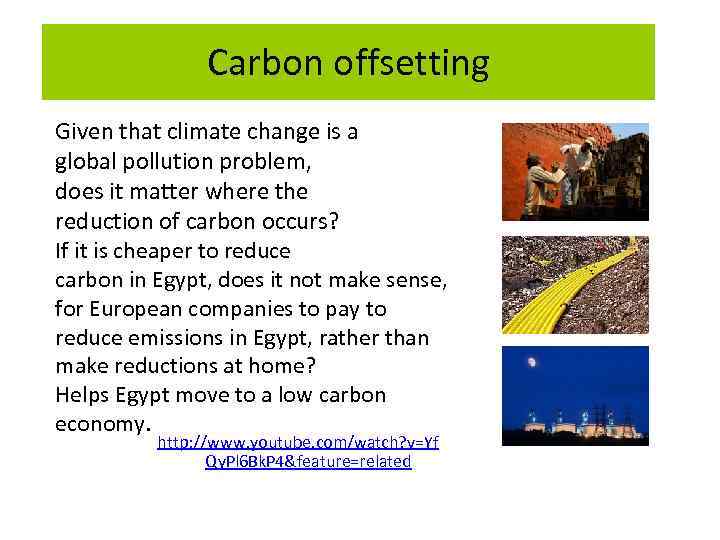
Carbon offsetting Given that climate change is a global pollution problem, does it matter where the reduction of carbon occurs? If it is cheaper to reduce carbon in Egypt, does it not make sense, for European companies to pay to reduce emissions in Egypt, rather than make reductions at home? Helps Egypt move to a low carbon economy. http: //www. youtube. com/watch? v=Yf Qy. Pl 6 Bk. P 4&feature=related
Carbon Neutral Strategy (Zero Carbon) has become popular with companies that are not major energy users. Set a net zero target for emission reduction achieved through implementing an offset-inclusive carbon management strategy. Becoming carbon neutral involves three basic steps: – CALCULATE carbon emissions and other greenhouse gases from activities – REDUCE emissions wherever possible through increased efficiencies – BALANCE the remainder by purchasing carbon offsets • Subject to criticism as could achieve carbon neutrality without changing behaviour • Needs to be adequately verified and monitored. Options: Carbon Neutral Company http: //www. carbonneutral. com/our-services/carbonneutral/ PAS 2060 British Standard Institute http: //www. carbonneutral. com/ourservices/pas-2060/
Carbon Neutral Strategy PAS 2060 Total amount of carbon emissions at the end of a reduction period be offset certified carbon credits which meet the following criteria: • From one of the PAS 2060 approved schemes (for example the CERs from Clean Development Mechanism, Joint Implementation, or Verified Carbon Standard (Voluntary standard)) • Genuinely additional (i. e. reductions that would not have happened anyway) • Verified by an independent third party to ensure that emission reductions are permanent, avoid leakage (so that emissions are not increased in another area as a result of the project reductions) and are not double counted • Retired after a maximum of 12 months to a credible registry.
Скачать презентацию Individual versus Collective responsibility Moral responsibility is associated
Responsibility and the Environment.pptx