


 Скачать презентацию Indicators for children s health Lennart Köhler Professor Nordic
4e334069f72a3838925d8f3e0807fd3b.ppt
- Количество слайдов: 70
 Indicators for children’s health Lennart Köhler Professor Nordic School of Public Health Göteborg, Sweden
 WP 2 Measurement and indicators To identify research in the measurement of child health
 Task 1: Stakeholders To identify and establish contacts with stakeholders and relevant research/child health groups.
 Task 2: Indicators of health and related behaviours A framework for data collection will be developed Data will be collected, assembled and disseminated A preliminary report will be discussed A final report will be published as section 1 in Report 1
 Indicators – definition, framework, principles and requirement
 Indicators – tool in improving child health and well-being by…
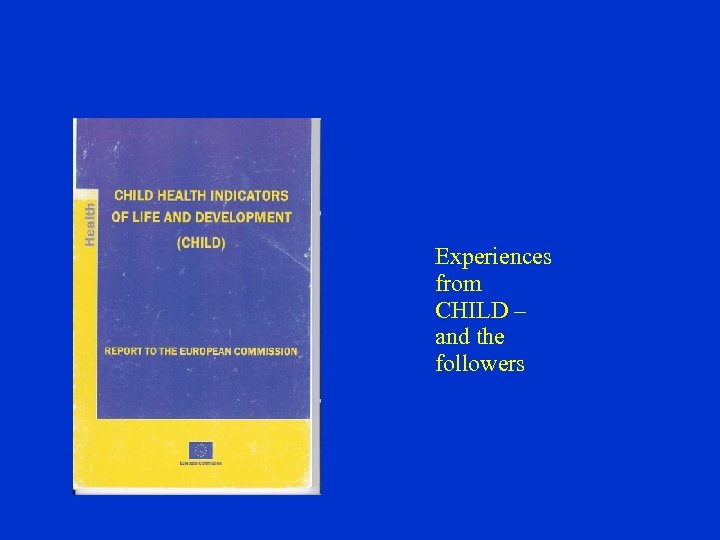 Experiences from CHILD – and the followers
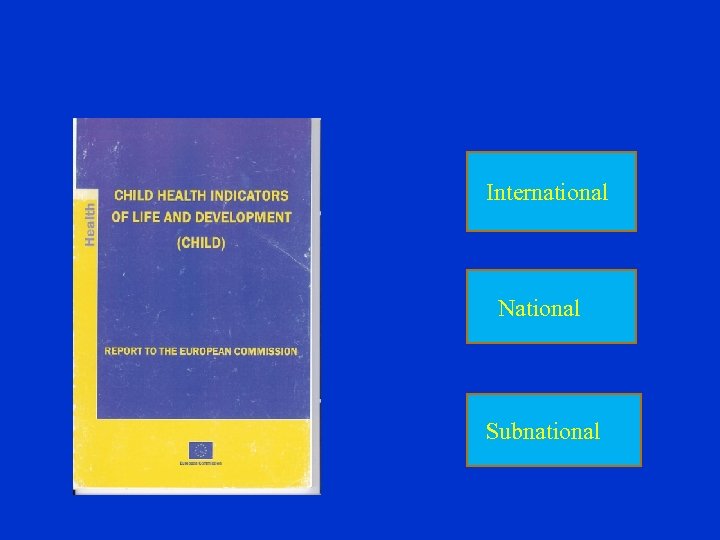
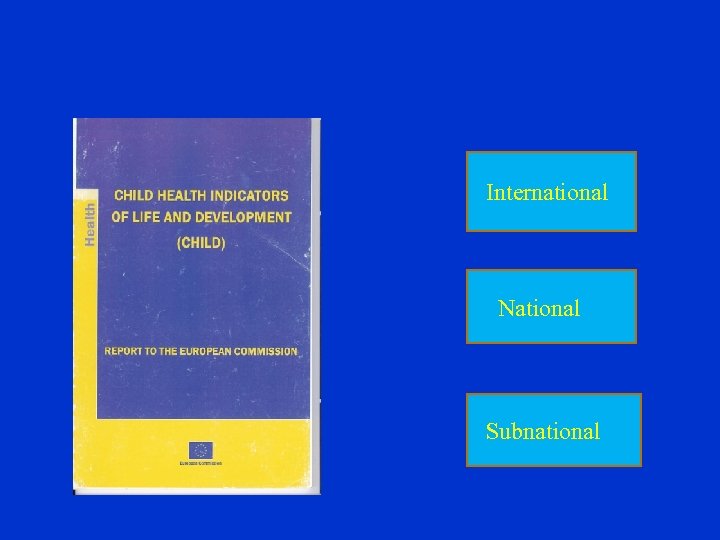 Text International National Subnational
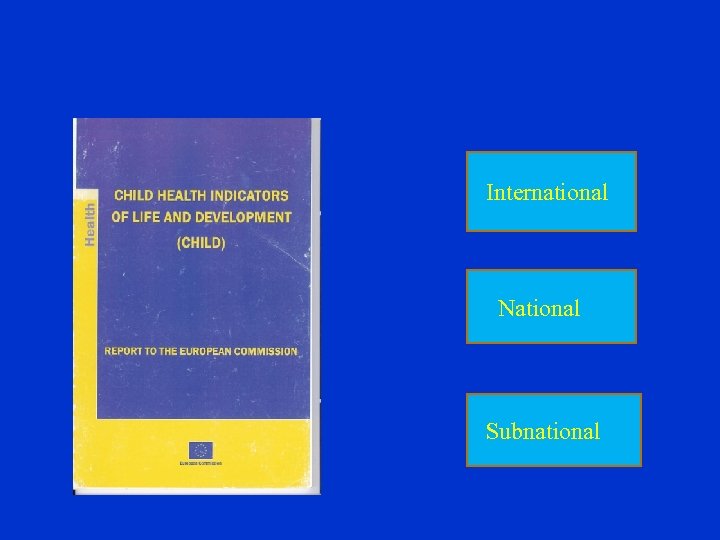
 Child Health Indicators for Health and Development (CHILD) A project within the EU Health Monitoring Programme
 CHILD Project 2000 – 2002 17 Countries 15 Member States; + Norway, Iceland Expert Panel - European critical review
 What is an indicator? An indicator is a defined, measurable dimension of the quality or appropriateness of important aspects of health.
 Indicators do not give you answers; they refine the questions
 CHILD Principle 1 Towards an ideal set of indicators The ambition should be to identify indicators that in the best way mirror the broad concepts of children's life and development
 CHILD Principle 2 A health perspective should be applied Broad multi-scientific, multiprofessional and intersectoral aspects on health and well-being should be used.
 CHILD Principle 3 A general population based perspective should be applied Indicators should cover the life of the whole child population, and not primarily be targeted towards riskgroups.
 CHILD Principle 4 Child perspective Children's perspective should be applied, wherever possible and both objective and subjective measures should be considered.
 CHILD Principle 5 Outcome indicators are preferred, sometimes process indicators are accepted. Structure indicators should be avoided. An indicator based on outcome is more reliable and definite. However, process components are often valuable. Structure indicators are usually too diverse to give
 CHILD Principle 6 All health indicators should be seen in their social context Socio-economic, cultural and demographic backgrounds of the indicators should be included
 In conclusion Click to edit the outline text format Relevant Valid Reliable Available Ø Ø Ø Useful Second Outline Robust Level Undestandable Third Outline Generally accepted Level Påverkbar Fourth Outline 1919 Level
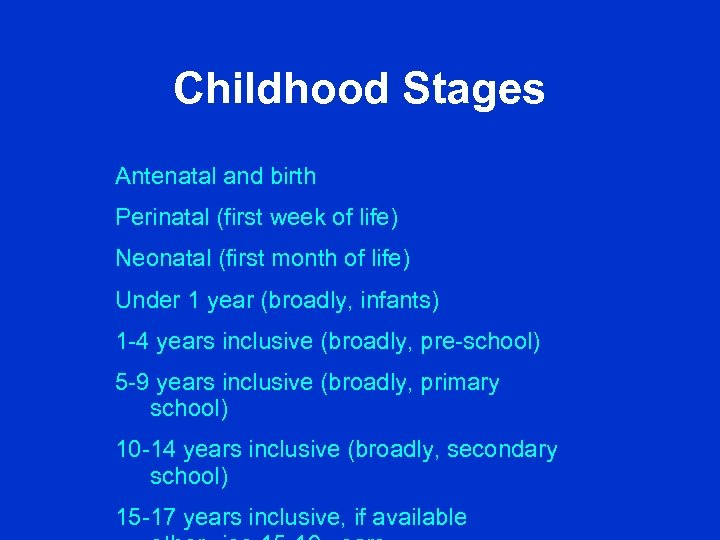 Childhood Stages Antenatal and birth Perinatal (first week of life) Neonatal (first month of life) Under 1 year (broadly, infants) 1 -4 years inclusive (broadly, pre-school) 5 -9 years inclusive (broadly, primary school) 10 -14 years inclusive (broadly, secondary school) 15 -17 years inclusive, if available
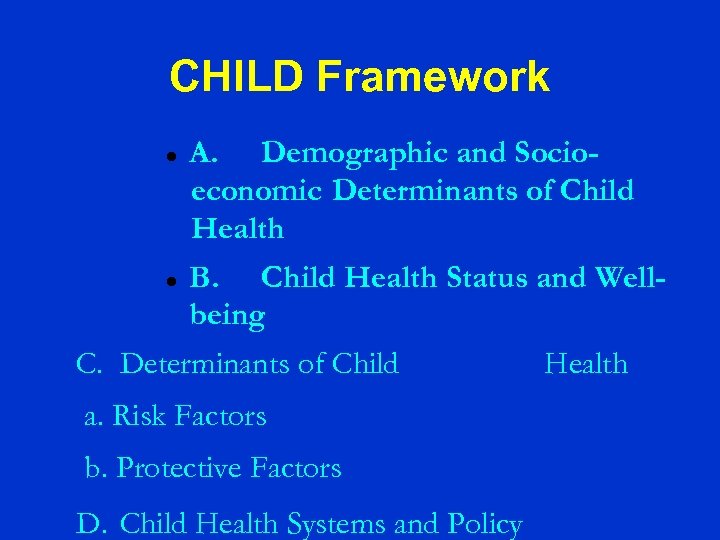 CHILD Framework A. Demographic and Socioeconomic Determinants of Child Health B. Child Health Status and Wellbeing C. Determinants of Child a. Risk Factors b. Protective Factors D. Child Health Systems and Policy Health
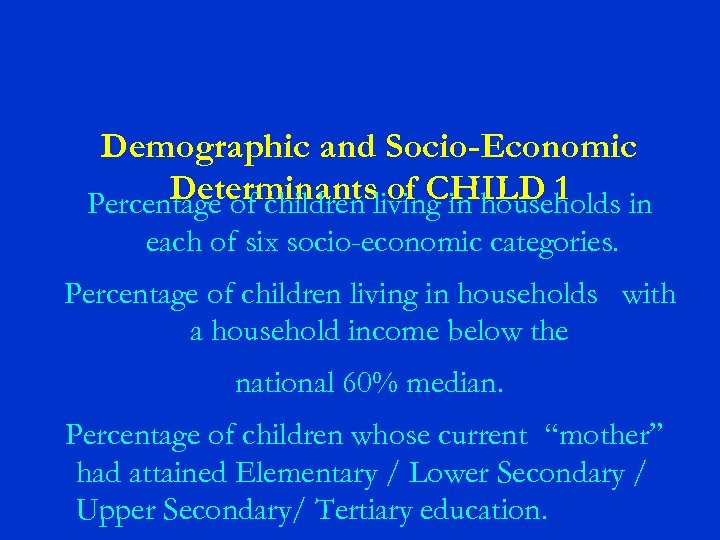 Demographic and Socio-Economic Determinantsliving in households in of CHILD 1 Percentage of children each of six socio-economic categories. Percentage of children living in households with a household income below the national 60% median. Percentage of children whose current “mother” had attained Elementary / Lower Secondary / Upper Secondary/ Tertiary education.
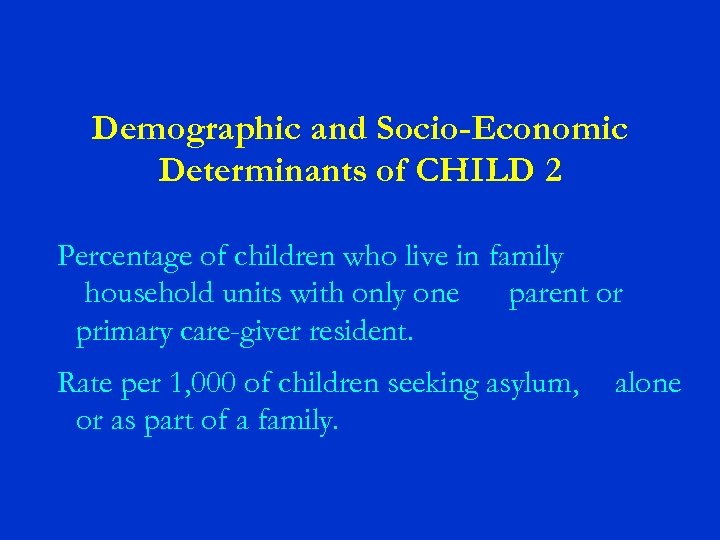 Demographic and Socio-Economic Determinants of CHILD 2 Percentage of children who live in family household units with only one parent or primary care-giver resident. Rate per 1, 000 of children seeking asylum, or as part of a family. alone
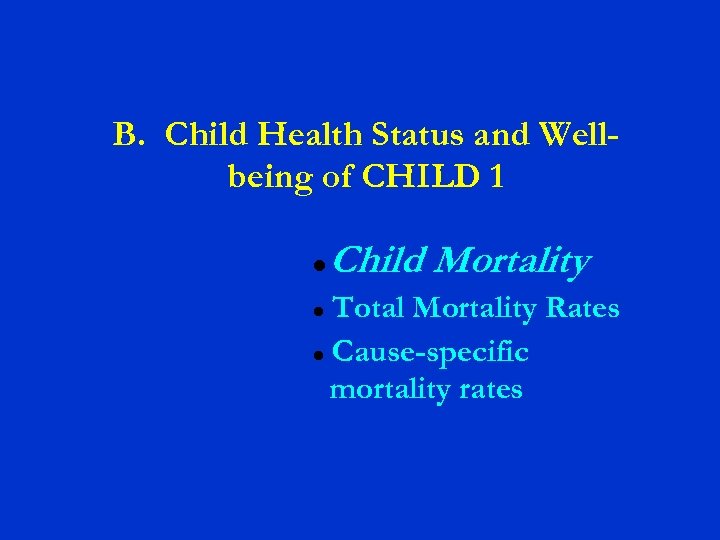 B. Child Health Status and Wellbeing of CHILD 1 Child Mortality Total Mortality Rates Cause-specific mortality rates
 B. Child Health Status and Wellbeing of CHILD 2 Child Morbidity Cancer Type 1 insulin-dependent diabetes Asthma Measles Bacterial meningitis Tuberculosis Caries
 B. Child Health Status and Wellbeing of CHILD 3 Child Morbidity Injuries to Children Burns Poisoning Fracture of long-bones
 B. Child Health Status and Wellbeing of CHILD 4 Child Morbidity Mental Health Attempted suicide
 C. Determinants of Child Health; Risk and Protective Factors of CHILD 1 Parental Determinants Breastfeeding Passive smokers Trust
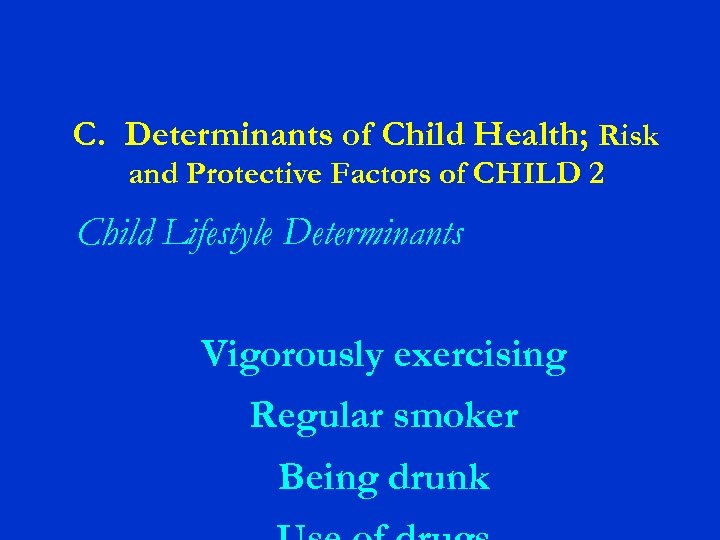 C. Determinants of Child Health; Risk and Protective Factors of CHILD 2 Child Lifestyle Determinants Vigorously exercising Regular smoker Being drunk
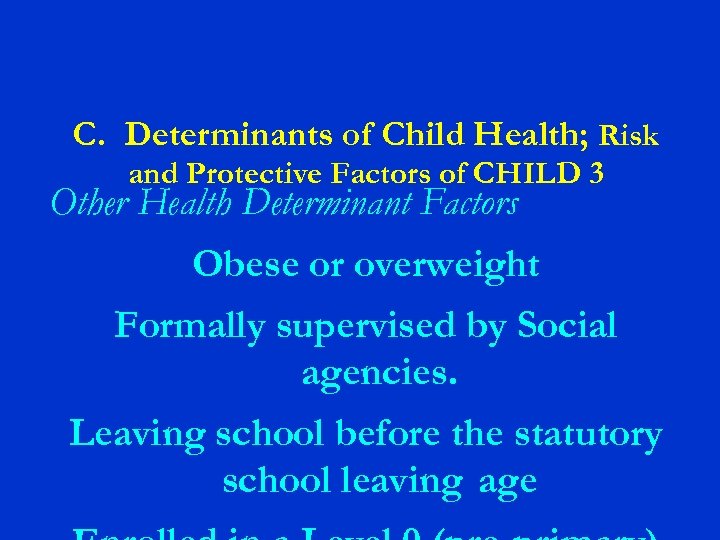 C. Determinants of Child Health; Risk and Protective Factors of CHILD 3 Other Health Determinant Factors Obese or overweight Formally supervised by Social agencies. Leaving school before the statutory school leaving age
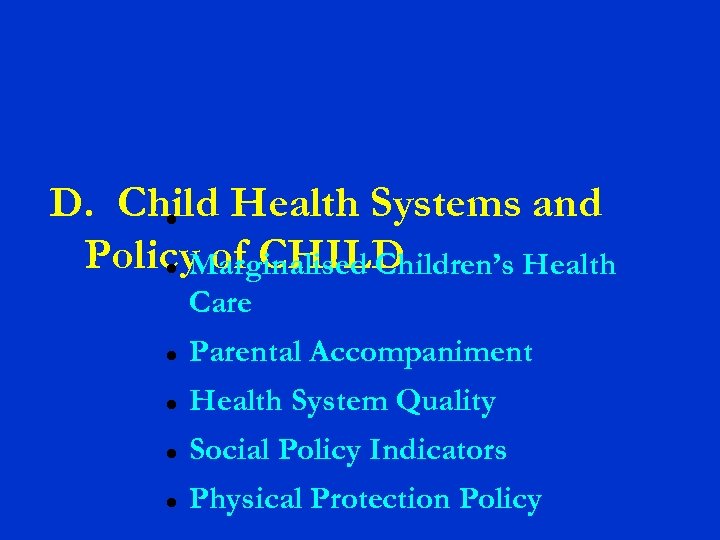 D. Child Health Systems and Policy of CHILD Marginalised Children’s Health Care Parental Accompaniment Health System Quality Social Policy Indicators Physical Protection Policy
 European Journal of Public Health Rigby M, Köhler L, Blair M, Mechtler R: Child Health Indicators for Europe: a Priority for a Caring Society. European Journal of Public Health 2003; 13 (3 Suppl): 38 -42
 Further work needed Health Care Access Inpatient Service Quality Health Service Access for Socially Restricted Children Medication Play and Leisure Assessment Healthy Parenting Mental Health Education
 Text International National Subnational
 WHO/EURO UNICEF/Bradshaw OECD EU/Bradshaw

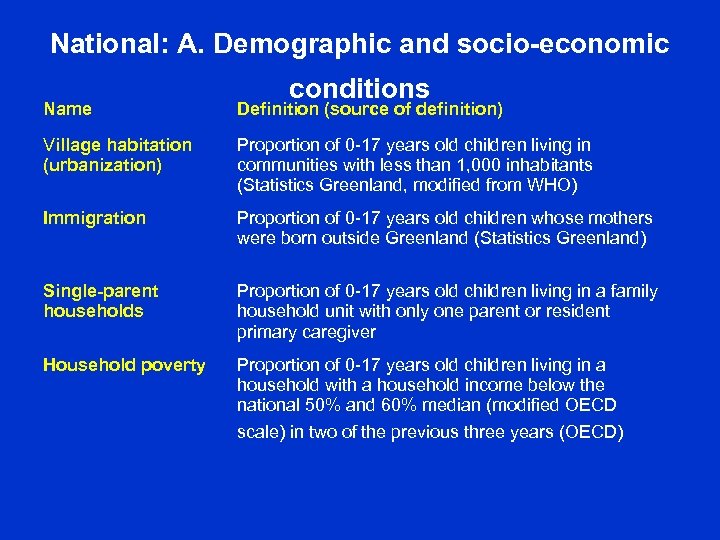 National: A. Demographic and socio-economic conditions Name Definition (source of definition) Village habitation (urbanization) Proportion of 0 -17 years old children living in communities with less than 1, 000 inhabitants (Statistics Greenland, modified from WHO) Immigration Proportion of 0 -17 years old children whose mothers were born outside Greenland (Statistics Greenland) Single-parent households Proportion of 0 -17 years old children living in a family household unit with only one parent or resident primary caregiver Household poverty Proportion of 0 -17 years old children living in a household with a household income below the national 50% and 60% median (modified OECD scale) in two of the previous three years (OECD)
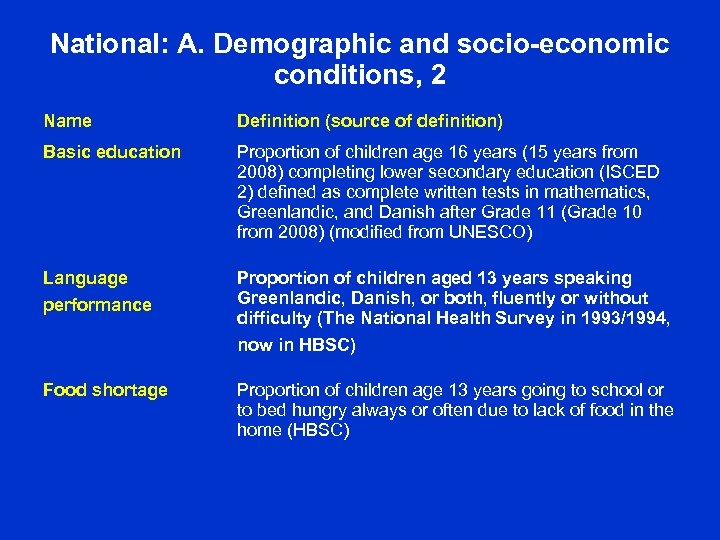 National: A. Demographic and socio-economic conditions, 2 Name Definition (source of definition) Basic education Proportion of children age 16 years (15 years from 2008) completing lower secondary education (ISCED 2) defined as complete written tests in mathematics, Greenlandic, and Danish after Grade 11 (Grade 10 from 2008) (modified from UNESCO) Language Proportion of children aged 13 years speaking Greenlandic, Danish, or both, fluently or without difficulty (The National Health Survey in 1993/1994, performance now in HBSC) Food shortage Proportion of children age 13 years going to school or to bed hungry always or often due to lack of food in the home (HBSC)
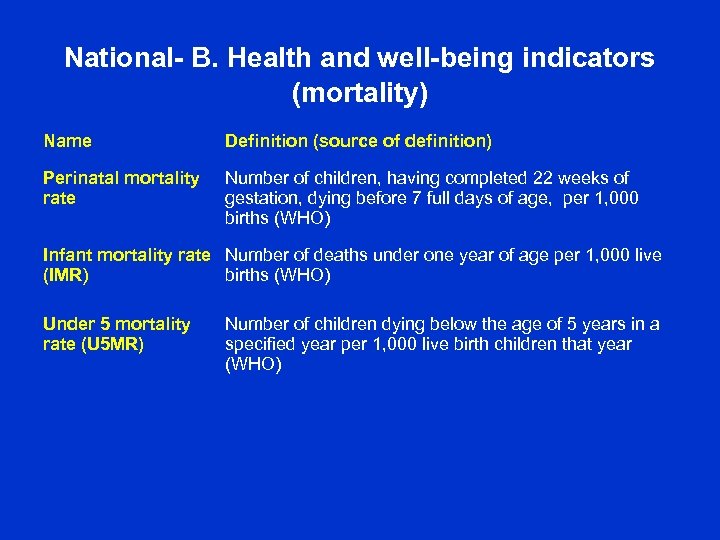 National- B. Health and well-being indicators (mortality) Name Definition (source of definition) Perinatal mortality rate Number of children, having completed 22 weeks of gestation, dying before 7 full days of age, per 1, 000 births (WHO) Infant mortality rate Number of deaths under one year of age per 1, 000 live (IMR) births (WHO) Under 5 mortality rate (U 5 MR) Number of children dying below the age of 5 years in a specified year per 1, 000 live birth children that year (WHO)
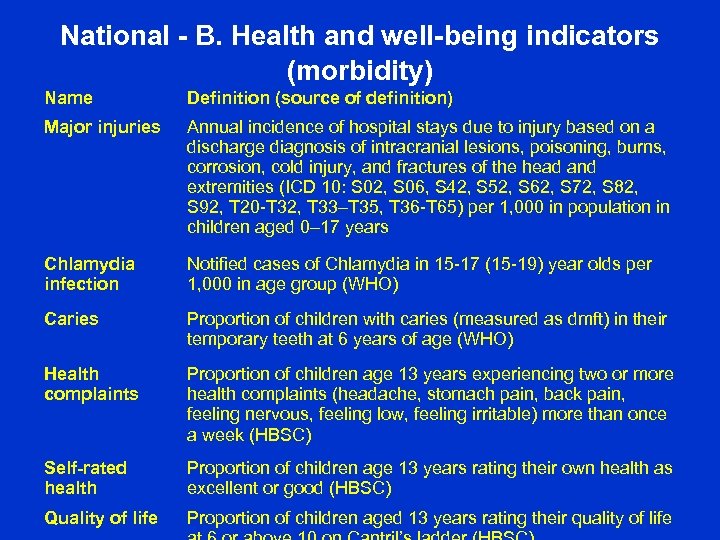 National - B. Health and well-being indicators (morbidity) Name Definition (source of definition) Major injuries Annual incidence of hospital stays due to injury based on a discharge diagnosis of intracranial lesions, poisoning, burns, corrosion, cold injury, and fractures of the head and extremities (ICD 10: S 02, S 06, S 42, S 52, S 62, S 72, S 82, S 92, T 20 -T 32, T 33–T 35, T 36 -T 65) per 1, 000 in population in children aged 0– 17 years Chlamydia infection Notified cases of Chlamydia in 15 -17 (15 -19) year olds per 1, 000 in age group (WHO) Caries Proportion of children with caries (measured as dmft) in their temporary teeth at 6 years of age (WHO) Health complaints Proportion of children age 13 years experiencing two or more health complaints (headache, stomach pain, back pain, feeling nervous, feeling low, feeling irritable) more than once a week (HBSC) Self-rated health Proportion of children age 13 years rating their own health as excellent or good (HBSC) Quality of life Proportion of children aged 13 years rating their quality of life
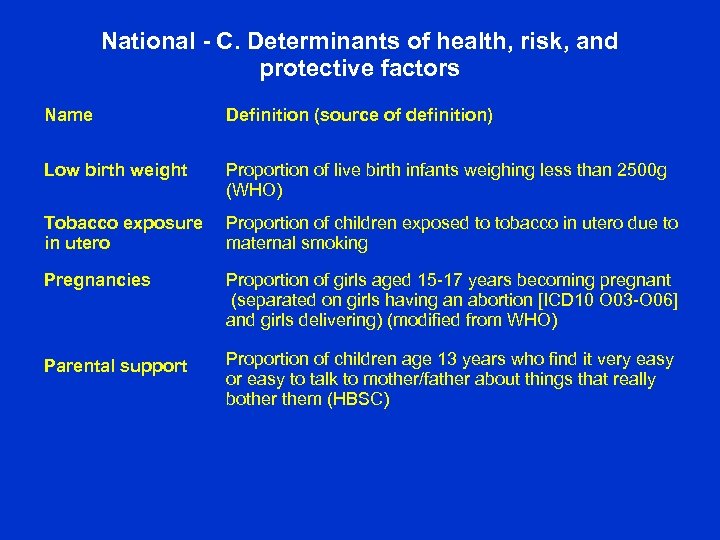 National - C. Determinants of health, risk, and protective factors Name Definition (source of definition) Low birth weight Proportion of live birth infants weighing less than 2500 g (WHO) Tobacco exposure in utero Proportion of children exposed to tobacco in utero due to maternal smoking Pregnancies Proportion of girls aged 15 -17 years becoming pregnant (separated on girls having an abortion [ICD 10 O 03 -O 06] and girls delivering) (modified from WHO) Parental support Proportion of children age 13 years who find it very easy or easy to talk to mother/father about things that really bother them (HBSC)
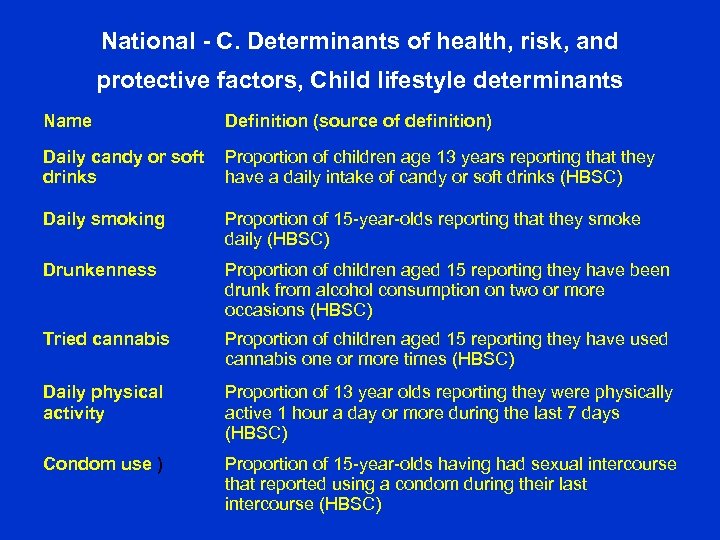 National - C. Determinants of health, risk, and protective factors, Child lifestyle determinants Name Definition (source of definition) Daily candy or soft drinks Proportion of children age 13 years reporting that they have a daily intake of candy or soft drinks (HBSC) Daily smoking Proportion of 15 -year-olds reporting that they smoke daily (HBSC) Drunkenness Proportion of children aged 15 reporting they have been drunk from alcohol consumption on two or more occasions (HBSC) Tried cannabis Proportion of children aged 15 reporting they have used cannabis one or more times (HBSC) Daily physical activity Proportion of 13 year olds reporting they were physically active 1 hour a day or more during the last 7 days (HBSC) Condom use ) Proportion of 15 -year-olds having had sexual intercourse that reported using a condom during their last intercourse (HBSC)
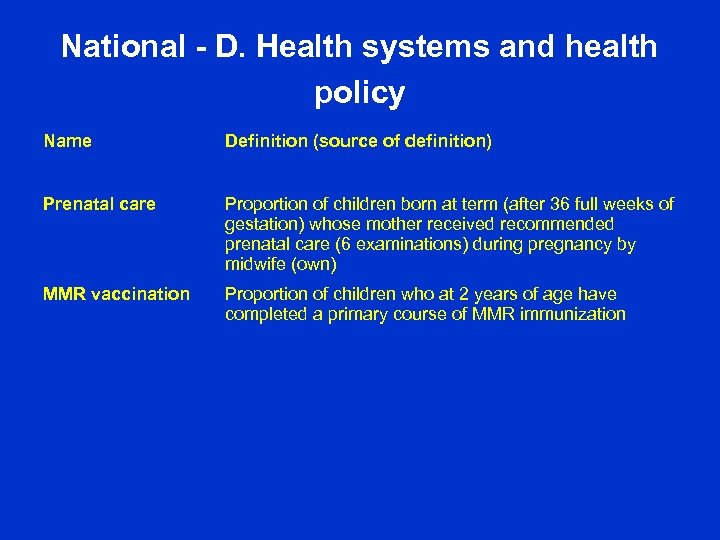 National - D. Health systems and health policy Name Definition (source of definition) Prenatal care Proportion of children born at term (after 36 full weeks of gestation) whose mother received recommended prenatal care (6 examinations) during pregnancy by midwife (own) MMR vaccination Proportion of children who at 2 years of age have completed a primary course of MMR immunization
 Text International National Subnational
 The commission from Save the Children, Sweden Operationalization in 3 steps of UN’s Convention of the Rights of the Child on the municipality level The Child’s right to standard of living (art 27) The Child’s right to health (art 24) The Child’s right to education (art 28)
 Requirements Ø Ø Index should measure and assess children’s health and its determinants in the municipalities and follow them over time Index should facilitate planning, followup and evaluation of the municipalities’ actions for children’s health
 Principles Index should use a Child Public Health perspective Index should cover all important health aspects Index should use a general population perspective Index should permeated by a child perspective Outcome indicators are preferred, sometimes process indicators are accepted. Structure indicators should be avoided.
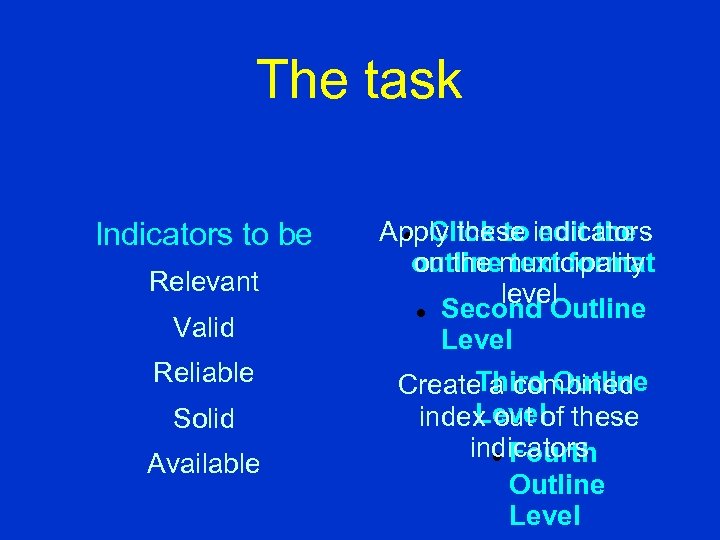 The task Indicators to be Relevant Valid Reliable Solid Available Apply these indicators Click to edit the outline text format on the municipality level Second Outline Level Third Outline Create a combined Level index out of these indicators Fourth Outline Level
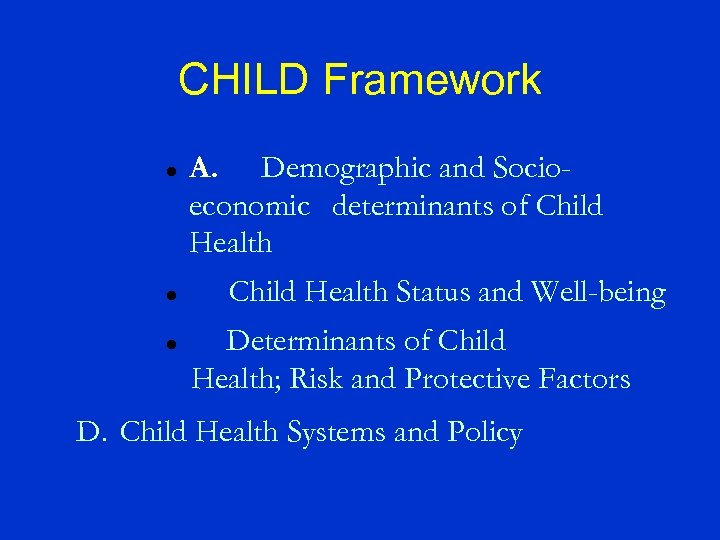 CHILD Framework A. Demographic and Socioeconomic determinants of Child Health Status and Well-being Determinants of Child Health; Risk and Protective Factors D. Child Health Systems and Policy
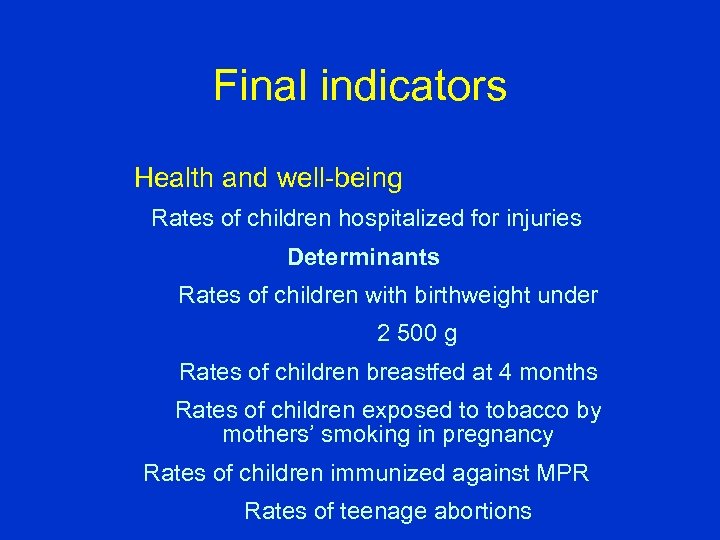 Final indicators Health and well-being Rates of children hospitalized for injuries Determinants Rates of children with birthweight under 2 500 g Rates of children breastfed at 4 months Rates of children exposed to tobacco by mothers’ smoking in pregnancy Rates of children immunized against MPR Rates of teenage abortions
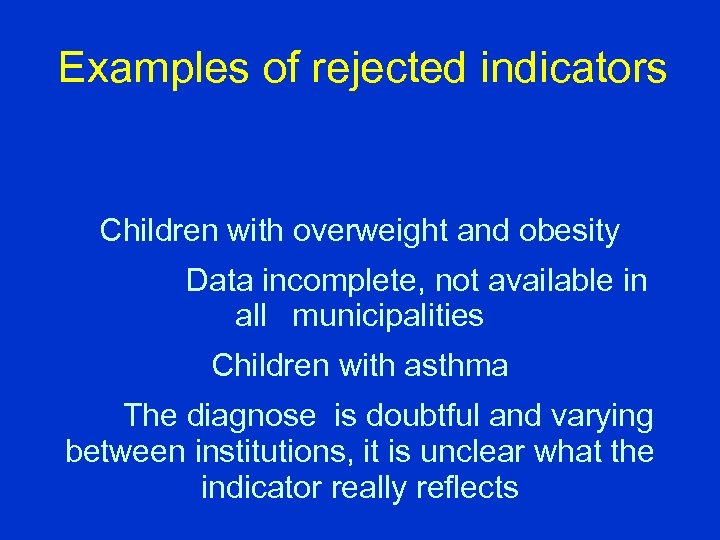 Examples of rejected indicators Children with overweight and obesity Data incomplete, not available in all municipalities Children with asthma The diagnose is doubtful and varying between institutions, it is unclear what the indicator really reflects
 Examples of rejected indicators Children’s alcohol use Data available only in samples of representative populations, not on all children in a municipality Safe and secure community Vaguely defined and unclear in its continuity; the direct connection with children’s health is difficult to prove
 Child Health Index The aim of each municipality is optimal health, i. e. the indicators should be 100 If 60% of the children are breastfed at 4 months, the indicator is 60; If abortion is performed on 22 per 1000 girls under 18 years, the indicator is 97. 8 To create a Child Health Index, the indicators are added and divided by 6, i. e.
 Poverty index ”children who live neither in households with low income standard nor in households with means tested social assistance” (Save the Children, Sweden 2002)
 Education index is a teacher resource index, consisting of two parts 1. 2. Number of full time employed teachers per 100 pupils Proportion of teachers with a formal certificate to teach (Save the Children, Sweden 2006)
 Child Municipal Index The same municipalities are found at the top and at the bottom for each of the three sets of indicators, (poverty, health and education)
 The good news Ø Ø The UN Convention of the Rights of the Child gives a politically and ideologically firm basis for the work To relate the index to the local level is important, because the municipalities have a major responsibility for the most important determinants of the wellbeing of children and families
 The good news 2 Ø Ø Both the indicators and the combined Index are based on existing data, collected by national authorities and easily available in aggregated form, and can be compiled for all municipalities at no extra cost The results show the need for further research and development of methodologies in measurement
 The bad news Ø Ø Ø Indicators fulfilling the basic requirements are few and cover only part of the child population and its health spectrum No indicators are based on children’s own appreciation of their health The 289 municipalities differ in many ways (population, infrastructure, economy), which makes comparisons problematic
 The bad news 2 Ø Ø Great variations can be found within the municipalities, especially the big ones, but are hidden in the averages The combined Health Index is the sum of several indicators with varying mathematical weight and different influence on the well-being of individuals and populations
 Conclusions Ø Ø Ø The study offers a thorough and systematic review of children’s health, seen in a broad public health perspective and focused on the municipalities A few, well defined and easily available child health indicators are presented. Additional indicators are suggested and further research proposed By studying the individual indicators of the Index the municipalities can prioritize its
 Differences between EU and Municipality index The EU indicators can use country representative samples; the Municipality indicators cannot The States have the ultimate responsibility the citizen’s health, not the municipalities Save the Children demands a combined Child Health Index; EU does not
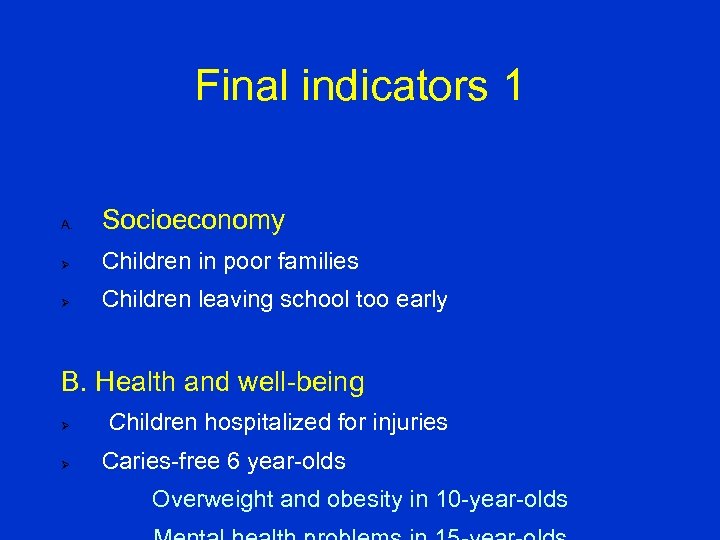 Final indicators 1 A. Socioeconomy Ø Children in poor families Ø Children leaving school too early B. Health and well-being Ø Ø Children hospitalized for injuries Caries-free 6 year-olds Overweight and obesity in 10 -year-olds
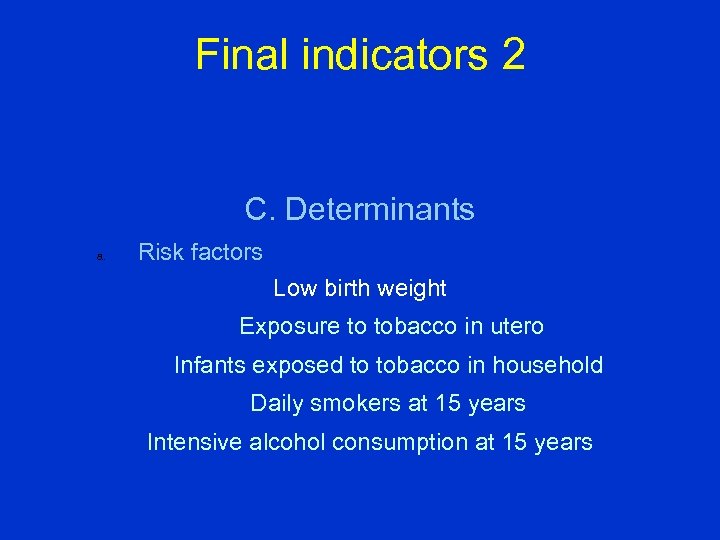 Final indicators 2 C. Determinants a. Risk factors Low birth weight Exposure to tobacco in utero Infants exposed to tobacco in household Daily smokers at 15 years Intensive alcohol consumption at 15 years
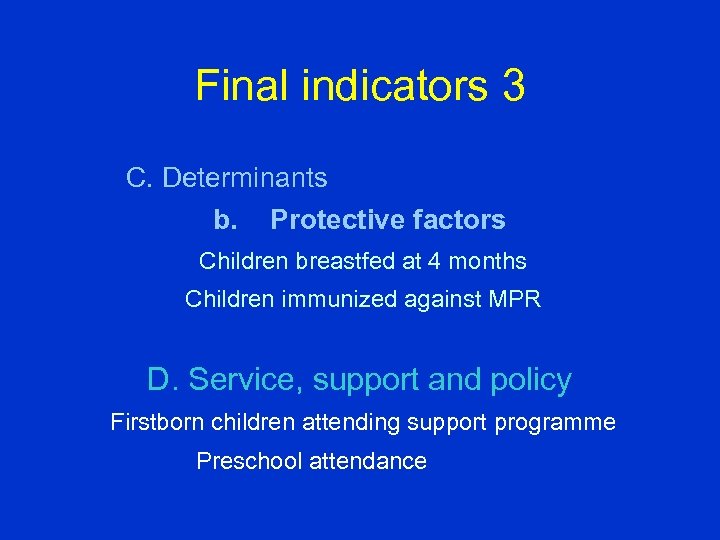 Final indicators 3 C. Determinants b. Protective factors Children breastfed at 4 months Children immunized against MPR D. Service, support and policy Firstborn children attending support programme Preschool attendance
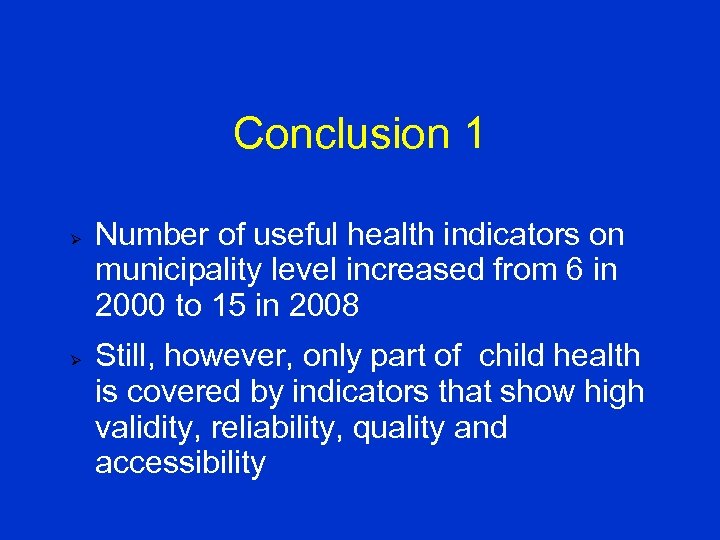 Conclusion 1 Ø Ø Number of useful health indicators on municipality level increased from 6 in 2000 to 15 in 2008 Still, however, only part of child health is covered by indicators that show high validity, reliability, quality and accessibility
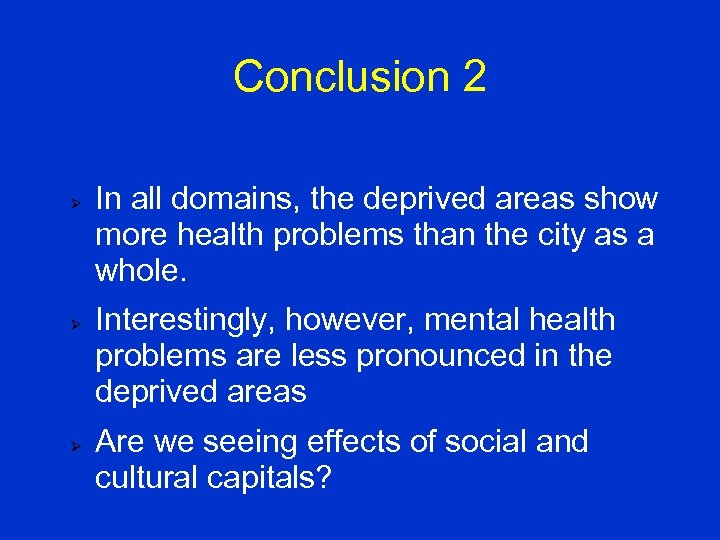 Conclusion 2 Ø Ø Ø In all domains, the deprived areas show more health problems than the city as a whole. Interestingly, however, mental health problems are less pronounced in the deprived areas Are we seeing effects of social and cultural capitals?