 Скачать презентацию Indiana Geological Survey s Petroleum Database DBMS and GIS
67151262d0650f061e16034c4c31e34e.ppt
- Количество слайдов: 11



Indiana Geological Survey’s Petroleum Database DBMS and GIS Prem Radhakrishnan, Charles W. Zuppann 03. 09. 2004 Indiana Geological Survey Indiana GIS Initiative Conference 2005
Overview ► Indiana Geological Survey is a state organization with the responsibility to collect and disseminate oil and gas data to the industry and research organizations. ► The data collected for the well borings in the state of Indiana comes from a variety of different sources. ► The data includes complex information that has to be organized and distributed. 03. 09. 2004 Indiana Geological Survey Indiana GIS Initiative Conference 2005
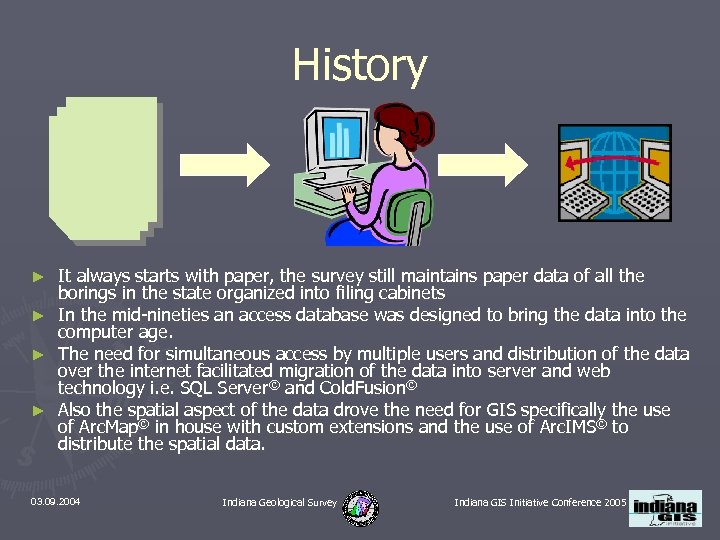
History ► ► It always starts with paper, the survey still maintains paper data of all the borings in the state organized into filing cabinets In the mid-nineties an access database was designed to bring the data into the computer age. The need for simultaneous access by multiple users and distribution of the data over the internet facilitated migration of the data into server and web technology i. e. SQL Server© and Cold. Fusion© Also the spatial aspect of the data drove the need for GIS specifically the use of Arc. Map© in house with custom extensions and the use of Arc. IMS© to distribute the spatial data. 03. 09. 2004 Indiana Geological Survey Indiana GIS Initiative Conference 2005
Data Organization ► The data is maintained in a Microsoft SQL server© with a number of applications facilitating access to the data § A Cold. Fusion© web application allows viewing and editing of the tabular data within the organization § A custom extension for Arc. Map© allows viewing and editing of the data spatially. § Another Cold. Fusion© web application allows the public to query and download the data. § The Arc. IMS© web application (which uses Flash© technology and server side Cold. Fusion© components) allows the public to view the data spatially. 03. 09. 2004 Indiana Geological Survey Indiana GIS Initiative Conference 2005
Interoperability ► The data is contained in multiple tables in the database. One of the tables which is the primary table with unique ids for each well contains the UTM X and Y coordinates as attribute information. ► Whenever data needs to be displayed in GIS it is done in two ways § A dynamic XY Event Layer is created whenever the purpose is only display § A dynamic shapefile is created whenever the data needs to be edited. The custom extension updates the SQL server table attributes when something is changed within the Arc. Map environment. 03. 09. 2004 Indiana Geological Survey Indiana GIS Initiative Conference 2005
Technology Used ► Database § Microsoft SQL Server© to store the data § Custom Visual Basic© DLL to perform some custom functions on the database ► GIS § Arc. Objects© to create the custom extensions / scripts for Arc. Map©. § Arc. Map© for data display and editing 03. 09. 2004 Indiana Geological Survey Indiana GIS Initiative Conference 2005
Technology Used (contd. . ) ► The World Wide Web § Cold. Fusion© is the main server side technology used. ►To create the web application for displaying and editing tabular information. ►Cold. Fusion© components were created to interact and retrieve information from Arc. IMS©. ►Flash Remoting© was used to enable flash to communicate with the Cold. Fusion© components. 03. 09. 2004 Indiana Geological Survey Indiana GIS Initiative Conference 2005
Where do we fit in? ► Databases of GIS have always been the backbone § Attention must be given to databases that do not have a major spatial component. § The general public does not understand the meaning of “GIS” and still needs to harness the power that we “GISaholics” can provide them. 03. 09. 2004 Indiana Geological Survey Indiana GIS Initiative Conference 2005
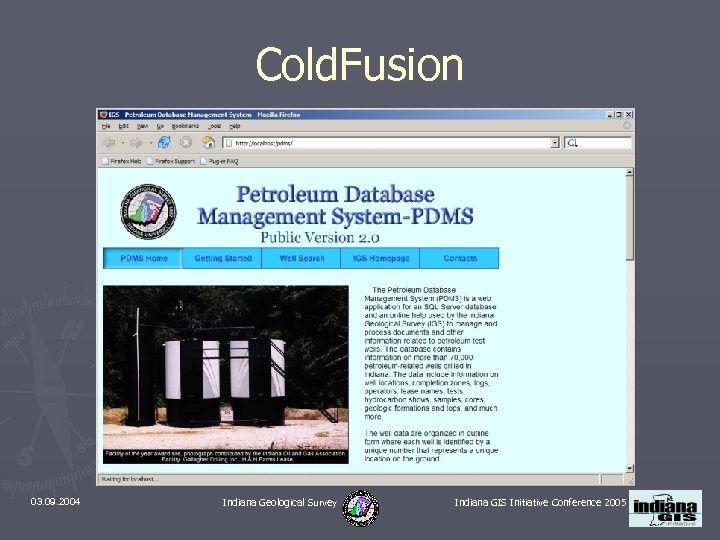
Cold. Fusion 03. 09. 2004 Indiana Geological Survey Indiana GIS Initiative Conference 2005
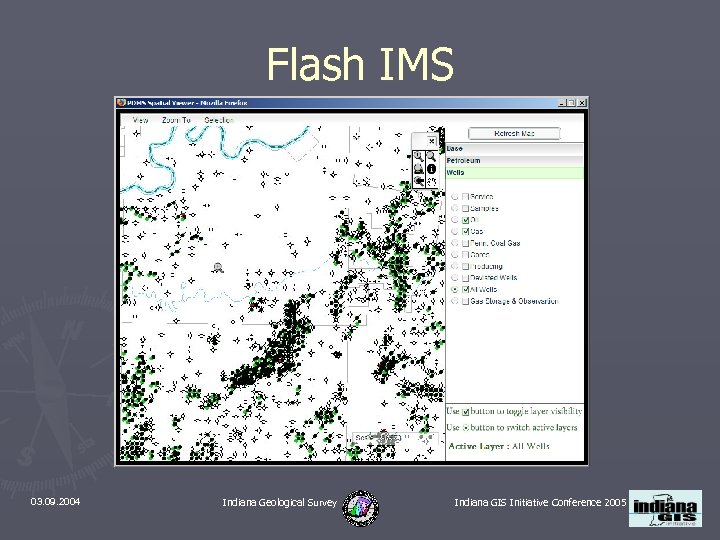
Flash IMS 03. 09. 2004 Indiana Geological Survey Indiana GIS Initiative Conference 2005
That’s it Folks!!! ► The website address is http: //igs. indiana. edu/pdms ► My email pradhakr@indiana. edu ► Questions 03. 09. 2004 ? Indiana Geological Survey Indiana GIS Initiative Conference 2005
Скачать презентацию Indiana Geological Survey s Petroleum Database DBMS and GIS
67151262d0650f061e16034c4c31e34e.ppt