


 Скачать презентацию Indian Power Sector Overview alka assistant director PSTI
5886c64944cf703ed0207cabac1badb1.ppt
- Количество слайдов: 98
 Indian Power Sector Overview alka, assistant director PSTI, NPTI, Bangalore July’ 11
 Power : The Building Block of Economy • Electricity- the most imp. Infrastructural input in the dev. & growth of economy. • Consumption of electricity- imp. Index of advancement of the country & standard of living. • Economic growth rate of 8 -9% on a sustained basis is necessary for us to catch up with the rest of the world.
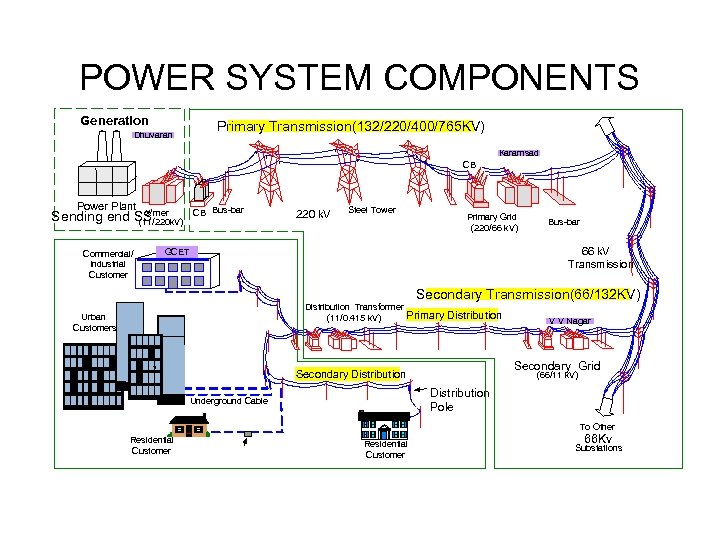 POWER SYSTEM COMPONENTS Generation Dhuvaran Primary Transmission(132/220/400/765 KV) Karamsad CB Power Plant X’mer Sending end SS (11/220 k. V) Commercial/ Industrial Customer CB Bus-bar 220 k. V Steel Tower Primary Grid (220/66 k. V) Bus-bar 66 k. V Transmission GCET Secondary Transmission(66/132 KV) Distribution Transformer Primary (11/0. 415 k. V) Urban Customers Distribution V V Nagar Secondary Grid Secondary Distribution (66/11 k. V) Distribution Pole Underground Cable To Other Residential Customer 66 Kv Substations
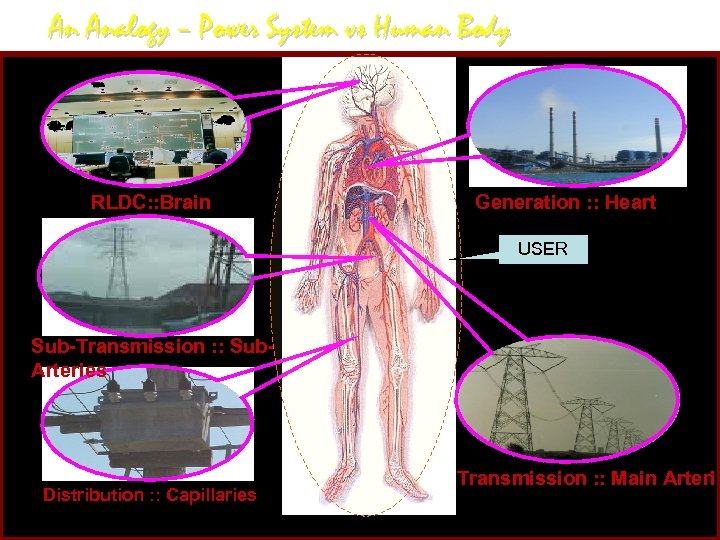 An Analogy – Power System vs Human Body RLDC: : Brain Generation : : Heart USER Sub-Transmission : : Sub. Arteries Distribution : : Capillaries Transmission : : Main Arterie
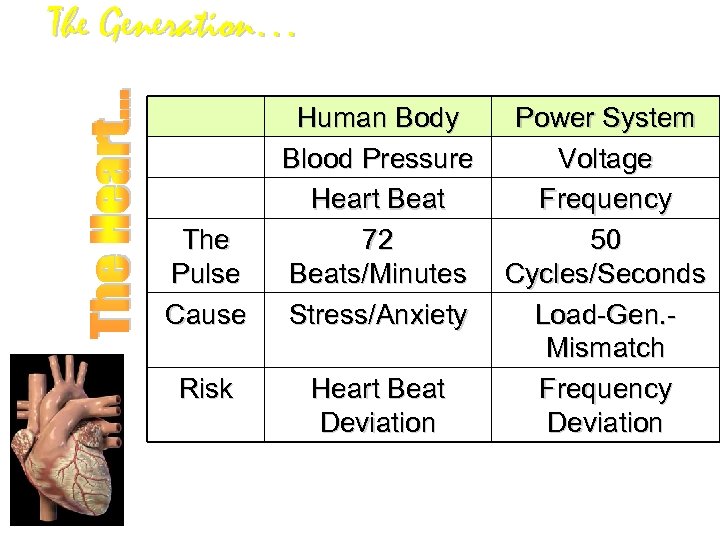 The Generation… The Pulse Cause Risk Human Body Blood Pressure Heart Beat 72 Beats/Minutes Stress/Anxiety Heart Beat Deviation Power System Voltage Frequency 50 Cycles/Seconds Load-Gen. Mismatch Frequency Deviation
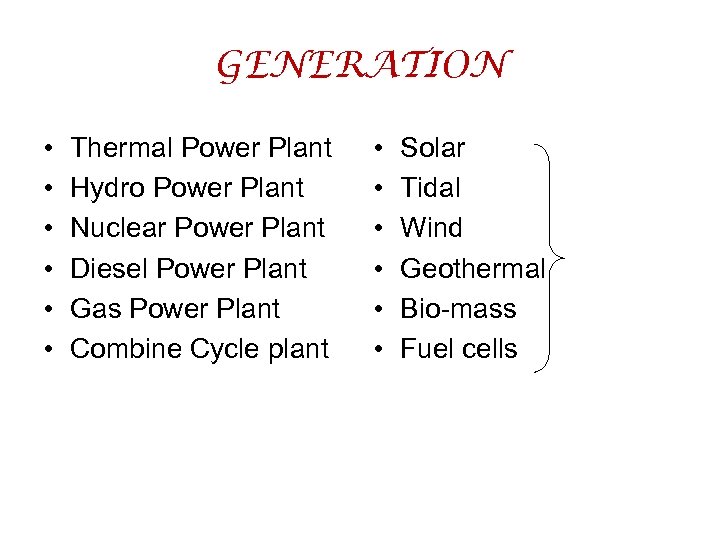 GENERATION • • • Thermal Power Plant Hydro Power Plant Nuclear Power Plant Diesel Power Plant Gas Power Plant Combine Cycle plant • • • Solar Tidal Wind Geothermal Bio-mass Fuel cells
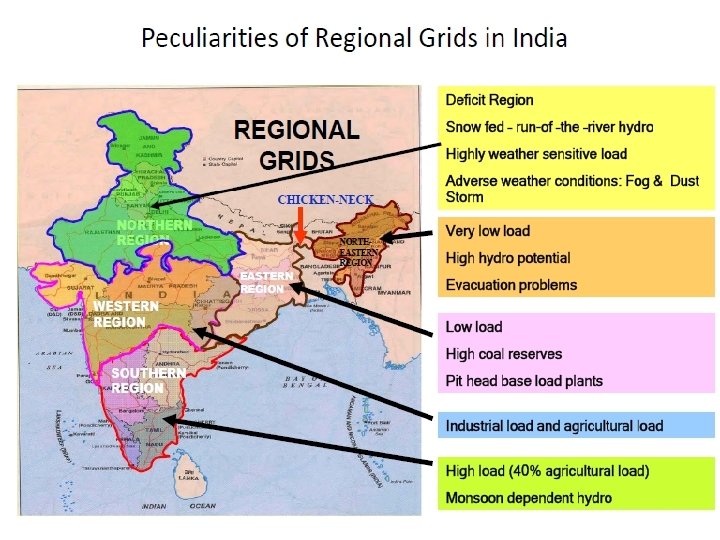
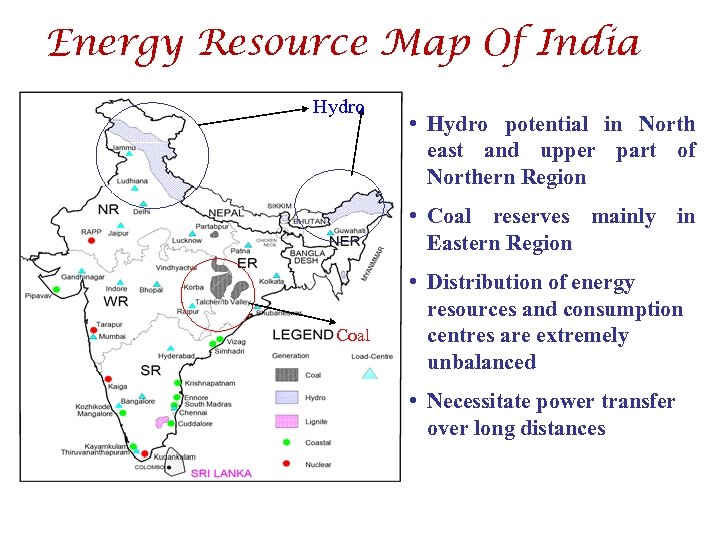 Energy Resource Map Of India Hydro • Hydro potential in North east and upper part of Northern Region • Coal reserves mainly in Eastern Region Coal • Distribution of energy resources and consumption centres are extremely unbalanced • Necessitate power transfer over long distances
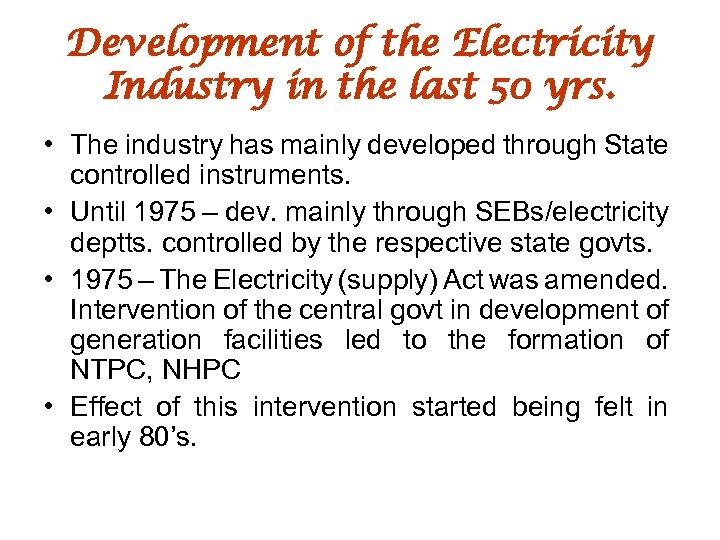 Development of the Electricity Industry in the last 50 yrs. • The industry has mainly developed through State controlled instruments. • Until 1975 – dev. mainly through SEBs/electricity deptts. controlled by the respective state govts. • 1975 – The Electricity (supply) Act was amended. Intervention of the central govt in development of generation facilities led to the formation of NTPC, NHPC • Effect of this intervention started being felt in early 80’s.
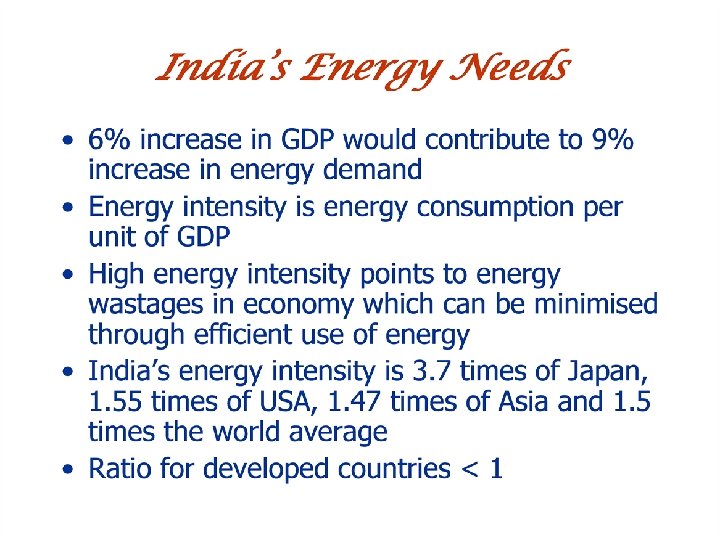
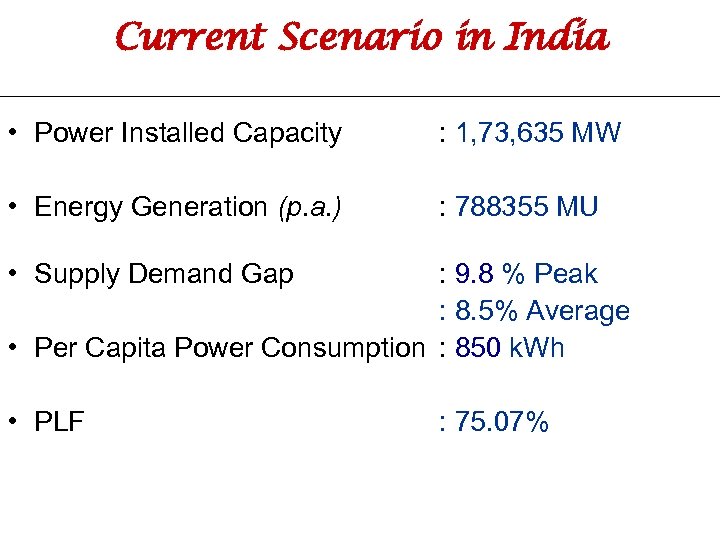 Current Scenario in India • Power Installed Capacity : 1, 73, 635 MW • Energy Generation (p. a. ) : 788355 MU • Supply Demand Gap : 9. 8 % Peak : 8. 5% Average • Per Capita Power Consumption : 850 k. Wh • PLF : 75. 07%
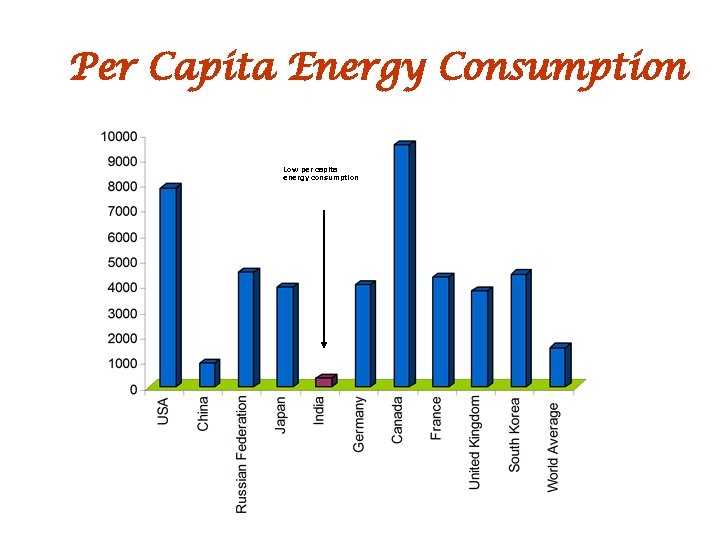 Per Capita Energy Consumption Low per capita energy consumption
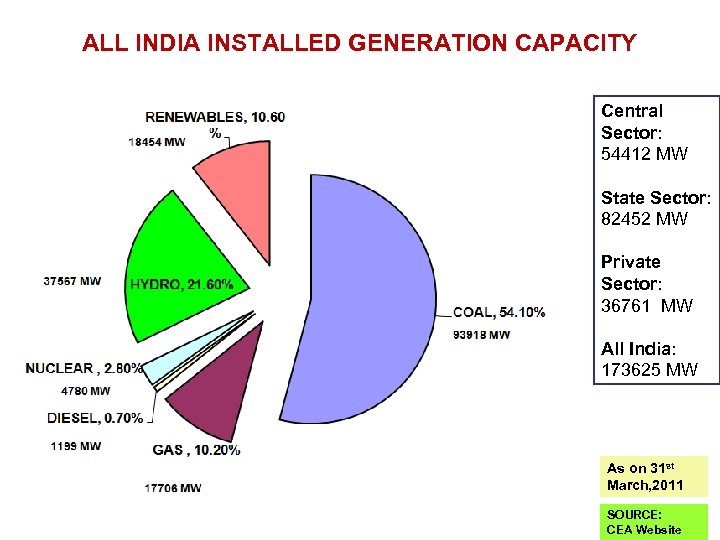 ALL INDIA INSTALLED GENERATION CAPACITY Central Sector: 54412 MW State Sector: 82452 MW Private Sector: 36761 MW All India: 173625 MW As on 31 st March, 2011 SOURCE: CEA Website
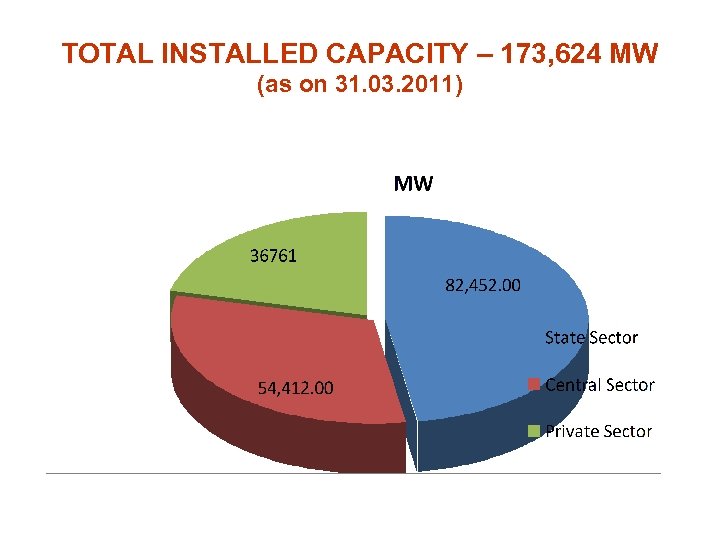 TOTAL INSTALLED CAPACITY – 173, 624 MW (as on 31. 03. 2011)
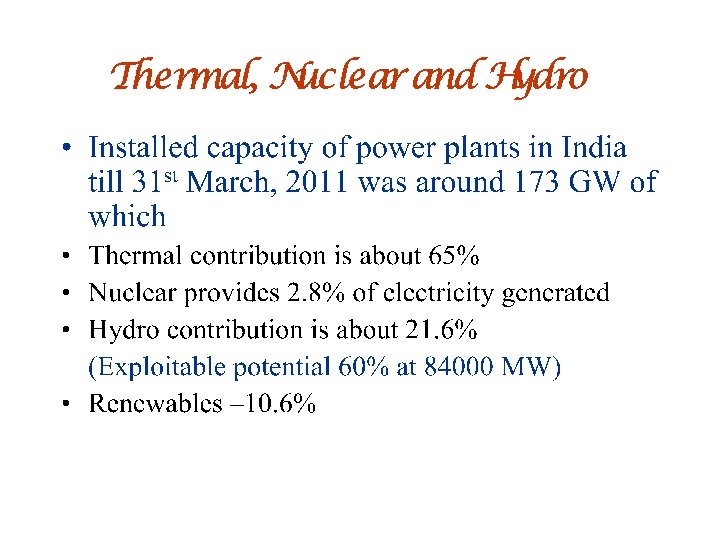
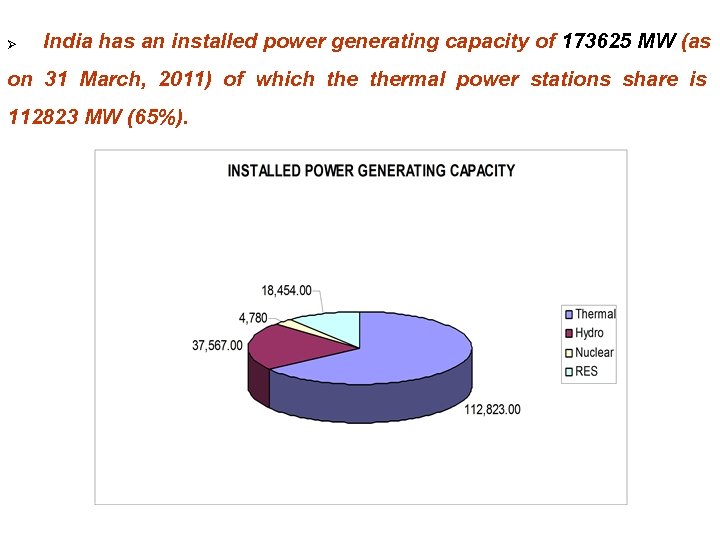 Ø India has an installed power generating capacity of 173625 MW (as on 31 March, 2011) of which thermal power stations share is 112823 MW (65%).
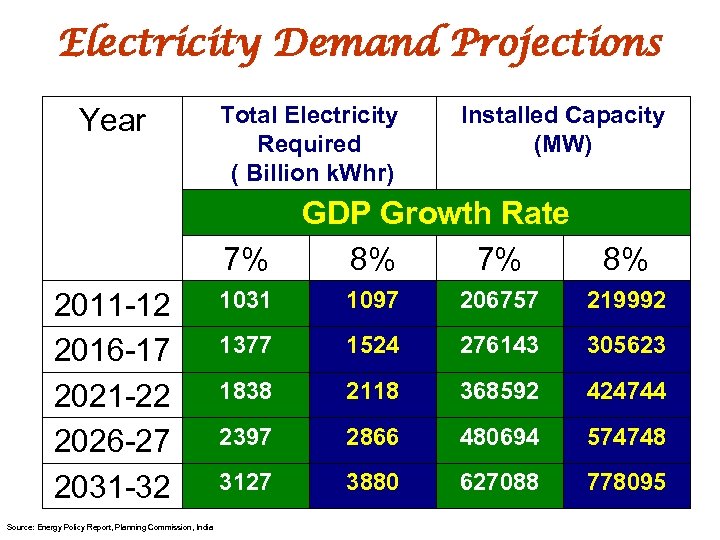 Electricity Demand Projections Year Total Electricity Required ( Billion k. Whr) 7% 2011 -12 2016 -17 2021 -22 2026 -27 2031 -32 Source: Energy Policy Report, Planning Commission, India Installed Capacity (MW) GDP Growth Rate 8% 7% 8% 1031 1097 206757 219992 1377 1524 276143 305623 1838 2118 368592 424744 2397 2866 480694 574748 3127 3880 627088 778095
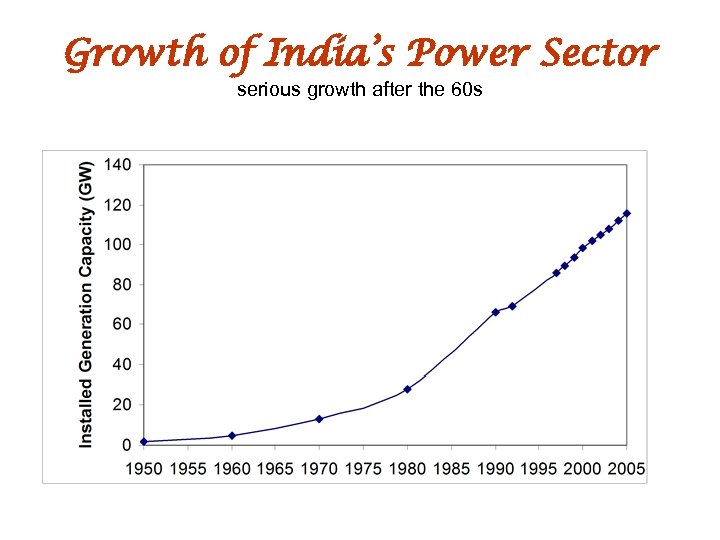 Growth of India’s Power Sector serious growth after the 60 s
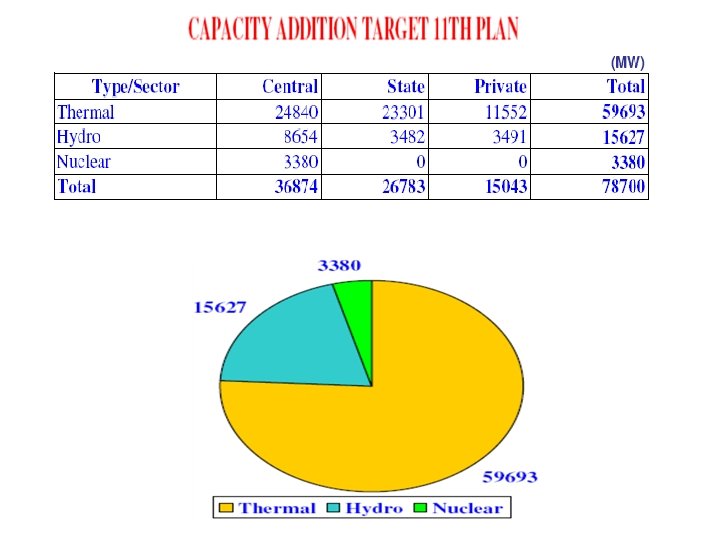
 Growth of the Indian Power Sector : INSTALLED CAPACITY • INSTALLED CAPACITY went up from 1. 36 GW in 1947 to more than 167 GW as of 31. 10; capacity comparable to UK / GERMANY. • Or a targeted 9. 5% growth in the power sector, a capacity addition of 78, 577 MW has been proposed for the 11 th Plan
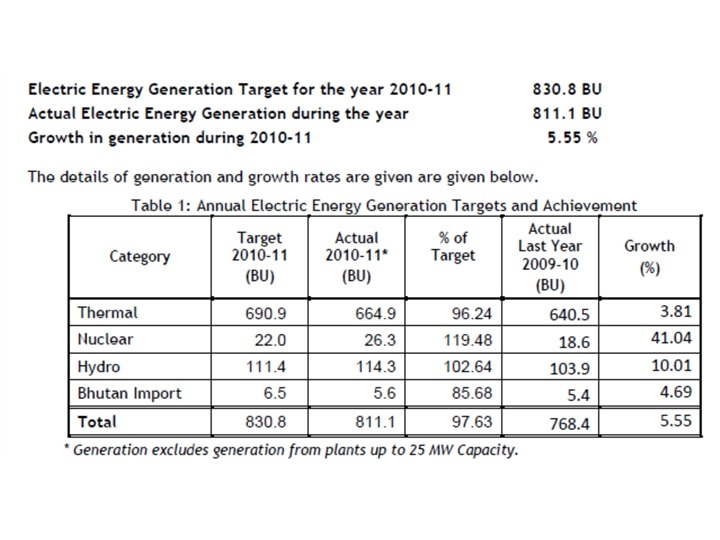
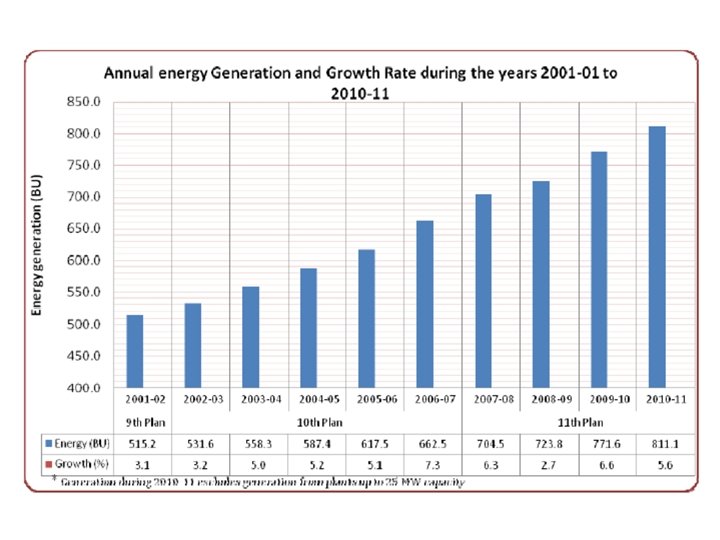
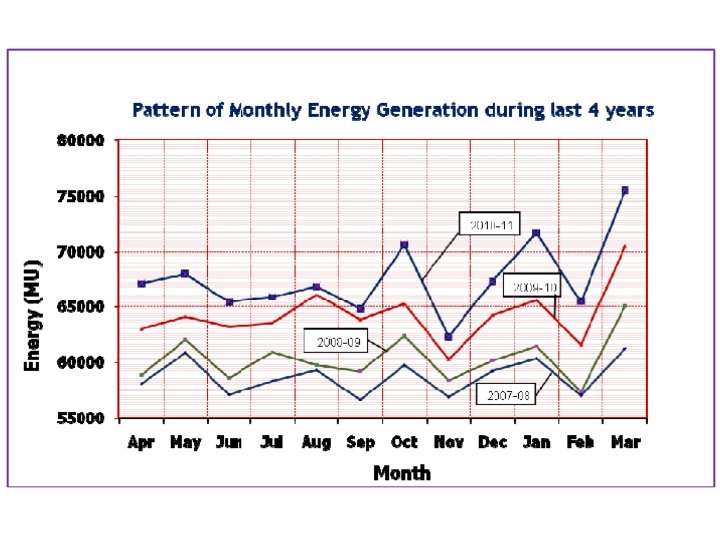
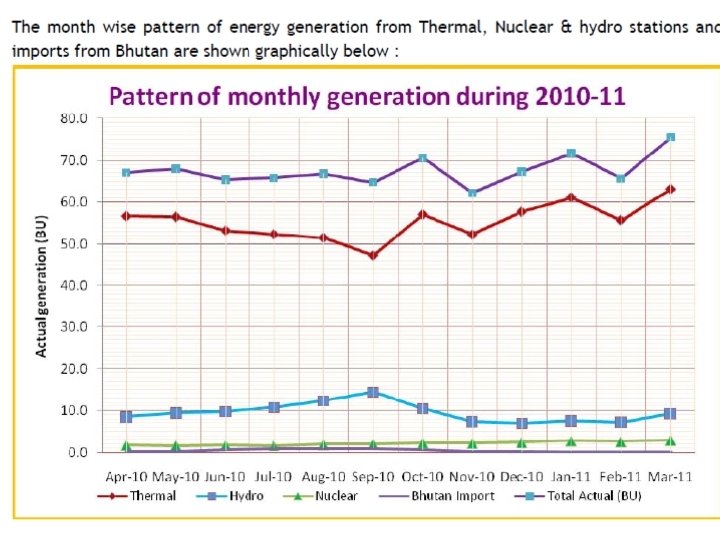
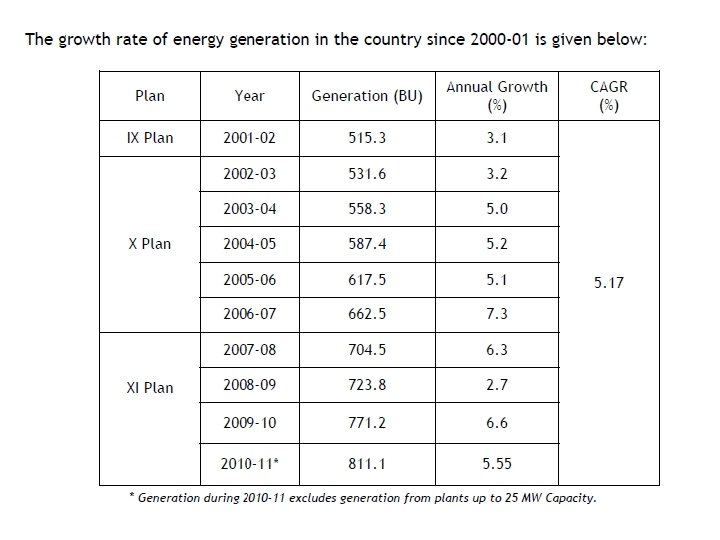
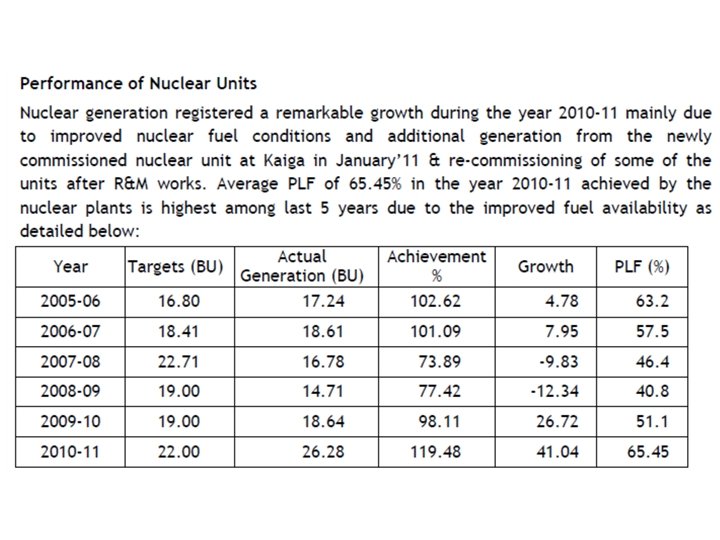
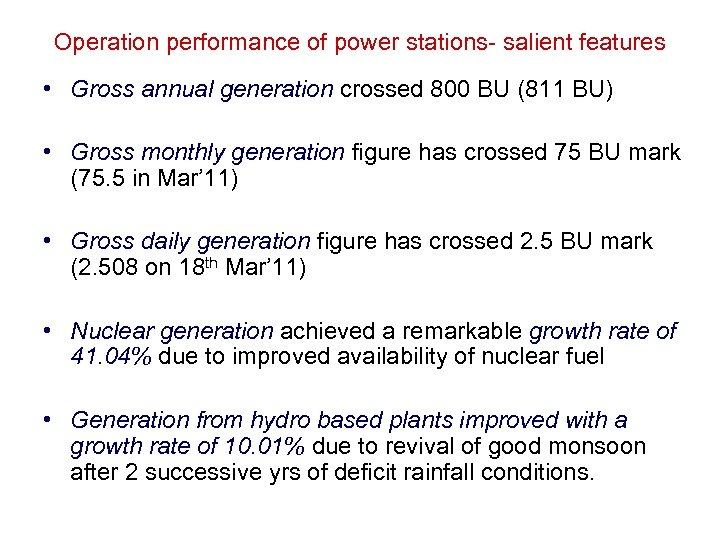 Operation performance of power stations- salient features • Gross annual generation crossed 800 BU (811 BU) • Gross monthly generation figure has crossed 75 BU mark (75. 5 in Mar’ 11) • Gross daily generation figure has crossed 2. 5 BU mark (2. 508 on 18 th Mar’ 11) • Nuclear generation achieved a remarkable growth rate of 41. 04% due to improved availability of nuclear fuel • Generation from hydro based plants improved with a growth rate of 10. 01% due to revival of good monsoon after 2 successive yrs of deficit rainfall conditions.
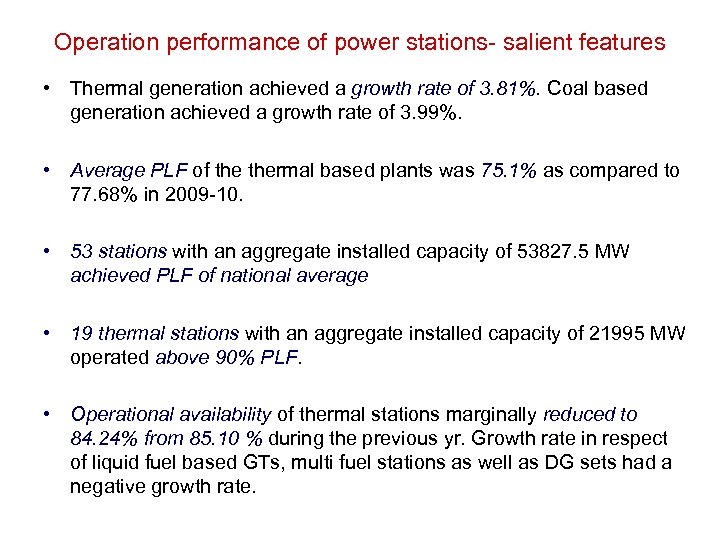 Operation performance of power stations- salient features • Thermal generation achieved a growth rate of 3. 81%. Coal based generation achieved a growth rate of 3. 99%. • Average PLF of thermal based plants was 75. 1% as compared to 77. 68% in 2009 -10. • 53 stations with an aggregate installed capacity of 53827. 5 MW achieved PLF of national average • 19 thermal stations with an aggregate installed capacity of 21995 MW operated above 90% PLF. • Operational availability of thermal stations marginally reduced to 84. 24% from 85. 10 % during the previous yr. Growth rate in respect of liquid fuel based GTs, multi fuel stations as well as DG sets had a negative growth rate.
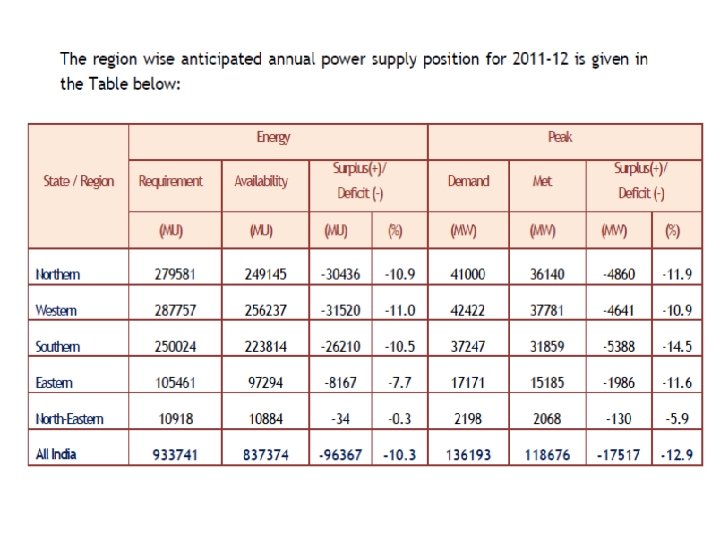
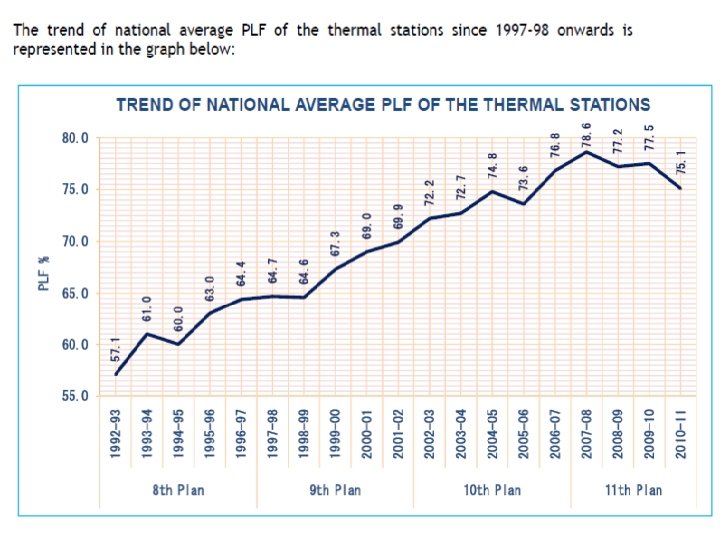
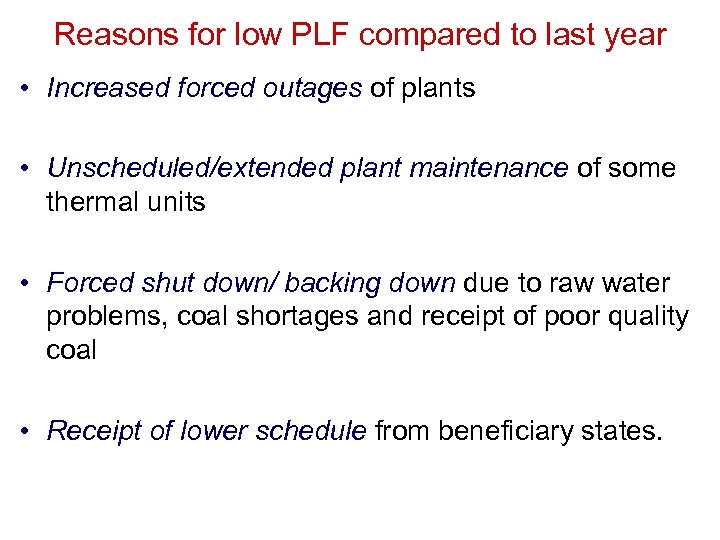 Reasons for low PLF compared to last year • Increased forced outages of plants • Unscheduled/extended plant maintenance of some thermal units • Forced shut down/ backing down due to raw water problems, coal shortages and receipt of poor quality coal • Receipt of lower schedule from beneficiary states.
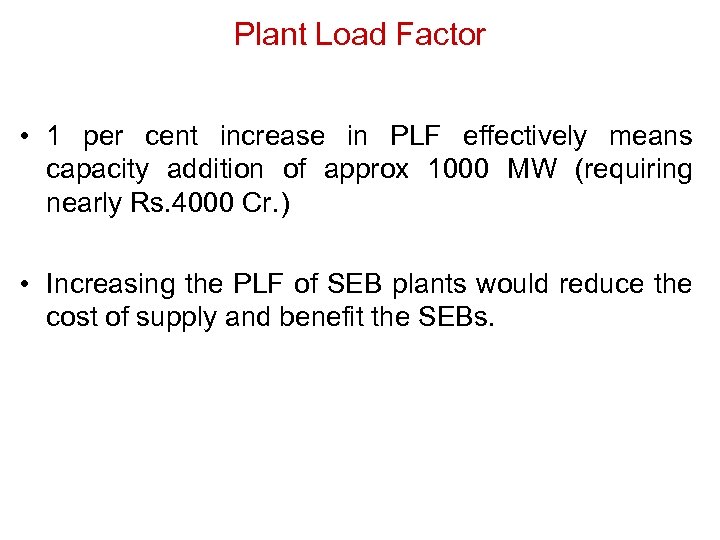 Plant Load Factor • 1 per cent increase in PLF effectively means capacity addition of approx 1000 MW (requiring nearly Rs. 4000 Cr. ) • Increasing the PLF of SEB plants would reduce the cost of supply and benefit the SEBs.
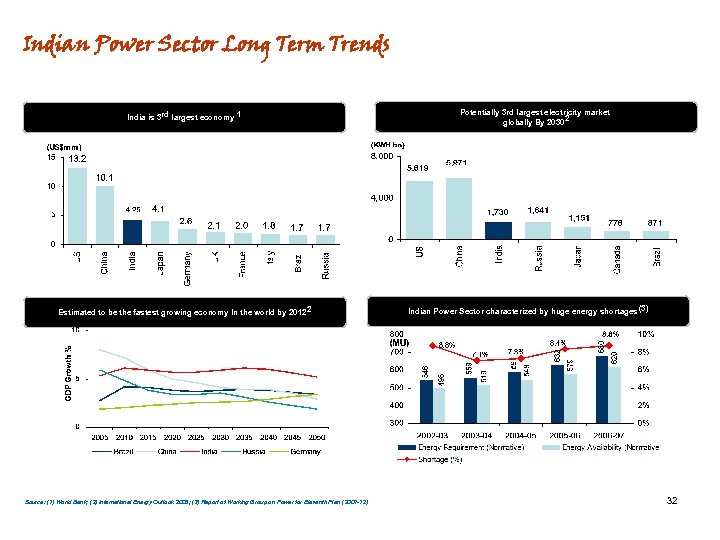 Indian Power Sector Long Term Trends India is 3 rd largest economy 1 Estimated to be the fastest growing economy In the world by 2012 2 Source: (1) World Bank; (2) International Energy Outlook 2006; (3) Report of Working Group on Power for Eleventh Plan (2007 -12) Potentially 3 rd largest electricity market globally By 2030 2 Indian Power Sector characterized by huge energy shortages (3) 32
 MAJOR REASONS FOR POWER SECTOR ILLS ØInadequate power generation capacity; ØLack of optimum utilization of the existing generation capacity; ØInefficient use of electricity by the end consumer; ØInadequate inter-regional transmission links; ØHuge T&D losses (theft) and skewed tariff structure, making SEBs unviable.
 Optimum utilization of the existing generation capacity through R&M • Old SEB units performing at low efficiency due to lack of R&M / poor maintenance. States unable to undertake R&M because of funds constraints. • R&M is a cost effective (Rs 1 Cr/MW for thermal and Rs 60 -70 Lakh/MW for hydro) and quick return option for increasing generation (new capacity @ Rs 4 -5 Cr/MW). • 170 thermal (11, 000 MW) and 35 hydel (3, 000 MW) units identified for R&M by CEA. • 90 BU (20% of current annual generation) expected through R&M
 Growth of Indian Power Sector: TRANSMISSION SYSTEM • Required development of high voltage transmission system did suffer in the early years. • During 80’s, when NTPC had the jurisdiction of creating HV transmission system along with their super thermal power stations, transmission side of the industry got a boost. • Subsequently, PGCIL was formed out of NTPC and from 1992, PGCIL has added significantly towards creation of HV transmission system and development of the national grid • Transmission sector opened up for private sector participation with the amendment of the ES Act in 1998
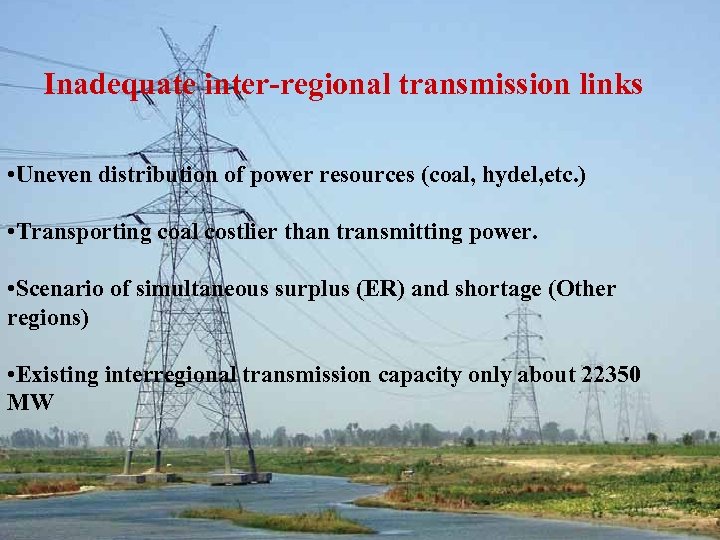 Inadequate inter-regional transmission links • Uneven distribution of power resources (coal, hydel, etc. ) • Transporting coal costlier than transmitting power. • Scenario of simultaneous surplus (ER) and shortage (Other regions) • Existing interregional transmission capacity only about 22350 MW
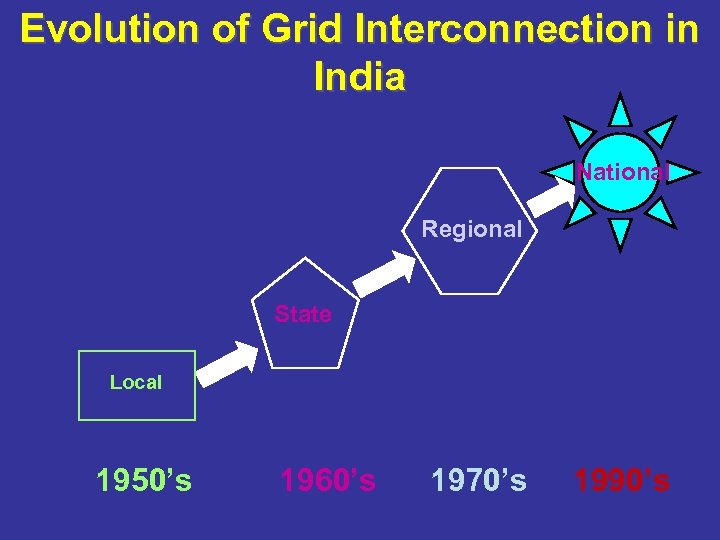 Evolution of Grid Interconnection in India National Regional State Local 1950’s 1960’s 1970’s 1990’s
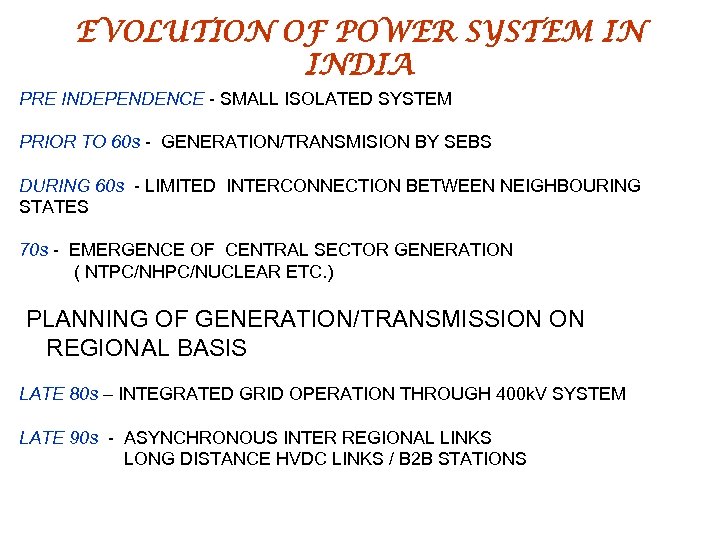 EVOLUTION OF POWER SYSTEM IN INDIA PRE INDEPENDENCE - SMALL ISOLATED SYSTEM PRIOR TO 60 s - GENERATION/TRANSMISION BY SEBS DURING 60 s - LIMITED INTERCONNECTION BETWEEN NEIGHBOURING STATES 70 s - EMERGENCE OF CENTRAL SECTOR GENERATION ( NTPC/NHPC/NUCLEAR ETC. ) PLANNING OF GENERATION/TRANSMISSION ON REGIONAL BASIS LATE 80 s – INTEGRATED GRID OPERATION THROUGH 400 k. V SYSTEM LATE 90 s - ASYNCHRONOUS INTER REGIONAL LINKS LONG DISTANCE HVDC LINKS / B 2 B STATIONS
 Isolated systems • Isolated systems developed in and around industrial & urban areas • Establishment of CEA under the Electricity (Supply) Act, 1948 for coordinated development of Power Sector • The Act also provided formation of State Electricity Boards (SEBs) in the States
 State Grid Systems • The systems around urban and industrial areas grew into full fledged State Grid systems • The country was demarcated in to five Regions for the purpose of coordinated power sector planning • Regional Electricity Boards were established in each of the regions for facilitating integrated operation of state systems • Inter-state lines were planned which were treated as Centrally sponsored schemes.
 Regional Grid System • 1975: Central Sector generation utilities created • Benefits of these to be shared by the states of the region. • Construction of associated transmission system for evacuation of power as well as delivery of power to the constituent states, also entrusted to these corporations • Focus of planning and development in the transmission system shifted from State Grid system to Regional Grid system • By the end of 1980's strong regional networks came into existence.
 Inter Region Links • 1989: Power Grid Corporation of India formed to give thrust to implementation of transmission system associated with Central generating stations • few inter-regional links were also planned and developed to facilitate exchange among the various regions (limited to emergency situations) • resource planning as well as grid operation and consequently the operational frequencies of various regions continued to be Region specific.
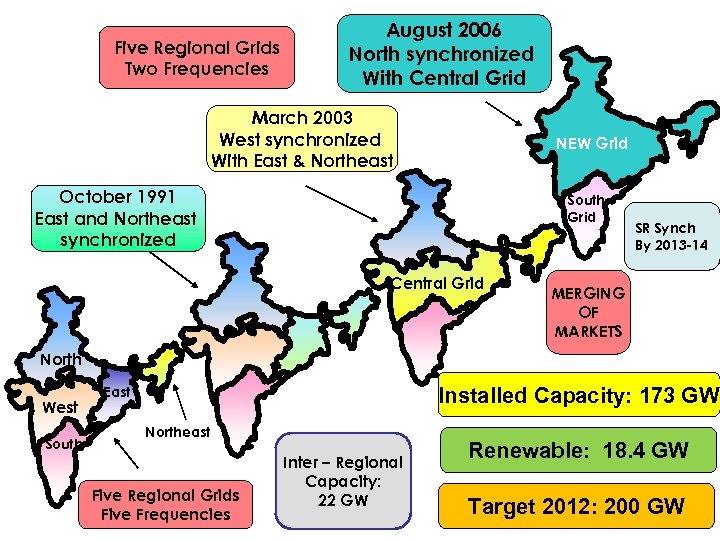 Five Regional Grids Two Frequencies August 2006 North synchronized With Central Grid March 2003 West synchronized With East & Northeast NEW Grid October 1991 East and Northeast synchronized South Grid Central Grid SR Synch By 2013 -14 MERGING OF MARKETS North West South Installed Capacity: 173 GW East Northeast Five Regional Grids Five Frequencies Inter – Regional Capacity: 22 GW Renewable: 18. 4 GW Target 2012: 200 GW
 National Grid • Focus of planning the generation and the transmission system shifted from the orientation of regional self-sufficiency to the concept of optimization of utilization of resources on All India basis • A strong National Grid system would enable such an all-India generation planning and development
 Objectives underlying the formation of National Grid • To transfer power from surplus regions to deficit regions • Utilise maximum diversified regions resources from • Ensure reliable, economical and quality power
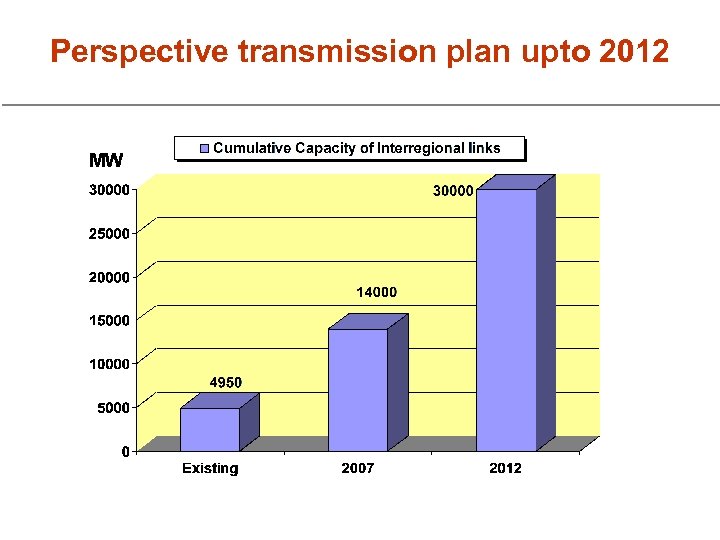 Perspective transmission plan upto 2012
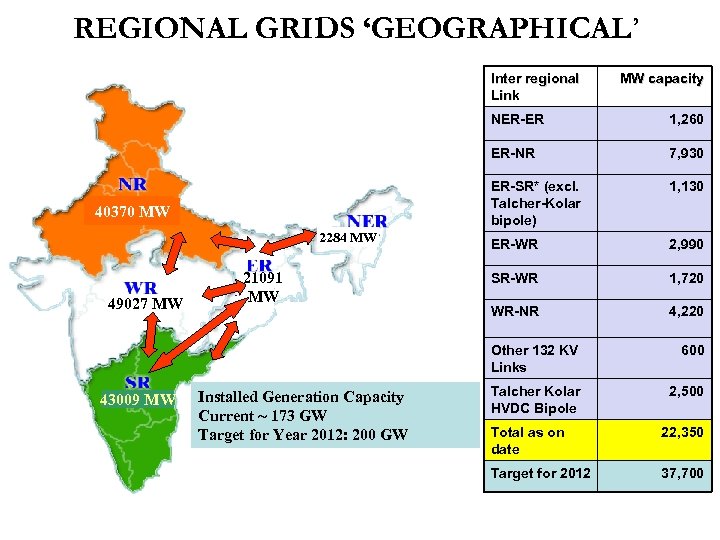 REGIONAL GRIDS ‘GEOGRAPHICAL’ Inter regional Link MW capacity NER-ER ER-NR 2284 MW 49027 MW 21091 MW 16, 000 7, 930 ER-SR* (excl. Talcher-Kolar bipole) 30, 500 MW 40370 MW 1, 260 1, 130 ER-WR 2, 990 SR-WR 1, 720 WR-NR 4, 220 Other 132 KV Links 43009 MW Installed Generation Capacity Current ~ 173 GW Target for Year 2012: 200 GW 600 Talcher Kolar HVDC Bipole 2, 500 Total as on date 22, 350 Target for 2012 37, 700
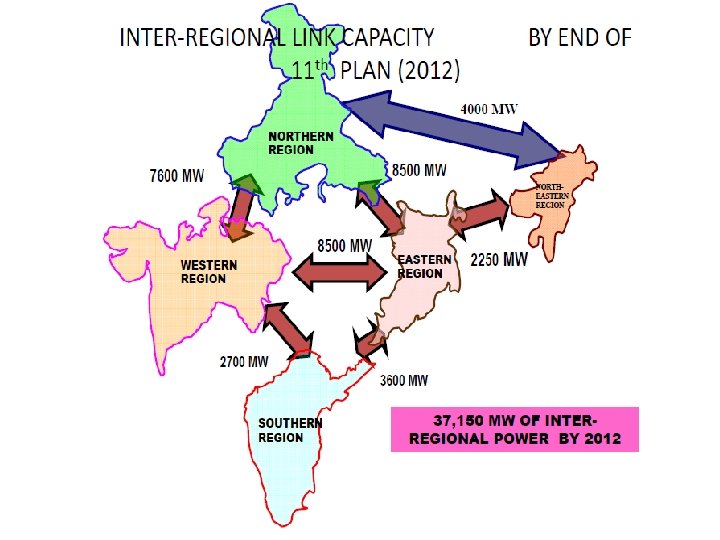
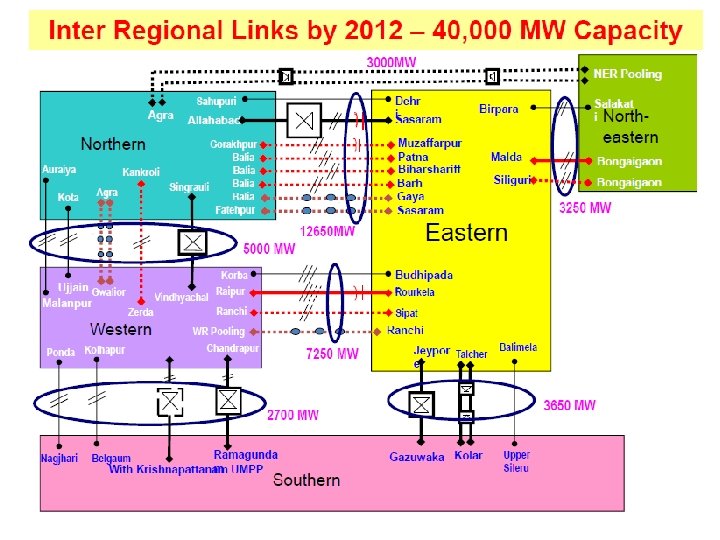
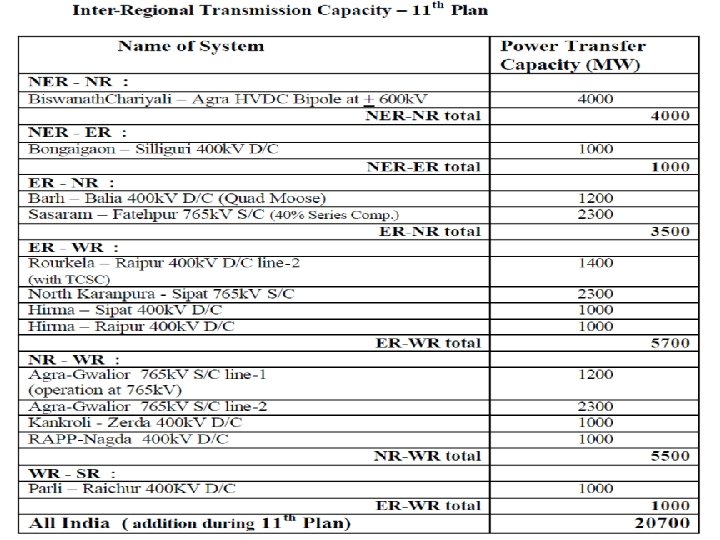
 Transmission System for Hydro development in NER 30 -35 GW of Hydro potential in North-eastern Region 10 GW from Sikkim and Bhutan Ø Substantial power from this region would be required to be transmitted to NR/WR over distances exceeding 2000 km. Ø Right of way constraints in the chicken neck area. Ø Hybrid network of EHVDC and high capacity 400 k. V AC developed.
 Acquiring Right of Way (ROW) for constructing transmission system is getting increasingly difficult. This necessitates creation of high capacity “Transmission Highways” , so that in future, constraints in ROW do not become bottleneck in harnessing natural resources Four major power regions of the country namely, North-Eastern, Western and Northern are now operating as one synchronous grid.
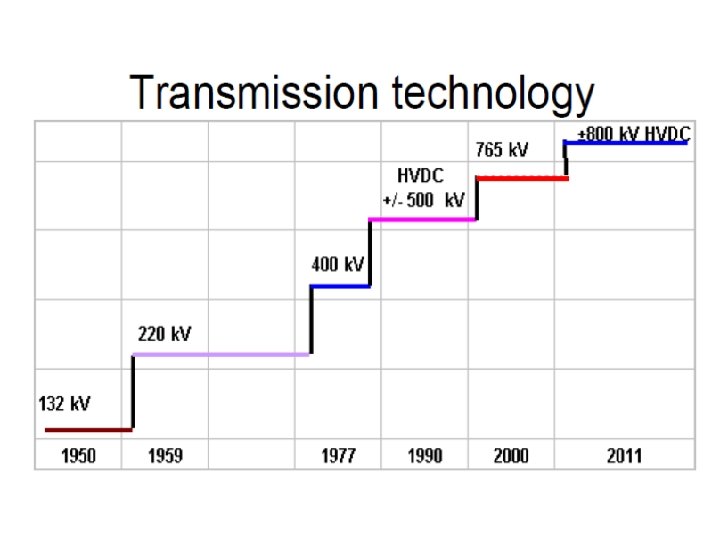
 NATIONAL GRID : THE ADVANTAGES • STRONG BACKBONE ‘ANYWHERE TO ANYWHERE’ ’ TRADING • ECONOMIC OPERATION • OPTIMAL UTILISATION OF SCARCE NATIONAL RESOURCES • HARNESS DIVERSITY – SAVING OF 13, 000 MW BY YEAR 2012 • • ADDED STABILITY BOUNDARY-LESS OPERATION HUB AND SPOKE ARRANGEMENT GENERATORS HAVE READY EVACUATION PATH THE NATIONAL GRID ENVISAGED BY POWERGRID IS A HYBRID NETWORK COMPRISING A 765 k. V HUB WITH 400 k. V AC AND 500 k. V HVDC SPOKES
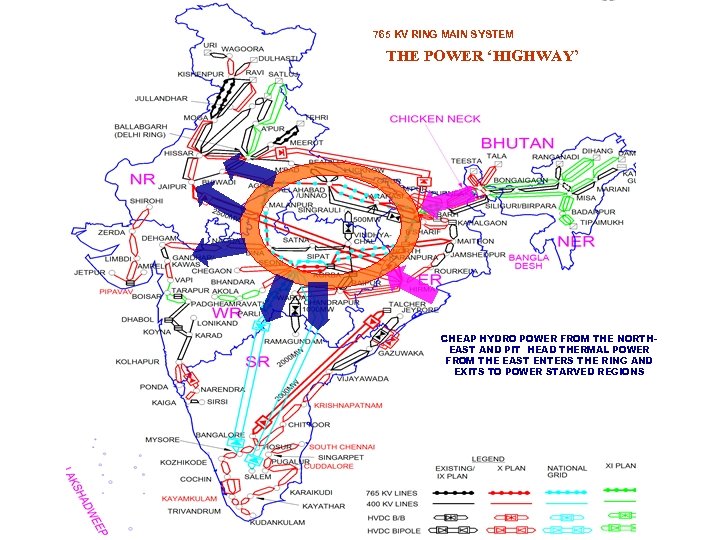 765 KV RING MAIN SYSTEM THE POWER ‘HIGHWAY’ CHEAP HYDRO POWER FROM THE NORTHEAST AND PIT HEAD THERMAL POWER FROM THE EAST ENTERS THE RING AND EXITS TO POWER STARVED REGIONS
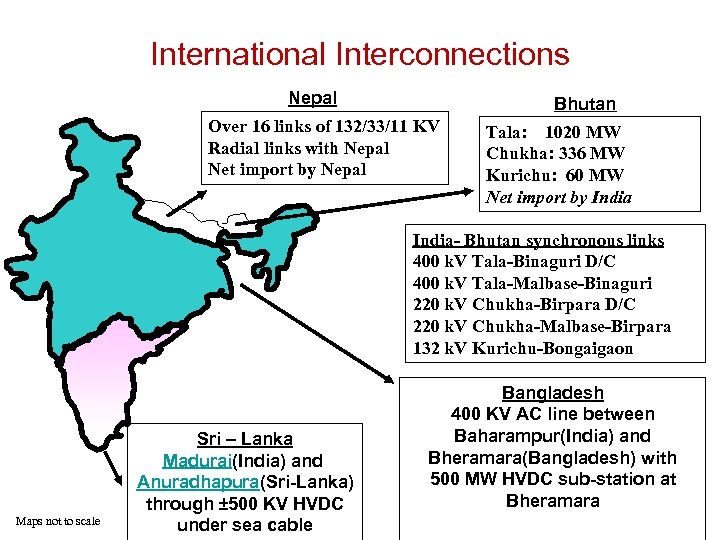 International Interconnections Nepal Bhutan Over 16 links of 132/33/11 KV Radial links with Nepal Net import by Nepal Tala: 1020 MW Chukha: 336 MW Kurichu: 60 MW Net import by India- Bhutan synchronous links 400 k. V Tala-Binaguri D/C 400 k. V Tala-Malbase-Binaguri 220 k. V Chukha-Birpara D/C 220 k. V Chukha-Malbase-Birpara 132 k. V Kurichu-Bongaigaon Maps not to scale Sri – Lanka Madurai(India) and Anuradhapura(Sri-Lanka) through ± 500 KV HVDC under sea cable Bangladesh 400 KV AC line between Baharampur(India) and Bheramara(Bangladesh) with 500 MW HVDC sub-station at Bheramara
 Control Centres • Bulk electric power systems comprise of hundreds of generating units interconnected by an intricate web of transmission & distribution spread across vast geographical stretches. • • For ensuring a reliable and quality supply to the consumers, the power system must be operated within the prescribed reliability standards. • The system operators positioned at wellequipped control centres provide the coordination services that are vital for operating the system within the operating limits.
 Load Despatch Centers in India • The control of the grid is planned to be done at 3 levels of hierarchy namely NLDC, RLDC and SLDC. • Each level of hierarchy has definite roles and responsibilities
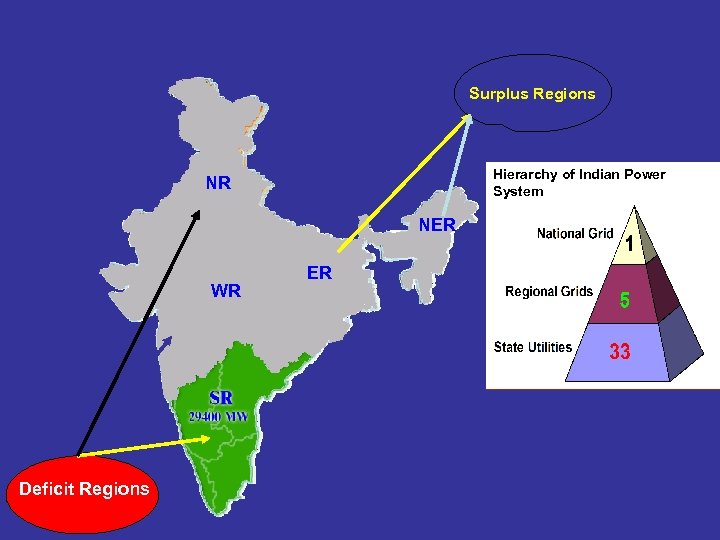 Surplus Regions Hierarchy of Indian Power System NR NER 2300 WR Deficit Regions ER
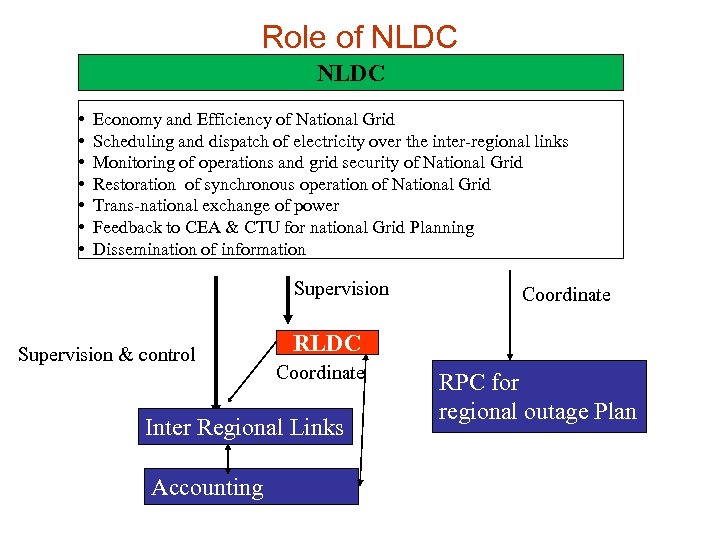 Role of NLDC • • Economy and Efficiency of National Grid Scheduling and dispatch of electricity over the inter-regional links Monitoring of operations and grid security of National Grid Restoration of synchronous operation of National Grid Trans-national exchange of power Feedback to CEA & CTU for national Grid Planning Dissemination of information Supervision & control RLDC Coordinate Inter Regional Links Accounting Coordinate RPC for regional outage Plan
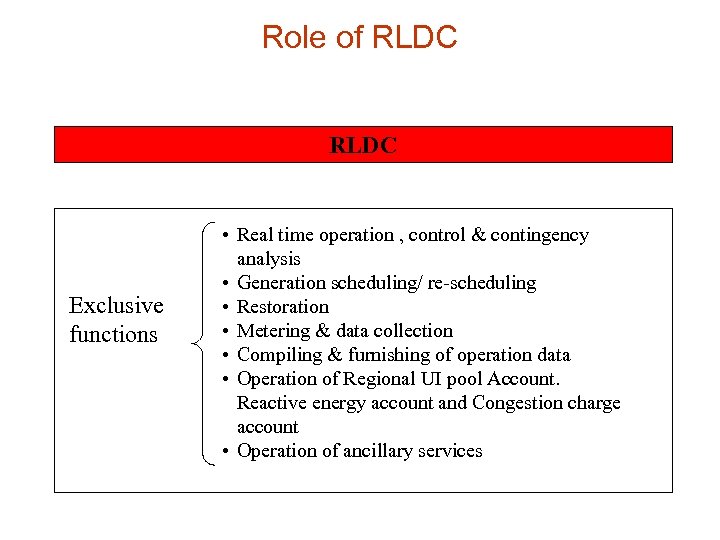 Role of RLDC Exclusive functions • Real time operation , control & contingency analysis • Generation scheduling/ re-scheduling • Restoration • Metering & data collection • Compiling & furnishing of operation data • Operation of Regional UI pool Account. Reactive energy account and Congestion charge account • Operation of ancillary services
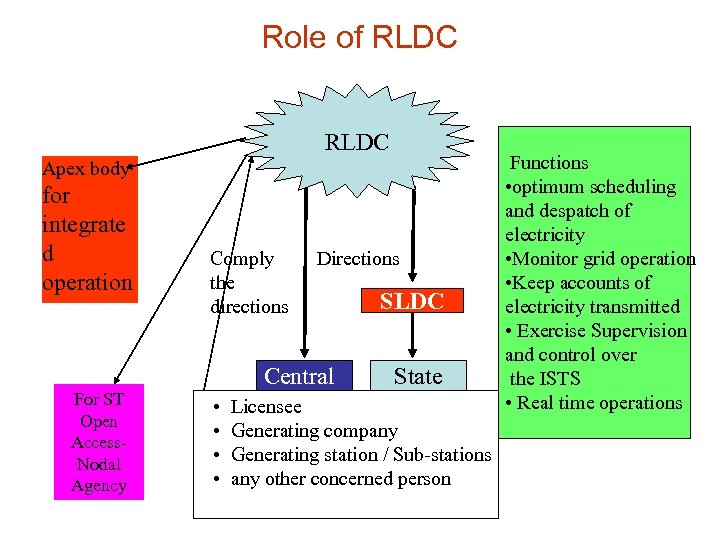 Role of RLDC Apex body for integrate d operation For ST Open Access. Nodal Agency Comply the directions Directions Central • • SLDC State Licensee Generating company Generating station / Sub-stations any other concerned person Functions • optimum scheduling and despatch of electricity • Monitor grid operation • Keep accounts of electricity transmitted • Exercise Supervision and control over the ISTS • Real time operations
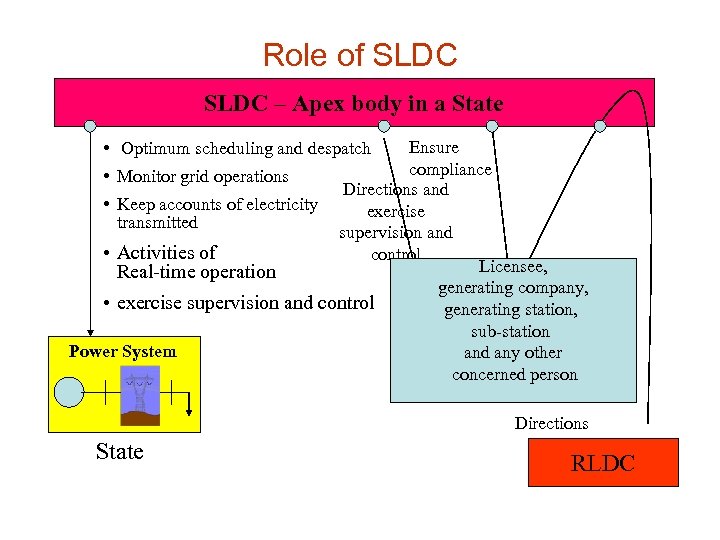 Role of SLDC – Apex body in a State Ensure compliance • Monitor grid operations Directions and • Keep accounts of electricity exercise transmitted supervision and • Activities of control Licensee, Real-time operation generating company, • exercise supervision and control generating station, sub-station Power System and any other concerned person • Optimum scheduling and despatch Directions State RLDC
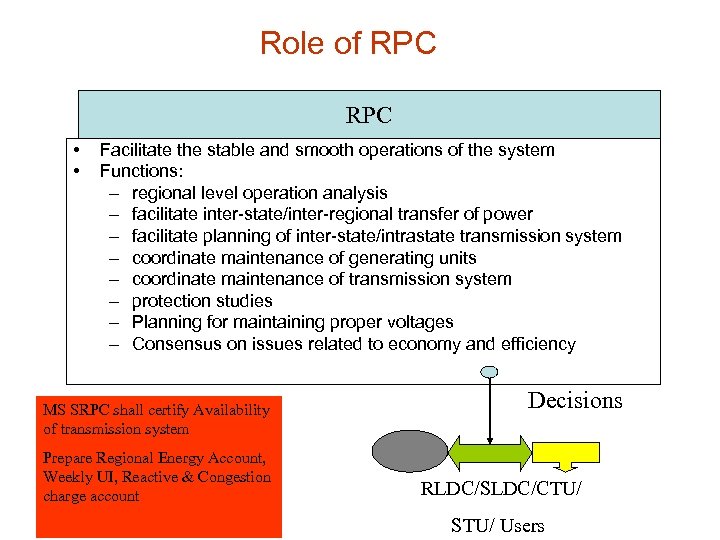 Role of RPC • • Facilitate the stable and smooth operations of the system Functions: – regional level operation analysis – facilitate inter-state/inter-regional transfer of power – facilitate planning of inter-state/intrastate transmission system – coordinate maintenance of generating units – coordinate maintenance of transmission system – protection studies – Planning for maintaining proper voltages – Consensus on issues related to economy and efficiency MS SRPC shall certify Availability of transmission system Prepare Regional Energy Account, Weekly UI, Reactive & Congestion charge account Decisions RLDC/SLDC/CTU/ STU/ Users
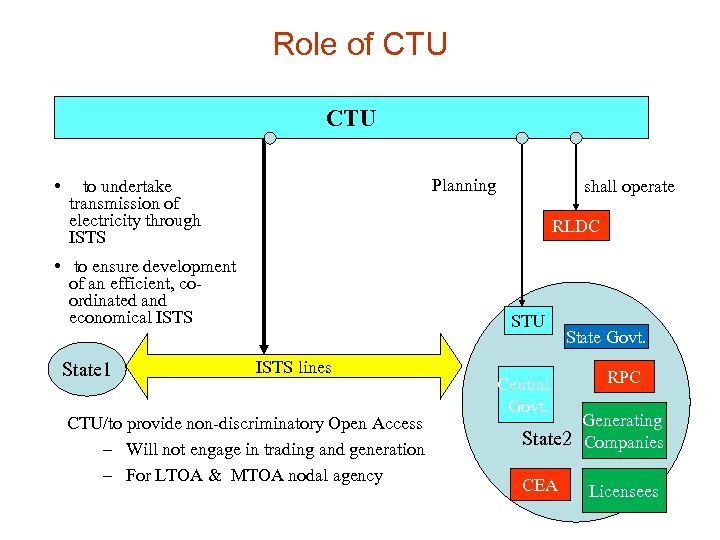 Role of CTU • Planning to undertake transmission of electricity through ISTS RLDC • to ensure development of an efficient, coordinated and economical ISTS State 1 shall operate STU ISTS lines CTU/to provide non-discriminatory Open Access – Will not engage in trading and generation – For LTOA & MTOA nodal agency Central Govt. State Govt. RPC Generating State 2 Companies CEA Licensees 66
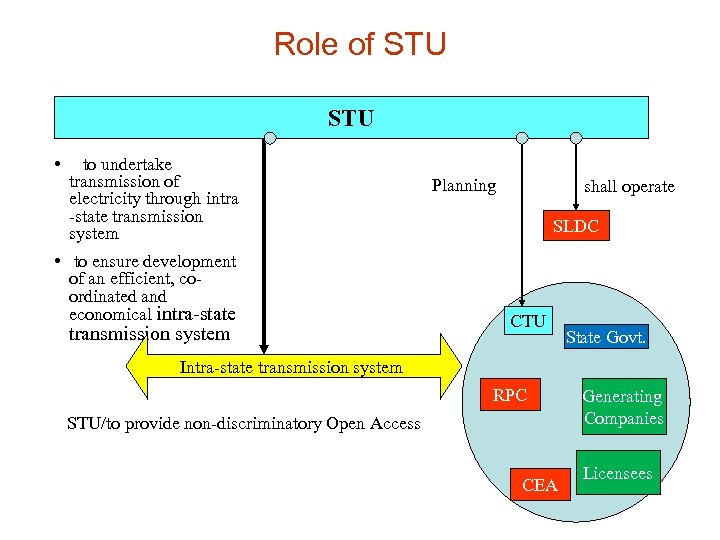 Role of STU • to undertake transmission of electricity through intra -state transmission system • to ensure development of an efficient, coordinated and economical intra-state transmission system Planning shall operate SLDC CTU State Govt. Intra-state transmission system RPC STU/to provide non-discriminatory Open Access CEA Generating Companies Licensees
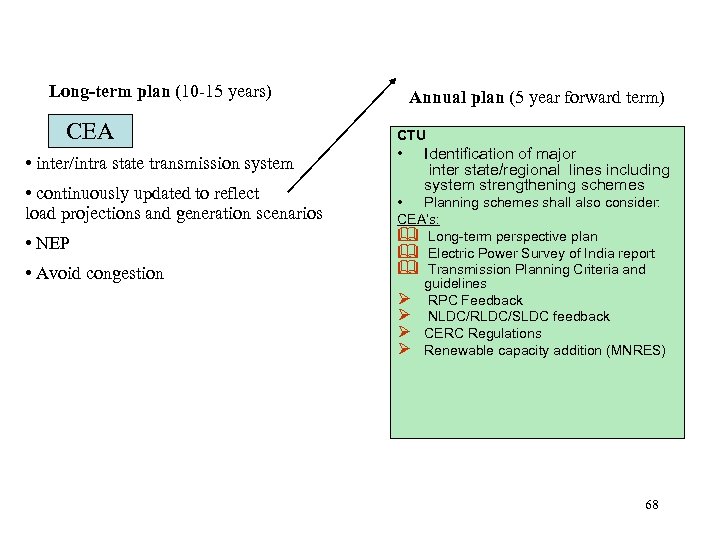 Long-term plan (10 -15 years) CEA • inter/intra state transmission system • continuously updated to reflect load projections and generation scenarios • NEP • Avoid congestion Annual plan (5 year forward term) CTU • Identification of major inter state/regional lines including system strengthening schemes • Planning schemes shall also consider: CEA’s: & Long-term perspective plan & Electric Power Survey of India report & Transmission Planning Criteria and guidelines Ø RPC Feedback Ø NLDC/RLDC/SLDC feedback Ø CERC Regulations Ø Renewable capacity addition (MNRES) 68
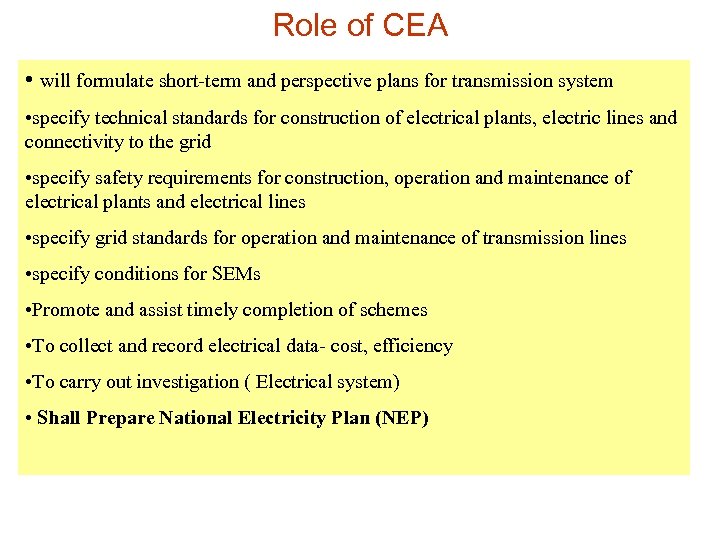 Role of CEA • will formulate short-term and perspective plans for transmission system • specify technical standards for construction of electrical plants, electric lines and connectivity to the grid • specify safety requirements for construction, operation and maintenance of electrical plants and electrical lines • specify grid standards for operation and maintenance of transmission lines • specify conditions for SEMs • Promote and assist timely completion of schemes • To collect and record electrical data- cost, efficiency • To carry out investigation ( Electrical system) • Shall Prepare National Electricity Plan (NEP)
 regulatory environment
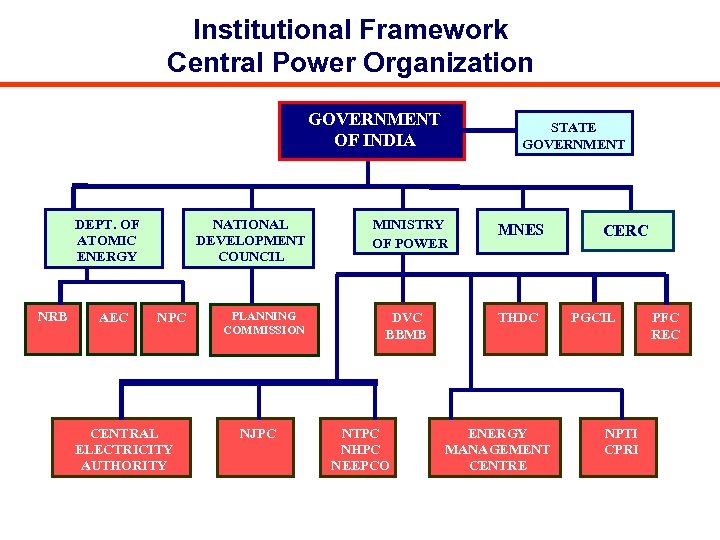 Institutional Framework Central Power Organization GOVERNMENT OF INDIA DEPT. OF ATOMIC ENERGY NRB AEC NATIONAL DEVELOPMENT COUNCIL NPC CENTRAL ELECTRICITY AUTHORITY PLANNING COMMISSION NJPC STATE GOVERNMENT MINISTRY OF POWER MNES DVC BBMB THDC NTPC NHPC NEEPCO ENERGY MANAGEMENT CENTRE CERC PGCIL NPTI CPRI PFC REC
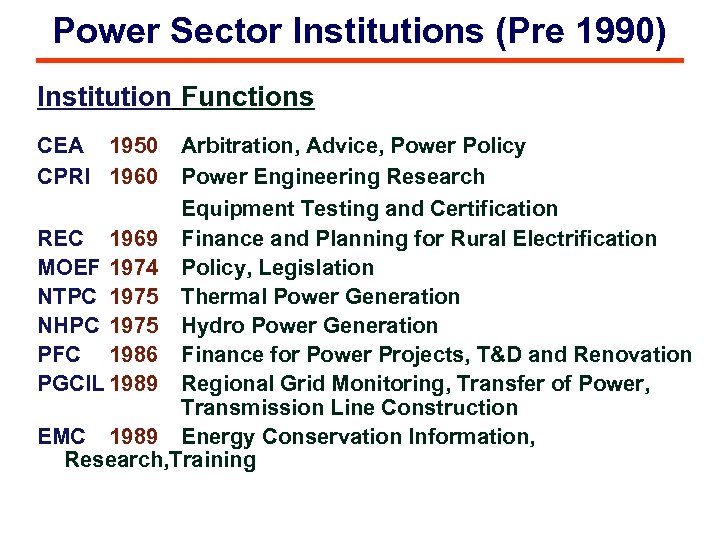 Power Sector Institutions (Pre 1990) Institution Functions CEA 1950 CPRI 1960 Arbitration, Advice, Power Policy Power Engineering Research Equipment Testing and Certification REC 1969 Finance and Planning for Rural Electrification MOEF 1974 Policy, Legislation NTPC 1975 Thermal Power Generation NHPC 1975 Hydro Power Generation PFC 1986 Finance for Power Projects, T&D and Renovation PGCIL 1989 Regional Grid Monitoring, Transfer of Power, Transmission Line Construction EMC 1989 Energy Conservation Information, Research, Training
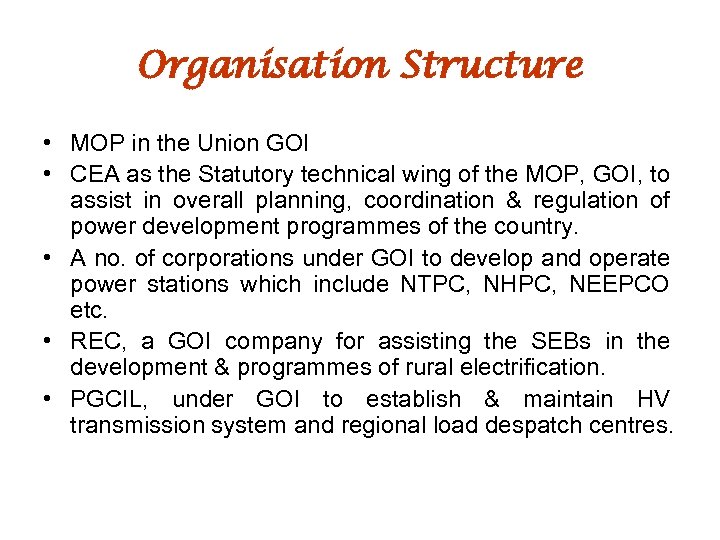 Organisation Structure • MOP in the Union GOI • CEA as the Statutory technical wing of the MOP, GOI, to assist in overall planning, coordination & regulation of power development programmes of the country. • A no. of corporations under GOI to develop and operate power stations which include NTPC, NHPC, NEEPCO etc. • REC, a GOI company for assisting the SEBs in the development & programmes of rural electrification. • PGCIL, under GOI to establish & maintain HV transmission system and regional load despatch centres.
 Organisation Structure (contd. ) • PFC under GOI to assist the various EBs & other organisations in the power sector. • Department of Energy/Power under various state goverments. • SEBs under respective state governments to take care of generation of thermal and hydro power as also transmission & distribution within their own states. Some of the state governments have also set up power generation corporations. • Professional organisations like CPRI, NPTI, Energy Management Centre, Council of Power Utility etc.
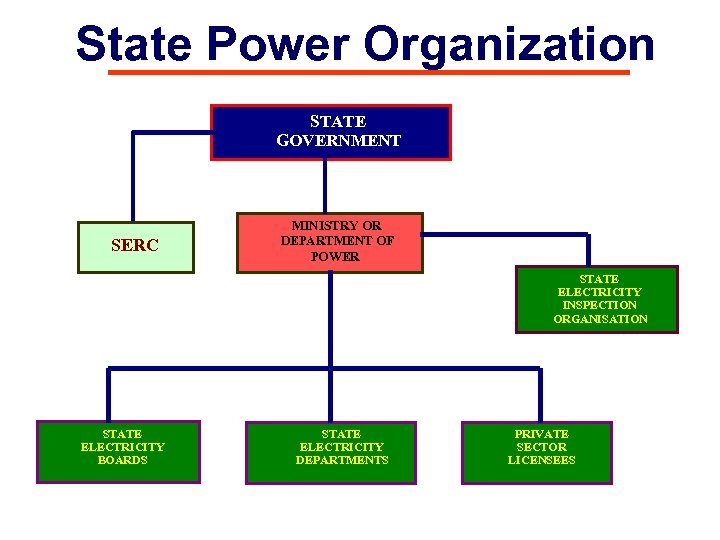 State Power Organization STATE GOVERNMENT SERC MINISTRY OR DEPARTMENT OF POWER STATE ELECTRICITY INSPECTION ORGANISATION STATE ELECTRICITY BOARDS STATE ELECTRICITY DEPARTMENTS PRIVATE SECTOR LICENSEES
 The Indian Electricity Act, 1910 • Provided basic framework for electric supply industry in India. • Growth of the sector through licensees. License by State Govt. • Provision for license for supply of electricity in a specified area. • Legal framework for laying down of wires and other works. • Provisions laying down relationship between licensee and consumer.
 The Electricity (Supply) Act, 1948 • Mandated creation of SEBs. • Need for the State to step in (through SEBs) to extend electrification (so far limited to cities) across the country.
 Main amendments to the Indian Electricity Supply Act • Amendment in 1975 to enable generation in Central sector. • Amendment in 1991 to open generation to private sector. • Amendment in 1998 to provide for private sector participation in transmission, and also provision relating to Transmission Utilities.
 The Electricity Regulatory Commission Act, 1998 • Provision for setting up of Central / State Electricity Regulatory Commission with powers to determine tariffs. • Constitution of SERC optional for States. • Distancing of Government from tariff determination.
 Energy Conservation Act, 2001 • The Act primarily ensures energy efficiency in consumption & consequently Demand Side Management (DSM) for reducing need for installing new capacity. • Bureau of Energy Efficiency (BEE) has been set up on 1 st March, 2002 formulating norms for processes, consumption standards, testing, certification and labeling procedures etc.
 Electricity Act 2003 It is a comprehensive legislation replacing Electricity Act 1910, Electricity Supply Act 1948 and Electricity Regulatory Commission Act 1998. The aim is to push the sector onto a trajectory of sound commercial growth and to enable the States and the Centre to move in harmony and coordination. The objective is to introduce competition, protect consumer’s interests and provide power for all.
 Electricity Act 2003 The Act provides for National Electricity Policy, Rural Electrification, Open access in transmission, phased open access in distribution, mandatory SERCs, license free generation and distribution, power trading, mandatory metering and stringent penalties for theft of electricity
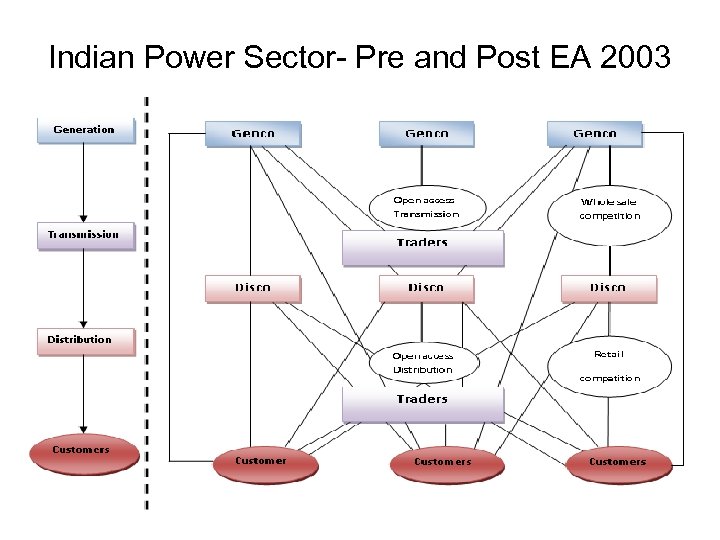 Indian Power Sector- Pre and Post EA 2003
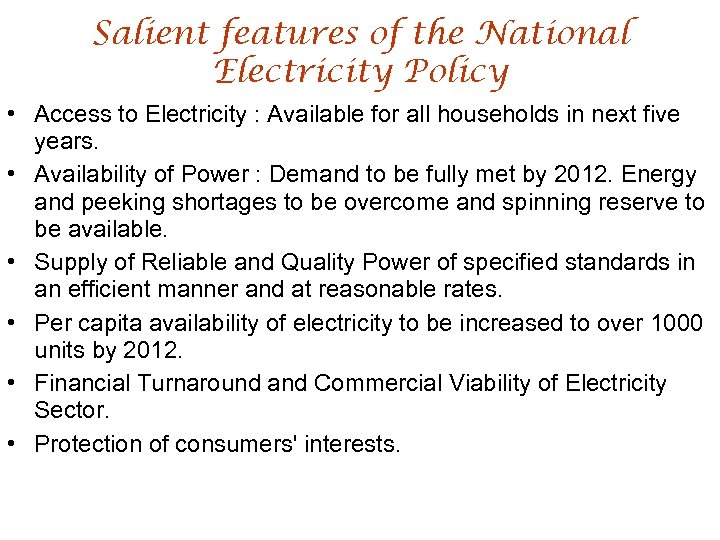 Salient features of the National Electricity Policy • Access to Electricity : Available for all households in next five years. • Availability of Power : Demand to be fully met by 2012. Energy and peeking shortages to be overcome and spinning reserve to be available. • Supply of Reliable and Quality Power of specified standards in an efficient manner and at reasonable rates. • Per capita availability of electricity to be increased to over 1000 units by 2012. • Financial Turnaround and Commercial Viability of Electricity Sector. • Protection of consumers' interests.
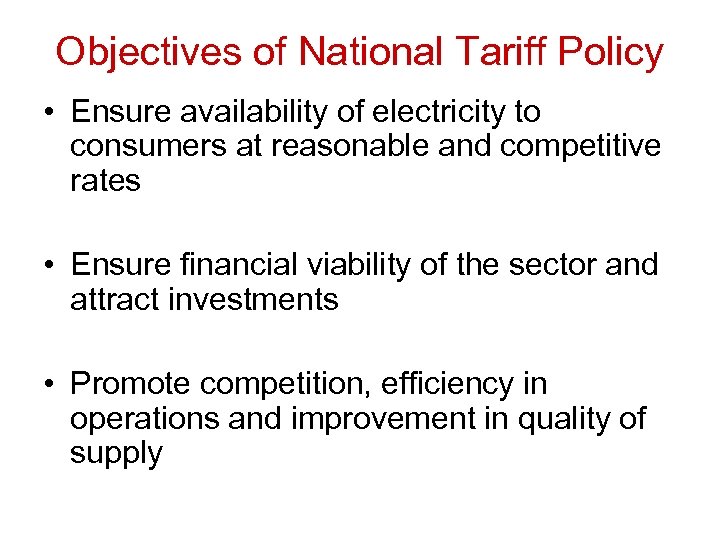 Objectives of National Tariff Policy • Ensure availability of electricity to consumers at reasonable and competitive rates • Ensure financial viability of the sector and attract investments • Promote competition, efficiency in operations and improvement in quality of supply
 Generation • To provide availabilty of over 1000 units of per capita electricity by 2010, more than 1, 000 MW wld be required during 200212. • No requirement of licensing for generation. Techno-economic clearance for thermal generation project no longer required. For hydro generation, concurrence of CEA required only above certain capital expenditure. Captive generation, freed from all controls.
 Transmission • Simultaneous planning of adequate transmission capacities to avoid mismatch between generation and transmission facilities. • Non-disriminatory Open Access in transmission introduced to promote competition.
 Distribution • Real challenge of reforms lies in the efficient management of the distribution system. • Private sector participation in distribution to be encouraged. • Energy Audits, energy accounting and declaration of results to be made mandatory. • HVDS to be introduced. • Stringent measures against theft of electricity.
 Electricity (Amendment) Act, 2007 The Electricity (Amendment) Act, 2007, amending certain provisions of the Electricity Act, 2003 The main features of the Amendment Act are: • Central Government, jointly with State Governments, to endeavour to provide access to electricity to all areas including villages and hamlets through rural electricity infrastructure and electrification of households. • No License required for sale of electricity from captive units. • Definition of theft expanded to cover use of tampered meters and use for unauthorized purpose. • Theft made explicitly cognizable and non-bailable. • Deletion of the provision for elimination of cross subsidies. The provision for reduction of cross subsidies would continue.
 ACCELERATED POWER DEVELOPMENT AND REFORMS PROGRAMME The Accelerated Power Development Reforms Programme (APDRP) was launched in 2002 -03 for implementation in the 10 th Plan as additional central assistance to the states for strengthening and up gradation of sub-transmission and distribution systems of high-density load centres like towns and industrial areas. The main objectives of the programme were to reduce AT&C loss and to improve quality and reliability of supply.
 Upgradation / Strengthening of subtransmission and distribution system • Fix Static meters on all HT and LT consumers and high accuracy tamper proof meters for other consumers. • Get Energy audit conducted for all distribution circles and sub divisions. • Introduce time of the day metering for HT and LT consumers.
 RAJIV GANDHI GRAMEEN VIDYUTIKARAN YOJANA(RGGVY) OF RURAL ELECTRICITY INFRASTRUCTURE & HOUSEHOLD ELECTRIFICATION Launched on 4 th April, 2005 for the attainment of the National Common Minimum Programme (NCMP) goa. I for providing access to electricity to all households in the country in five years. Rural Electrification Corporation (REC) is the nodal agency for the scheme. Under the scheme 90% capital subsidy would be provided for overall cost of the project for provision of: Rural Electricity Distribution Backbone (REDB) with at least one 33/11 k. V (or 66/11 k. V) substation in each block Village Electrification Infrastructure (VEl) with at least one distribution transformer in each village/habitation. Decentralized Distribution Generation (DDG) Systems where grid supply is either not feasible or not cost-effective.
 • • • Legislative/administrative Initiatives taken by the Government to improve the health of Power Sector (recap) Electricity Regulatory Commissions Act, 1998. Electricity Laws (Amendment) Act, 1998 to facilitate private investment in transmission. Ultra Mega Power Projects (UMPPs) Setting up of Power Trading Corporation. Development of merchant power Plants New Hydel Policy to provide thrust to Hydro capacity addition. Accelerated Power Development & Reforms Programme Energy Conservation Act in place Electricity Bill 2001 tabled in Parliament Settlement of Outstandings of PSUs with States Private participation in transmission Development of transmission projects through competitive bidding
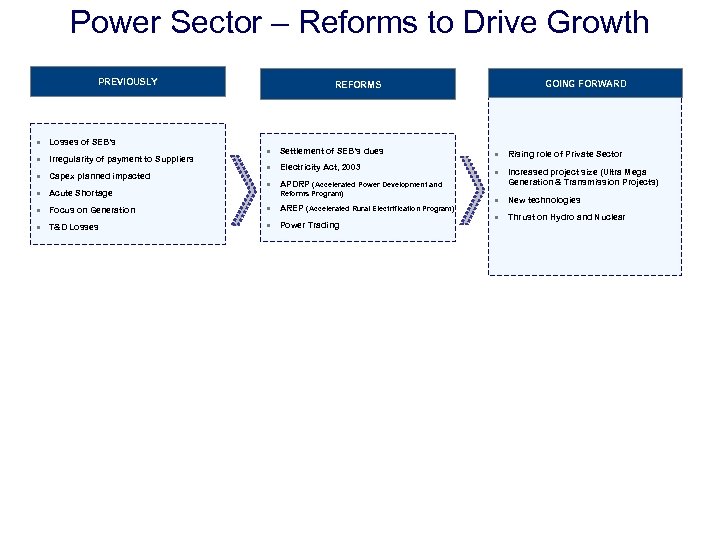 Power Sector – Reforms to Drive Growth PREVIOUSLY Losses of SEB’s Irregularity of payment to Suppliers Capex planned impacted GOING FORWARD REFORMS Settlement of SEB’s dues Electricity Act, 2003 APDRP (Accelerated Power Development and Acute Shortage Focus on Generation AREP (Accelerated Rural Electrification Program) T&D Losses Power Trading Reforms Program) Rising role of Private Sector Increased project size (Ultra Mega Generation & Transmission Projects) New technologies Thrust on Hydro and Nuclear
 Strengths and opportunities in the sector • Abundant coal reserves (enough to last at least 200 years). • Vast hydroelectric potential • Large pool of highly skilled technical personnel. • Impressive power development in absolute terms (comparable in size to those of Germany and UK). • Expertise in integrated and coordinated planning (CEA and Planning Commission).
 Strengths and opportunities in the sector (contd. ) • Emergence of strong and globally comparable central utilities (NTPC, POWERGRID, ). • Wide outreach of state utilities. • Enabling framework for private investors. • Well laid out mechanisms for dispute resolution. • Political consensus on reforms. • Potentially, one of the largest power markets in the world.
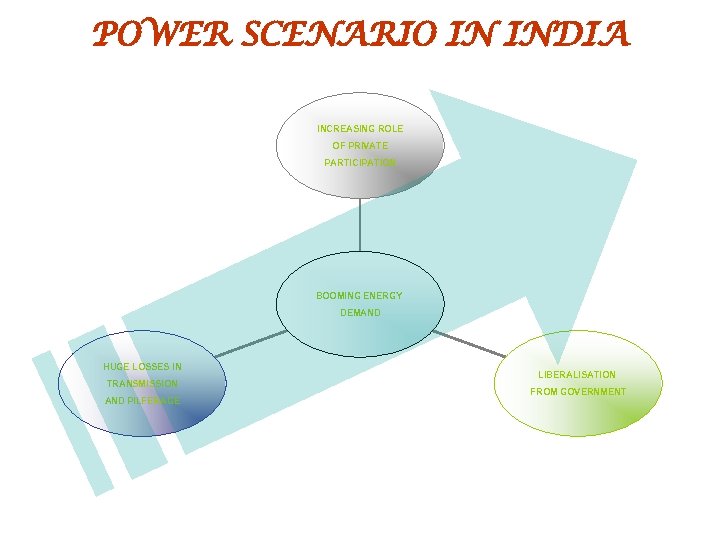 POWER SCENARIO IN INDIA INCREASING ROLE OF PRIVATE PARTICIPATION BOOMING ENERGY DEMAND HUGE LOSSES IN TRANSMISSION AND PILFERAGE LIBERALISATION FROM GOVERNMENT
 Thank you!