 Скачать презентацию Indian Institute of Technology Kanpur REACH Symposium October
da9a0d80e749d5436693c03c2f6d4f03.ppt
- Количество слайдов: 36



Indian Institute of Technology Kanpur REACH Symposium, October 10 -12, 2010 Chemiresistor Sensors for Environmental Monitoring Clifford K. Ho Sandia National Laboratories Albuquerque, NM 87185 ckho@sandia. gov Sandia National Laboratories is a multi-program laboratory managed and operated by Sandia Corporation, a wholly owned subsidiary of Lockheed Martin Corporation, for the U. S. Department of Energy’s National Nuclear Security Administration under contract DE-AC 04 -94 AL 85000.
Overview • Background and Need • Sensor Development • Field Tests • Lesson Learned and Next Steps
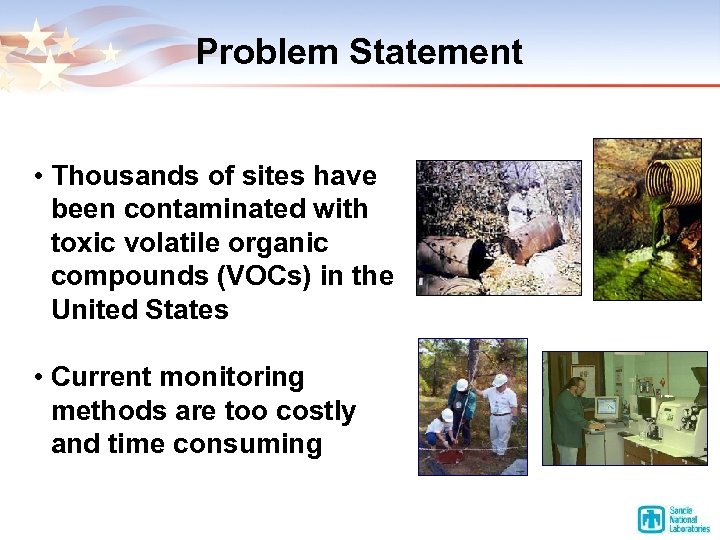
Problem Statement • Thousands of sites have been contaminated with toxic volatile organic compounds (VOCs) in the United States • Current monitoring methods are too costly and time consuming
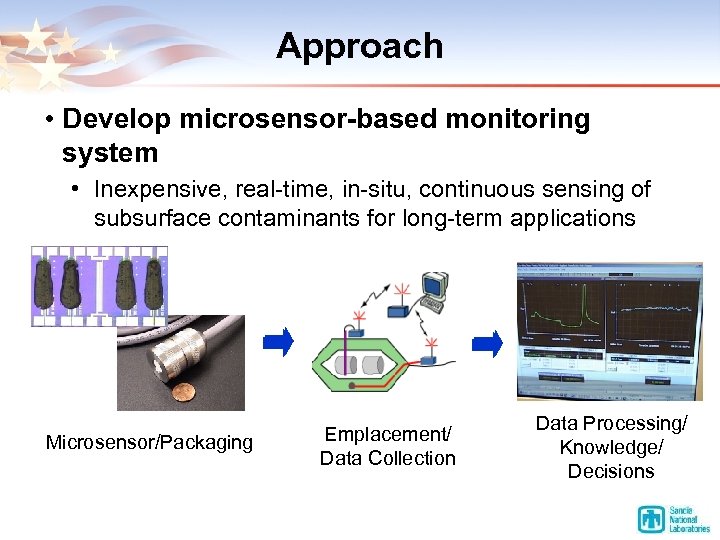
Approach • Develop microsensor-based monitoring system • Inexpensive, real-time, in-situ, continuous sensing of subsurface contaminants for long-term applications Microsensor/Packaging Emplacement/ Data Collection Data Processing/ Knowledge/ Decisions
Overview • Background and Need • Sensor Development • Field Tests • Lesson Learned and Next Steps
Chemiresistor Sensor • Conductive polymer films on microfabricated circuits form chemically sensitive resistors • Sandia National Labs • www. sandia. gov/sensor • • Cal Tech (Professor Nathan Lewis) University of Michigan (Professor Zeller) Stanford University (Professor Bao) Australia (U. New South Wales, CSIRO)
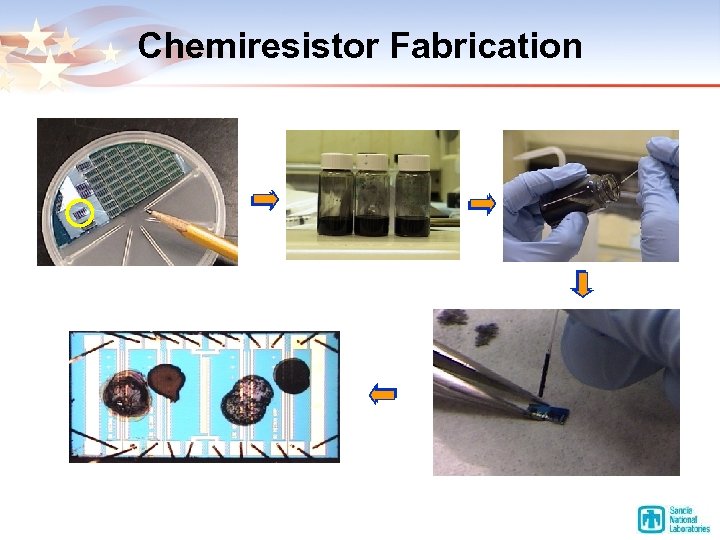
Chemiresistor Fabrication
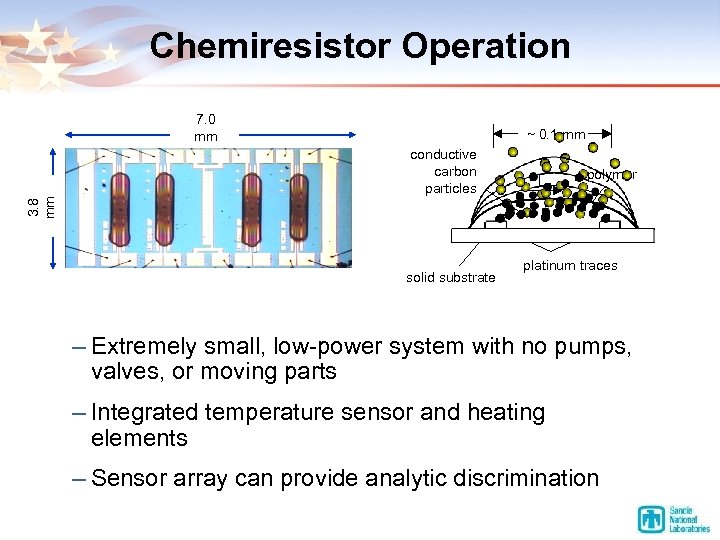
Chemiresistor Operation 7. 0 mm ~ 0. 1 mm I polymer 3. 8 mm conductive carbon particles solid substrate platinum traces – Extremely small, low-power system with no pumps, valves, or moving parts – Integrated temperature sensor and heating elements – Sensor array can provide analytic discrimination
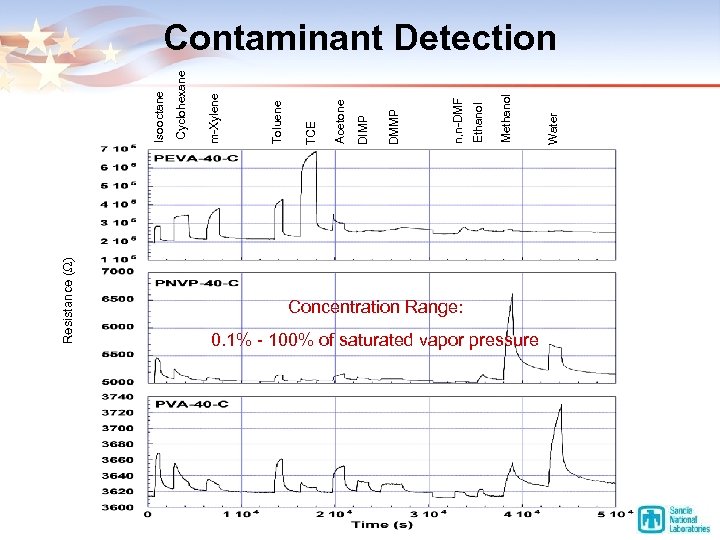
Resistance ( ) Concentration Range: 0. 1% - 100% of saturated vapor pressure Water Methanol Ethanol n, n-DMF DMMP DIMP Acetone TCE Toluene m-Xylene Cyclohexane Isooctane Contaminant Detection
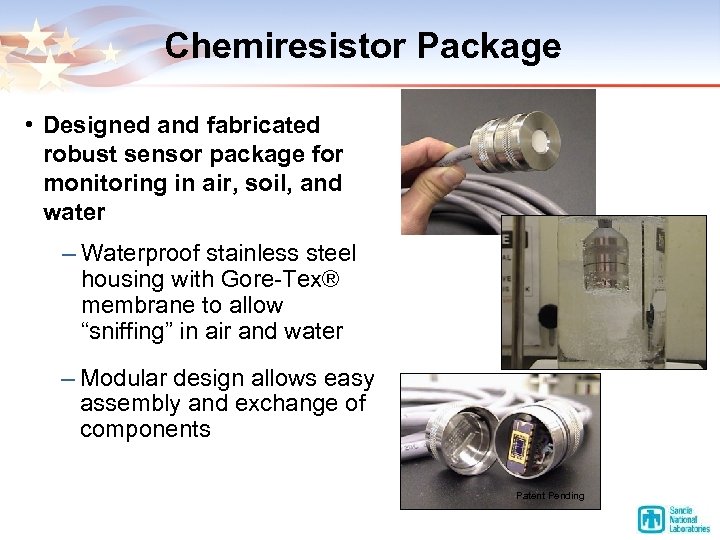
Chemiresistor Package • Designed and fabricated robust sensor package for monitoring in air, soil, and water – Waterproof stainless steel housing with Gore-Tex® membrane to allow “sniffing” in air and water – Modular design allows easy assembly and exchange of components Patent Pending
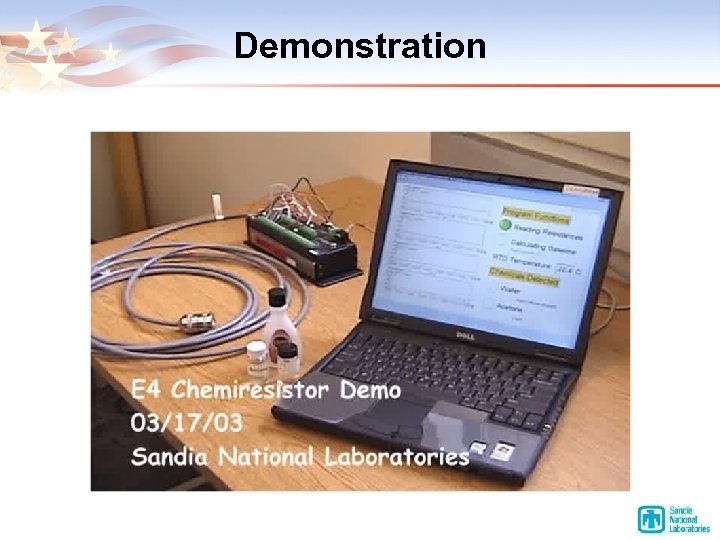
Demonstration
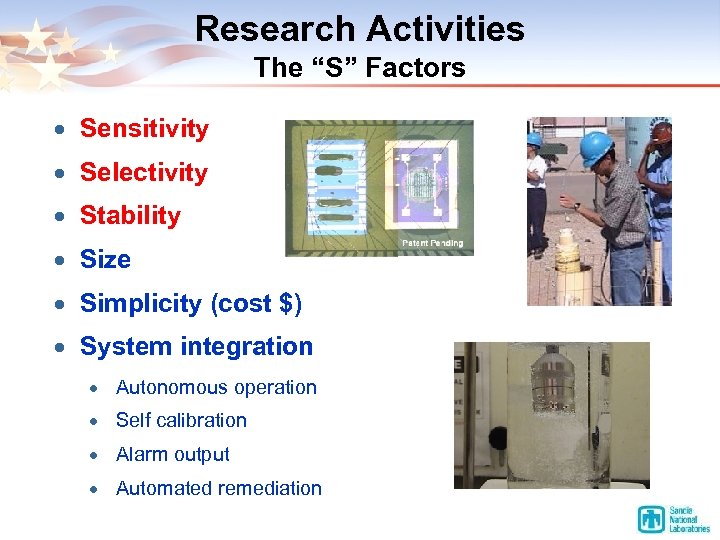
Research Activities The “S” Factors · Sensitivity · Selectivity · Stability · Size · Simplicity (cost $) · System integration · Autonomous operation · Self calibration · Alarm output · Automated remediation
Overview • Background and Need • Sensor Development • Field Tests • Lesson Learned and Next Steps
Field Test Objectives • Determine engineering requirements for remote operation in the field • Power • Data acquisition • Data processing and dissemination • Assess longevity and robustness of sensors and packaging • Determine performance and issues
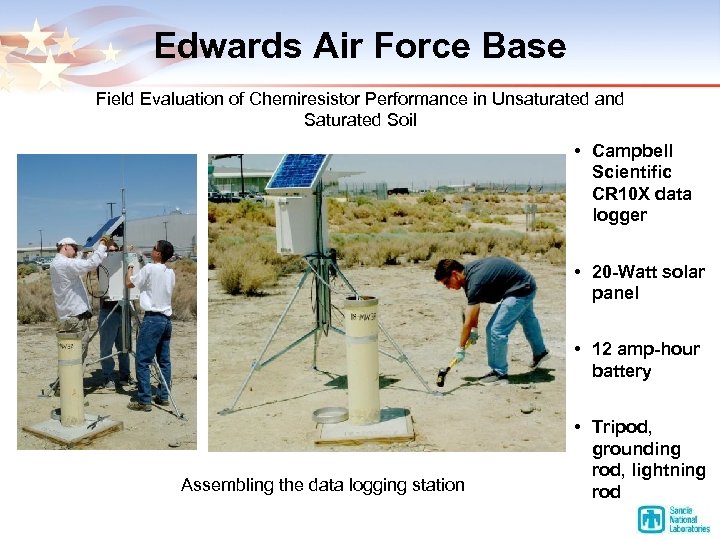
Edwards Air Force Base Field Evaluation of Chemiresistor Performance in Unsaturated and Saturated Soil • Campbell Scientific CR 10 X data logger • 20 -Watt solar panel • 12 amp-hour battery Assembling the data logging station • Tripod, grounding rod, lightning rod
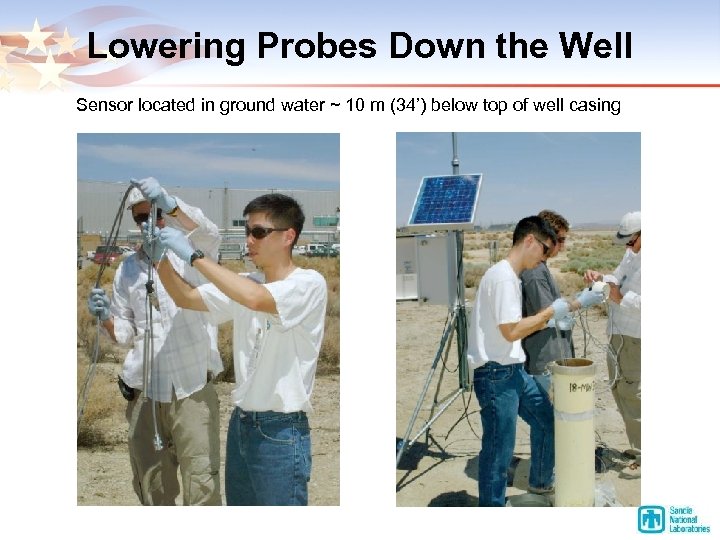
Lowering Probes Down the Well Sensor located in ground water ~ 10 m (34’) below top of well casing
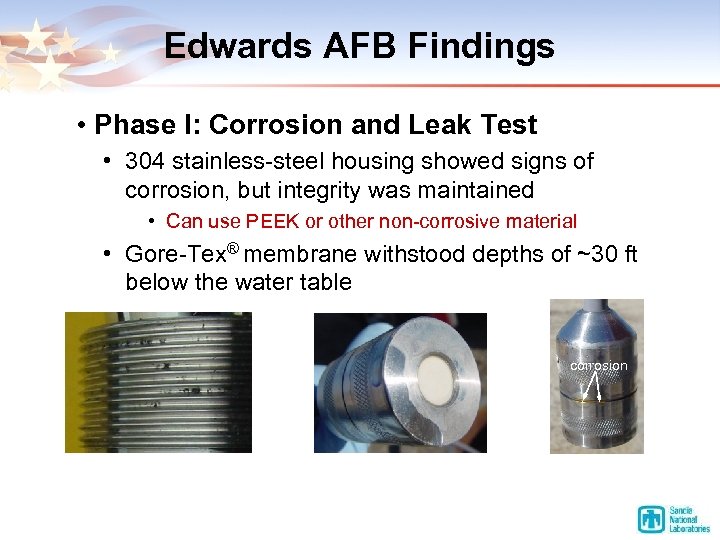
Edwards AFB Findings • Phase I: Corrosion and Leak Test • 304 stainless-steel housing showed signs of corrosion, but integrity was maintained • Can use PEEK or other non-corrosive material • Gore-Tex® membrane withstood depths of ~30 ft below the water table corrosion
Edwards AFB Findings • Phases II & III: Performance and Operation • Chemiresistor sensor operated continuously over four-month period in well 18 -MW 37 • • Campbell Scientific CR 10 X data logger 20 -Watt solar panel 12 amp-hour battery Add wireless telemetry (cell-phone modem) • Chemiresistor response was unstable due to high water-vapor concentrations (100% RH) • Recommended heating the chip above ambient temperatures to eliminate condensation and instabilities • Heating elements are already on the chips – no added complexity
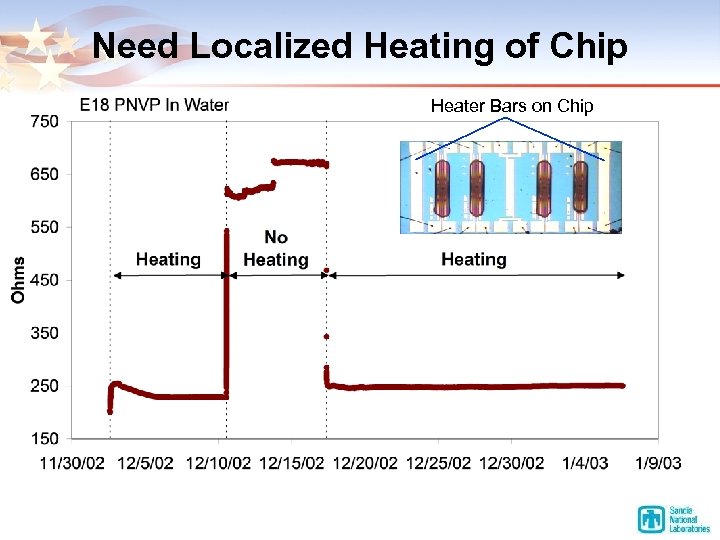
Need Localized Heating of Chip Heater Bars on Chip
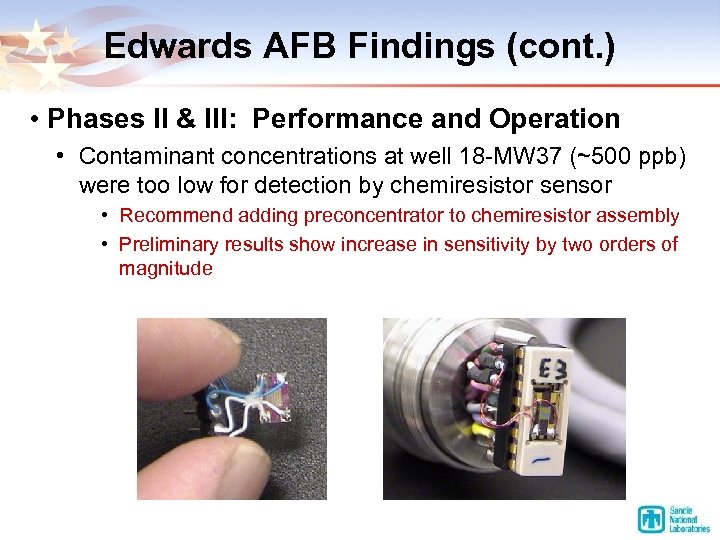
Edwards AFB Findings (cont. ) • Phases II & III: Performance and Operation • Contaminant concentrations at well 18 -MW 37 (~500 ppb) were too low for detection by chemiresistor sensor • Recommend adding preconcentrator to chemiresistor assembly • Preliminary results show increase in sensitivity by two orders of magnitude
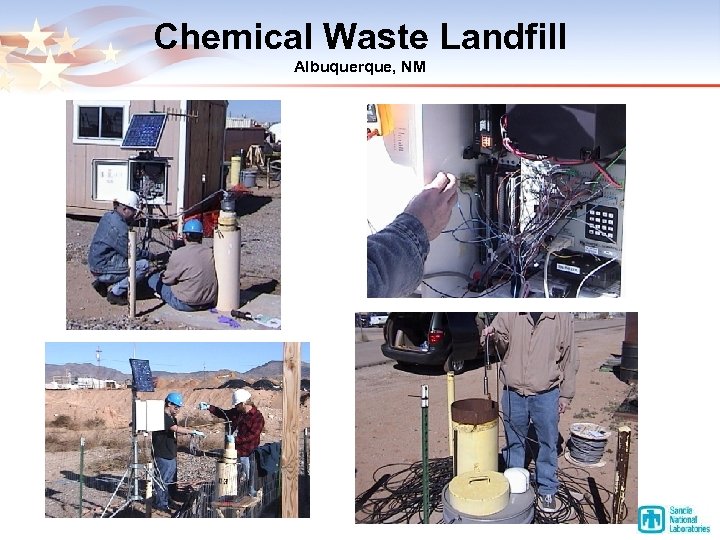
Chemical Waste Landfill Albuquerque, NM
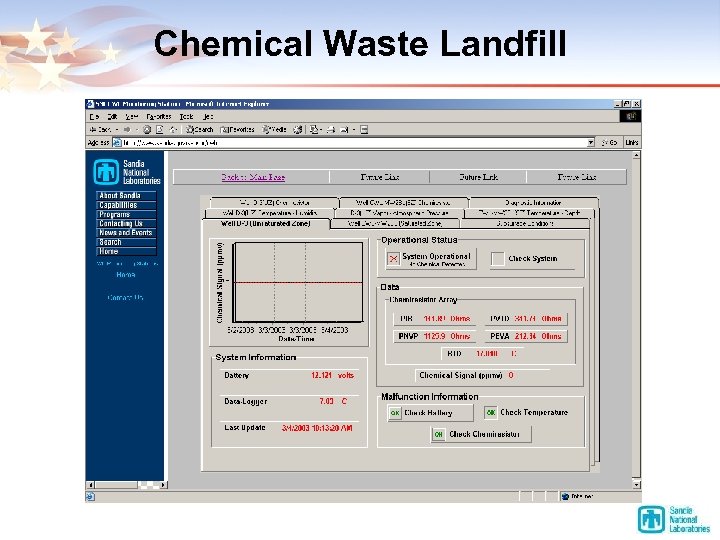
Chemical Waste Landfill
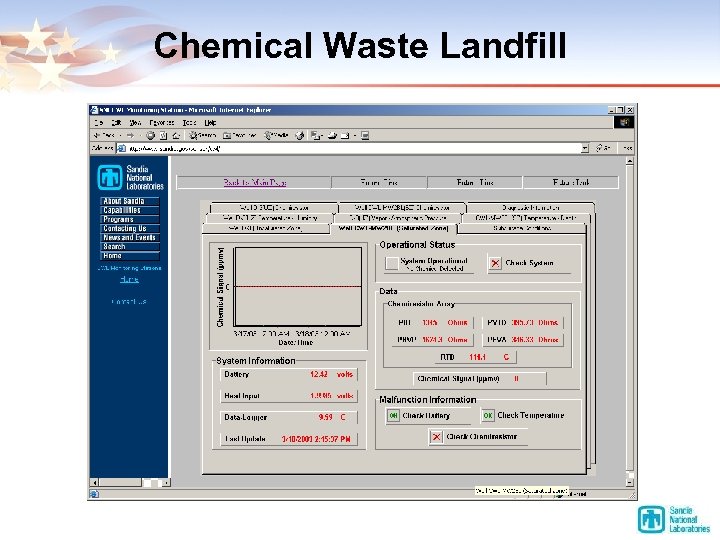
Chemical Waste Landfill
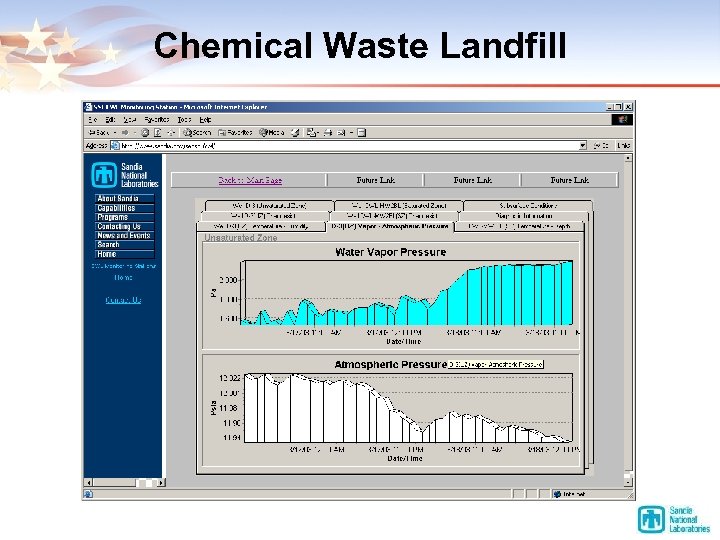
Chemical Waste Landfill
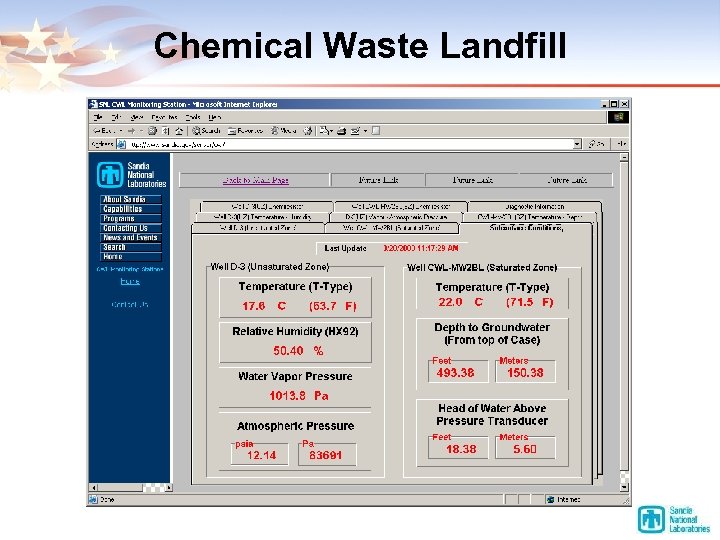
Chemical Waste Landfill
Overview • Background and Need • Sensor Development • Field Tests • Lesson Learned and Next Steps
Lessons Learned • Fully understand requirements of application and limitations of sensor technology • Field test as soon as possible • Identify issues in uncontrolled environments • Environmental fluctuations (e. g. , temperature, humidity) can cause interferences • Local heating required • Sensitivity of chemiresistor limited • May need preconcentrator for ppb levels

Alternative Designs and Additional Research 28
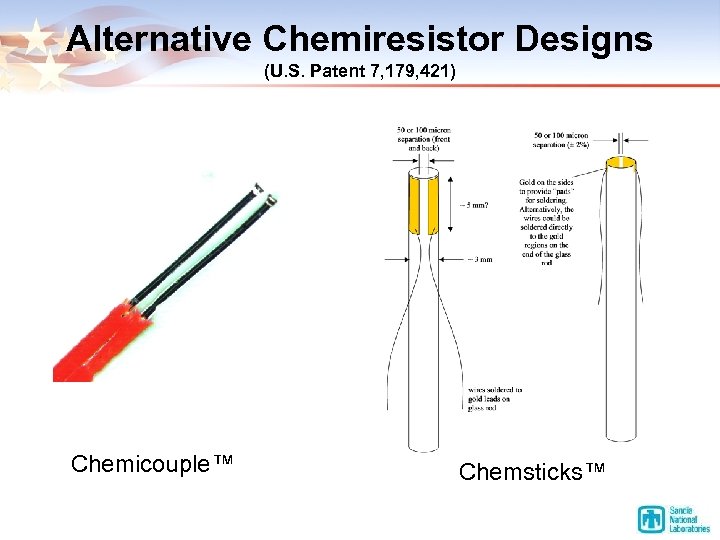
Alternative Chemiresistor Designs (U. S. Patent 7, 179, 421) Chemicouple™ Chemsticks™
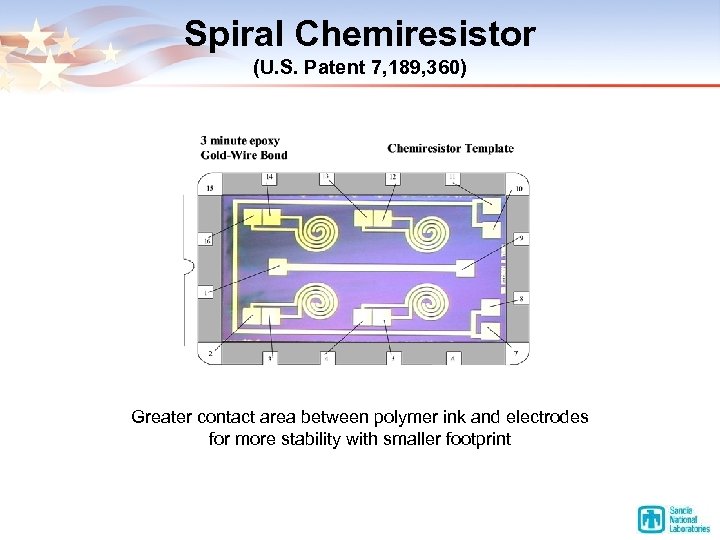
Spiral Chemiresistor (U. S. Patent 7, 189, 360) Greater contact area between polymer ink and electrodes for more stability with smaller footprint
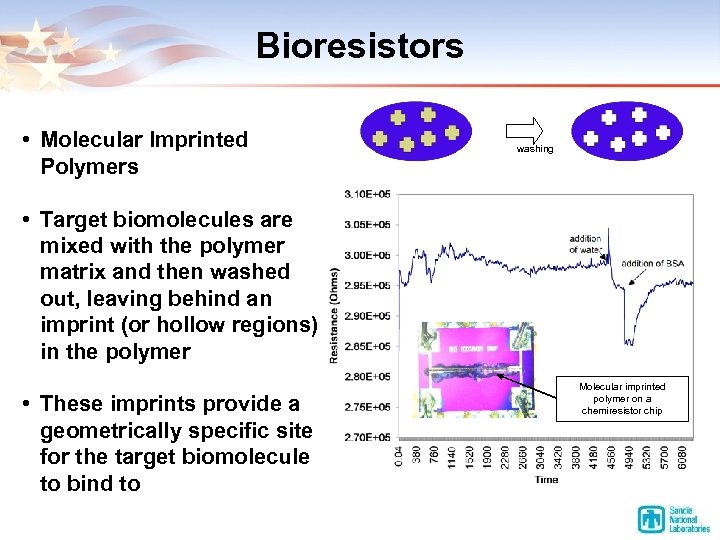
Bioresistors • Molecular Imprinted Polymers washing • Target biomolecules are mixed with the polymer matrix and then washed out, leaving behind an imprint (or hollow regions) in the polymer • These imprints provide a geometrically specific site for the target biomolecule to bind to Molecular imprinted polymer on a chemiresistor chip
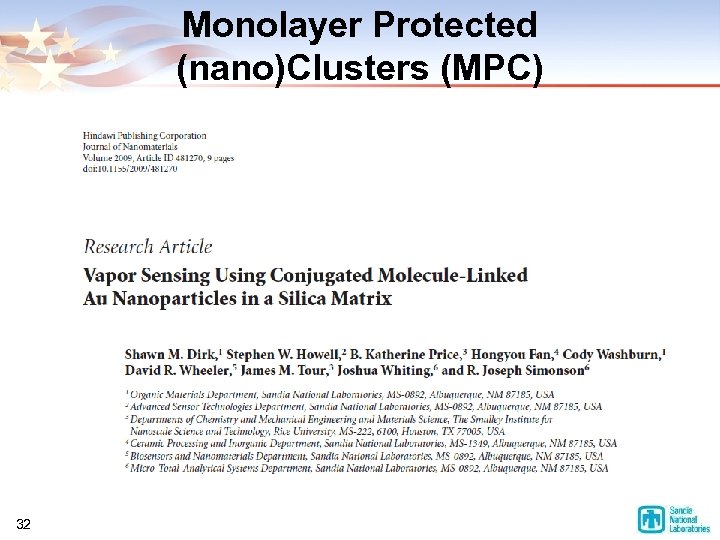
Monolayer Protected (nano)Clusters (MPC) 32
Acknowledgments 33
Acknowledgments • Chemiresistor Technology & Fabrication • Bob Hughes, Graham Yelton, Mark Jenkins, John Lucero, Tina Petersen, Gayle Schwartz, (SNL) • Packaging • Paul Reynolds (Team Specialty Products) • Testing and Calibration • Chad Davis, Lucas Mc. Grath, Jerome Wright, Michael Thomas, Irene Ma, Angela Mc. Lain (SNL) • Data Analysis • Dion Rivera, Kathy Alam (SNL) • Field Testing • James May, Mary Spencer, Irene Nester (Edwards AFB) • Charles Lohrstorfer (Nevada Test Site) • Sue Collins, Robert Ziock, Henry Bryant, Sharissa Young (Chemical Waste Landfill)
Backup Slides
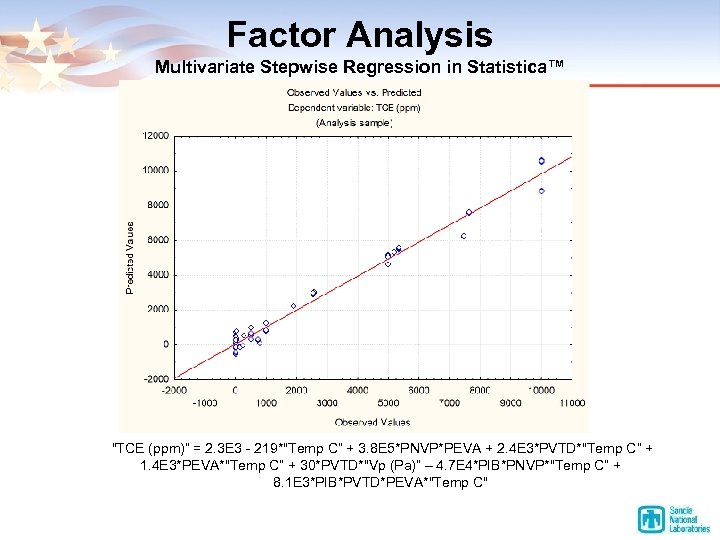
Factor Analysis Multivariate Stepwise Regression in Statistica™ "TCE (ppm)“ = 2. 3 E 3 - 219*"Temp C“ + 3. 8 E 5*PNVP*PEVA + 2. 4 E 3*PVTD*"Temp C“ + 1. 4 E 3*PEVA*"Temp C“ + 30*PVTD*"Vp (Pa)“ – 4. 7 E 4*PIB*PNVP*"Temp C“ + 8. 1 E 3*PIB*PVTD*PEVA*"Temp C"
Скачать презентацию Indian Institute of Technology Kanpur REACH Symposium October
da9a0d80e749d5436693c03c2f6d4f03.ppt