

India Geography and Economy Geography India lies to

 Скачать презентацию India Geography and Economy Geography India lies to
28516-india.ppt
- Количество слайдов: 4
India Geography and Economy
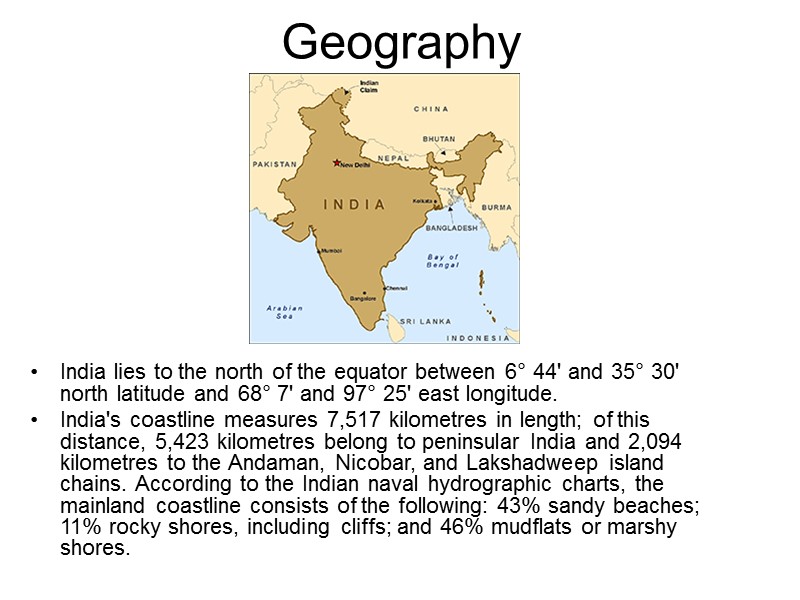
Geography India lies to the north of the equator between 6° 44' and 35° 30' north latitude and 68° 7' and 97° 25' east longitude. India's coastline measures 7,517 kilometres in length; of this distance, 5,423 kilometres belong to peninsular India and 2,094 kilometres to the Andaman, Nicobar, and Lakshadweep island chains. According to the Indian naval hydrographic charts, the mainland coastline consists of the following: 43% sandy beaches; 11% rocky shores, including cliffs; and 46% mudflats or marshy shores.
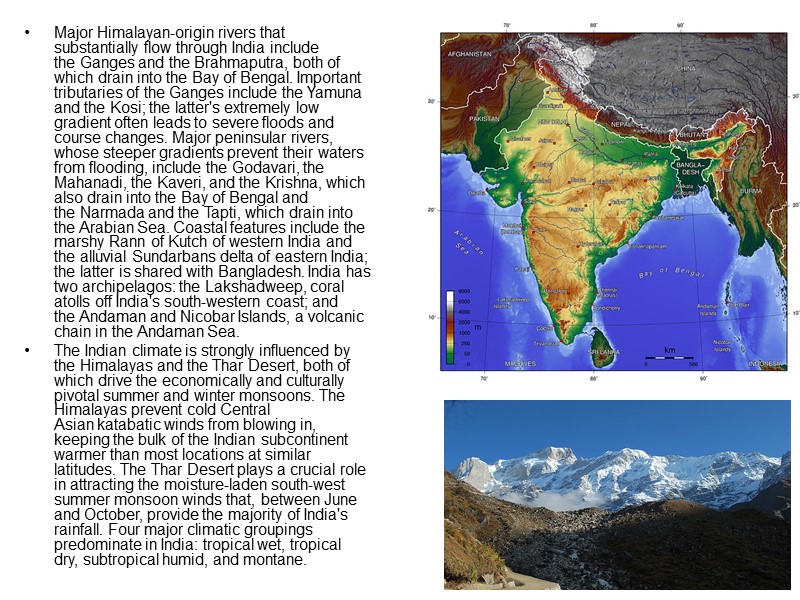
Major Himalayan-origin rivers that substantially flow through India include the Ganges and the Brahmaputra, both of which drain into the Bay of Bengal. Important tributaries of the Ganges include the Yamuna and the Kosi; the latter's extremely low gradient often leads to severe floods and course changes. Major peninsular rivers, whose steeper gradients prevent their waters from flooding, include the Godavari, the Mahanadi, the Kaveri, and the Krishna, which also drain into the Bay of Bengal and the Narmada and the Tapti, which drain into the Arabian Sea. Coastal features include the marshy Rann of Kutch of western India and the alluvial Sundarbans delta of eastern India; the latter is shared with Bangladesh. India has two archipelagos: the Lakshadweep, coral atolls off India's south-western coast; and the Andaman and Nicobar Islands, a volcanic chain in the Andaman Sea. The Indian climate is strongly influenced by the Himalayas and the Thar Desert, both of which drive the economically and culturally pivotal summer and winter monsoons. The Himalayas prevent cold Central Asian katabatic winds from blowing in, keeping the bulk of the Indian subcontinent warmer than most locations at similar latitudes. The Thar Desert plays a crucial role in attracting the moisture-laden south-west summer monsoon winds that, between June and October, provide the majority of India's rainfall. Four major climatic groupings predominate in India: tropical wet, tropical dry, subtropical humid, and montane.
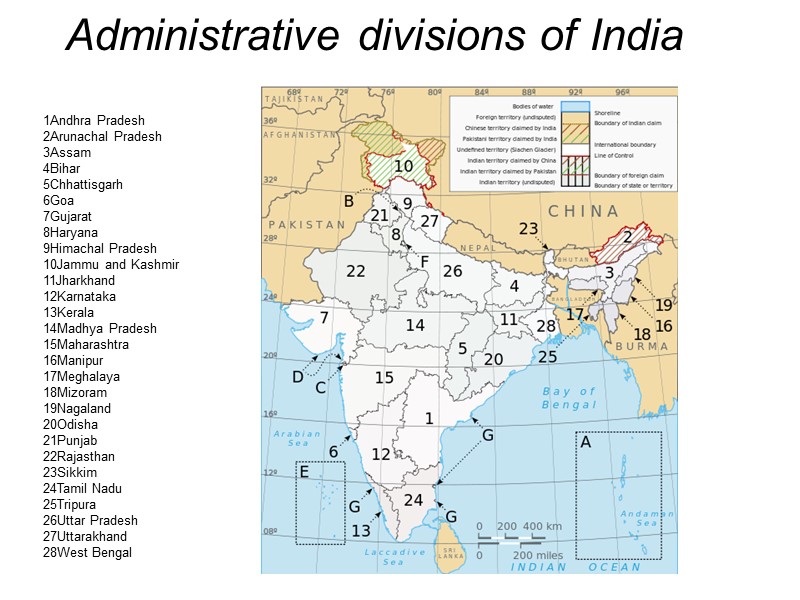
Administrative divisions of India 1Andhra Pradesh 2Arunachal Pradesh 3Assam 4Bihar 5Chhattisgarh 6Goa 7Gujarat 8Haryana 9Himachal Pradesh 10Jammu and Kashmir 11Jharkhand 12Karnataka 13Kerala 14Madhya Pradesh 15Maharashtra 16Manipur 17Meghalaya 18Mizoram 19Nagaland 20Odisha 21Punjab 22Rajasthan 23Sikkim 24Tamil Nadu 25Tripura 26Uttar Pradesh 27Uttarakhand 28West Bengal