


 Скачать презентацию INDIA AT 70 RELATIONS WITH IMF LECTURE AT
3bafa993e8eae2cb0caa6049dec2fb7e.ppt
- Количество слайдов: 38
 INDIA AT 70: RELATIONS WITH IMF LECTURE AT THE INDIA INTERNATIONAL CENTER DATED JANUARY 17, 2018 V. SRINIVAS, IAS
 INTRODUCTION • INDIA AT BRETTON WOODS 1944 • INDIA – IMF RELATIONS IN PROGRAM YEARS 1966, 1981, 1991 • INDIA – IMF RELATIONS IN GROWTH YEARS 2004 – 2009 • IMF REFORMS
 SIGNIFICANT ENGAGEMENTS • A. D. SHROFF – JOHN MAYNARD KEYNES AT BRETTON WOODS IN 1944 • M. NARASIMHAM – JACQUES DE LAROSIERE AT EXECUTIVE BOARD OF IMF 1981 • MONTEK SINGH AHLUWALIA – HUBERT NEISS AT NORTH BLOCK 1992 -95 • Y. V. REDDY – RODRIGO DE RATO / ANNE KRUEGER 2003– 2007 • DUVVURI SUBBARAO – DOMINIQUE STRAUSS-KAHN 2008– 2012 • Intellectual convergence of ideas
 INDIA – AN ORIGINAL MEMBER OF IMF • The United Nations Monetary and Financial Conference at Bretton Woods in July 1944 attended by 44 countries • India was represented by a six member delegation • India is an original member of the IMF since 1944 • 5 th largest quota in 1945 • As of 2016, India’s has 8 th largest quota of 2. 66 percent
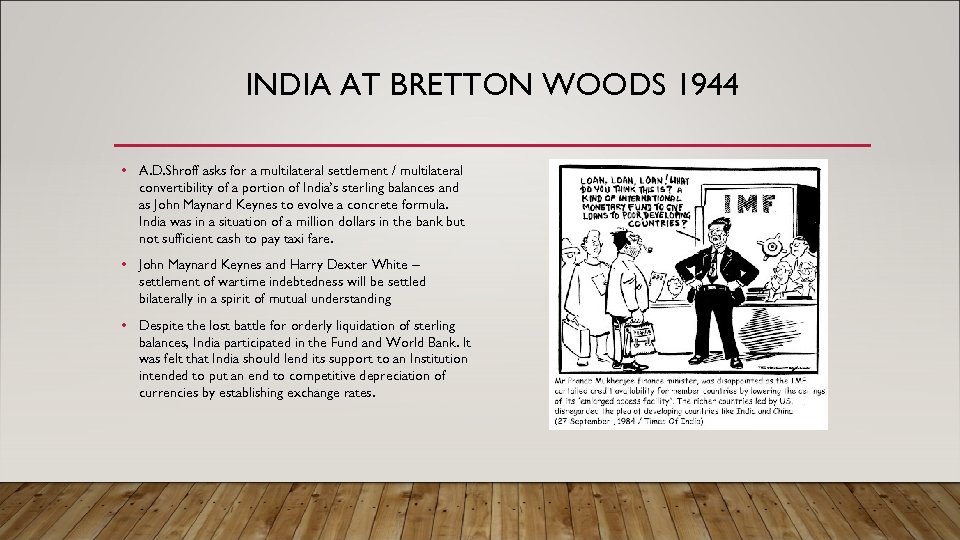 INDIA AT BRETTON WOODS 1944 • A. D. Shroff asks for a multilateral settlement / multilateral convertibility of a portion of India’s sterling balances and as John Maynard Keynes to evolve a concrete formula. India was in a situation of a million dollars in the bank but not sufficient cash to pay taxi fare. • John Maynard Keynes and Harry Dexter White – settlement of wartime indebtedness will be settled bilaterally in a spirit of mutual understanding • Despite the lost battle for orderly liquidation of sterling balances, India participated in the Fund and World Bank. It was felt that India should lend its support to an Institution intended to put an end to competitive depreciation of currencies by establishing exchange rates.
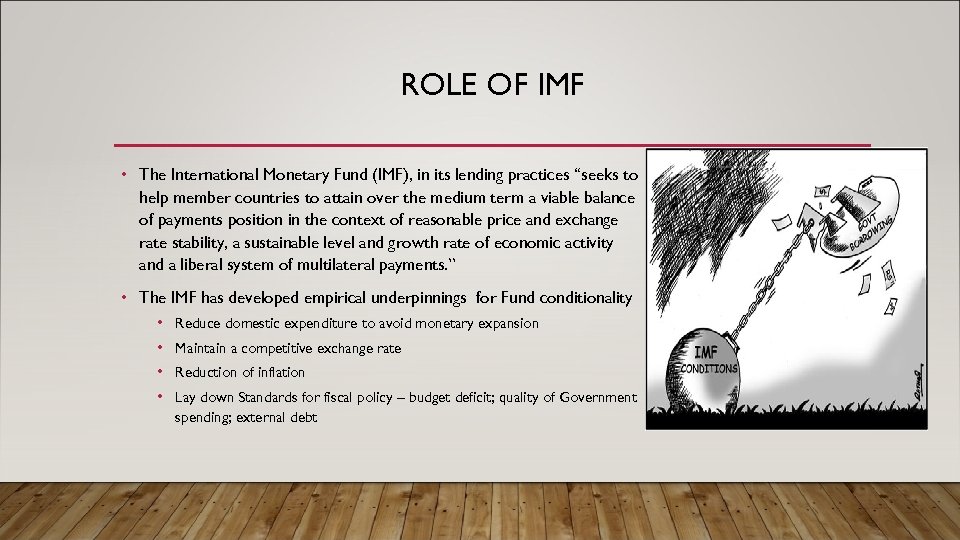 ROLE OF IMF • The International Monetary Fund (IMF), in its lending practices “seeks to help member countries to attain over the medium term a viable balance of payments position in the context of reasonable price and exchange rate stability, a sustainable level and growth rate of economic activity and a liberal system of multilateral payments. ” • The IMF has developed empirical underpinnings for Fund conditionality • Reduce domestic expenditure to avoid monetary expansion • Maintain a competitive exchange rate • Reduction of inflation • Lay down Standards for fiscal policy – budget deficit; quality of Government spending; external debt
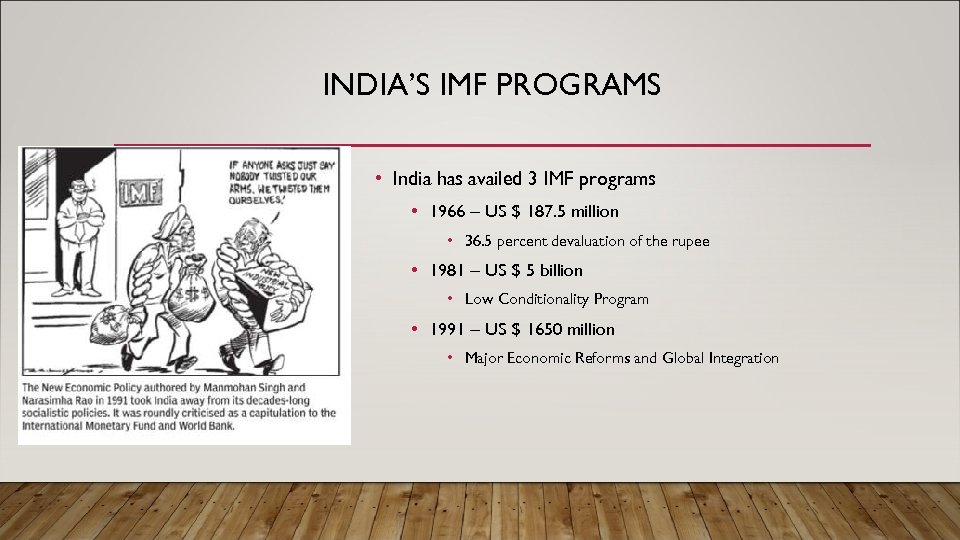 INDIA’S IMF PROGRAMS • India has availed 3 IMF programs • 1966 – US $ 187. 5 million • 36. 5 percent devaluation of the rupee • 1981 – US $ 5 billion • Low Conditionality Program • 1991 – US $ 1650 million • Major Economic Reforms and Global Integration
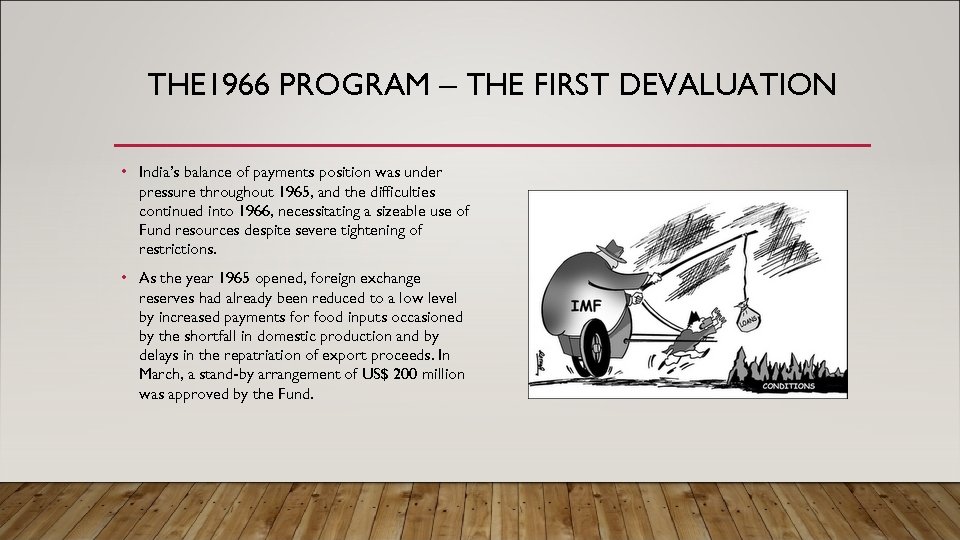 THE 1966 PROGRAM – THE FIRST DEVALUATION • India’s balance of payments position was under pressure throughout 1965, and the difficulties continued into 1966, necessitating a sizeable use of Fund resources despite severe tightening of restrictions. • As the year 1965 opened, foreign exchange reserves had already been reduced to a low level by increased payments for food inputs occasioned by the shortfall in domestic production and by delays in the repatriation of export proceeds. In March, a stand-by arrangement of US$ 200 million was approved by the Fund.
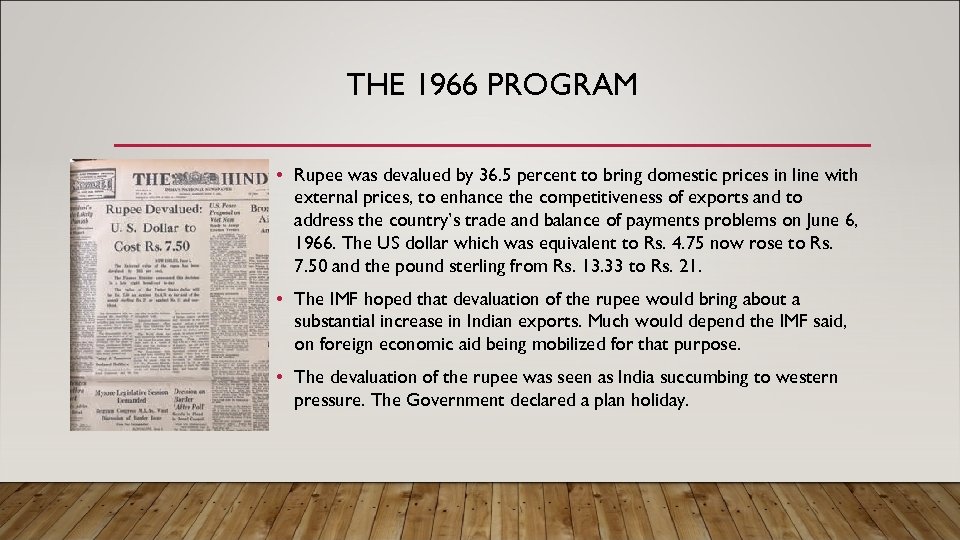 THE 1966 PROGRAM • Rupee was devalued by 36. 5 percent to bring domestic prices in line with external prices, to enhance the competitiveness of exports and to address the country’s trade and balance of payments problems on June 6, 1966. The US dollar which was equivalent to Rs. 4. 75 now rose to Rs. 7. 50 and the pound sterling from Rs. 13. 33 to Rs. 21. • The IMF hoped that devaluation of the rupee would bring about a substantial increase in Indian exports. Much would depend the IMF said, on foreign economic aid being mobilized for that purpose. • The devaluation of the rupee was seen as India succumbing to western pressure. The Government declared a plan holiday.
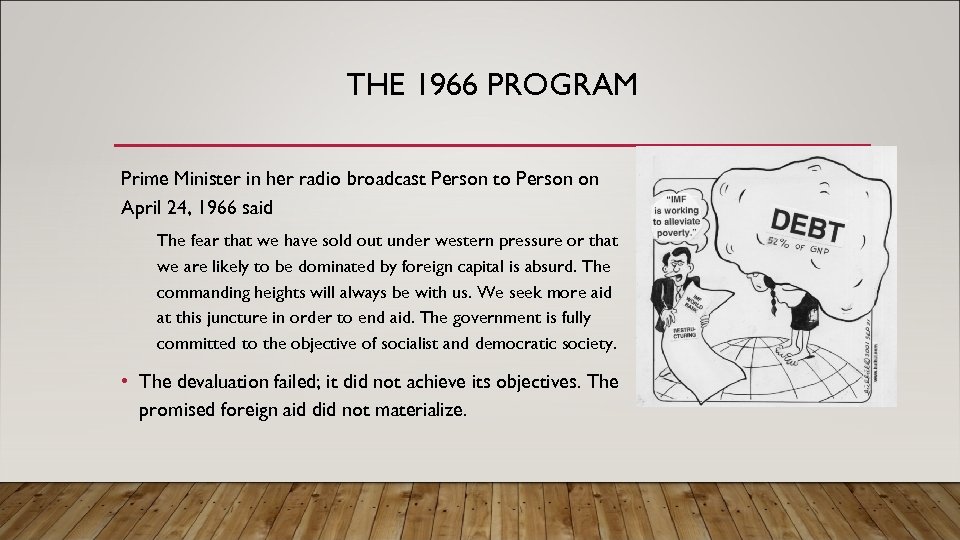 THE 1966 PROGRAM Prime Minister in her radio broadcast Person to Person on April 24, 1966 said The fear that we have sold out under western pressure or that we are likely to be dominated by foreign capital is absurd. The commanding heights will always be with us. We seek more aid at this juncture in order to end aid. The government is fully committed to the objective of socialist and democratic society. • The devaluation failed; it did not achieve its objectives. The promised foreign aid did not materialize.
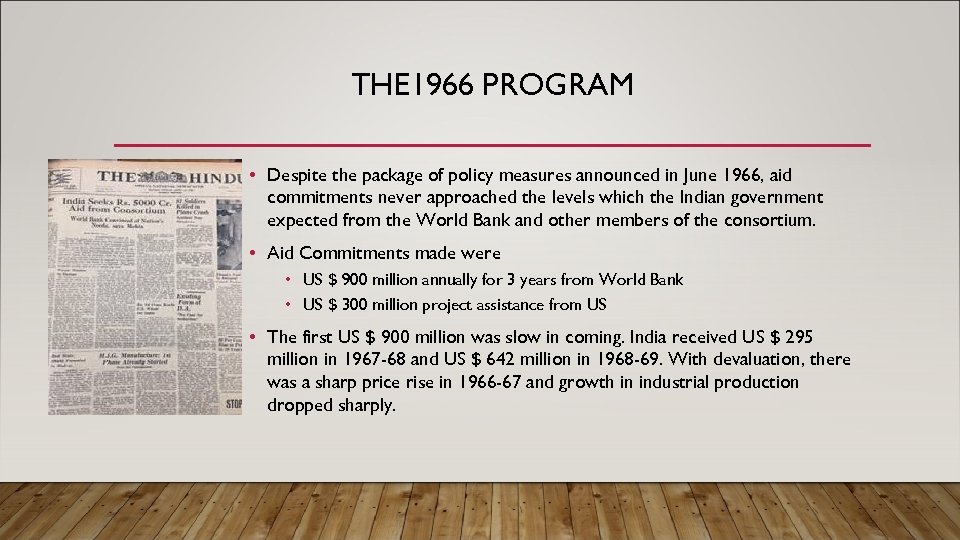 THE 1966 PROGRAM • Despite the package of policy measures announced in June 1966, aid commitments never approached the levels which the Indian government expected from the World Bank and other members of the consortium. • Aid Commitments made were • US $ 900 million annually for 3 years from World Bank • US $ 300 million project assistance from US • The first US $ 900 million was slow in coming. India received US $ 295 million in 1967 -68 and US $ 642 million in 1968 -69. With devaluation, there was a sharp price rise in 1966 -67 and growth in industrial production dropped sharply.
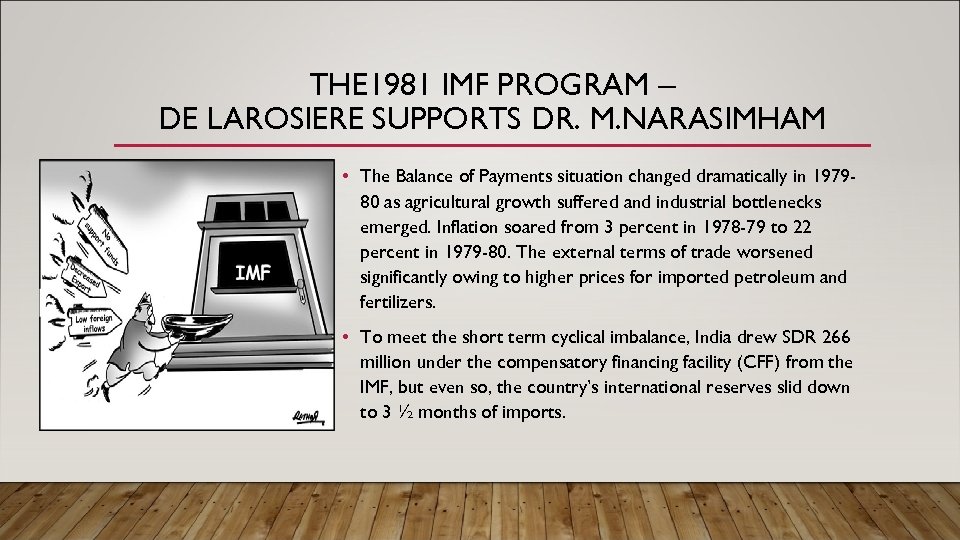 THE 1981 IMF PROGRAM – DE LAROSIERE SUPPORTS DR. M. NARASIMHAM • The Balance of Payments situation changed dramatically in 197980 as agricultural growth suffered and industrial bottlenecks emerged. Inflation soared from 3 percent in 1978 -79 to 22 percent in 1979 -80. The external terms of trade worsened significantly owing to higher prices for imported petroleum and fertilizers. • To meet the short term cyclical imbalance, India drew SDR 266 million under the compensatory financing facility (CFF) from the IMF, but even so, the country’s international reserves slid down to 3 ½ months of imports.
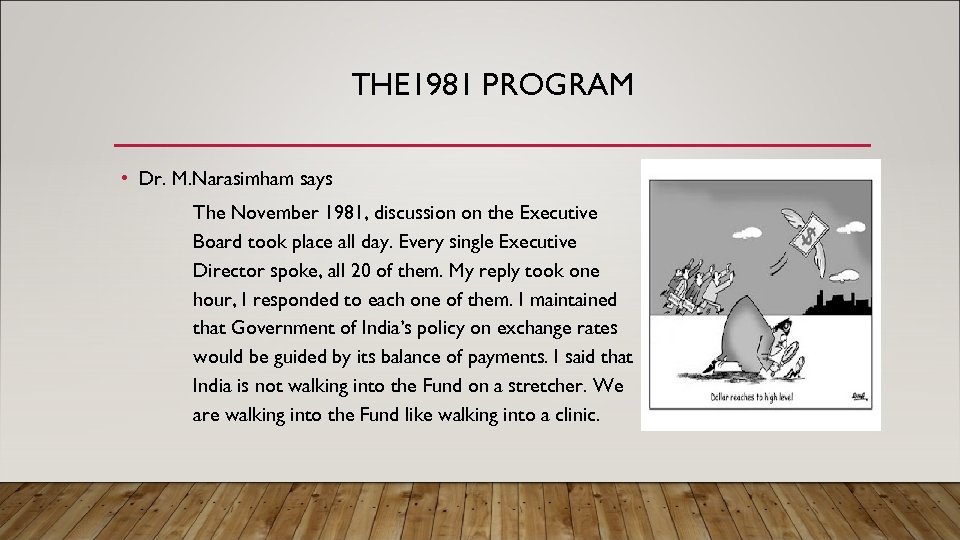 THE 1981 PROGRAM • Dr. M. Narasimham says The November 1981, discussion on the Executive Board took place all day. Every single Executive Director spoke, all 20 of them. My reply took one hour, I responded to each one of them. I maintained that Government of India’s policy on exchange rates would be guided by its balance of payments. I said that India is not walking into the Fund on a stretcher. We are walking into the Fund like walking into a clinic.
 THE 1981 PROGRAM • It is quite surprising that India went through the 1981 IMF program without major reforms. • Dr. Narasimham, the Executive Director IMF, who negotiated the IMF program, did not yield much ground on the reform front. He assured the Prime Minister Mrs. Gandhi that he had succeeded in persuading the IMF to permit flexibility to develop a fully home-grown program. • In the 1981 -84 period, the Government did start changes e. g. Export Oriented Units and SEZs were established. But the pace of reforms was slow. • Following the 1984 elections, the reforms continued. But there were no major overhauling reforms. Gradualism ruled.
 THE 1981 PROGRAM • The RBI’s history says that India’s EFF experiment was a classic case of a country’s readiness to accept selfimposed conditionality in adjusting its economy to a changed structural scenario and aimed at tackling the root cause of the problem. It could be claimed as a precursor for member country’s ownership of conditionality and adjustment programs.
 1966 AND 1981 IMF PROGRAMS • The IMF programs of 1966 and 1981 helped tide over periods of high inflation and difficult balance of payments position faced at that point of time. They were modestly successful in bringing economic reforms to the Indian economy. • Although there was no devaluation of the rupee after 1966, the exchange rate policy was aimed at gradual depreciation of the rupee to maintain price competitiveness of the exports sector. • Expansionary fiscal policy continued in the 1980 s, and the automatic monetization of budgetary deficits by issuing adhoc Treasury bills strained credit policy. • India entered the 1990 s with structural rigidities and imbalances in the economy, pronounced macroeconomic imbalances despite a significant growth rate of 5 percent. Several adverse domestic and external developments precipitated in the balance of payments (BOP) crisis in 1991. From this crisis, emerged a comprehensive reform agenda backed by an IMF program which was effectively implemented.
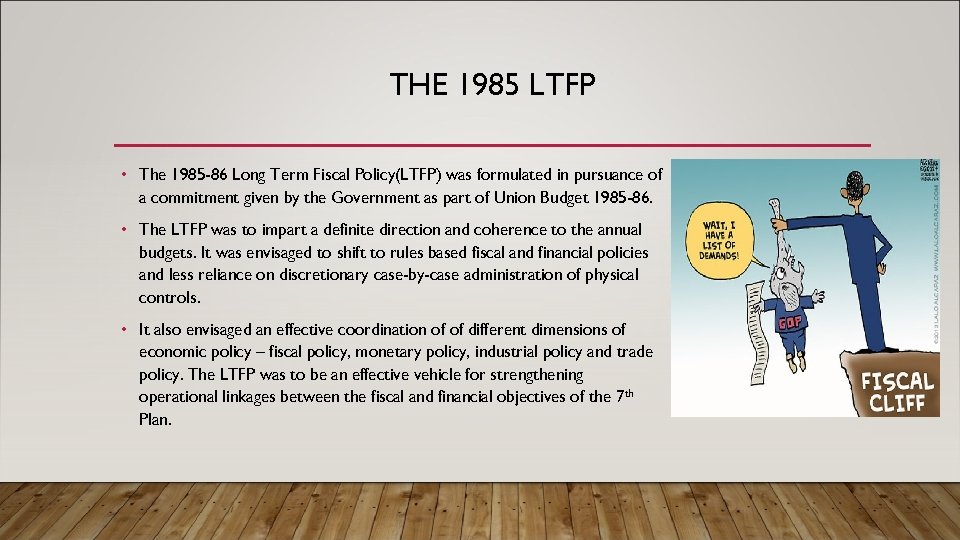 THE 1985 LTFP • The 1985 -86 Long Term Fiscal Policy(LTFP) was formulated in pursuance of a commitment given by the Government as part of Union Budget 1985 -86. • The LTFP was to impart a definite direction and coherence to the annual budgets. It was envisaged to shift to rules based fiscal and financial policies and less reliance on discretionary case-by-case administration of physical controls. • It also envisaged an effective coordination of of different dimensions of economic policy – fiscal policy, monetary policy, industrial policy and trade policy. The LTFP was to be an effective vehicle for strengthening operational linkages between the fiscal and financial objectives of the 7 th Plan.
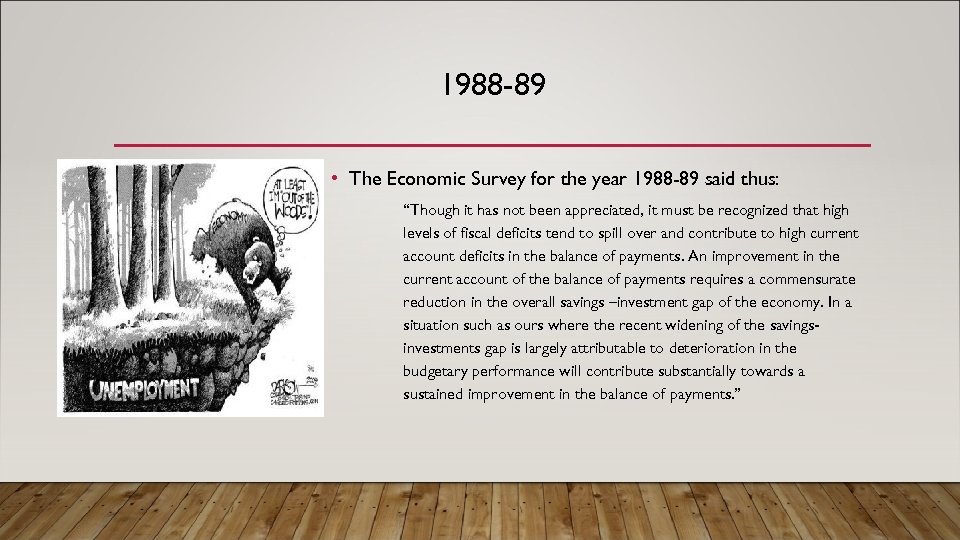 1988 -89 • The Economic Survey for the year 1988 -89 said thus: “Though it has not been appreciated, it must be recognized that high levels of fiscal deficits tend to spill over and contribute to high current account deficits in the balance of payments. An improvement in the current account of the balance of payments requires a commensurate reduction in the overall savings –investment gap of the economy. In a situation such as ours where the recent widening of the savingsinvestments gap is largely attributable to deterioration in the budgetary performance will contribute substantially towards a sustained improvement in the balance of payments. ”
 1989 -90 • The Economic Survey for the year 1989 -90 said thus: • “India’s balance of payments situation has remained under considerable pressure during 1989 -90 despite a buoyant trend in exports and a slow-down in the growth of imports. Deterioration in our balance of payments position during the 7 th Plan period is due to several unfavorable factors such as deceleration in the growth of domestic oil production bunching of repayment obligations to the IMF and other sources, limited availability of concessional assistance and a rise in debt service payments on external debt. The continuing strain on our balance of payments is reflected in steep depletion of foreign exchange reserves which stood at Rs. 5531 crores at the end of January 1990. ”
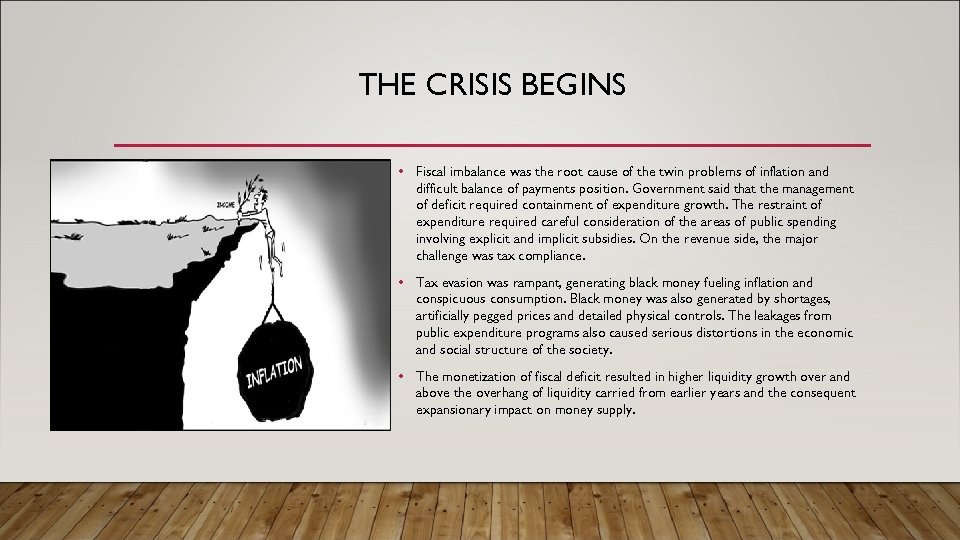 THE CRISIS BEGINS • Fiscal imbalance was the root cause of the twin problems of inflation and difficult balance of payments position. Government said that the management of deficit required containment of expenditure growth. The restraint of expenditure required careful consideration of the areas of public spending involving explicit and implicit subsidies. On the revenue side, the major challenge was tax compliance. • Tax evasion was rampant, generating black money fueling inflation and conspicuous consumption. Black money was also generated by shortages, artificially pegged prices and detailed physical controls. The leakages from public expenditure programs also caused serious distortions in the economic and social structure of the society. • The monetization of fiscal deficit resulted in higher liquidity growth over and above the overhang of liquidity carried from earlier years and the consequent expansionary impact on money supply.
 1991 -92 • The Economic Survey for the year 1991 -92 said thus: “The first signs of the current payments crisis became evident in the second half of 1990 -91 when the Gulf war led to a sharp increase in oil prices. Foreign exchange reserves began to decline from September 1990. They declined to a level of Rs. 5480 crores (US $ 3. 11 billion) at the end of August 1990 to Rs. 1666 crores (US $ 896 million) on 16 th January 1991. During the period the Government took recourse to the IMF by drawing Rs. 1177 crores (US $ 60 million) from the reserve tranche during July-September 1990. Again in January 1991, the Government made a drawing of Rs. 1884 crores (US $ 1. 025 billion) under the compensatory and contingency financing facility (CCFF) and a drawing of Rs. 1450 crores (US $ 789 million) under a first credit tranche arrangement (FCT). The purchases from the International Monetary Fund in January 1991 amounted to Rs. 3334 crores (US $ 1. 814 billion). Nevertheless the decline in reserves continued unabated. ”
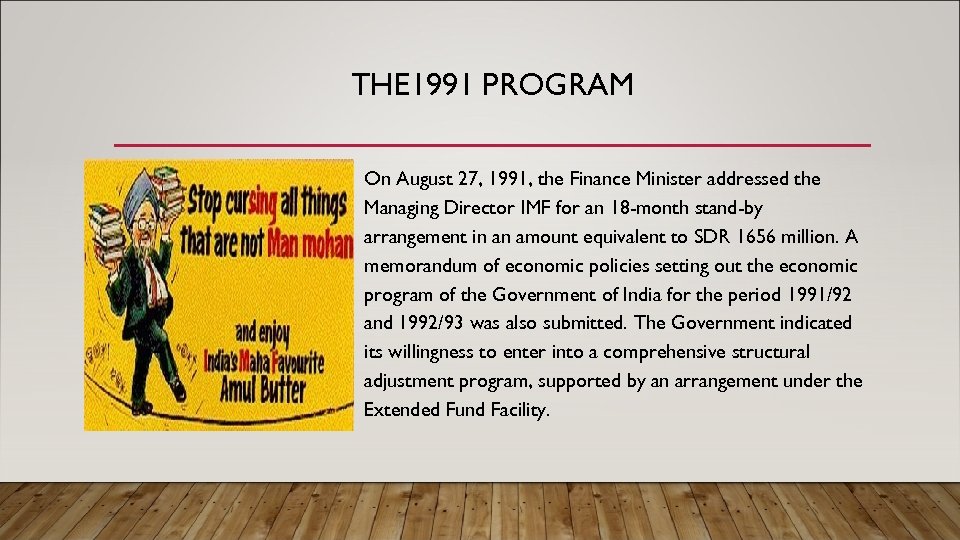 THE 1991 PROGRAM • On August 27, 1991, the Finance Minister addressed the Managing Director IMF for an 18 -month stand-by arrangement in an amount equivalent to SDR 1656 million. A memorandum of economic policies setting out the economic program of the Government of India for the period 1991/92 and 1992/93 was also submitted. The Government indicated its willingness to enter into a comprehensive structural adjustment program, supported by an arrangement under the Extended Fund Facility.
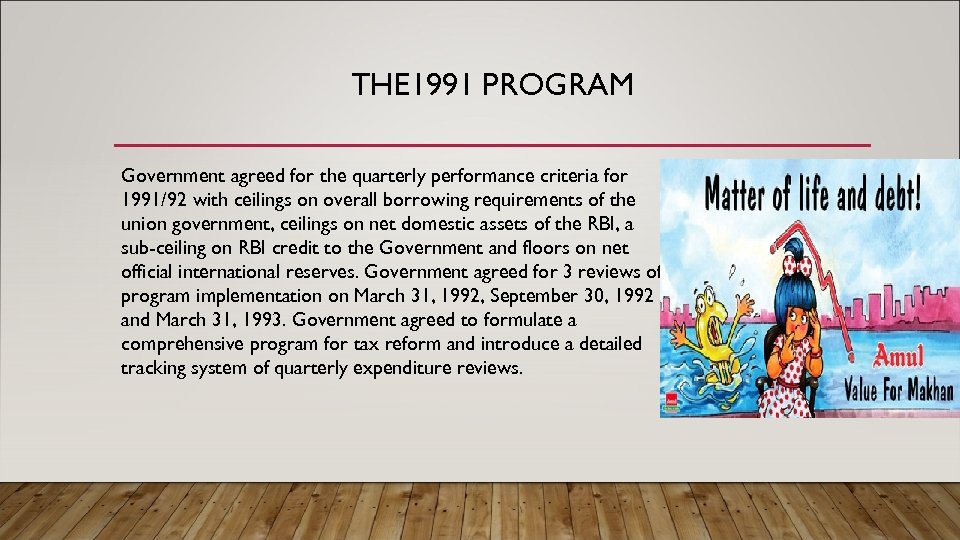 THE 1991 PROGRAM Government agreed for the quarterly performance criteria for 1991/92 with ceilings on overall borrowing requirements of the union government, ceilings on net domestic assets of the RBI, a sub-ceiling on RBI credit to the Government and floors on net official international reserves. Government agreed for 3 reviews of program implementation on March 31, 1992, September 30, 1992 and March 31, 1993. Government agreed to formulate a comprehensive program for tax reform and introduce a detailed tracking system of quarterly expenditure reviews.
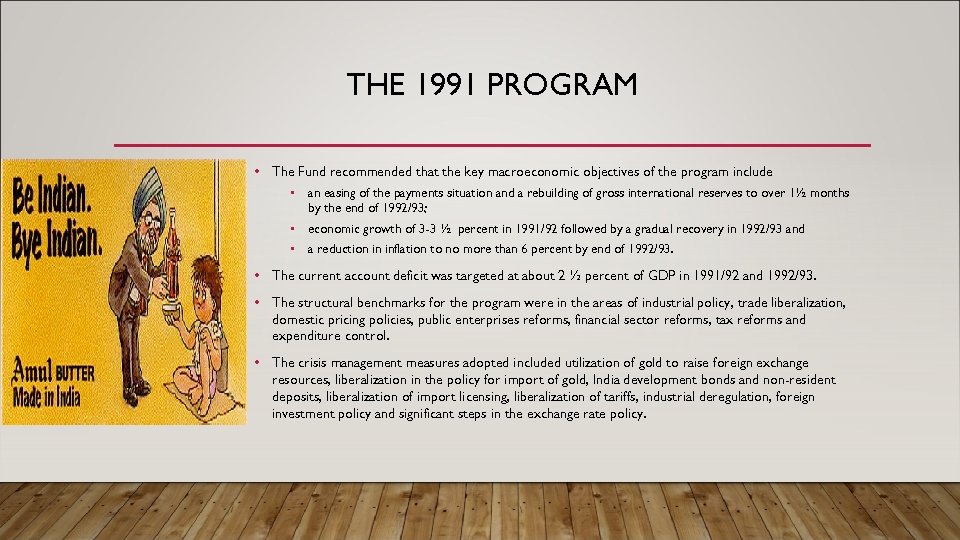 THE 1991 PROGRAM • The Fund recommended that the key macroeconomic objectives of the program include • an easing of the payments situation and a rebuilding of gross international reserves to over 1½ months by the end of 1992/93; • economic growth of 3 -3 ½ percent in 1991/92 followed by a gradual recovery in 1992/93 and • a reduction in inflation to no more than 6 percent by end of 1992/93. • The current account deficit was targeted at about 2 ½ percent of GDP in 1991/92 and 1992/93. • The structural benchmarks for the program were in the areas of industrial policy, trade liberalization, domestic pricing policies, public enterprises reforms, financial sector reforms, tax reforms and expenditure control. • The crisis management measures adopted included utilization of gold to raise foreign exchange resources, liberalization in the policy for import of gold, India development bonds and non-resident deposits, liberalization of import licensing, liberalization of tariffs, industrial deregulation, foreign investment policy and significant steps in the exchange rate policy.
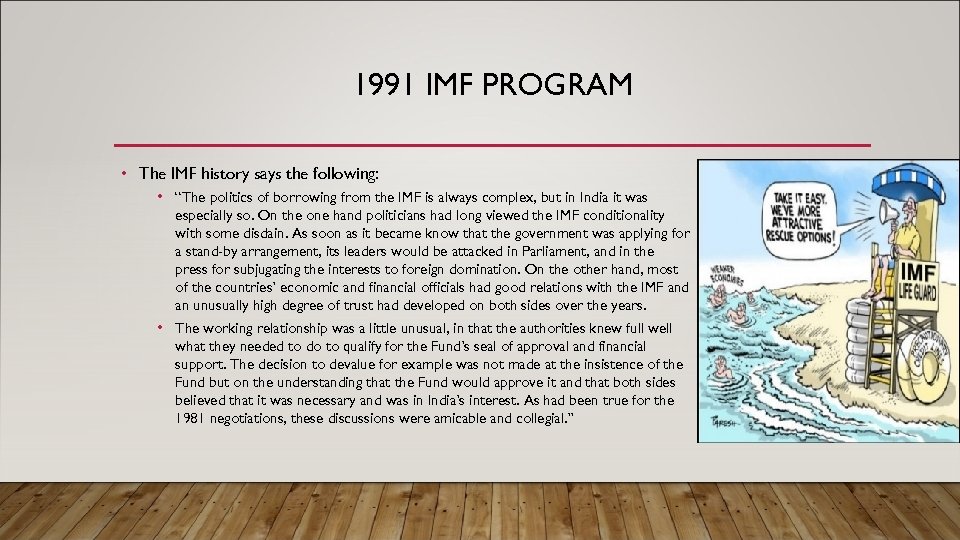 1991 IMF PROGRAM • The IMF history says the following: • “The politics of borrowing from the IMF is always complex, but in India it was especially so. On the one hand politicians had long viewed the IMF conditionality with some disdain. As soon as it became know that the government was applying for a stand-by arrangement, its leaders would be attacked in Parliament, and in the press for subjugating the interests to foreign domination. On the other hand, most of the countries’ economic and financial officials had good relations with the IMF and an unusually high degree of trust had developed on both sides over the years. • The working relationship was a little unusual, in that the authorities knew full well what they needed to do to qualify for the Fund’s seal of approval and financial support. The decision to devalue for example was not made at the insistence of the Fund but on the understanding that the Fund would approve it and that both sides believed that it was necessary and was in India’s interest. As had been true for the 1981 negotiations, these discussions were amicable and collegial. ”
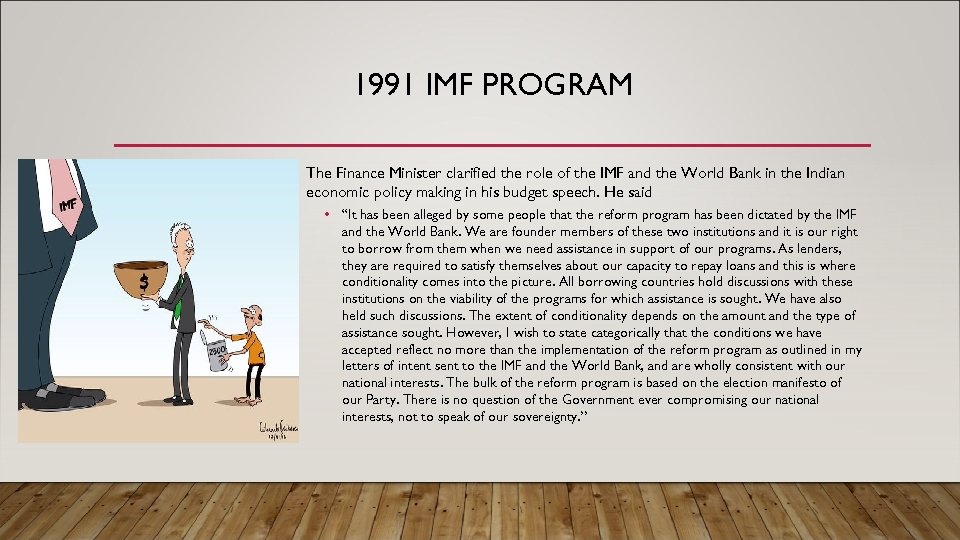 1991 IMF PROGRAM • The Finance Minister clarified the role of the IMF and the World Bank in the Indian economic policy making in his budget speech. He said • “It has been alleged by some people that the reform program has been dictated by the IMF and the World Bank. We are founder members of these two institutions and it is our right to borrow from them when we need assistance in support of our programs. As lenders, they are required to satisfy themselves about our capacity to repay loans and this is where conditionality comes into the picture. All borrowing countries hold discussions with these institutions on the viability of the programs for which assistance is sought. We have also held such discussions. The extent of conditionality depends on the amount and the type of assistance sought. However, I wish to state categorically that the conditions we have accepted reflect no more than the implementation of the reform program as outlined in my letters of intent sent to the IMF and the World Bank, and are wholly consistent with our national interests. The bulk of the reform program is based on the election manifesto of our Party. There is no question of the Government ever compromising our national interests, not to speak of our sovereignty. ”
 THE GROWTH YEARS 2004 -2009 • Indian economy witnessed average growth rate of 8. 5 percent for 5 years 2004 -08 • Export growth was robust at 20 percent and capital flows financed current account deficit • India became a creditor country in the IMF Financial Transactions Plan • The Fund became irrelevant in the 2000 s with several countries building reserves. Private capital flows became larger • India purchased US $ 10 billion of IMF notes to enhance Fund’s lending capacity • The Fund reinvented itself with greater focus on Technical Assistance and Low Income Countries
 2008 GLOBAL FINANCIAL CRISIS • By 2009, India had arrived on the international economic scene. The Indian economy had grown at 8. 6 percent for 5 years, and it was opined that if the rate of growth kept up, India would be transformed like China with US $ 1 trillion economy doubling 8 ½ years. It was projected that poverty would be reduced at an unimaginable speed and the 11 th Five Year Plan had projected an annual growth rate of 9 percent rising to 10 percent by 2011. • Indian policy makers had reckoned that India may not be severely affected from the 2008 Global Financial Crisis largely because of public ownership of banks, strict prudential rules laid down by RBI and limits on external commercial borrowings. That said, Indian stock markets witnessed a 60 percent loss in values, foreign portfolio investment slowed down and rupee lost 20 percent value against the dollar reaching Rs. 50/ dollar, with the global financial freeze accelerating the currency depreciation. Government borrowing rose sharply and abruptly in the crisis years of 2008 -09 and 2009 -10. • The Reserve Bank of India managed the borrowing program by maintaining easy liquidity conditions. The growth forecast was revised from 9 percent to 7. 1 percent and even that proved optimistic, although India remained the second fastest growing economy in the world after China.
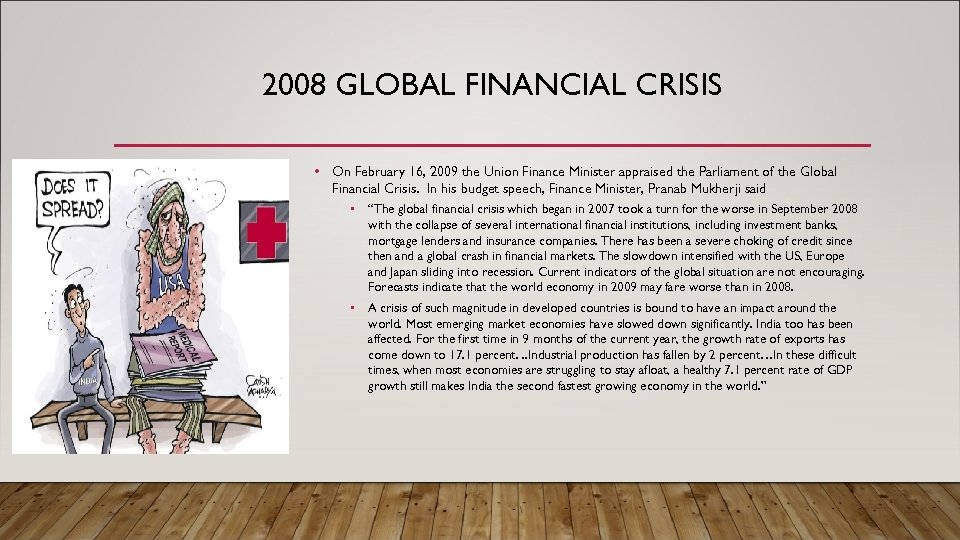 2008 GLOBAL FINANCIAL CRISIS • On February 16, 2009 the Union Finance Minister appraised the Parliament of the Global Financial Crisis. In his budget speech, Finance Minister, Pranab Mukherji said • “The global financial crisis which began in 2007 took a turn for the worse in September 2008 with the collapse of several international financial institutions, including investment banks, mortgage lenders and insurance companies. There has been a severe choking of credit since then and a global crash in financial markets. The slowdown intensified with the US, Europe and Japan sliding into recession. Current indicators of the global situation are not encouraging. Forecasts indicate that the world economy in 2009 may fare worse than in 2008. • A crisis of such magnitude in developed countries is bound to have an impact around the world. Most emerging market economies have slowed down significantly. India too has been affected. For the first time in 9 months of the current year, the growth rate of exports has come down to 17. 1 percent. . . Industrial production has fallen by 2 percent…In these difficult times, when most economies are struggling to stay afloat, a healthy 7. 1 percent rate of GDP growth still makes India the second fastest growing economy in the world. ”
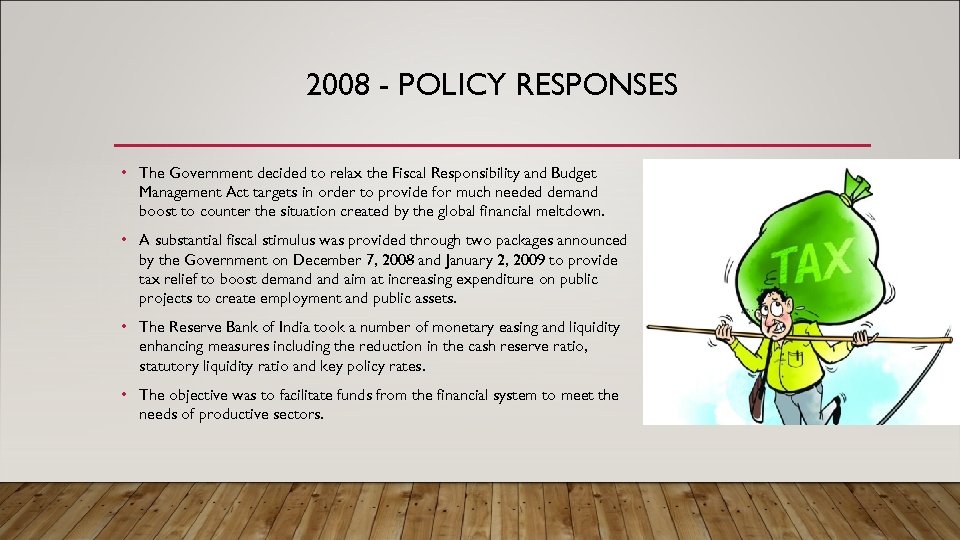 2008 - POLICY RESPONSES • The Government decided to relax the Fiscal Responsibility and Budget Management Act targets in order to provide for much needed demand boost to counter the situation created by the global financial meltdown. • A substantial fiscal stimulus was provided through two packages announced by the Government on December 7, 2008 and January 2, 2009 to provide tax relief to boost demand aim at increasing expenditure on public projects to create employment and public assets. • The Reserve Bank of India took a number of monetary easing and liquidity enhancing measures including the reduction in the cash reserve ratio, statutory liquidity ratio and key policy rates. • The objective was to facilitate funds from the financial system to meet the needs of productive sectors.
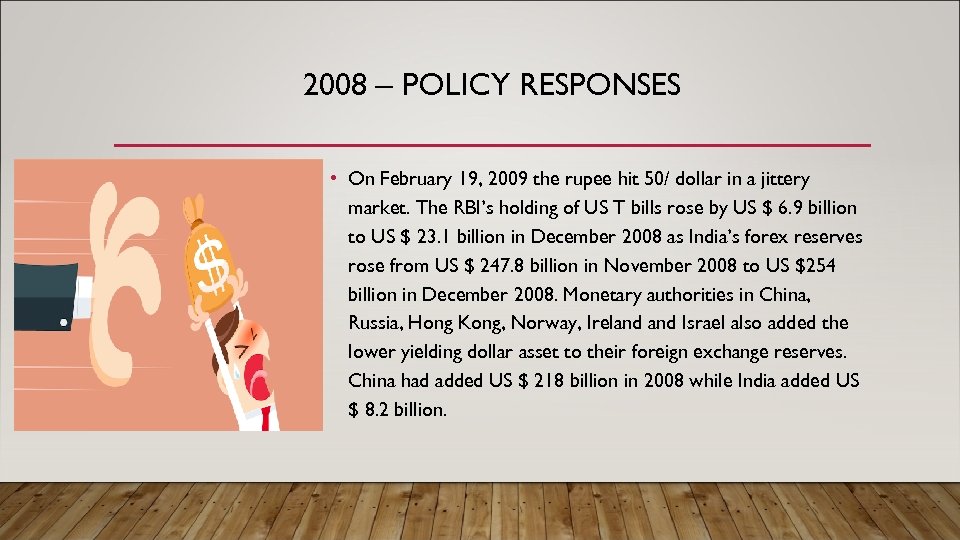 2008 – POLICY RESPONSES • On February 19, 2009 the rupee hit 50/ dollar in a jittery market. The RBI’s holding of US T bills rose by US $ 6. 9 billion to US $ 23. 1 billion in December 2008 as India’s forex reserves rose from US $ 247. 8 billion in November 2008 to US $254 billion in December 2008. Monetary authorities in China, Russia, Hong Kong, Norway, Ireland Israel also added the lower yielding dollar asset to their foreign exchange reserves. China had added US $ 218 billion in 2008 while India added US $ 8. 2 billion.
 2009 – THE CRISIS CONTINUES • The Economic Times said • “On Wednesday, the rupee briefly breached the 50 -mark against the dollar to end Rs. 49. 97, with the market beginning to price in political risk, fiscal slippages and decline in interest of foreign fund houses in emerging market assets. What’s pushing up the dollar in the international market is the pervasive interest even among central banks, in US Treasury bills. Despite the US slowdown and abysmal return in US T bills, funds, banks and sovereigns are buying these bonds, which are still perceived as safe haven. • In the face of these forces, the domestic currency market largely ignored RBI Governor D. Subbarao’s sentiment that lower inflation and current account deficit in coming months could create the possibility of a rate cut. Some state owned banks sold dollars to prevent the rupee from dropping further, but this did not help. ” The Economic Times. , Rupee hits 50 in jittery market. , dated February 19, 2009
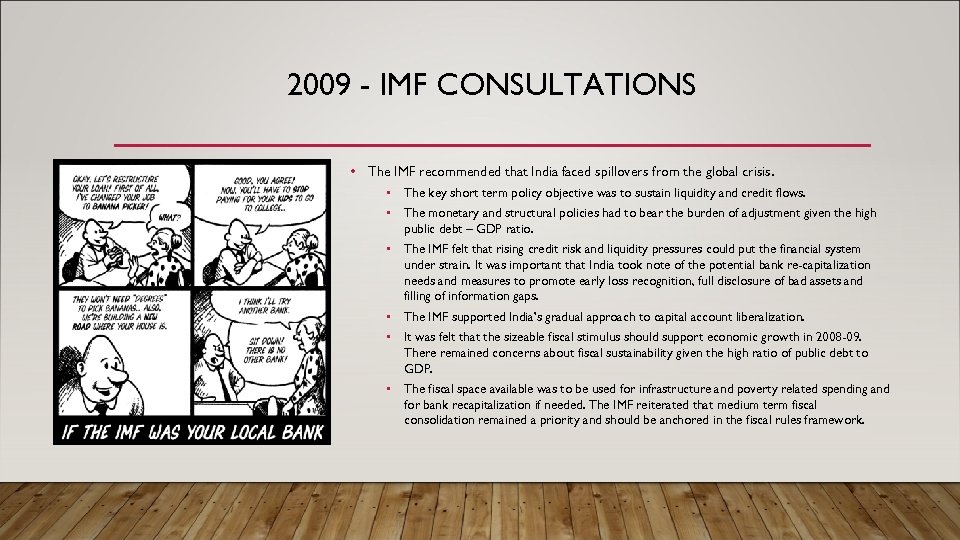 2009 - IMF CONSULTATIONS • The IMF recommended that India faced spillovers from the global crisis. • The key short term policy objective was to sustain liquidity and credit flows. • The monetary and structural policies had to bear the burden of adjustment given the high public debt – GDP ratio. • The IMF felt that rising credit risk and liquidity pressures could put the financial system under strain. It was important that India took note of the potential bank re-capitalization needs and measures to promote early loss recognition, full disclosure of bad assets and filling of information gaps. • The IMF supported India’s gradual approach to capital account liberalization. • It was felt that the sizeable fiscal stimulus should support economic growth in 2008 -09. There remained concerns about fiscal sustainability given the high ratio of public debt to GDP. • The fiscal space available was to be used for infrastructure and poverty related spending and for bank recapitalization if needed. The IMF reiterated that medium term fiscal consolidation remained a priority and should be anchored in the fiscal rules framework.
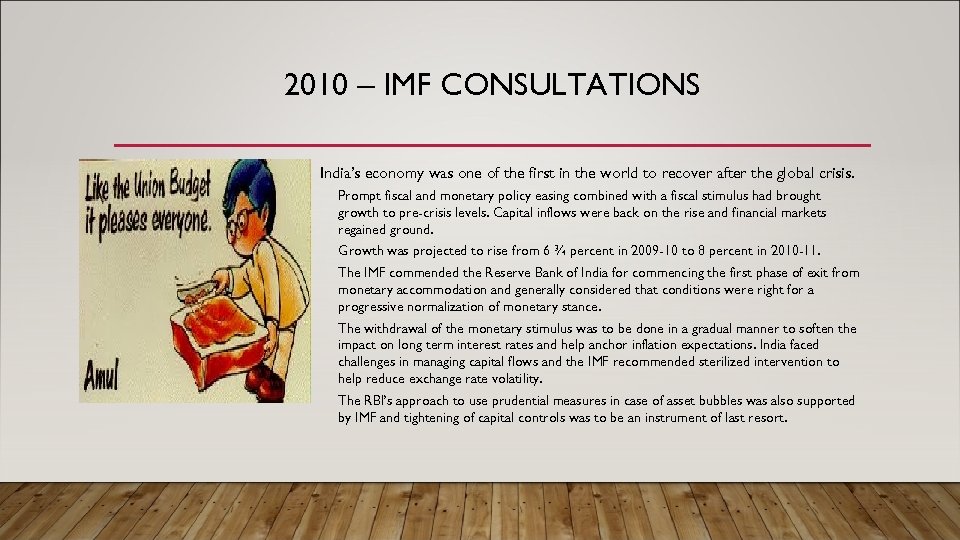 2010 – IMF CONSULTATIONS • India’s economy was one of the first in the world to recover after the global crisis. Prompt fiscal and monetary policy easing combined with a fiscal stimulus had brought growth to pre-crisis levels. Capital inflows were back on the rise and financial markets regained ground. Growth was projected to rise from 6 ¾ percent in 2009 -10 to 8 percent in 2010 -11. The IMF commended the Reserve Bank of India for commencing the first phase of exit from monetary accommodation and generally considered that conditions were right for a progressive normalization of monetary stance. The withdrawal of the monetary stimulus was to be done in a gradual manner to soften the impact on long term interest rates and help anchor inflation expectations. India faced challenges in managing capital flows and the IMF recommended sterilized intervention to help reduce exchange rate volatility. The RBI’s approach to use prudential measures in case of asset bubbles was also supported by IMF and tightening of capital controls was to be an instrument of last resort.
 IMF REFORMS • December 2015 – the US Congress approved the IMF 2010 Quota and Governance Reforms • A more representative and modern IMF to meet 21 st century needs • 6 percent quota shares were shifted to dynamic emerging market countries • 2 nd Alternate Executive Director for Multi Member Constituencies • China got a 4 th Deputy Managing Director • Revised Quota – China 6. 14 India – 2. 66
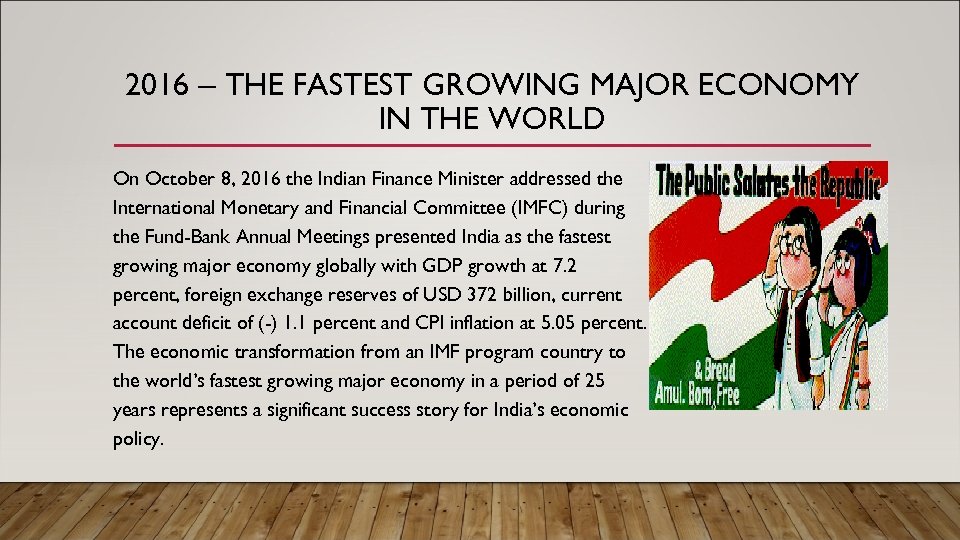 2016 – THE FASTEST GROWING MAJOR ECONOMY IN THE WORLD On October 8, 2016 the Indian Finance Minister addressed the International Monetary and Financial Committee (IMFC) during the Fund-Bank Annual Meetings presented India as the fastest growing major economy globally with GDP growth at 7. 2 percent, foreign exchange reserves of USD 372 billion, current account deficit of (-) 1. 1 percent and CPI inflation at 5. 05 percent. The economic transformation from an IMF program country to the world’s fastest growing major economy in a period of 25 years represents a significant success story for India’s economic policy.
 CONCLUSION • The IMF remains very relevant to India. • An Institution of high credibility whose voice is heard and heeded across the world • As India’s financial systems are integrating with global economy, India’s prospects depend on global growth and global welfare more than ever before.
 THANK YOU