


 Скачать презентацию Indexes Rose-Hulman Institute of Technology Curt Clifton
fe0fe65c0c1b630c7b754820621e639c.ppt
- Количество слайдов: 26
 Indexes Rose-Hulman Institute of Technology Curt Clifton
 Overview o o o Introduction to Indexes Index Architecture How SQL Server Retrieves Stored Data How SQL Server Maintains Index and Heap Structures Deciding Which Columns to Index
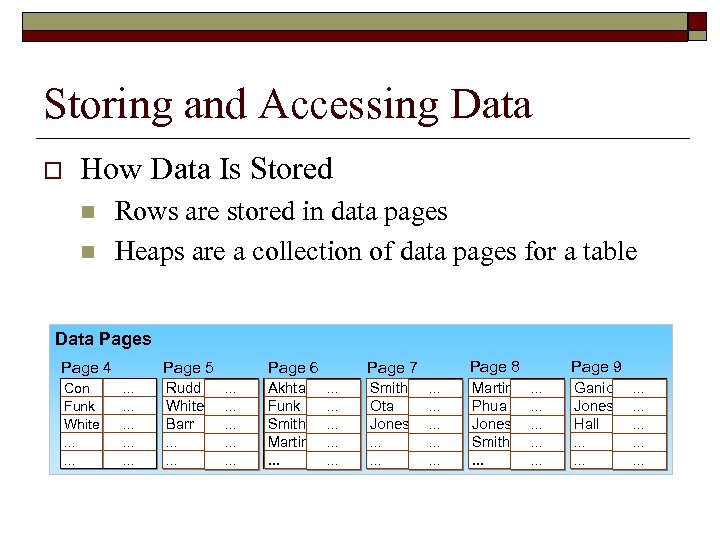 Storing and Accessing Data o How Data Is Stored n n Rows are stored in data pages Heaps are a collection of data pages for a table Data Pages Page 4 Con Funk White. . . Page 5. . . . Rudd White Barr. . . Page 6. . . . Akhtar Funk Smith Martin. . . Page 8 Page 7. . . . Smith Ota Jones. . . . . Martin Phua Jones Smith. . . Page 9. . . . Ganio Jones Hall. . . . .
 Whether to Create Indexes o Why to Create an Index n n o Speeds up data access Enforces uniqueness of rows Why Not to Create an Index n n Consumes disk space Incurs overhead
 Using Heaps o o SQL Server: Uses Index Allocation Map Pages That: n n n o Contain information on where the extents of a heap are stored Navigate through the heap and find available space for new rows being inserted Connect data pages Reclaims Space for New Rows in the Heap When a Row Is Deleted
 Using Clustered Indexes o o o Each Table Can Have Only One Clustered Index The Physical Row Order of the Table and the Order of Rows in the Index Are the Same Key Value Uniqueness Is Maintained Explicitly or Implicitly
 Using Nonclustered Indexes o o Nonclustered Indexes Are the SQL Server Default Existing Nonclustered Indexes Are Automatically Rebuilt When: n n n An existing clustered index is dropped A new clustered index is created The DROP_EXISTING option is used to change which columns define the clustered index
 Maintaining Index and Heap Structures
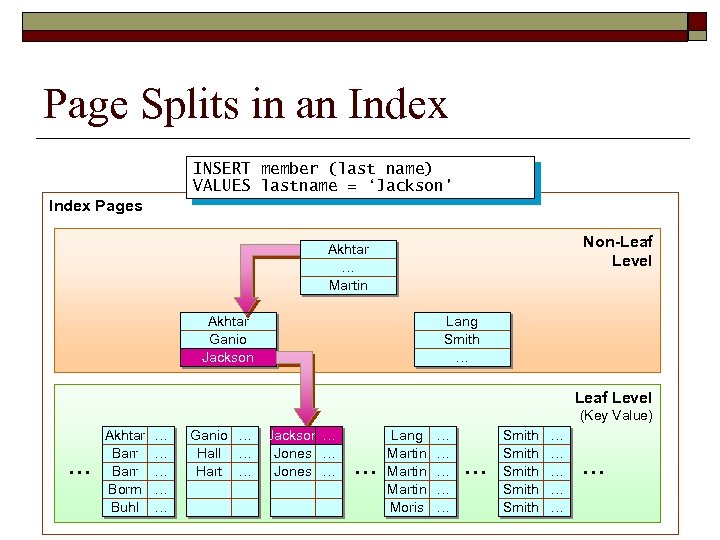 Page Splits in an Index INSERT member (last name) VALUES lastname = ‘Jackson' Index Pages Non-Leaf Level Akhtar … Martin Akhtar Ganio Jackson … Lang Smith … Leaf Level (Key Value) … Akhtar Barr Borm Buhl … … … Ganio Akhtar Hall Barr Hart Barr Borm Buhl … Jackson … … Ganio … … … Jones … Hall … … … Jones … Hart … … Jones … … … Lang Martin Moris … … … Smith Smith … … …
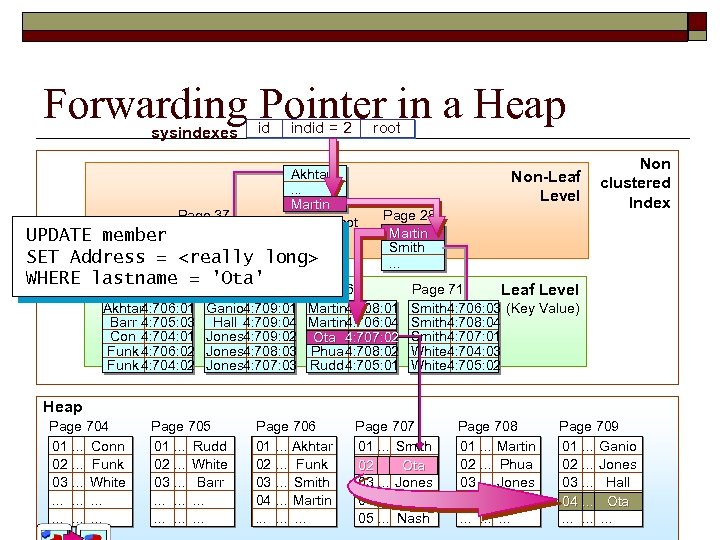 Forwarding Pointer in a Heap sysindexes Page 37 Akhtar Ganio
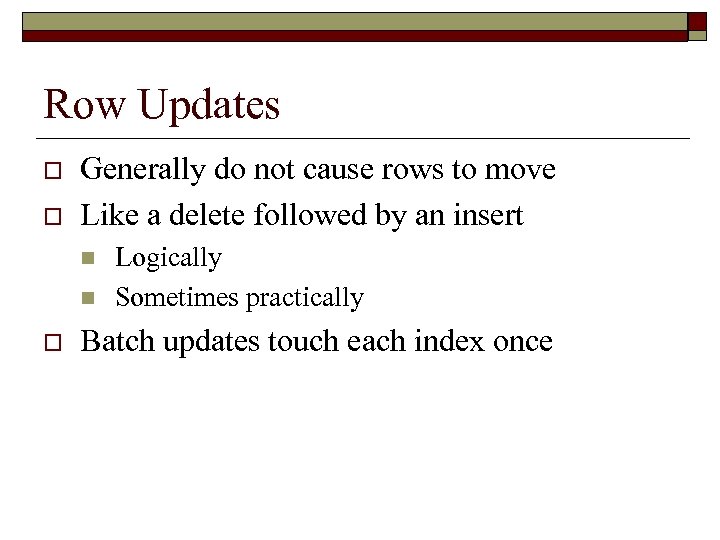 Row Updates o o Generally do not cause rows to move Like a delete followed by an insert n n o Logically Sometimes practically Batch updates touch each index once
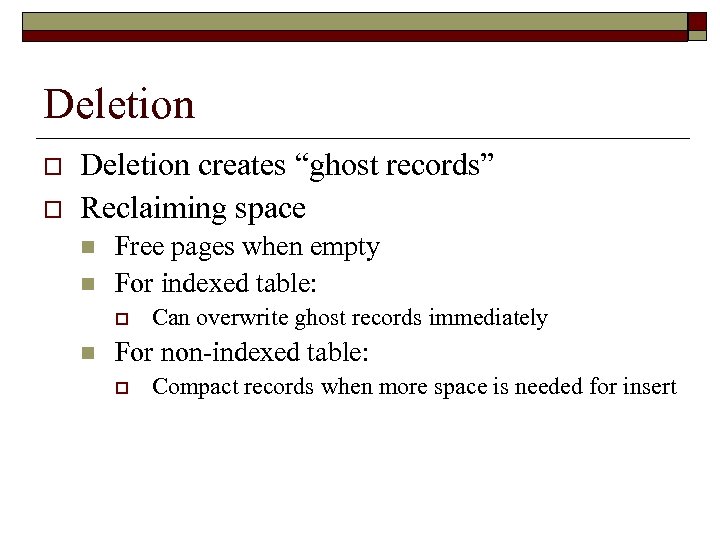 Deletion o o Deletion creates “ghost records” Reclaiming space n n Free pages when empty For indexed table: o n Can overwrite ghost records immediately For non-indexed table: o Compact records when more space is needed for insert
 Deciding What to Index
 What You Need to Know o o o Logical and Physical Database Design Data Characteristics How Data Is Used n n The types of queries performed The frequency of queries that are typically performed
 Indexing Guidelines o Columns to Index n n o Primary and foreign keys Those frequently searched in ranges Those frequently accessed in sorted order Those frequently grouped together during aggregation Columns Not to Index n n n Those seldom referenced in queries Those that contain few unique values Those defined with text, ntext, or image data types
 Choosing the Clustered Index o Heavily Updated Tables n o Sorting n o A clustered index with an identity column keeps updated pages in memory A clustered index keeps the data pre-sorted Column Length and Data Type n n n Limit the number of columns Reduce the number of characters Use the smallest data type possible
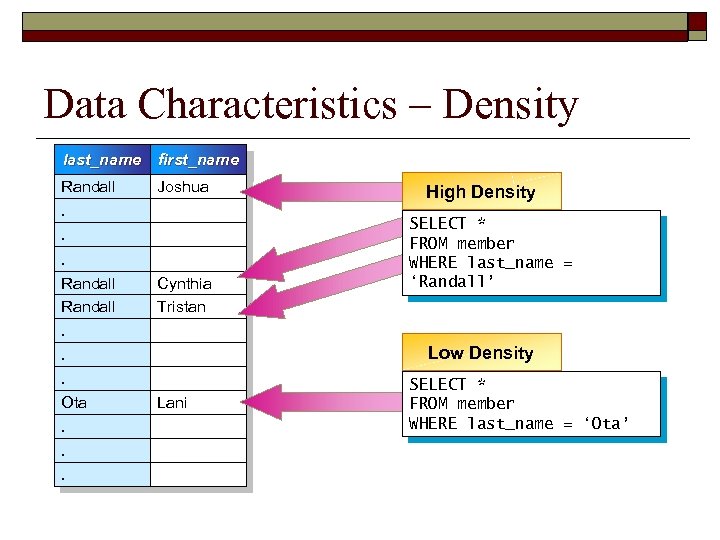 Data Characteristics – Density last_name first_name Randall Joshua . . . Randall. . . Ota. . . Cynthia Tristan High Density SELECT * FROM member WHERE last_name = ‘Randall’ Low Density Lani SELECT * FROM member WHERE last_name = ‘Ota’
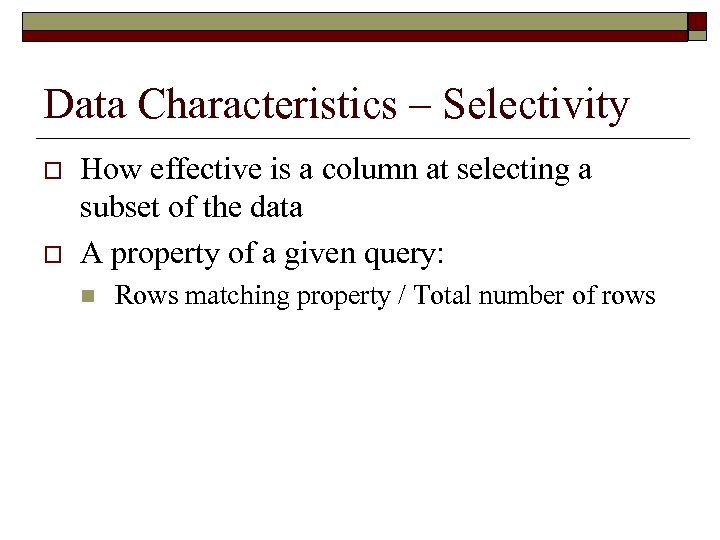 Data Characteristics – Selectivity o o How effective is a column at selecting a subset of the data A property of a given query: n Rows matching property / Total number of rows
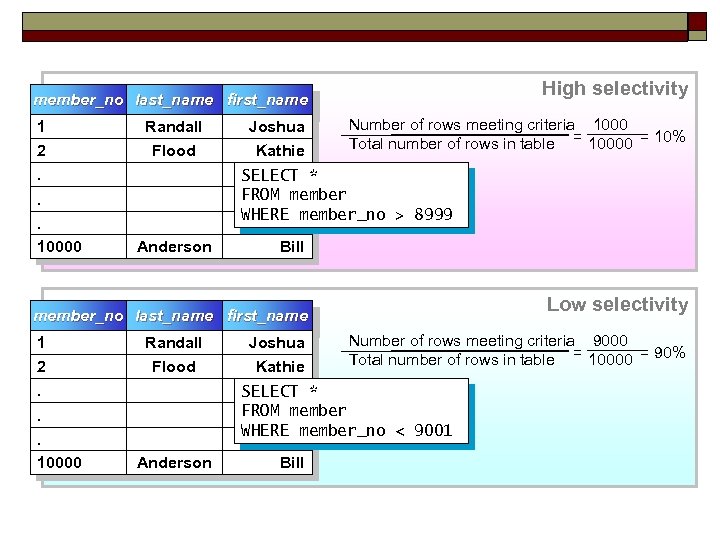 Determining Selectivity member_no last_name first_name 1 Randall Joshua 2. Flood Kathie Number of rows meeting criteria 1000 Total number of rows in table = 10000 = 10% SELECT * FROM member WHERE member_no > 8999 . . 10000 Anderson Bill Low selectivity member_no last_name first_name 1 2. Randall Flood Joshua Kathie Number of rows meeting criteria 9000 Total number of rows in table = 10000 = 90% SELECT * FROM member WHERE member_no < 9001 . . 10000 High selectivity Anderson Bill
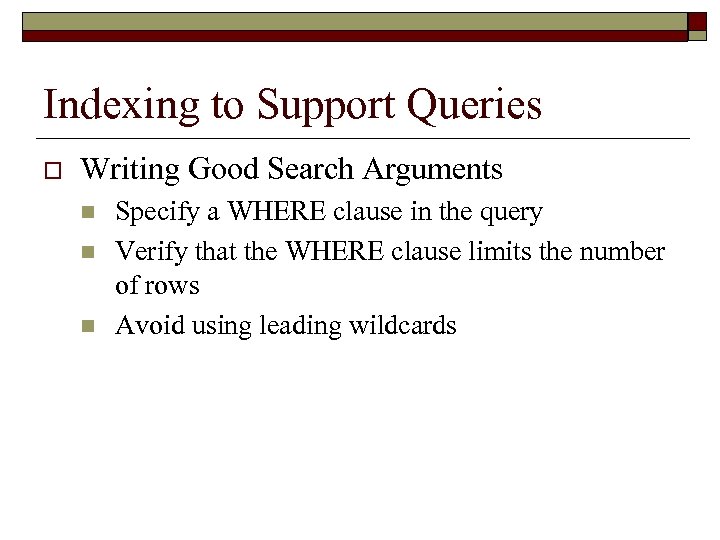 Indexing to Support Queries o Writing Good Search Arguments n n n Specify a WHERE clause in the query Verify that the WHERE clause limits the number of rows Avoid using leading wildcards
 Introduction to Statistics
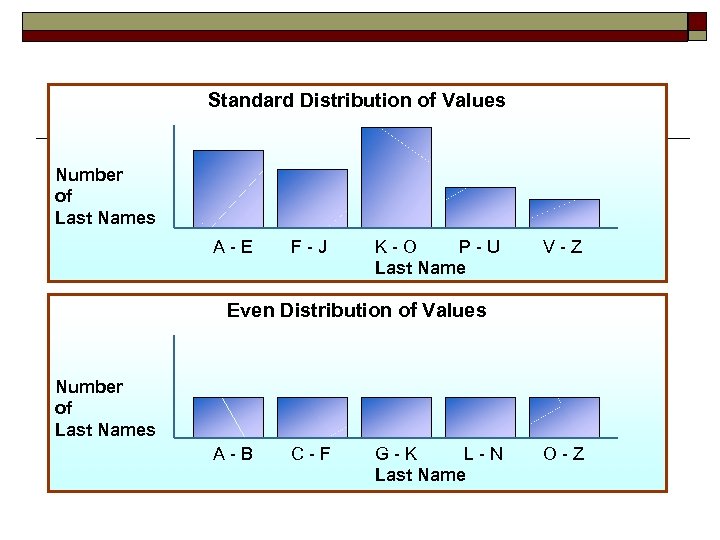 Standard Distribution of Values Number of Last Names A-E F-J K-O P-U Last Name V-Z Even Distribution of Values Number of Last Names A-B C-F G-K L-N Last Name O-Z
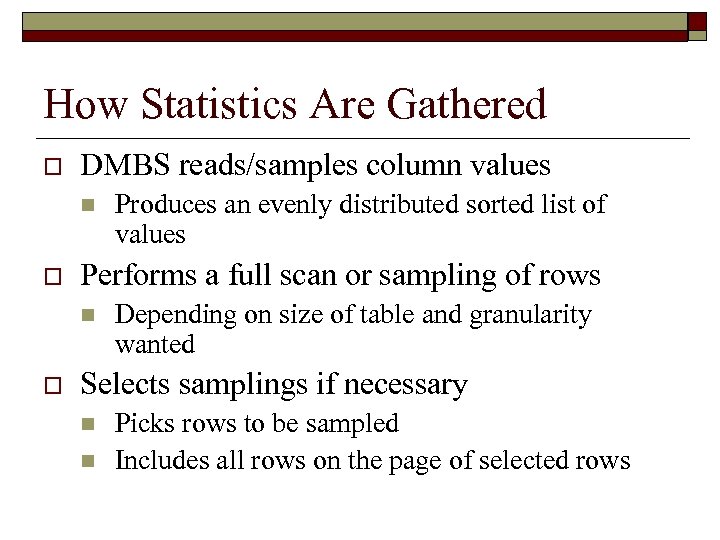 How Statistics Are Gathered o DMBS reads/samples column values n o Performs a full scan or sampling of rows n o Produces an evenly distributed sorted list of values Depending on size of table and granularity wanted Selects samplings if necessary n n Picks rows to be sampled Includes all rows on the page of selected rows
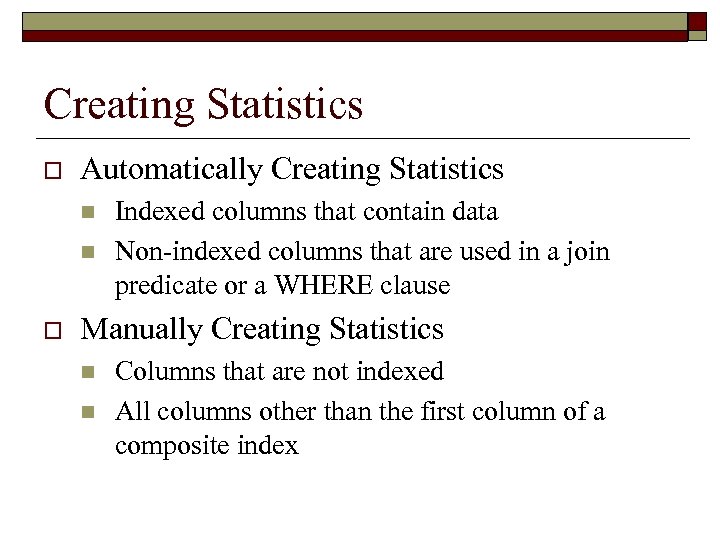 Creating Statistics o Automatically Creating Statistics n n o Indexed columns that contain data Non-indexed columns that are used in a join predicate or a WHERE clause Manually Creating Statistics n n Columns that are not indexed All columns other than the first column of a composite index
 Viewing Statistics o o The DBCC SHOW_STATISTICS Statement Returns Statistical Information in the Distribution Page for an Index or Column Statistical Information Includes: n n n The time when the statistics were last updated The number of rows sampled to produce the histogram Density information Average key length Histogram step information
 Performance Considerations o o Create Indexes on Foreign Keys Create the Clustered Index Before Nonclustered Indexes Consider Creating Composite Indexes Create Multiple Indexes for a Table That Is Read Frequently