 Скачать презентацию INDEPENDENT PROJECT ANALYSIS INCORPORATED Presented by Dean Findley
2fde44c09e4fe6311add4a39854778ee.ppt
- Количество слайдов: 49




INDEPENDENT PROJECT ANALYSIS, INCORPORATED Presented by: Dean Findley THE AMERICAS u THE NETHERLANDS u AUSTRALIA u CHINA 1
Why Labor Productivity? • This is the second report back on a three year IBC study of construction labor productivity • Why worry about productivity: – About one-quarter of all construction cost is field labor – Labor is usually the largest non-material cost in a project – Very little is really understood about how to best measure field productivity or how to influence it – In developed economies of Europe and North America construction labor shortages will become more and more common as the population ages – In low wage countries, poor labor productivity is the primary obstacle to low cost manufacturing facilities Labor Productivity Phase II 2 INDEPENDENT PROJECT ANALYSIS
Goals of This Research • Phase I Goals – Develop and validate a reliable approach to measuring labor cost and productivity – Understand the relationships between labor productivity and the project practices that IPA has traditionally gathered (FEL, etc. ) • Phase II Goals – Explore the relationship between engineering and construction execution practices and labor productivity in high wage countries • Phase III Goals – Explore the relationship between engineering and construction execution practices and labor productivity in low wage countries Labor Productivity Phase II 3 INDEPENDENT PROJECT ANALYSIS
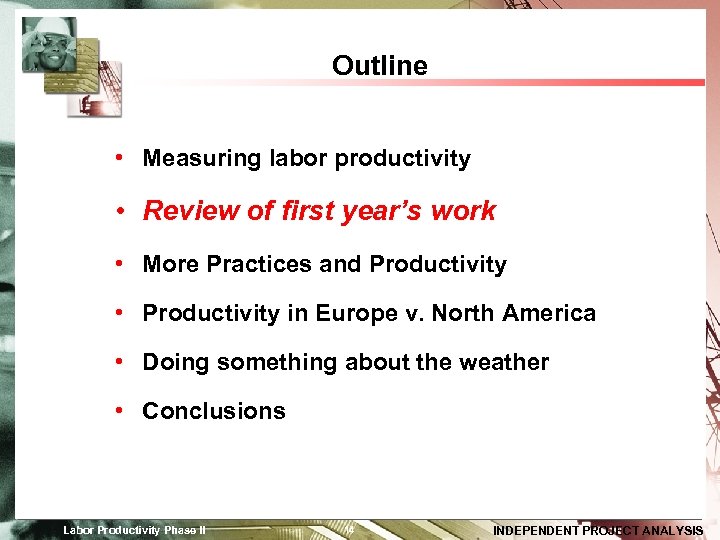
Outline • Measuring labor productivity • Review of first year’s work • More Practices and Productivity • Productivity in Europe v. North America • Doing something about the weather • Conclusions Labor Productivity Phase II 4 INDEPENDENT PROJECT ANALYSIS
Labor Productivity Database • 1185 projects in the United States and Europe • 103 companies represented - Labor Productivity Phase II 5 INDEPENDENT PROJECT ANALYSIS
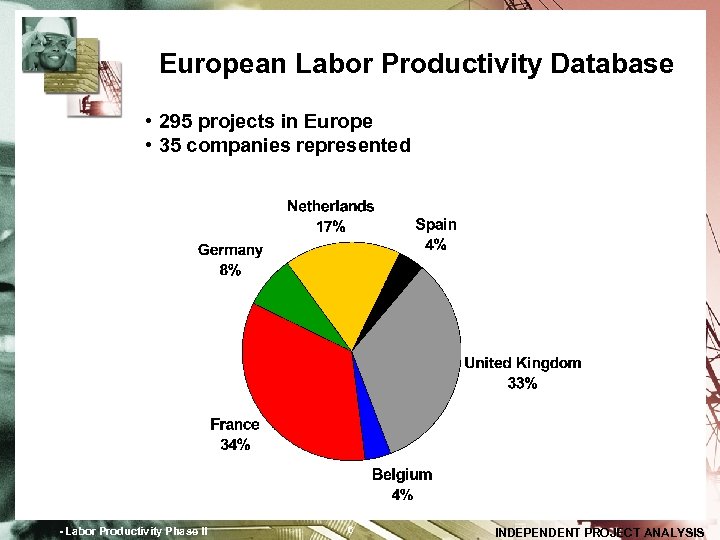
European Labor Productivity Database • 295 projects in Europe • 35 companies represented - Labor Productivity Phase II 6 INDEPENDENT PROJECT ANALYSIS
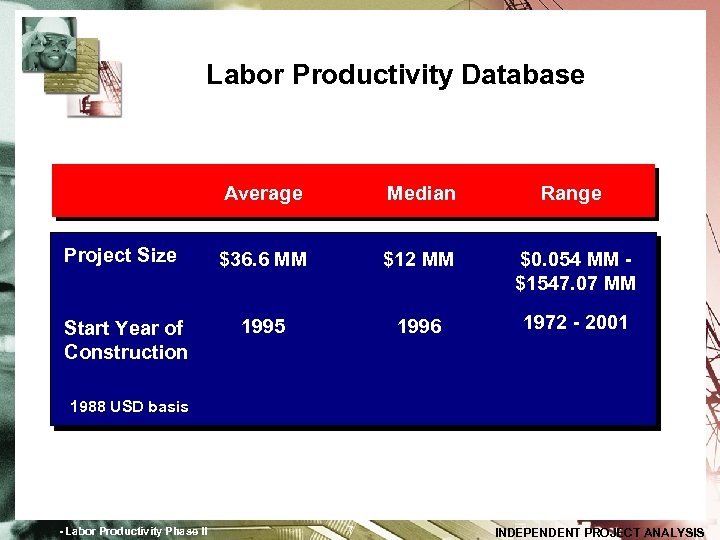
Labor Productivity Database Average Median Range Project Size $36. 6 MM $12 MM $0. 054 MM $1547. 07 MM Start Year of Construction 1995 1996 1972 - 2001 1988 USD basis - Labor Productivity Phase II 7 INDEPENDENT PROJECT ANALYSIS
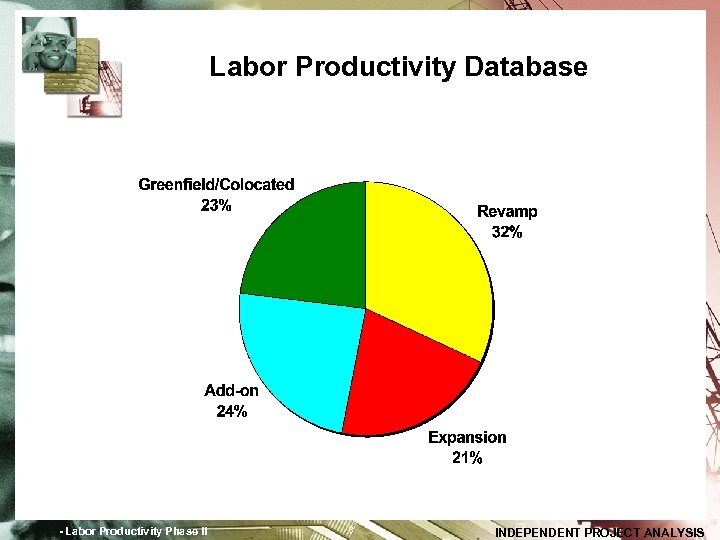
Labor Productivity Database - Labor Productivity Phase II 8 INDEPENDENT PROJECT ANALYSIS
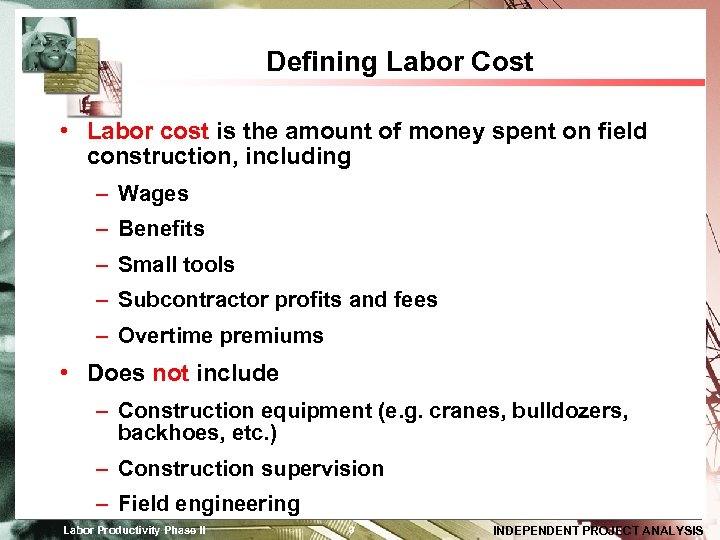
Defining Labor Cost • Labor cost is the amount of money spent on field construction, including – Wages – Benefits – Small tools – Subcontractor profits and fees – Overtime premiums • Does not include – Construction equipment (e. g. cranes, bulldozers, backhoes, etc. ) – Construction supervision – Field engineering Labor Productivity Phase II 9 INDEPENDENT PROJECT ANALYSIS
Methodology (1) • Projects were again grouped according to process type and project type to minimize scope variations • A base location was created in Europe • Database was increased from 570 to 1100 • Both large and small projects were added • Labor cost breakouts were available for all projects Labor Productivity Phase II 10 INDEPENDENT PROJECT ANALYSIS
Methodology (2) • Each group provides a good like-for-like field work to be performed • Modular projects were excluded to minimize error • Each group has good dispersal of projects geographically • Each group has a good sample of projects in Greater Houston to provide a US Gulf Coast anchor • As the methodology develops, other “anchors” will be developed and become interchangeable – Rotterdam has been added this year – Singapore and São Paulo will be added next year Labor Productivity Phase II 11 INDEPENDENT PROJECT ANALYSIS
Methodology (3) • Effective Labor Cost Index compares the amount of labor required within each group; groups are then aggregated – The Labor Cost Index measures the relative amount of money a project spent on field labor – Greater Houston is set equal to 1. 0 • The Labor Productivity Index is created by adjusting the all-in wages to the same US dollar basis – The Labor Productivity Index measures the comparative number of labor hours that like scope required to complete Labor Productivity Phase II 12 INDEPENDENT PROJECT ANALYSIS
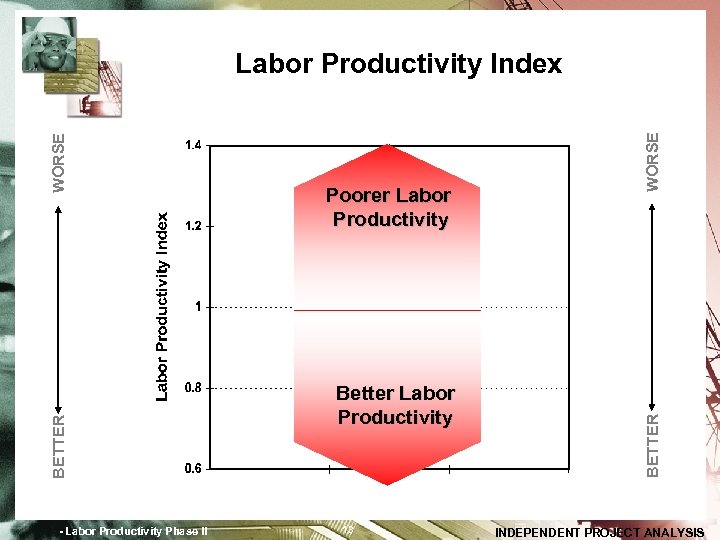
- Labor Productivity Phase II Better Labor Productivity 13 WORSE Poorer Labor Productivity BETTER WORSE Labor Productivity Index INDEPENDENT PROJECT ANALYSIS
Outline • Measuring labor productivity • Review of first year’s work • More Practices and Productivity • Productivity in Europe v. North America • Doing something about the weather • Conclusions Labor Productivity Phase II 14 INDEPENDENT PROJECT ANALYSIS
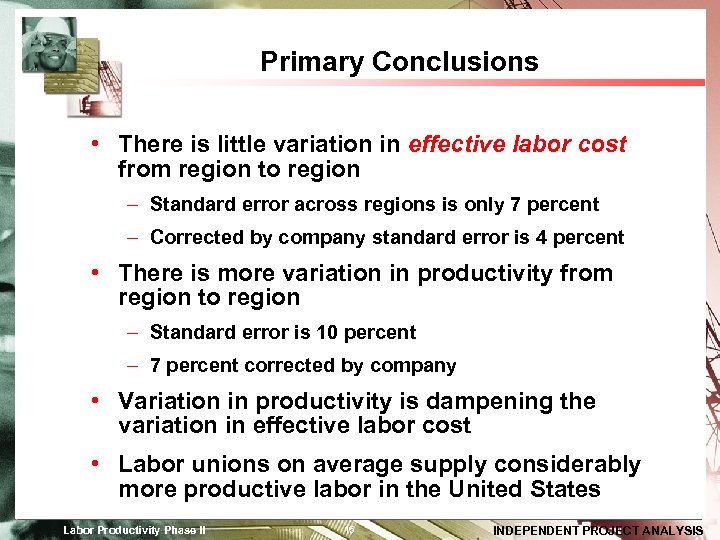
Primary Conclusions • There is little variation in effective labor cost from region to region – Standard error across regions is only 7 percent – Corrected by company standard error is 4 percent • There is more variation in productivity from region to region – Standard error is 10 percent – 7 percent corrected by company • Variation in productivity is dampening the variation in effective labor cost • Labor unions on average supply considerably more productive labor in the United States Labor Productivity Phase II 15 INDEPENDENT PROJECT ANALYSIS
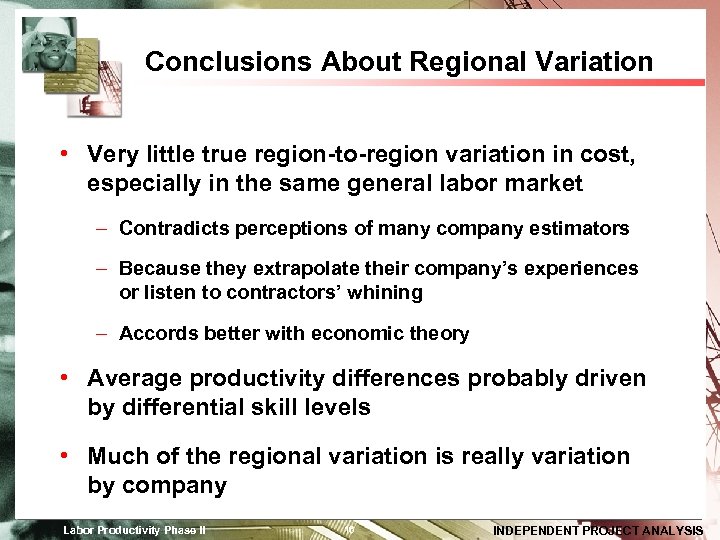
Conclusions About Regional Variation • Very little true region-to-region variation in cost, especially in the same general labor market – Contradicts perceptions of many company estimators – Because they extrapolate their company’s experiences or listen to contractors’ whining – Accords better with economic theory • Average productivity differences probably driven by differential skill levels • Much of the regional variation is really variation by company Labor Productivity Phase II 16 INDEPENDENT PROJECT ANALYSIS
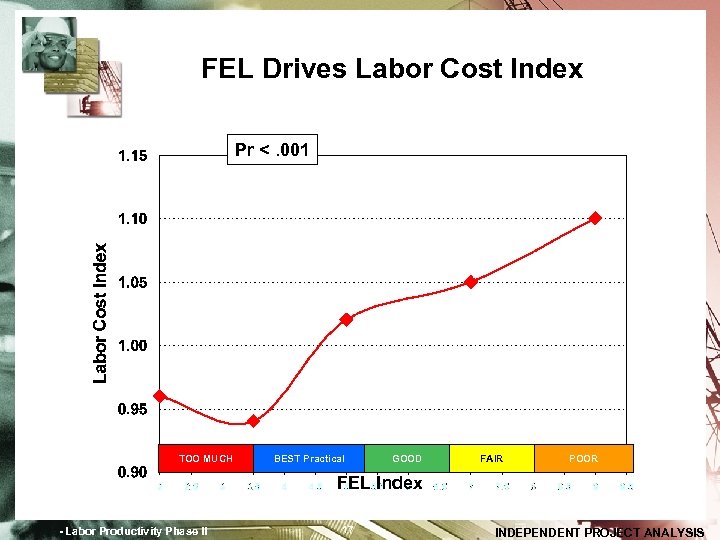
FEL Drives Labor Cost Index Pr <. 001 TOO MUCH BEST Practical GOOD FAIR POOR FEL Index - Labor Productivity Phase II 17 INDEPENDENT PROJECT ANALYSIS
FEL Drives Labor Productivity • Significant components are: – Definition of soils – Definition of health and safety – Engineering status • By far the most important FEL Component for Productivity is Execution Planning Labor Productivity Phase II 18 INDEPENDENT PROJECT ANALYSIS
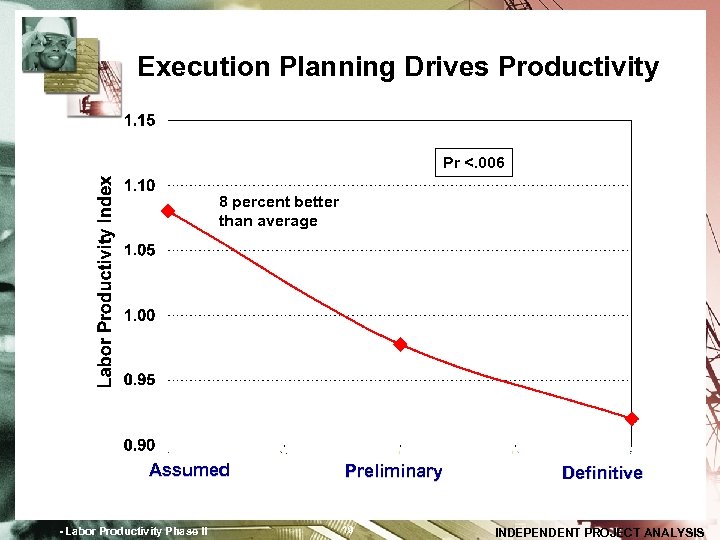
Execution Planning Drives Productivity Pr <. 006 8 percent better than average Assumed - Labor Productivity Phase II Preliminary 19 Definitive INDEPENDENT PROJECT ANALYSIS
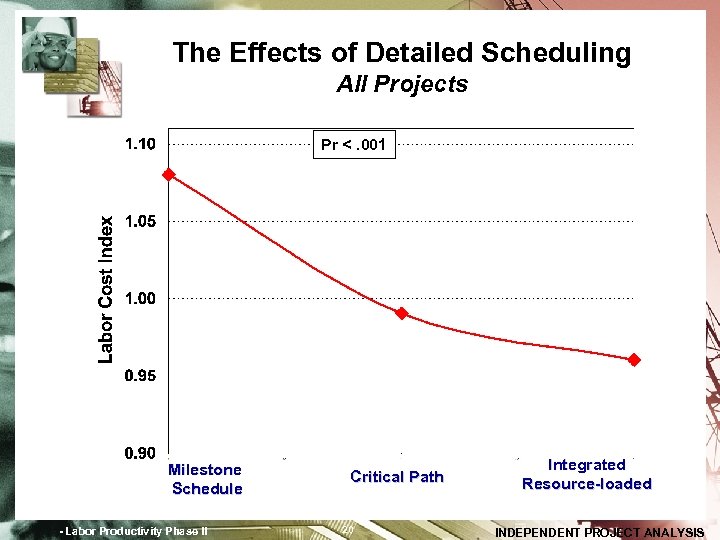
The Effects of Detailed Scheduling All Projects Pr <. 001 Milestone Schedule - Labor Productivity Phase II Critical Path 20 Integrated Resource-loaded INDEPENDENT PROJECT ANALYSIS
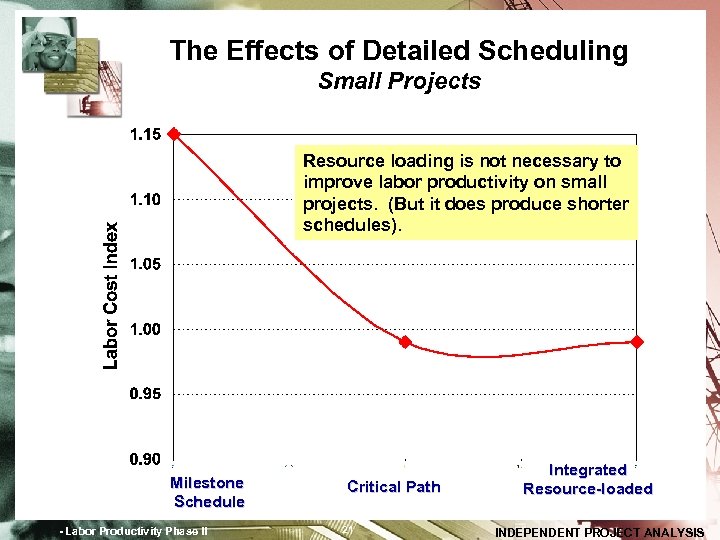
The Effects of Detailed Scheduling Small Projects Resource loading is not necessary to improve labor productivity on small projects. (But it does produce shorter schedules). Milestone Schedule - Labor Productivity Phase II Critical Path 21 Integrated Resource-loaded INDEPENDENT PROJECT ANALYSIS
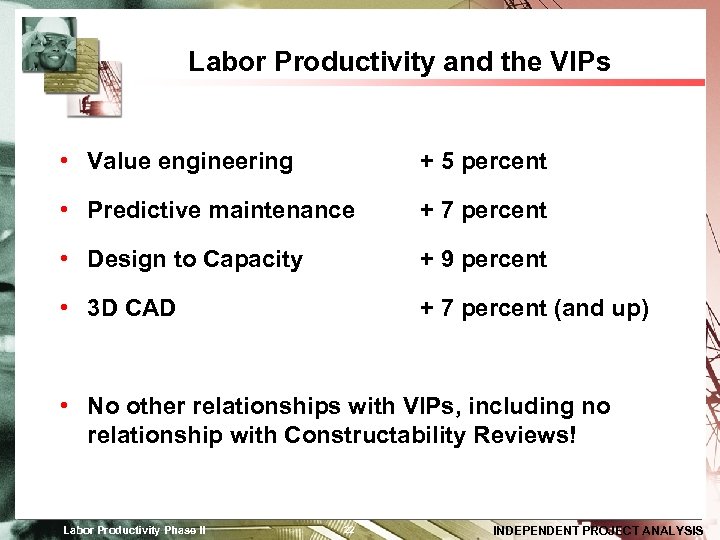
Labor Productivity and the VIPs • Value engineering + 5 percent • Predictive maintenance + 7 percent • Design to Capacity + 9 percent • 3 D CAD + 7 percent (and up) • No other relationships with VIPs, including no relationship with Constructability Reviews! Labor Productivity Phase II 22 INDEPENDENT PROJECT ANALYSIS
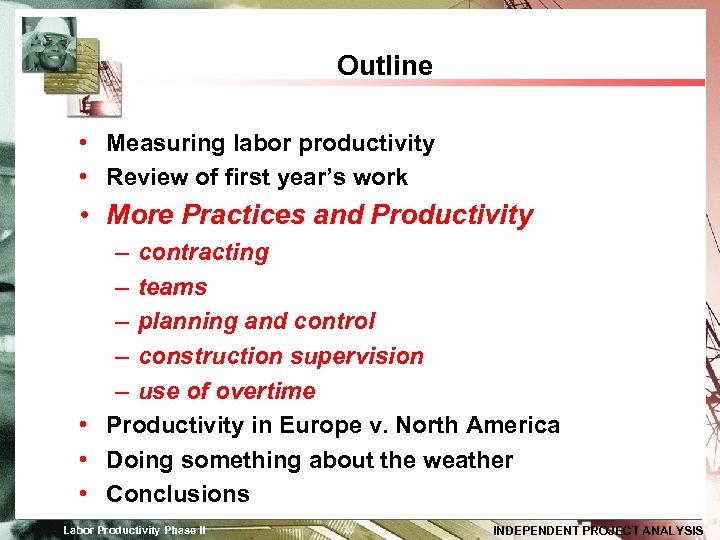
Outline • Measuring labor productivity • Review of first year’s work • More Practices and Productivity – contracting – teams – planning and control – construction supervision – use of overtime • Productivity in Europe v. North America • Doing something about the weather • Conclusions Labor Productivity Phase II 23 INDEPENDENT PROJECT ANALYSIS
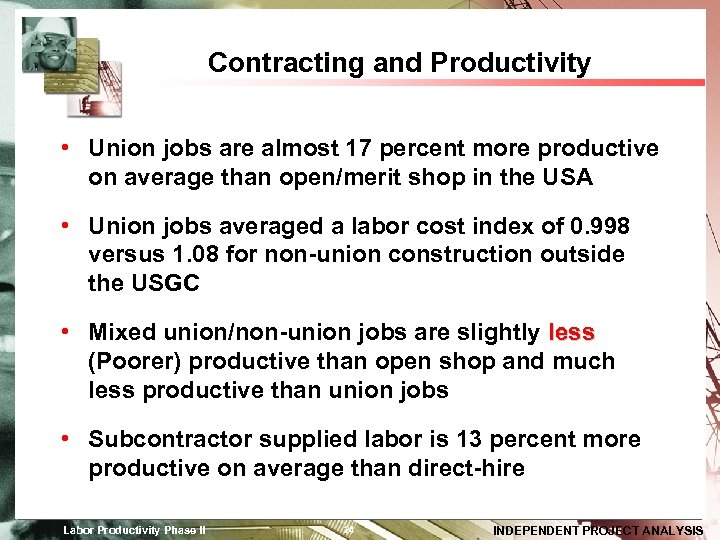
Contracting and Productivity • Union jobs are almost 17 percent more productive on average than open/merit shop in the USA • Union jobs averaged a labor cost index of 0. 998 versus 1. 08 for non-union construction outside the USGC • Mixed union/non-union jobs are slightly less (Poorer) productive than open shop and much less productive than union jobs • Subcontractor supplied labor is 13 percent more productive on average than direct-hire Labor Productivity Phase II 24 INDEPENDENT PROJECT ANALYSIS
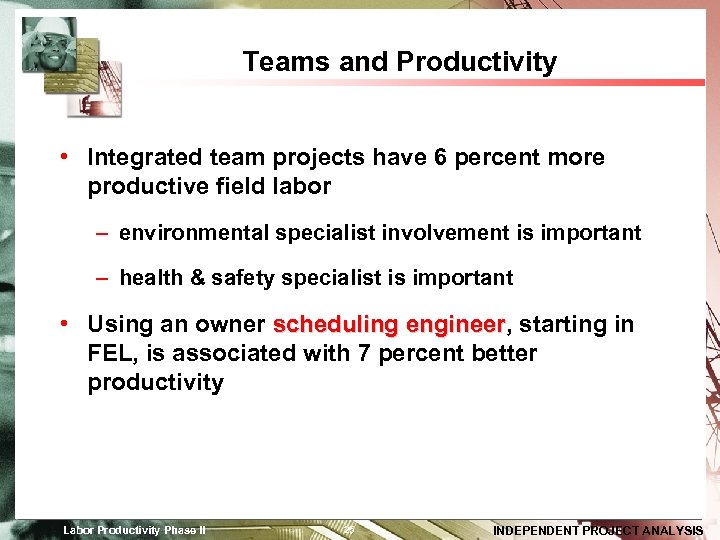
Teams and Productivity • Integrated team projects have 6 percent more productive field labor – environmental specialist involvement is important – health & safety specialist is important • Using an owner scheduling engineer, starting in engineer FEL, is associated with 7 percent better productivity Labor Productivity Phase II 25 INDEPENDENT PROJECT ANALYSIS
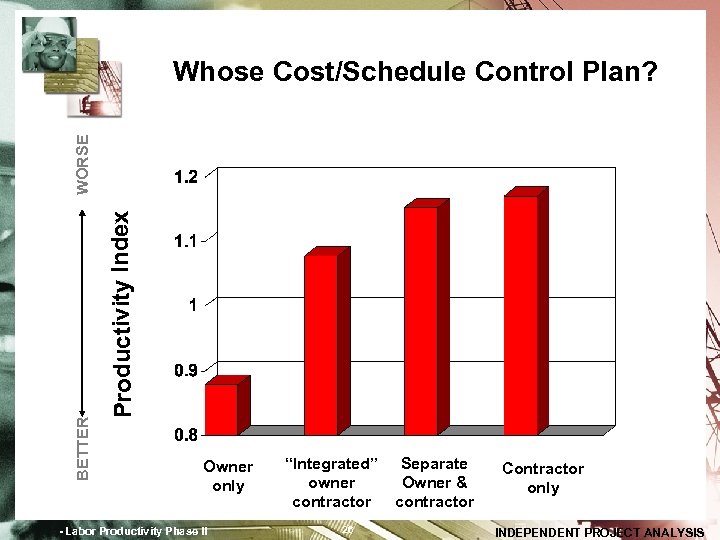
Productivity Index BETTER WORSE Whose Cost/Schedule Control Plan? Owner only - Labor Productivity Phase II “Integrated” owner contractor 26 Separate Owner & contractor Contractor only INDEPENDENT PROJECT ANALYSIS
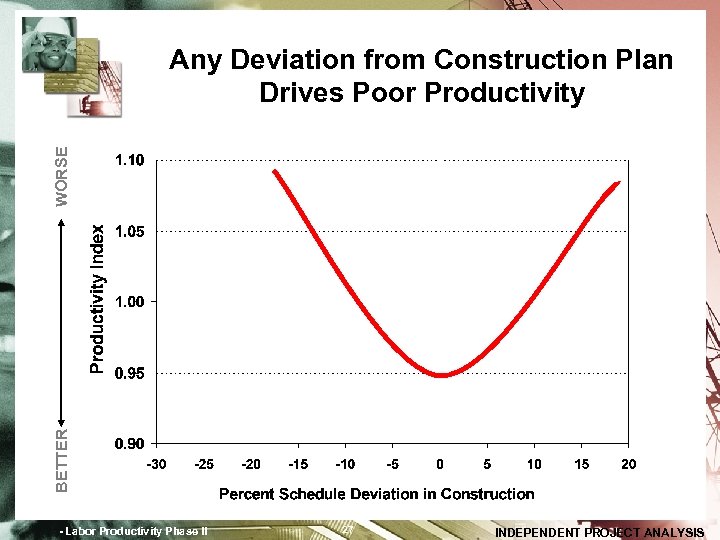
BETTER WORSE Any Deviation from Construction Plan Drives Poor Productivity - Labor Productivity Phase II 27 INDEPENDENT PROJECT ANALYSIS
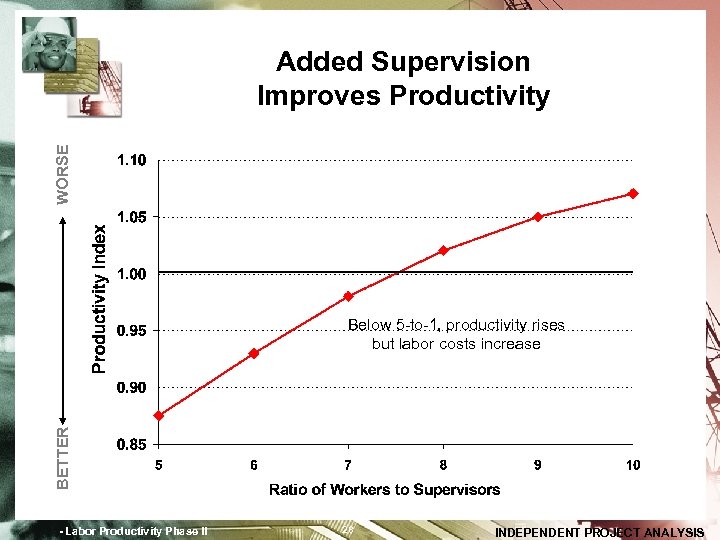
WORSE Added Supervision Improves Productivity BETTER Below 5 -to-1, productivity rises but labor costs increase - Labor Productivity Phase II 28 INDEPENDENT PROJECT ANALYSIS
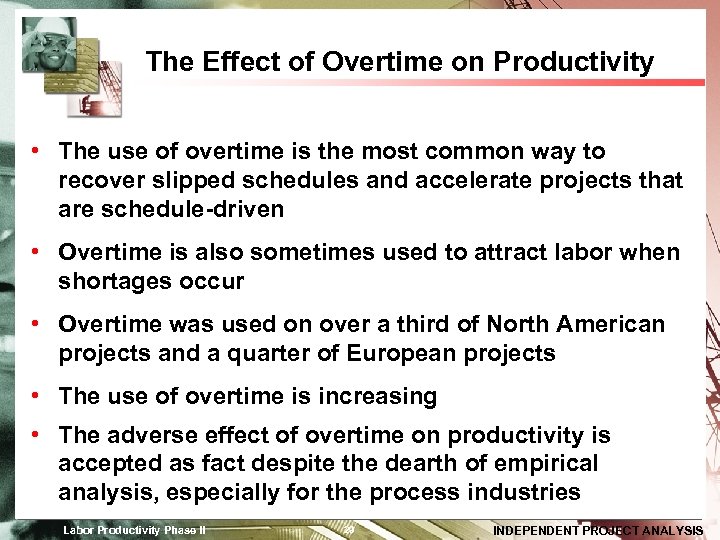
The Effect of Overtime on Productivity • The use of overtime is the most common way to recover slipped schedules and accelerate projects that are schedule-driven • Overtime is also sometimes used to attract labor when shortages occur • Overtime was used on over a third of North American projects and a quarter of European projects • The use of overtime is increasing • The adverse effect of overtime on productivity is accepted as fact despite the dearth of empirical analysis, especially for the process industries Labor Productivity Phase II 29 INDEPENDENT PROJECT ANALYSIS
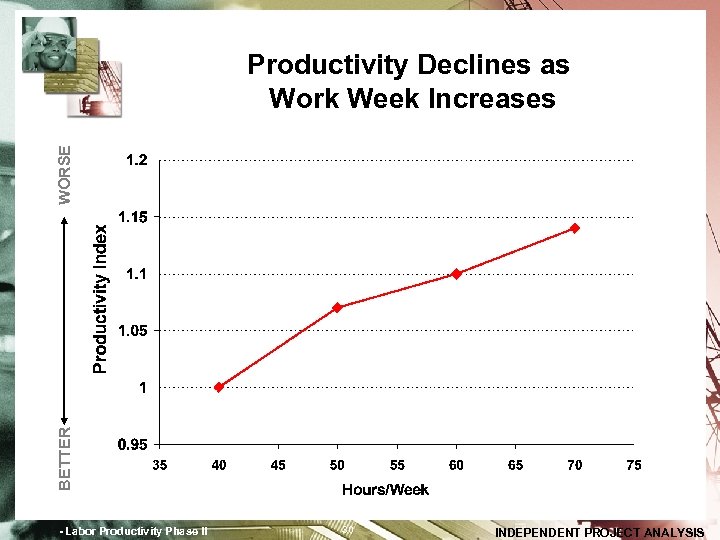
BETTER WORSE Productivity Declines as Work Week Increases - Labor Productivity Phase II 30 INDEPENDENT PROJECT ANALYSIS
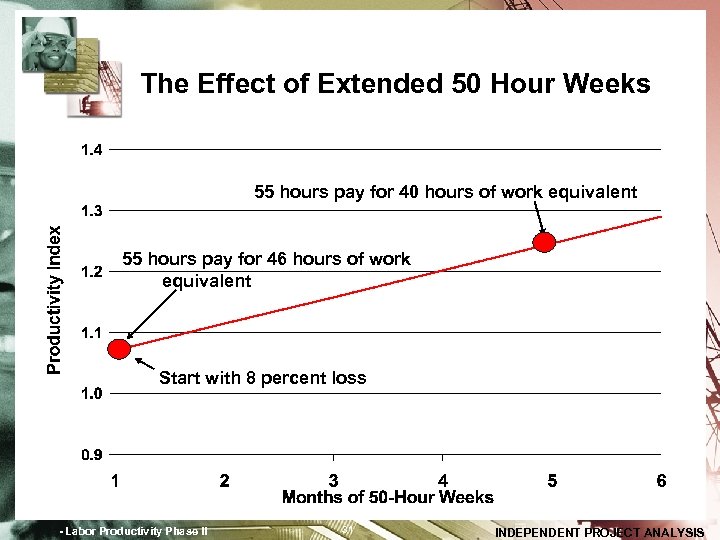
The Effect of Extended 50 Hour Weeks 55 hours pay for 40 hours of work equivalent 55 hours pay for 46 hours of work equivalent Start with 8 percent loss - Labor Productivity Phase II 31 INDEPENDENT PROJECT ANALYSIS
Outline • Measuring labor productivity • Review of first year’s work • More Practices and Productivity • Productivity in Europe v. North America • Doing something about the weather • Conclusions Labor Productivity Phase II 32 INDEPENDENT PROJECT ANALYSIS
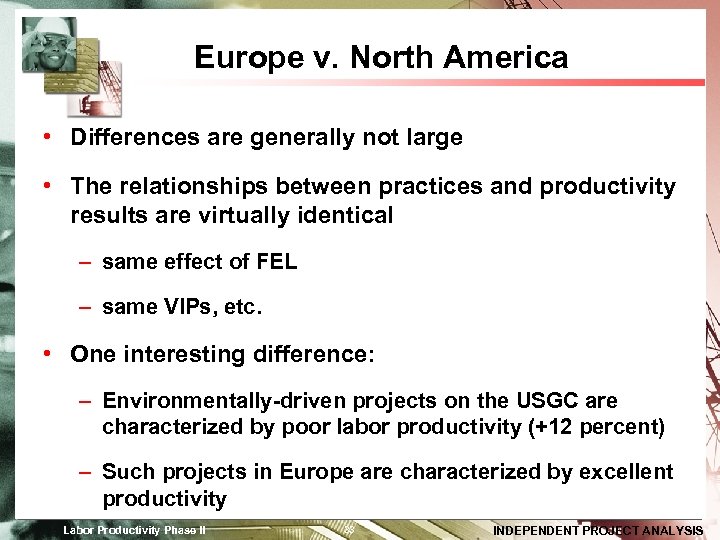
Europe v. North America • Differences are generally not large • The relationships between practices and productivity results are virtually identical – same effect of FEL – same VIPs, etc. • One interesting difference: – Environmentally-driven projects on the USGC are characterized by poor labor productivity (+12 percent) – Such projects in Europe are characterized by excellent productivity Labor Productivity Phase II 33 INDEPENDENT PROJECT ANALYSIS
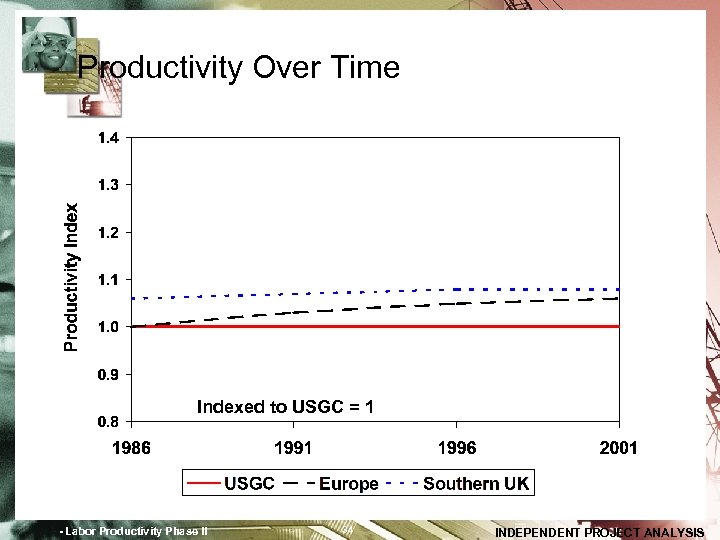
Productivity Over Time Indexed to USGC = 1 - Labor Productivity Phase II 34 INDEPENDENT PROJECT ANALYSIS
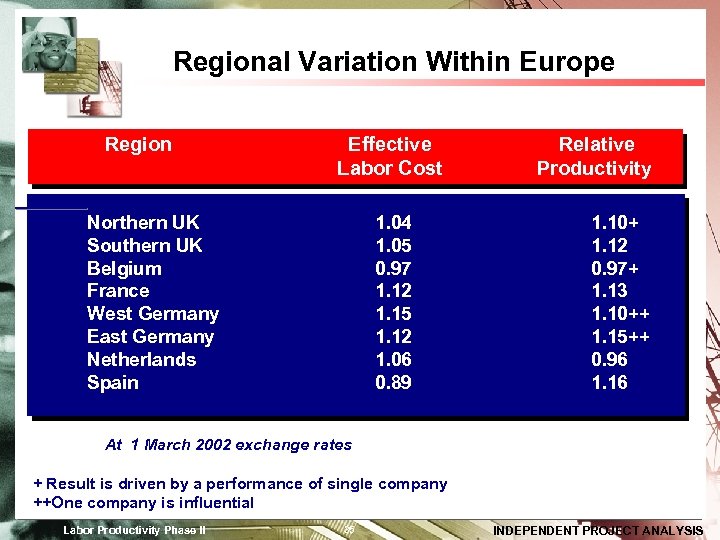
Regional Variation Within Europe Region Effective Labor Cost Northern UK Southern UK Belgium France West Germany East Germany Netherlands Spain 1. 04 1. 05 0. 97 1. 12 1. 15 1. 12 1. 06 0. 89 Relative Productivity 1. 10+ 1. 12 0. 97+ 1. 13 1. 10++ 1. 15++ 0. 96 1. 16 At 1 March 2002 exchange rates + Result is driven by a performance of single company ++One company is influential Labor Productivity Phase II 35 INDEPENDENT PROJECT ANALYSIS
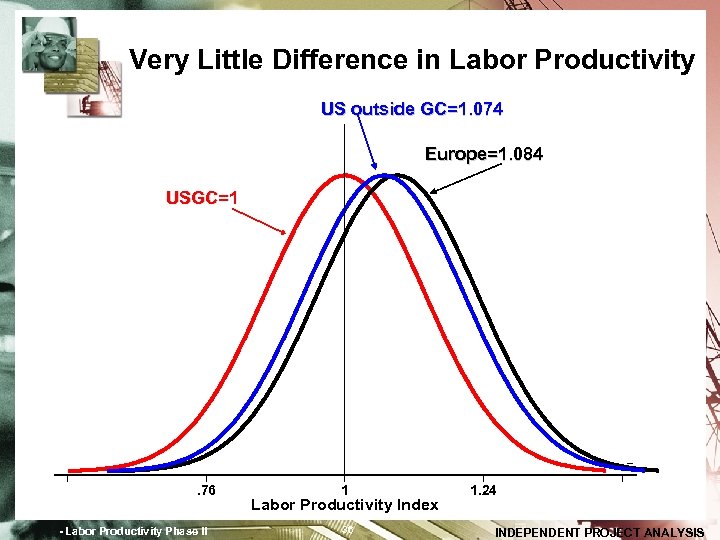
Very Little Difference in Labor Productivity US outside GC=1. 074 Europe=1. 084 USGC=1 . 76 - Labor Productivity Phase II 1 Labor Productivity Index 36 1. 24 INDEPENDENT PROJECT ANALYSIS
Outline • Measuring labor productivity • Review of first year’s work • Productivity in Europe v. North America • More Practices and Productivity • Doing something about the weather • Conclusions Labor Productivity Phase II 37 INDEPENDENT PROJECT ANALYSIS
Why Worry About the Weather? • The weather is a significant risk factor for many projects • The weather is an important estimating issue between owners and contractors and is sometimes used by contractors to “fatten” estimates on reimbursable or negotiated lump-sum contracts • Therefore, establishing some quantitative data around the effects of specific weather on productivity should be useful Labor Productivity Phase II 38 INDEPENDENT PROJECT ANALYSIS
Weather data • The US National Oceanographic and Atmospheric Administration (NOAA) keeps very detailed records of weather at most construction locations in the USA • We purchased daily weather information in electronic form for the construction periods of approximately 50 percent US projects in our productivity database • We then matched weather results to productivity Labor Productivity Phase II 39 INDEPENDENT PROJECT ANALYSIS
Weather Variables • Temperature Variables – temp 90 - Percent of construction days with the daily high temperature above 90 degrees Fahrenheit (32 degrees C) – coldxx - Percent of construction days with the “cooling degree days” measure greater than 10, 15, 20, or 25. Cooling degree days are measured as each degree of temperature of the daily mean above 65 degrees F (18 degrees C). – Heatxx - Percent of construction days with the “heating degree days” measure greater than 10, 15, 20, or 25. Heating degree days are measured as each degree of temperature of the daily mean below 65 degrees Fahrenheit. • Precipitation Variables – snow - Percent of construction days with 1/2 inch or more of daily snowfall Labor Productivity Phase II 40 INDEPENDENT PROJECT ANALYSIS
Weather Variables (cont. ) • Wind – windxx - Percent of construction days with resultant wind speed greater than 15, 20, or 25 miles per hour. Resultant wind speed is calculated as the vector sum of the wind’s speed divided by the number of observations. • Discomfort – Caution - Percent of construction days where combination of heat and humidity qualified as a “caution” condition by the National Weather Service – Danger - Percent of construction days where combination of heat and humidity qualified as a “Danger” condition by the National Weather Service Labor Productivity Phase II 41 INDEPENDENT PROJECT ANALYSIS
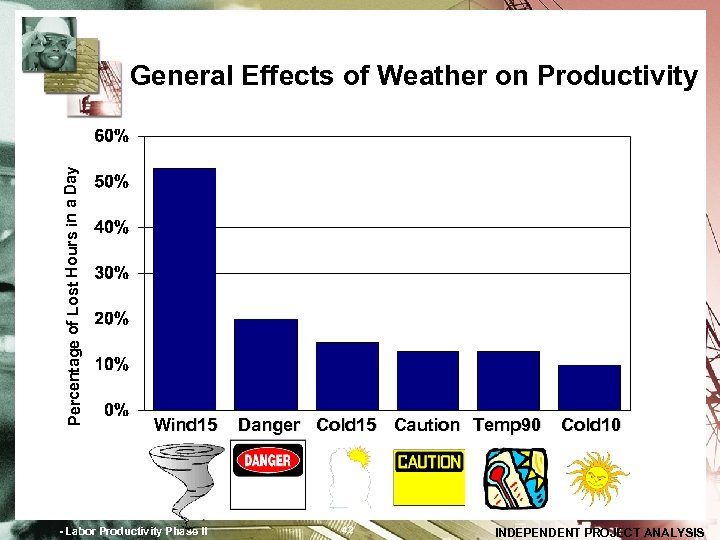
Percentage of Lost Hours in a Day General Effects of Weather on Productivity Wind 15 - Labor Productivity Phase II Danger Cold 15 Caution Temp 90 42 Cold 10 INDEPENDENT PROJECT ANALYSIS
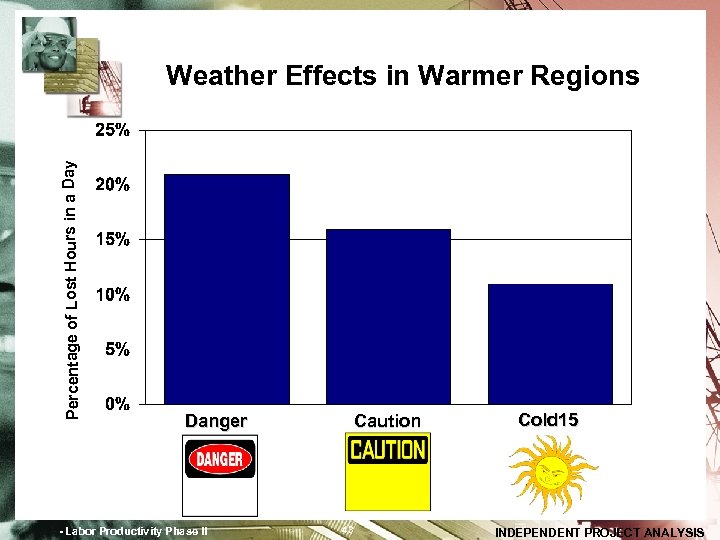
Percentage of Lost Hours in a Day Weather Effects in Warmer Regions Danger - Labor Productivity Phase II Caution 43 Cold 15 INDEPENDENT PROJECT ANALYSIS
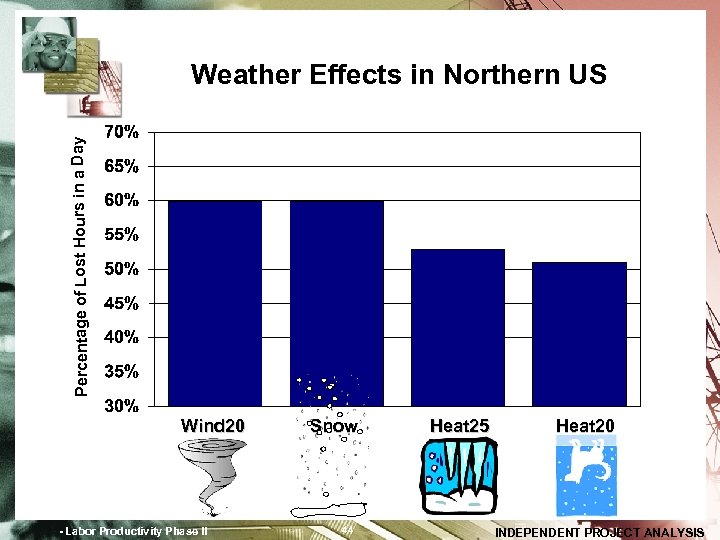
Percentage of Lost Hours in a Day Weather Effects in Northern US Wind 20 - Labor Productivity Phase II Snow 44 Heat 25 Heat 20 INDEPENDENT PROJECT ANALYSIS
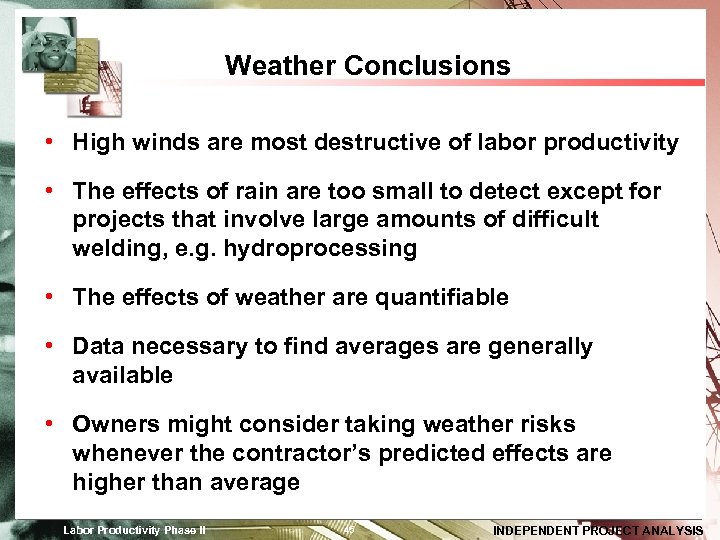
Weather Conclusions • High winds are most destructive of labor productivity • The effects of rain are too small to detect except for projects that involve large amounts of difficult welding, e. g. hydroprocessing • The effects of weather are quantifiable • Data necessary to find averages are generally available • Owners might consider taking weather risks whenever the contractor’s predicted effects are higher than average Labor Productivity Phase II 45 INDEPENDENT PROJECT ANALYSIS
Outline • Measuring labor productivity • Review of first year’s work • Productivity in Europe v. North America • More Practices and Productivity • Doing something about the weather • Conclusions Labor Productivity Phase II 46 INDEPENDENT PROJECT ANALYSIS
Conclusions • Overall project-to-project variation in labor productivity is 24 percent on a single standard deviation • Even within highly homogeneous projects in the same region, the variation is about 15 percent • This means there is a substantial gain available in improved labor productivity • Good labor productivity does more than reduce cost – Improves schedule – Improves quality Labor Productivity Phase II 47 INDEPENDENT PROJECT ANALYSIS
Keys to Better Productivity • Detailed execution planning is the single most important driver of better field productivity • Execution planning has been progressively outsourced to contractors • But the data are clear: owner execution planning and control are central to securing good labor productivity • The principal role of the engineering contractor is to provide timely, high-quality engineering documents to construction; it is not to take the place of the owner in the execution planning process Labor Productivity Phase II 48 INDEPENDENT PROJECT ANALYSIS
Path Forward -- Phase III • Work will continue on the collection of more detailed practices in the field that may affect productivity • Regional focus for IBC 2003 will be Latin America and Asia • Main emphasis will be on low-wage, generally lower skilled labor situations in which major cost swings can be achieved Labor Productivity Phase II 49 INDEPENDENT PROJECT ANALYSIS
Скачать презентацию INDEPENDENT PROJECT ANALYSIS INCORPORATED Presented by Dean Findley
2fde44c09e4fe6311add4a39854778ee.ppt