 Скачать презентацию Independent Development Trust PORTFOLIO COMMITTEE ON PUBLIC WORKS
71c34345ce97a560fe0564a592cfcf11.ppt
- Количество слайдов: 66



Independent Development Trust PORTFOLIO COMMITTEE ON PUBLIC WORKS Presentation Draft Corporate Plan 2012/13 20 March 2012
PRESENTATION OVERVIEW 1. REVISITING THE IDT STRATEGIC PLAN 2. PROGRAMMES 3. CORPORATE GOVERNANCE 4. BUSINESS CASE AND ANNUAL PERFOMANCE PLAN 5. FINANCES, FUNDING MODELS, and RISKS 6. LEGISLATIVE AND POLICY OVERVIEW 7. RECOMMENDATIONS
Revisiting and reconfirming the IDT Strategic Plan as submitted to parliament
The IDT PURPOSE: To support and add value to the national development agenda. We do that by deploying our resources in the initiation and delivery of innovative and sustainable development programmes, which make a measurable difference in the levels of poverty and underdevelopment. VISION: “… to be the leading knowledge-based development agency” MISSION: “The IDT, together with strategic partners, will enable poor communities to access resources, recognise and unlock their own potential and continuously improve their quality of life”
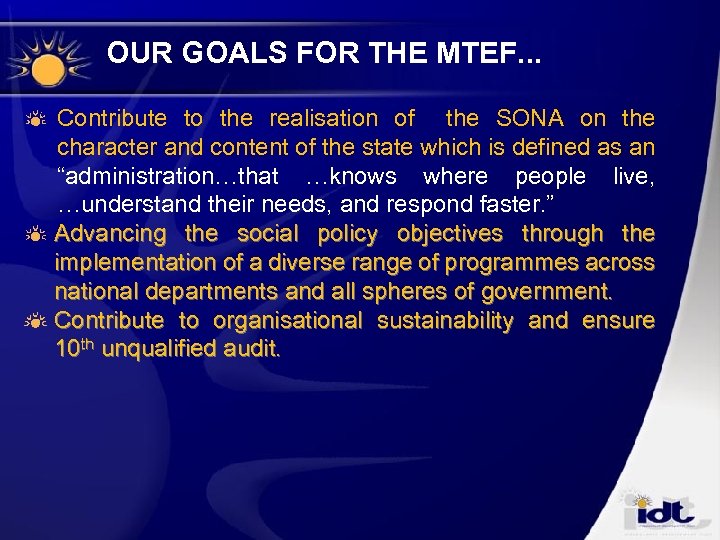
OUR GOALS FOR THE MTEF. . . Contribute to the realisation of the SONA on the character and content of the state which is defined as an “administration…that …knows where people live, …understand their needs, and respond faster. ” Advancing the social policy objectives through the implementation of a diverse range of programmes across national departments and all spheres of government. Contribute to organisational sustainability and ensure 10 th unqualified audit.
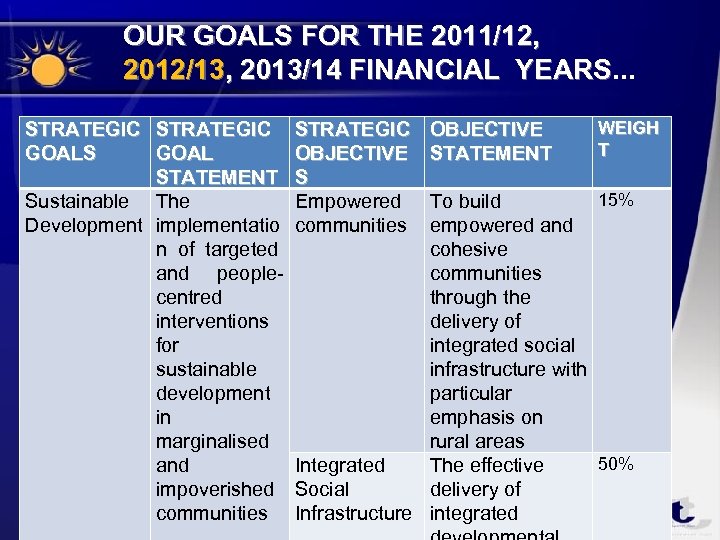
OUR GOALS FOR THE 2011/12, 2012/13, 2013/14 FINANCIAL YEARS. . . , 2013/14 FINANCIAL YEARS STRATEGIC GOALS GOAL OBJECTIVE STATEMENT S Sustainable The Empowered Development implementatio communities n of targeted and peoplecentred interventions for sustainable development in marginalised and Integrated impoverished Social communities Infrastructure OBJECTIVE STATEMENT WEIGH T 15% To build empowered and cohesive communities through the delivery of integrated social infrastructure with particular emphasis on rural areas 50% The effective delivery of integrated
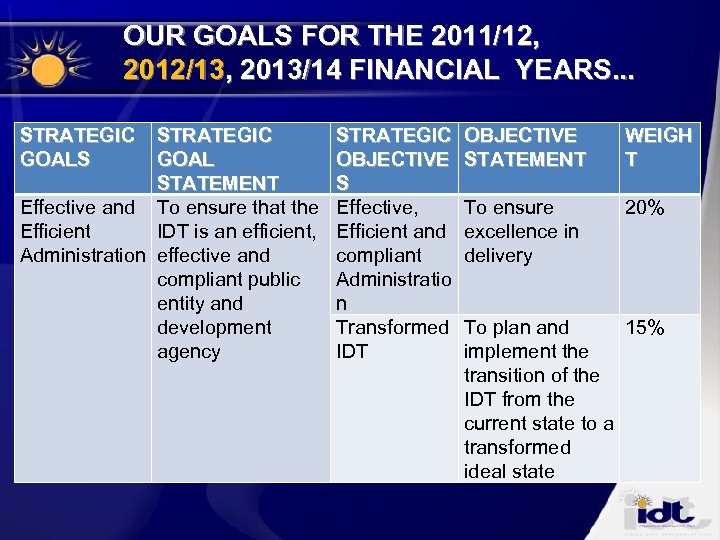
OUR GOALS FOR THE 2011/12, 2012/13, 2013/14 FINANCIAL YEARS. . . STRATEGIC GOALS GOAL STATEMENT Effective and To ensure that the Efficient IDT is an efficient, Administration effective and compliant public entity and development agency STRATEGIC OBJECTIVE S Effective, Efficient and compliant Administratio n Transformed IDT OBJECTIVE STATEMENT WEIGH T To ensure excellence in delivery 20% To plan and 15% implement the transition of the IDT from the current state to a transformed ideal state

3 rd Quarter Financial Performance Trends
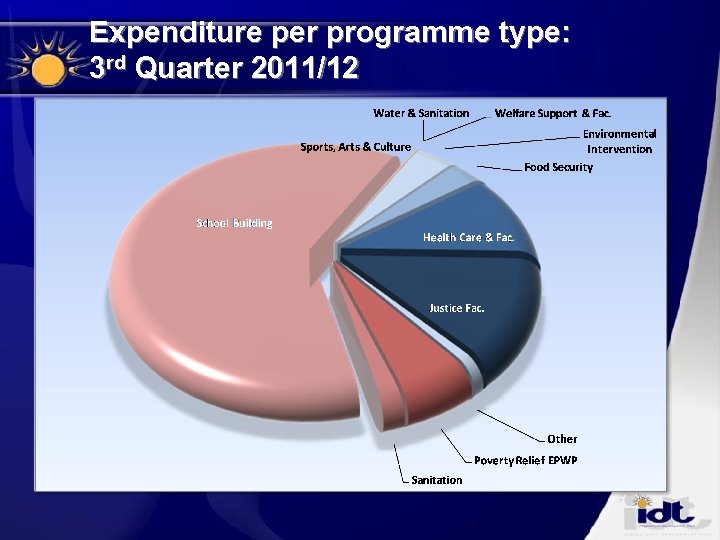
Expenditure per programme type: 3 rd Quarter 2011/12
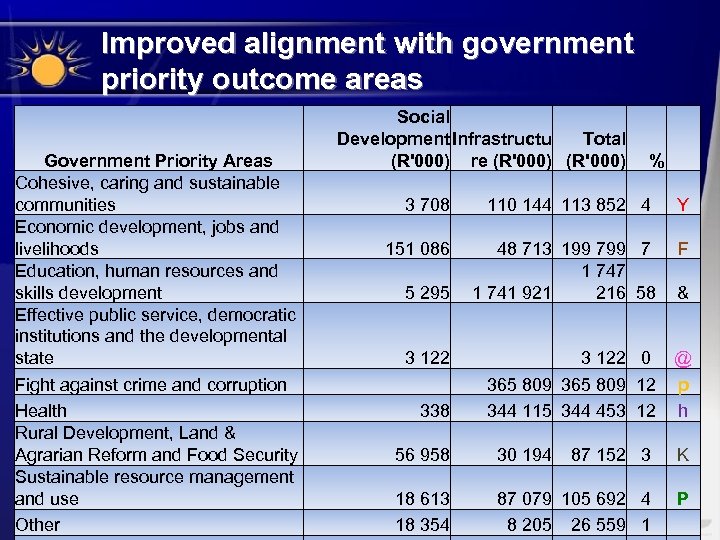
Improved alignment with government priority outcome areas Government Priority Areas Cohesive, caring and sustainable communities Economic development, jobs and livelihoods Education, human resources and skills development Effective public service, democratic institutions and the developmental state Fight against crime and corruption Health Rural Development, Land & Agrarian Reform and Food Security Sustainable resource management and use Other Social Development Infrastructu Total (R'000) re (R'000) % 3 708 110 144 113 852 4 Y 151 086 48 713 199 7 1 747 1 741 921 216 58 F 5 295 3 122 338 & 3 122 0 @ 365 809 12 p 344 115 344 453 12 h 56 958 30 194 87 152 3 K 18 613 18 354 87 079 105 692 4 8 205 26 559 1 P
Programme Management: Selected issues www. ikhwezifarms. co. za
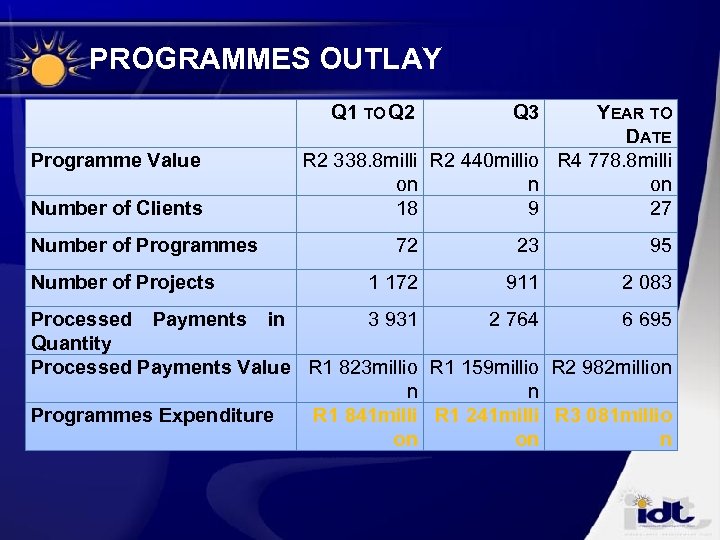
PROGRAMMES OUTLAY Q 1 TO Q 2 Programme Value Number of Clients Number of Programmes Number of Projects Q 3 YEAR TO DATE R 2 338. 8 milli R 2 440 millio R 4 778. 8 milli on n on 18 9 27 72 23 95 1 172 911 2 083 Processed Payments in 3 931 2 764 6 695 Quantity Processed Payments Value R 1 823 millio R 1 159 millio R 2 982 million n n Programmes Expenditure R 1 841 milli R 1 241 milli R 3 081 millio on on n
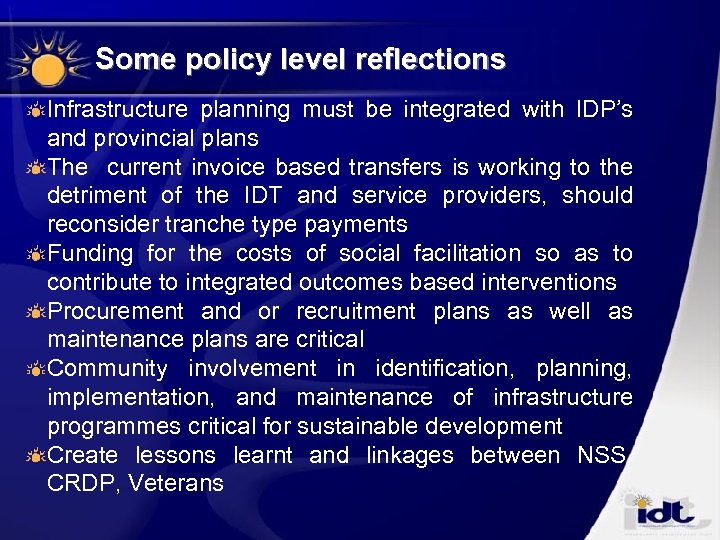
Some policy level reflections Infrastructure planning must be integrated with IDP’s and provincial plans The current invoice based transfers is working to the detriment of the IDT and service providers, should reconsider tranche type payments Funding for the costs of social facilitation so as to contribute to integrated outcomes based interventions Procurement and or recruitment plans as well as maintenance plans are critical Community involvement in identification, planning, implementation, and maintenance of infrastructure programmes critical for sustainable development Create lessons learnt and linkages between NSS, CRDP, Veterans
CORPORATE GOVERNANCE
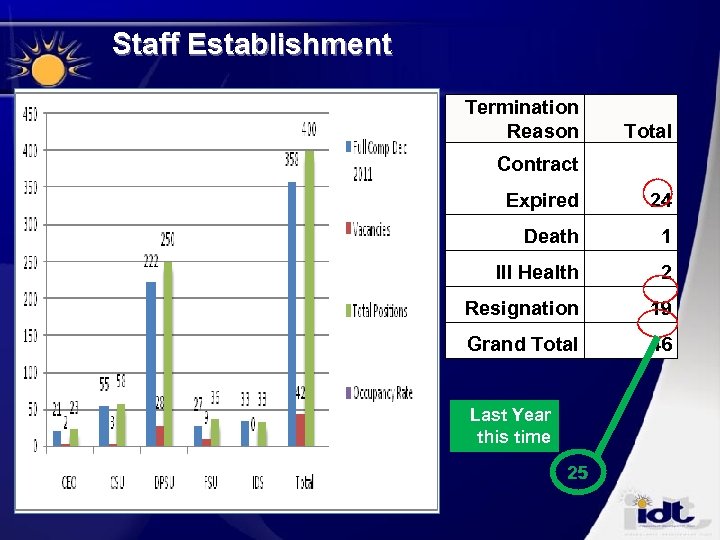
Staff Establishment Termination Reason Total Contract Expired 24 Death 1 Ill Health 2 Resignation 19 Grand Total 46 Last Year this time 25
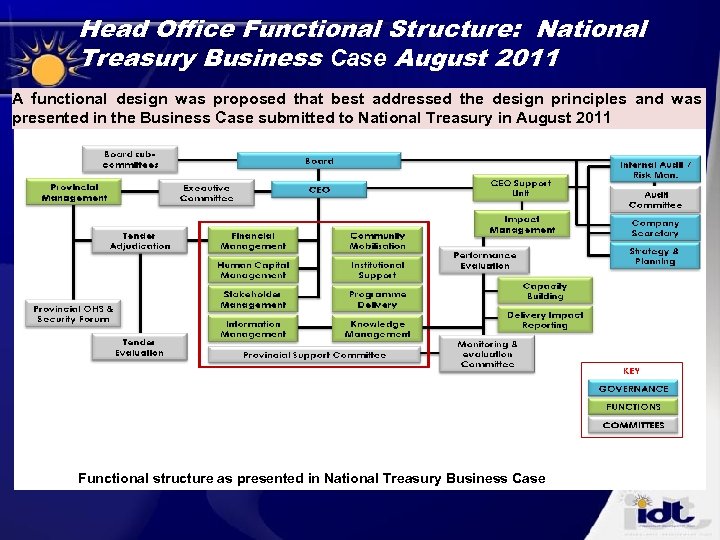
Head Office Functional Structure: National Treasury Business Case August 2011 A functional design was proposed that best addressed the design principles and was presented in the Business Case submitted to National Treasury in August 2011 Functional structure as presented in National Treasury Business Case
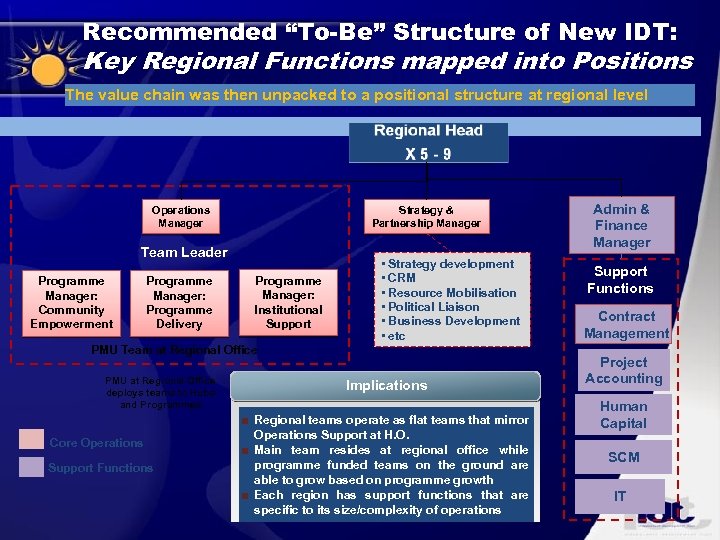
Recommended “To-Be” Structure of New IDT: Key Regional Functions mapped into Positions The value chain was then unpacked to a positional structure at regional level Operations Manager Strategy & Partnership Manager Team Leader Programme Manager: Community Empowerment v Programme Manager: Programme Delivery Programme Manager: Institutional Support • Strategy development • CRM • Resource Mobilisation • Political Liaison • Business Development • etc PMU Team at Regional Office PMU at Regional Office deploys teams to Hubs and Programmes Core Operations Support Functions Implications ■ Regional teams operate as flat teams that mirror Operations Support at H. O. ■ Main team resides at regional office while programme funded teams on the ground are able to grow based on programme growth ■ Each region has support functions that are specific to its size/complexity of operations Admin & Finance Manager Support Functions Contract Management Project Accounting Human Capital SCM IT
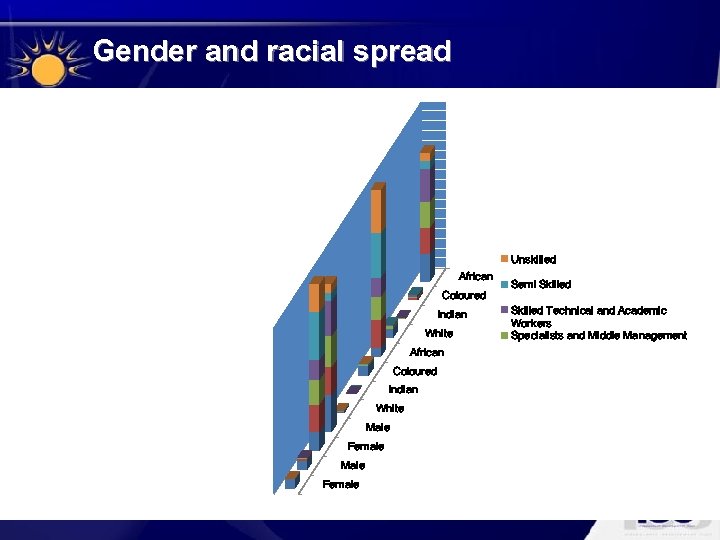
Gender and racial spread Unskilled African Coloured Indian White Male Female Semi Skilled Technical and Academic Workers Specialists and Middle Management

2012/13 CORPORATE PLAN
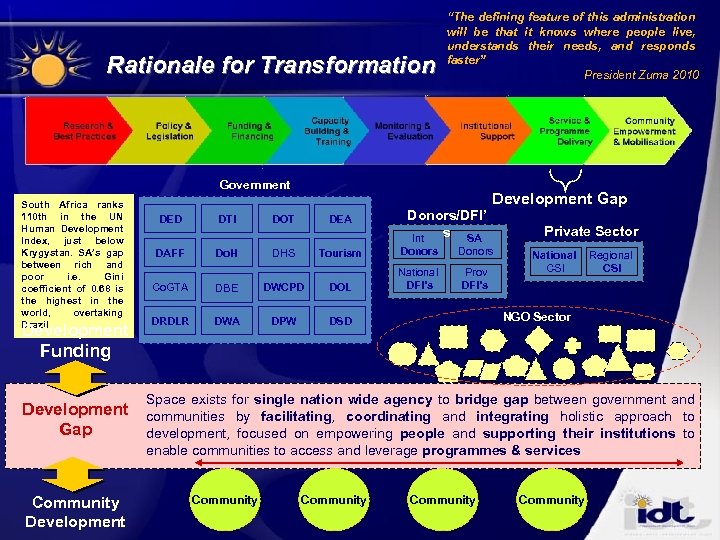
Rationale for Transformation “The defining feature of this administration will be that it knows where people live, understands their needs, and responds faster” President Zuma 2010 Government South Africa ranks 110 th in the UN Human Development Index, just below Krygystan. SA’s gap between rich and poor i. e. Gini coefficient of 0. 68 is the highest in the world, overtaking Brazil Development Gap Donors/DFI’ Int s SA DED DTI DOT DEA DAFF Do. H DHS Tourism Donors Co. GTA DBE DWCPD DOL National DFI’s Prov DFI’s DRDLR DWA DPW DSD Private Sector National Regional CSI NGO Sector Funding Space exists for single nation wide agency to bridge gap between government and Development communities by facilitating, coordinating and integrating holistic approach to Gap development, focused on empowering people and supporting their institutions to enable communities to access and leverage programmes & services Community Development Community
Given Gap and Journey Map the IDT in the Medium Term Shall… Be a development agency that offers programme Management, Institutional Support, and Community Mobilisaton as well as development advisory services to all spheres of the public service as well as other development partners. Emphasis is on the eradication of chronic intergenerational poverty, especially among the rural poor. Maintain its VISION of being “the leading knowledge based development agency” Readjust its MISSION to “The IDT, together with strategic partners, will enable poor communities to recognise and unlock their own potential for sustainable development”.
Given Gap and Journey Map the IDT in the Medium Term Shall… Maintain its values of : People Centred, Having Integrity, Professionalism, Accountability and being Visionary Prepare Communities to receive, own, manage and sustain their own development through: v delivering Social Infrastructure where Social Infrastructure is seen as all the necessary measures, facilities and networks required for sustainable development in such communities
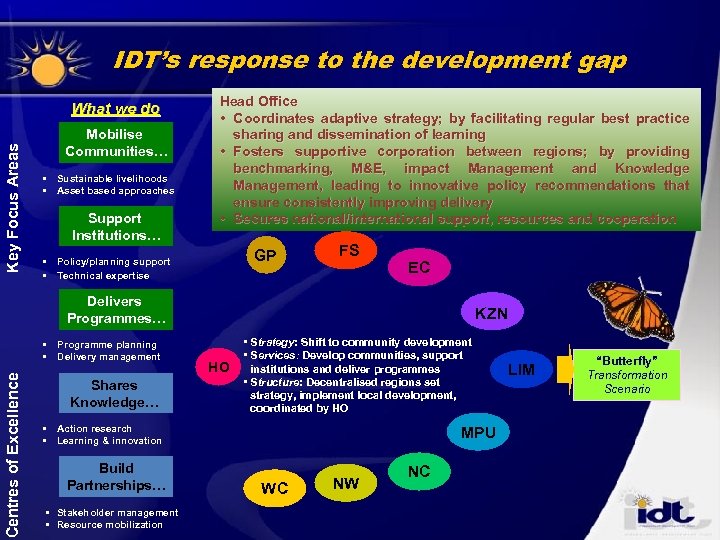
IDT’s response to the development gap Key Focus Areas What we do Mobilise Communities… • Sustainable livelihoods • Asset based approaches Support Institutions… Head Office • Coordinates adaptive strategy; by facilitating regular best practice sharing and dissemination of learning • Fosters supportive corporation between regions; by providing benchmarking, M&E, impact Management and Knowledge Management, leading to innovative policy recommendations that ensure consistently improving delivery • Secures national/international support, resources and cooperation GP • Policy/planning support • Technical expertise FS EC Delivers Programmes… Centres of Excellence • Programme planning • Delivery management Shares Knowledge… KZN HO • Strategy: Shift to community development • Services: Develop communities, support institutions and deliver programmes • Structure: Decentralised regions set strategy, implement local development, coordinated by HO • Action research • Learning & innovation Build Partnerships… • Stakeholder management • Resource mobilization MPU WC NW NC LIM “Butterfly” Transformation Scenario
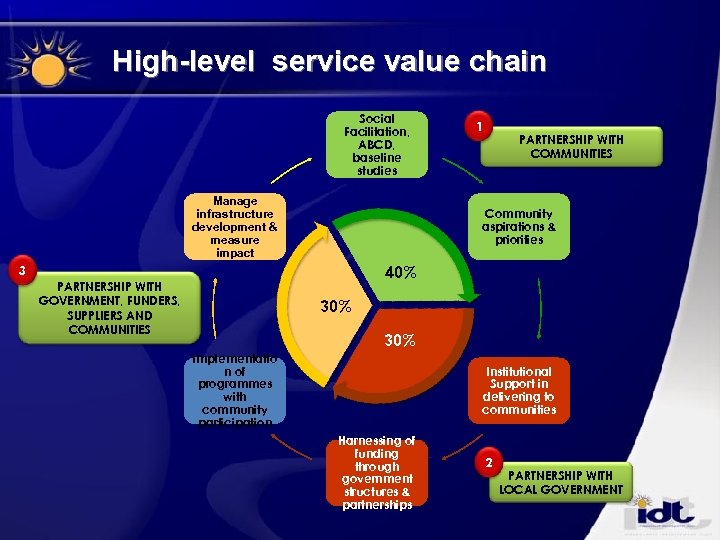
High-level service value chain Social Facilitation, ABCD, baseline studies Manage infrastructure development & measure impact 1 PARTNERSHIP WITH COMMUNITIES Community aspirations & priorities 40% 3 PARTNERSHIP WITH GOVERNMENT, FUNDERS, SUPPLIERS AND COMMUNITIES 30% Implementatio n of programmes with community participation Institutional Support in delivering to communities Harnessing of funding through government structures & partnerships 2 PARTNERSHIP WITH LOCAL GOVERNMENT
FUNDING
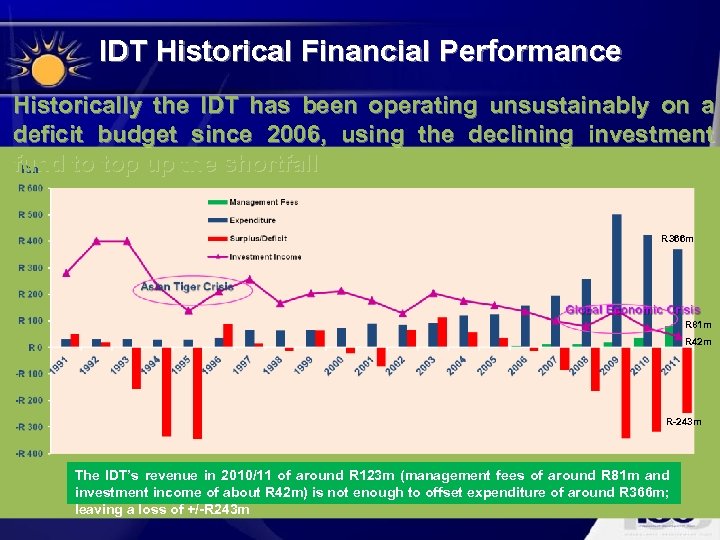
IDT Historical Financial Performance Historically the IDT has been operating unsustainably on a deficit budget since 2006, using the declining investment fund to top up the shortfall Rm R 366 m R 81 m R 42 m R-243 m The IDT’s revenue in 2010/11 of around R 123 m (management fees of around R 81 m and investment income of about R 42 m) is not enough to offset expenditure of around R 366 m; leaving a loss of +/-R 243 m
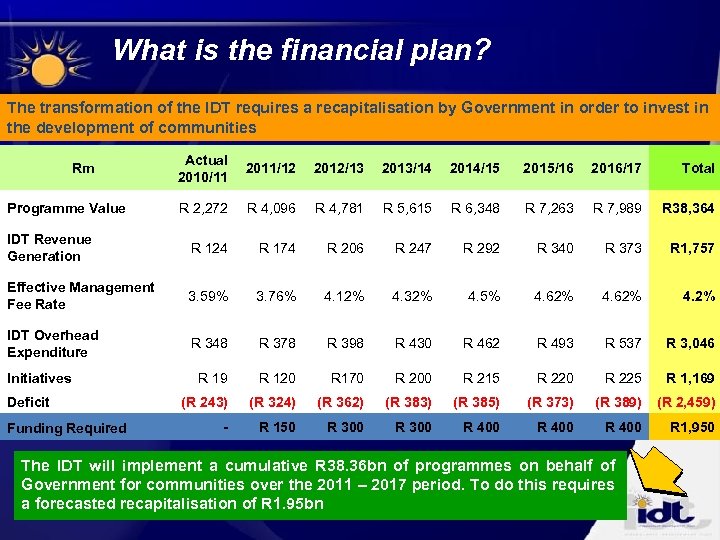
What is the financial plan? The transformation of the IDT requires a recapitalisation by Government in order to invest in the development of communities Actual 2011/12 2010/11 2012/13 2013/14 2014/15 2015/16 2016/17 Total R 2, 272 R 4, 096 R 4, 781 R 5, 615 R 6, 348 R 7, 263 R 7, 989 R 38, 364 IDT Revenue Generation R 124 R 174 R 206 R 247 R 292 R 340 R 373 R 1, 757 Effective Management Fee Rate 3. 59% 3. 76% 4. 12% 4. 32% 4. 5% 4. 62% 4. 2% IDT Overhead Expenditure R 348 R 378 R 398 R 430 R 462 R 493 R 537 R 3, 046 R 19 R 120 R 170 R 200 R 215 R 220 R 225 R 1, 169 (R 243) (R 324) (R 362) (R 383) (R 385) (R 373) (R 389) (R 2, 459) - R 150 R 300 R 400 R 1, 950 Rm Programme Value Initiatives Deficit Funding Required The IDT will implement a cumulative R 38. 36 bn of programmes on behalf of Government for communities over the 2011 – 2017 period. To do this requires a forecasted recapitalisation of R 1. 95 bn
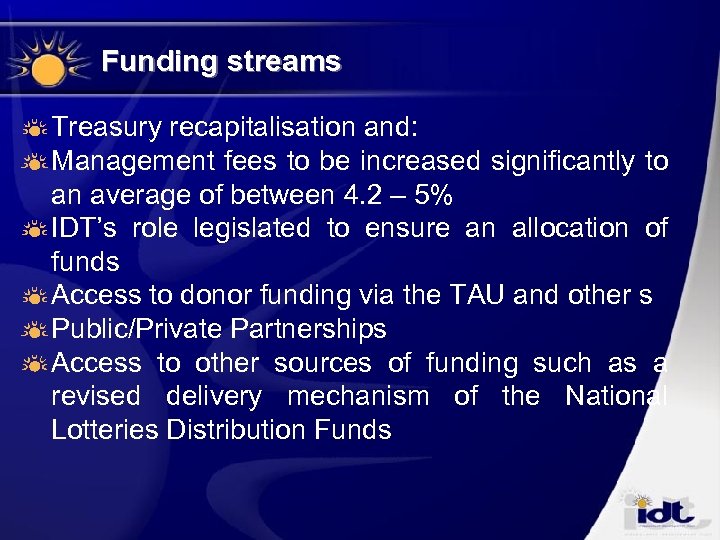
Funding streams Treasury recapitalisation and: Management fees to be increased significantly to an average of between 4. 2 – 5% IDT’s role legislated to ensure an allocation of funds Access to donor funding via the TAU and other s Public/Private Partnerships Access to other sources of funding such as a revised delivery mechanism of the National Lotteries Distribution Funds
Funding streams However since there is currently no treasury allocations approved survivalist scenario….
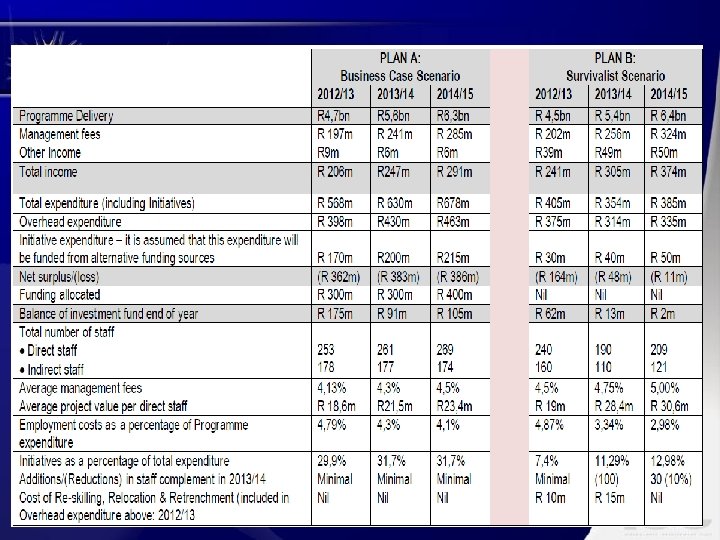
Scenarios for 2012/13
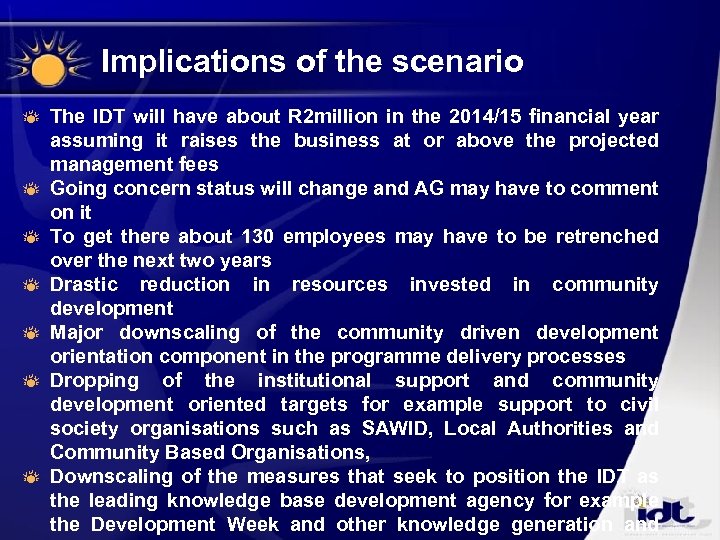
Implications of the scenario The IDT will have about R 2 million in the 2014/15 financial year assuming it raises the business at or above the projected management fees Going concern status will change and AG may have to comment on it To get there about 130 employees may have to be retrenched over the next two years Drastic reduction in resources invested in community development Major downscaling of the community driven development orientation component in the programme delivery processes Dropping of the institutional support and community development oriented targets for example support to civil society organisations such as SAWID, Local Authorities and Community Based Organisations, Downscaling of the measures that seek to position the IDT as the leading knowledge base development agency for example the Development Week and other knowledge generation and
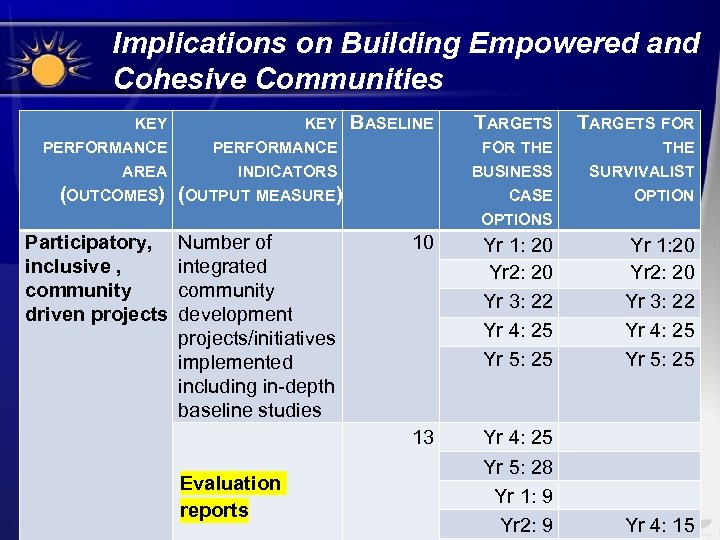
Implications on Building Empowered and Cohesive Communities KEY PERFORMANCE AREA BASELINE INDICATORS (OUTCOMES) (OUTPUT MEASURE) TARGETS FOR THE BUSINESS SURVIVALIST CASE OPTIONS Participatory, inclusive , community driven projects Number of integrated community development projects/initiatives implemented including in-depth baseline studies Yr 1: 20 Yr 2: 20 Yr 3: 22 Yr 4: 25 Yr 5: 25 13 Evaluation reports 10 Yr 4: 25 Yr 5: 28 Yr 1: 9 Yr 2: 9 Yr 4: 15
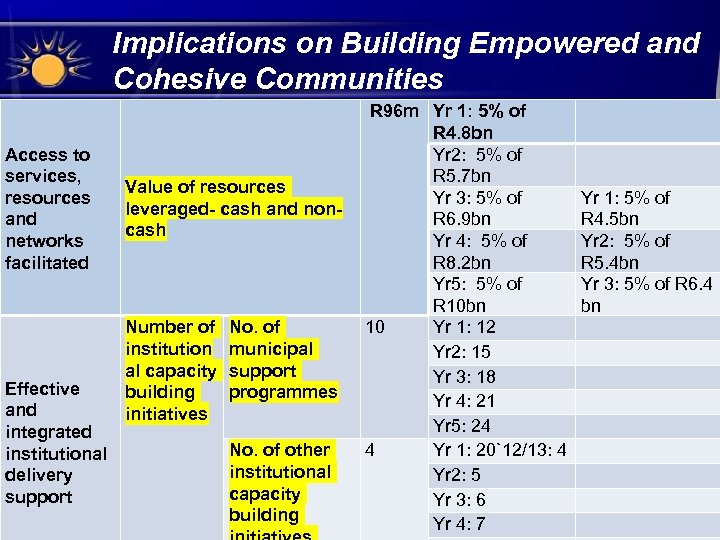
Implications on Building Empowered and Cohesive Communities Access to services, resources and networks facilitated Effective and integrated institutional delivery support Value of resources leveraged- cash and noncash Number of institution al capacity building initiatives No. of municipal support programmes No. of other institutional capacity building R 96 m Yr 1: 5% of R 4. 8 bn Yr 2: 5% of R 5. 7 bn Yr 3: 5% of R 6. 9 bn Yr 4: 5% of R 8. 2 bn Yr 5: 5% of R 10 bn 10 Yr 1: 12 Yr 2: 15 Yr 3: 18 Yr 4: 21 Yr 5: 24 4 Yr 1: 20`12/13: 4 Yr 2: 5 Yr 3: 6 Yr 4: 7 Yr 1: 5% of R 4. 5 bn Yr 2: 5% of R 5. 4 bn Yr 3: 5% of R 6. 4 bn
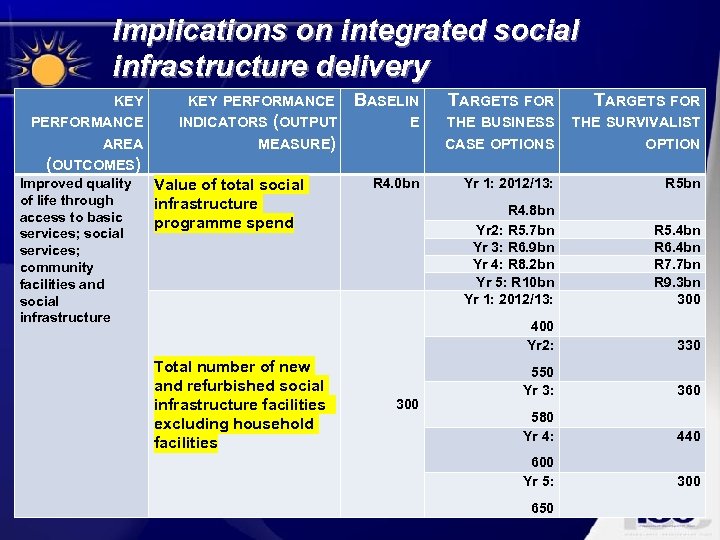
Implications on integrated social infrastructure delivery KEY PERFORMANCE INDICATORS (OUTPUT AREA BASELIN E MEASURE) TARGETS FOR THE BUSINESS CASE OPTIONS TARGETS FOR THE SURVIVALIST OPTION (OUTCOMES) Improved quality of life through access to basic services; social services; community facilities and social infrastructure Total number of new and refurbished social infrastructure facilities excluding household facilities R 4. 0 bn R 5 bn R 4. 8 bn Yr 2: R 5. 7 bn Yr 3: R 6. 9 bn Yr 4: R 8. 2 bn Yr 5: R 10 bn Yr 1: 2012/13: 300 Yr 1: 2012/13: R 5. 4 bn R 6. 4 bn R 7. 7 bn R 9. 3 bn 300 400 Yr 2: Value of total social infrastructure programme spend 330 550 Yr 3: 360 580 Yr 4: 440 600 Yr 5: 300 650
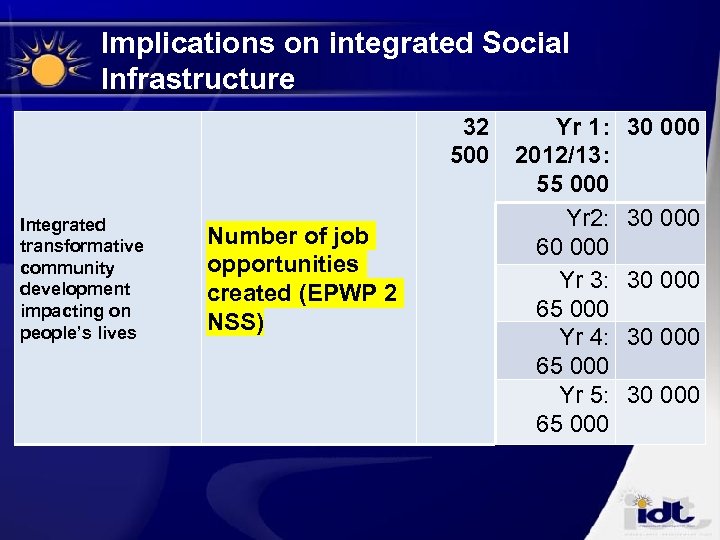
Implications on integrated Social Infrastructure Integrated transformative community development impacting on people’s lives Number of job opportunities created (EPWP 2 NSS) 32 Yr 1: 500 2012/13: 55 000 Yr 2: 60 000 Yr 3: 65 000 Yr 4: 65 000 Yr 5: 65 000 30 000 30 000
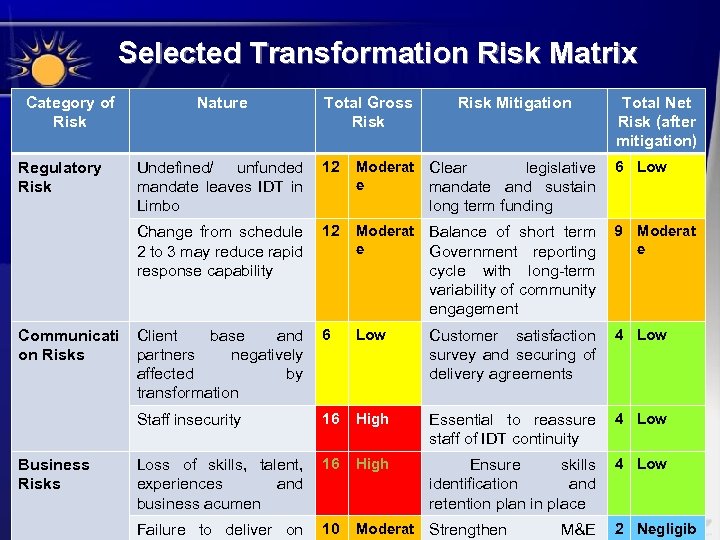
Selected Transformation Risk Matrix Category of Risk Nature Total Gross Risk Mitigation Total Net Risk (after mitigation) Communicati on Risks Undefined/ unfunded 12 mandate leaves IDT in Limbo Moderat Clear legislative 6 Low e mandate and sustain Change from schedule 12 2 to 3 may reduce rapid response capability Regulatory Risk Moderat Balance of short term 9 Moderat e e Government reporting Client base and 6 partners negatively affected by transformation Low Customer satisfaction 4 Low survey and securing of delivery agreements 16 High Essential to reassure 4 Low staff of IDT continuity Loss of skills, talent, 16 experiences and business acumen High Ensure skills 4 Low identification and retention plan in place Failure to deliver on 10 Moderat Strengthen Staff insecurity Business Risks long term funding cycle with long-term variability of community engagement M&E 2 Negligib
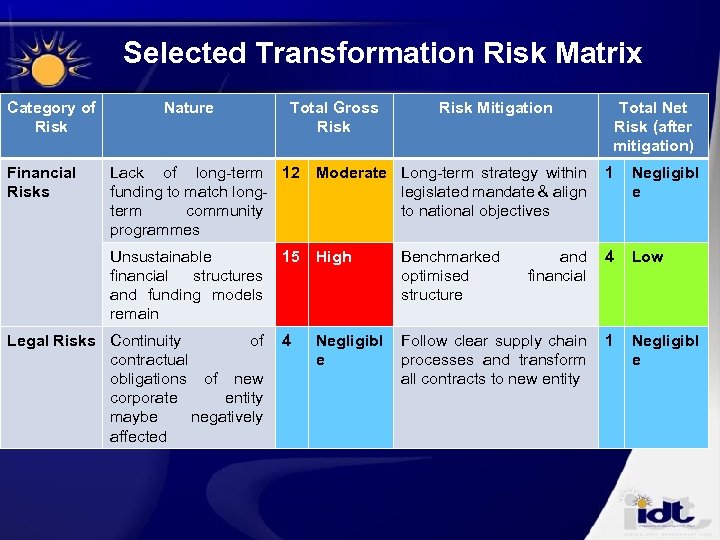
Selected Transformation Risk Matrix Category of Risk Financial Risks Nature Total Gross Risk Mitigation Total Net Risk (after mitigation) Lack of long-term 12 Moderate Long-term strategy within 1 funding to match longlegislated mandate & align term community to national objectives programmes Negligibl e Unsustainable 15 High financial structures and funding models remain Low Legal Risks Continuity of 4 contractual obligations of new corporate entity maybe negatively affected Negligibl e Benchmarked optimised structure and 4 financial Follow clear supply chain 1 processes and transform all contracts to new entity Negligibl e
LEGISLATIVE ANALYSIS
The Brief The IDT has submitted its Business Case to the DPW and the National Treasury In the Business Case certain mandates are given to the IDT, which include the delivery of a revised social infrastructure with the service offerings of (1) Community empowerment, (2) Programme management and (3) Institutional capacity building The Business Case Document also identified the development gaps in South Africa leaning on the Review on DFI’s as undertaken by the National Treasury In addressing these gaps it was argued that an enabling legislation would be required to enable the IDT to function It is the Minister’s expectation that the IDT would provide a rationale for the need for such legislation so that the policy unit can evaluate
The History Phase I: “Support Equity” – The ushering in of a new South Africa was characterised as a divided society which required an equitable redistribution of the country’s wealth (amongst others). Consequently, the IDT’s early history concentrated on grant funding development actors as the Government focused on establishing an equitable policy framework. During the period, 1990 – 1998/9 the IDT expended R 2. 8 bn on 8, 800 projects country-wide. Phase II: “Service Delivery” – Having laid the policy foundations for a new South Africa the emphasis on the rights based approaches created an increased demand for services. In March 1997, Cabinet endorsed a recommendation of a Cabinet Advisory Committee that, inter alia, "The IDT must be transformed into a government development agency that will implement projects which are commissioned by government departments. It must cease to be a civil society organisation, an independent agency or a funding agency. " Thus with the promulgation of the Public Finance Management Act (PFMA) in 1999 (Act No. 1 of 1999 as amended in 2010) the IDT was listed as a Schedule 2 Public Entity. At the time the
The History Phase III: “Infrastructure Provision” - In recent years, taking advantage of the infrastructure focus the IDT has played an instrumental role as Government’s implementing agency for infrastructure provision in for the social sector (in the main), helping lay the platform for future growth. The IDT’s programme portfolio grew from R 260 m in 1998/99 to R 2. 5 bn in 2010/11 and is projected at over R 4 bn in 2011/12 and has been effective in creating infrastructure oriented models of poverty eradication mainly targeting rural, marginalised and vulnerable communities.
Current Legislative Mandate The Constitution and the RDP v. The Constitution and the Reconstruction and Development Programme are the founding documents for an all encompassing social contract, against which the IDT contextualises its development mandate and objectives. v. Integration, coordination and a sustainable programme among all three spheres of government which would be delivered in partnership with civil society, business and state owned entities; v. People centeredness; v. Fostering of economic expansion and greater development as a way of ending endemic violence; and
Supportive International Commitments International Covenant on Economic, Social and Cultural Rights remains relevant as advanced by resolution 41/128 of 4 December 1986 “on the Right to Development” mutually reinforcing goals and objectives of global agreements and outcomes of major United Nations meetings and conferences including the World Summit for Social Development (1995, Copenhagen), the World Conference on Women (1995, Beijing), the Millennium Summit (2000, New York), and the World Summit for Sustainable Development (Johannesburg, 2002), Millennium Development Goals (MDGs), African Union’s (AU) New Partnership for Africa’s Development (NEPAD); SADC Protocol on Gender and Development: the principles and objectives of the African Women’s Decade; and the Southern African Development
Current Legislative and Policy Imperatives South Africa’s legislative and policy framework takes into cognisance “the fact that the struggle to eradicate poverty and underdevelopment in our own country is fundamental to the achievement of our own national goal to build a caring and people centred society” The Ten-Year Review of Governance which was reemphasised by the ‘Towards a Fifteen Year Review’ report showed that social infrastructure backlogs still existed, and that unacceptably high-levels of poverty remained in the country The South African Government has reaffirmed its position with respect to prioritising holistic development and has restated its ongoing commitment to being a developmental state. Implicit in the adoption of the developmental state paradigm is the long term desire to reconfigure
Current Legislative and Policy Imperatives Implicit in the adoption of this terminology is the pursuance of selected packages of policies which are directed at steering economic and social activity towards long term economic and social outcomes. In the medium term these are expressed in government’s Medium-Term Strategic Framework (MTSF) as interspersed by the annually reviewed cluster based Programme of Action (POA). The embedding of performance monitoring and evaluation into government’s planning approach, right down to a quarterly cycle, introduces greater agility, through ensuring that adaptation of plans in response to changes in the environment and past performance (or underperformance) takes place at regular intervals.
Historic Refinements on mandate Presidential Decision 2 February 1990 establishes IDT, supported by July 1990 Cabinet decision and Deed of Trust establish IDT on 14 August 1994 “It is in everybody's interest that a more acceptable and better balanced situation with regard to living and other standards should come about in South Africa with all possible speed…today’s Budget creates, by way of a transfer from the 1989 -90 surplus, a fund specifically dedicated to the reduction of socio-economic backlogs in our country” Minister of Finance Barend du Plessis 14 March 1990 “R 2 000 million…is to form the basis of a Trust to be administered outside the direct ambit of the Government…The Trust is to be managed by Mr Jan Steyn, who is well known for his leadership in the field of socioeconomic development” President F W de Klerk 16 March 1990
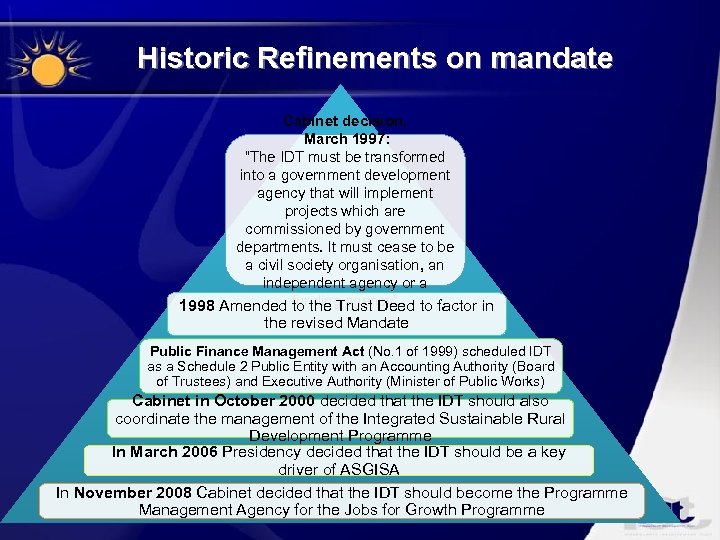
Historic Refinements on mandate Cabinet decision, March 1997: “The IDT must be transformed into a government development agency that will implement projects which are commissioned by government departments. It must cease to be a civil society organisation, an independent agency or a funding agency” 1998 Amended to the Trust Deed to factor in the revised Mandate Public Finance Management Act (No. 1 of 1999) scheduled IDT as a Schedule 2 Public Entity with an Accounting Authority (Board of Trustees) and Executive Authority (Minister of Public Works) Cabinet in October 2000 decided that the IDT should also coordinate the management of the Integrated Sustainable Rural Development Programme In March 2006 Presidency decided that the IDT should be a key driver of ASGISA In November 2008 Cabinet decided that the IDT should become the Programme Management Agency for the Jobs for Growth Programme
Corporate Form Options and analysis
The Trust If It isn't broken why fix it?
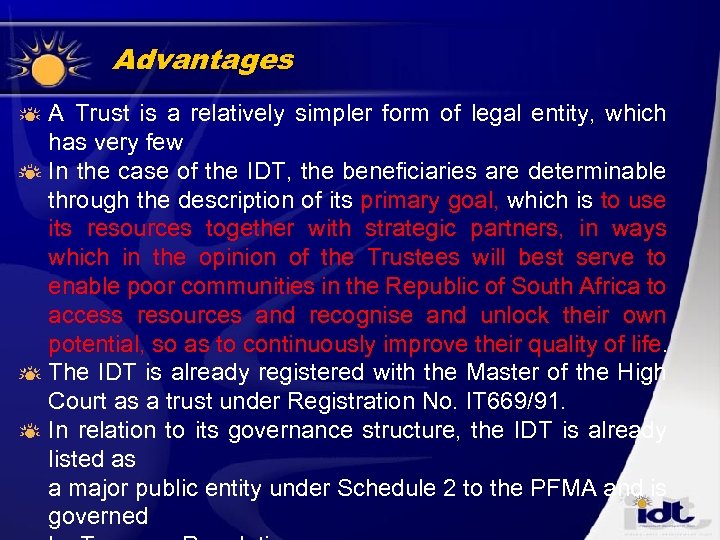
Advantages A Trust is a relatively simpler form of legal entity, which has very few In the case of the IDT, the beneficiaries are determinable through the description of its primary goal, which is to use its resources together with strategic partners, in ways which in the opinion of the Trustees will best serve to enable poor communities in the Republic of South Africa to access resources and recognise and unlock their own potential, so as to continuously improve their quality of life. The IDT is already registered with the Master of the High Court as a trust under Registration No. IT 669/91. In relation to its governance structure, the IDT is already listed as a major public entity under Schedule 2 to the PFMA and is governed
Disadvantages “Classification Framework and Corporate Forms”, the National Treasury lists amongst what are termed “Prohibited Corporate Forms”, Trusts established in terms of the Trust Property Control Act. “Independence” of Trustees --- Deed and the shareholders compact, all of which are further subject to the PFMA. Consequently, the National Treasury concludes, inter alia, that “given the logical moves by the Government to make the IDT more accountable and align its activities with the national development agenda, the continuation of
Conclusions The IDT can in the short term maintain its Trust Status but in the long run this must be shed with no implications on the name

Non Profit Company To the benefit of society…
Advantages The New Act introduces new terminology and categorises companies as non profit and profit companies. To a large extent the rules on how a company must state and use its name and what must be included as part of the name remain the same. As an example, a non-profit company must have “NPC” as part of its name. Companies will still have to describe themselves with reference to the category they fall into. Whether the IDT proceeds with a NPC or remain a Trust, it makes no difference from a tax perspective provided that the entity complies with the provisions of the Non Profit Organisation Act 71 of 1997 read with the Income Tax Act 58 of 1962 to qualify for tax exemption in terms of the Income Tax Act.
Disadvantages and Conclusions The fact that it may now be much simpler to form a Non. Profit Company may not necessarily be an issue in the bigger scheme of things. This is more so, when one considers that there are no real benefits that the IDT would derive from such a legal structure, which it could not derive from its current legal structure as a trust. The fact that there would be directors, instead of trustees does not give the IDT any added benefit. The PFMA still prevails over the New Companies Act.
Schedule 2 Public with Enabling To the benefit of the entire public service…
Advantages The process of creating the entity in question becomes a result of a comprehensive consultation process; Once a bill becomes an act of Parliament, its provisions cannot be amended easily or frequently, as would be the case with an agreement such as the Deed or memorandum of incorporation; Even if the enabling legislation were to be amended, this should not always affect the main object of the Act The enabling legislation should at least create a high degree of certainty with regards to the relationship between the Schedule 2 public entity and its line ministry as well as other Government departments
Disadvantages Schedule 2 public entities are largely required to be selffunding entities. They may still be funded from the fiscus by means of grants but they are expected to raise their own funding. The process of establishing a Schedule 2 public entity governed by its own enabling legislation can be rather protracted, Furthermore, the IDT should take note of the National Treasury’s cautionary remarks against the IDT trying to keep its Schedule 2 PFMA status.
Conclusions The IDT given the proposed mandate, scope and agility could be secured if we were to opt for this with reporting lines to transversal Department such as Public Works, DPSA, Treasury and Presidency
Legislative Process Cabinet Memo Discussion document, known as the green paper be drafted by the line ministry White Paper Draft Bill Furthermore, a memorandum explaining the objects of the proposed legislation is required from the Minister. Joint Tagging Mechanism (“JTM”) for classification in terms of the rules of Parliament. (sec 75 & 76)
Schedule 3 Public with Enabling To the benefit of the entire public service…
Advantages and Disadvantages The possible advantages and disadvantages of a Schedule 3 public entity are similar to those of a Schedule 2 public entity. Please also refer to the discussion of the legislative process. The main differentiating factor between Schedule 2 and Schedule 3 public entities is the nature or type of functions these public entities perform and the financing mechanisms. We briefly discuss some of the examples of these entities below, namely IDC, DBSA, SITA, and the South African Civil Aviation Authority. These entities have been selected at random, simply to illustrate the nature of Schedule 2 and Schedule 3 public entities, including their functions, funding mechanism and line ministries respectively. In the case of the DBSA, the aim is also to illustrate the point about IDT’s cross-cutting mandate.
Our recommendation By virtue of the type of services offered by the IDT, visa-vis schedule 3 public entities, which mainly focus on regulatory and research work, we recommend that the IDT be listed as a schedule 2 public entity with its own enabling legislation. As already alluded to above, this means that should its Business Case be approved, of becoming a schedule 2 public entity with its own enabling legislation, it would then, in the main, be expected and required to finance its own operations. The Business case does address in crystal clear terms, how the IDT intends meeting this obligation. Consider 70/30 funding mechanisms as with the research institutions and bodies
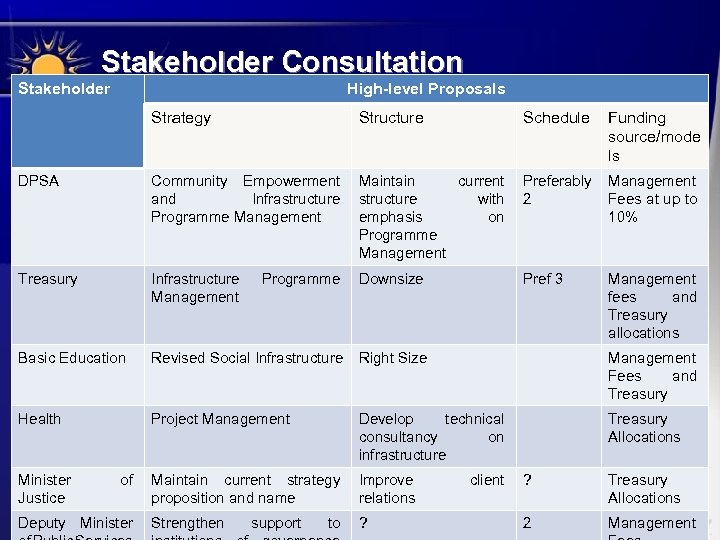
Stakeholder Consultation Stakeholder High-level Proposals Strategy Structure Schedule Funding source/mode ls DPSA Community Empowerment Maintain current Preferably Management and Infrastructure with 2 Fees at up to Programme Management emphasis on 10% Programme Management Treasury Infrastructure Management Basic Education Revised Social Infrastructure Right Size Management Fees and Treasury Health Project Management Develop technical consultancy on infrastructure Treasury Allocations Minister Justice Programme Downsize of Maintain current strategy Improve proposition and name relations Deputy Minister Strengthen support to ? Pref 3 client ? 2 Management fees and Treasury allocations Treasury Allocations Management
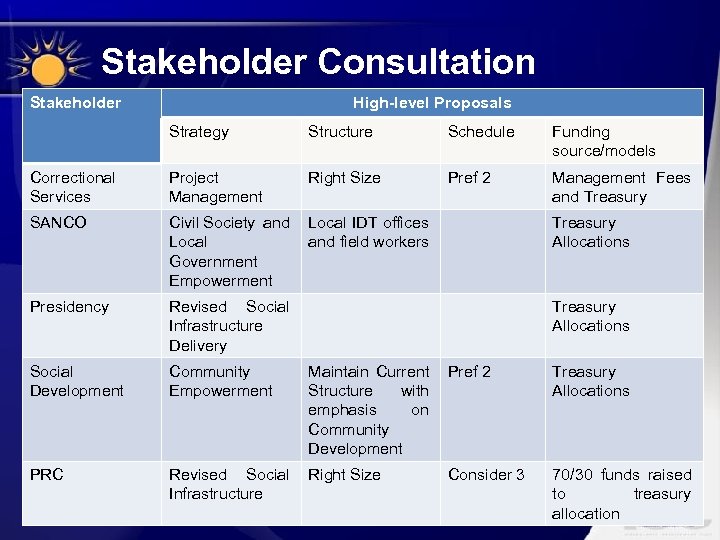
Stakeholder Consultation Stakeholder High-level Proposals Strategy Structure Schedule Funding source/models Correctional Services Project Management Right Size Pref 2 Management Fees and Treasury SANCO Civil Society and Local IDT offices Local and field workers Government Empowerment Treasury Allocations Presidency Revised Social Infrastructure Delivery Treasury Allocations Social Development Community Empowerment PRC Revised Social Right Size Infrastructure Maintain Current Pref 2 Structure with emphasis on Community Development Consider 3 Treasury Allocations 70/30 funds raised to treasury allocation
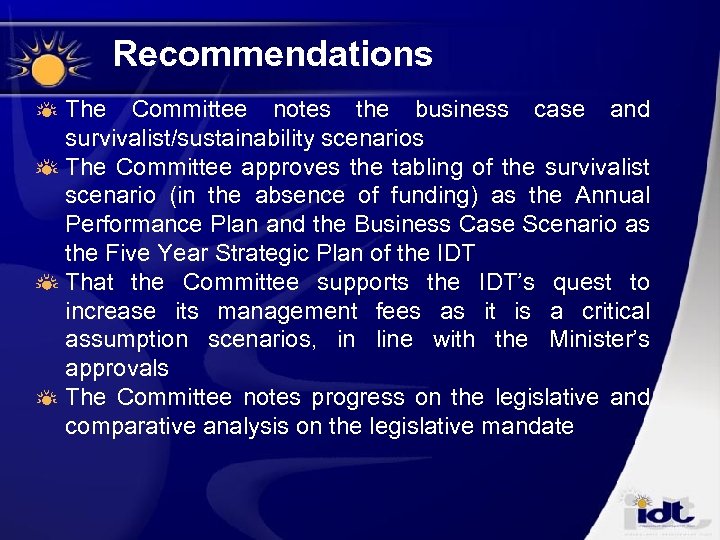
Recommendations The Committee notes the business case and survivalist/sustainability scenarios The Committee approves the tabling of the survivalist scenario (in the absence of funding) as the Annual Performance Plan and the Business Case Scenario as the Five Year Strategic Plan of the IDT That the Committee supports the IDT’s quest to increase its management fees as it is a critical assumption scenarios, in line with the Minister’s approvals The Committee notes progress on the legislative and comparative analysis on the legislative mandate
Скачать презентацию Independent Development Trust PORTFOLIO COMMITTEE ON PUBLIC WORKS
71c34345ce97a560fe0564a592cfcf11.ppt