 Скачать презентацию Independent advice to government on building a low-carbon
71a5115ef8acf06eb13fc3be8e4b49e3.ppt
- Количество слайдов: 60



Independent advice to government on building a low-carbon economy and preparing for climate change Monitoring and evaluating the National Adaptation Programme People and the built environment theme: • • • Flood risk management and climate change Coastal change Household water use Public health and wellbeing Emergency management Last updated: 23 June 2017
Introduction This slidepack: Serves as a technical annex to Chapter 4: People and the built environment in the ASC’s second statutory report to Parliament on the National Adaptation Programme, available at www. theccc. org. uk/publications Provides the latest trend information on indicators of exposure, vulnerability, action and realised impacts that informed the ASC’s assessment. Will be updated periodically as new data becomes available. Highlights indicators that would be useful but where the necessary datasets have not yet been identified. Follows the structure of the people and built environment chapter in the ASC’s progress report, which is based on the ‘adaptation priorities’ the ASC identified. This annex sets out the underlying indicator data by adaptation priority. 2
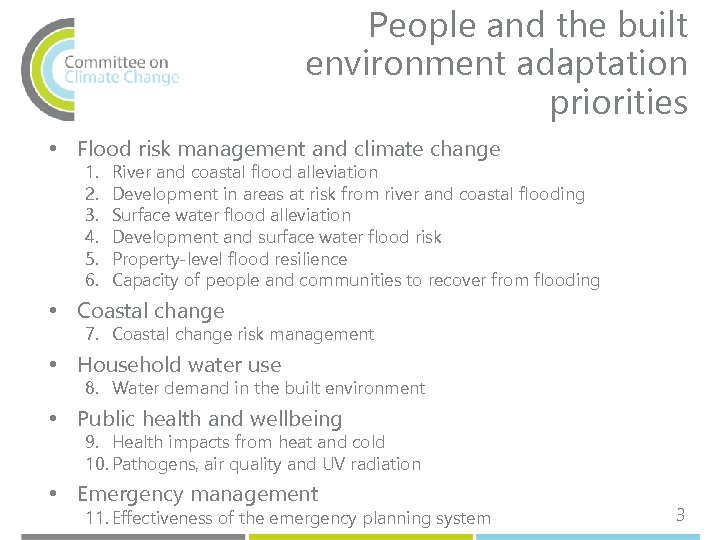
People and the built environment adaptation priorities • Flood risk management and climate change 1. 2. 3. 4. 5. 6. River and coastal flood alleviation Development in areas at risk from river and coastal flooding Surface water flood alleviation Development and surface water flood risk Property-level flood resilience Capacity of people and communities to recover from flooding • Coastal change 7. Coastal change risk management • Household water use 8. Water demand in the built environment • Public health and wellbeing 9. Health impacts from heat and cold 10. Pathogens, air quality and UV radiation • Emergency management 11. Effectiveness of the emergency planning system 3
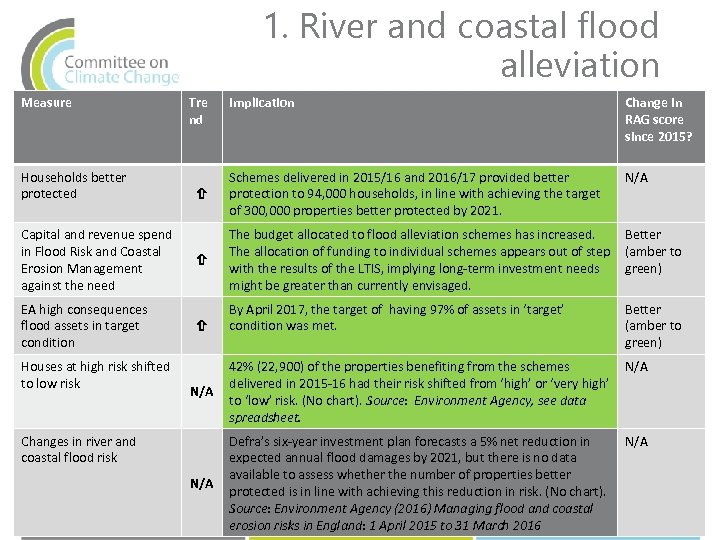
1. River and coastal flood alleviation Measure Households better protected Capital and revenue spend in Flood Risk and Coastal Erosion Management against the need EA high consequences flood assets in target condition Houses at high risk shifted to low risk Tre nd Implication Change in RAG score since 2015? N/A Schemes delivered in 2015/16 and 2016/17 provided better protection to 94, 000 households, in line with achieving the target of 300, 000 properties better protected by 2021. The budget allocated to flood alleviation schemes has increased. The allocation of funding to individual schemes appears out of step with the results of the LTIS, implying long-term investment needs might be greater than currently envisaged. Better (amber to green) By April 2017, the target of having 97% of assets in ‘target’ condition was met. Better (amber to green) N/A 42% (22, 900) of the properties benefiting from the schemes delivered in 2015 -16 had their risk shifted from ‘high’ or ‘very high’ to ‘low’ risk. (No chart). Source: Environment Agency, see data spreadsheet. N/A Defra’s six-year investment plan forecasts a 5% net reduction in expected annual flood damages by 2021, but there is no data available to assess whether the number of properties better protected is in line with achieving this reduction in risk. (No chart). Source: Environment Agency (2016) Managing flood and coastal erosion risks in England: 1 April 2015 to 31 March 2016 Changes in river and coastal flood risk
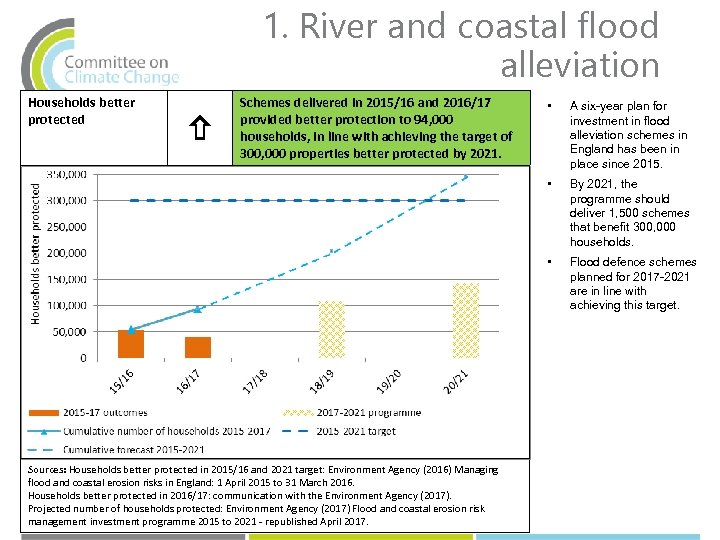
1. River and coastal flood alleviation Households better protected Schemes delivered in 2015/16 and 2016/17 provided better protection to 94, 000 households, in line with achieving the target of 300, 000 properties better protected by 2021. By 2021, the programme should deliver 1, 500 schemes that benefit 300, 000 households. • Sources: Households better protected in 2015/16 and 2021 target: Environment Agency (2016) Managing flood and coastal erosion risks in England: 1 April 2015 to 31 March 2016. Households better protected in 2016/17: communication with the Environment Agency (2017). Projected number of households protected: Environment Agency (2017) Flood and coastal erosion risk management investment programme 2015 to 2021 - republished April 2017. A six-year plan for investment in flood alleviation schemes in England has been in place since 2015. • • Flood defence schemes planned for 2017 -2021 are in line with achieving this target.
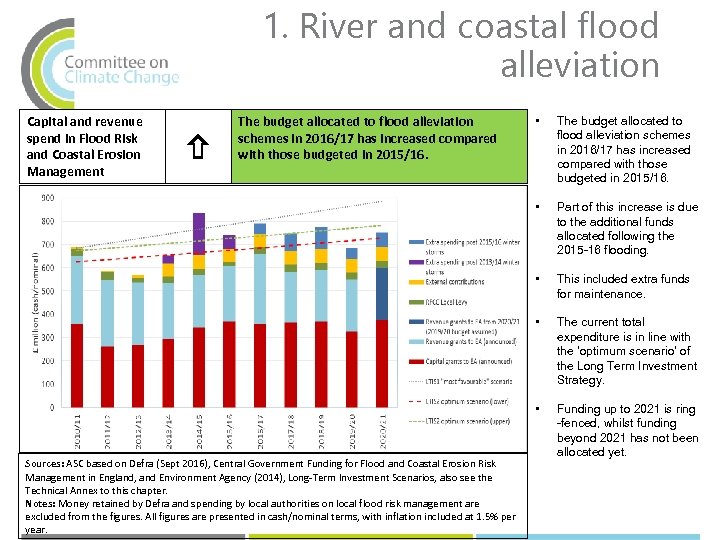
1. River and coastal flood alleviation Capital and revenue spend in Flood Risk and Coastal Erosion Management The budget allocated to flood alleviation schemes in 2016/17 has increased compared with those budgeted in 2015/16. Part of this increase is due to the additional funds allocated following the 2015 -16 flooding. • This included extra funds for maintenance. • The current total expenditure is in line with the ‘optimum scenario’ of the Long Term Investment Strategy. • Sources: ASC based on Defra (Sept 2016), Central Government Funding for Flood and Coastal Erosion Risk Management in England, and Environment Agency (2014), Long-Term Investment Scenarios, also see the Technical Annex to this chapter. Notes: Money retained by Defra and spending by local authorities on local flood risk management are excluded from the figures. All figures are presented in cash/nominal terms, with inflation included at 1. 5% per year. The budget allocated to flood alleviation schemes in 2016/17 has increased compared with those budgeted in 2015/16. • • Funding up to 2021 is ring -fenced, whilst funding beyond 2021 has not been allocated yet.
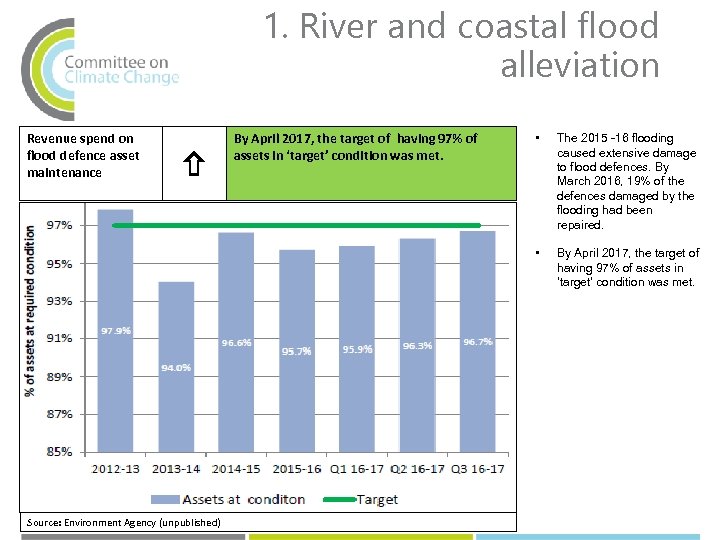
1. River and coastal flood alleviation Revenue spend on flood defence asset maintenance By April 2017, the target of having 97% of assets in ‘target’ condition was met. To be updated Source: Environment Agency (unpublished) The 2015 -16 flooding caused extensive damage to flood defences. By March 2016, 19% of the defences damaged by the flooding had been repaired. • • By April 2017, the target of having 97% of assets in ‘target’ condition was met.
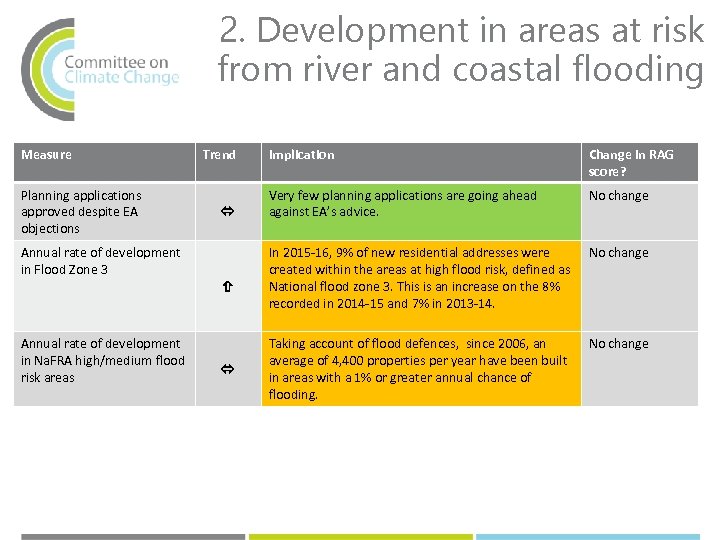
2. Development in areas at risk from river and coastal flooding Measure Planning applications approved despite EA objections Trend Annual rate of development in Flood Zone 3 Annual rate of development in Na. FRA high/medium flood risk areas Implication Change in RAG score? Very few planning applications are going ahead against EA’s advice. No change In 2015 -16, 9% of new residential addresses were created within the areas at high flood risk, defined as National flood zone 3. This is an increase on the 8% recorded in 2014 -15 and 7% in 2013 -14. No change Taking account of flood defences, since 2006, an average of 4, 400 properties per year have been built in areas with a 1% or greater annual chance of flooding. No change
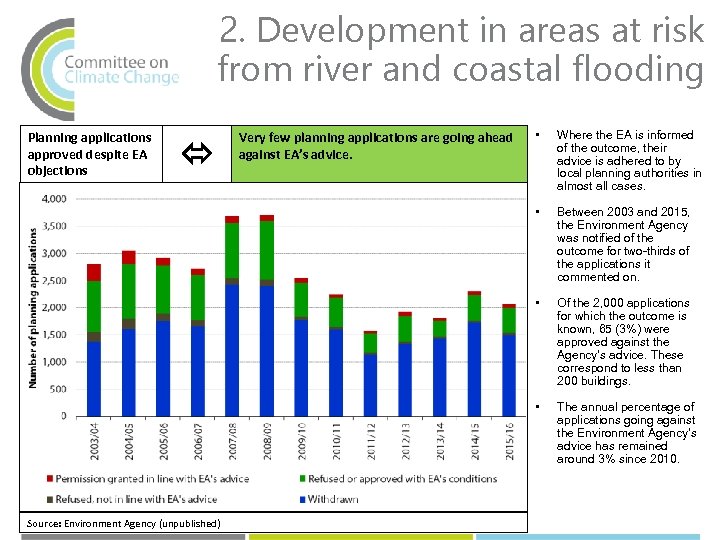
2. Development in areas at risk from river and coastal flooding Between 2003 and 2015, the Environment Agency was notified of the outcome for two-thirds of the applications it commented on. Of the 2, 000 applications for which the outcome is known, 65 (3%) were approved against the Agency’s advice. These correspond to less than 200 buildings. • Source: Environment Agency (unpublished) Where the EA is informed of the outcome, their advice is adhered to by local planning authorities in almost all cases. • Very few planning applications are going ahead against EA’s advice. • • Planning applications approved despite EA objections The annual percentage of applications going against the Environment Agency’s advice has remained around 3% since 2010.
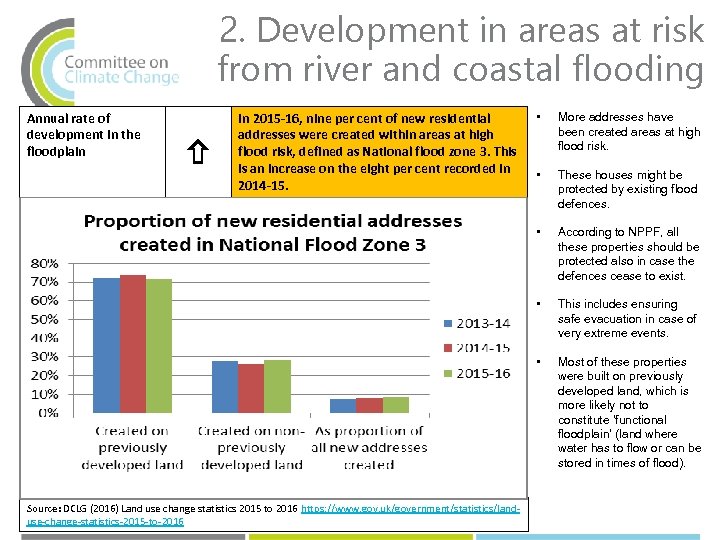
2. Development in areas at risk from river and coastal flooding Annual rate of development in the floodplain In 2015 -16, nine per cent of new residential addresses were created within areas at high flood risk, defined as National flood zone 3. This is an increase on the eight per cent recorded in 2014 -15. • These houses might be protected by existing flood defences. According to NPPF, all these properties should be protected also in case the defences cease to exist. • This includes ensuring safe evacuation in case of very extreme events. • Source: DCLG (2016) Land use change statistics 2015 to 2016 https: //www. gov. uk/government/statistics/landuse-change-statistics-2015 -to-2016 More addresses have been created areas at high flood risk. • • Most of these properties were built on previously developed land, which is more likely not to constitute ‘functional floodplain’ (land where water has to flow or can be stored in times of flood).
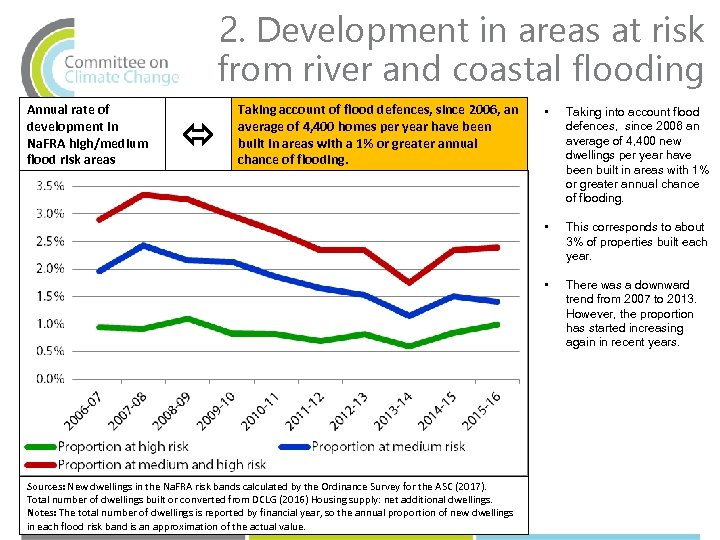
2. Development in areas at risk from river and coastal flooding Annual rate of development in Na. FRA high/medium flood risk areas Taking account of flood defences, since 2006, an average of 4, 400 homes per year have been built in areas with a 1% or greater annual chance of flooding. This corresponds to about 3% of properties built each year. • Sources: New dwellings in the Na. FRA risk bands calculated by the Ordinance Survey for the ASC (2017). Total number of dwellings built or converted from DCLG (2016) Housing supply: net additional dwellings. Notes: The total number of dwellings is reported by financial year, so the annual proportion of new dwellings in each flood risk band is an approximation of the actual value. Taking into account flood defences, since 2006 an average of 4, 400 new dwellings per year have been built in areas with 1% or greater annual chance of flooding. • • There was a downward trend from 2007 to 2013. However, the proportion has started increasing again in recent years.
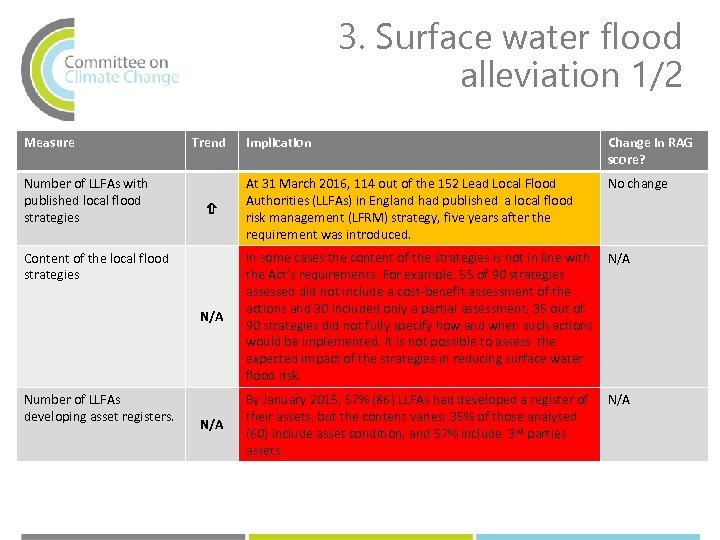
3. Surface water flood alleviation 1/2 Measure Implication Change in RAG score? At 31 March 2016, 114 out of the 152 Lead Local Flood Authorities (LLFAs) in England had published a local flood risk management (LFRM) strategy, five years after the requirement was introduced. No change In some cases the content of the strategies is not in line with the Act’s requirements. For example, 55 of 90 strategies assessed did not include a cost-benefit assessment of the actions and 30 included only a partial assessment. 35 out of 90 strategies did not fully specify how and when such actions would be implemented. It is not possible to assess the expected impact of the strategies in reducing surface water flood risk. N/A Number of LLFAs with published local flood strategies Trend N/A By January 2015, 57% (86) LLFAs had developed a register of their assets, but the content varies: 35% of those analysed (60) include asset condition, and 57% include 3 rd parties assets. Content of the local flood strategies Number of LLFAs developing asset registers.
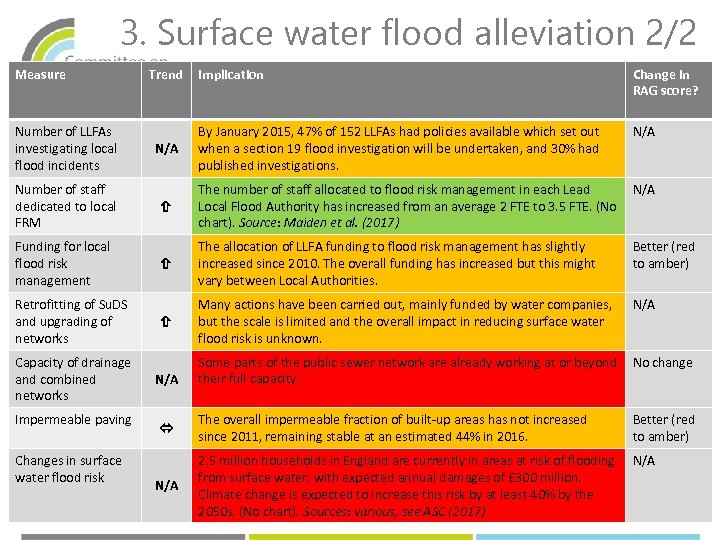
3. Surface water flood alleviation 2/2 Measure Number of LLFAs investigating local flood incidents Number of staff dedicated to local FRM Funding for local flood risk management Retrofitting of Su. DS and upgrading of networks Capacity of drainage and combined networks Impermeable paving Changes in surface water flood risk Trend Implication Change in RAG score? By January 2015, 47% of 152 LLFAs had policies available which set out when a section 19 flood investigation will be undertaken, and 30% had published investigations. N/A The number of staff allocated to flood risk management in each Lead Local Flood Authority has increased from an average 2 FTE to 3. 5 FTE. (No chart). Source: Maiden et al. (2017) The allocation of LLFA funding to flood risk management has slightly increased since 2010. The overall funding has increased but this might vary between Local Authorities. Better (red to amber) N/A Many actions have been carried out, mainly funded by water companies, but the scale is limited and the overall impact in reducing surface water flood risk is unknown. Some parts of the public sewer network are already working at or beyond their full capacity. No change The overall impermeable fraction of built-up areas has not increased since 2011, remaining stable at an estimated 44% in 2016. Better (red to amber) 2. 5 million households in England are currently in areas at risk of flooding from surface water, with expected annual damages of £ 300 million. Climate change is expected to increase this risk by at least 40% by the 2050 s. (No chart). Sources: various, see ASC (2017) N/A N/A
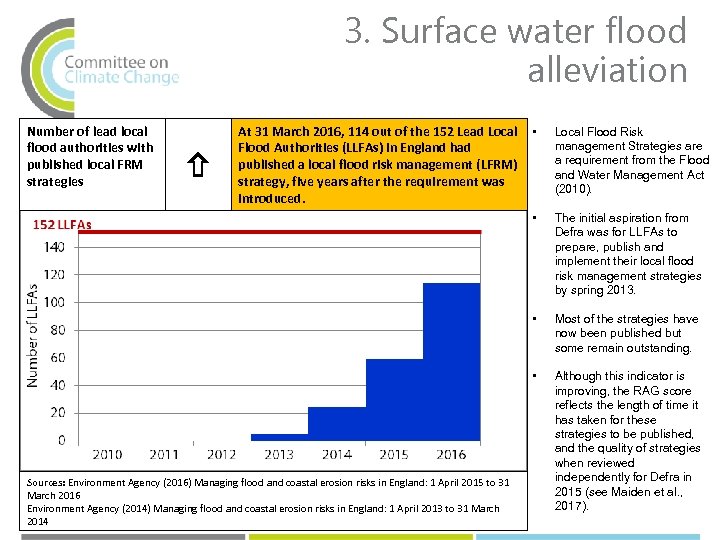
3. Surface water flood alleviation Number of lead local flood authorities with published local FRM strategies At 31 March 2016, 114 out of the 152 Lead Local Flood Authorities (LLFAs) in England had published a local flood risk management (LFRM) strategy, five years after the requirement was introduced. The initial aspiration from Defra was for LLFAs to prepare, publish and implement their local flood risk management strategies by spring 2013. • Most of the strategies have now been published but some remain outstanding. • Sources: Environment Agency (2016) Managing flood and coastal erosion risks in England: 1 April 2015 to 31 March 2016 Environment Agency (2014) Managing flood and coastal erosion risks in England: 1 April 2013 to 31 March 2014 Local Flood Risk management Strategies are a requirement from the Flood and Water Management Act (2010). • • Although this indicator is improving, the RAG score reflects the length of time it has taken for these strategies to be published, and the quality of strategies when reviewed independently for Defra in 2015 (see Maiden et al. , 2017).
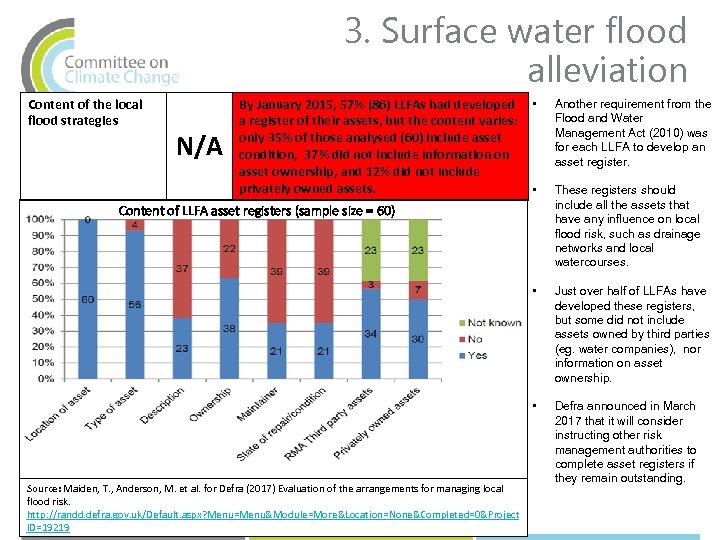
3. Surface water flood alleviation Content of the local flood strategies By January 2015, 57% (86) LLFAs had developed a register of their assets, but the content varies: only 35% of those analysed (60) include asset condition, 37% did not include information on asset ownership, and 12% did not include privately owned assets. Another requirement from the Flood and Water Management Act (2010) was for each LLFA to develop an asset register. • These registers should include all the assets that have any influence on local flood risk, such as drainage networks and local watercourses. • Just over half of LLFAs have developed these registers, but some did not include assets owned by third parties (eg. water companies), nor information on asset ownership. • N/A • Defra announced in March 2017 that it will consider instructing other risk management authorities to complete asset registers if they remain outstanding. Content of LLFA asset registers (sample size = 60) Source: Maiden, T. , Anderson, M. et al. for Defra (2017) Evaluation of the arrangements for managing local flood risk. http: //randd. defra. gov. uk/Default. aspx? Menu=Menu&Module=More&Location=None&Completed=0&Project ID=19219
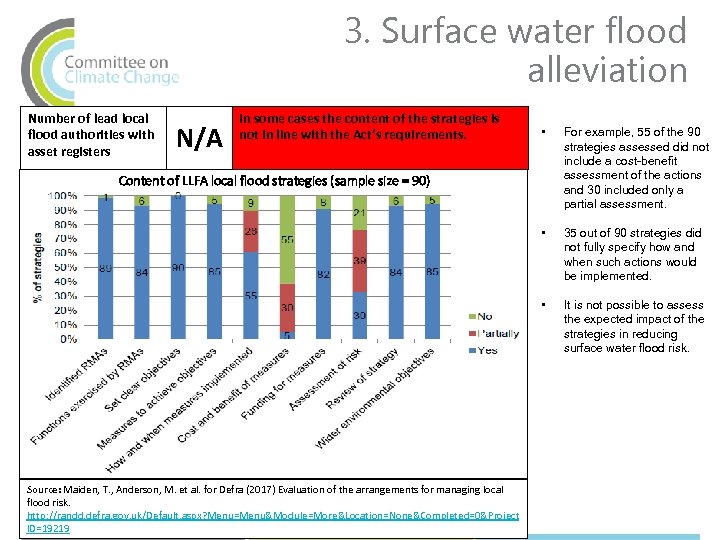
3. Surface water flood alleviation Number of lead local flood authorities with asset registers N/A In some cases the content of the strategies is not in line with the Act’s requirements. • For example, 55 of the 90 strategies assessed did not include a cost-benefit assessment of the actions and 30 included only a partial assessment. • 35 out of 90 strategies did not fully specify how and when such actions would be implemented. • It is not possible to assess the expected impact of the strategies in reducing surface water flood risk. Content of LLFA local flood strategies (sample size = 90) Source: Maiden, T. , Anderson, M. et al. for Defra (2017) Evaluation of the arrangements for managing local flood risk. http: //randd. defra. gov. uk/Default. aspx? Menu=Menu&Module=More&Location=None&Completed=0&Project ID=19219
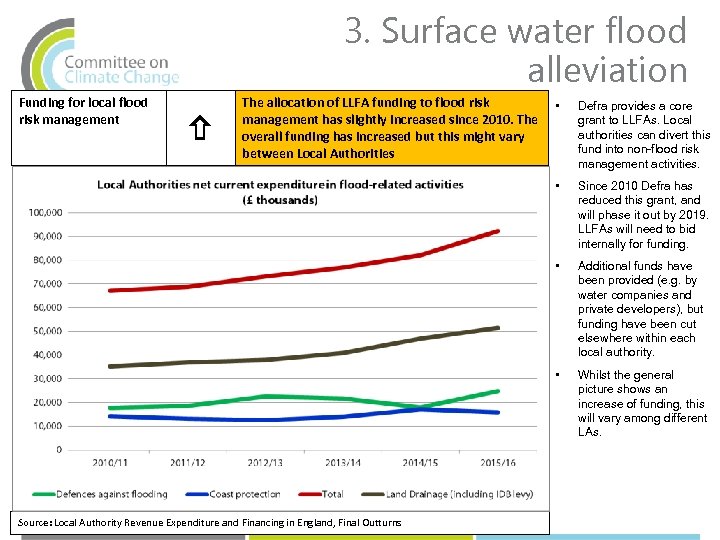
3. Surface water flood alleviation Funding for local flood risk management The allocation of LLFA funding to flood risk management has slightly increased since 2010. The overall funding has increased but this might vary between Local Authorities Since 2010 Defra has reduced this grant, and will phase it out by 2019. LLFAs will need to bid internally for funding. • Additional funds have been provided (e. g. by water companies and private developers), but funding have been cut elsewhere within each local authority. • Source: Local Authority Revenue Expenditure and Financing in England, Final Outturns Defra provides a core grant to LLFAs. Local authorities can divert this fund into non-flood risk management activities. • • Whilst the general picture shows an increase of funding, this will vary among different LAs.
3. Surface water flood alleviation In urban areas, rainfall is drained into stormwater or combined sewer networks, which constitute the public sewer network owned by water companies. • Any rainfall exceeding the ‘design flooding return period’ of the network would cause surface water flooding. For new networks, the design flood return period is 1 -in-30 with no allowance for climate change. • N/A Some parts of the public sewer network are already working at or beyond their full capacity. Even assuming no additional load from new buildings, climate change is going to increase the chance of flooding by one third (medium emissions scenario, 50 th percentile). • • Capacity of combined and drainage systems Whilst some networks exceed this design criteria, most of the network in England was built before this standard was in place. Much of the public sewer network is 50 or more years old. • A 2015 survey from Pw. C concluded that this design flood is considered to be exceeded “relatively frequently”. No chart Sources: ASC (2015) Progress on preparing for climate change, https: //www. theccc. org. uk/publication/reducing-emissions-and-preparing-for-climate-change-2015 progress-report-to-parliament 21 st Century Drainage Programme (2016) Protecting health, supporting communities, securing the environment now and for the future, https: //dl. dropboxusercontent. com/u/299993612/Publications/21 st%20 Century%20 Drainage/21 st%20 Cent ury%20 Drainage. pdf Pw. C (2015) for Ofwat. Balance of risk: Risk and reward across the water and sewerage value chain, https: //www. ofwat. gov. uk/wp-content/uploads/2015/12/rpt_com 201512 pwcrisk. pdf
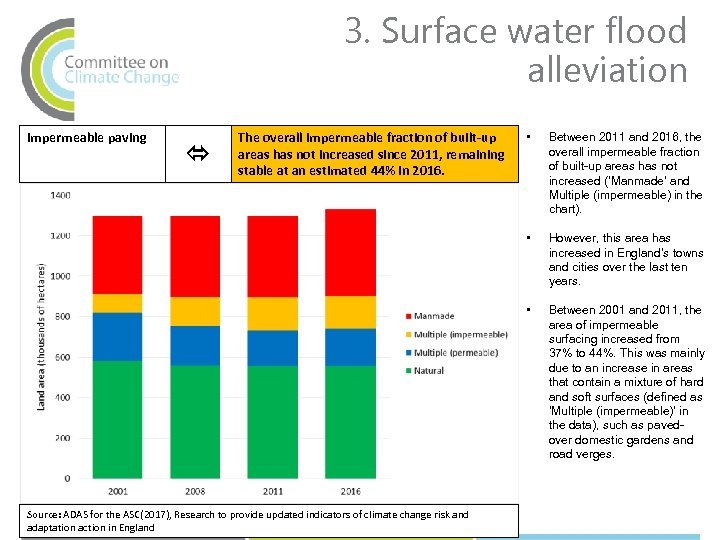
3. Surface water flood alleviation Impermeable paving The overall impermeable fraction of built-up areas has not increased since 2011, remaining stable at an estimated 44% in 2016. However, this area has increased in England’s towns and cities over the last ten years. • Source: ADAS for the ASC(2017), Research to provide updated indicators of climate change risk and adaptation action in England Between 2011 and 2016, the overall impermeable fraction of built-up areas has not increased (‘Manmade’ and Multiple (impermeable) in the chart). • • Between 2001 and 2011, the area of impermeable surfacing increased from 37% to 44%. This was mainly due to an increase in areas that contain a mixture of hard and soft surfaces (defined as ‘Multiple (impermeable)’ in the data), such as pavedover domestic gardens and road verges.
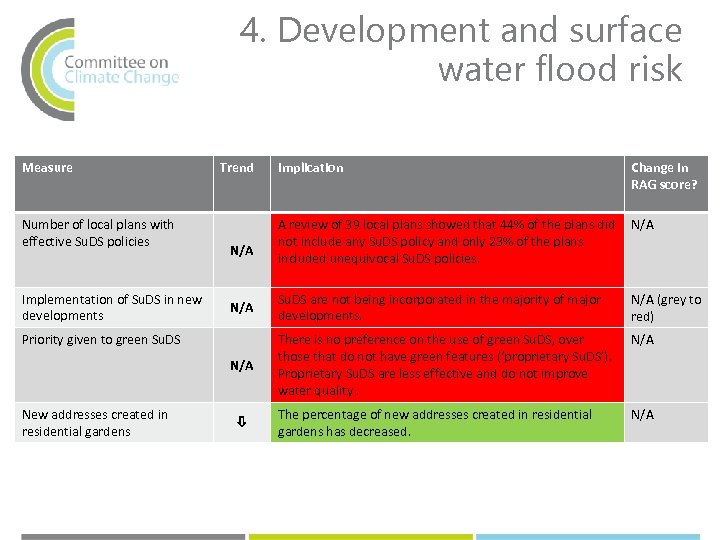
4. Development and surface water flood risk Measure Implementation of Su. DS in new developments Implication Change in RAG score? A review of 39 local plans showed that 44% of the plans did not include any Su. DS policy and only 23% of the plans included unequivocal Su. DS policies. N/A Su. DS are not being incorporated in the majority of major developments. N/A (grey to red) There is no preference on the use of green Su. DS, over those that do not have green features (‘proprietary Su. DS’). Proprietary Su. DS are less effective and do not improve water quality. N/A Number of local plans with effective Su. DS policies Trend The percentage of new addresses created in residential gardens has decreased. N/A Priority given to green Su. DS New addresses created in residential gardens
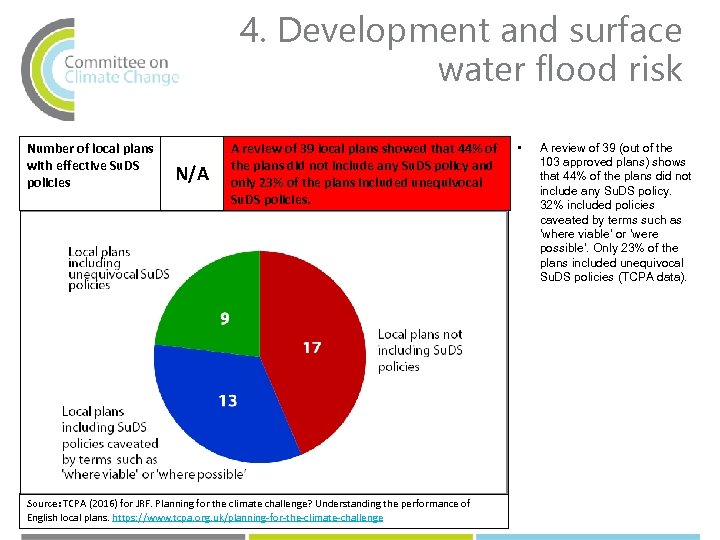
4. Development and surface water flood risk Number of local plans with effective Su. DS policies N/A A review of 39 local plans showed that 44% of the plans did not include any Su. DS policy and only 23% of the plans included unequivocal Su. DS policies. Source: TCPA (2016) for JRF. Planning for the climate challenge? Understanding the performance of English local plans. https: //www. tcpa. org. uk/planning-for-the-climate-challenge • A review of 39 (out of the 103 approved plans) shows that 44% of the plans did not include any Su. DS policy. 32% included policies caveated by terms such as ‘where viable’ or ‘were possible’. Only 23% of the plans included unequivocal Su. DS policies (TCPA data).
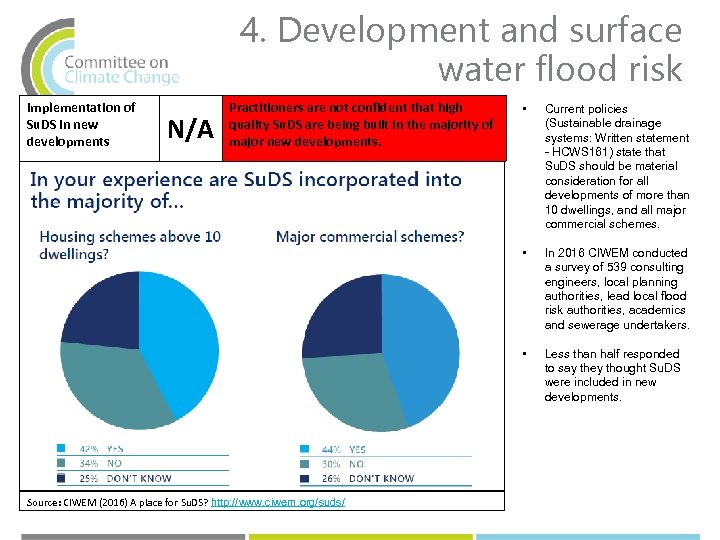
4. Development and surface water flood risk Implementation of Su. DS in new developments Practitioners are not confident that high quality Su. DS are being built in the majority of major new developments. In 2016 CIWEM conducted a survey of 539 consulting engineers, local planning authorities, lead local flood risk authorities, academics and sewerage undertakers. • Source: CIWEM (2016) A place for Su. DS? http: //www. ciwem. org/suds/ Current policies (Sustainable drainage systems: Written statement - HCWS 161) state that Su. DS should be material consideration for all developments of more than 10 dwellings, and all major commercial schemes. • N/A • Less than half responded to say they thought Su. DS were included in new developments.
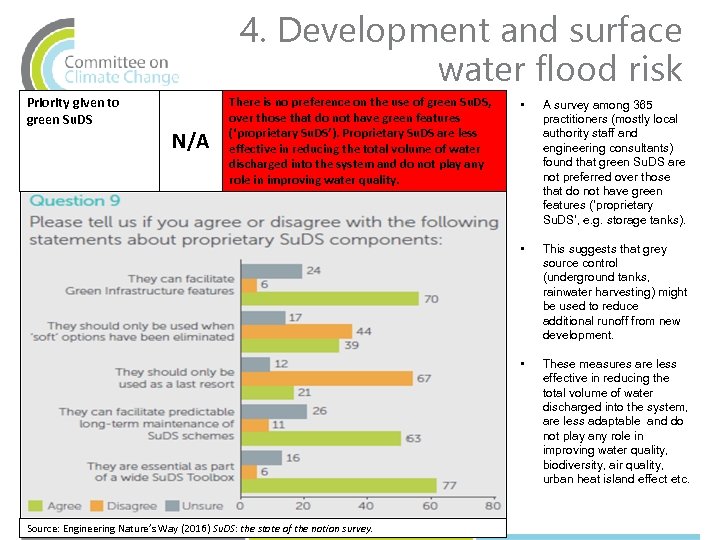
4. Development and surface water flood risk Priority given to green Su. DS There is no preference on the use of green Su. DS, over those that do not have green features (‘proprietary Su. DS’). Proprietary Su. DS are less effective in reducing the total volume of water discharged into the system and do not play any role in improving water quality. Source: Engineering Nature’s Way (2016) Su. DS: the state of the nation survey. This suggests that grey source control (underground tanks, rainwater harvesting) might be used to reduce additional runoff from new development. • (). A survey among 365 practitioners (mostly local authority staff and engineering consultants) found that green Su. DS are not preferred over those that do not have green features (‘proprietary Su. DS’, e. g. storage tanks). • N/A • These measures are less effective in reducing the total volume of water discharged into the system, are less adaptable and do not play any role in improving water quality, biodiversity, air quality, urban heat island effect etc.
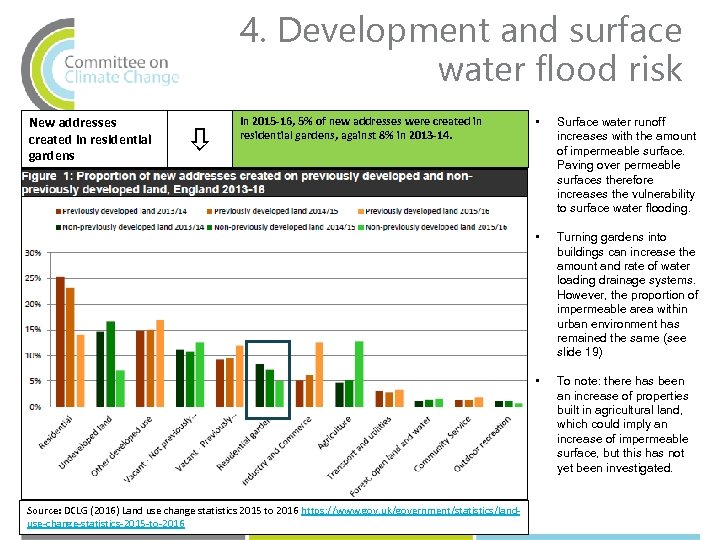
4. Development and surface water flood risk New addresses created in residential gardens In 2015 -16, 5% of new addresses were created in residential gardens, against 8% in 2013 -14. Turning gardens into buildings can increase the amount and rate of water loading drainage systems. However, the proportion of impermeable area within urban environment has remained the same (see slide 19) • Source: DCLG (2016) Land use change statistics 2015 to 2016 https: //www. gov. uk/government/statistics/landuse-change-statistics-2015 -to-2016 Surface water runoff increases with the amount of impermeable surface. Paving over permeable surfaces therefore increases the vulnerability to surface water flooding. • • To note: there has been an increase of properties built in agricultural land, which could imply an increase of impermeable surface, but this has not yet been investigated.
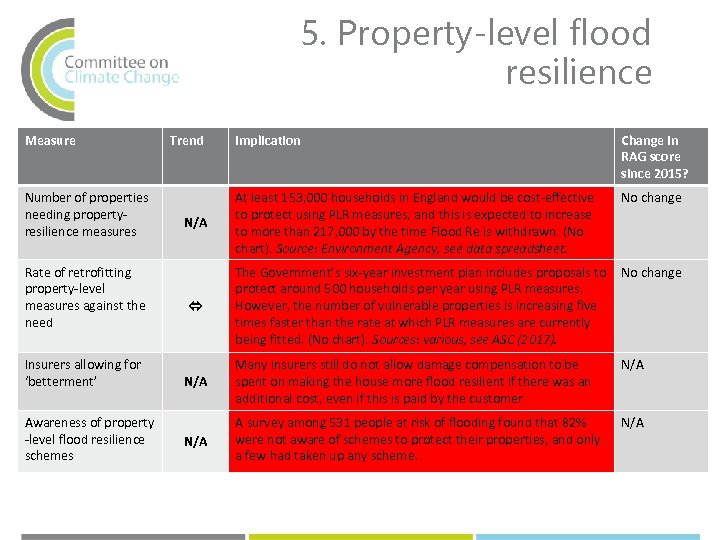
5. Property-level flood resilience Measure Number of properties needing propertyresilience measures Rate of retrofitting property-level measures against the need Insurers allowing for ‘betterment’ Awareness of property -level flood resilience schemes Trend Implication Change in RAG score since 2015? At least 153, 000 households in England would be cost-effective to protect using PLR measures, and this is expected to increase to more than 217, 000 by the time Flood Re is withdrawn. (No chart). Source: Environment Agency, see data spreadsheet. No change The Government’s six-year investment plan includes proposals to protect around 500 households per year using PLR measures. However, the number of vulnerable properties is increasing five times faster than the rate at which PLR measures are currently being fitted. (No chart). Sources: various, see ASC (2017). No change N/A Many insurers still do not allow damage compensation to be spent on making the house more flood resilient if there was an additional cost, even if this is paid by the customer N/A N/A A survey among 531 people at risk of flooding found that 82% were not aware of schemes to protect their properties, and only a few had taken up any scheme. N/A
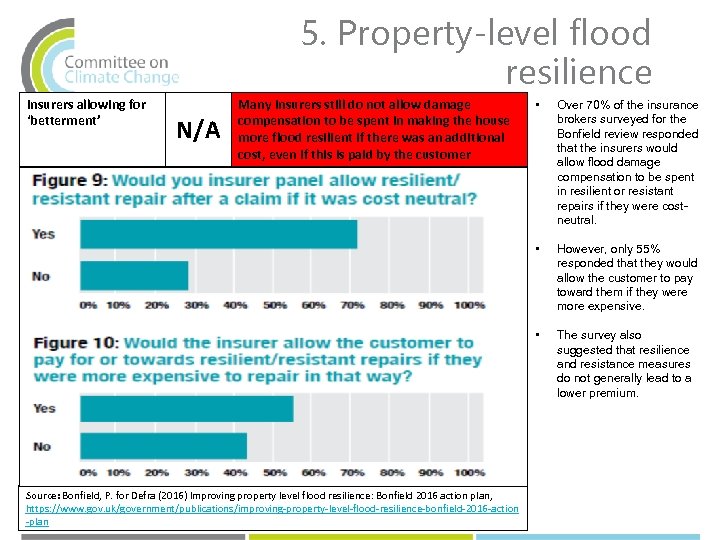
5. Property-level flood resilience Insurers allowing for ‘betterment’ Many insurers still do not allow damage compensation to be spent in making the house more flood resilient if there was an additional cost, even if this is paid by the customer However, only 55% responded that they would allow the customer to pay toward them if they were more expensive. • Source: Bonfield, P. for Defra (2016) Improving property level flood resilience: Bonfield 2016 action plan, https: //www. gov. uk/government/publications/improving-property-level-flood-resilience-bonfield-2016 -action -plan Over 70% of the insurance brokers surveyed for the Bonfield review responded that the insurers would allow flood damage compensation to be spent in resilient or resistant repairs if they were costneutral. • N/A • The survey also suggested that resilience and resistance measures do not generally lead to a lower premium.
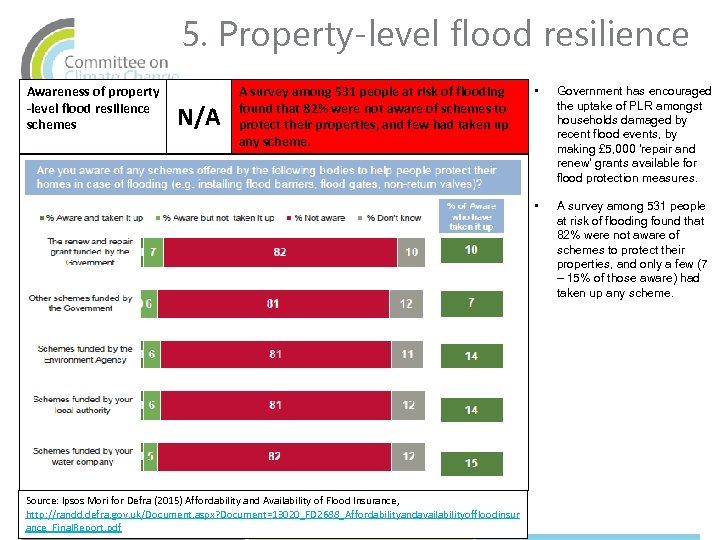
5. Property-level flood resilience Awareness of property -level flood resilience schemes A survey among 531 people at risk of flooding found that 82% were not aware of schemes to protect their properties, and few had taken up any scheme. Source: Ipsos Mori for Defra (2015) Affordability and Availability of Flood Insurance, http: //randd. defra. gov. uk/Document. aspx? Document=13020_FD 2688_Affordabilityandavailabilityoffloodinsur ance_Final. Report. pdf Government has encouraged the uptake of PLR amongst households damaged by recent flood events, by making £ 5, 000 ‘repair and renew’ grants available for flood protection measures. • N/A • A survey among 531 people at risk of flooding found that 82% were not aware of schemes to protect their properties, and only a few (7 – 15% of those aware) had taken up any scheme.
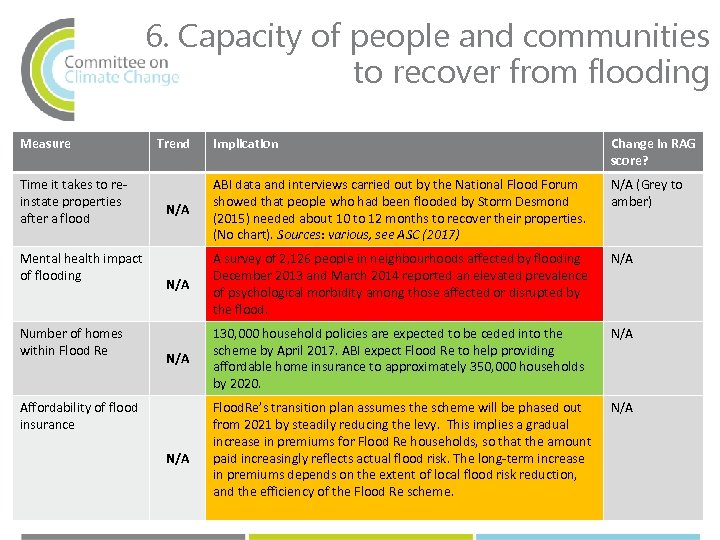
6. Capacity of people and communities to recover from flooding Measure Time it takes to reinstate properties after a flood Mental health impact of flooding Number of homes within Flood Re Trend Implication Change in RAG score? N/A ABI data and interviews carried out by the National Flood Forum showed that people who had been flooded by Storm Desmond (2015) needed about 10 to 12 months to recover their properties. (No chart). Sources: various, see ASC (2017) N/A (Grey to amber) N/A A survey of 2, 126 people in neighbourhoods affected by flooding December 2013 and March 2014 reported an elevated prevalence of psychological morbidity among those affected or disrupted by the flood. N/A 130, 000 household policies are expected to be ceded into the scheme by April 2017. ABI expect Flood Re to help providing affordable home insurance to approximately 350, 000 households by 2020. Flood. Re’s transition plan assumes the scheme will be phased out from 2021 by steadily reducing the levy. This implies a gradual increase in premiums for Flood Re households, so that the amount paid increasingly reflects actual flood risk. The long-term increase in premiums depends on the extent of local flood risk reduction, and the efficiency of the Flood Re scheme. N/A Affordability of flood insurance N/A
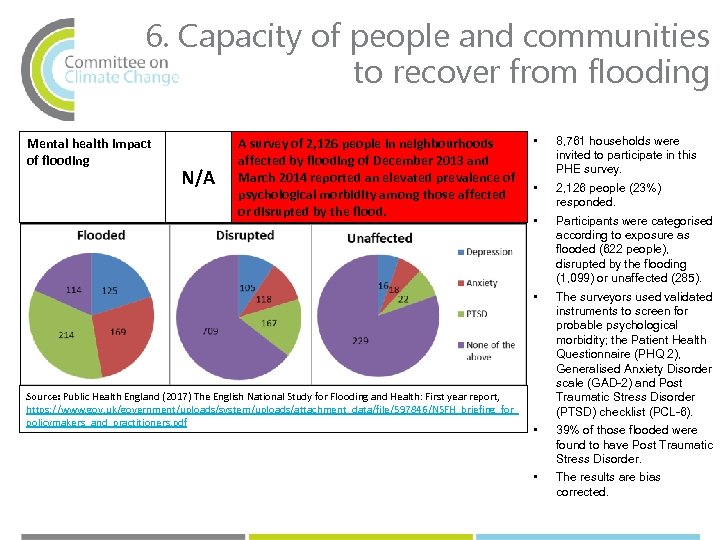
6. Capacity of people and communities to recover from flooding N/A A survey of 2, 126 people in neighbourhoods affected by flooding of December 2013 and March 2014 reported an elevated prevalence of psychological morbidity among those affected or disrupted by the flood. Source: Public Health England (2017) The English National Study for Flooding and Health: First year report, https: //www. gov. uk/government/uploads/system/uploads/attachment_data/file/597846/NSFH_briefing_for_ policymakers_and_practitioners. pdf • 8, 761 households were invited to participate in this PHE survey. • 2, 126 people (23%) responded. • Participants were categorised according to exposure as flooded (622 people), disrupted by the flooding (1, 099) or unaffected (285). • Mental health impact of flooding The surveyors used validated instruments to screen for probable psychological morbidity; the Patient Health Questionnaire (PHQ 2), Generalised Anxiety Disorder scale (GAD-2) and Post Traumatic Stress Disorder (PTSD) checklist (PCL-6). • 39% of those flooded were found to have Post Traumatic Stress Disorder. • The results are bias corrected.
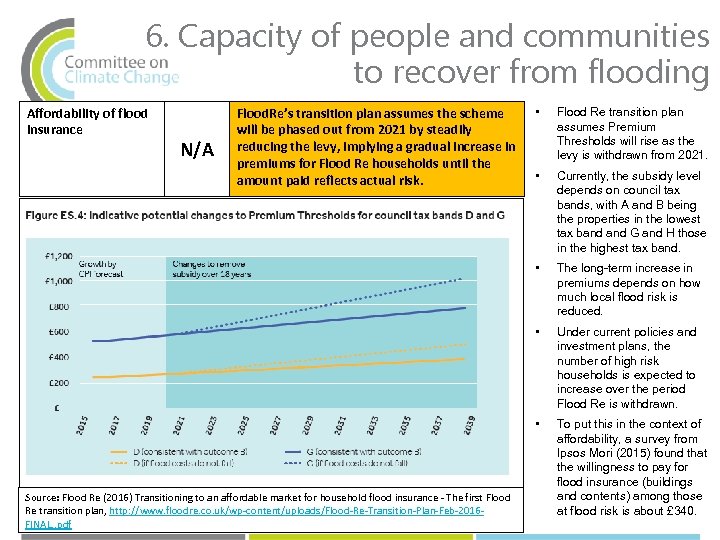
6. Capacity of people and communities to recover from flooding Affordability of flood insurance Flood. Re’s transition plan assumes the scheme will be phased out from 2021 by steadily reducing the levy, implying a gradual increase in premiums for Flood Re households until the amount paid reflects actual risk. • Currently, the subsidy level depends on council tax bands, with A and B being the properties in the lowest tax band G and H those in the highest tax band. The long-term increase in premiums depends on how much local flood risk is reduced. • Under current policies and investment plans, the number of high risk households is expected to increase over the period Flood Re is withdrawn. • Source: Flood Re (2016) Transitioning to an affordable market for household flood insurance - The first Flood Re transition plan, http: //www. floodre. co. uk/wp-content/uploads/Flood-Re-Transition-Plan-Feb-2016 FINAL. . pdf Flood Re transition plan assumes Premium Thresholds will rise as the levy is withdrawn from 2021. • N/A • To put this in the context of affordability, a survey from Ipsos Mori (2015) found that the willingness to pay for flood insurance (buildings and contents) among those at flood risk is about £ 340.
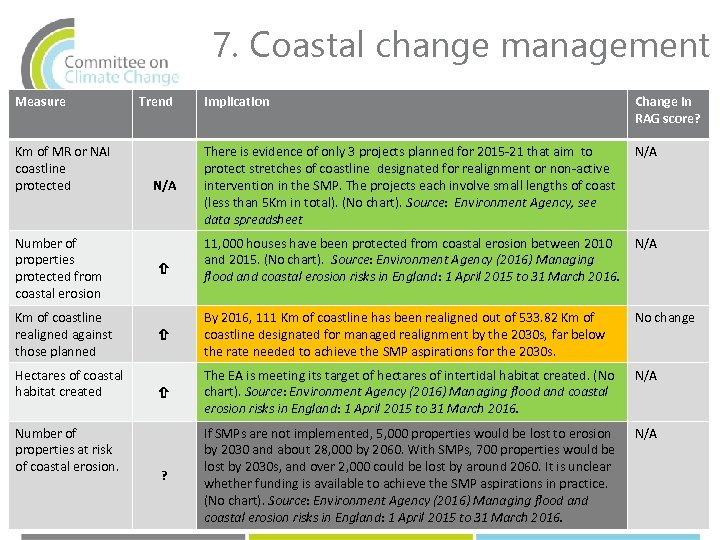
7. Coastal change management Measure Km of MR or NAI coastline protected Number of properties protected from coastal erosion Km of coastline realigned against those planned Hectares of coastal habitat created Number of properties at risk of coastal erosion. Trend Implication Change in RAG score? There is evidence of only 3 projects planned for 2015 -21 that aim to protect stretches of coastline designated for realignment or non-active intervention in the SMP. The projects each involve small lengths of coast (less than 5 Km in total). (No chart). Source: Environment Agency, see data spreadsheet N/A 11, 000 houses have been protected from coastal erosion between 2010 and 2015. (No chart). Source: Environment Agency (2016) Managing flood and coastal erosion risks in England: 1 April 2015 to 31 March 2016. N/A No change By 2016, 111 Km of coastline has been realigned out of 533. 82 Km of coastline designated for managed realignment by the 2030 s, far below the rate needed to achieve the SMP aspirations for the 2030 s. N/A The EA is meeting its target of hectares of intertidal habitat created. (No chart). Source: Environment Agency (2016) Managing flood and coastal erosion risks in England: 1 April 2015 to 31 March 2016. N/A ? If SMPs are not implemented, 5, 000 properties would be lost to erosion by 2030 and about 28, 000 by 2060. With SMPs, 700 properties would be lost by 2030 s, and over 2, 000 could be lost by around 2060. It is unclear whether funding is available to achieve the SMP aspirations in practice. (No chart). Source: Environment Agency (2016) Managing flood and coastal erosion risks in England: 1 April 2015 to 31 March 2016. N/A
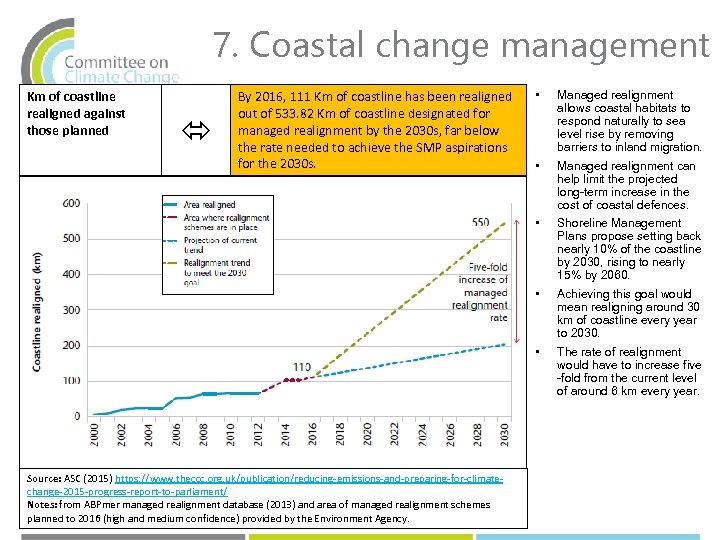
7. Coastal change management • Managed realignment can help limit the projected long-term increase in the cost of coastal defences. Shoreline Management Plans propose setting back nearly 10% of the coastline by 2030, rising to nearly 15% by 2060. Achieving this goal would mean realigning around 30 km of coastline every year to 2030. • Source: ASC (2015) https: //www. theccc. org. uk/publication/reducing-emissions-and-preparing-for-climatechange-2015 -progress-report-to-parliament/ Notes: from ABPmer managed realignment database (2013) and area of managed realignment schemes planned to 2016 (high and medium confidence) provided by the Environment Agency. Managed realignment allows coastal habitats to respond naturally to sea level rise by removing barriers to inland migration. • By 2016, 111 Km of coastline has been realigned out of 533. 82 Km of coastline designated for managed realignment by the 2030 s, far below the rate needed to achieve the SMP aspirations for the 2030 s. • • Km of coastline realigned against those planned The rate of realignment would have to increase five -fold from the current level of around 6 km every year.
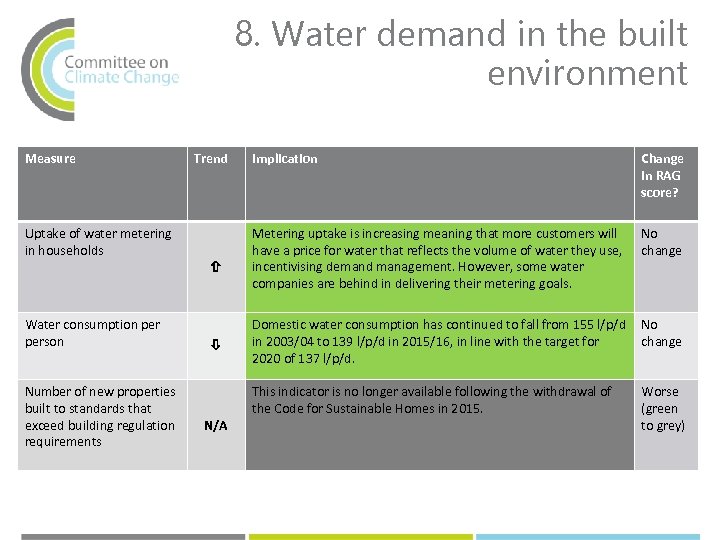
8. Water demand in the built environment Measure Trend Uptake of water metering in households Water consumption person Number of new properties built to standards that exceed building regulation requirements N/A Implication Change in RAG score? Metering uptake is increasing meaning that more customers will have a price for water that reflects the volume of water they use, incentivising demand management. However, some water companies are behind in delivering their metering goals. No change Domestic water consumption has continued to fall from 155 l/p/d in 2003/04 to 139 l/p/d in 2015/16, in line with the target for 2020 of 137 l/p/d. No change This indicator is no longer available following the withdrawal of the Code for Sustainable Homes in 2015. Worse (green to grey)
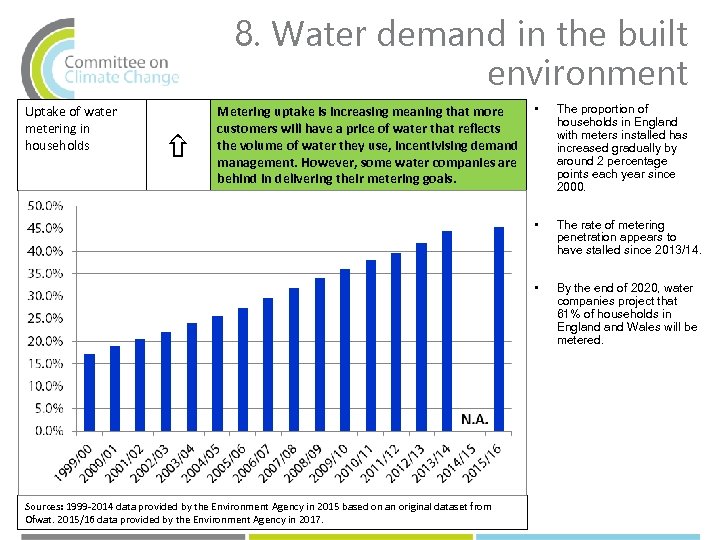
8. Water demand in the built environment Sources: 1999 -2014 data provided by the Environment Agency in 2015 based on an original dataset from Ofwat. 2015/16 data provided by the Environment Agency in 2017. The proportion of households in England with meters installed has increased gradually by around 2 percentage points each year since 2000. The rate of metering penetration appears to have stalled since 2013/14. • Metering uptake is increasing meaning that more customers will have a price of water that reflects the volume of water they use, incentivising demand management. However, some water companies are behind in delivering their metering goals. • • Uptake of water metering in households By the end of 2020, water companies project that 61% of households in England Wales will be metered.
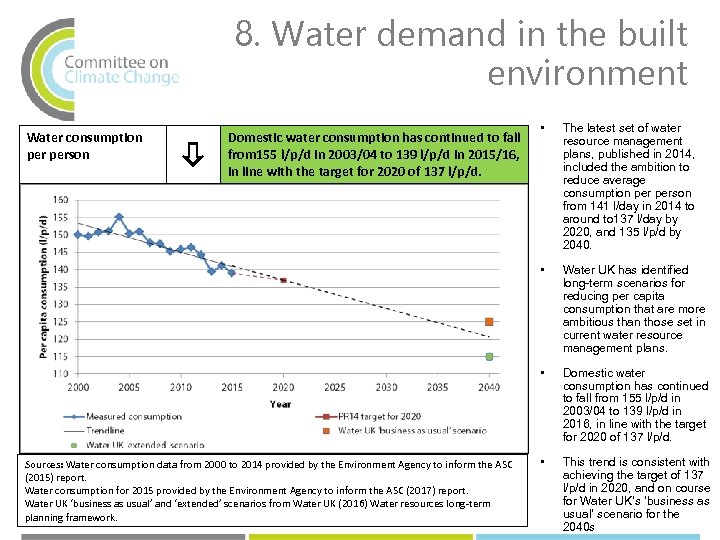
8. Water demand in the built environment Sources: Water consumption data from 2000 to 2014 provided by the Environment Agency to inform the ASC (2015) report. Water consumption for 2015 provided by the Environment Agency to inform the ASC (2017) report. Water UK ‘business as usual’ and ‘extended’ scenarios from Water UK (2016) Water resources long-term planning framework. The latest set of water resource management plans, published in 2014, included the ambition to reduce average consumption person from 141 l/day in 2014 to around to 137 l/day by 2020, and 135 l/p/d by 2040. Water UK has identified long-term scenarios for reducing per capita consumption that are more ambitious than those set in current water resource management plans. • Domestic water consumption has continued to fall from 155 l/p/d in 2003/04 to 139 l/p/d in 2015/16, in line with the target for 2020 of 137 l/p/d. • • Water consumption person Domestic water consumption has continued to fall from 155 l/p/d in 2003/04 to 139 l/p/d in 2016, in line with the target for 2020 of 137 l/p/d. • This trend is consistent with achieving the target of 137 l/p/d in 2020, and on course for Water UK’s ‘business as usual’ scenario for the 2040 s
8. Water demand in the built environment Number of new properties built to standards that exceed building regulation requirements • Existing building regulations require all new build properties to have a modelled consumption person not in excess of 125 l/day. • Our 2015 analysis suggested that developers could achieve a standard of 115 l/day at no extra cost. • N/A This indicator is no longer available following the withdrawal of the Code for Sustainable Homes in 2015. Until 2014, the number of properties exceeding the building standards was captured by the Code for Sustainable Homes. The code was withdrawn in 2015. • The Department for Communities and Local Government has added an ‘optional requirement’ for local planning associations to require a minimum standard of 110 l/p/d. No chart
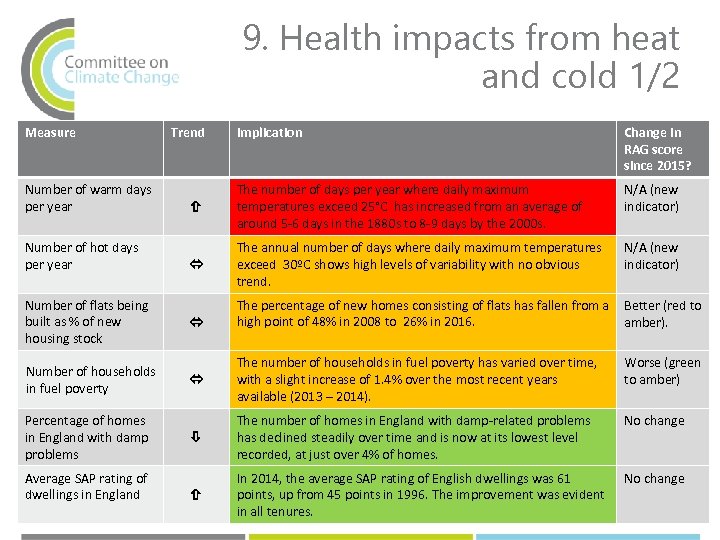
9. Health impacts from heat and cold 1/2 Measure Number of warm days per year Number of hot days per year Number of flats being built as % of new housing stock Number of households in fuel poverty Percentage of homes in England with damp problems Average SAP rating of dwellings in England Trend Implication Change in RAG score since 2015? The number of days per year where daily maximum temperatures exceed 25°C has increased from an average of around 5 -6 days in the 1880 s to 8 -9 days by the 2000 s. N/A (new indicator) The annual number of days where daily maximum temperatures exceed 30ºC shows high levels of variability with no obvious trend. N/A (new indicator) The percentage of new homes consisting of flats has fallen from a high point of 48% in 2008 to 26% in 2016. Better (red to amber). The number of households in fuel poverty has varied over time, with a slight increase of 1. 4% over the most recent years available (2013 – 2014). Worse (green to amber) No change The number of homes in England with damp-related problems has declined steadily over time and is now at its lowest level recorded, at just over 4% of homes. No change In 2014, the average SAP rating of English dwellings was 61 points, up from 45 points in 1996. The improvement was evident in all tenures.
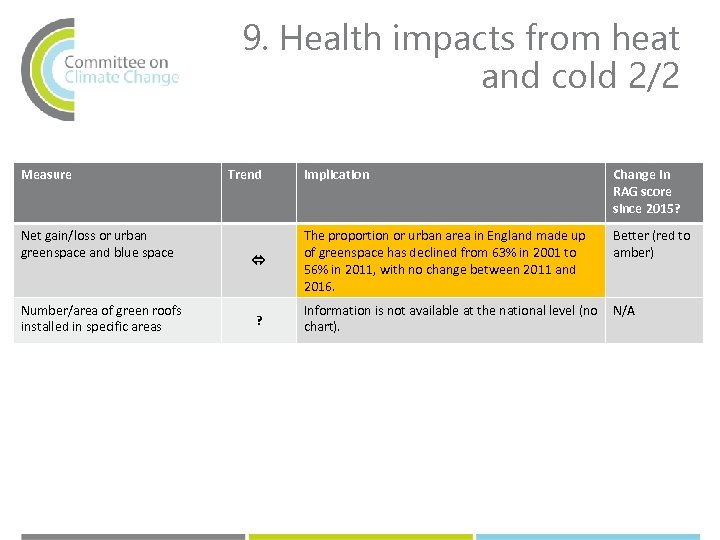
9. Health impacts from heat and cold 2/2 Measure Net gain/loss or urban greenspace and blue space Number/area of green roofs installed in specific areas Trend Implication Change in RAG score since 2015? The proportion or urban area in England made up of greenspace has declined from 63% in 2001 to 56% in 2011, with no change between 2011 and 2016. Better (red to amber) ? Information is not available at the national level (no chart). N/A
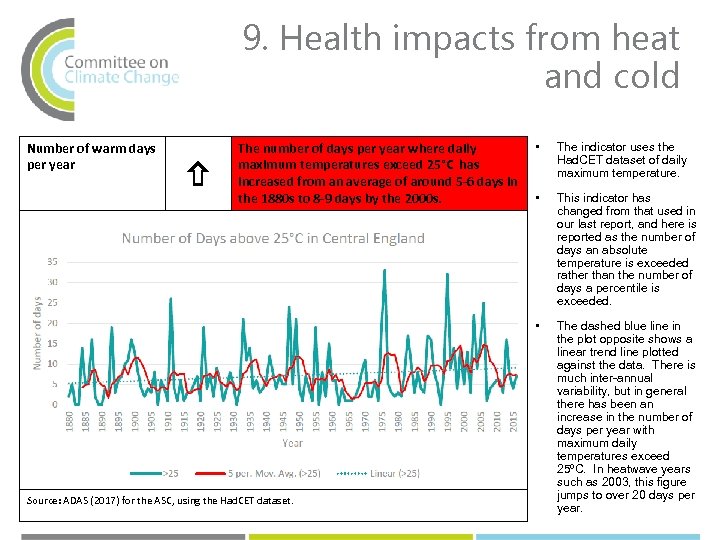
9. Health impacts from heat and cold Number of warm days per year The number of days per year where daily maximum temperatures exceed 25°C has increased from an average of around 5 -6 days in the 1880 s to 8 -9 days by the 2000 s. Source: ADAS (2017) for the ASC, using the Had. CET dataset. The indicator uses the Had. CET dataset of daily maximum temperature. • This indicator has changed from that used in our last report, and here is reported as the number of days an absolute temperature is exceeded rather than the number of days a percentile is exceeded. • • The dashed blue line in the plot opposite shows a linear trend line plotted against the data. There is much inter-annual variability, but in general there has been an increase in the number of days per year with maximum daily temperatures exceed 25ºC. In heatwave years such as 2003, this figure jumps to over 20 days per year.
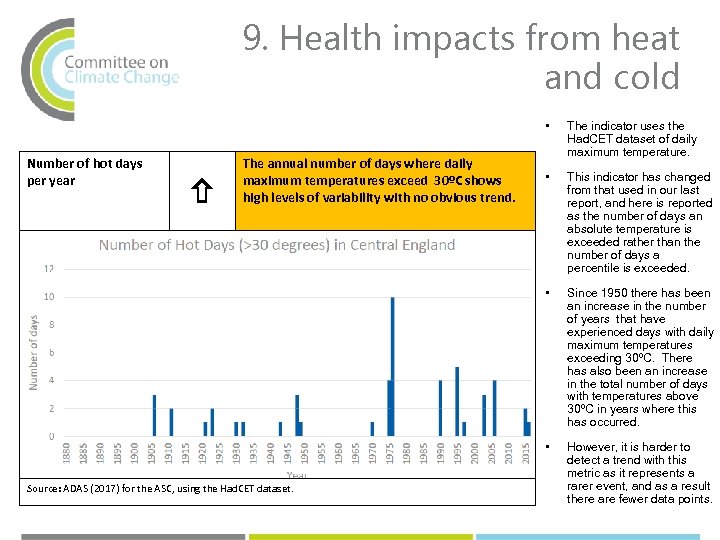
9. Health impacts from heat and cold • Source: ADAS (2017) for the ASC, using the Had. CET dataset. This indicator has changed from that used in our last report, and here is reported as the number of days an absolute temperature is exceeded rather than the number of days a percentile is exceeded. Since 1950 there has been an increase in the number of years that have experienced days with daily maximum temperatures exceeding 30ºC. There has also been an increase in the total number of days with temperatures above 30ºC in years where this has occurred. • The annual number of days where daily maximum temperatures exceed 30ºC shows high levels of variability with no obvious trend. • • Number of hot days per year The indicator uses the Had. CET dataset of daily maximum temperature. However, it is harder to detect a trend with this metric as it represents a rarer event, and as a result there are fewer data points.
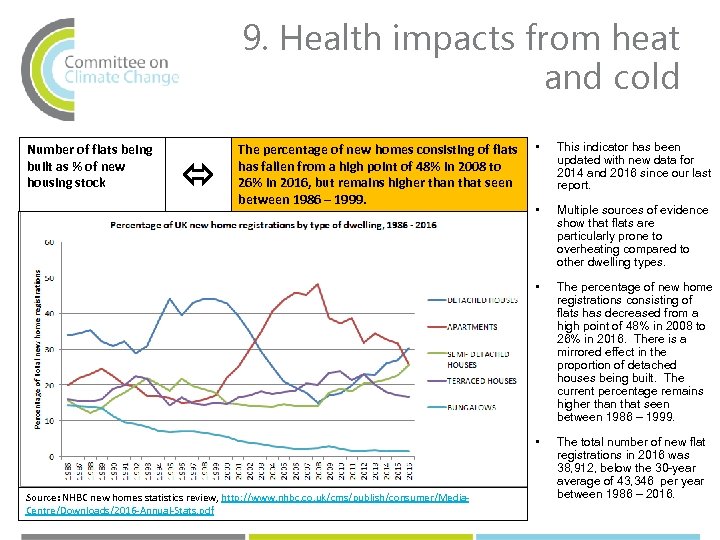
9. Health impacts from heat and cold Source: NHBC new homes statistics review, http: //www. nhbc. co. uk/cms/publish/consumer/Media. Centre/Downloads/2016 -Annual-Stats. pdf This indicator has been updated with new data for 2014 and 2016 since our last report. • Multiple sources of evidence show that flats are particularly prone to overheating compared to other dwelling types. The percentage of new home registrations consisting of flats has decreased from a high point of 48% in 2008 to 26% in 2016. There is a mirrored effect in the proportion of detached houses being built. The current percentage remains higher than that seen between 1986 – 1999. • The percentage of new homes consisting of flats has fallen from a high point of 48% in 2008 to 26% in 2016, but remains higher than that seen between 1986 – 1999. • • Number of flats being built as % of new housing stock The total number of new flat registrations in 2016 was 38, 912, below the 30 -year average of 43, 346 per year between 1986 – 2016.
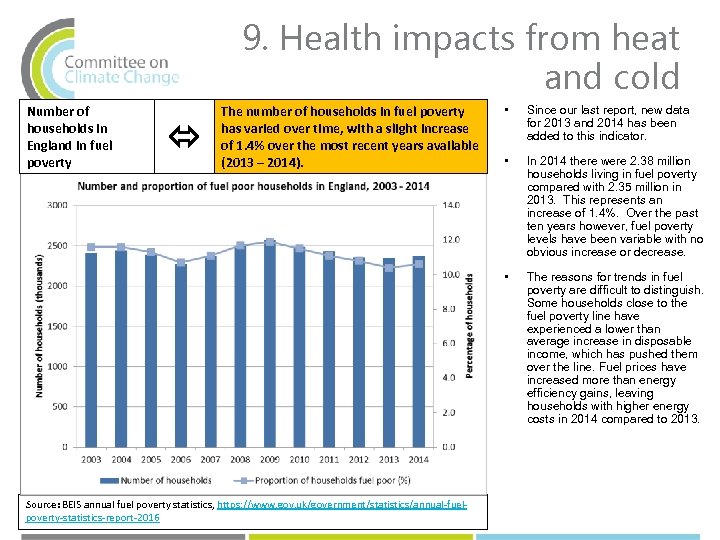
9. Health impacts from heat and cold The number of households in fuel poverty has varied over time, with a slight increase of 1. 4% over the most recent years available (2013 – 2014). Source: BEIS annual fuel poverty statistics, https: //www. gov. uk/government/statistics/annual-fuelpoverty-statistics-report-2016 • Since our last report, new data for 2013 and 2014 has been added to this indicator. • In 2014 there were 2. 38 million households living in fuel poverty compared with 2. 35 million in 2013. This represents an increase of 1. 4%. Over the past ten years however, fuel poverty levels have been variable with no obvious increase or decrease. • Number of households in England in fuel poverty The reasons for trends in fuel poverty are difficult to distinguish. Some households close to the fuel poverty line have experienced a lower than average increase in disposable income, which has pushed them over the line. Fuel prices have increased more than energy efficiency gains, leaving households with higher energy costs in 2014 compared to 2013.
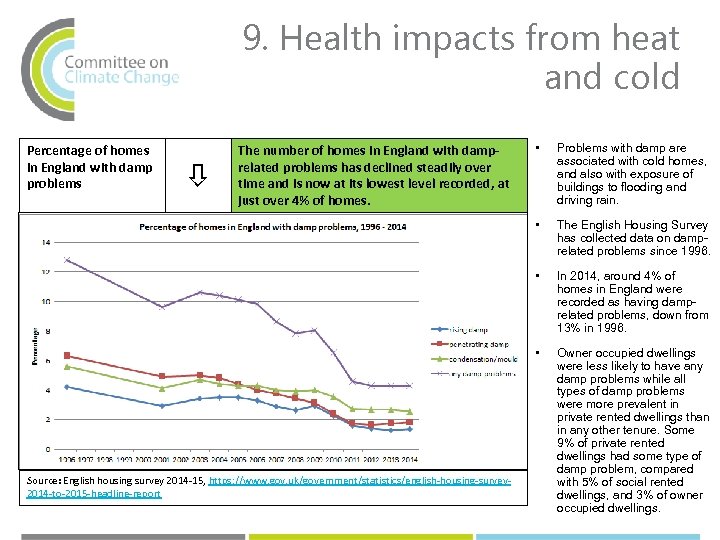
9. Health impacts from heat and cold The English Housing Survey has collected data on damprelated problems since 1996. In 2014, around 4% of homes in England were recorded as having damprelated problems, down from 13% in 1996. • Source: English housing survey 2014 -15, https: //www. gov. uk/government/statistics/english-housing-survey 2014 -to-2015 -headline-report Problems with damp are associated with cold homes, and also with exposure of buildings to flooding and driving rain. • The number of homes in England with damprelated problems has declined steadily over time and is now at its lowest level recorded, at just over 4% of homes. • • Percentage of homes in England with damp problems Owner occupied dwellings were less likely to have any damp problems while all types of damp problems were more prevalent in private rented dwellings than in any other tenure. Some 9% of private rented dwellings had some type of damp problem, compared with 5% of social rented dwellings, and 3% of owner occupied dwellings.
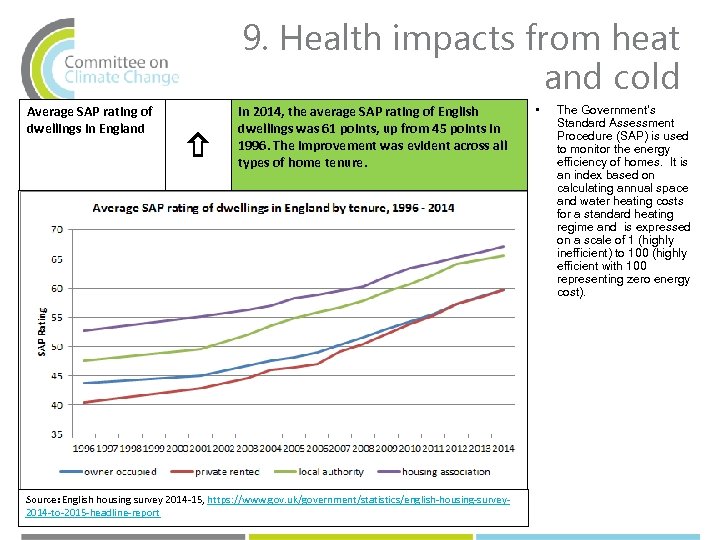
9. Health impacts from heat and cold Average SAP rating of dwellings in England In 2014, the average SAP rating of English dwellings was 61 points, up from 45 points in 1996. The improvement was evident across all types of home tenure. Source: English housing survey 2014 -15, https: //www. gov. uk/government/statistics/english-housing-survey 2014 -to-2015 -headline-report • The Government’s Standard Assessment Procedure (SAP) is used to monitor the energy efficiency of homes. It is an index based on calculating annual space and water heating costs for a standard heating regime and is expressed on a scale of 1 (highly inefficient) to 100 (highly efficient with 100 representing zero energy cost).
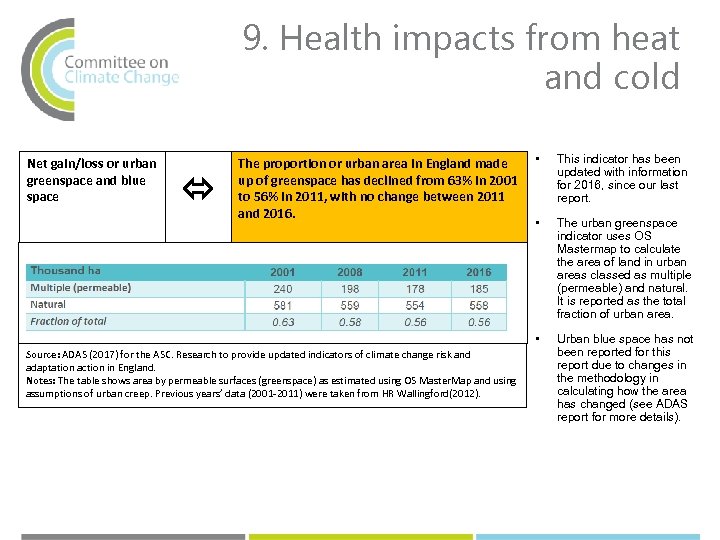
9. Health impacts from heat and cold The proportion or urban area in England made up of greenspace has declined from 63% in 2001 to 56% in 2011, with no change between 2011 and 2016. Source: ADAS (2017) for the ASC. Research to provide updated indicators of climate change risk and adaptation action in England. Notes: The table shows area by permeable surfaces (greenspace) as estimated using OS Master. Map and using assumptions of urban creep. Previous years’ data (2001 -2011) were taken from HR Wallingford(2012). • This indicator has been updated with information for 2016, since our last report. • The urban greenspace indicator uses OS Mastermap to calculate the area of land in urban areas classed as multiple (permeable) and natural. It is reported as the total fraction of urban area. • Net gain/loss or urban greenspace and blue space Urban blue space has not been reported for this report due to changes in the methodology in calculating how the area has changed (see ADAS report for more details).
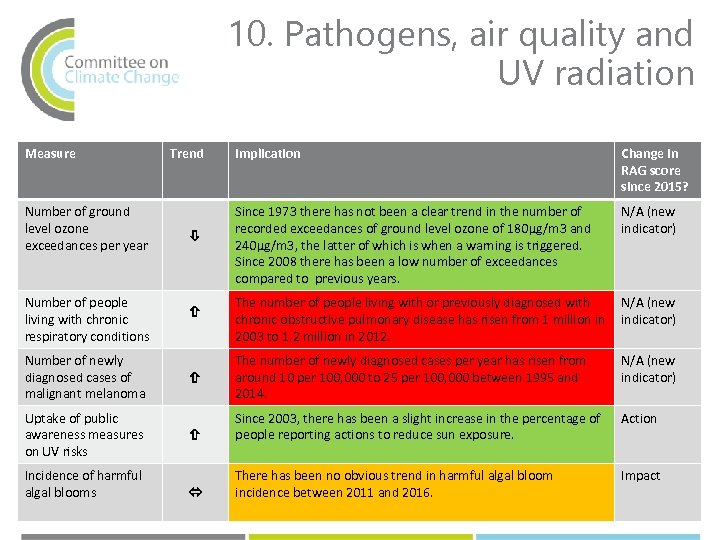
10. Pathogens, air quality and UV radiation Measure Number of ground level ozone exceedances per year Number of people living with chronic respiratory conditions Number of newly diagnosed cases of malignant melanoma Uptake of public awareness measures on UV risks Incidence of harmful algal blooms Trend Implication Change in RAG score since 2015? Since 1973 there has not been a clear trend in the number of recorded exceedances of ground level ozone of 180μg/m 3 and 240μg/m 3, the latter of which is when a warning is triggered. Since 2008 there has been a low number of exceedances compared to previous years. N/A (new indicator) The number of people living with or previously diagnosed with chronic obstructive pulmonary disease has risen from 1 million in 2003 to 1. 2 million in 2012. N/A (new indicator) The number of newly diagnosed cases per year has risen from around 10 per 100, 000 to 25 per 100, 000 between 1995 and 2014. N/A (new indicator) Action Since 2003, there has been a slight increase in the percentage of people reporting actions to reduce sun exposure. Impact There has been no obvious trend in harmful algal bloom incidence between 2011 and 2016.
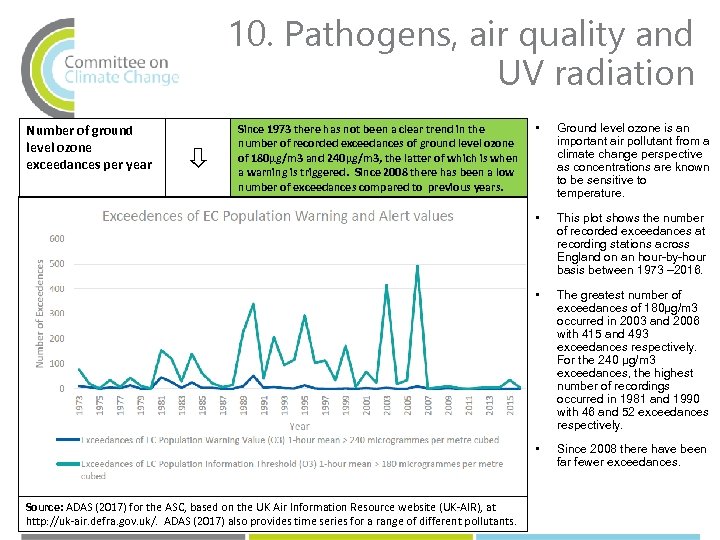
10. Pathogens, air quality and UV radiation This plot shows the number of recorded exceedances at recording stations across England on an hour-by-hour basis between 1973 – 2016. The greatest number of exceedances of 180μg/m 3 occurred in 2003 and 2006 with 415 and 493 exceedances respectively. For the 240 μg/m 3 exceedances, the highest number of recordings occurred in 1981 and 1990 with 46 and 52 exceedances respectively. • Source: ADAS (2017) for the ASC, based on the UK Air Information Resource website (UK-AIR), at http: //uk-air. defra. gov. uk/. ADAS (2017) also provides time series for a range of different pollutants. Ground level ozone is an important air pollutant from a climate change perspective as concentrations are known to be sensitive to temperature. • Since 1973 there has not been a clear trend in the number of recorded exceedances of ground level ozone of 180μg/m 3 and 240μg/m 3, the latter of which is when a warning is triggered. Since 2008 there has been a low number of exceedances compared to previous years. • • Number of ground level ozone exceedances per year Since 2008 there have been far fewer exceedances.
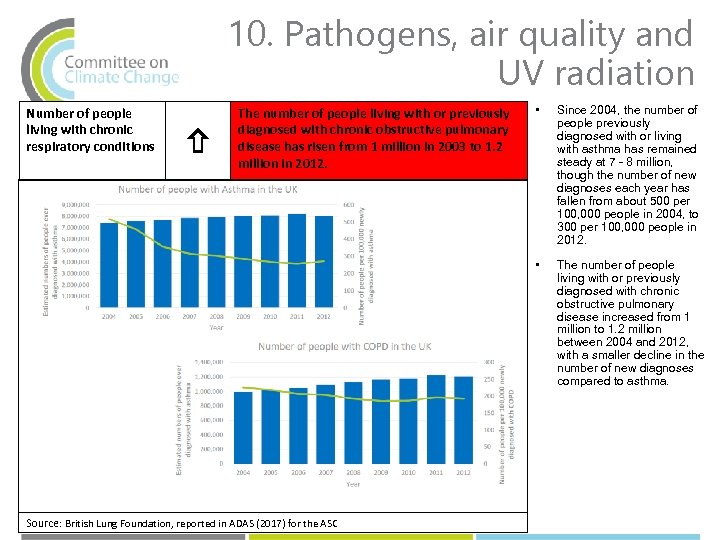
10. Pathogens, air quality and UV radiation The number of people living with or previously diagnosed with chronic obstructive pulmonary disease has risen from 1 million in 2003 to 1. 2 million in 2012. Source: British Lung Foundation, reported in ADAS (2017) for the ASC • Since 2004, the number of people previously diagnosed with or living with asthma has remained steady at 7 - 8 million, though the number of new diagnoses each year has fallen from about 500 per 100, 000 people in 2004, to 300 per 100, 000 people in 2012. • Number of people living with chronic respiratory conditions The number of people living with or previously diagnosed with chronic obstructive pulmonary disease increased from 1 million to 1. 2 million between 2004 and 2012, with a smaller decline in the number of new diagnoses compared to asthma.
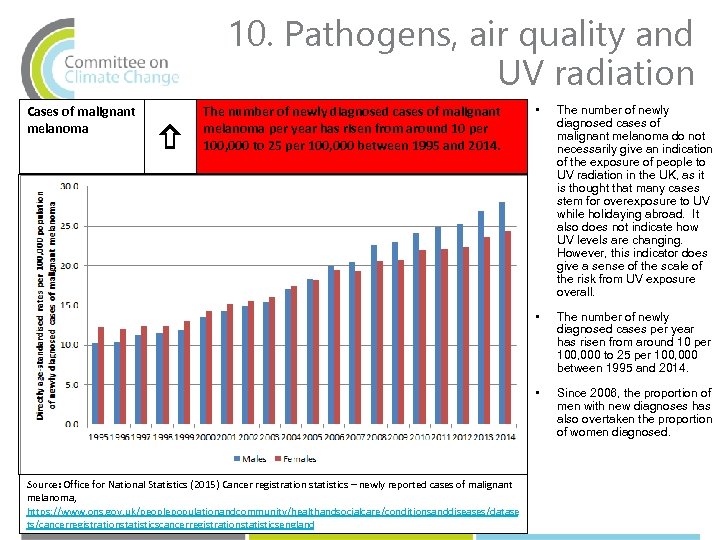
10. Pathogens, air quality and UV radiation Source: Office for National Statistics (2015) Cancer registration statistics – newly reported cases of malignant melanoma, https: //www. ons. gov. uk/peoplepopulationandcommunity/healthandsocialcare/conditionsanddiseases/datase ts/cancerregistrationstatisticsengland The number of newly diagnosed cases of malignant melanoma do not necessarily give an indication of the exposure of people to UV radiation in the UK, as it is thought that many cases stem for overexposure to UV while holidaying abroad. It also does not indicate how UV levels are changing. However, this indicator does give a sense of the scale of the risk from UV exposure overall. The number of newly diagnosed cases per year has risen from around 10 per 100, 000 to 25 per 100, 000 between 1995 and 2014. • The number of newly diagnosed cases of malignant melanoma per year has risen from around 10 per 100, 000 to 25 per 100, 000 between 1995 and 2014. • • Cases of malignant melanoma Since 2006, the proportion of men with new diagnoses has also overtaken the proportion of women diagnosed.
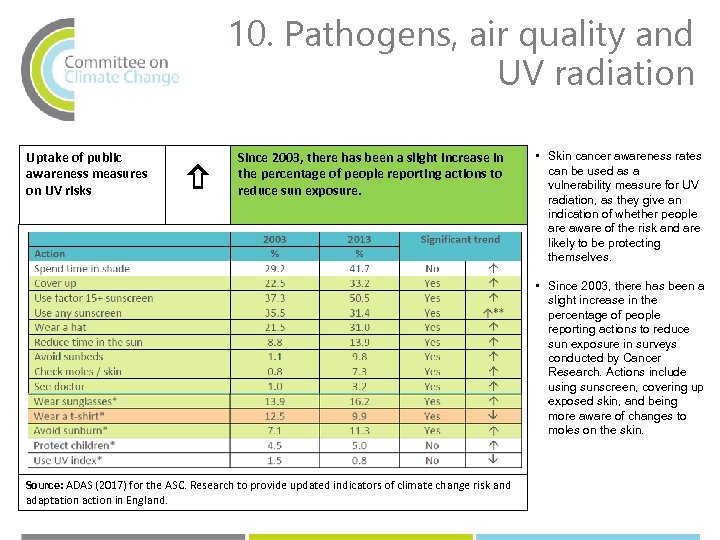
10. Pathogens, air quality and UV radiation Uptake of public awareness measures on UV risks Since 2003, there has been a slight increase in the percentage of people reporting actions to reduce sun exposure. • Skin cancer awareness rates can be used as a vulnerability measure for UV radiation, as they give an indication of whether people are aware of the risk and are likely to be protecting themselves. • Since 2003, there has been a slight increase in the percentage of people reporting actions to reduce sun exposure in surveys conducted by Cancer Research. Actions include using sunscreen, covering up exposed skin, and being more aware of changes to moles on the skin. Source: ADAS (2017) for the ASC. Research to provide updated indicators of climate change risk and adaptation action in England.
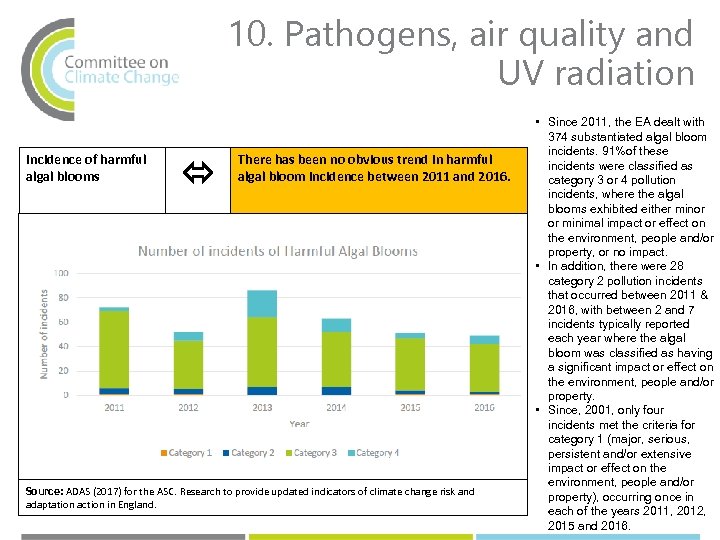
10. Pathogens, air quality and UV radiation Incidence of harmful algal blooms There has been no obvious trend in harmful algal bloom incidence between 2011 and 2016. Source: ADAS (2017) for the ASC. Research to provide updated indicators of climate change risk and adaptation action in England. • Since 2011, the EA dealt with 374 substantiated algal bloom incidents. 91%of these incidents were classified as category 3 or 4 pollution incidents, where the algal blooms exhibited either minor or minimal impact or effect on the environment, people and/or property, or no impact. • In addition, there were 28 category 2 pollution incidents that occurred between 2011 & 2016, with between 2 and 7 incidents typically reported each year where the algal bloom was classified as having a significant impact or effect on the environment, people and/or property. • Since, 2001, only four incidents met the criteria for category 1 (major, serious, persistent and/or extensive impact or effect on the environment, people and/or property), occurring once in each of the years 2011, 2012, 2015 and 2016.
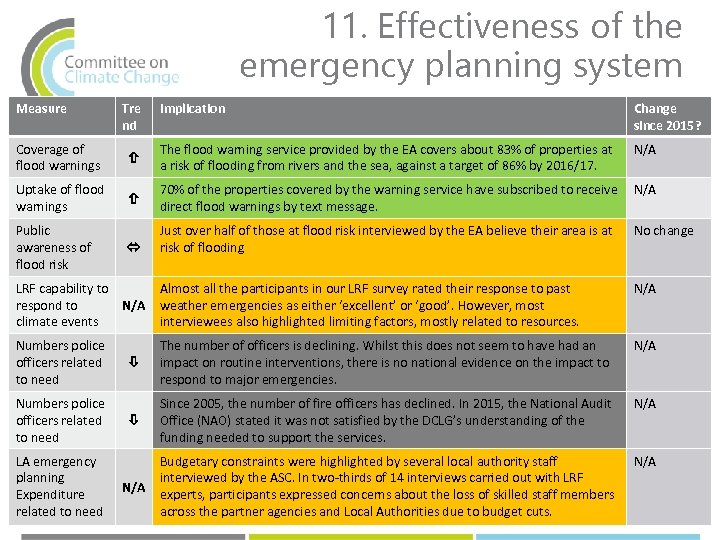
11. Effectiveness of the emergency planning system Measure Tre nd Implication Change since 2015? Coverage of flood warnings The flood warning service provided by the EA covers about 83% of properties at a risk of flooding from rivers and the sea, against a target of 86% by 2016/17. N/A Uptake of flood warnings 70% of the properties covered by the warning service have subscribed to receive direct flood warnings by text message. N/A Just over half of those at flood risk interviewed by the EA believe their area is at risk of flooding No change LRF capability to respond to N/A climate events Almost all the participants in our LRF survey rated their response to past weather emergencies as either ‘excellent’ or ‘good’. However, most interviewees also highlighted limiting factors, mostly related to resources. N/A Numbers police officers related to need N/A The number of officers is declining. Whilst this does not seem to have had an impact on routine interventions, there is no national evidence on the impact to respond to major emergencies. N/A Since 2005, the number of fire officers has declined. In 2015, the National Audit Office (NAO) stated it was not satisfied by the DCLG’s understanding of the funding needed to support the services. N/A Budgetary constraints were highlighted by several local authority staff interviewed by the ASC. In two-thirds of 14 interviews carried out with LRF experts, participants expressed concerns about the loss of skilled staff members across the partner agencies and Local Authorities due to budget cuts. Public awareness of flood risk Numbers police officers related to need LA emergency planning Expenditure related to need
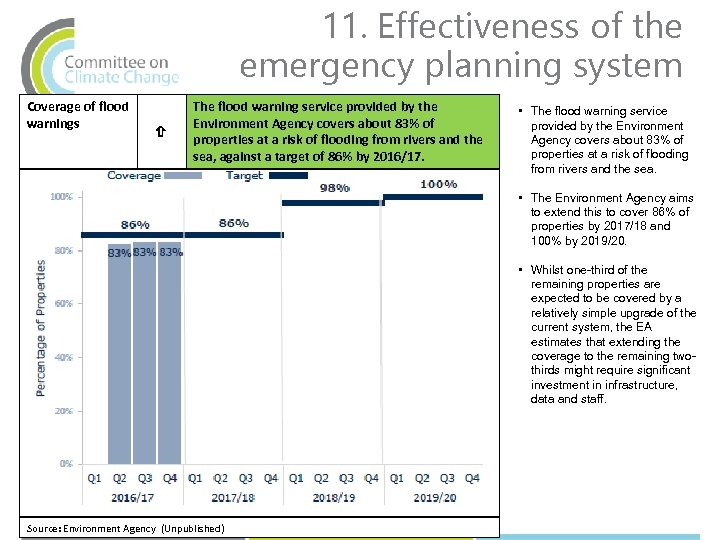
11. Effectiveness of the emergency planning system Coverage of flood warnings The flood warning service provided by the Environment Agency covers about 83% of properties at a risk of flooding from rivers and the sea, against a target of 86% by 2016/17. • The flood warning service provided by the Environment Agency covers about 83% of properties at a risk of flooding from rivers and the sea. • The Environment Agency aims to extend this to cover 86% of properties by 2017/18 and 100% by 2019/20. • Whilst one-third of the remaining properties are expected to be covered by a relatively simple upgrade of the current system, the EA estimates that extending the coverage to the remaining twothirds might require significant investment in infrastructure, data and staff. Source: Environment Agency (Unpublished)
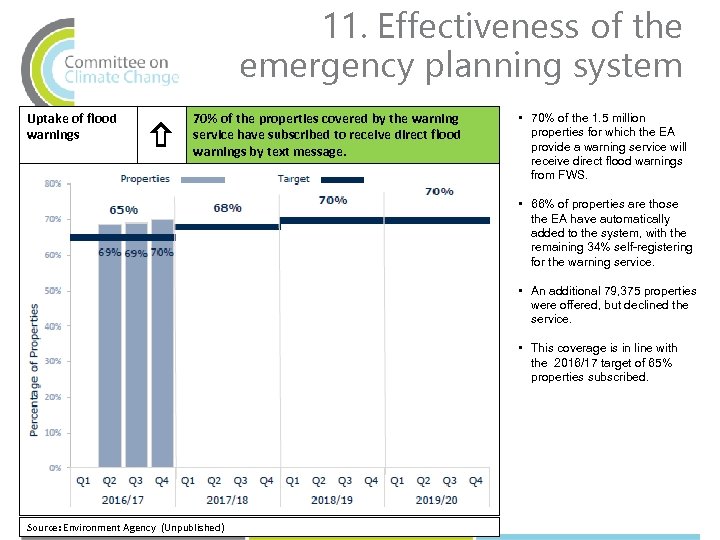
11. Effectiveness of the emergency planning system Uptake of flood warnings 70% of the properties covered by the warning service have subscribed to receive direct flood warnings by text message. • 70% of the 1. 5 million properties for which the EA provide a warning service will receive direct flood warnings from FWS. • 66% of properties are those the EA have automatically added to the system, with the remaining 34% self-registering for the warning service. • An additional 79, 375 properties were offered, but declined the service. • This coverage is in line with the 2016/17 target of 65% properties subscribed. Source: Environment Agency (Unpublished)
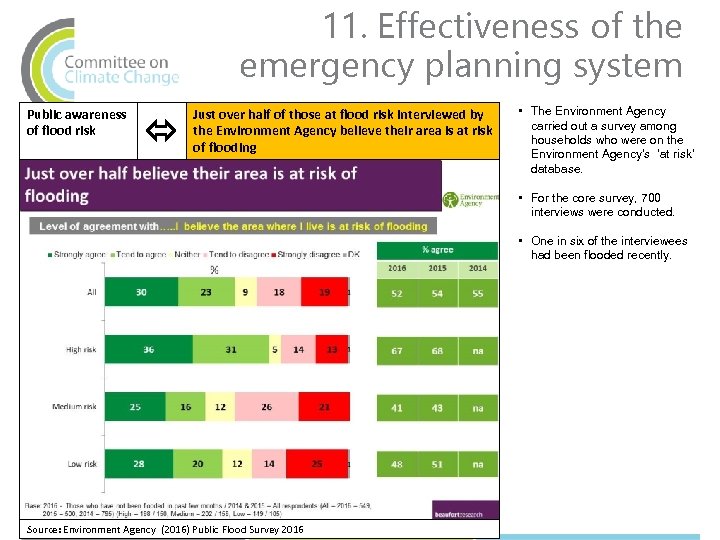
11. Effectiveness of the emergency planning system Public awareness of flood risk Just over half of those at flood risk interviewed by the Environment Agency believe their area is at risk of flooding • The Environment Agency carried out a survey among households who were on the Environment Agency’s ‘at risk’ database. • For the core survey, 700 interviews were conducted. • One in six of the interviewees had been flooded recently. Source: Environment Agency (2016) Public Flood Survey 2016
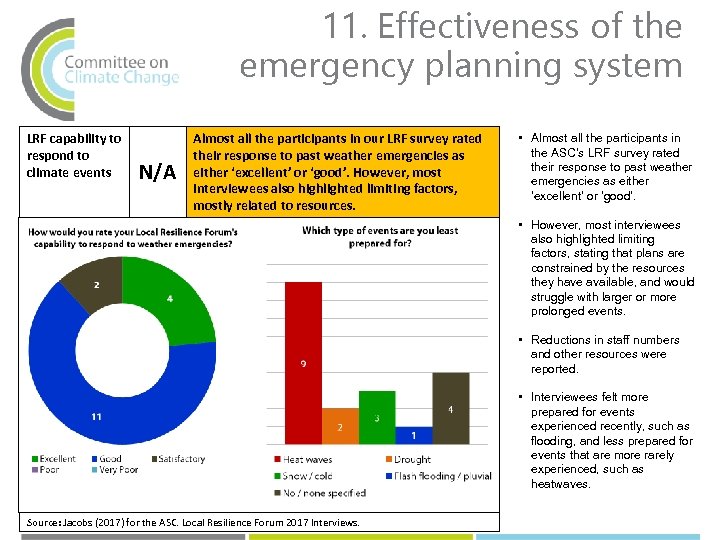
11. Effectiveness of the emergency planning system LRF capability to respond to climate events N/A Almost all the participants in our LRF survey rated their response to past weather emergencies as either ‘excellent’ or ‘good’. However, most interviewees also highlighted limiting factors, mostly related to resources. • Almost all the participants in the ASC’s LRF survey rated their response to past weather emergencies as either ‘excellent’ or ‘good’. • However, most interviewees also highlighted limiting factors, stating that plans are constrained by the resources they have available, and would struggle with larger or more prolonged events. • Reductions in staff numbers and other resources were reported. • Interviewees felt more prepared for events experienced recently, such as flooding, and less prepared for events that are more rarely experienced, such as heatwaves. Source: Jacobs (2017) for the ASC. Local Resilience Forum 2017 Interviews.
11. Effectiveness of the emergency planning system Numbers of police officers (related to required capability) The number of officers has further declined in 2016, with 5, 000 police officers less than those in 2014, a 12% reduction from 2005. Whilst these did not seem to have had an impact on routine interventions, there is no national evidence on the impact to respond to major emergencies. No chart Source: Home Office (2016) Police workforce, England Wales https: //www. gov. uk/government/statistics/police-workforce-england-wales-31 -march-2016 • In 2015, the ASC reported between 2005 and 2014, the number of police officers in England had declined by 13, 000 (8%). • These results reportedly did not have an impact on routine interventions, as crime levels have fallen by 33% since 2005. However, there is no national evidence on the impact to respond to major emergencies. • The number of officers has further declined in 2016, with 5, 000 police officers less than those in 2014, a 12% reduction from 2005.
11. Effectiveness of the emergency planning system Numbers of fire and police officers (related to required capability) Since 2005, the number of fire officers declined by 2, 000 (4%) in 2014 and by an additional 5, 000 between 2014 and 2016, corresponding to an 18% reduction since 2005. In 2015, the National Audit Office (NAO) stated it was not satisfied by the Department of Communities and Local Governments’ understanding of the appropriate funding level necessary to support the services. No chart Source: Home office (2005 -2016) Fire statistics England https: //www. gov. uk/government/collections/firestatistics-great-britain National Audit Office (2015) Financial sustainability of fire and rescue services https: //www. nao. org. uk/wpcontent/uploads/2015/11/Financial-sustainability-of-fire-and-rescue-services-amended. pdf • Since 2005, the number of fire officers declined by 2, 000 (4%) in 2014 and by an additional 5, 000 between 2014 and 2016, corresponding to an 18% reduction since 2005. • A report from the National Audit Office (NAO) has shown that the sector has coped well with financial challenges to date. However, the NAO was not satisfied by the Department of Communities and Local Governments’ understanding of the appropriate funding level necessary to support the services. • The NAO highlighted that DCLG takes an outcomesbased rather than a risk-based approach when reviewing the financial resilience of the sector. This makes it more difficult to detect in advance where service reductions are hindering the capability to deal with the risks.
11. Effectiveness of the emergency planning system LA emergency planning expenditure related to need N/A Budgetary constraints were highlighted by several local authority staff interviewed by the ASC. In twothirds of 14 interviews carried out with LRF experts, participants expressed concerns about the loss of experienced and skilled staff members across the partner agencies and Local Authorities due to budget cuts. No chart Source: Jacobs (2017) for the ASC. Local Resilience Forum 2017 Interviews. • Between 2010 and 2014, central Government funding to local authorities declined by £ 6 billion (19. 6%). The overall effect on emergency preparedness is not known, in part because of the lack of information on what capability levels should be. • When asked about the changes in capability within their LRFs, the interviewees taking part in the ASC’s study felt that their capability and understanding of the risks are growing, but capacity and resources to respond are decreasing. Budgetary constraints were highlighted by several interviewees from local authorities. I • Having to do more with less was consistently mentioned by the interviewees, for example in cases in which the LRF’s remit had increased to cover multiple regions with smaller teams.

Adaptation Sub-Committee http: //www. theccc. org. uk 60
Скачать презентацию Independent advice to government on building a low-carbon
71a5115ef8acf06eb13fc3be8e4b49e3.ppt