 Скачать презентацию Increasing Sales A Defensive Approach Delivering More Bang
f1dbf3b18b43e2253bf3950107ead6e2.ppt
- Количество слайдов: 15



Increasing Sales A Defensive Approach Delivering More Bang for The Buck! Paul D’Adamo - Recycling Growth - A Publication of
TABLE OF CONTENTS Letter from Author 3 About Recycling Growth 4 Inventory Techniques to Increase Sales 5 How Returns and Credits Affect Sales 11 Call to Action 14
Letter from the Author Every business seeks to increase sales. We can look at business development and sales using two approaches; offensive and defensive. In this Ebook, we will focus on defensive means of increasing sales. In fact, I believe that these actions could deliver more bang for the buck than the traditional means of increasing sales. The goal is to deliver dollars to the bottom line. I personally believe in the concept of spending money to make money, but it is critical to also understand tweak your system defensively to ensure quality parts and service to your customer and that’s where I think many business owners miss the point. If you can harvest more sales from your inventory and processes without adding to your fixed costs, that is a win, win. Acquiring new customers is costly. It is critical to always build new customers in the pipeline. But if you are losing customers due to bad service and or inventory issues, you are incurring the loss of revenue from steady customers, while still expending the time, money and other resources to acquire new customers. This type of thinking can be utilized in any organization, however most do not because it requires measurement, analysis, and planning for action. Be bold. Make a decision to step back and analyze your business. Of course, we are here to help if you need some assistance to focus and build your business from the inside out. Enjoy the reading, but more importantly, take action! Best Paul
About Recycling Growth • • • At Recycling Growth, we are focused on Best Practices. This applies to Sales, Production, Shipping and other areas of the business. We all need goals to aspire to. Best Practices can provide a blueprint to assess where you are and where you need to go. The Owner may already have specific areas they feel are critical to the project. However, a fresh set of eyes on the situation may provide insight into why a department or process is not performing up to expectations. Often times, Key Managers have a different line of sight into the problem. Several questions come to mind: . § § § • Is the Owner blinded from their perspective and not receiving feedback from the Managers to truly analyze and produce an acceptable solution? Has enough analysis been put into the data to hone in on a solution which has the most chance for success. ? Do we have the will and the resources to implement the required changes? What is our track record implementing changes? Recycling Growth is committed to helping you identify, manage and commit to change in your organization. If done correctly, all parties involved will not only have a role to play, but will better understand what elements are necessary to develop a culture of change which will benefit the organization in the long term.
CHAPTER 1 Inventory Techniques to Increase Sales
Inventory Techniques to Increase Sales Turning a Negative into a Positive Inventory can cause many headaches, especially for the Auto Recycler. We buy vehicles that may be old, wrecked, flooded, and/or all of the above. Our objective is to identify value in the midst of damage, age and abuse. Wow! Sounds like a winning proposition. Who wouldn’t want to get into this business. Of course, small and large retailers of new products also have inventory issues. Suppliers can’t fill orders, product gets damaged in transit. And let’s not forget about shrinkage due to theft, mismanagement, or logistics glitches “It shows you have 10 in stock at your store. . . You’re saying you have none? ”. So anyone who sells anything has inventory issues. Action#1 – Inventory more parts on each car Use your PDR’s (pre-dismantle reports) as a sales tool. For the Auto Recycler, our inventory is based on the vehicles we purchase and the parts identified and inventoried on the vehicle. How many parts are you inventorying on each vehicle? Considering the time invested while you are at the car, how much more time would it take to inventory another 10 -20 parts? Another 20 clicks? Another 20 chances to sell parts. Incremental effort could reap large rewards. You might also review the PDR’s to determine if some parts should remain on the list. Review, take action.
How Inventory Affects Sales (continued) Action #2 – Step up your Core Program Commodity or Sellable Part? Again, the PDR presents an incredible opportunity to generate immediate sales. How? Review what parts should automatically be put to core in the inventory cycle. Are starters, alternators, rack and pinions in the top 20 parts sold in your operation? Why stock them if they aren’t, especially if the average ticket is below your standard. The parts requested by core companies are too numerous to mention and they are in demand. With all the electronic tools provided by the Core Companies and the Yard Management Systems, this is an opportune time to cash your cores out on a short term basis to enable your cash flow to buy more vehicles. The goal is to turn cars, not marry them, the same holds true for cores. I hear from many core companies that Recyclers have loads of stock that they can’t seem to part with because it might sell. . . some day. In some cases, the core companies are paying near retail on some items. No warranty, no returns, no worries! Run your business for Today, not. . . some day.
How Inventory Affects Sales (continued) Action #3 –Manage your Inventory. Out with the old, In with the new! Old Stock makes it look like we are full of inventory. However, when I see parts with over 3 K days, I question why we still have it. Check your days in stock and make some decisions. As soon as I see motors and transmissions in the aisles of our warehouses, I immediately want to print reports. Chances are high that 20% of your inventory is un-sellable due to duplication, age, price, lack of demand. or a combination of all four. Out with the old, in with the new! Action #4 – Do it Right! Accuracy, Damage Codes and Bad Words We have awesome systems to help us grade parts. Mechanical parts are automatically graded based on the mileage and the year of the vehicle. Body parts need some help from a highly skilled employee. You can’t judge a door based strictly on age, color, or model, condition is critical. A qualified inventory person is the individual who is tasked with identifying sellable parts and then describing them in such a way that our customers are able to make an educated decision whether to buy from us or not. Make sure you following the damage codes and not including bad words. The key to the inventory game is to get it “Right” the first time. Availability, accuracy in interchange, understandable descriptions, and appropriate damage codes for body parts are what sell your parts. Words like “Nice” are very 1970, especially if that is how you describe all of your parts.
How Inventory Affects Sales (continued) Action #5 – Ensure Current Prices and Eliminate Unpriced Parts While price is not Everything, I would guess it is a big part of the consumer’s decision-making process. First, ALL parts should be repriced within a 12 month period. All systems have a report to tell you when parts were last priced. If 50% of your parts have not been priced in the last 6 months, there is a high probability that they haven’t been priced in the last 12 months. Ouch! Second, run the Unpriced parts report to identify those parts that have slipped through the cracks totally. Zero Part Pricing is a pet peeve of consumers and fellow auto recyclers looking to do business with you. In fact, most will pass over you for someone with listed prices. With the whole world shifting to mobile devices, your customers are making decisions quickly and the more difficult you make it, the fewer times they will make the effort to buy your parts. PAUSE… RE-READ. Action #6 – Review the descriptions that display on Car-part The goal is to sell every part available. Don’t fill the descriptions with useless information. Consider promoting your 6 month warranty. Look up 20 -25 parts and see what others are doing. Take the best ideas and incorporate them into your inventory scheme. Some descriptions can be a real turn-off. Ten to fifteen years ago, we could get away with not pricing parts and putting unintelligible comments. Customers still came. They dealt with inaccuracy and the unavailability of parts. “What, I drove here from Connecticut and now the part is damaged? Or Missing?
How Inventory Affects Sales (continued) With the availability of parts data (price, condition, and availability) coupled with lightning fast shipping on the internet, the automotive parts market is in hyper drive and we are in a war to maintain a competitive edge. Inventory feeds the Sales Pipeline. • • • Data: Accuracy in Inventory is critical. • Color, mileage, damage, 2 D 1 Availability: Ensure returned parts are properly returned to vehicle and that collateral damage to vehicles by equipment and personnel is kept to a minimum. Use Reports to Manage Inventory • Un-located Parts, Overstocked Parts Step #7 – Pictures sell Parts, Get Ready for the next evolution A Picture is worth a $1, 000 words and is very effective in selling auto parts. We live in a world of Images. Spend 30 seconds on the web and you will be bombarded by images. Go on ebay, go on Amazon. Car-Part, the largest advertiser of Genuine Recycled OEM Parts will soon be linking images to individual parts. Are you ready for this transformation? Talk to your Inventory person taking photos for your business and give them a T-shirt that says “I Sell Parts”. They probably do not recognize the part they play in the sales cycle. Make sure they have good equipment and training to ensure that your parts stand out.
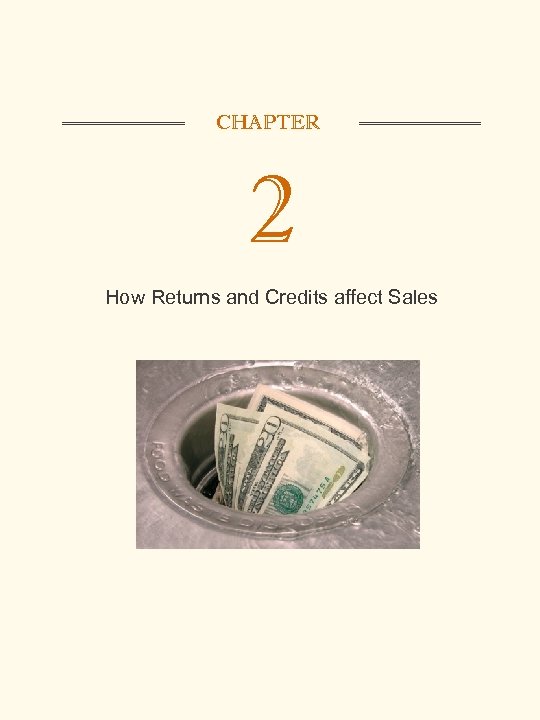
CHAPTER 2 How Returns and Credits affect Sales
Returns and Credits I don’t think any author ever won an award for talking about returns and credits. In fact, it would probably rank last on any Sales Managers List of “Top Ten Ways to Improve Sales”. Returns and Credits are dreaded by most people. While not a feel good topic, much is at risk when we fail to pay attention to WHY we have returns, WHEN we issue credits and the IMPACT it has on our business. Create a positive energy system with staff who are empowered to engage the customer on a returned part and come to a reasonable resolution. Don’t put too many rules in place. Customers have many other options today and they will exercise them. More importantly, a bad experience on a return not only gives the involved recycler a bad name, the experience is generalized to the entire industry. Action #8 – Track your Average Monthly Credit Percent Is it hovering at 10% or are you pushing 30 -35%? What is acceptable to you? More importantly, why is it where it is? I would be very curious about my drivetrain returns/credits since 40% of our parts sales are in this category. What are the reasons for high returns? • Damaged Parts? Check your Shipping Department? • Customer Lost Job/didn’t need it? Are Sales People qualifying? • Mechanical Failure? What is your QC process? There are no sure fire answers for every operation, but I can almost guarantee that high returns represent a weakness in some part of our business. More importantly, I don’t think the Customer or their experience is factored into the Return process in most of our operations.
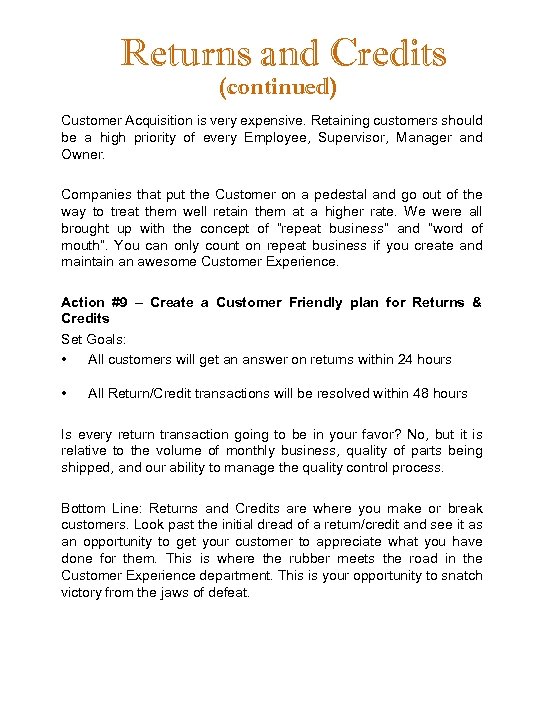
Returns and Credits (continued) Customer Acquisition is very expensive. Retaining customers should be a high priority of every Employee, Supervisor, Manager and Owner. Companies that put the Customer on a pedestal and go out of the way to treat them well retain them at a higher rate. We were all brought up with the concept of “repeat business” and “word of mouth”. You can only count on repeat business if you create and maintain an awesome Customer Experience. Action #9 – Create a Customer Friendly plan for Returns & Credits Set Goals: • All customers will get an answer on returns within 24 hours • All Return/Credit transactions will be resolved within 48 hours Is every return transaction going to be in your favor? No, but it is relative to the volume of monthly business, quality of parts being shipped, and our ability to manage the quality control process. Bottom Line: Returns and Credits are where you make or break customers. Look past the initial dread of a return/credit and see it as an opportunity to get your customer to appreciate what you have done for them. This is where the rubber meets the road in the Customer Experience department. This is your opportunity to snatch victory from the jaws of defeat.
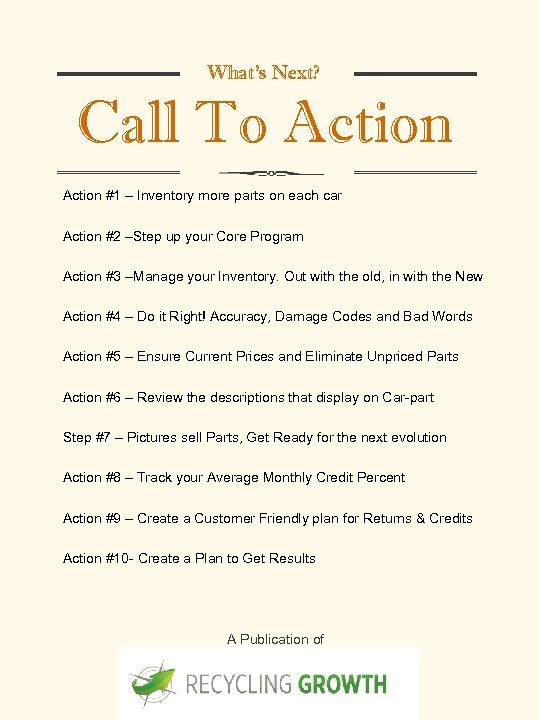
What’s Next? Call To Action #1 – Inventory more parts on each car Action #2 –Step up your Core Program Action #3 –Manage your Inventory. Out with the old, in with the New Action #4 – Do it Right! Accuracy, Damage Codes and Bad Words Action #5 – Ensure Current Prices and Eliminate Unpriced Parts Action #6 – Review the descriptions that display on Car-part Step #7 – Pictures sell Parts, Get Ready for the next evolution Action #8 – Track your Average Monthly Credit Percent Action #9 – Create a Customer Friendly plan for Returns & Credits Action #10 - Create a Plan to Get Results A Publication of
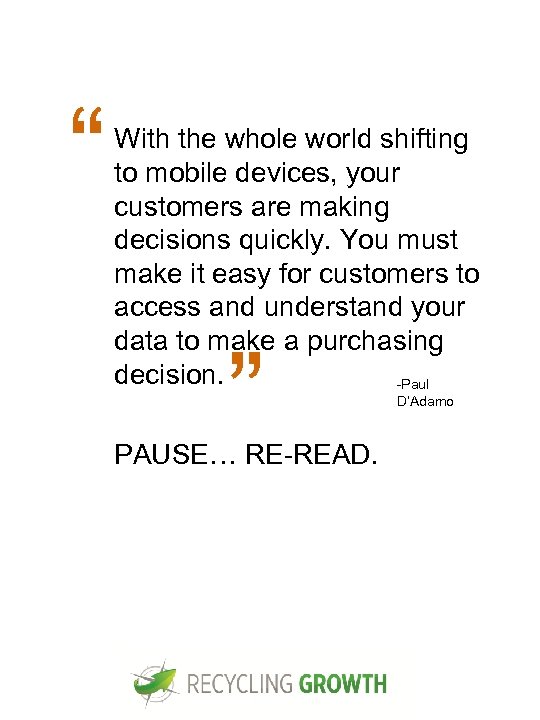
“ With the whole world shifting to mobile devices, your customers are making decisions quickly. You must make it easy for customers to access and understand your data to make a purchasing decision. -Paul ” PAUSE… RE-READ. D’Adamo
Скачать презентацию Increasing Sales A Defensive Approach Delivering More Bang
f1dbf3b18b43e2253bf3950107ead6e2.ppt