 Скачать презентацию INCOSE IW 09 Feb 2 2009 San Francisco
a9c10d309df5a2d64e755298cdad9b30.ppt
- Количество слайдов: 66



INCOSE IW 09 Feb 2, 2009 San Francisco Model-Based Systems Engineering (MBSE) Challenge Modeling & Simulation Interoperability (MSI) Team Status Update [with Mechatronics Applications] Updates beyond IS 08 - Phase 1 results (8/2008) - Phase 2 progress (as of 1/2009) Presenter Russell Peak - Georgia Tech Other Team Leaders Roger Burkhart, Sandy Friedenthal, Chris Paredis, Leon Mc. Ginnis v 1. 1 Portions are Copyright © 2009 by Georgia Tech Research Corporation, Atlanta, Georgia 30332 -0415 USA. All Rights Reserved. Permission to reproduce and distribute without changes for non-commercial purposes (including internal corporate usage) is hereby granted provided this notice and a proper citation are included. Page 1
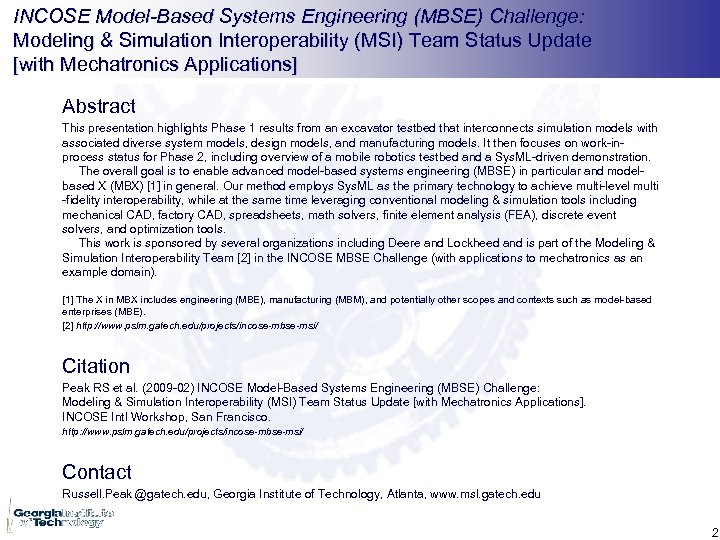
INCOSE Model-Based Systems Engineering (MBSE) Challenge: Modeling & Simulation Interoperability (MSI) Team Status Update [with Mechatronics Applications] Abstract This presentation highlights Phase 1 results from an excavator testbed that interconnects simulation models with associated diverse system models, design models, and manufacturing models. It then focuses on work-inprocess status for Phase 2, including overview of a mobile robotics testbed and a Sys. ML-driven demonstration. The overall goal is to enable advanced model-based systems engineering (MBSE) in particular and modelbased X (MBX) [1] in general. Our method employs Sys. ML as the primary technology to achieve multi-level multi -fidelity interoperability, while at the same time leveraging conventional modeling & simulation tools including mechanical CAD, factory CAD, spreadsheets, math solvers, finite element analysis (FEA), discrete event solvers, and optimization tools. This work is sponsored by several organizations including Deere and Lockheed and is part of the Modeling & Simulation Interoperability Team [2] in the INCOSE MBSE Challenge (with applications to mechatronics as an example domain). [1] The X in MBX includes engineering (MBE), manufacturing (MBM), and potentially other scopes and contexts such as model-based enterprises (MBE). [2] http: //www. pslm. gatech. edu/projects/incose-mbse-msi/ Citation Peak RS et al. (2009 -02) INCOSE Model-Based Systems Engineering (MBSE) Challenge: Modeling & Simulation Interoperability (MSI) Team Status Update [with Mechatronics Applications]. INCOSE Intl Workshop, San Francisco. http: //www. pslm. gatech. edu/projects/incose-mbse-msi/ Contact Russell. Peak @ gatech. edu, Georgia Institute of Technology, Atlanta, www. msl. gatech. edu 2
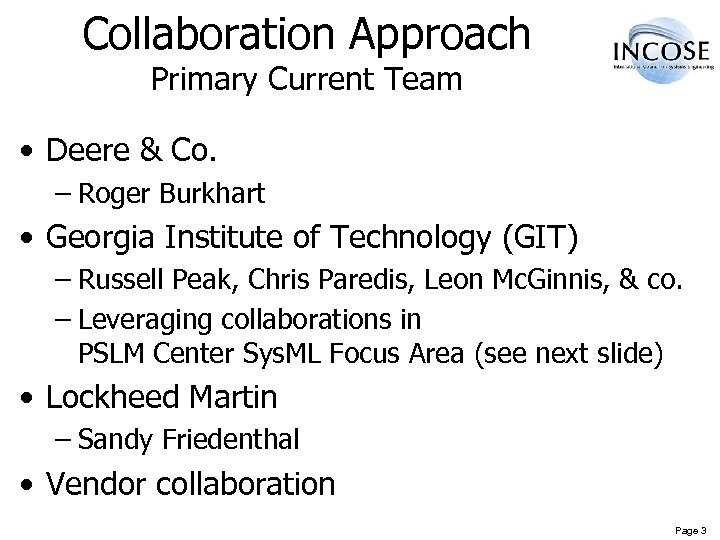
Collaboration Approach Primary Current Team • Deere & Co. – Roger Burkhart • Georgia Institute of Technology (GIT) – Russell Peak, Chris Paredis, Leon Mc. Ginnis, & co. – Leveraging collaborations in PSLM Center Sys. ML Focus Area (see next slide) • Lockheed Martin – Sandy Friedenthal • Vendor collaboration Page 3
Contents • Phase 1 Overview and Results – From August 2007 to August 2008 • Phase 2 Progress – From August 2008 to August 2009 4
Simulation & Analysis Using Sys. ML Dec 2008: Final Phase 1 Overview Presentation Experiences Applying Sys. ML in an Excavator Testbed and More Abstract This talk overviews Phase 1 experiences and lessons learned from an excavator testbed that interconnects simulation models with associated diverse system models, design models, and manufacturing models. The goal is to enable advanced model-based systems engineering (MBSE) in particular and model-based X (MBX) [1] in general. Our method employs Sys. ML as the primary technology to achieve multi-level multi-fidelity interoperability, while at the same time leveraging conventional modeling & simulation tools including mechanical CAD, factory CAD, spreadsheets, math solvers, finite element analysis (FEA), discrete event solvers, and optimization tools. This work is sponsored by several organizations including Deere and Lockheed and is part of the Modeling & Simulation Interoperability Team [2] in the INCOSE MBSE Challenge (with applications to mechatronics as an example domain). [1] The X in MBX includes engineering (MBE), manufacturing (MBM), and potentially other scopes and contexts such as model-based enterprises (MBE). [2] http: //www. pslm. gatech. edu/projects/incose-mbse-msi/ Citation RS Peak, CJJ Paredis, LF Mc. Ginnis, DA Zwemer (2008 -12) Simulation & Analysis Using Sys. ML—Experiences Applying Sys. ML in an Excavator Testbed and More. OMG Sys. ML Information Days, Burlingame CA. http: //eislab. gatech. edu/pubs/seminars-etc/2008 -12 -omg-sysml-info-days-peak/ Contact Russell. Peak@gatech. edu, Georgia Institute of Technology, Atlanta, www. msl. gatech. edu 5
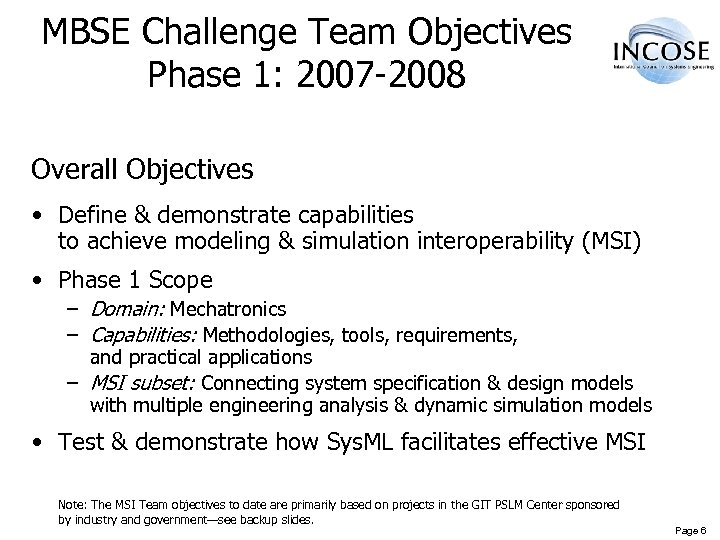
MBSE Challenge Team Objectives Phase 1: 2007 -2008 Overall Objectives • Define & demonstrate capabilities to achieve modeling & simulation interoperability (MSI) • Phase 1 Scope – Domain: Mechatronics – Capabilities: Methodologies, tools, requirements, and practical applications – MSI subset: Connecting system specification & design models with multiple engineering analysis & dynamic simulation models • Test & demonstrate how Sys. ML facilitates effective MSI Note: The MSI Team objectives to date are primarily based on projects in the GIT PSLM Center sponsored by industry and government—see backup slides. Page 6
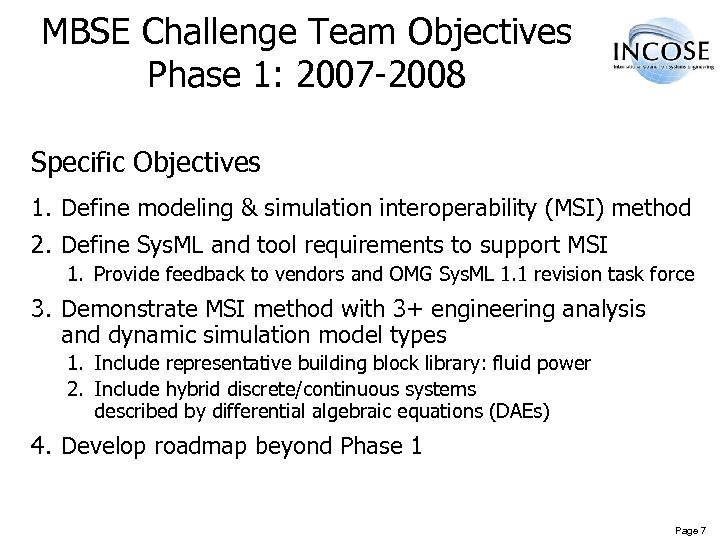
MBSE Challenge Team Objectives Phase 1: 2007 -2008 Specific Objectives 1. Define modeling & simulation interoperability (MSI) method 2. Define Sys. ML and tool requirements to support MSI 1. Provide feedback to vendors and OMG Sys. ML 1. 1 revision task force 3. Demonstrate MSI method with 3+ engineering analysis and dynamic simulation model types 1. Include representative building block library: fluid power 2. Include hybrid discrete/continuous systems described by differential algebraic equations (DAEs) 4. Develop roadmap beyond Phase 1 Page 7
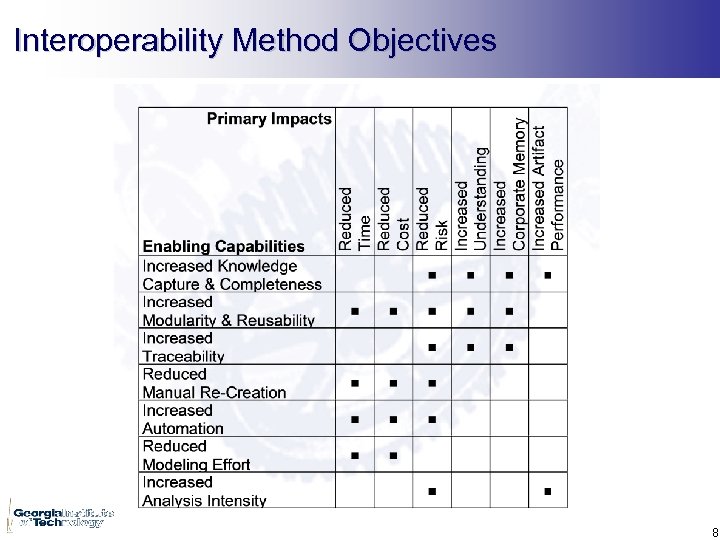
Interoperability Method Objectives 8
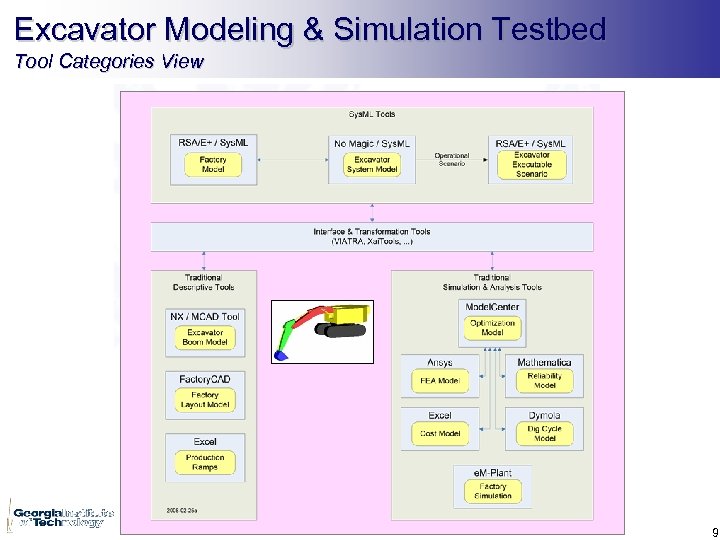
Excavator Modeling & Simulation Testbed Tool Categories View 9
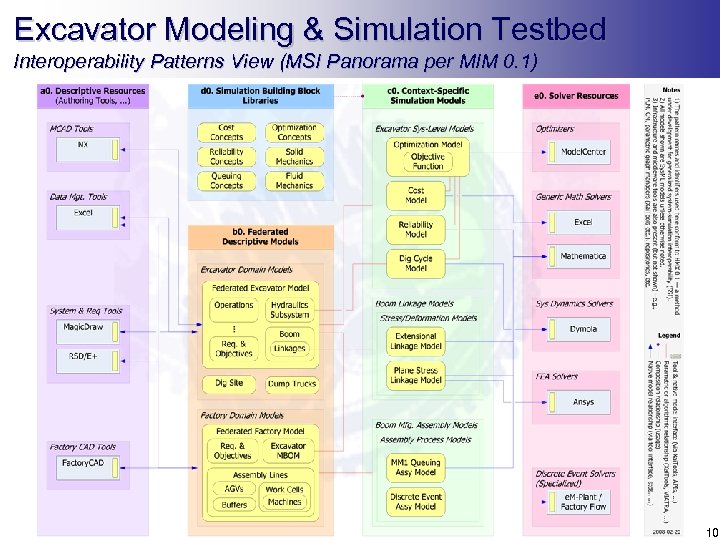
Excavator Modeling & Simulation Testbed Interoperability Patterns View (MSI Panorama per MIM 0. 1) 10
Contents • Problem Description – Characteristics of Mechatronic Systems – Challenge Team Objectives • Technical Approach – Techniques and Testbeds • Deliverables & Outcomes • Collaboration Approach Page 11
Deliverables & Outcomes Phase 1 (Aug 2008) • Solution and supporting models – Excavator test case models, test suites, … • MBSE practices used – Modeling & simulation interoperability (MSI) method, … • Model interchange capabilities – Tests between Sys. ML tools, CAD/CAE tools, … • MBSE metrics/value – See “Benefits” slide with candidate metrics • MBSE findings, issues, & recommendations – Issue submissions to OMG and vendors, publications, … • Training material – Examples, tutorials, … • Plan forward (Phase 2 and beyond) Page 12
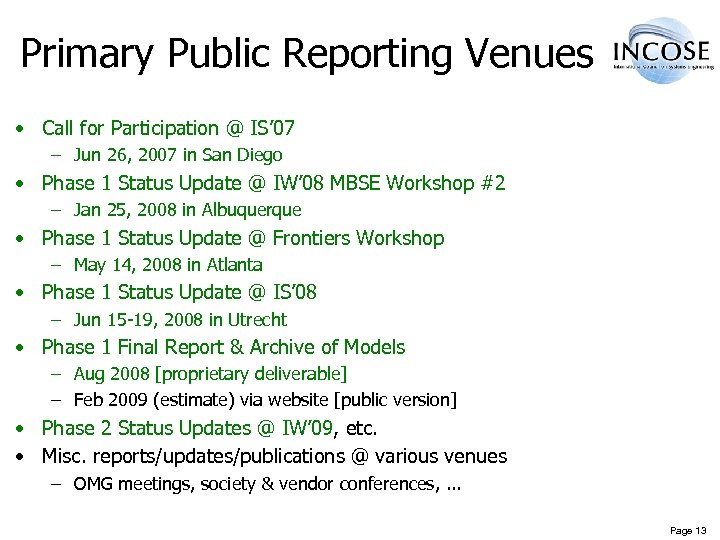
Primary Public Reporting Venues • Call for Participation @ IS’ 07 – Jun 26, 2007 in San Diego • Phase 1 Status Update @ IW’ 08 MBSE Workshop #2 – Jan 25, 2008 in Albuquerque • Phase 1 Status Update @ Frontiers Workshop – May 14, 2008 in Atlanta • Phase 1 Status Update @ IS’ 08 – Jun 15 -19, 2008 in Utrecht • Phase 1 Final Report & Archive of Models – Aug 2008 [proprietary deliverable] – Feb 2009 (estimate) via website [public version] • Phase 2 Status Updates @ IW’ 09, etc. • Misc. reports/updates/publications @ various venues – OMG meetings, society & vendor conferences, . . . Page 13
Phase 1 Report • Proprietary Deliverable: Aug 31, 2008 (v 1. 0) – 127 pages; 137 figures; 5 tables • Sanitized public version: expected ~Feb 2009 http: //www. pslm. gatech. edu/projects/incose-mbse-msi/ Page 14
Contents • Phase 1 Overview and Results – From August 2007 to August 2008 • Phase 2 Progress – From August 2008 to August 2009 15
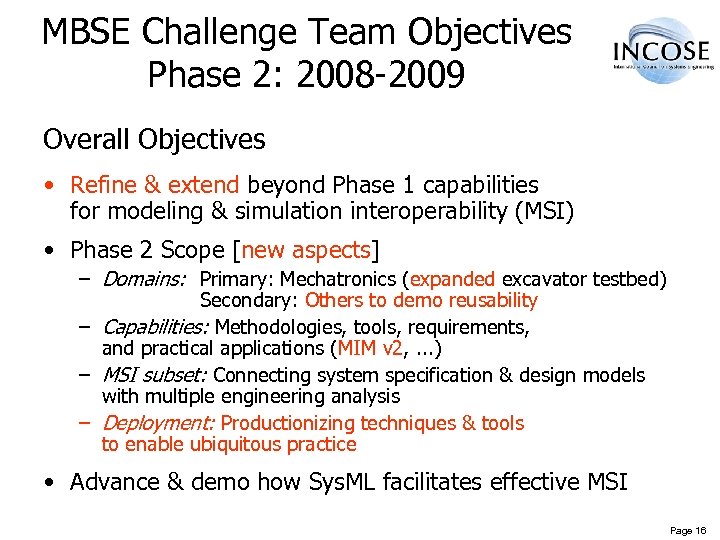
MBSE Challenge Team Objectives Phase 2: 2008 -2009 Overall Objectives • Refine & extend beyond Phase 1 capabilities for modeling & simulation interoperability (MSI) • Phase 2 Scope [new aspects] – Domains: Primary: Mechatronics (expanded excavator testbed) Secondary: Others to demo reusability – Capabilities: Methodologies, tools, requirements, and practical applications (MIM v 2, . . . ) – MSI subset: Connecting system specification & design models with multiple engineering analysis – Deployment: Productionizing techniques & tools to enable ubiquitous practice • Advance & demo how Sys. ML facilitates effective MSI Page 16
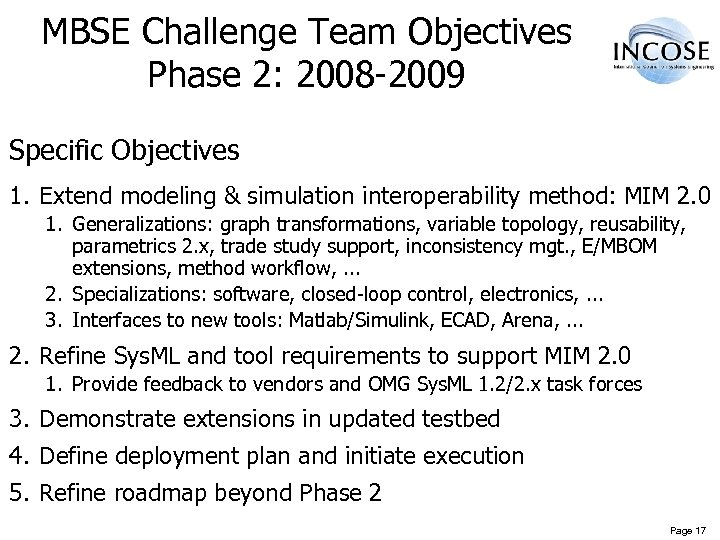
MBSE Challenge Team Objectives Phase 2: 2008 -2009 Specific Objectives 1. Extend modeling & simulation interoperability method: MIM 2. 0 1. Generalizations: graph transformations, variable topology, reusability, parametrics 2. x, trade study support, inconsistency mgt. , E/MBOM extensions, method workflow, . . . 2. Specializations: software, closed-loop control, electronics, . . . 3. Interfaces to new tools: Matlab/Simulink, ECAD, Arena, . . . 2. Refine Sys. ML and tool requirements to support MIM 2. 0 1. Provide feedback to vendors and OMG Sys. ML 1. 2/2. x task forces 3. Demonstrate extensions in updated testbed 4. Define deployment plan and initiate execution 5. Refine roadmap beyond Phase 2 Page 17
![Phase 2 Work-In-Process [selected topics] • Sys. ML parametrics and solvers • Sys. ML-Modelica](https://present5.com/presentation/a9c10d309df5a2d64e755298cdad9b30/image-18.jpg "Phase 2 Work-In-Process [selected topics] • Sys. ML parametrics and solvers • Sys. ML-Modelica")
Phase 2 Work-In-Process [selected topics] • Sys. ML parametrics and solvers • Sys. ML-Modelica interoperability • Mobile robots demonstration platform 18
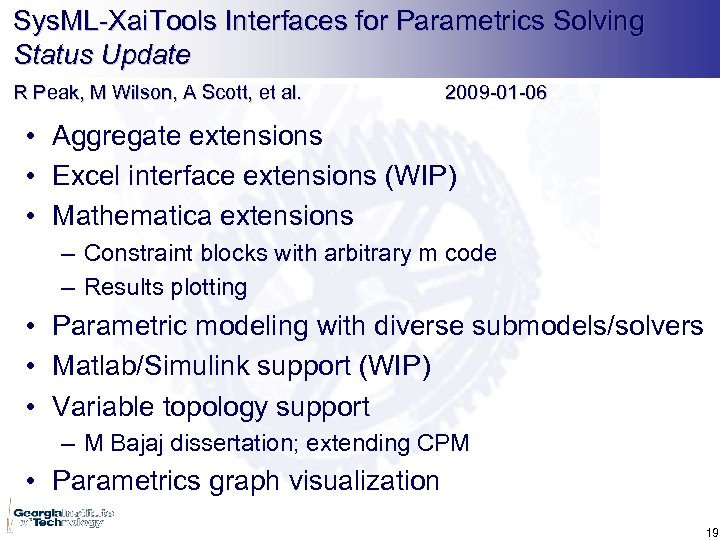
Sys. ML-Xai. Tools Interfaces for Parametrics Solving Status Update R Peak, M Wilson, A Scott, et al. 2009 -01 -06 • Aggregate extensions • Excel interface extensions (WIP) • Mathematica extensions – Constraint blocks with arbitrary m code – Results plotting • Parametric modeling with diverse submodels/solvers • Matlab/Simulink support (WIP) • Variable topology support – M Bajaj dissertation; extending CPM • Parametrics graph visualization 19
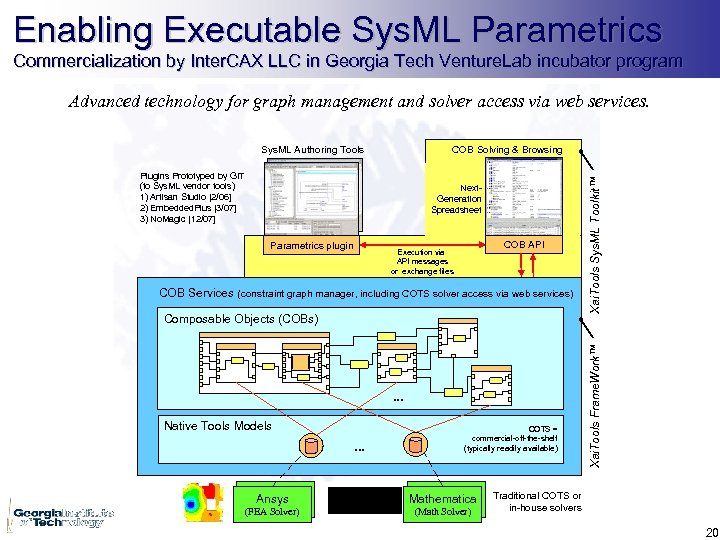
Enabling Executable Sys. ML Parametrics Commercialization by Inter. CAX LLC in Georgia Tech Venture. Lab incubator program Advanced technology for graph management and solver access via web services. Plugins Prototyped by GIT (to Sys. ML vendor tools) 1) Artisan Studio [2/06] 2) Embedded. Plus [3/07] 3) No. Magic [12/07] Next. Generation Spreadsheet Parametrics plugin COB API Execution via API messages or exchange files COB Services (constraint graph manager, including COTS solver access via web services) Composable Objects (COBs) . . . Native Tools Models . . . Ansys (FEA Solver) . . . COTS = commercial-off-the-shelf (typically readily available) Mathematica (Math Solver) Xai. Tools Sys. ML Toolkit™ COB Solving & Browsing Xai. Tools Frame. Work™ Sys. ML Authoring Tools Traditional COTS or in-house solvers 20
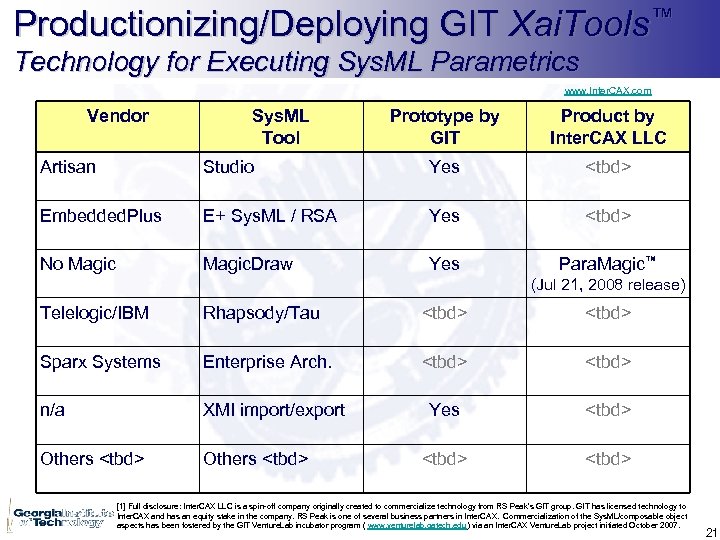
Productionizing/Deploying GIT Xai. Tools™ Technology for Executing Sys. ML Parametrics www. Inter. CAX. com Vendor Sys. ML Tool Prototype by GIT Product by Inter. CAX LLC Artisan Studio Yes <tbd> Embedded. Plus E+ Sys. ML / RSA Yes <tbd> No Magic. Draw Yes Para. Magic™ (Jul 21, 2008 release) Telelogic/IBM Rhapsody/Tau <tbd> Sparx Systems Enterprise Arch. <tbd> n/a XMI import/export Yes <tbd> Others <tbd> [1] Full disclosure: Inter. CAX LLC is a spin-off company originally created to commercialize technology from RS Peak’s GIT group. GIT has licensed technology to Inter. CAX and has an equity stake in the company. RS Peak is one of several business partners in Inter. CAX. Commercialization of the Sys. ML/composable object aspects has been fostered by the GIT Venture. Lab incubator program ( www. venturelab. gatech. edu) via an Inter. CAX Venture. Lab project initiated October 2007. 21
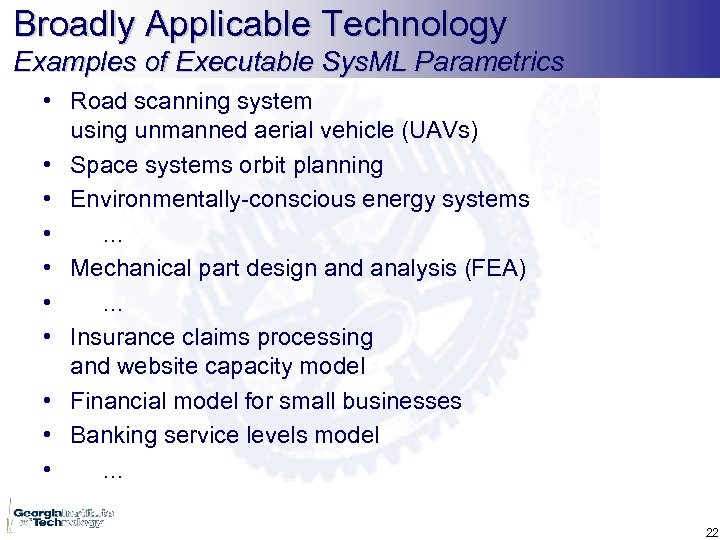
Broadly Applicable Technology Examples of Executable Sys. ML Parametrics • Road scanning system using unmanned aerial vehicle (UAVs) • Space systems orbit planning • Environmentally-conscious energy systems • . . . • Mechanical part design and analysis (FEA) • . . . • Insurance claims processing and website capacity model • Financial model for small businesses • Banking service levels model • . . . 22
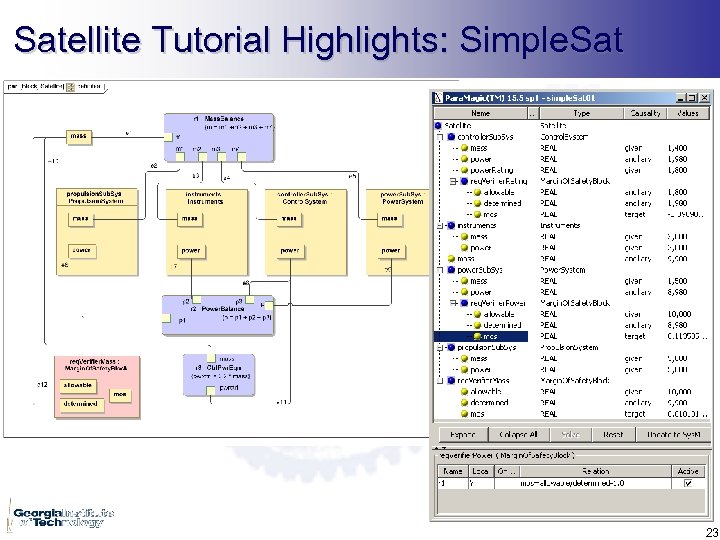
Satellite Tutorial Highlights: Simple. Sat 23
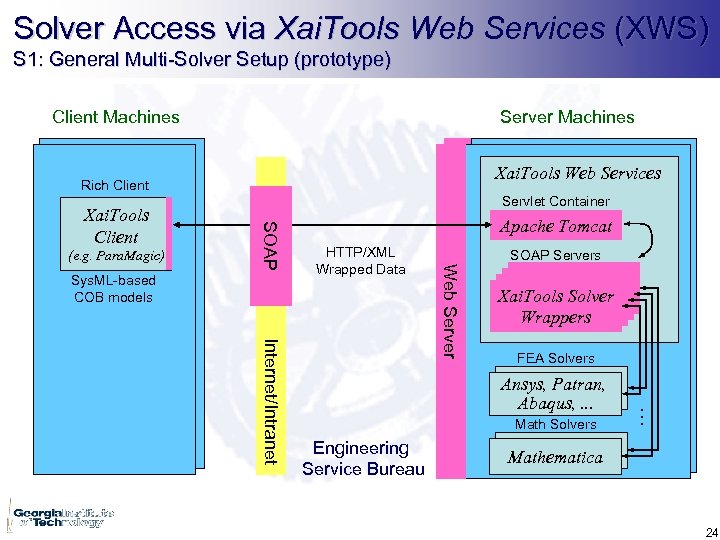
Solver Access via Xai. Tools Web Services (XWS) S 1: General Multi-Solver Setup (prototype) Client Machines Server Machines Xai. Tools Web Services Rich Client HTTP/XML Wrapped Data SOAP Servers Xai. Tools. Ansys Xai. Tools. Math. Xai. Tools. Solver Xai. Tools Server Solver Server Wrappers Internet/Intranet FEA Solvers Ansys, Patran, Abaqus, . . . Math Solvers Engineering Service Bureau . . . Sys. ML-based COB models Apache Tomcat Web Server (e. g. Para. Magic) SOAP Internet Xai. Tools Client Servlet Container Mathematica 24
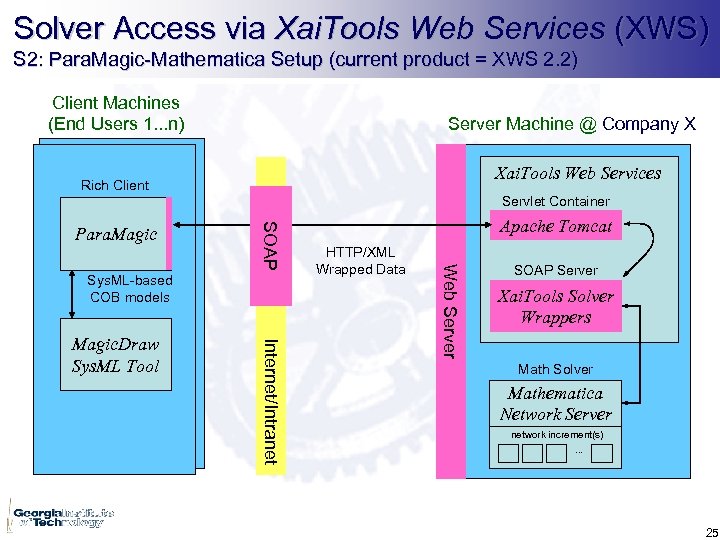
Solver Access via Xai. Tools Web Services (XWS) S 2: Para. Magic-Mathematica Setup (current product = XWS 2. 2) Client Machines (End Users 1. . . n) Server Machine @ Company X Xai. Tools Web Services Rich Client Servlet Container Internet/Intranet Magic. Draw Sys. ML Tool Apache Tomcat HTTP/XML Wrapped Data Web Server Sys. ML-based COB models SOAP Internet Para. Magic SOAP Server Xai. Tools Solver Wrappers Math Solver Mathematica Network Server network increment(s). . . 25
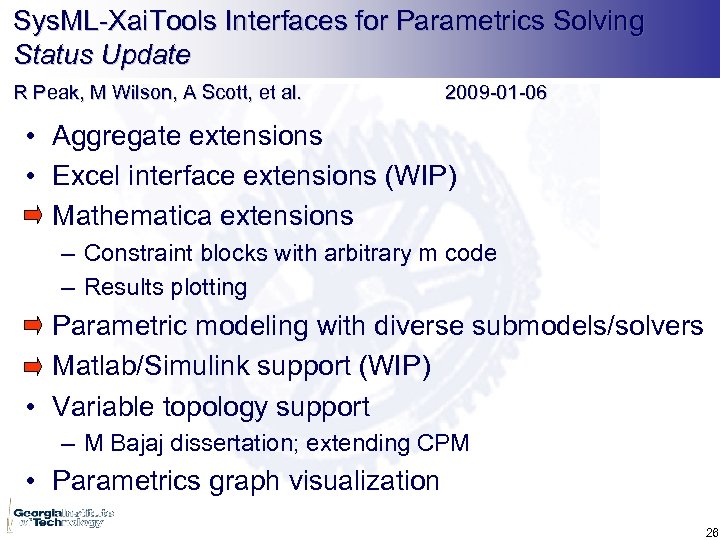
Sys. ML-Xai. Tools Interfaces for Parametrics Solving Status Update R Peak, M Wilson, A Scott, et al. 2009 -01 -06 • Aggregate extensions • Excel interface extensions (WIP) • Mathematica extensions – Constraint blocks with arbitrary m code – Results plotting • Parametric modeling with diverse submodels/solvers • Matlab/Simulink support (WIP) • Variable topology support – M Bajaj dissertation; extending CPM • Parametrics graph visualization 26
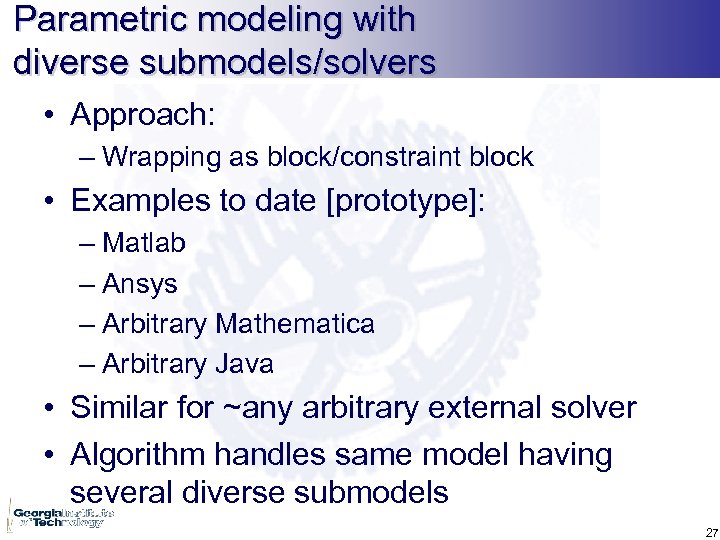
Parametric modeling with diverse submodels/solvers • Approach: – Wrapping as block/constraint block • Examples to date [prototype]: – Matlab – Ansys – Arbitrary Mathematica – Arbitrary Java • Similar for ~any arbitrary external solver • Algorithm handles same model having several diverse submodels 27
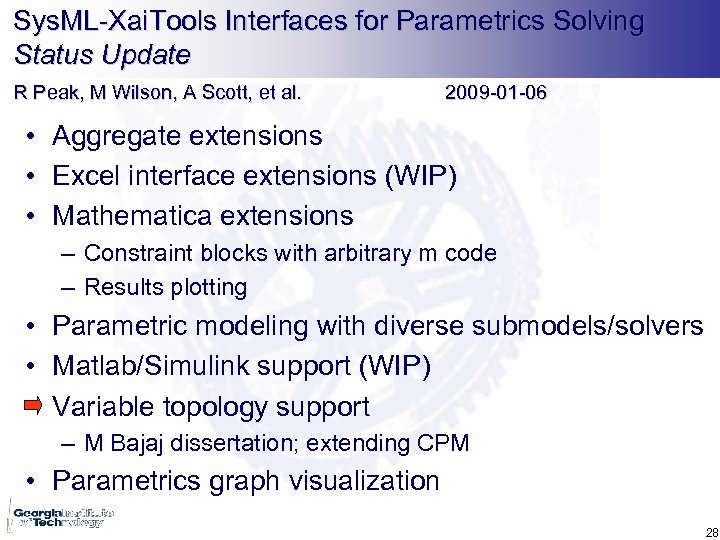
Sys. ML-Xai. Tools Interfaces for Parametrics Solving Status Update R Peak, M Wilson, A Scott, et al. 2009 -01 -06 • Aggregate extensions • Excel interface extensions (WIP) • Mathematica extensions – Constraint blocks with arbitrary m code – Results plotting • Parametric modeling with diverse submodels/solvers • Matlab/Simulink support (WIP) • Variable topology support – M Bajaj dissertation; extending CPM • Parametrics graph visualization 28
Ph. D Dissertation Defense G. W. Woodruff School of Mechanical Engineering Georgia Institute of Technology Atlanta, GA, USA Nov 3, 2008 * MRDC 4211 Knowledge Composition Methodology for Effective Analysis Problem Formulation in Simulation-based Design Manas Bajaj manas. bajaj@gatech. edu Georgia Tech Engineering Information Systems Lab www. eislab. gatech. edu Systems Realization Lab www. srl. gatech. edu Addre ssing challe of var ng iable topolo es and a nalys is inte gy nt. . . Copyright © 1993 -2008 by Georgia Tech Research Corporation, Atlanta, Georgia 30332 -0415 USA. All Rights Reserved.
Abstract http: //smartech. gatech. edu/handle/1853/26639 In simulation-based design, a key challenge is to formulate and solve analysis problems efficiently to evaluate a large variety of design alternatives. The solution of analysis problems has benefited from advancements in commercial off-the-shelf math solvers and computational capabilities. However, the formulation of analysis problems is often a costly and laborious process. Traditional simulation templates used for representing analysis problems are typically brittle with respect to variations in artifact topology and the idealization decisions taken by analysts. These templates often require manual updates and “re-wiring” of the analysis knowledge embodied in them. This makes the use of traditional simulation templates ineffective for multi-disciplinary design and optimization problems. Based on these issues, this dissertation defines a special class of problems known as variable topology multi -body (VTMB) problems that characterizes the types of variations seen in design-analysis interoperability. This research thus primarily answers the following question: How can we improve the effectiveness of the analysis problem formulation process for VTMB problems? The knowledge composition methodology (KCM) presented in this dissertation answers this question by addressing the following research gaps: (1) the lack of formalization of the knowledge used by analysts in formulating simulation templates, and (2) the inability to leverage this knowledge to define model composition methods formulating simulation templates. KCM overcomes these gaps by providing: (1) formal representation of analysis knowledge as modular, reusable, analyst-intelligible building blocks, (2) graph transformation-based methods to automatically compose simulation templates from these building blocks based on analyst idealization decisions, and (3) meta-models for representing advanced simulation templates—VTMB design models, analysis models, and the idealization relationships between them. Applications of the KCM to thermo-mechanical analysis of multi-stratum printed wiring boards and multicomponent chip packages demonstrate its effectiveness—handling VTMB and idealization variations, and enhanced computational efficiency (from several hours in existing methods to few minutes). In addition to enhancing the effectiveness of analysis problem formulation, the KCM is envisioned to provide a foundational approach to model formulation for generalized variable topology problems. Copyright © 1993 -2008 by Georgia Tech Research Corporation, Atlanta, Georgia 30332 -0415 USA. All Rights Reserved. 30
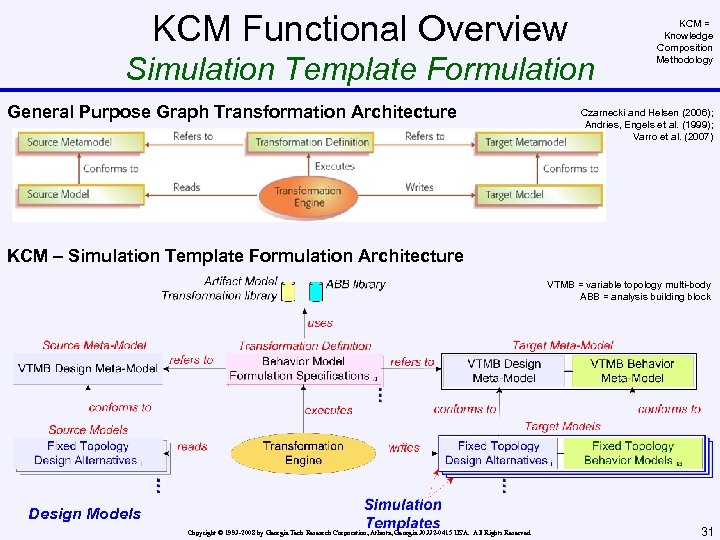
KCM Functional Overview Simulation Template Formulation General Purpose Graph Transformation Architecture KCM = Knowledge Composition Methodology Czarnecki and Helsen (2006); Andries, Engels et al. (1999); Varro et al. (2007) KCM – Simulation Template Formulation Architecture VTMB = variable topology multi-body ABB = analysis building block Design Models Copyright © 1993 -2008 by Georgia Tech Research Corporation, Atlanta, Georgia 30332 -0415 USA. All Rights Reserved. 31
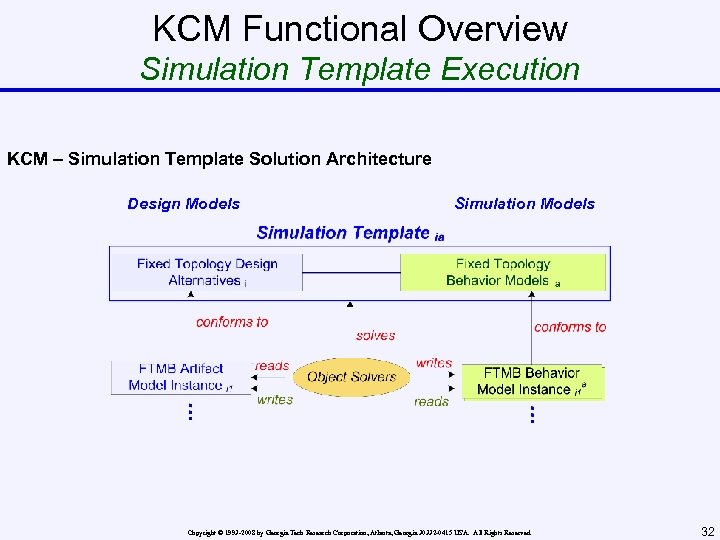
KCM Functional Overview Simulation Template Execution KCM – Simulation Template Solution Architecture Design Models Simulation Models Copyright © 1993 -2008 by Georgia Tech Research Corporation, Atlanta, Georgia 30332 -0415 USA. All Rights Reserved. 32
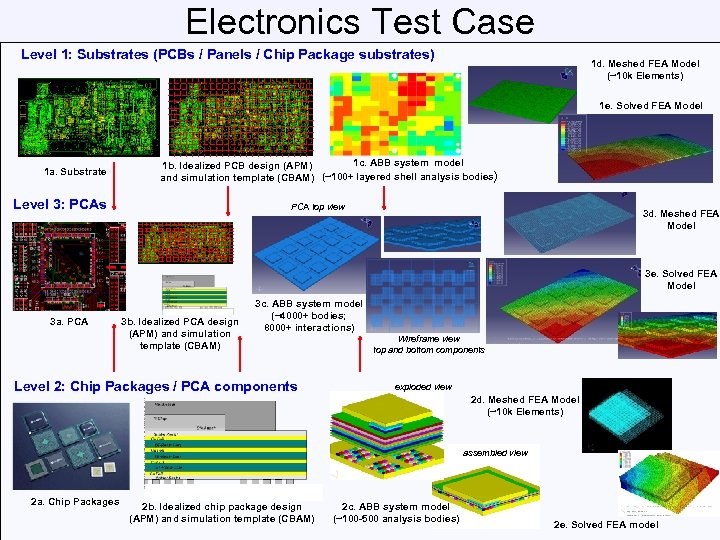
Electronics Test Case Level 1: Substrates (PCBs / Panels / Chip Package substrates) 1 d. Meshed FEA Model (~10 k Elements) 1 e. Solved FEA Model 1 a. Substrate 1 c. ABB system model 1 b. Idealized PCB design (APM) (~100+ layered shell analysis bodies) and simulation template (CBAM) Level 3: PCAs PCA top view 3 d. Meshed FEA Model 3 e. Solved FEA Model 3 a. PCA 3 b. Idealized PCA design (APM) and simulation template (CBAM) 3 c. ABB system model (~4000+ bodies; 8000+ interactions) Level 2: Chip Packages / PCA components Wireframe view top and bottom components exploded view 2 d. Meshed FEA Model (~10 k Elements) assembled view 2 a. Chip Packages 2 b. Idealized chip package design (APM) and simulation template (CBAM) 2 c. ABB system model (~100 -500 analysis bodies) Copyright © 1993 -2008 by Georgia Tech Research Corporation, Atlanta, Georgia 30332 -0415 USA. All Rights Reserved. 2 e. Solved FEA model 33
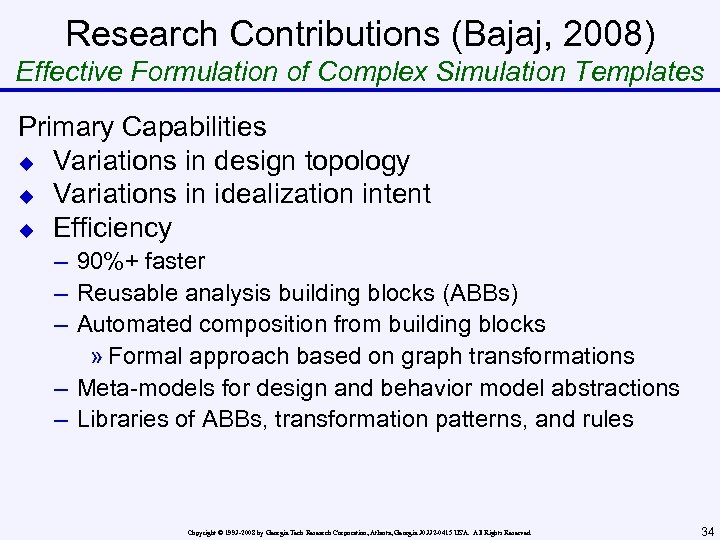
Research Contributions (Bajaj, 2008) Effective Formulation of Complex Simulation Templates Primary Capabilities u Variations in design topology u Variations in idealization intent u Efficiency – 90%+ faster – Reusable analysis building blocks (ABBs) – Automated composition from building blocks » Formal approach based on graph transformations – Meta-models for design and behavior model abstractions – Libraries of ABBs, transformation patterns, and rules Copyright © 1993 -2008 by Georgia Tech Research Corporation, Atlanta, Georgia 30332 -0415 USA. All Rights Reserved. 34
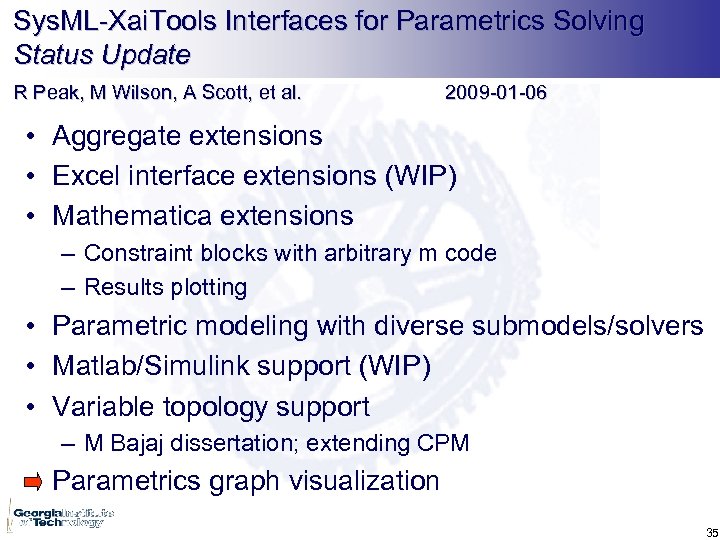
Sys. ML-Xai. Tools Interfaces for Parametrics Solving Status Update R Peak, M Wilson, A Scott, et al. 2009 -01 -06 • Aggregate extensions • Excel interface extensions (WIP) • Mathematica extensions – Constraint blocks with arbitrary m code – Results plotting • Parametric modeling with diverse submodels/solvers • Matlab/Simulink support (WIP) • Variable topology support – M Bajaj dissertation; extending CPM • Parametrics graph visualization 35
![Flattened Graph Visualization [in collaboration with Inter. CAX—A. Scott Fall 2008 internship] • Flattened](https://present5.com/presentation/a9c10d309df5a2d64e755298cdad9b30/image-36.jpg "Flattened Graph Visualization [in collaboration with Inter. CAX—A. Scott Fall 2008 internship] • Flattened")
Flattened Graph Visualization [in collaboration with Inter. CAX—A. Scott Fall 2008 internship] • Flattened graph [aka COB constraint graph] – Flattened graph among value types – Block encapsulation not shown • Purpose – Alternative way to understand / interact with a given model • Primitive connections/relationships, structure, complexity, . . . – Enable visual/intuitive comparison of several models – Possible additional Sys. ML view of models • Status – Prototype that leverages ygraph toolkit – Auto-generates flattened graph – Construction animation and static final view 36
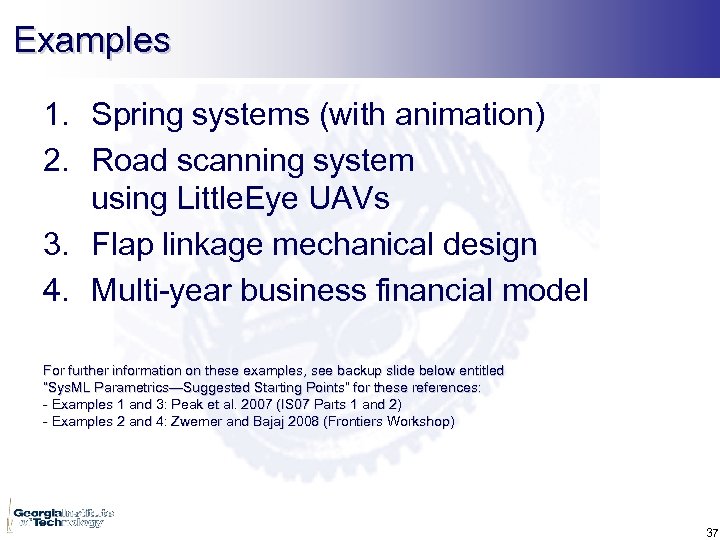
Examples 1. Spring systems (with animation) 2. Road scanning system using Little. Eye UAVs 3. Flap linkage mechanical design 4. Multi-year business financial model For further information on these examples, see backup slide below entitled “Sys. ML Parametrics—Suggested Starting Points” for these references: - Examples 1 and 3: Peak et al. 2007 (IS 07 Parts 1 and 2) - Examples 2 and 4: Zwemer and Bajaj 2008 (Frontiers Workshop) 37
![Examples [3] [1] [4] [2] 38](https://present5.com/presentation/a9c10d309df5a2d64e755298cdad9b30/image-38.jpg "Examples [3] [1] [4] [2] 38")
Examples [3] [1] [4] [2] 38
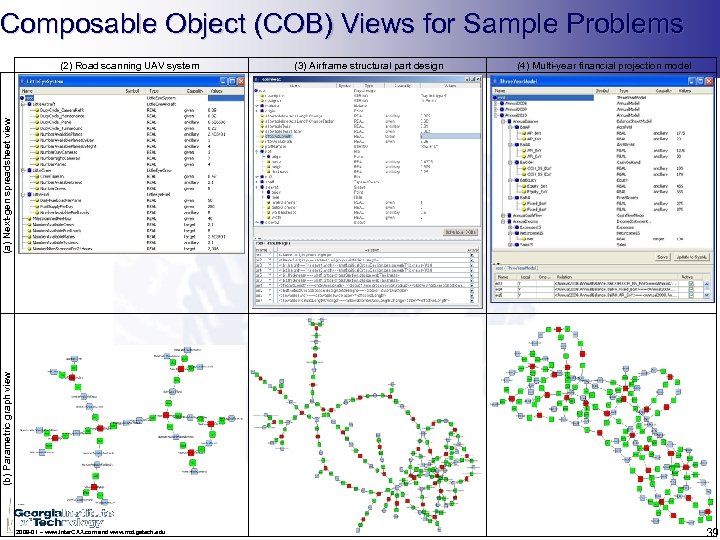
Composable Object (COB) Views for Sample Problems (3) Airframe structural part design (4) Multi-year financial projection model (b) Parametric graph view (a) Next-gen spreadsheet view (2) Road scanning UAV system 2009 -01 – www. Inter. CAX. com and www. msl. gatech. edu 39
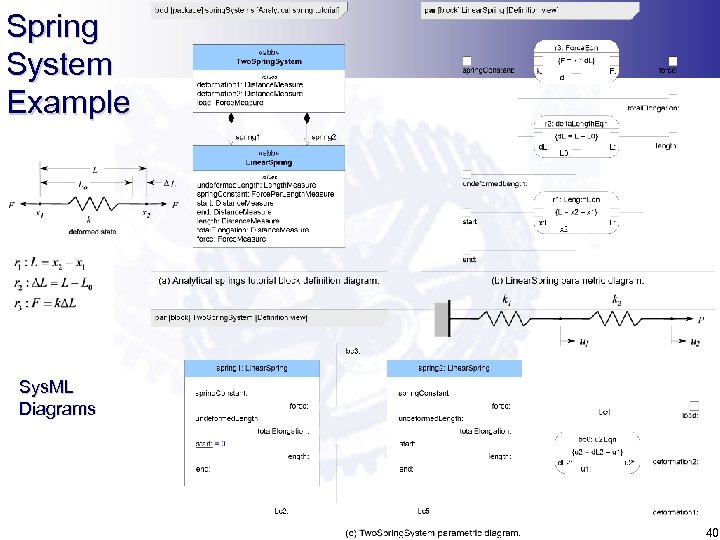
Spring System Example Sys. ML Diagrams 40
![[1] Spring System: Flattened Graph [Sys. ML constraint property name annotations] bc 4 spring](https://present5.com/presentation/a9c10d309df5a2d64e755298cdad9b30/image-41.jpg "[1] Spring System: Flattened Graph [Sys. ML constraint property name annotations] bc 4 spring")
[1] Spring System: Flattened Graph [Sys. ML constraint property name annotations] bc 4 spring 1. r 3 bc 3 spring 2. r 3 bc 6 spring 1. r 2 bc 5 spring 2. r 2 spring 1. r 1 bc 2 spring 2. r 1 41
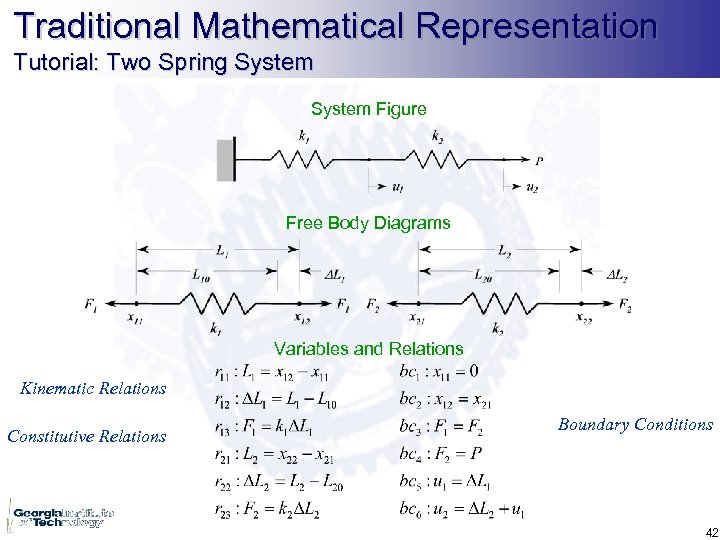
Traditional Mathematical Representation Tutorial: Two Spring System Figure Free Body Diagrams Variables and Relations Kinematic Relations Constitutive Relations Boundary Conditions 42
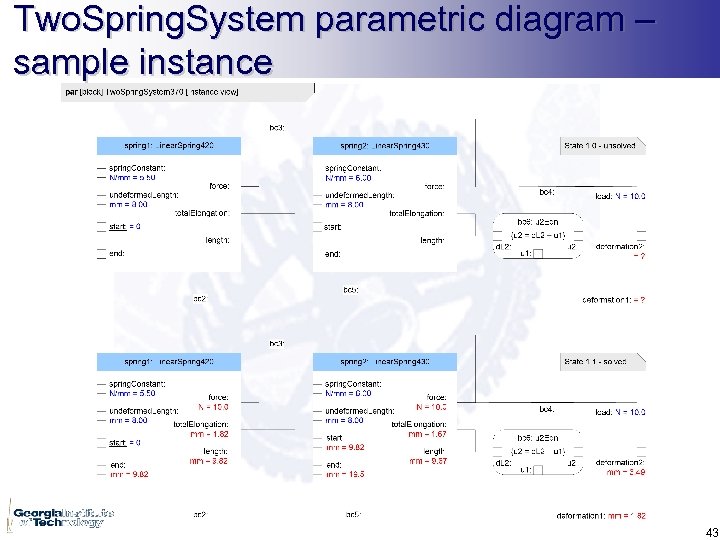
Two. Spring. System parametric diagram – sample instance 43
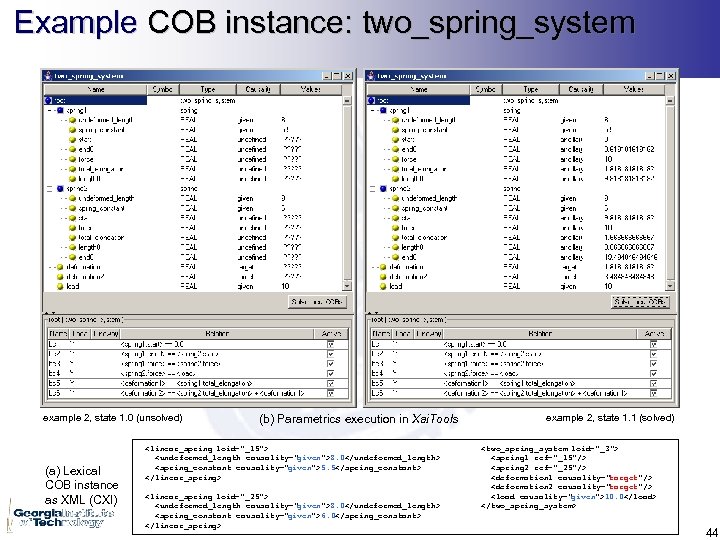
Example COB instance: two_spring_system example 2, state 1. 0 (unsolved) (a) Lexical COB instance as XML (CXI) (b) Parametrics execution in Xai. Tools <linear_spring loid="_15"> <undeformed_length causality=" given">8. 0</undeformed_length> <spring_constant causality="given">5. 5</spring_constant> </linear_spring> <linear_spring loid="_25"> <undeformed_length causality=" given">8. 0</undeformed_length> <spring_constant causality="given">6. 0</spring_constant> </linear_spring> example 2, state 1. 1 (solved) <two_spring_system loid="_3"> <spring 1 ref="_15"/> <spring 2 ref="_25"/> <deformation 1 causality="target"/> <deformation 2 causality="target"/> <load causality="given">10. 0</load> </two_spring_system> 44
![Phase 2 Work-In-Process [selected topics] • Sys. ML parametrics and solvers • Sys. ML-Modelica](https://present5.com/presentation/a9c10d309df5a2d64e755298cdad9b30/image-45.jpg "Phase 2 Work-In-Process [selected topics] • Sys. ML parametrics and solvers • Sys. ML-Modelica")
Phase 2 Work-In-Process [selected topics] • Sys. ML parametrics and solvers • Sys. ML-Modelica interoperability [WIP] – Generalized mapping underway – Contact Chris Paredis for further information • Mobile robots demonstration platform 45
![Phase 2 Work-In-Process [selected topics] • Sys. ML parametrics and solvers • Sys. ML-Modelica](https://present5.com/presentation/a9c10d309df5a2d64e755298cdad9b30/image-46.jpg "Phase 2 Work-In-Process [selected topics] • Sys. ML parametrics and solvers • Sys. ML-Modelica")
Phase 2 Work-In-Process [selected topics] • Sys. ML parametrics and solvers • Sys. ML-Modelica interoperability • Mobile robots demonstration platform 46
Sys. ML and Mobile Robotic Systems: A Research Testbed and Educational Platform Status Update R Peak, B Wilson, et al. 2009 -02 -02 • Background & Objectives • Domain Sys. ML model (WIP) • Demonstration 47
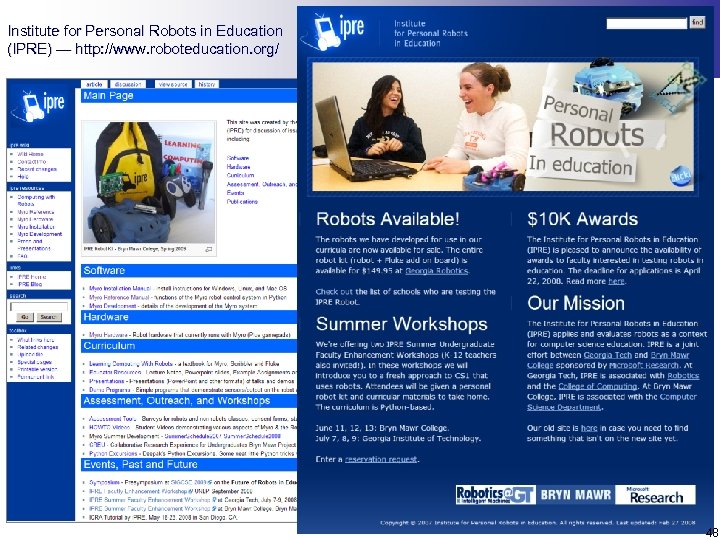
Institute for Personal Robots in Education (IPRE) — http: //www. roboteducation. org/ 48
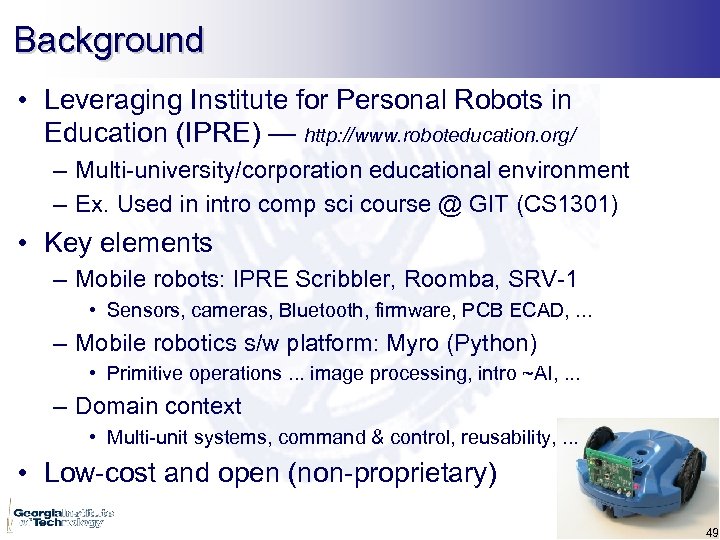
Background • Leveraging Institute for Personal Robots in Education (IPRE) — http: //www. roboteducation. org/ – Multi-university/corporation educational environment – Ex. Used in intro comp sci course @ GIT (CS 1301) • Key elements – Mobile robots: IPRE Scribbler, Roomba, SRV-1 • Sensors, cameras, Bluetooth, firmware, PCB ECAD, . . . – Mobile robotics s/w platform: Myro (Python) • Primitive operations. . . image processing, intro ~AI, . . . – Domain context • Multi-unit systems, command & control, reusability, . . . • Low-cost and open (non-proprietary) 49
Objectives—Big Picture • Research & demonstration testbed [achieve MSI Team Phase 2 objectives. . . ] – System run-time operation aided by Sys. ML – Embedded software / firmware • Hardware-software relations, real-time factors, . . . – Executable Sys. ML across multiple constructs • Activities, parametrics, state machines. . . – Misc: instance levels, versioning/config mgt. • Sys. ML education platform – Usage in hands-on courses (industry short courses, university courses, . . . ) – Model it and run it! 50
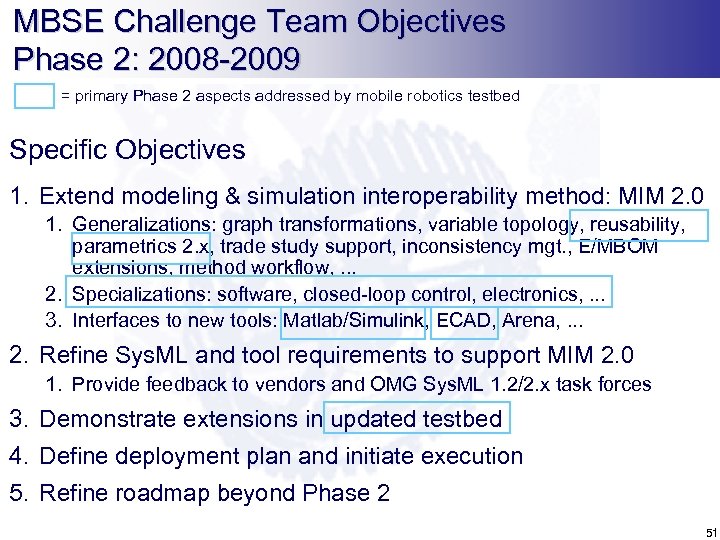
MBSE Challenge Team Objectives Phase 2: 2008 -2009 = primary Phase 2 aspects addressed by mobile robotics testbed Specific Objectives 1. Extend modeling & simulation interoperability method: MIM 2. 0 1. Generalizations: graph transformations, variable topology, reusability, parametrics 2. x, trade study support, inconsistency mgt. , E/MBOM extensions, method workflow, . . . 2. Specializations: software, closed-loop control, electronics, . . . 3. Interfaces to new tools: Matlab/Simulink, ECAD, Arena, . . . 2. Refine Sys. ML and tool requirements to support MIM 2. 0 1. Provide feedback to vendors and OMG Sys. ML 1. 2/2. x task forces 3. Demonstrate extensions in updated testbed 4. Define deployment plan and initiate execution 5. Refine roadmap beyond Phase 2 51
Objectives—Near-Term • Get basic infrastructure in place – Prototyping (executable activity basics) – Familiarity with IPRE environment (and beyond) • Determine what is feasible longer term • Develop draft domain Sys. ML model • Update big picture objectives and proceed 52
![Scribbler / Myro Demo Executable Sys. ML Activity Model [1 - original] 53](https://present5.com/presentation/a9c10d309df5a2d64e755298cdad9b30/image-53.jpg "Scribbler / Myro Demo Executable Sys. ML Activity Model [1 - original] 53")
Scribbler / Myro Demo Executable Sys. ML Activity Model [1 - original] 53
![Scribbler / Myro Demo Executable Sys. ML Activity Model [2 - after interactive update]](https://present5.com/presentation/a9c10d309df5a2d64e755298cdad9b30/image-54.jpg "Scribbler / Myro Demo Executable Sys. ML Activity Model [2 - after interactive update]")
Scribbler / Myro Demo Executable Sys. ML Activity Model [2 - after interactive update] 54
![Scribbler / Myro Demo Executable Sys. ML Activity Model [activity building blocks] 55](https://present5.com/presentation/a9c10d309df5a2d64e755298cdad9b30/image-55.jpg "Scribbler / Myro Demo Executable Sys. ML Activity Model [activity building blocks] 55")
Scribbler / Myro Demo Executable Sys. ML Activity Model [activity building blocks] 55
Contents • Phase 1 Overview and Results – From August 2007 to August 2008 • Phase 2 Progress – From August 2008 to August 2009 • Summary 56
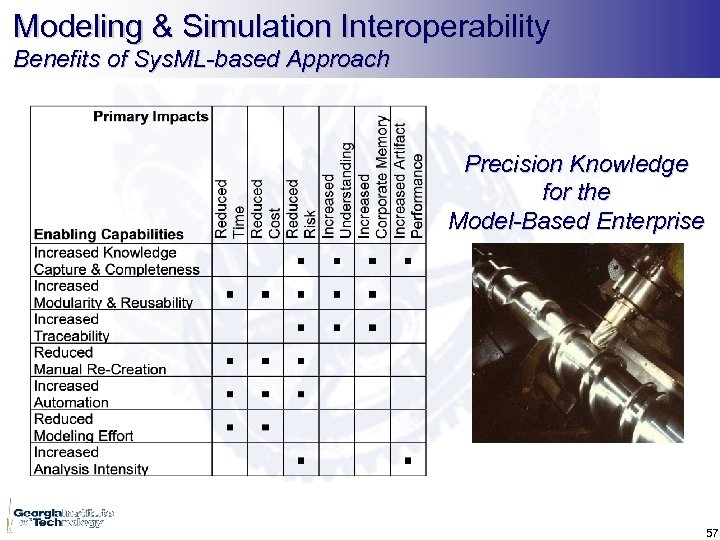
Modeling & Simulation Interoperability Benefits of Sys. ML-based Approach Precision Knowledge for the Model-Based Enterprise 57
MBSE Challenge Team Mechatronics / Model Interoperability Open “Call for Participation” • Systems engineering drivers in commercial settings – Increased system complexity – Cross-disciplinary communication/coordination • Enhancement possibilities based on interest – Other demonstration examples and testbeds – Interoperability testing between Sys. ML tools – Shared models and libraries • Primary contacts – Russell Peak [Russell. Peak @ gatech. edu] – Sandy Friedenthal [sanford. friedenthal @ lmco. com] – Roger Burkhart [Burkhart. Roger. M @ John. Deere. com] Page 58
Related Resources Page 59
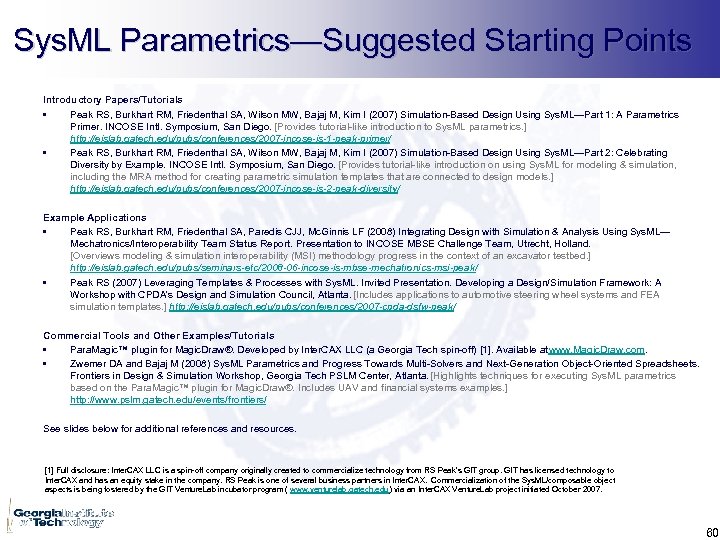
Sys. ML Parametrics—Suggested Starting Points Introductory Papers/Tutorials • Peak RS, Burkhart RM, Friedenthal SA, Wilson MW, Bajaj M, Kim I (2007) Simulation-Based Design Using Sys. ML—Part 1: A Parametrics Primer. INCOSE Intl. Symposium, San Diego. [Provides tutorial-like introduction to Sys. ML parametrics. ] http: //eislab. gatech. edu/pubs/conferences/2007 -incose-is-1 -peak-primer/ • Peak RS, Burkhart RM, Friedenthal SA, Wilson MW, Bajaj M, Kim I (2007) Simulation-Based Design Using Sys. ML—Part 2: Celebrating Diversity by Example. INCOSE Intl. Symposium, San Diego. [Provides tutorial-like introduction on using Sys. ML for modeling & simulation, including the MRA method for creating parametric simulation templates that are connected to design models. ] http: //eislab. gatech. edu/pubs/conferences/2007 -incose-is-2 -peak-diversity/ Example Applications • Peak RS, Burkhart RM, Friedenthal SA, Paredis CJJ, Mc. Ginnis LF (2008) Integrating Design with Simulation & Analysis Using Sys. ML— Mechatronics/Interoperability Team Status Report. Presentation to INCOSE MBSE Challenge Team, Utrecht, Holland. [Overviews modeling & simulation interoperability (MSI) methodology progress in the context of an excavator testbed. ] http: //eislab. gatech. edu/pubs/seminars-etc/2008 -06 -incose-is-mbse-mechatronics-msi-peak/ • Peak RS (2007) Leveraging Templates & Processes with Sys. ML. Invited Presentation. Developing a Design/Simulation Framework: A Workshop with CPDA's Design and Simulation Council, Atlanta. [Includes applications to automotive steering wheel systems and FEA simulation templates. ] http: //eislab. gatech. edu/pubs/conferences/2007 -cpda-dsfw-peak/ Commercial Tools and Other Examples/Tutorials • Para. Magic™ plugin for Magic. Draw®. Developed by Inter. CAX LLC (a Georgia Tech spin-off) [1]. Available at www. Magic. Draw. com. • Zwemer DA and Bajaj M (2008) Sys. ML Parametrics and Progress Towards Multi-Solvers and Next-Generation Object-Oriented Spreadsheets. Frontiers in Design & Simulation Workshop, Georgia Tech PSLM Center, Atlanta. [Highlights techniques for executing Sys. ML parametrics based on the Para. Magic™ plugin for Magic. Draw®. Includes UAV and financial systems examples. ] http: //www. pslm. gatech. edu/events/frontiers/ See slides below for additional references and resources. [1] Full disclosure: Inter. CAX LLC is a spin-off company originally created to commercialize technology from RS Peak’s GIT group. GIT has licensed technology to Inter. CAX and has an equity stake in the company. RS Peak is one of several business partners in Inter. CAX. Commercialization of the Sys. ML/composable object aspects is being fostered by the GIT Venture. Lab incubator program ( www. venturelab. gatech. edu) via an Inter. CAX Venture. Lab project initiated October 2007. 60
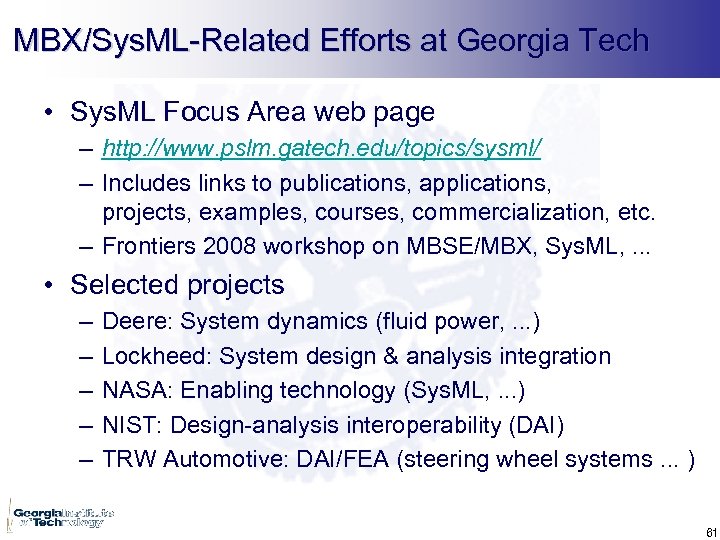
MBX/Sys. ML-Related Efforts at Georgia Tech • Sys. ML Focus Area web page – http: //www. pslm. gatech. edu/topics/sysml/ – Includes links to publications, applications, projects, examples, courses, commercialization, etc. – Frontiers 2008 workshop on MBSE/MBX, Sys. ML, . . . • Selected projects – – – Deere: System dynamics (fluid power, . . . ) Lockheed: System design & analysis integration NASA: Enabling technology (Sys. ML, . . . ) NIST: Design-analysis interoperability (DAI) TRW Automotive: DAI/FEA (steering wheel systems. . . ) 61
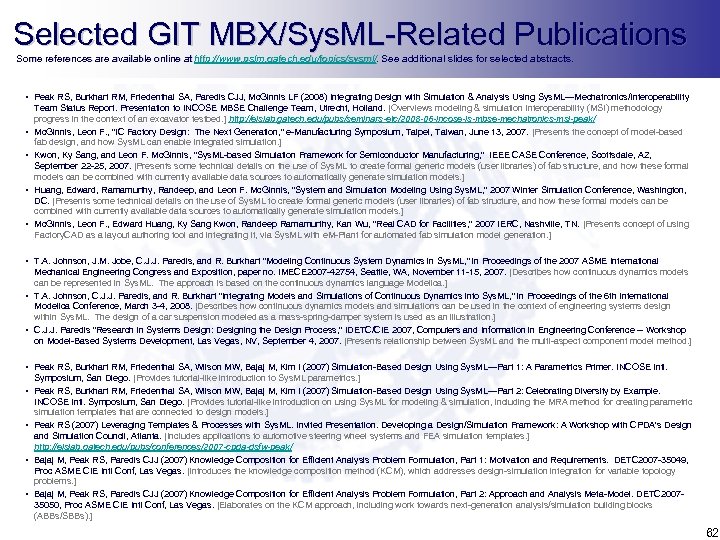
Selected GIT MBX/Sys. ML-Related Publications Some references are available online at http: //www. pslm. gatech. edu/topics/sysml/. See additional slides for selected abstracts. http: //www. pslm. gatech. edu/topics/sysml/. • Peak RS, Burkhart RM, Friedenthal SA, Paredis CJJ, Mc. Ginnis LF (2008) Integrating Design with Simulation & Analysis Using Sys. ML—Mechatronics/Interoperability • • Team Status Report. Presentation to INCOSE MBSE Challenge Team, Utrecht, Holland. [Overviews modeling & simulation interoperability (MSI) methodology progress in the context of an excavator testbed. ] http: //eislab. gatech. edu/pubs/seminars-etc/2008 -06 -incose-is-mbse-mechatronics-msi-peak/ Mc. Ginnis, Leon F. , "IC Factory Design: The Next Generation, " e-Manufacturing Symposium, Taipei, Taiwan, June 13, 2007. [Presents the concept of model-based fab design, and how Sys. ML can enable integrated simulation. ] Kwon, Ky Sang, and Leon F. Mc. Ginnis, "Sys. ML-based Simulation Framework for Semiconductor Manufacturing, " IEEE CASE Conference, Scottsdale, AZ, September 22 -25, 2007. [Presents some technical details on the use of Sys. ML to create formal generic models (user libraries) of fab structure, and how these formal models can be combined with currently available data sources to automatically generate simulation models. ] Huang, Edward, Ramamurthy, Randeep, and Leon F. Mc. Ginnis, "System and Simulation Modeling Using Sys. ML, " 2007 Winter Simulation Conference, Washington, DC. [Presents some technical details on the use of Sys. ML to create formal generic models (user libraries) of fab structure, and how these formal models can be combined with currently available data sources to automatically generate simulation models. ] Mc. Ginnis, Leon F. , Edward Huang, Ky Sang Kwon, Randeep Ramamurthy, Kan Wu, "Real CAD for Facilities, " 2007 IERC, Nashville, TN. [Presents concept of using Factory. CAD as a layout authoring tool and integrating it, via Sys. ML with e. M-Plant for automated fab simulation model generation. ] • T. A. Johnson, J. M. Jobe, C. J. J. Paredis, and R. Burkhart "Modeling Continuous System Dynamics in Sys. ML, " in Proceedings of the 2007 ASME International Mechanical Engineering Congress and Exposition, paper no. IMECE 2007 -42754, Seattle, WA, November 11 -15, 2007. [Describes how continuous dynamics models can be represented in Sys. ML. The approach is based on the continuous dynamics language Modelica. ] • T. A. Johnson, C. J. J. Paredis, and R. Burkhart "Integrating Models and Simulations of Continuous Dynamics into Sys. ML, " in Proceedings of the 6 th International Modelica Conference, March 3 -4, 2008. [Describes how continuous dynamics models and simulations can be used in the context of engineering systems design within Sys. ML. The design of a car suspension modeled as a mass-spring-damper system is used as an illustration. ] • C. J. J. Paredis "Research in Systems Design: Designing the Design Process, " IDETC/CIE 2007, Computers and Information in Engineering Conference -- Workshop on Model-Based Systems Development, Las Vegas, NV, September 4, 2007. [Presents relationship between Sys. ML and the multi-aspect component model method. ] • Peak RS, Burkhart RM, Friedenthal SA, Wilson MW, Bajaj M, Kim I (2007) Simulation-Based Design Using Sys. ML—Part 1: A Parametrics Primer. INCOSE Intl. Symposium, San Diego. [Provides tutorial-like introduction to Sys. ML parametrics. ] • Peak RS, Burkhart RM, Friedenthal SA, Wilson MW, Bajaj M, Kim I (2007) Simulation-Based Design Using Sys. ML—Part 2: Celebrating Diversity by Example. INCOSE Intl. Symposium, San Diego. [Provides tutorial-like introduction on using Sys. ML for modeling & simulation, including the MRA method for creating parametric simulation templates that are connected to design models. ] • Peak RS (2007) Leveraging Templates & Processes with Sys. ML. Invited Presentation. Developing a Design/Simulation Framework: A Workshop with CPDA's Design and Simulation Council, Atlanta. [Includes applications to automotive steering wheel systems and FEA simulation templates. ] http: //eislab. gatech. edu/pubs/conferences/2007 -cpda-dsfw-peak/ • Bajaj M, Peak RS, Paredis CJJ (2007) Knowledge Composition for Efficient Analysis Problem Formulation, Part 1: Motivation and Requirements. DETC 2007 -35049, Proc ASME CIE Intl Conf, Las Vegas. [Introduces the knowledge composition method (KCM), which addresses design-simulation integration for variable topology problems. ] • Bajaj M, Peak RS, Paredis CJJ (2007) Knowledge Composition for Efficient Analysis Problem Formulation, Part 2: Approach and Analysis Meta-Model. DETC 200735050, Proc ASME CIE Intl Conf, Las Vegas. [Elaborates on the KCM approach, including work towards next-generation analysis/simulation building blocks (ABBs/SBBs). ] 62
Integrating Design with Simulation & Analysis Using Sys. ML— Mechatronics/Interoperability Team Status Report Abstract This presentation overviews work-in-progress experiences and lessons learned from an excavator testbed that interconnects simulation models with associated diverse system models, design models, and manufacturing models. The goal is to enable advanced model-based systems engineering (MBSE) in particular and model-based X 1 (MBX) in general. Our method employs Sys. ML as the primary technology to achieve multi-level multi-fidelity interoperability, while at the same time leveraging conventional modeling & simulation tools including mechanical CAD, factory CAD, spreadsheets, math solvers, finite element analysis (FEA), discrete event solvers, and optimization tools. This work is currently sponsored by several organizations (including Deere and Lockheed) and is part of the Mechatronics & Interoperability Team in the INCOSE MBSE Challenge. Citation Peak RS, Burkhart RM, Friedenthal SA, Paredis CJJ, Mc. Ginnis LF (2008) Integrating Design with Simulation & Analysis Using Sys. ML—Mechatronics/Interoperability Team Status Report. Presentation to INCOSE MBSE Challenge Team, Utrecht, Holland. http: //eislab. gatech. edu/pubs/seminars-etc/2008 -06 -incose-is-mbse-mechatronics-msi-peak/ [1] The X in MBX includes engineering (MBE), manufacturing (MBM), and potentially other scopes and contexts such as model-based enterprises (MBE). 63
Simulation-Based Design Using Sys. ML Part 1: A Parametrics Primer Part 2: Celebrating Diversity by Example OMG Sys. ML™ is a modeling language for specifying, analyzing, designing, and verifying complex systems. It is a general-purpose graphical modeling language with computer-sensible semantics. This Part 1 paper and its Part 2 companion show Sys. ML supports simulation-based design (SBD) via tutorial-like examples. Our target audience is end users wanting to learn about Sys. ML parametrics in general and its applications to engineering design and analysis in particular. We include background on the development of Sys. ML parametrics that may also be useful for other stakeholders (e. g, vendors and researchers). In Part 1 we walk through models of simple objects that progressively introduce Sys. ML parametrics concepts. To enhance understanding by comparison and contrast, we present corresponding models based on composable objects (COBs). The COB knowledge representation has provided a conceptual foundation for Sys. ML parametrics, including executability and validation. We end with sample analysis building blocks (ABBs) from mechanics of materials showing how Sys. ML captures engineering knowledge in a reusable form. Part 2 employs these ABBs in a high diversity mechanical example that integrates computer-aided design and engineering analysis (CAD/CAE). The object and constraint graph concepts embodied in Sys. ML parametrics and COBs provide modular analysis capabilities based on multi -directional constraints. These concepts and capabilities provide a semantically rich way to organize and reuse the complex relations and properties that characterize SBD models. Representing relations as noncausal constraints, which generally accept any valid combination of inputs and outputs, enhances modeling flexibility and expressiveness. We envision Sys. ML becoming a unifying representation of domain-specific engineering analysis models that include fine-grain associativity with other domain- and system-level models, ultimately providing fundamental capabilities for next-generation systems lifecycle management. These two companion papers present foundational principles of parametrics in OMG Sys. ML™ and their application to simulation-based design. Parametrics capabilities have been included in Sys. ML to support integrating engineering analysis with system requirements, behavior, and structure models. This Part 2 paper walks through Sys. ML models for a benchmark tutorial on analysis templates utilizing an airframe system component called a flap linkage. This example highlights how engineering analysis models, such as stress models, are captured in Sys. ML, and then executed by external tools including math solvers and finite element analysis solvers. We summarize the multi-representation architecture (MRA) method and how its simulation knowledge patterns support computing environments having a diversity of analysis fidelities, physical behaviors, solution methods, and CAD/CAE tools. Sys. ML and composable object (COB) techniques described in Part 1 together provide the MRA with graphical modeling languages, executable parametrics, and reusable, modular, multidirectional capabilities. We also demonstrate additional Sys. ML modeling concepts, including packages, building block libraries, and requirements-verification-simulation interrelationships. Results indicate that Sys. ML offers significant promise as a unifying language for a variety of models-from top-level system models to discipline-specific leaf-level models. Citation Peak RS, Burkhart RM, Friedenthal SA, Wilson MW, Bajaj M, Kim I (2007) Simulation-Based Design Using Sys. ML. INCOSE Intl. Symposium, San Diego. Part 1: A Parametrics Primer http: //eislab. gatech. edu/pubs/conferences/2007 -incose-is-1 -peak-primer/ Part 2: Celebrating Diversity by Example http: //eislab. gatech. edu/pubs/conferences/2007 -incose-is-2 -peak-diversity/ 64
Composable Objects (COB) Requirements & Objectives Abstract This document formulates a vision for advanced collaborative engineering environments (CEEs) to aid in the design, simulation and configuration management of complex engineering systems. Based on inputs from experienced Systems Engineers and technologists from various industries and government agencies, it identifies the current major challenges and pain points of Collaborative Engineering. Each of these challenges and pain points are mapped into desired capabilities of an envisioned CEE System that will address them. Next, we present a CEE methodology that embodies these capabilities. We overview work done to date by GIT on the composable object (COB) knowledge representation as a basis for next-generation CEE systems. This methodology leverages the multi-representation architecture (MRA) for simulation templates, the user-oriented Sys. ML standard for system modeling, and standards like STEP AP 233 (ISO 10303 -233) for enhanced interoperability. Finally, we present COB representation requirements in the context of this CEE methodology. In this current project and subsequent phases we are striving to fulfill these requirements as we develop next-generation COB capabilities. Citation DR Tamburini, RS Peak, CJ Paredis, et al. (2005) Composable Objects (COB) Requirements & Objectives v 1. 0. Technical Report, Georgia Tech, Atlanta. http: //eislab. gatech. edu/projects/nasa-ngcobs/ Associated Project The Composable Object (COB) Knowledge Representation: Enabling Advanced Collaborative Engineering Environments (CEEs). http: //eislab. gatech. edu/projects/nasa-ngcobs/ 65
Leveraging Simulation Templates & Processes with Sys. ML Applications to CAD-FEA Interoperability Abstract Sys. ML holds the promise of leveraging generic templates and processes across design and simulation. Russell Peak joins us to give an update on the latest efforts at Georgia Tech to apply this approach in various domains, including specific examples with a top-tier automotive supplier. Learn how you too may join this project and implement a similar effort within your own company to enhance modularity and reusability through a unified method that links diverse models. Russell will also highlight Sys. ML’s parametrics capabilities and usage for physics-based analysis, including integrated CAD-CAE and simulation-based requirements verification. Go to www. omgsysml. org for background on Sys. ML—a graphical modeling language based on UML 2 for specifying, designing, analyzing, and verifying complex systems. Speaker Biosketch Russell S. Peak focuses on knowledge representations that enable complex system interoperability and simulation automation. He originated composable objects (COBs), the multi-representation architecture (MRA) for CAD-CAE interoperability, and context-based analysis models (CBAMs)—a simulation template knowledge pattern that explicitly captures design-analysis associativity. This work has provided the conceptual foundation for Sys. ML parametrics and its validation. He teaches this and related material, and is principal investigator on numerous research projects with sponsors including Boeing, Do. D, IBM, NASA, NIST, Rockwell Collins, Shinko Electric, and TRW Automotive. Dr. Peak joined the GIT research faculty in 1996 to create and lead a design-analysis interoperability thrust area. Prior experience includes business phone design at Bell Laboratories and design-analysis integration exploration as a Visiting Researcher at Hitachi in Japan. Citation RS Peak (2007) Leveraging Simulation Templates & Processes with Sys. ML: Applications to CAD-FEA Interoperability. Developing a Design/Simulation Framework, CPDA Workshop, Atlanta. http: //eislab. gatech. edu/pubs/conferences/2007 -cpda-dsfw-peak/ 66
Скачать презентацию INCOSE IW 09 Feb 2 2009 San Francisco
a9c10d309df5a2d64e755298cdad9b30.ppt