


 Скачать презентацию Inclusive Placement Opportunities for Preschoolers IPOP One State s
8f138d0b54e31f38fa973e2edb5e5ace.ppt
- Количество слайдов: 40
 Inclusive Placement Opportunities for Preschoolers (IPOP): One State’s Plan for Systems Change July 2008 8 th National Early Childhood Inclusion Institute
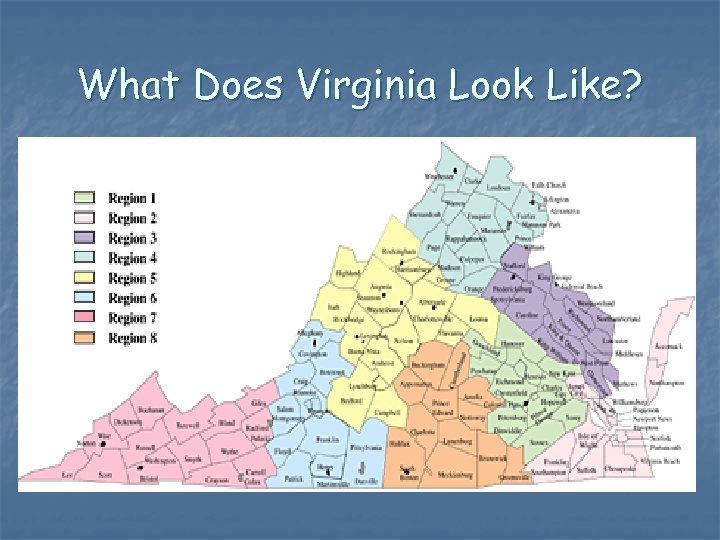 What Does Virginia Look Like?
 State Demographics State population – 7, 642, 884 (2006); 8% growth from 2000; 6. 7% under 5 years PK ECSE Special Ed All students 2006 2007 20, 396 28, 986 16, 773 16, 859 172, 704 169, 669 1, 221, 939 1, 232, 436 (Some duplication in PK numbers. Does not include community-based Head Start) Virginia’s SPP and APR z Preschool Placement Baseline (2004) – 28% in settings with typically developing peers z Placement data 2005 – 30% z 70 divisions met target (62 did not)
 Why Make the Effort? Greater and more lasting impact if change occurs through a coordinated system-wide approach versus several isolated and disconnected initiatives z NCLB/IDEA ‘ 04 z State standards for 4 -year-olds z We Are Passionate About Doing What Is Best For Kids! z
 Federal Description of Data Needed for State Annual Performance Plan z Indicator 6: Percent of children with IEPs who received special education and related services in settings with typically developing peers (i. e. , early childhood settings, home, and part-time early childhood/part-time early childhood special education)
 Preschool Placement Data
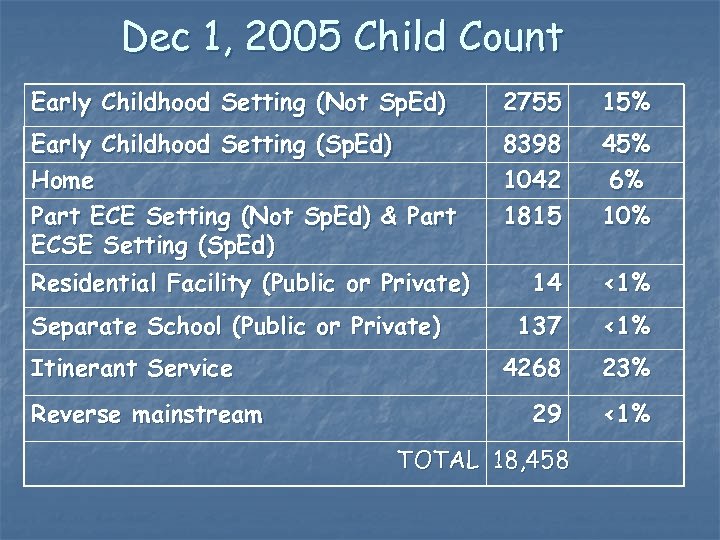 Dec 1, 2005 Child Count Early Childhood Setting (Not Sp. Ed) 2755 15% Early Childhood Setting (Sp. Ed) Home Part ECE Setting (Not Sp. Ed) & Part ECSE Setting (Sp. Ed) 8398 1042 1815 45% 6% 10% 14 <1% 137 <1% 4268 23% 29 <1% Residential Facility (Public or Private) Separate School (Public or Private) Itinerant Service Reverse mainstream TOTAL 18, 458
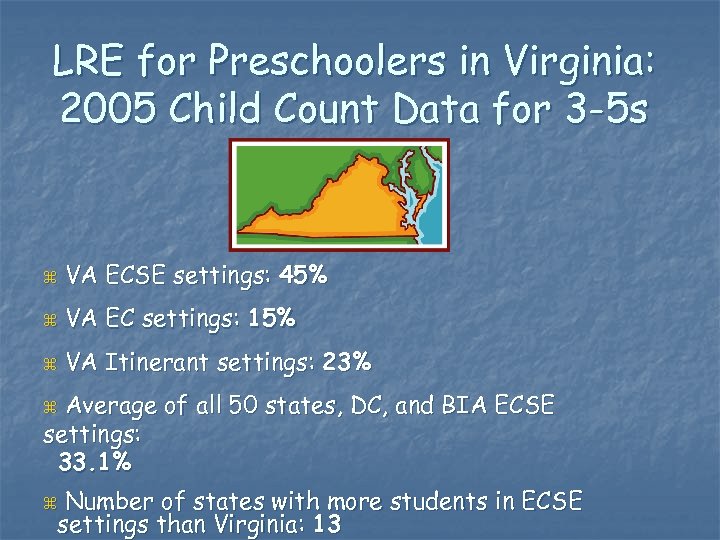 LRE for Preschoolers in Virginia: 2005 Child Count Data for 3 -5 s z VA ECSE settings: 45% z VA EC settings: 15% z VA Itinerant settings: 23% Average of all 50 states, DC, and BIA ECSE settings: 33. 1% z Number of states with more students in ECSE settings than Virginia: 13 z
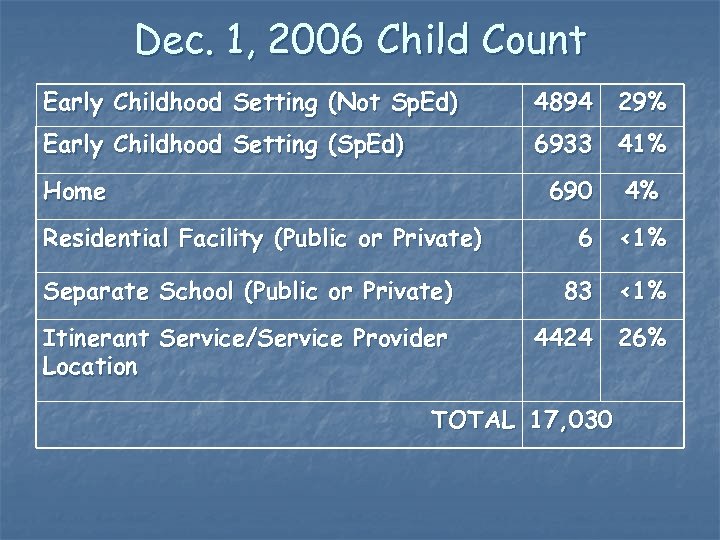 Dec. 1, 2006 Child Count Early Childhood Setting (Not Sp. Ed) 4894 29% Early Childhood Setting (Sp. Ed) 6933 41% Home 690 Residential Facility (Public or Private) 4% 6 <1% Separate School (Public or Private) 83 <1% Itinerant Service/Service Provider Location 4424 26% TOTAL 17, 030
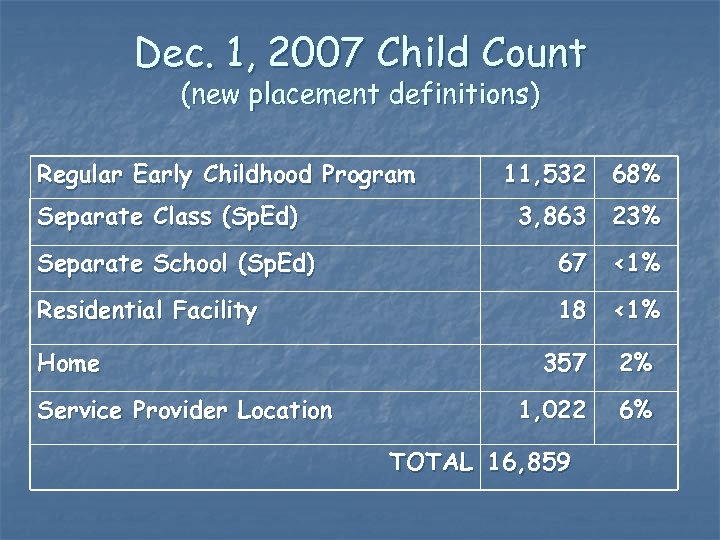 Dec. 1, 2007 Child Count (new placement definitions) Regular Early Childhood Program Separate Class (Sp. Ed) 11, 532 68% 3, 863 23% Separate School (Sp. Ed) 67 <1% Residential Facility 18 <1% Home Service Provider Location 357 2% 1, 022 6% TOTAL 16, 859
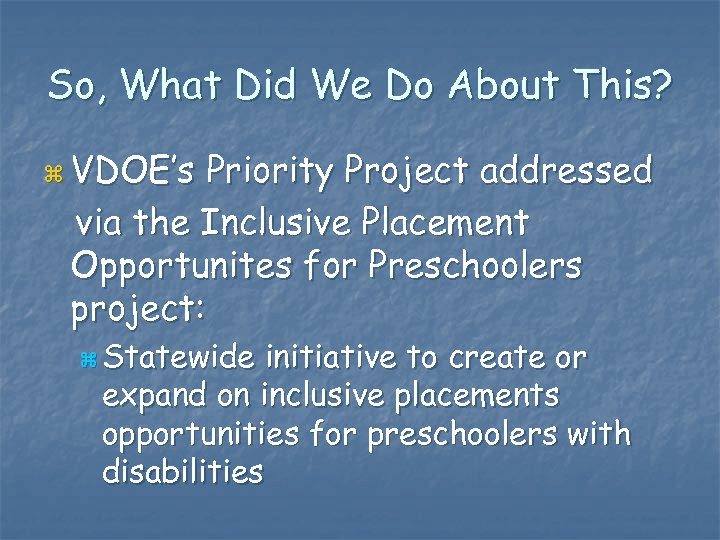 So, What Did We Do About This? z VDOE’s Priority Project addressed via the Inclusive Placement Opportunites for Preschoolers project: z Statewide initiative to create or expand on inclusive placements opportunities for preschoolers with disabilities
 What is IPOP? z VDOE initiative; information shared via Supt’s. Memo z Application process
 How Many IPOP Teams? Cohort 1 - 2005 (7 teams) z Cohort 2 - 2006 (7 teams) z Cohort 3 - 2007 (6 teams) z Cohort 4 – 2008 (9 teams) z z Total = 29 teams
 Why Did We Choose A Systems Change Approach To IPOP? Systems change is: z An orderly plan to add or alter an existing program z A process involving key stakeholders z A commitment
 Components of IPOP z Planning guide and training modules z Statewide training on system change and teaming z Long Term Technical Assistance within programs z Resources and materials z Funding
 What We Know Works z Focus is top priority of program staff z Involves stakeholders from all levels z Builds in staff development with follow-up z Utilizes participatory decision making for all steps
 What Works, con’t. z Hold regular planning meetings z Focus on using research-based models z Use structured team meeting process z Use process for reaching consensus/handling conflict z Have “critical friend” to the school team
 What It Takes! Time: 2 -3 year commitment z Planning: A team to coordinate the effort z Leadership: Administrative involvement z Buy In: Is the focus of the initiative a top priority? z On-going data collection: Determine needs and help with decision making z Evaluation: How do you know you are making progress? z
 4 Phases of Systems Change z Readiness z Planning z Implementation z Continuation
 Readiness Phase z Gather momentum z Obtain administrative approval z Form a team z Clarify z Gain purpose consensus to apply and complete application for Long Term Technical Assistance
 Planning Phase z Learn a structured team meeting process z Gather information about current situation z Learn about research-based models to address the need z Visit model sites
 Planning Phase, con’t. z Select a model to use z Develop a philosophy z Develop an action plan (state outcomes desired) z Gain support of school division administrators z Develop description/guide
 Planning Phase, con’t. z Share information, seek support, elicit concerns z Guide the faculty to develop the program z Plan for and conduct on-going evaluations z Plan z If for and conduct series of training needed: Develop or recommend changes to position descriptions
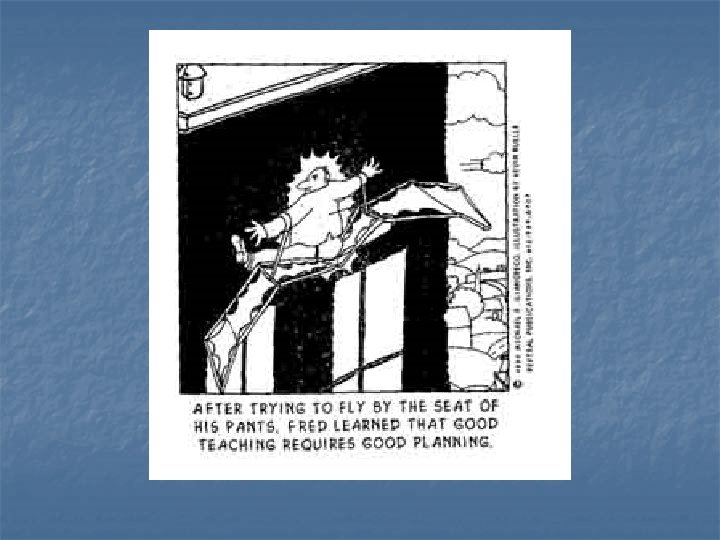
 Why We Plan First!
 Implementation Phase z Plan for and conduct orientation activities to introduce and create awareness of new initiative z Pilot the initiative z Conduct regularly scheduled meetings z Evaluate the pilot and determine how/when to continue on a larger scale
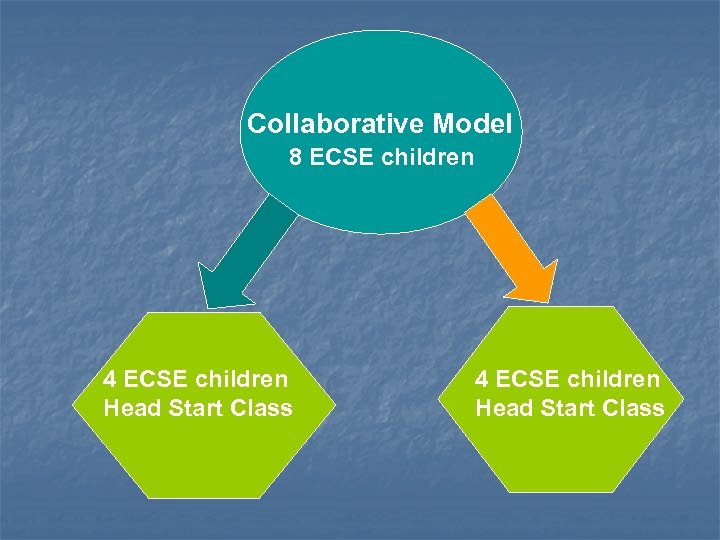 Collaborative Model 8 ECSE children 4 ECSE children Head Start Class
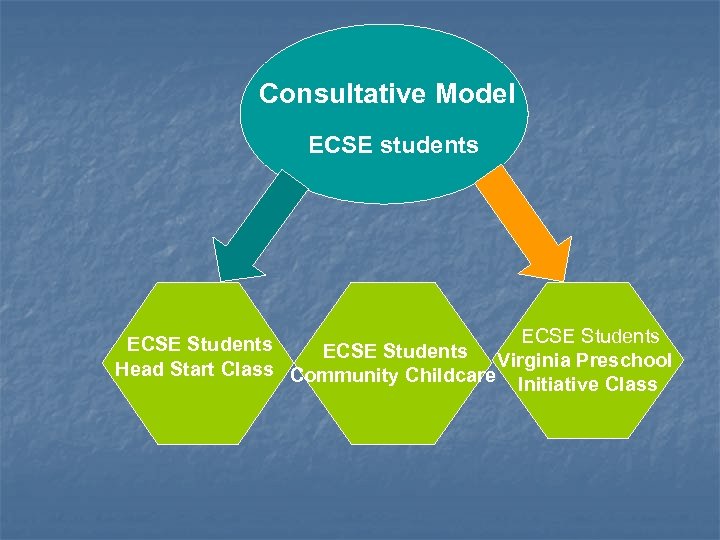 Consultative Model ECSE students ECSE Students Virginia Preschool Head Start Class Community Childcare Initiative Class
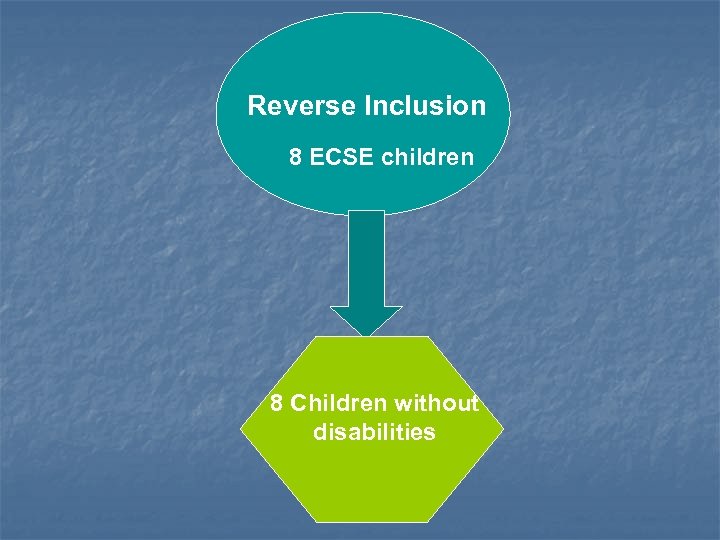 Reverse Inclusion 8 ECSE children 8 Children without disabilities
 Continuation Phase z Refine aspects of the program z Make program an on-going part of the system z Participation in state QRIS
 Tools for Quality Improvement z Early Childhood Environment Rating Scale-Revised (ECERS-R) www. fpg. unc. edu/~ECERS/ z Classroom Assessment Scoring System (CLASS) http: //classobservation. com/
 Virginia Governor’s Pre-K Initiatives z Early Childhood Initiatives www. education. virginia. gov/Initiatives/Early. Childhood/index. cfm Governor’s Working Group www. education. virginia. gov/Initiatives/Early. Childhood/Gov. Working. Grou p. cfm The Alignment Project Home Visiting Consortium Professional Development VA’s Plan for Smart Beginnings Quality Rating Improvement System School Readiness z z Milestones of Child Development Competencies for Early Childhood Professionals www. dss. virginia. gov/family/cc/publications. cgi
 Benchmarks z Benchmarks of Quality Inclusive Placements z Tools to Support z z Goal Functionality Scale II Intervention Matrix EIEIO STARE z National Individualizing Preschool Inclusion Project (NIPIP) z z Robin Mc. William www. vanderbiltchildrens. com/interior. php? mid=1157
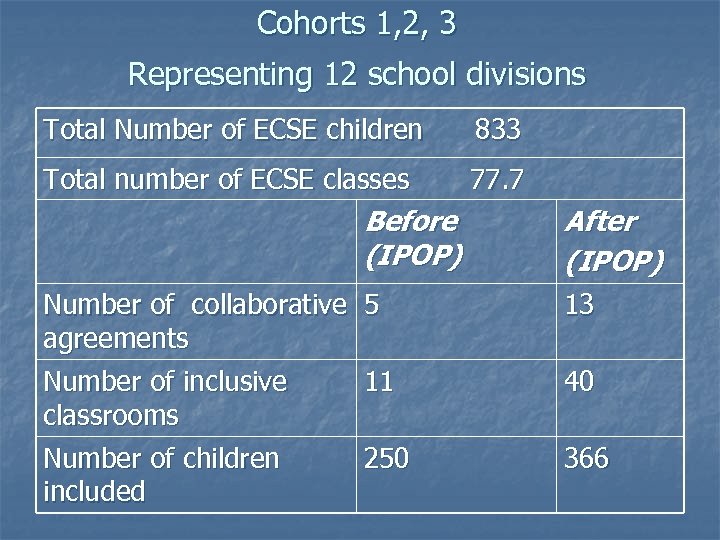 Cohorts 1, 2, 3 Representing 12 school divisions Total Number of ECSE children 833 Total number of ECSE classes 77. 7 Before (IPOP) Number of collaborative agreements Number of inclusive classrooms Number of children included After (IPOP) 5 13 11 40 250 366
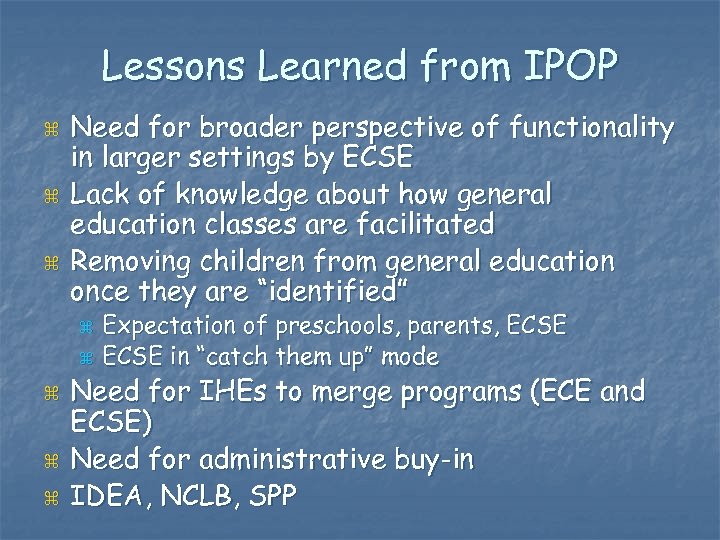 Lessons Learned from IPOP z z z Need for broader perspective of functionality in larger settings by ECSE Lack of knowledge about how general education classes are facilitated Removing children from general education once they are “identified” z z z Expectation of preschools, parents, ECSE in “catch them up” mode Need for IHEs to merge programs (ECE and ECSE) Need for administrative buy-in IDEA, NCLB, SPP
 Communication Between IPOP Sites And Resource Staff z PB WIKI http: //earlychildhoodpp. pbwiki. com/ z TTAC Online http: //www. ttaconline. org/
 Clarifying Questions?
 VDOE Resources Virginia’s Foundation Blocks for Early Learning z www. doe. virginia. gov/VDOE/Instruction/Elem_M/Found ation. Blocks. pdf Preschool Curriculum Review Rubric and Planning Tool z www. doe. virginia. gov/VDOE/Instruction/Elem_M/presc hool_rubric. pdf z Early Childhood Special Education www. doe. virginia. gov/VDOE/sped/earlychildhood. html
 Contact Information z VA Department of Education (VDOE) z Phyllis Mondak, 619 Coordinator z z Phyllis. mondak@doe. virginia. gov VDOE Training & Technical Assistance Centers (T/TAC) z Cheryl Henderson, Co-Director (JMU) z z Dianne Koontz Lowman, ECSE Coordinator (JMU) z z hendercl@jmu. edu lowmandk@jmu. edu Sandy Wilberger, Co-Director (VCU) z slwilber@vcu. edu
 References z Lazara, A. , Danaher, J. , & Kraus, R. (Eds. ). (2007). Section 619 Profile (15 th ed. ). Available from www. nectac. org/~pdfs/pubs/sec 619_20 07. pdf