 Скачать презентацию INCA- Integrated Nowcasting through Comprehensive Analysis by T
748720fdd114043b86b0b4bddf21fb8d.ppt
- Количество слайдов: 30



INCA- Integrated Nowcasting through Comprehensive Analysis by T. Haiden; A. Kann; K. Stadlbacher; G. Pistotnik; C. Wittmann Mag. Thomas Turecek Austrian Meteorological Service (ZAMG) Tel. : ++43 1 36026/2311 Fax: ++43 1 3602673 E-mail: thomas. turecek@zamg. ac. at Internet: http: //www. zamg. ac. at
Content § Introduction § § Why do we need INCA? General characteristics § § § Data sources and NWP-model output INCA analysis system INCA forecasting system What‘s new? Short Introduction in Cine. Sat § some examples how to use the system
Problems we have…. § In NWP products there are the same errors in the nowcasting range up to 6 hours occur as in the range up to 12 hours because of the model initialization. § The limitation of the horizontal resolution which does not allow to reproduce all of the small-scale phenomena which determine local conditions. § For temperature forecasts a simple persistence forecast or a forecast based on climatology can be better than NWP forecast for up to several hours. § As the NWP-models are weak prefering nowcasting, ZAMG is developing the observation-based analysis and forecasting system INCA. § →Integrated Nowcasting through Comprehensive Analysis
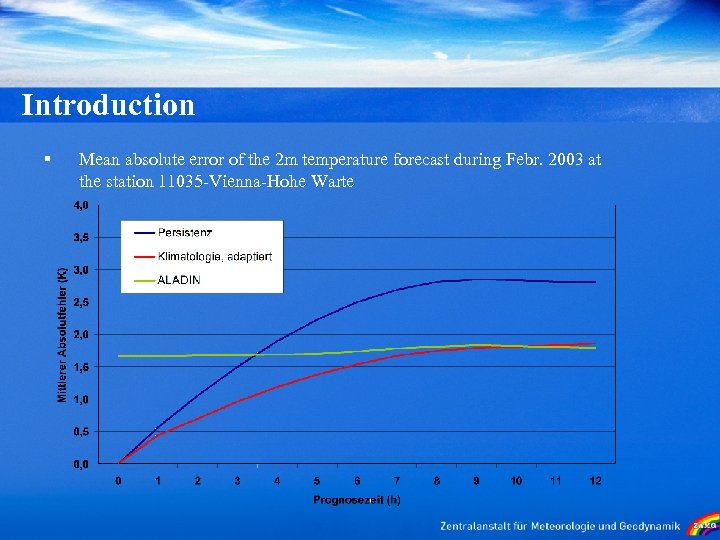
Introduction § Mean absolute error of the 2 m temperature forecast during Febr. 2003 at the station 11035 -Vienna-Hohe Warte
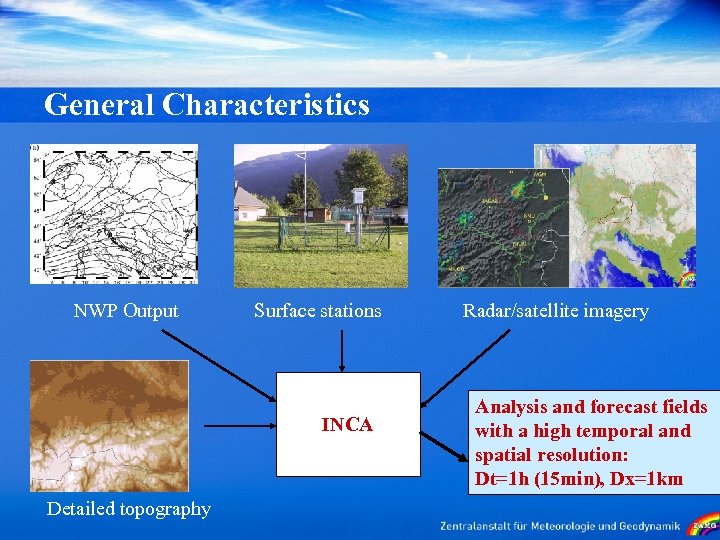
General Characteristics NWP Output Surface stations INCA Detailed topography Radar/satellite imagery Analysis and forecast fields with a high temporal and spatial resolution: Dt=1 h (15 min), Dx=1 km
Data Source- NWP-Model-Output § § § Three dimensional INCA analyses of temperature; humidity and wind are based on ALADIN output. ALADIN is used because it`s a limited area model which has been run operationally at ZAMG since 1999 and its output fields are readily available. Model characteristics (ALADIN): § § § Resolution 9, 6 km with 45 levels in the vertical Parameter fields are 1 -hourly Forecast runs 4 times a day (00. 06, 12, 18 UTC) § § 00, 12 runs are integrated up to +72 hours 06, 18 runs are integrated up to +60 hours Fields are available about 4 hours after analysis time Parameter fields are: temperature, total and low level cloudiness, geopotential height, wind, humidity, precipitation
Surface Station Observation § Most important data source for INCA system are surface stations § ZAMG runs a network of ~150 automated stations (TAWES) § About 200 hydrological Stations § Some SYNOP-stations from neighbouring countries § What data do we use? (measurements every once a minute) § 2 m temperature § relative humidity § dew point § 10 m wind speed/ direction § precipitation amount § duration of precipitation § insolation minutes
Other Data § Radar data: § 4 radarstations (Vienna-Airport, near City of Salzburg, Patscherkofel mountain, Zirbitzkogel mountain) § measurements every 5 minutes § Satellite data § MSG § measurements every 15 minutes § Elevation data § dataset from the US Geological Survey § resolution: 930 m in latitudinal direction § 630 m in longitudinal direction
INCA Data-Fields § 2 -D Analysis und forecasts § § § Precipitation Total Cloud-Cover 3 -D Analysis und forecasts § § temperature humidity wind speed and direction global radiation
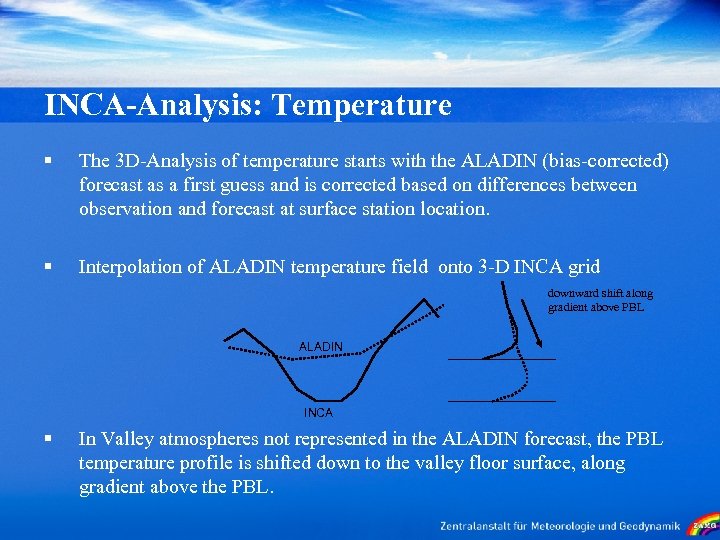
INCA-Analysis: Temperature § The 3 D-Analysis of temperature starts with the ALADIN (bias-corrected) forecast as a first guess and is corrected based on differences between observation and forecast at surface station location. § Interpolation of ALADIN temperature field onto 3 -D INCA grid downward shift along gradient above PBL ALADIN INCA § In Valley atmospheres not represented in the ALADIN forecast, the PBL temperature profile is shifted down to the valley floor surface, along gradient above the PBL.
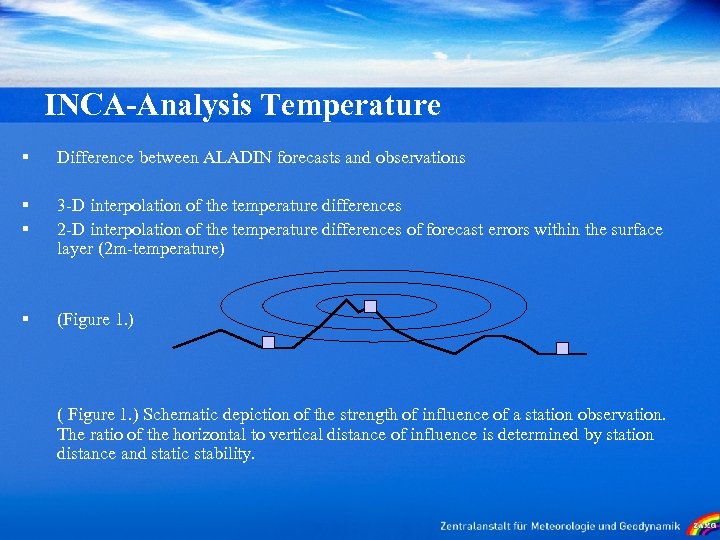
INCA-Analysis Temperature § Difference between ALADIN forecasts and observations § § 3 -D interpolation of the temperature differences 2 -D interpolation of the temperature differences of forecast errors within the surface layer (2 m-temperature) § (Figure 1. ) ( Figure 1. ) Schematic depiction of the strength of influence of a station observation. The ratio of the horizontal to vertical distance of influence is determined by station distance and static stability.
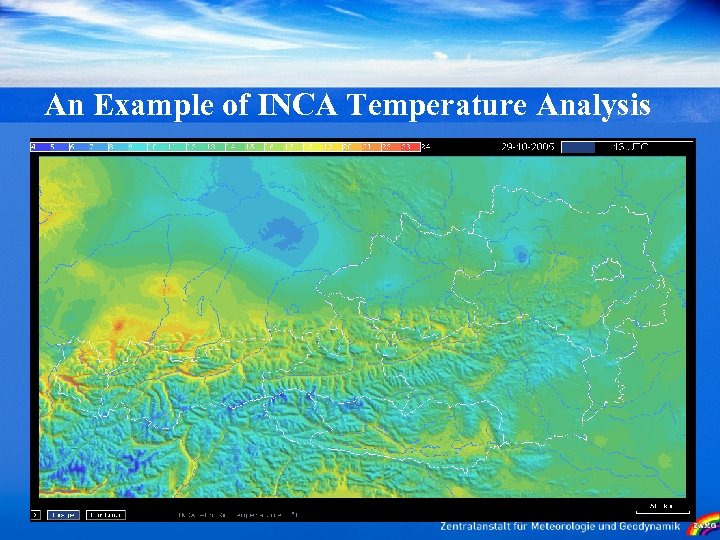
An Example of INCA Temperature Analysis
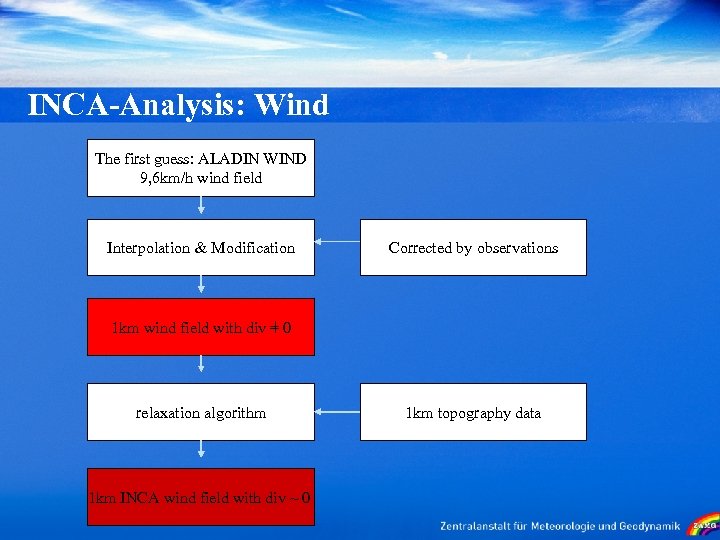
INCA-Analysis: Wind The first guess: ALADIN WIND 9, 6 km/h wind field Interpolation & Modification Corrected by observations 1 km wind field with div = 0 relaxation algorithm 1 km INCA wind field with div ~ 0 1 km topography data
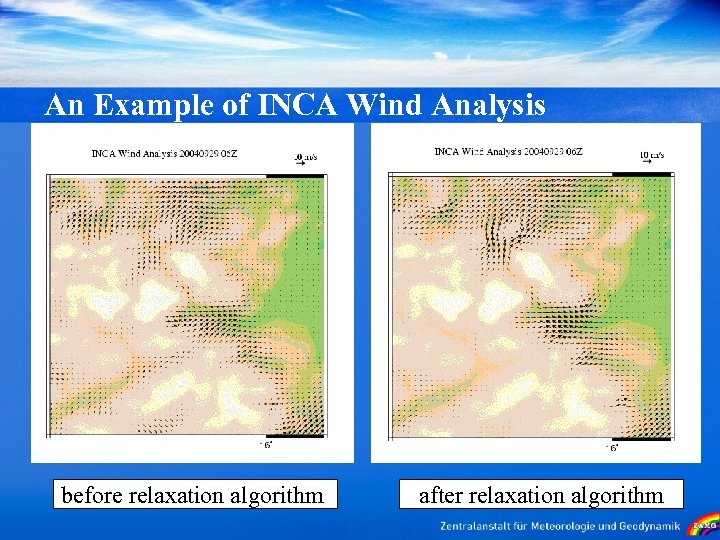
An Example of INCA Wind Analysis before relaxation algorithm after relaxation algorithm
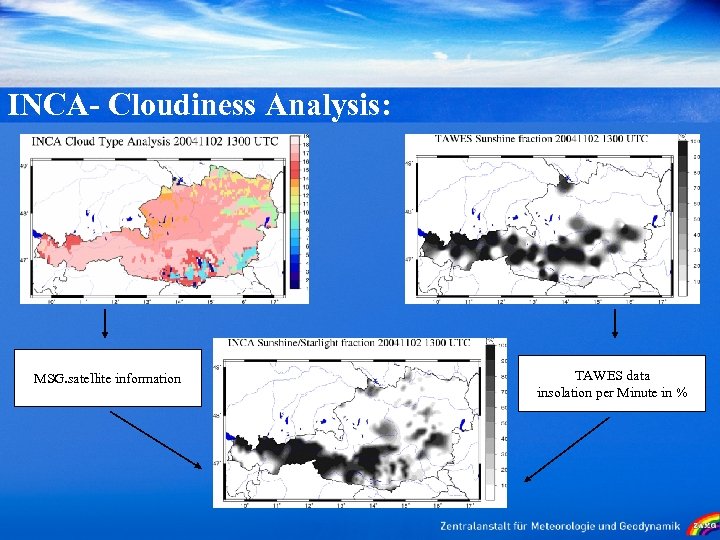
INCA- Cloudiness Analysis: MSG. satellite information TAWES data insolation per Minute in %
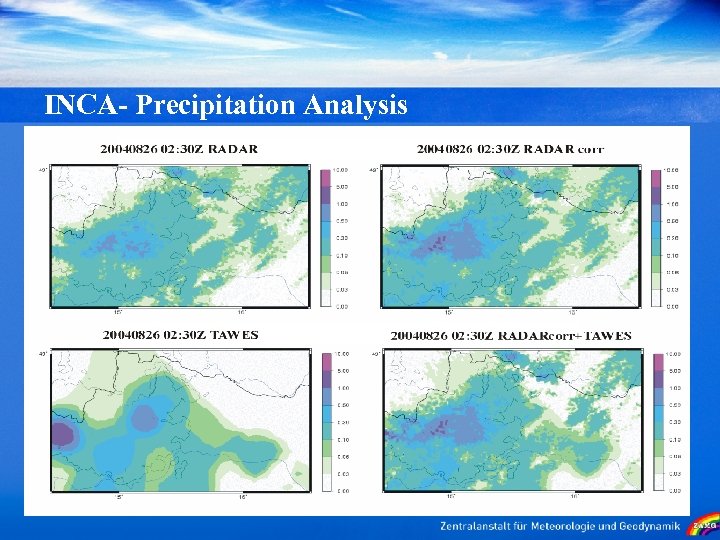
INCA- Precipitation Analysis § § The precipitation analysis is a synthesis of station interpolation and radardata. It‘s designed to combine the strength of both methods. § § Radar: can detect precipitating cells that do not hit a station Interpolation: provides a precipitation analysis in areas not accessible by the radar beam. • Aggregation of 5 min radar to 15 min amounts • Aggregation of 1 min observations to 15 min amounts • Correlation radar values/observed values through linear regression (10 surrounding stations)
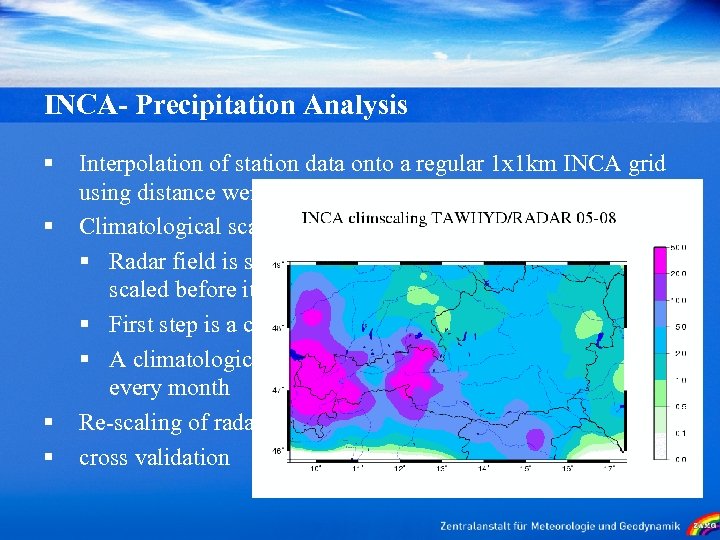
INCA- Precipitation Analysis § § Interpolation of station data onto a regular 1 x 1 km INCA grid using distance weighting. Climatological scaling of radar data § Radar field is strongly range dependent so it must be scaled before it‘s used in the analysis. § First step is a climatological scaling § A climatological scaling factor RFJ(i, j) is calculated for every month Re-scaling of radar data using the latest observation cross validation
INCA- Precipitation Analysis
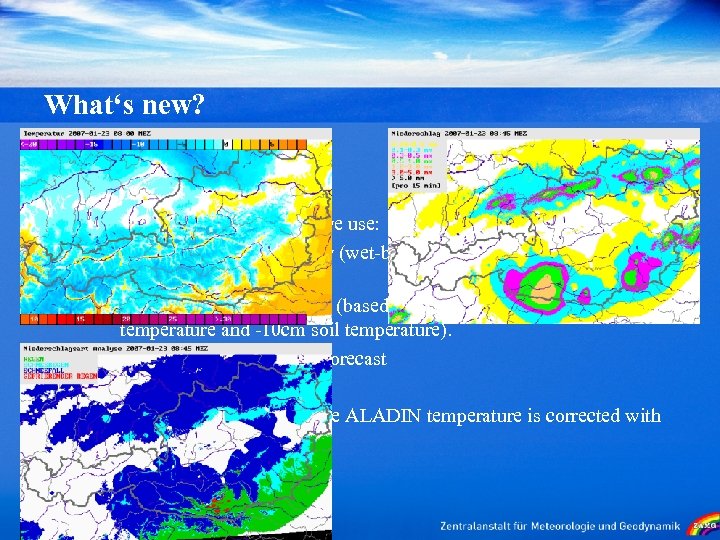
What‘s new? § Precipitation Type § For INCA precipitation type we use: § Temperature and humidity (wet-bulb temperature +1, 4°C to locate the snowline). § INCA ground temperature (based on surface observations of +5 cm temperature and -10 cm soil temperature). § Precipitation analyis and forecast § To locate cold air-pools the ALADIN temperature is corrected with local stations.
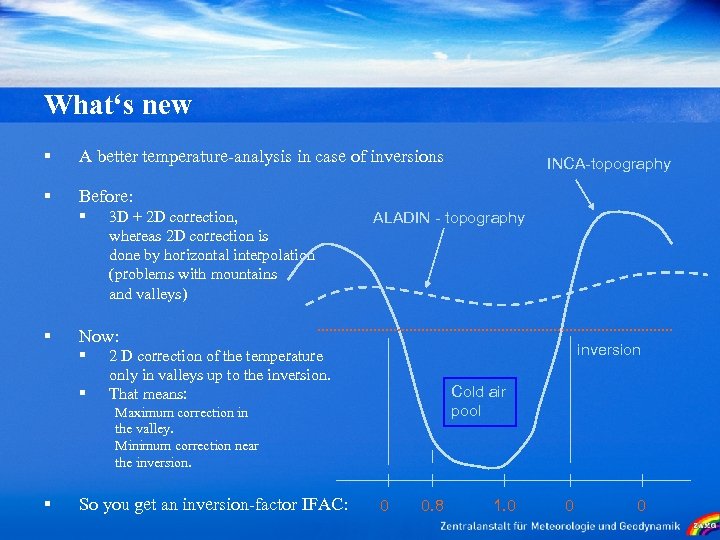
What‘s new § A better temperature-analysis in case of inversions § Before: § § 3 D + 2 D correction, whereas 2 D correction is done by horizontal interpolation (problems with mountains and valleys) ALADIN - topography Now: § § inversion 2 D correction of the temperature only in valleys up to the inversion. That means: Cold air pool Maximum correction in the valley. Minimum correction near the inversion. § INCA-topography So you get an inversion-factor IFAC: 0 0. 8 1. 0 0 0
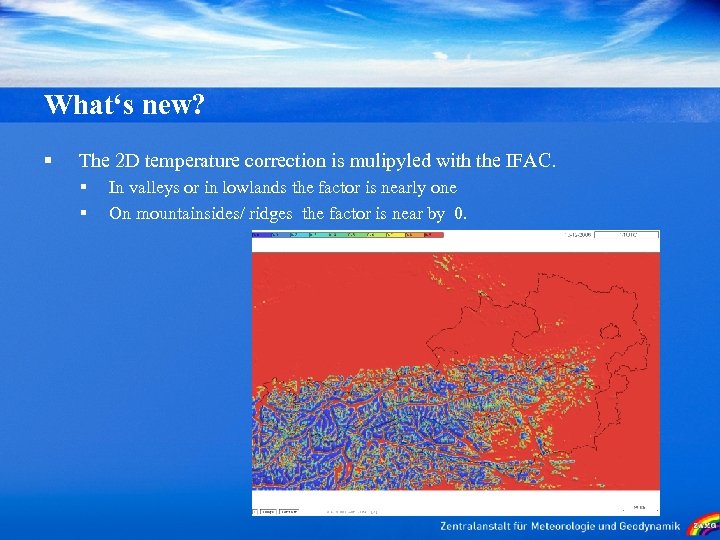
What‘s new? § The 2 D temperature correction is mulipyled with the IFAC. § § In valleys or in lowlands the factor is nearly one On mountainsides/ ridges the factor is near by 0.
What‘s new? § § § global radiation forecast diagnostic fields of convective parameters like § lifted condensation level § level of free convection § CAPE § CIN § showalter index § lifted index icing potential Wind Chill operational verification of INCA
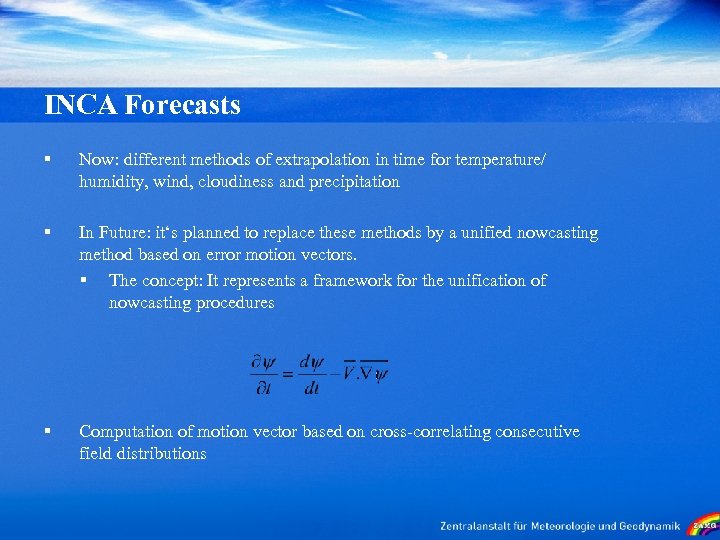
INCA Forecasts § Now: different methods of extrapolation in time for temperature/ humidity, wind, cloudiness and precipitation § In Future: it‘s planned to replace these methods by a unified nowcasting method based on error motion vectors. § The concept: It represents a framework for the unification of nowcasting procedures § Computation of motion vector based on cross-correlating consecutive field distributions
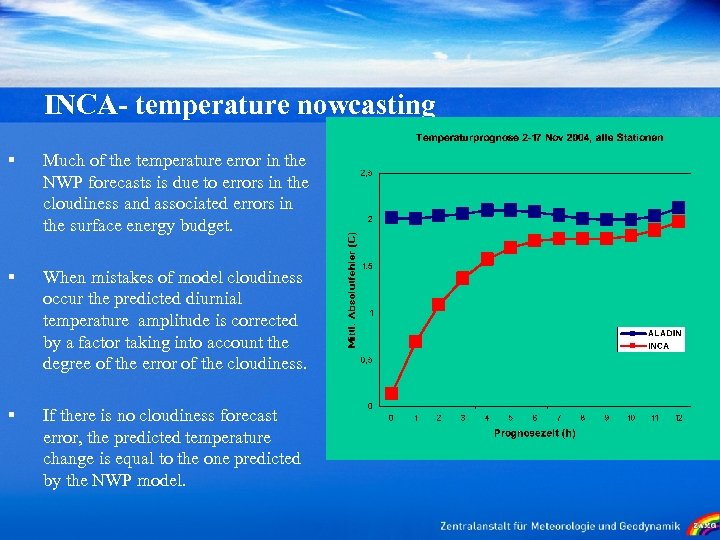
INCA- temperature nowcasting § Much of the temperature error in the NWP forecasts is due to errors in the cloudiness and associated errors in the surface energy budget. § When mistakes of model cloudiness occur the predicted diurnial temperature amplitude is corrected by a factor taking into account the degree of the error of the cloudiness. § If there is no cloudiness forecast error, the predicted temperature change is equal to the one predicted by the NWP model.
INCA-Cloudiness Forecasts § INCA nowcasting of cloudiness is based on cloud motion vectors derived from consecutive visible (during daytime) and infrared (during nighttime) satellite images. § During sunrise and sunset a time weighted combination of both vector field is used. § The nowcasting procedure of cloudiness is finalized by a consistency check with the nowcasting field precipitation.
INCA-Precipitation Forecast § Based on two components § Observation based extrapolation based on motion vectors determined from previous analyses like § Radar motion Vectors § Cloud motion vectors § Water vapour motion vectors § INCA motion vectors. § A NWP-model forecast (output fields of ALADIN and ECMWF)
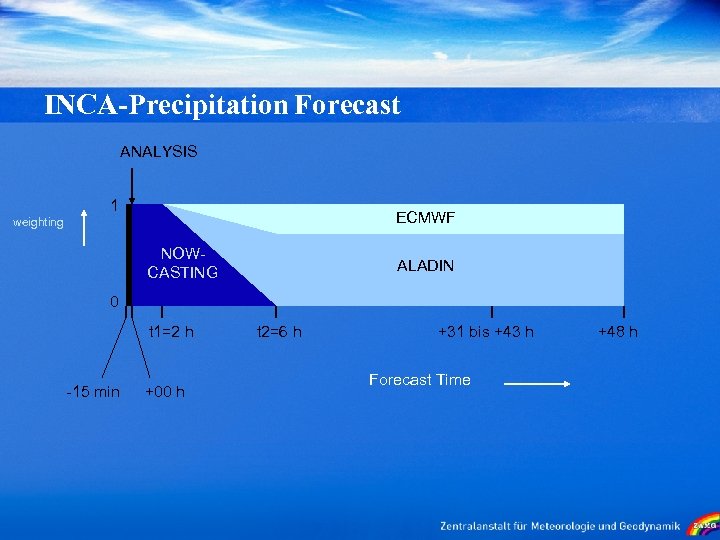
INCA-Precipitation Forecast ANALYSIS 1 ECMWF weighting NOWCASTING ALADIN 0 t 1=2 h -15 min +00 h t 2=6 h +31 bis +43 h Forecast Time +48 h
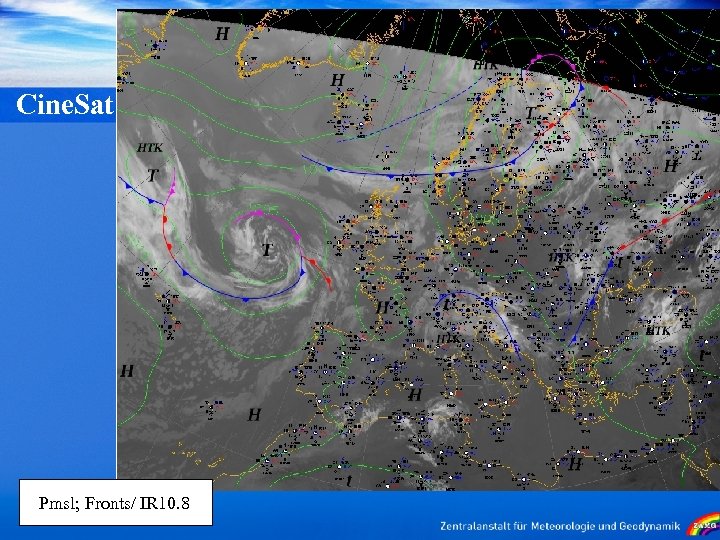
Cine. Sat Pmsl; Fronts/ IR 10. 8
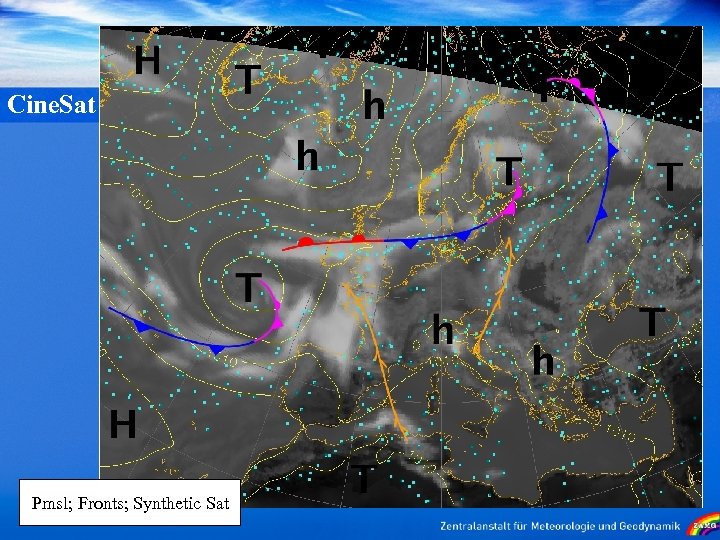
Cine. Sat Pmsl; Fronts; Synthetic Sat
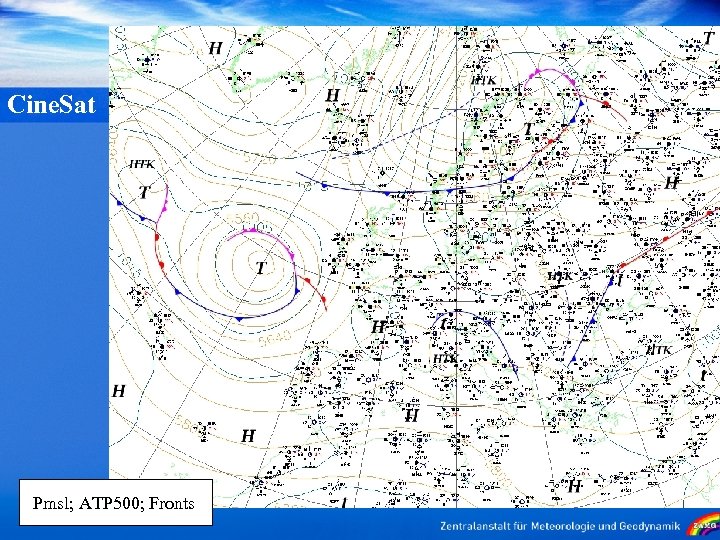
Cine. Sat Pmsl; ATP 500; Fronts
Скачать презентацию INCA- Integrated Nowcasting through Comprehensive Analysis by T
748720fdd114043b86b0b4bddf21fb8d.ppt