


 Скачать презентацию INC 161 CPE 100 Computer Programming Lecture
8958f843872204aab2f9d9793a7974a2.ppt
- Количество слайдов: 22
 INC 161 , CPE 100 Computer Programming Lecture 8 Function
 Introduction • A C program is generally formed by a set of functions. These functions subsequently consist of many programming statements. • By using functions, a large task can be broken down into smaller ones. • Functions are important because of their reusability. That is, users can develop an application program based upon what others have done. They do not have to start from scratch.
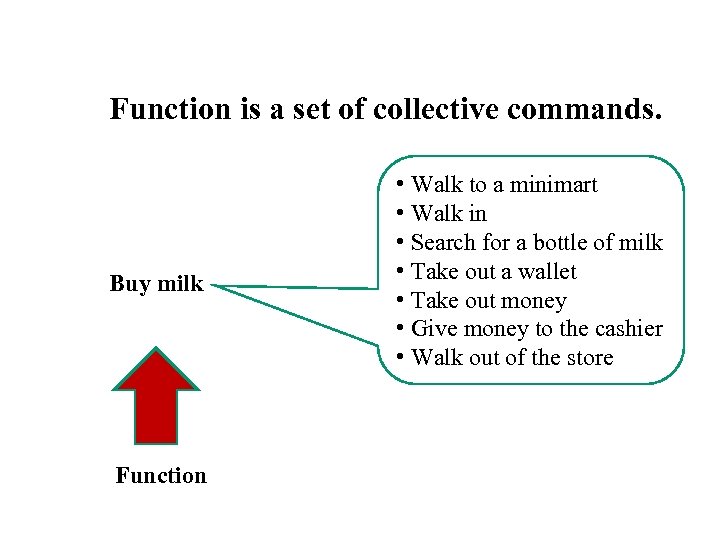 Function is a set of collective commands. Buy milk Function • Walk to a minimart • Walk in • Search for a bottle of milk • Take out a wallet • Take out money • Give money to the cashier • Walk out of the store
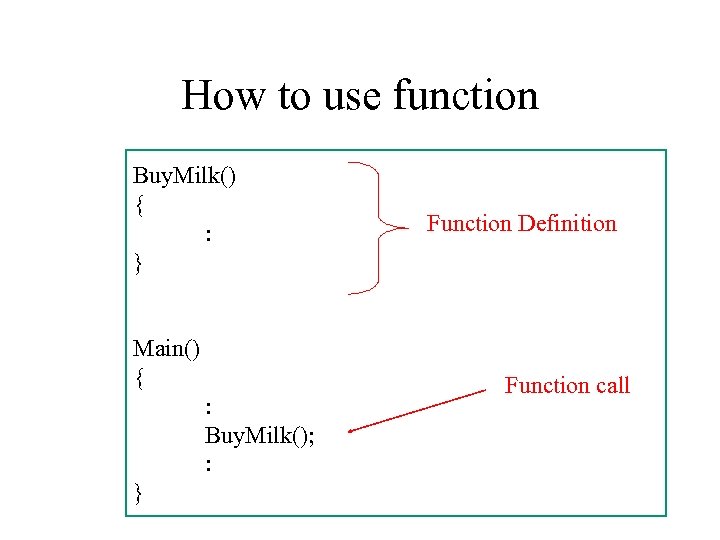 How to use function Buy. Milk() { : } Main() { : Buy. Milk(); : } Function Definition Function call
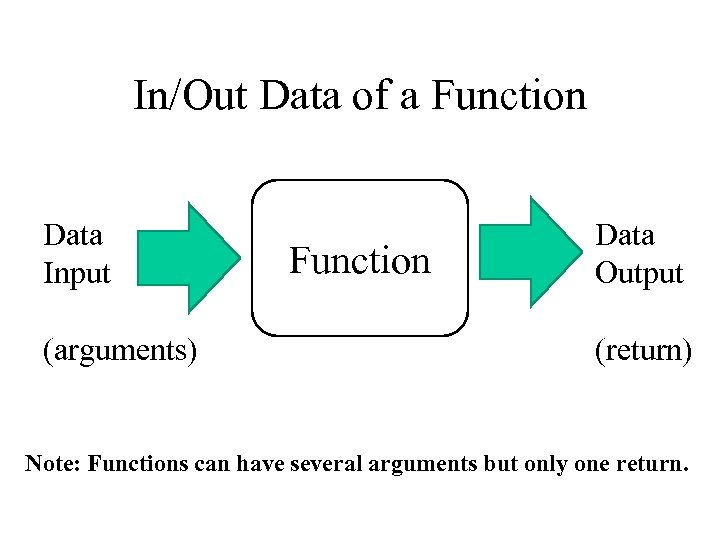 In/Out Data of a Function Data Input (arguments) Function Data Output (return) Note: Functions can have several arguments but only one return.
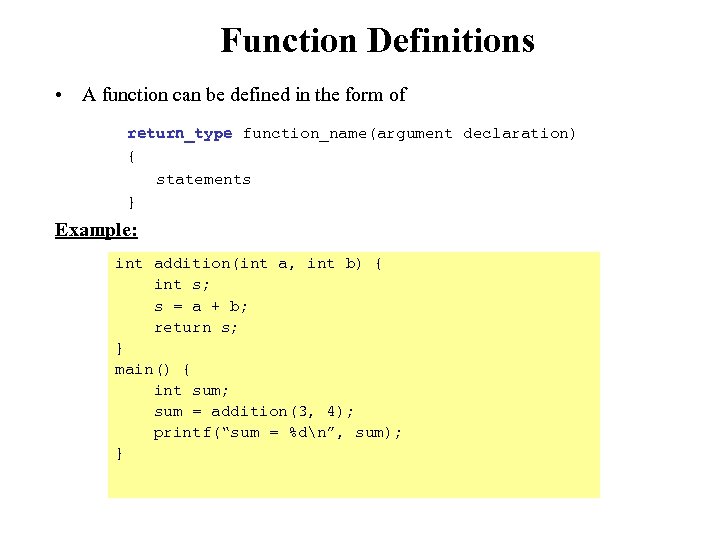 Function Definitions • A function can be defined in the form of return_type function_name(argument declaration) { statements } Example: int addition(int a, int b) { int s; s = a + b; return s; } main() { int sum; sum = addition(3, 4); printf(“sum = %dn”, sum); }
 The function definition has to appear before the real usage. Otherwise, the compiler will not know the meaning of the function. (Try swap the function definition to come after main() and you will get an error. )
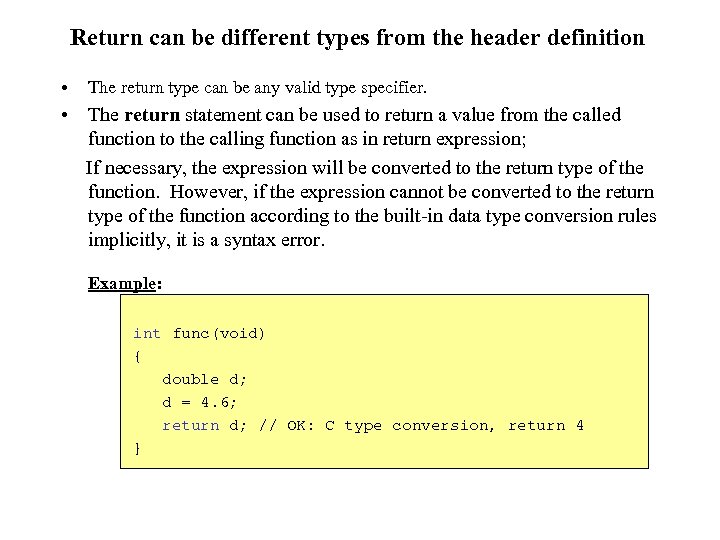 Return can be different types from the header definition • The return type can be any valid type specifier. • The return statement can be used to return a value from the called function to the calling function as in return expression; If necessary, the expression will be converted to the return type of the function. However, if the expression cannot be converted to the return type of the function according to the built-in data type conversion rules implicitly, it is a syntax error. Example: int func(void) { double d; d = 4. 6; return d; // OK: C type conversion, return 4 }
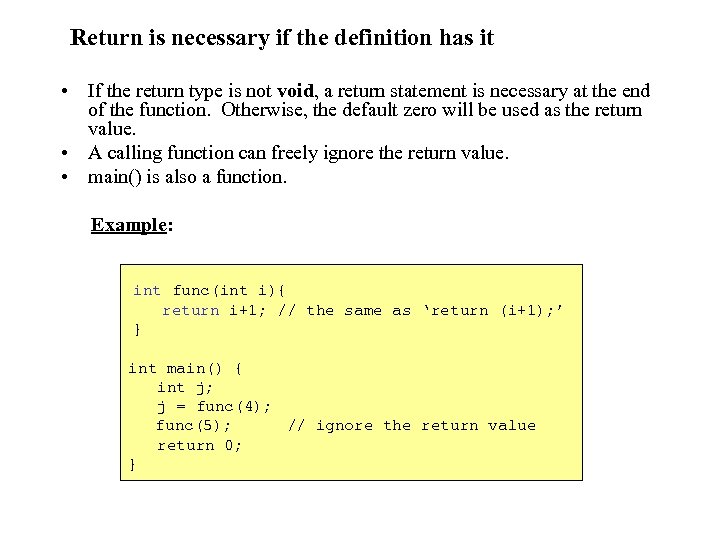 Return is necessary if the definition has it • If the return type is not void, a return statement is necessary at the end of the function. Otherwise, the default zero will be used as the return value. • A calling function can freely ignore the return value. • main() is also a function. Example: int func(int i){ return i+1; // the same as ‘return (i+1); ’ } int main() { int j; j = func(4); func(5); // ignore the return value return 0; }
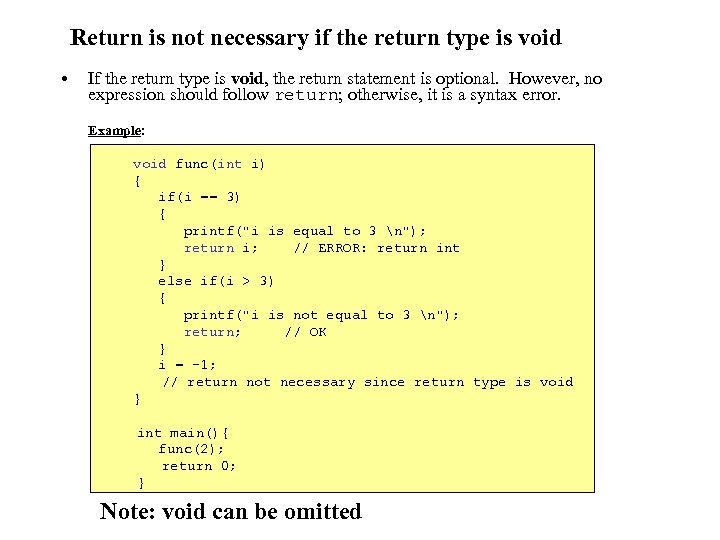 Return is not necessary if the return type is void • If the return type is void, the return statement is optional. However, no expression should follow return; otherwise, it is a syntax error. Example: void func(int i) { if(i == 3) { printf("i is equal to 3 n"); return i; // ERROR: return int } else if(i > 3) { printf("i is not equal to 3 n"); return; // OK } i = -1; // return not necessary since return type is void } int main(){ func(2); return 0; } Note: void can be omitted
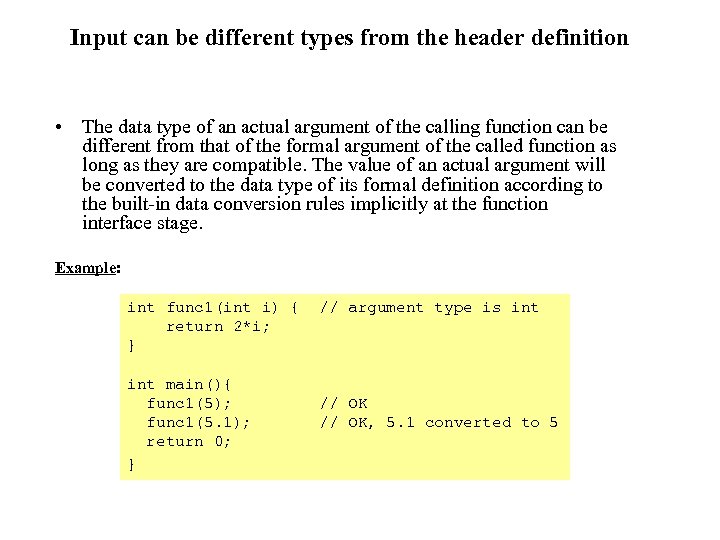 Input can be different types from the header definition • The data type of an actual argument of the calling function can be different from that of the formal argument of the called function as long as they are compatible. The value of an actual argument will be converted to the data type of its formal definition according to the built-in data conversion rules implicitly at the function interface stage. Example: int func 1(int i) { return 2*i; } int main(){ func 1(5); func 1(5. 1); return 0; } // argument type is int // OK, 5. 1 converted to 5
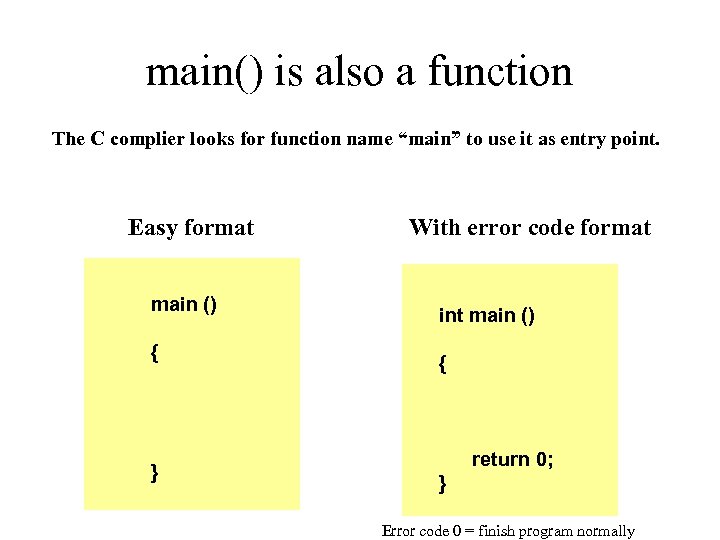 main() is also a function The C complier looks for function name “main” to use it as entry point. Easy format main () { } With error code format int main () { return 0; } Error code 0 = finish program normally
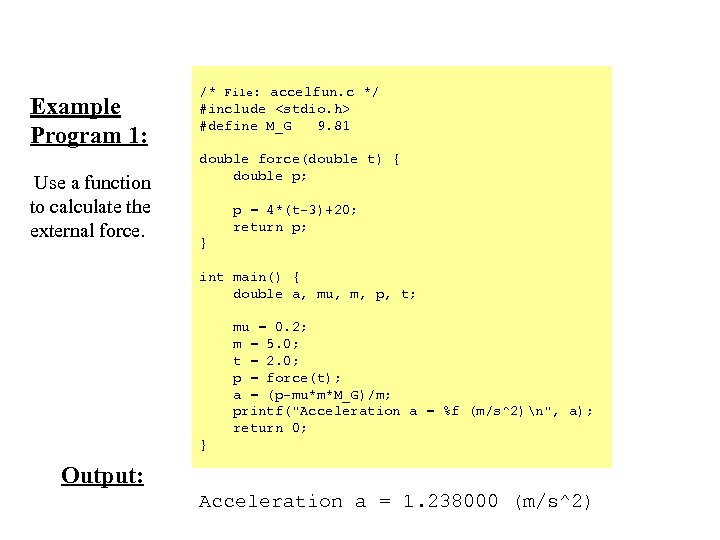 Example Program 1: Use a function to calculate the external force. /* File: accelfun. c */ #include
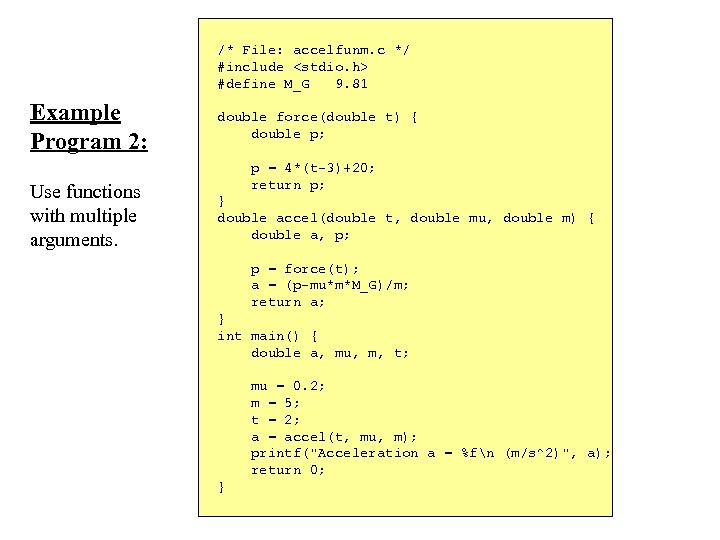 /* File: accelfunm. c */ #include
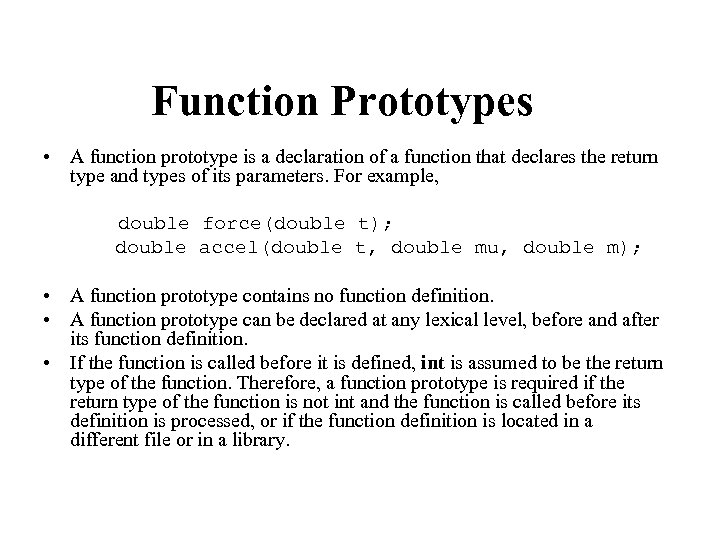 Function Prototypes • A function prototype is a declaration of a function that declares the return type and types of its parameters. For example, double force(double t); double accel(double t, double mu, double m); • A function prototype contains no function definition. • A function prototype can be declared at any lexical level, before and after its function definition. • If the function is called before it is defined, int is assumed to be the return type of the function. Therefore, a function prototype is required if the return type of the function is not int and the function is called before its definition is processed, or if the function definition is located in a different file or in a library.
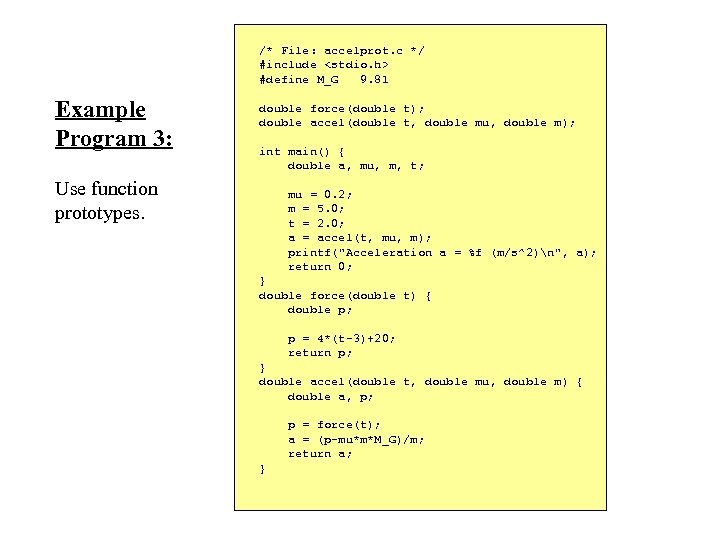 /* File: accelprot. c */ #include
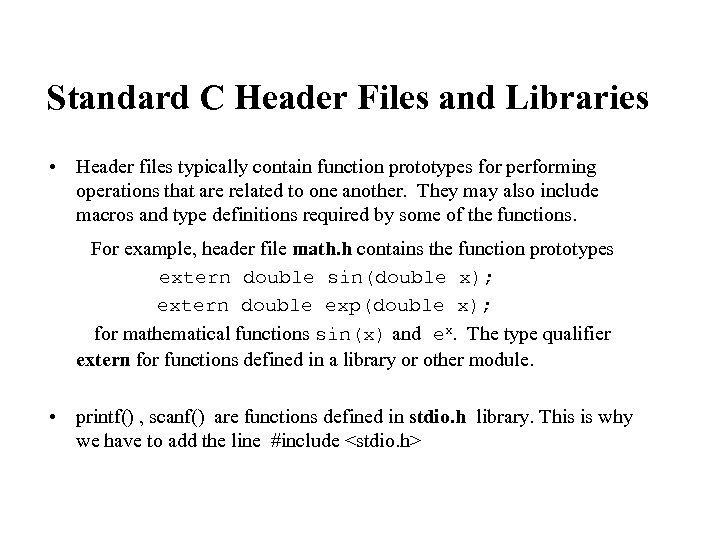 Standard C Header Files and Libraries • Header files typically contain function prototypes for performing operations that are related to one another. They may also include macros and type definitions required by some of the functions. For example, header file math. h contains the function prototypes extern double sin(double x); extern double exp(double x); for mathematical functions sin(x) and ex. The type qualifier extern for functions defined in a library or other module. • printf() , scanf() are functions defined in stdio. h library. This is why we have to add the line #include
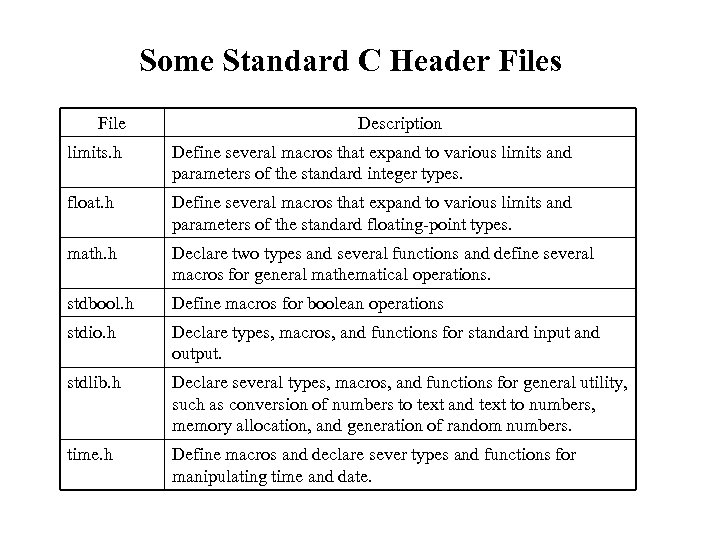 Some Standard C Header Files File Description limits. h Define several macros that expand to various limits and parameters of the standard integer types. float. h Define several macros that expand to various limits and parameters of the standard floating-point types. math. h Declare two types and several functions and define several macros for general mathematical operations. stdbool. h Define macros for boolean operations stdio. h Declare types, macros, and functions for standard input and output. stdlib. h Declare several types, macros, and functions for general utility, such as conversion of numbers to text and text to numbers, memory allocation, and generation of random numbers. time. h Define macros and declare sever types and functions for manipulating time and date.
 Recursive Functions • Functions may be used recursively. This means that a function call itself directly. • When a function calls itself recursively, each function call will have a new set of local variables. • Recursive functions usually contain conditional statements, such as ifelse, to allow exit of the function and return control to the calling function. • A function may also call itself indirectly.
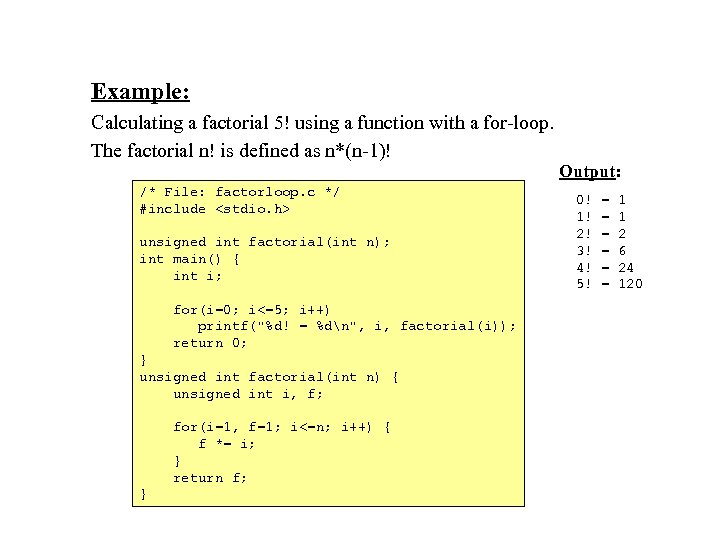 Example: Calculating a factorial 5! using a function with a for-loop. The factorial n! is defined as n*(n-1)! /* File: factorloop. c */ #include
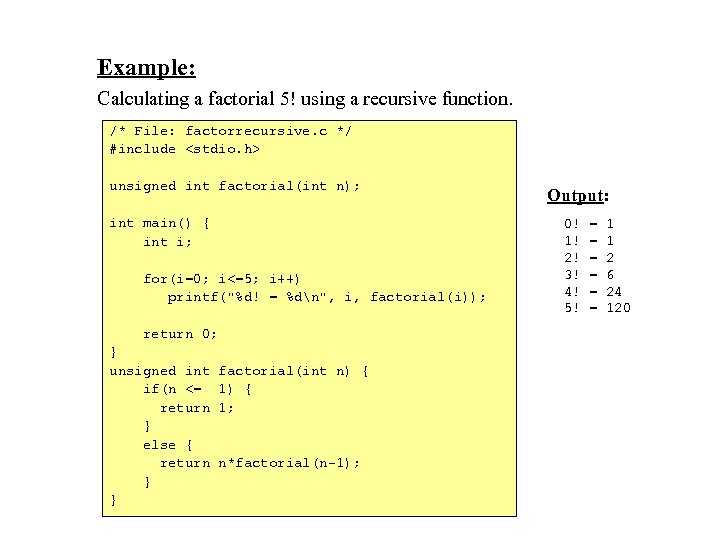 Example: Calculating a factorial 5! using a recursive function. /* File: factorrecursive. c */ #include
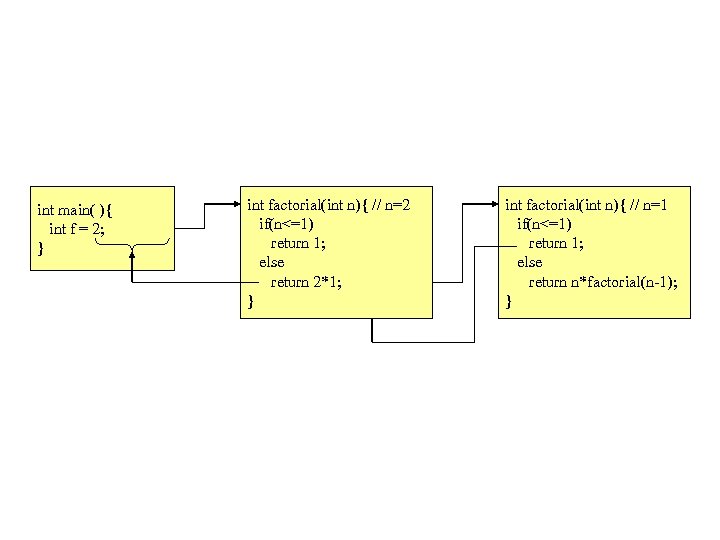 int main(){ main( ){ int f = factorial(2); 2; } int factorial(int n){ // n=2 if(n<=1) return 1; else return n*factorial(n-1); 2*1; 2*factorial(1); } int factorial(int n){ // n=1 if(n<=1) return 1; else return n*factorial(n-1); }