


 Скачать презентацию In search of statehood and security From the
4441965e373152432dded40cbb5961d1.ppt
- Количество слайдов: 20
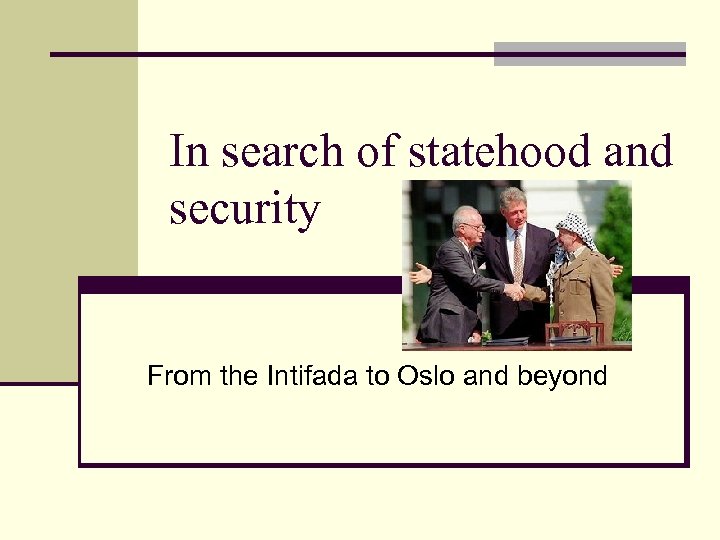 In search of statehood and security From the Intifada to Oslo and beyond
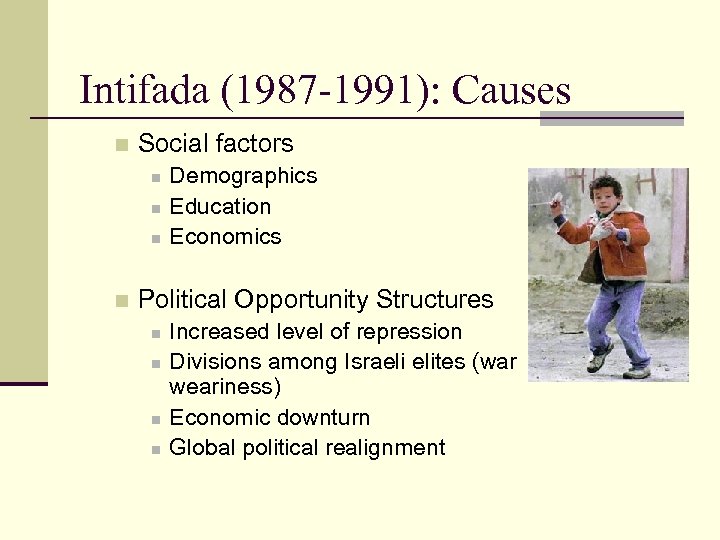 Intifada (1987 -1991): Causes n Social factors n n Demographics Education Economics Political Opportunity Structures n n Increased level of repression Divisions among Israeli elites (war weariness) Economic downturn Global political realignment
 Background to Intifada: Political conditions n n n Israeli land seizures & settlements n By 1985 Israelis have control over 52% of the West Bank’s land at least 40% of the Gaza Strip. n 1977 -’ 85: 119 new Israeli settlements Israeli military administration (courts, laws, etc. ) n Detention: Pal’s could be held for 6 months without trial (only 62 such cases in 198085; 131 in last five months of 1985) n torture Dismissal of Palestinian mayors Freezing of Palestinian building permits, new limitations on freedom of expression Collective Punishment n Over 15, 000 houses destroyed between 1967 -1980 n Curfews n School closures n checkpoints Deportations n Around 1, 100 people deported between 1967 and 1977 n Most targeted groups: educators, professionals, students (included President of Bir Zeit University in 1974). n Less than 1 percent allowed to return* Source: Ann Lesch, winter 1979 J. of P Studies
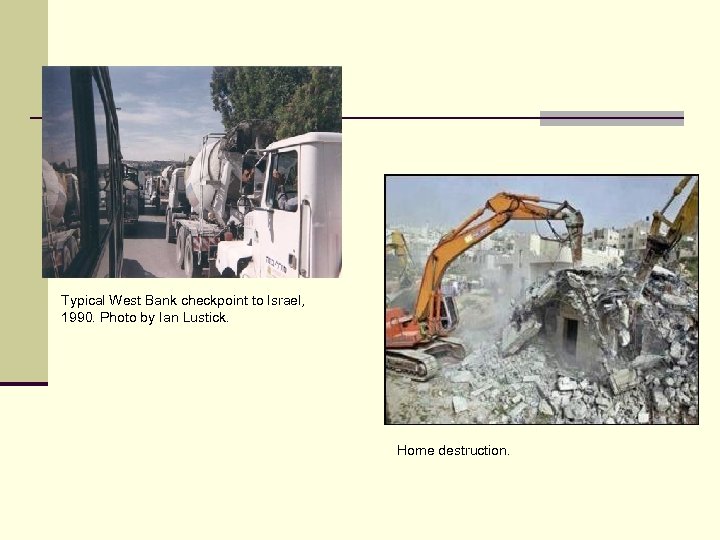 Typical West Bank checkpoint to Israel, 1990. Photo by Ian Lustick. Home destruction.
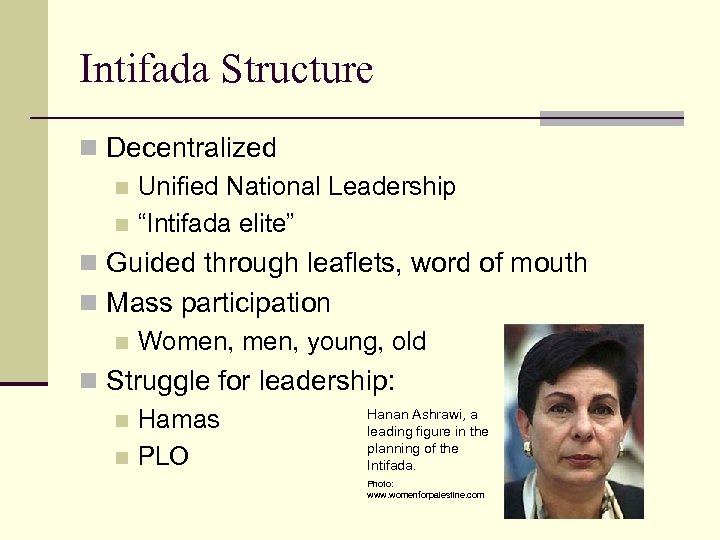 Intifada Structure n Decentralized n Unified National Leadership n “Intifada elite” n Guided through leaflets, word of mouth n Mass participation n Women, young, old n Struggle for leadership: Hanan Ashrawi, a n Hamas leading figure in the planning of the n PLO Intifada. Photo: www. womenforpalestine. com
 Mainstream Intifada: Goals & Strategies n Goals n n Israeli withdrawal from the territories and creation of Independent Palestinian state Other issues: n n Jerusalem Right of return End of settlements Hamas: Eradication of Israel n Strategies n n n Humanize Palestinian suffering and through this, induce Israelis to want to compromise (Ashrawi) Reduce Palestinian economic dependence on Israel Undermine authority of Israeli rule by civil revolt that would force withdrawal and create a Palestinian state
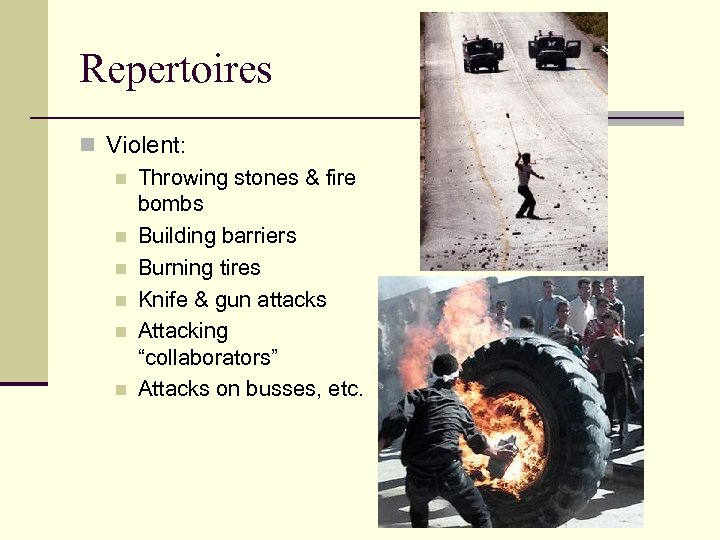 Repertoires n Violent: n Throwing stones & fire bombs n Building barriers n Burning tires n Knife & gun attacks n Attacking “collaborators” n Attacks on busses, etc.
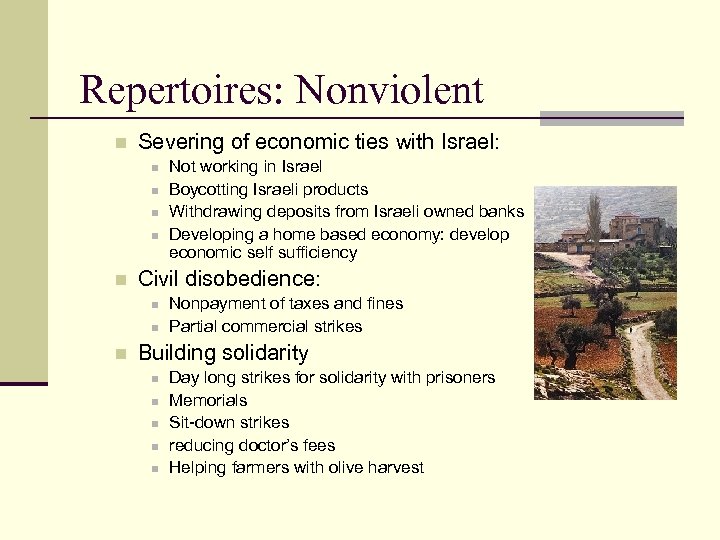 Repertoires: Nonviolent n Severing of economic ties with Israel: n n n Civil disobedience: n n n Not working in Israel Boycotting Israeli products Withdrawing deposits from Israeli owned banks Developing a home based economy: develop economic self sufficiency Nonpayment of taxes and fines Partial commercial strikes Building solidarity n n n Day long strikes for solidarity with prisoners Memorials Sit-down strikes reducing doctor’s fees Helping farmers with olive harvest
 Israeli responses n Deportations n 69 leaders of the Intifada sent into exile between 1987 and 1991 n B’TSELEM-- December 1992, 415 deportations n Palestinians advocating nonviolence seemed especially targeted n Arrests n By end of 1989 35, 000 -40, 000 Palestinians arrested n 75, 000 Palestinians arrested during the first three years of the Intifada. Of these, about 15, 000 were actually charged each year. n Assassinations of PLO officials associated with the Intifada n Collective punishment, intimidation n Intifada as “terrorism” n Beatings, tear gas n Curfews n Raiding of Palestinian homes and gardens n Closure of schools & universities
 Casualties n 1987 -1989: 626 Palestinians and 43 Israelis killed. n 37, 439 Palestinians wounded n Total casualties in the Occupied Territories and Israel from December 9, 1987 to September 30, 2000: n Palestinian civilians killed by Israeli forces - 1, 407 n 33% below the age of 18 (usually 14 -18) n Palestinian civilians killed by Israeli civilians - 140 n Israeli civilians killed by Palestinian civilians - 270 n Members of the Israeli forces killed by Palestinian civilians 135 n Hundreds of Palestinians killed by other Palestinians as collaborators
 Why did the first Intifada end? (circa 1991) n Exhaustion & suppression n Palestinian economic problems n PLO centralization & Israeli eradication of leadership n 1990 -91 Gulf War n 1991 Madrid conference/negotiations
 1 st Intifada: Effects n Seriously challenged the Israeli belief in the sustainability of n n n occupation. Deeply affected public opinion in Israel. Forced discussion and a search for an alternative. New recognition of Palestinians in Israel and idea that partition was necessary. New & more pragmatic goals: local leadership pushed the PLO towards a two-state solution and acceptance of Israel. Helped force new rounds of negotiations (Madrid, Oslo) New images of Palestinians, internally, in Israel and & internationally More self-sufficiency- classrooms, education, dairy farming
 Why didn’t the 1 st Intifada achieve Palestinian goals? n Difficult to sustain: Israeli use of increased repression and encirclement of refugee camps. n Isolation of communities n Palestinian economic problems: 30 -40% unemployment. Families lost as much as three-quarters of their income n Decimation of Palestinian leadership Use of violence Intransigent factions on both sides Palestinian lack of leverage: Imbalance of power between Israel & the Palestinians Palestinian lack of influential external allies n n n
 Negotiations n Palestinians & Israelis come to the negotiation table for the 1 st time. Why? End of Cold War n Gulf War n US pressure n Intifada n n 1991 Madrid negotiations n 1993 & 1995 Oslo Accords
 Main tenets of the Oslo Accords n Interim settlement NOT a final agreement n PLO recognizes Israel’s “right to exist” and forswears use of violence n Israel allows creation of Palestinian National Authority under leadership of the PLO to govern some parts of the Occupied Territories in some administrative & economic spheres. Total territory transferred to sole Palestinian control is 3 -4% of the West Bank & Gaza.
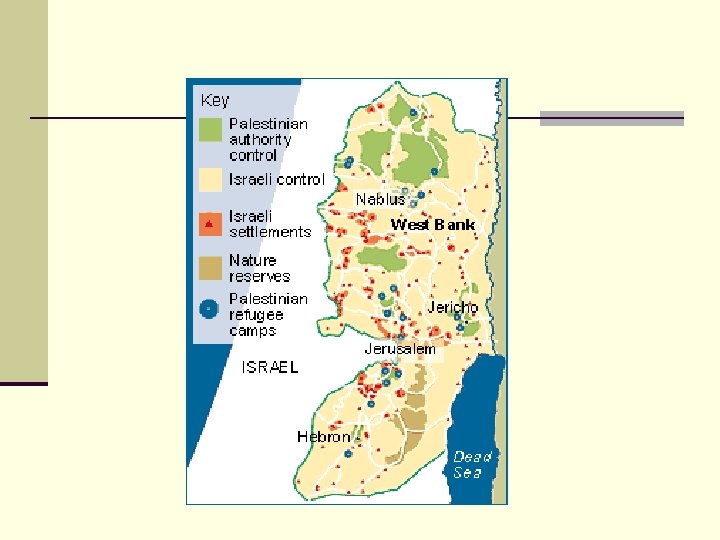
 Oslo Accords: Control over Land n Palestinians get modicum of self rule for the 1 st time in their history, but highly circumscribed. n Israel retains right to patrol all borders & control airspace n Israeli military, Jewish settlers, and Israeli citizens retain all rights to enter all territories n Palestinian area divided into more than 100 enclaves n Land in the Occupied Territories divided into 3 zones n Area A zones: full PA civil and security control n Area B zones: PA civil control, Israeli military & security control n Area C zones: Israeli civil and security control n Ultimately gave PA control over most of the territories’ population but only over about 5 % of land
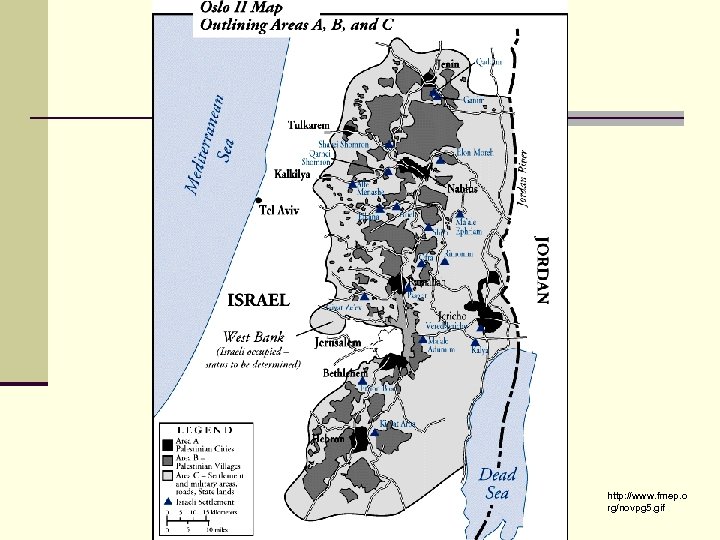 http: //www. fmep. o rg/novpg 5. gif
 Collapse of peace negotiations, rise of the 2 nd Intifada, 1995 -2001 n 1995 Assassination of Prime Minister Yitzhak Rabin by Israeli assassin n Bombings within Israel by Palestinian Islamic groups, 1994 and especially after 1996 n 1996 Election of more conservative Israeli government (Netanyahu) n Delays in implementation of the Oslo accords n End of Oslo, 2001 and after n Election of Ariel Sharon n 2 nd intifada, post-2001 n n More violent, mostly young men Summer 2002 Israeli army moves back into PA areas
 Underlying causes of collapse of the Peace Process n Oslo “frontloading” of Israeli benefits but “backloading” of Palestinian benefits- gave Israel little reason to negotiate and Palestinians little leverage n Domestic weakness on both sides that gave Oslo rejectionists undue influence n Palestinian bombings & PA authoritarianism n Israeli settlements n Failure to take “society” into consideration n n Hardliners on both sides increasingly frame conflict in religious terms Use of violence on both sides § Assassination of Rabin, Nov. 1995 n Absence of Arbiters n Imbalance of power