


 Скачать презентацию In Search of Funding Providing Open Access to
0b9ddb4d2a181231eea62135e0c5c095.ppt
- Количество слайдов: 21
 In Search of Funding: Providing Open Access to Secondary Discourses Stacey Shubitz Teachers College, Columbia University P. S. 171, East Harlem Literate Lives: A Human Right Whole Language Umbrella Louisville, Kentucky Friday, July 13 th, 2007
 Primary Discourses n n Primary discourses are taught early in life as part of people’s primary socialization (as members of particular families within their socio-cultural settings). Primary discourses constitute the first social identity: discourses are a part of each person’s knowledge base. q q n Everyone learns a considerable amount about language as they develop through interaction with their primary discourse. Most of the information people learn about language through their primary discourse is acquired subconsciously. People either accept or resist their primary discourse later in life since primary discourses form initial understandings of: q q q who people are. how people behave in and out of public. the sorts of things people value, do and say in and out of public.
 Secondary Discourses n n The secondary discourse refers to all other social and cultural discourses outside the primary discourse. Secondary discourses are learned, as part of one’s socialization, within groups and institutions outside of one’s peer group. q Secondary discourses are those learned by people when they become part of groups after their early home experiences. n Businesses, churches and schools are examples of groups for which one must learn a secondary discourse.
 Secondary Discourses, cont. n n Secondary discourses involve the social institutions beyond the family, including classroom settings. Students may acquire language from their secondary discourse and add it to their primary discourse. q A person’s discourse becomes more complex and acquires more layers the older one becomes.
 CRITICAL LITERACY n Guiding Question q How do I provide my students, who come from low SES/working class backgrounds, with access to as many secondary discourses as possible?
 DECONSTRUCTION n Patrick Finn, author of Literacy with an Attitude: Educating Working-Class Children in Their Own Self-Interest, encourages teachers in working class schools to give their students access to the same experiences as students in affluent professional and elite schools. q Bottom Line: Working class students need access to secondary discourses! n The question becomes: How do you make this happen when funds are scarce?
 DECONSTRUCTION n “The stigma of being poor is overwhelming and can place families in a position of endless denial so as to not carry the burden of shame that is placed upon them by the larger society” (Jones, 2006, 22). q Students should not have to accept a “handout” or be punished by staying behind.
 RECONSTRUCTION n n Making families pay for trips, when they could barely afford basic school supplies, is not fair. Why shouldn’t they have the same enriching educational experiences as middle class and affluent students have?
 SOCIAL ACTION n SOLUTION: Seek out funds or partnerships so that students can obtain secondary discourses. q q q Donors. Choose Field Trip Factory Junior Achievement of New York Local Organizations Partnerships with local organizations (e. g. , WABC-TV)
 Take advantage of local organizations and resources n Free Field Trips q Examples: n n n Brooklyn Botanical Garden Metropolitan Museum of Art Museum of the City of New York Botanical Garden Poets House No-Cost Excursions q Examples: n n n Libraries Parks (e. g. , Central Park) Zoos (many have a “free” day for schools)
 Field Trip Factory n Free community-based field trips in the following disciplines: q q q n n Animal Habitats and Responsibility Farm Fundamentals Health and Wellness Materials and classroom activities are provided online, free of charge http: //fieldtripfactory. com
 Partnerships n Junior Achievement q http: //www. ja. org/ n n Career Day Classroom Course Volunteer Local Business Week WABC-TV q q Holiday Gifts Tour of the Studio
 Donors. Choose n Teachers write proposals for materials or experiences they want their students to have. q n n Citizen philanthropists fund those experiences. From March 2005 – present, my fifth grade classroom has received nearly $25, 000 in funds from Donors. Choose will serve 48 states starting on Labor Day. q www. donorschoose. org
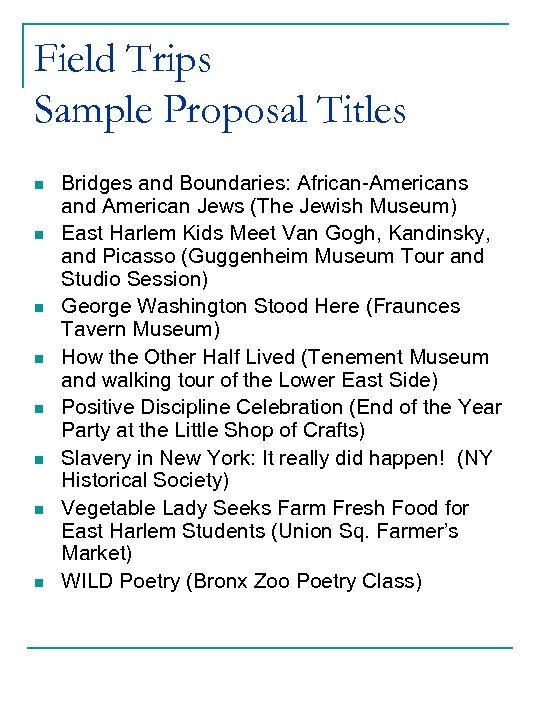 Field Trips Sample Proposal Titles n n n n Bridges and Boundaries: African-Americans and American Jews (The Jewish Museum) East Harlem Kids Meet Van Gogh, Kandinsky, and Picasso (Guggenheim Museum Tour and Studio Session) George Washington Stood Here (Fraunces Tavern Museum) How the Other Half Lived (Tenement Museum and walking tour of the Lower East Side) Positive Discipline Celebration (End of the Year Party at the Little Shop of Crafts) Slavery in New York: It really did happen! (NY Historical Society) Vegetable Lady Seeks Farm Fresh Food for East Harlem Students (Union Sq. Farmer’s Market) WILD Poetry (Bronx Zoo Poetry Class)
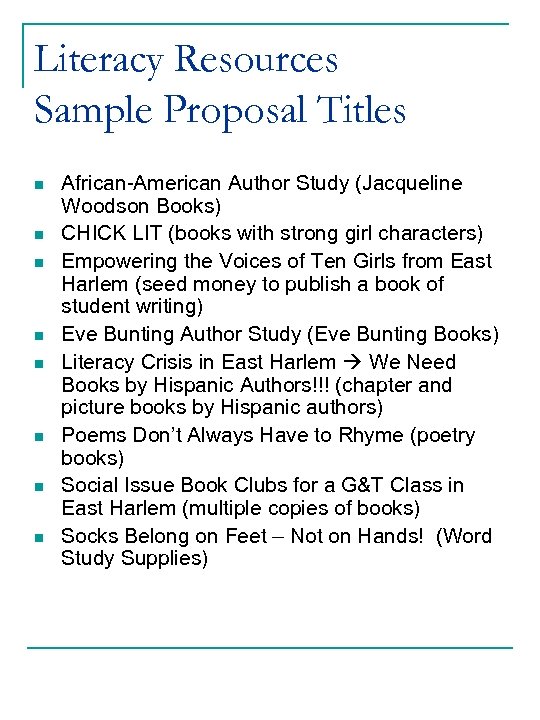 Literacy Resources Sample Proposal Titles n n n n African-American Author Study (Jacqueline Woodson Books) CHICK LIT (books with strong girl characters) Empowering the Voices of Ten Girls from East Harlem (seed money to publish a book of student writing) Eve Bunting Author Study (Eve Bunting Books) Literacy Crisis in East Harlem We Need Books by Hispanic Authors!!! (chapter and picture books by Hispanic authors) Poems Don’t Always Have to Rhyme (poetry books) Social Issue Book Clubs for a G&T Class in East Harlem (multiple copies of books) Socks Belong on Feet – Not on Hands! (Word Study Supplies)
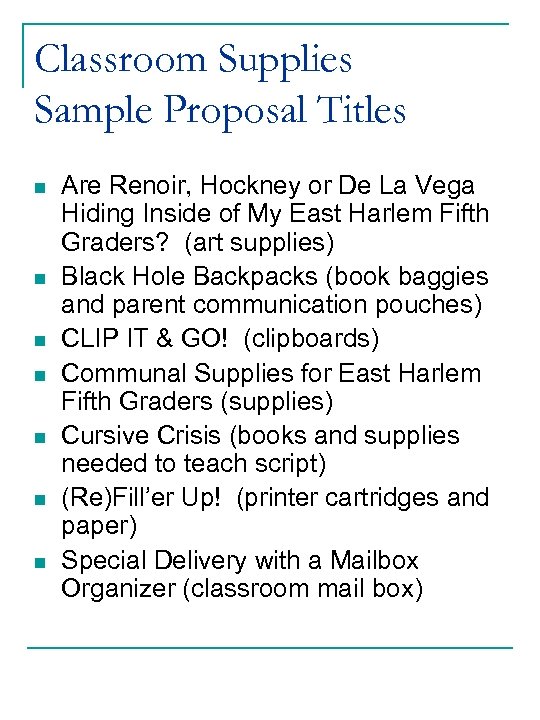 Classroom Supplies Sample Proposal Titles n n n n Are Renoir, Hockney or De La Vega Hiding Inside of My East Harlem Fifth Graders? (art supplies) Black Hole Backpacks (book baggies and parent communication pouches) CLIP IT & GO! (clipboards) Communal Supplies for East Harlem Fifth Graders (supplies) Cursive Crisis (books and supplies needed to teach script) (Re)Fill’er Up! (printer cartridges and paper) Special Delivery with a Mailbox Organizer (classroom mail box)
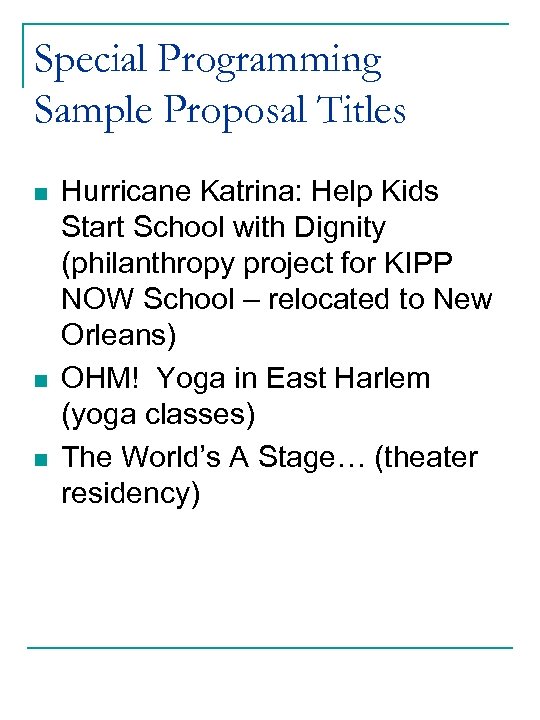 Special Programming Sample Proposal Titles n n n Hurricane Katrina: Help Kids Start School with Dignity (philanthropy project for KIPP NOW School – relocated to New Orleans) OHM! Yoga in East Harlem (yoga classes) The World’s A Stage… (theater residency)
 Other Organizations n Adopt-A-Classroom q n Grants Alert q q n www. adoptaclassroom. com http: //www. grantsalert. com/gsft. cfm This site links to corporations that provide grants for educators. Teachers Network q www. teachersnetwork. org
 Q&A n Ask away!
 Closing Thoughts n n n As an educator in a working class school, I have come to realize I am unable to change the socio-economic status of the families whose children I am privileged to teach. However, I pledge to continue helping my students gain access to secondary discourses by taking advantage of local resources and writing grant proposals so I can give all of my students the rich educational experiences I believe they deserve. What do you pledge to do? What will your next steps be?
 References n BOOKS: q q q n Finn, P. D. (1999). Literacy with an attitude: Educating workingclass children in their own self-interest. Albany: SUNY. Gee, J. P. (1990). What is literacy? In Mitchell, C. & Walker K. (Eds. ) Rewriting literacy: Culture and the discourse of the other. Westport, CT: Greenwood Publishing Group, Inc. Jones, S. (2006). Girls, social class & literacy: What teachers can do to make a difference. Portsmouth, NH: Heinemann. WEB: q q http: //www. literacyandtechnology. org/v 1 n 2/wsu/klaus. html http: //www. tcrecord. org/Content. asp? Content. ID=12320 http: //findarticles. com/p/articles/mi_qa 3785/is_200407/ai_n 9419922 /pg_4 http: //links. jstor. org/sici? sici=03802361(199924)24%3 A 1%3 C 94%3 AEFLLAS%3 E 2. 0. CO%3 B 2 -7