Скачать презентацию In Search of a Phase Transition in the
2ec025bdbdb6b25dc79bd3b19ca3c396.ppt
- Количество слайдов: 28
 In Search of a Phase Transition in the AC-Matching Problem Phokion G. Kolaitis Thomas Raffill Computer Science Department UC Santa Cruz
 Phase Transitions n A phase transition is an abrupt change in the behavior of a property of a “system”. n Extensive study of phase transitions in physics (statistical mechanics). n Extensive study of phase transitions in NPcomplete problems during the past decade.
 Motivation and Goals n Understand the “structure” of NP-complete problems. n Relate phase transitions to the average-case performance of particular algorithms for NPcomplete problems.
 NP-Complete Problems n n Introduce a “constrainedness” parameter to partition the space of instances. Generate random instances at fixed parameter values. For some problems, probability of a “yes” instance abruptly changes from 1 to 0 at some critical value. For some problems and some solvers, average difficulty peaks sharply at the same critical value.
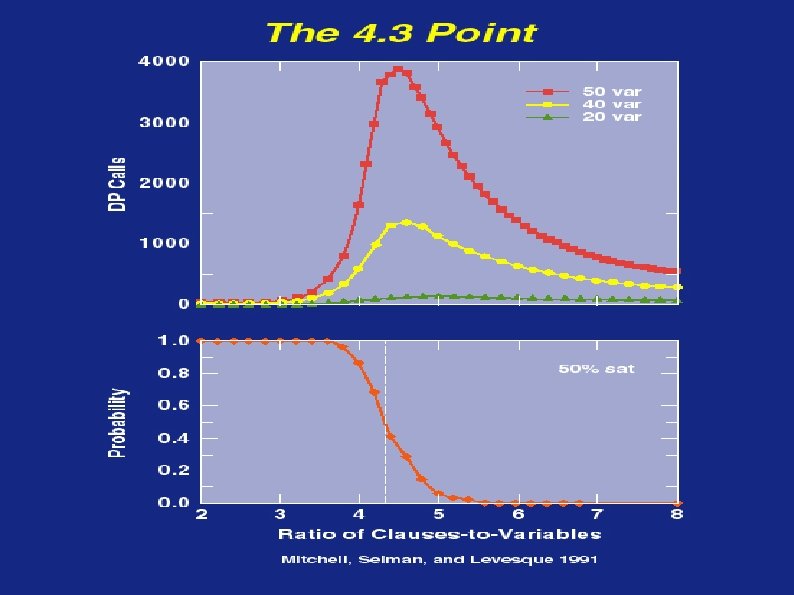
 Main Example: 3 -SAT Parameter: Ratio of number of clauses to number of variables. n Intuition: Low ratios are underconstrained, high ratios are overconstrained. n Critical Value: Experimental results suggest that it is about 4. 3 clauses to variables. n Average Performance: DPLL procedure peaks around 4. 3 n
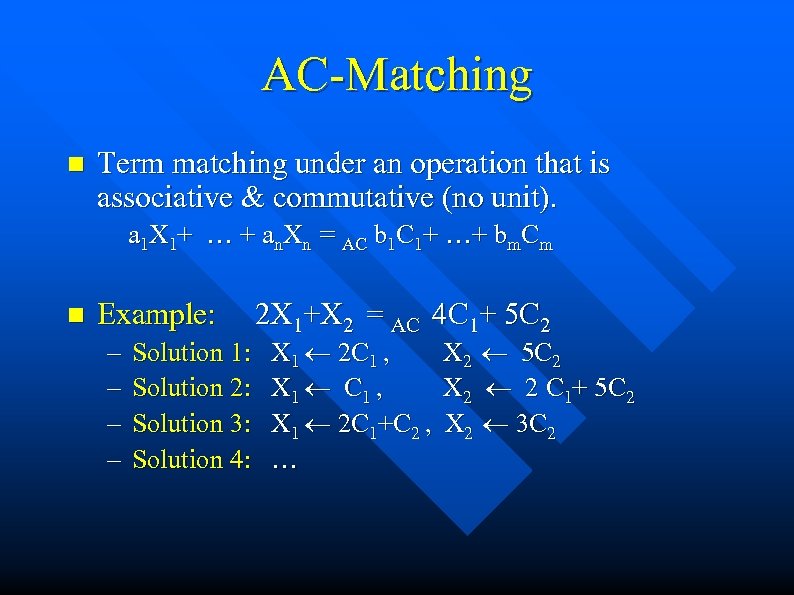 AC-Matching n Term matching under an operation that is associative & commutative (no unit). a 1 X 1+ … + an. Xn = AC b 1 C 1+ …+ bm. Cm n Example: – – Solution 1: Solution 2: Solution 3: Solution 4: 2 X 1+X 2 = AC 4 C 1+ 5 C 2 X 1 2 C 1 , X 2 5 C 2 X 1 C 1 , X 2 2 C 1+ 5 C 2 X 1 2 C 1+C 2 , X 2 3 C 2 …
 AC-Matching AC-matching plays an important role in automated deduction. n AC-matching solvers are key components of many theorem-provers (eg. , EQP). n AC-matching is strong NP-complete (it is NP-complete even if the coefficients are given in unary). n
 Parametrization of AC-Matching n n n Several different parameters come into play: number of variables, number of constants, maximum coefficients, … a 1 X 1+ … + an. Xn = AC b 1 C 1+ …+ bm. Cm Our chosen parameter: r = ( ai ) / ( bj) Some intuition: – – – more variables more constrained instance more constants less constrained instance reflects both # of symbols and multiplicities.
 NP-Completeness for Fixed Ratios n n n Definition: AC(r)-Matching is the restriction of AC -Matching to instances of ratio r. Fact: If r > 1, then every instance of AC(r)-Matching is negative. Theorem: If r is such that 0 < r 1, then AC(r)-Matching is NP-complete. -- r = 1: 3 -Partition is reducible to AC(1)-Matching (Eker – 1993). -- 0 < r < 1: By careful padding, can reduce AC(1)-Matching to AC(r)-Matching.
 Phase Transition Conjecture n Pr(r, s) = probability that a random instance of AC(r)-Matching of size s is positive, where s = ai + bj. n Conjecture: There is critical ratio r* s. t. – If r < r*, then Pr(r, s) 1 , as s ; – If r > r*, then Pr(r, s) 0 , as s .
 Generating Random Instances Fix size s. n Step through ratios u/v 1, where u+v = s. n Generate random partitions of u and v. n Use the partition of u for LHS coefficients; Use the partition of v for RHS coefficients. n 1200 samples give < 4% margin of error with 95% confidence. n 30000 samples give < 1% margin of error. n
 Solvers Used in Experiments n Direct AC-Matching Solver developed by S. Eker at SRI as part of Maude, a high-performance system for equational logic and rewriting. n Reduction to Integer Linear Programming (ILP) and CPLEX, a commercial optimization package with a powerful ILP solver. n Reduction to SAT and Grasp, one of the main SAT solvers developed by J. Silva.
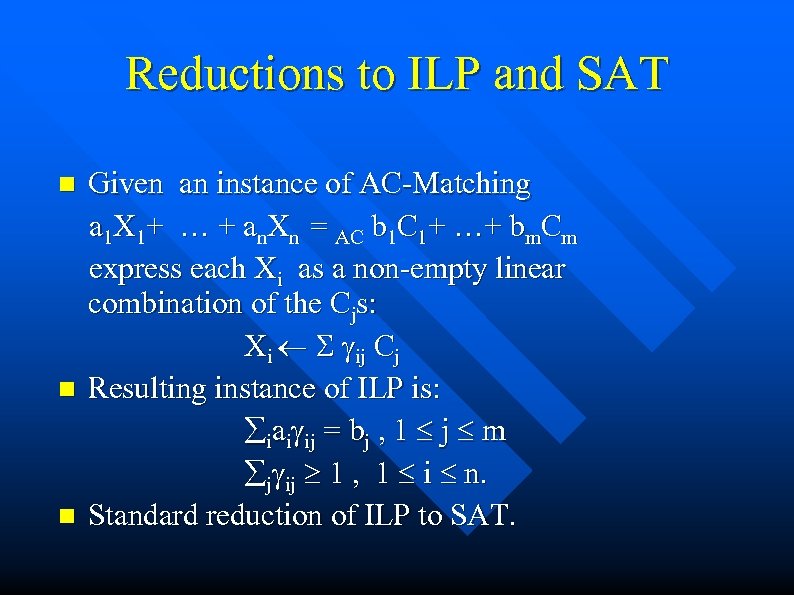 Reductions to ILP and SAT n n n Given an instance of AC-Matching a 1 X 1+ … + an. Xn = AC b 1 C 1+ …+ bm. Cm express each Xi as a non-empty linear combination of the Cjs: Xi S ij Cj Resulting instance of ILP is: iai ij = bj , 1 j m j ij 1 , 1 i n. Standard reduction of ILP to SAT.
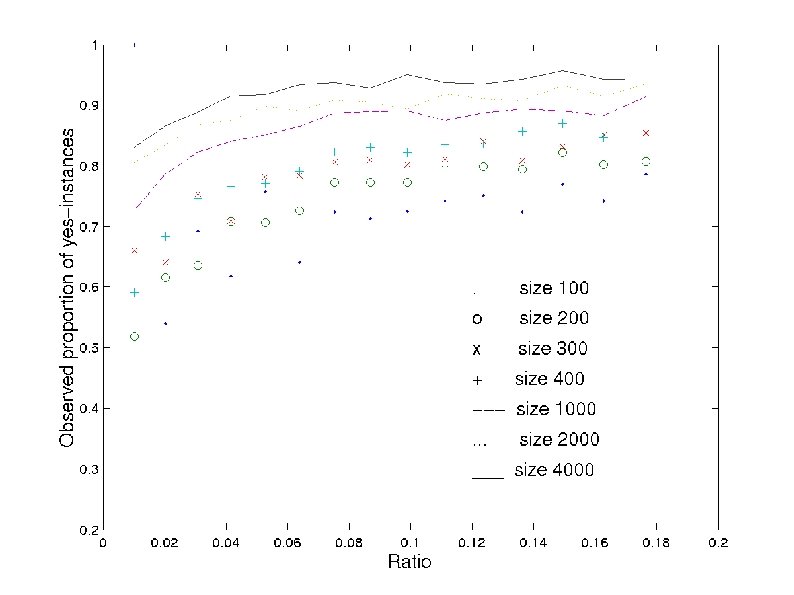
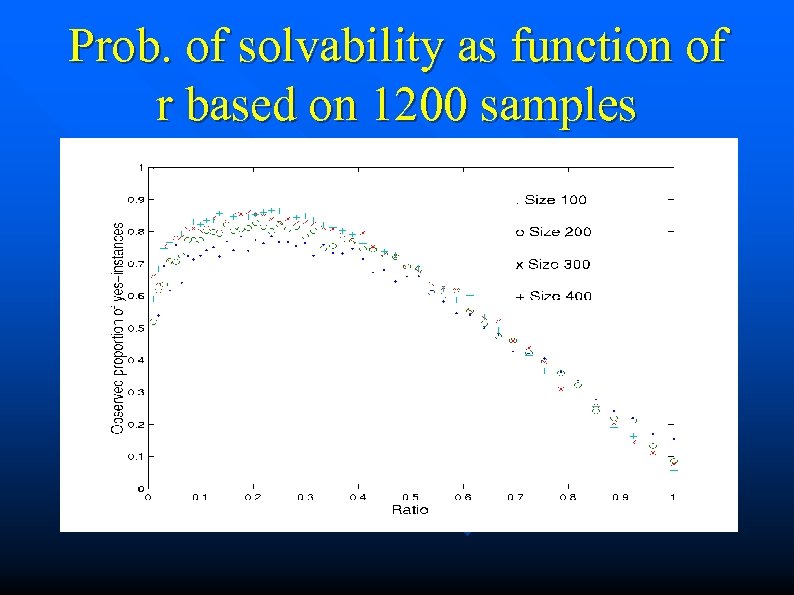 Prob. of solvability as function of r based on 1200 samples
 Large-Scale Experiments Initial experiments based on instances of size up to 400 and on samples of size 1200 suggest a possible crossover near ratio 42: 58 n Large-scale experiments were carried out on the interval of ratios [30: 70, 50: 50] n – Instance sizes: 100, 200, 400, 800, 1600 – Sample size: 30000 random instances for each data point.
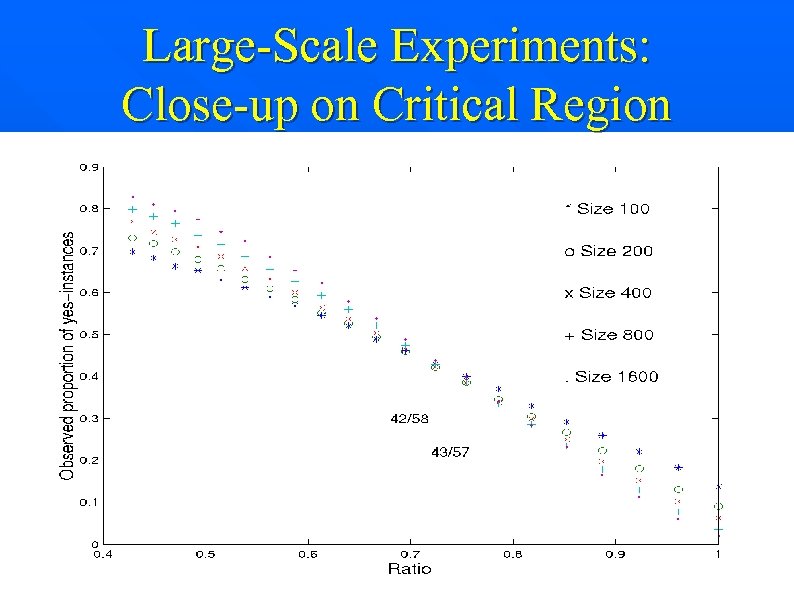 Large-Scale Experiments: Close-up on Critical Region
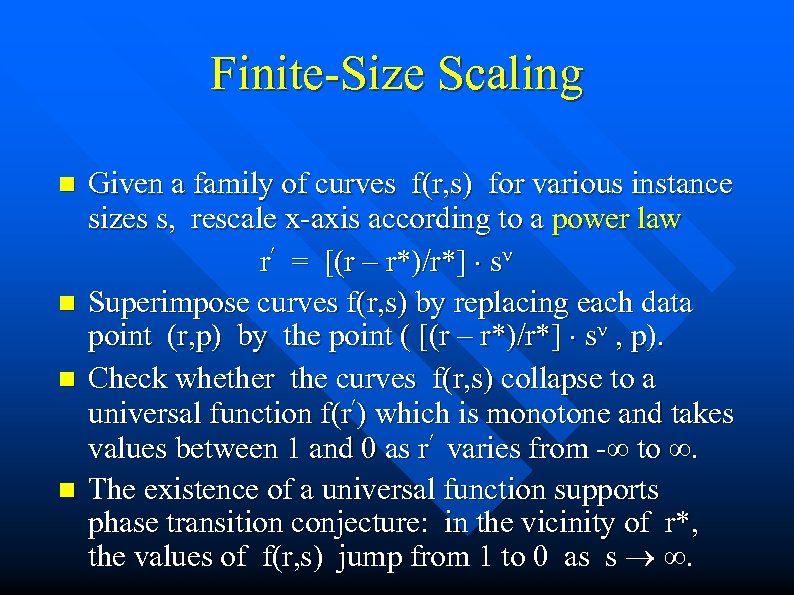 Finite-Size Scaling n n Given a family of curves f(r, s) for various instance sizes s, rescale x-axis according to a power law r = [(r – r*)/r*] s Superimpose curves f(r, s) by replacing each data point (r, p) by the point ( [(r – r*)/r*] s , p). Check whether the curves f(r, s) collapse to a universal function f(r ) which is monotone and takes values between 1 and 0 as r varies from - to . The existence of a universal function supports phase transition conjecture: in the vicinity of r*, the values of f(r, s) jump from 1 to 0 as s .
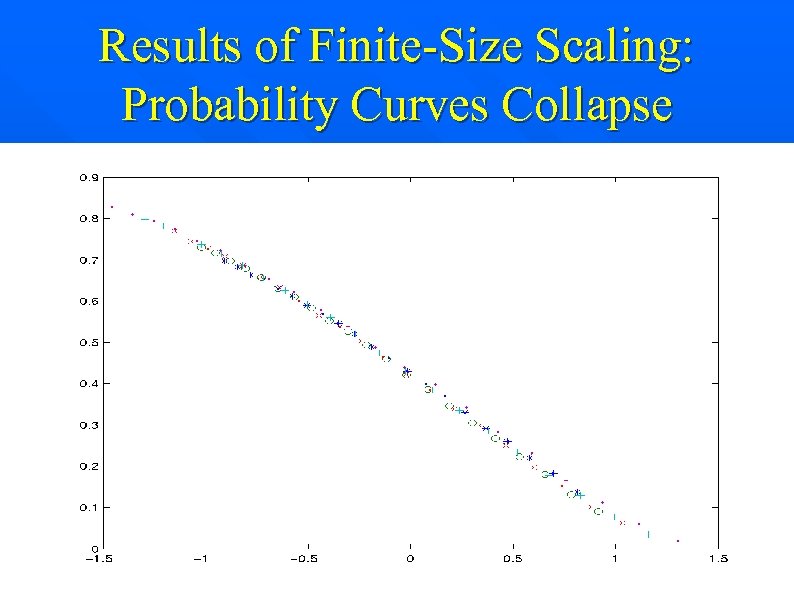 Results of Finite-Size Scaling: Probability Curves Collapse
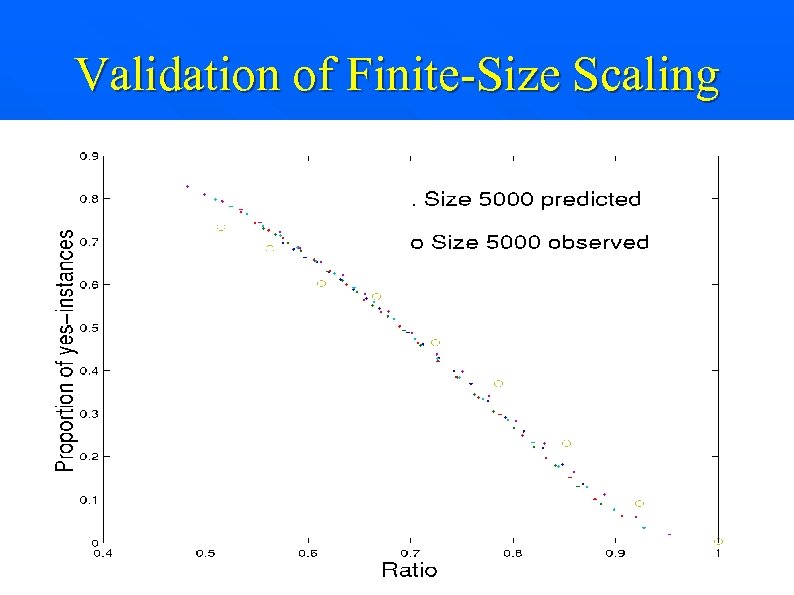 Validation of Finite-Size Scaling
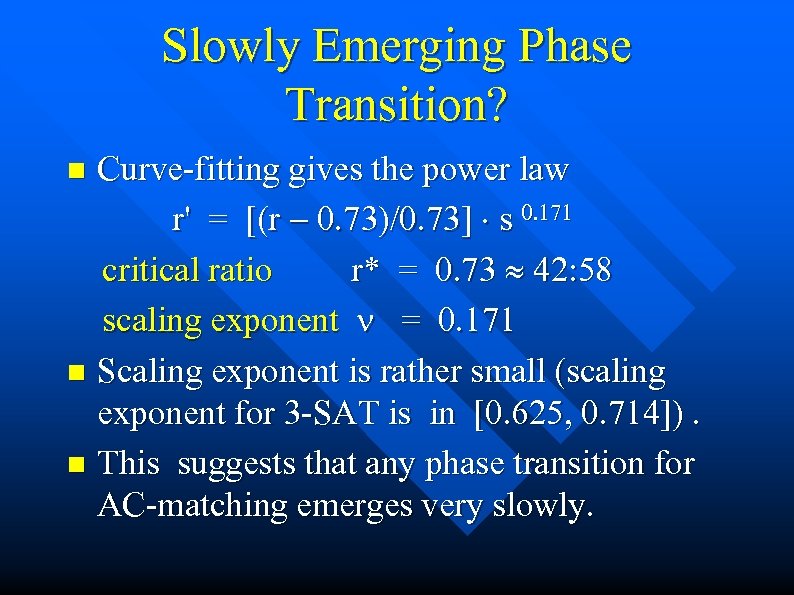 Slowly Emerging Phase Transition? Curve-fitting gives the power law r' = [(r 0. 73)/0. 73] s 0. 171 critical ratio r* = 0. 73 42: 58 scaling exponent = 0. 171 n Scaling exponent is rather small (scaling exponent for 3 -SAT is in [0. 625, 0. 714]). n This suggests that any phase transition for AC-matching emerges very slowly. n
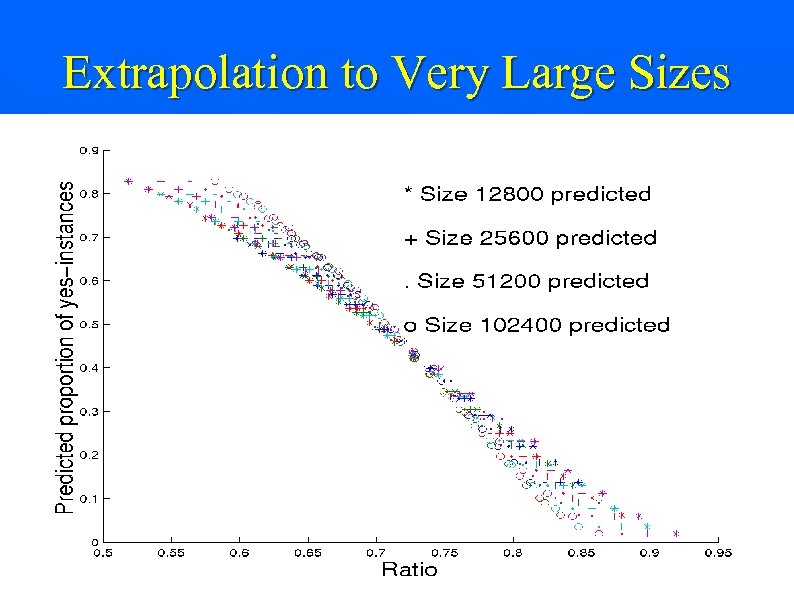 Extrapolation to Very Large Sizes
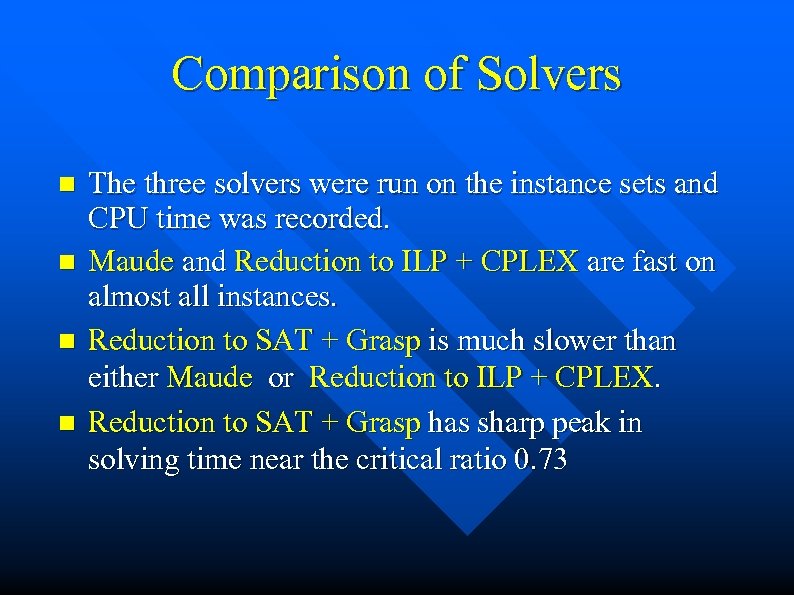 Comparison of Solvers n n The three solvers were run on the instance sets and CPU time was recorded. Maude and Reduction to ILP + CPLEX are fast on almost all instances. Reduction to SAT + Grasp is much slower than either Maude or Reduction to ILP + CPLEX. Reduction to SAT + Grasp has sharp peak in solving time near the critical ratio 0. 73
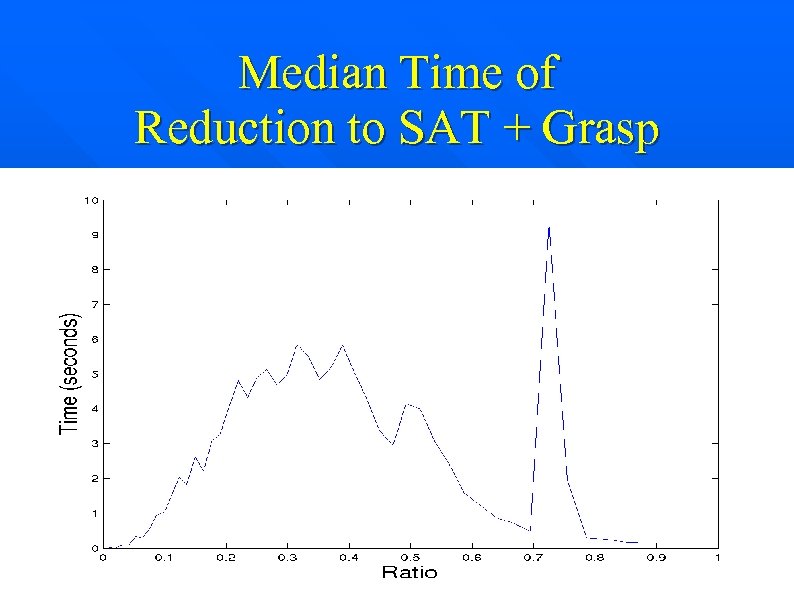 Median Time of Reduction to SAT + Grasp
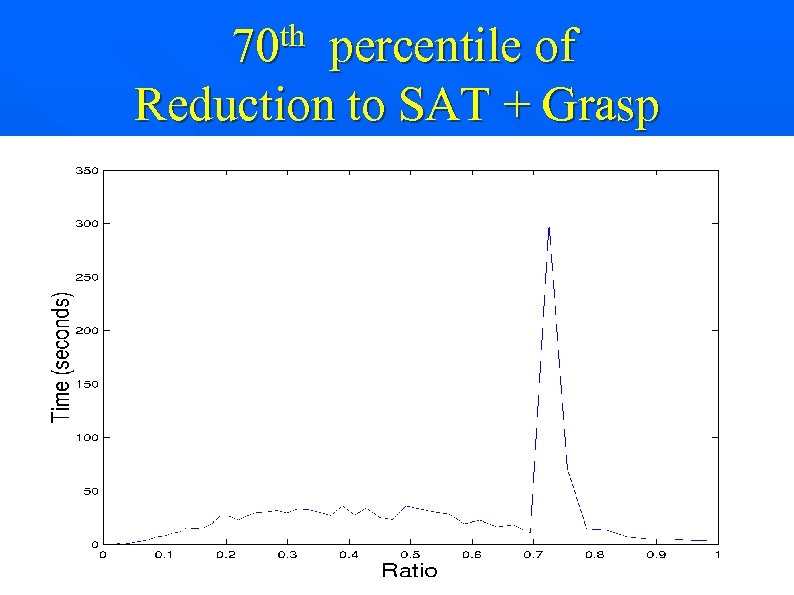 th 70 percentile of Reduction to SAT + Grasp
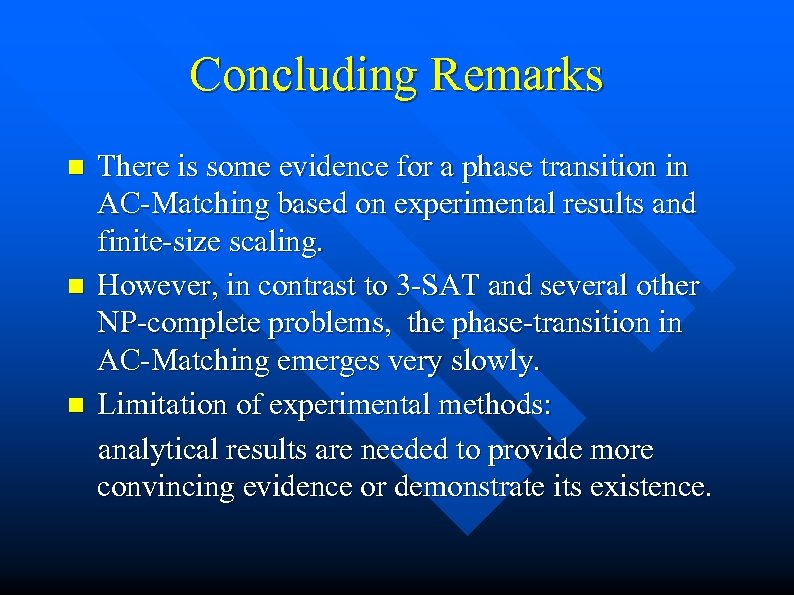 Concluding Remarks n n n There is some evidence for a phase transition in AC-Matching based on experimental results and finite-size scaling. However, in contrast to 3 -SAT and several other NP-complete problems, the phase-transition in AC-Matching emerges very slowly. Limitation of experimental methods: analytical results are needed to provide more convincing evidence or demonstrate its existence.
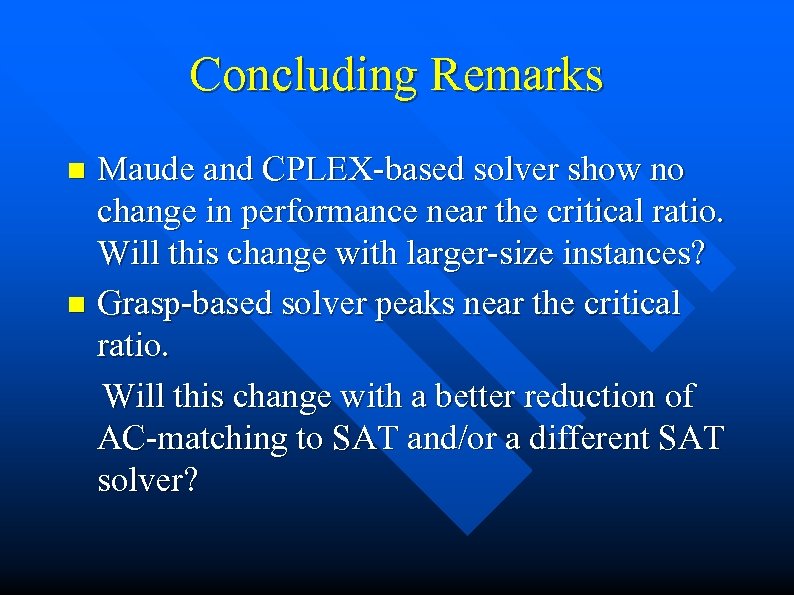 Concluding Remarks Maude and CPLEX-based solver show no change in performance near the critical ratio. Will this change with larger-size instances? n Grasp-based solver peaks near the critical ratio. Will this change with a better reduction of AC-matching to SAT and/or a different SAT solver? n