 Скачать презентацию In Pieces Breaking down monolithic applications with Spring-DM
b8a6038793583f85d40fd7565ec59482.ppt
- Количество слайдов: 48



In Pieces Breaking down monolithic applications with Spring-DM and OSGi
Agenda • The problem: Lack of modularity • OSGi Basics • OSGi without Spring-DM • Introducing Spring-DM • Spring-DM and the web • Blueprint Services • So what? • Moving to OSGi E-mail: craig@habuma. com Blog: http: //www. springinaction. com Twitter: habuma
The Problem
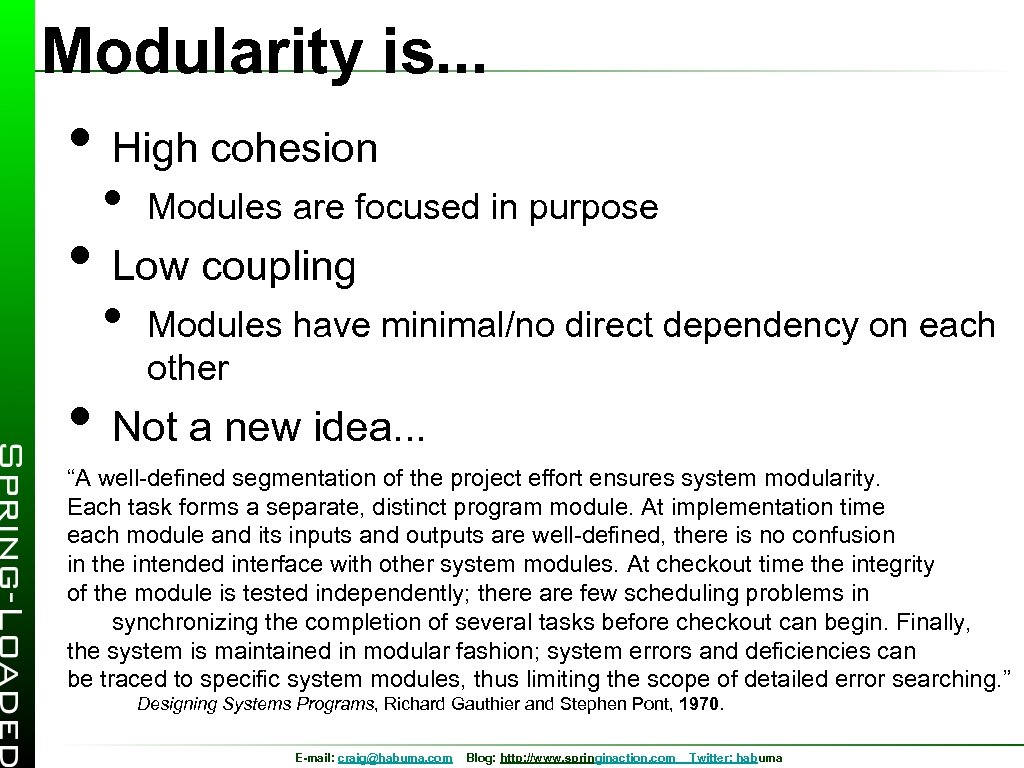
Modularity is. . . • High cohesion • Modules are focused in purpose • Low coupling • Modules have minimal/no direct dependency on each other • Not a new idea. . . “A well-defined segmentation of the project effort ensures system modularity. Each task forms a separate, distinct program module. At implementation time each module and its inputs and outputs are well-defined, there is no confusion in the intended interface with other system modules. At checkout time the integrity of the module is tested independently; there are few scheduling problems in synchronizing the completion of several tasks before checkout can begin. Finally, the system is maintained in modular fashion; system errors and deficiencies can be traced to specific system modules, thus limiting the scope of detailed error searching. ” Designing Systems Programs, Richard Gauthier and Stephen Pont, 1970. E-mail: craig@habuma. com Blog: http: //www. springinaction. com Twitter: habuma
Modularity promotes. . . • Testability • Comprehensibility • Flexibility • Reusability • Plugability E-mail: craig@habuma. com Blog: http: //www. springinaction. com Twitter: habuma
Modularity in Java? • Java lacks some essential features to support modular development • • • Classes encapsulate data and functionality • They’re too fine-grained for practical modularity Packages only contain classes • They’re only an organizational mechanism JAR files only contain packages/classes • Their boundaries dissolve when placed on the classpath E-mail: craig@habuma. com Blog: http: //www. springinaction. com Twitter: habuma
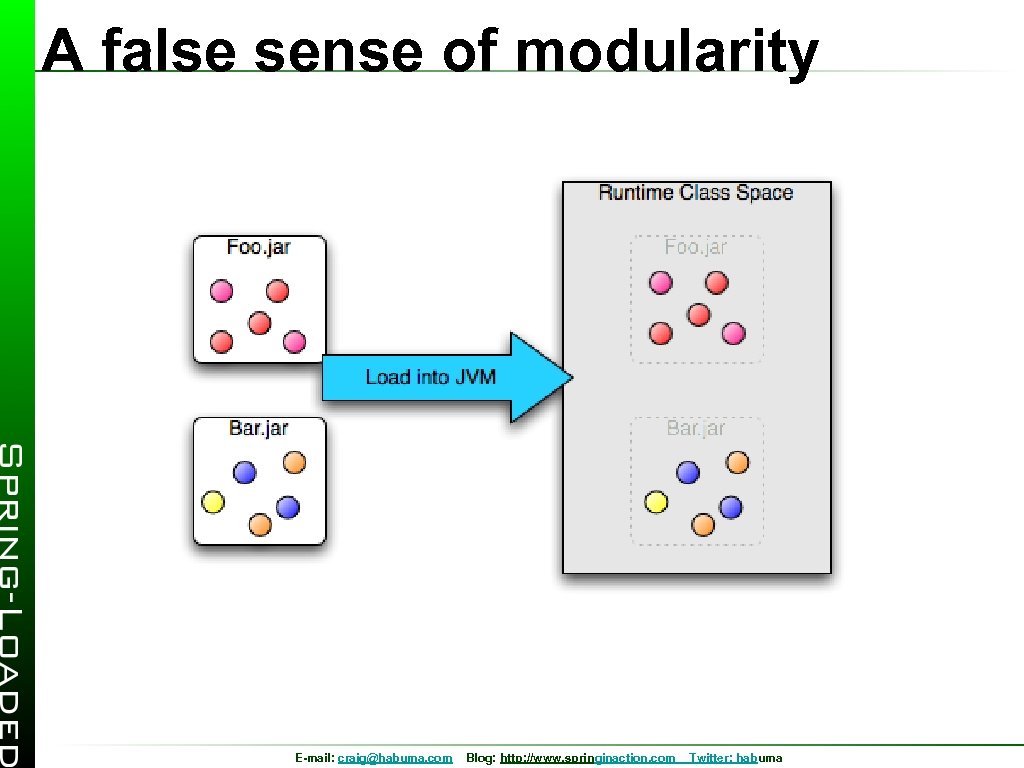
A false sense of modularity E-mail: craig@habuma. com Blog: http: //www. springinaction. com Twitter: habuma
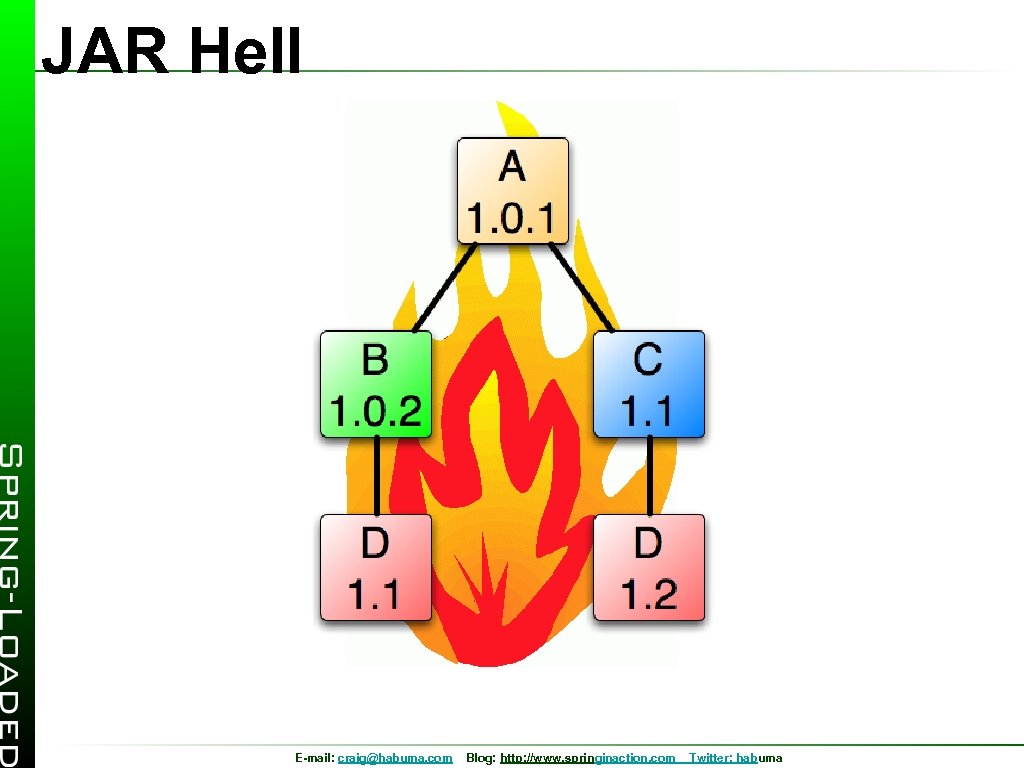
JAR Hell E-mail: craig@habuma. com Blog: http: //www. springinaction. com Twitter: habuma
The solution. . . OSGi • Modular framework for the OSGi platform • Classpath++ • POJO-oriented • Dynamic Runtime • Modules can be installed, started, stopped, updated, and uninstalled. . . in a live program • Ends JAR Hell • Multiple versions of a class can reside in OSGi simultaneously E-mail: craig@habuma. com Blog: http: //www. springinaction. com Twitter: habuma
You think you’re modular? Then why do you deploy your web applications as a single large WAR file? E-mail: craig@habuma. com Blog: http: //www. springinaction. com Twitter: habuma
Yeah, but. . . Isn’t OSGi hard? E-mail: craig@habuma. com Blog: http: //www. springinaction. com Twitter: habuma
OSGi Basics
Bundles • Just JAR files • Contain special metadata in MANIFEST. MF • All content is private by default • • May export packages to be imported by other bundles May publish services • May be versioned E-mail: craig@habuma. com Blog: http: //www. springinaction. com Twitter: habuma
Fragments • Just JAR files, like bundles, but. . . • Must be hosted by another bundle • Physically separate, logically united • Used to add content (classes, resources, etc) to a hosting bundle E-mail: craig@habuma. com Blog: http: //www. springinaction. com Twitter: habuma
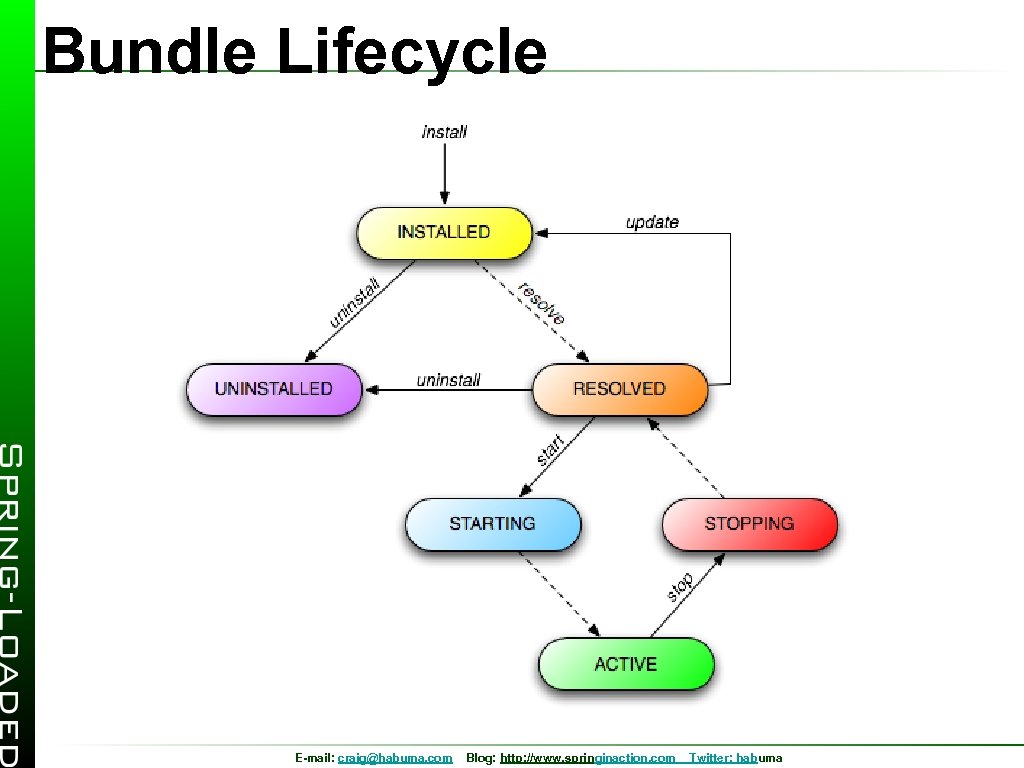
Bundle Lifecycle E-mail: craig@habuma. com Blog: http: //www. springinaction. com Twitter: habuma
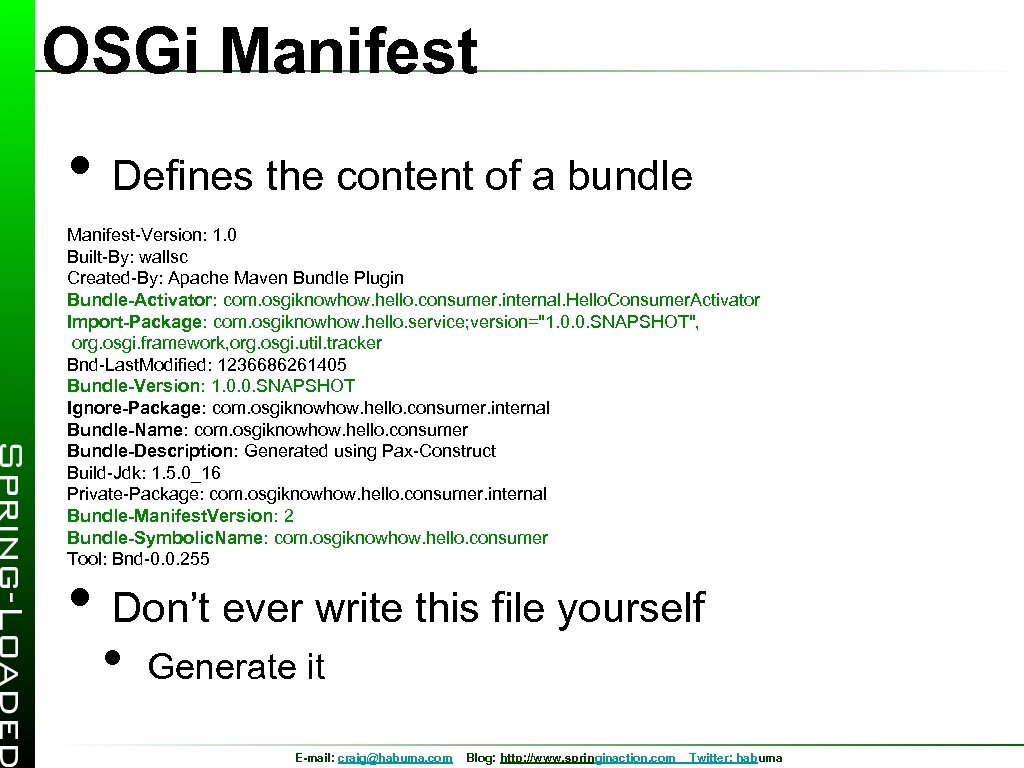
OSGi Manifest • Defines the content of a bundle Manifest-Version: 1. 0 Built-By: wallsc Created-By: Apache Maven Bundle Plugin Bundle-Activator: com. osgiknowhow. hello. consumer. internal. Hello. Consumer. Activator Import-Package: com. osgiknowhow. hello. service; version="1. 0. 0. SNAPSHOT", org. osgi. framework, org. osgi. util. tracker Bnd-Last. Modified: 1236686261405 Bundle-Version: 1. 0. 0. SNAPSHOT Ignore-Package: com. osgiknowhow. hello. consumer. internal Bundle-Name: com. osgiknowhow. hello. consumer Bundle-Description: Generated using Pax-Construct Build-Jdk: 1. 5. 0_16 Private-Package: com. osgiknowhow. hello. consumer. internal Bundle-Manifest. Version: 2 Bundle-Symbolic. Name: com. osgiknowhow. hello. consumer Tool: Bnd-0. 0. 255 • Don’t ever write this file yourself • Generate it E-mail: craig@habuma. com Blog: http: //www. springinaction. com Twitter: habuma
Activators • Perform some functionality when a bundle is started and stopped • Typically used to publish and/or consume services • Should be quick. . . or else they’ll hold up the starting/stopping of a bundle E-mail: craig@habuma. com Blog: http: //www. springinaction. com Twitter: habuma
Versioning • Bundles and packages can be versioned • Can even be versioned independent from each other • Multiple versions can be available simultaneously • Packages can be imported by specifying a specific version, a version range, or no version at all (implying an infinite version range) E-mail: craig@habuma. com Blog: http: //www. springinaction. com Twitter: habuma
Services • Bundle functionality encapsulated behind services • Bundles can publish/consume services • • • Identified by their interface(s) and optional parameters Publish programatically using bundle context Consume programatically using bundle context and service tracker • Can be published/consumed declaratively • Declarative Services, i. POJO, Spring-DM E-mail: craig@habuma. com Blog: http: //www. springinaction. com Twitter: habuma
OSGi without Spring-DM
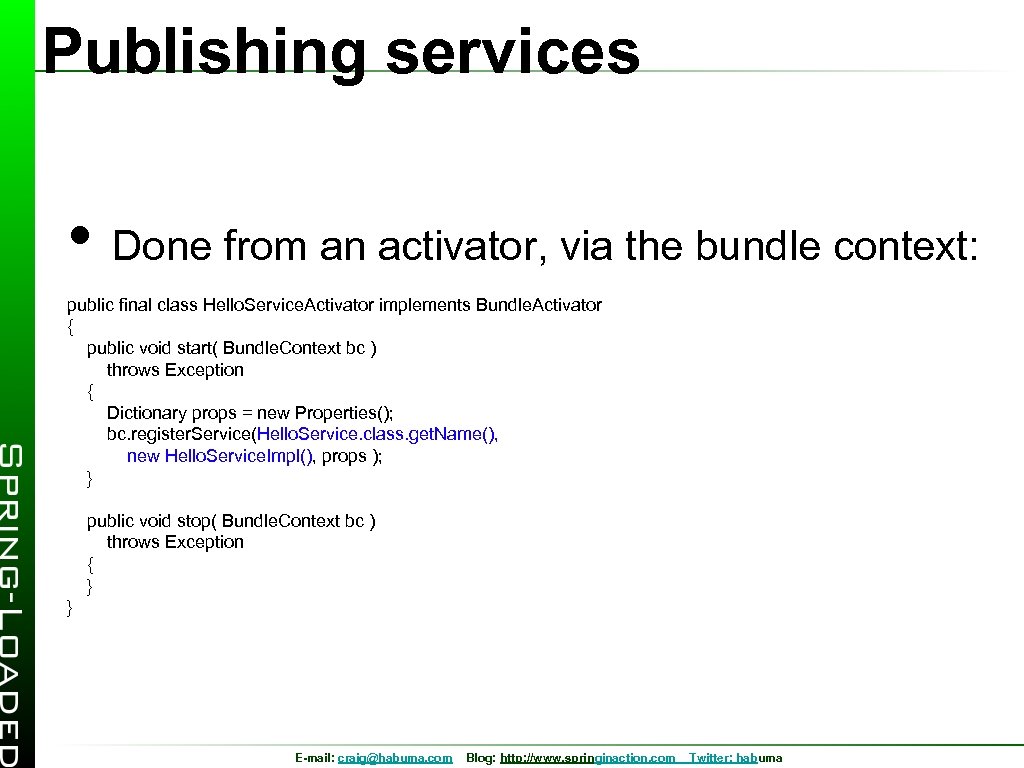
Publishing services • Done from an activator, via the bundle context: public final class Hello. Service. Activator implements Bundle. Activator { public void start( Bundle. Context bc ) throws Exception { Dictionary props = new Properties(); bc. register. Service(Hello. Service. class. get. Name(), new Hello. Service. Impl(), props ); } public void stop( Bundle. Context bc ) throws Exception { } } E-mail: craig@habuma. com Blog: http: //www. springinaction. com Twitter: habuma
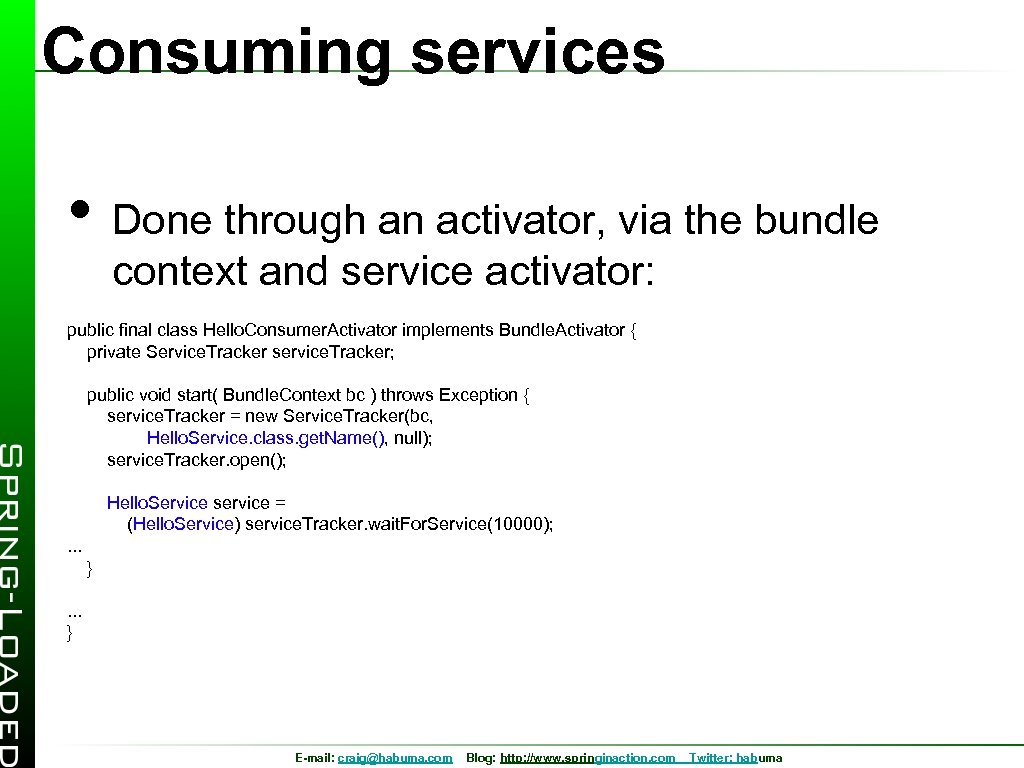
Consuming services • Done through an activator, via the bundle context and service activator: public final class Hello. Consumer. Activator implements Bundle. Activator { private Service. Tracker service. Tracker; public void start( Bundle. Context bc ) throws Exception { service. Tracker = new Service. Tracker(bc, Hello. Service. class. get. Name(), null); service. Tracker. open(); Hello. Service service = (Hello. Service) service. Tracker. wait. For. Service(10000); . . . } E-mail: craig@habuma. com Blog: http: //www. springinaction. com Twitter: habuma
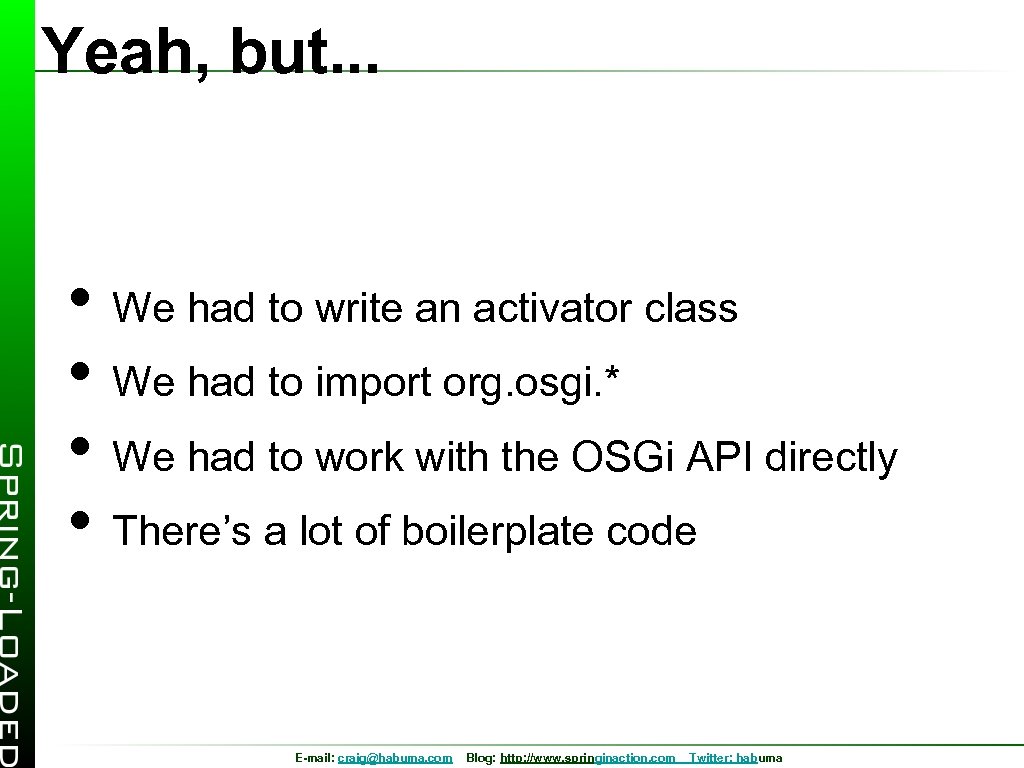
Yeah, but. . . • We had to write an activator class • We had to import org. osgi. * • We had to work with the OSGi API directly • There’s a lot of boilerplate code E-mail: craig@habuma. com Blog: http: //www. springinaction. com Twitter: habuma
Wouldn’t it be great if. . . • . . . we could eliminate the boilerplate? • . . . we could declare services for publication and consumption? E-mail: craig@habuma. com Blog: http: //www. springinaction. com Twitter: habuma
Introducing Spring. DM
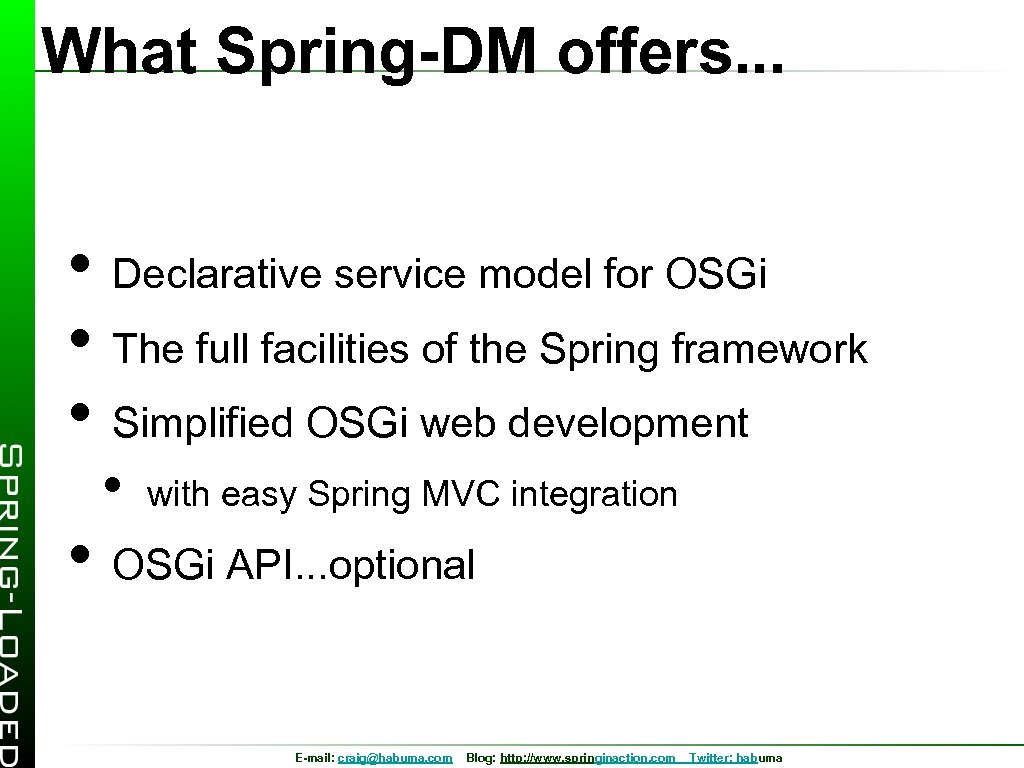
What Spring-DM offers. . . • Declarative service model for OSGi • The full facilities of the Spring framework • Simplified OSGi web development • with easy Spring MVC integration • OSGi API. . . optional E-mail: craig@habuma. com Blog: http: //www. springinaction. com Twitter: habuma
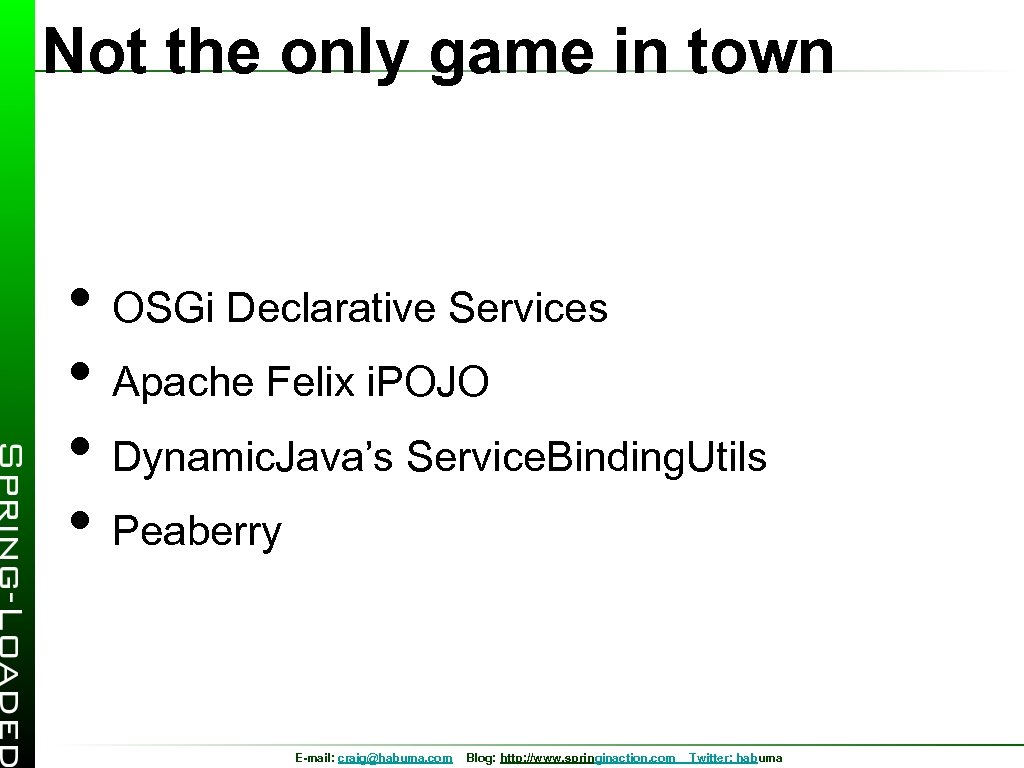
Not the only game in town • OSGi Declarative Services • Apache Felix i. POJO • Dynamic. Java’s Service. Binding. Utils • Peaberry E-mail: craig@habuma. com Blog: http: //www. springinaction. com Twitter: habuma
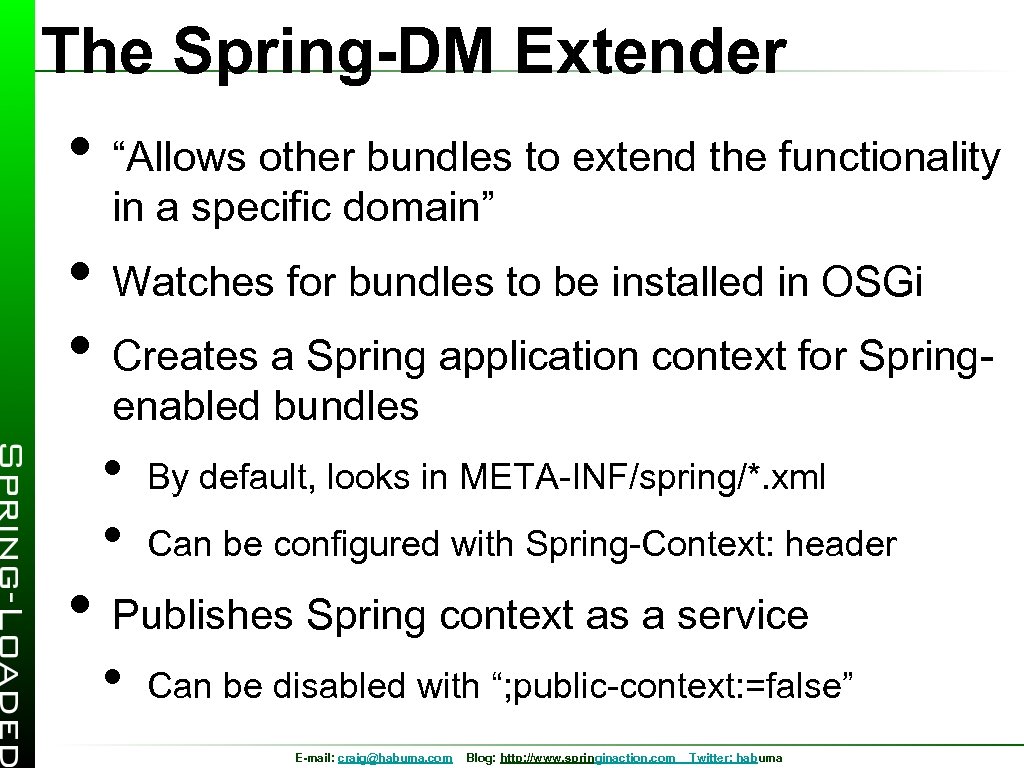
The Spring-DM Extender • “Allows other bundles to extend the functionality in a specific domain” • Watches for bundles to be installed in OSGi • Creates a Spring application context for Springenabled bundles • • By default, looks in META-INF/spring/*. xml Can be configured with Spring-Context: header • Publishes Spring context as a service • Can be disabled with “; public-context: =false” E-mail: craig@habuma. com Blog: http: //www. springinaction. com Twitter: habuma
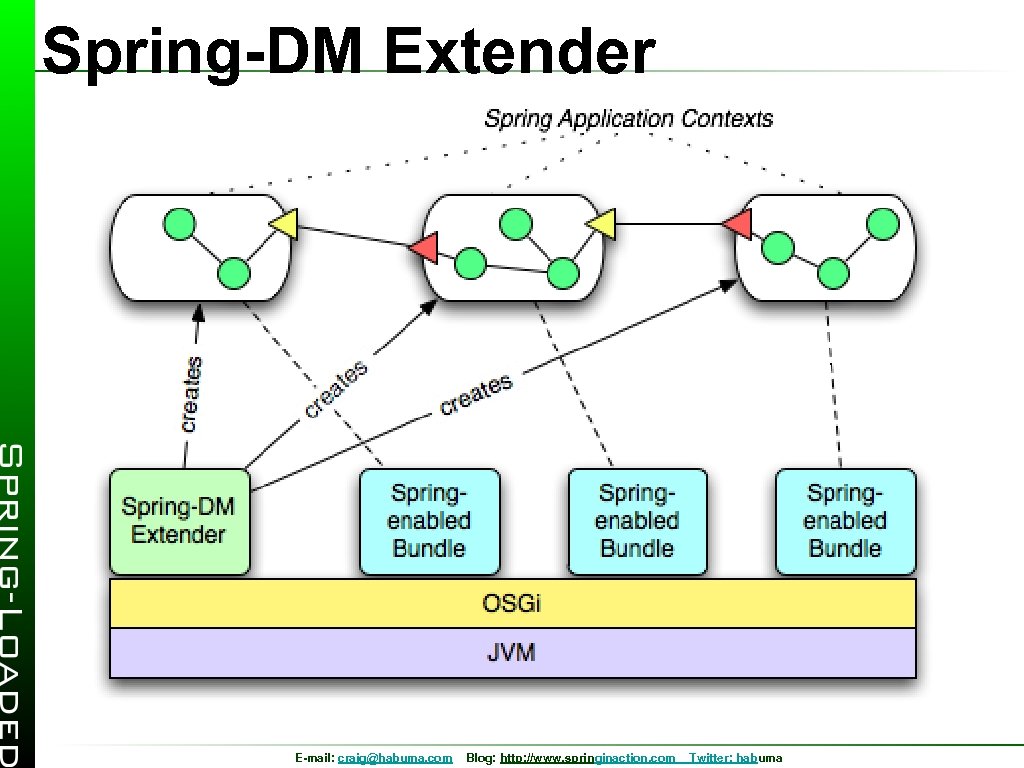
Spring-DM Extender E-mail: craig@habuma. com Blog: http: //www. springinaction. com Twitter: habuma
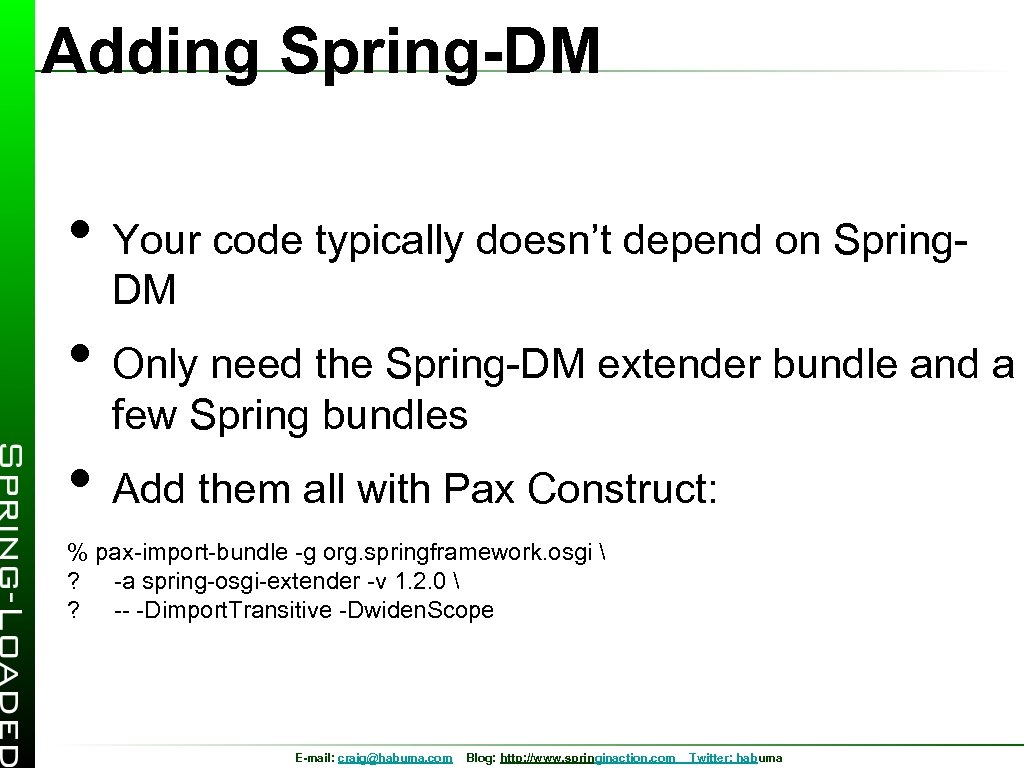
Adding Spring-DM • Your code typically doesn’t depend on Spring. DM • Only need the Spring-DM extender bundle and a few Spring bundles • Add them all with Pax Construct: % pax-import-bundle -g org. springframework. osgi ? -a spring-osgi-extender -v 1. 2. 0 ? -- -Dimport. Transitive -Dwiden. Scope E-mail: craig@habuma. com Blog: http: //www. springinaction. com Twitter: habuma
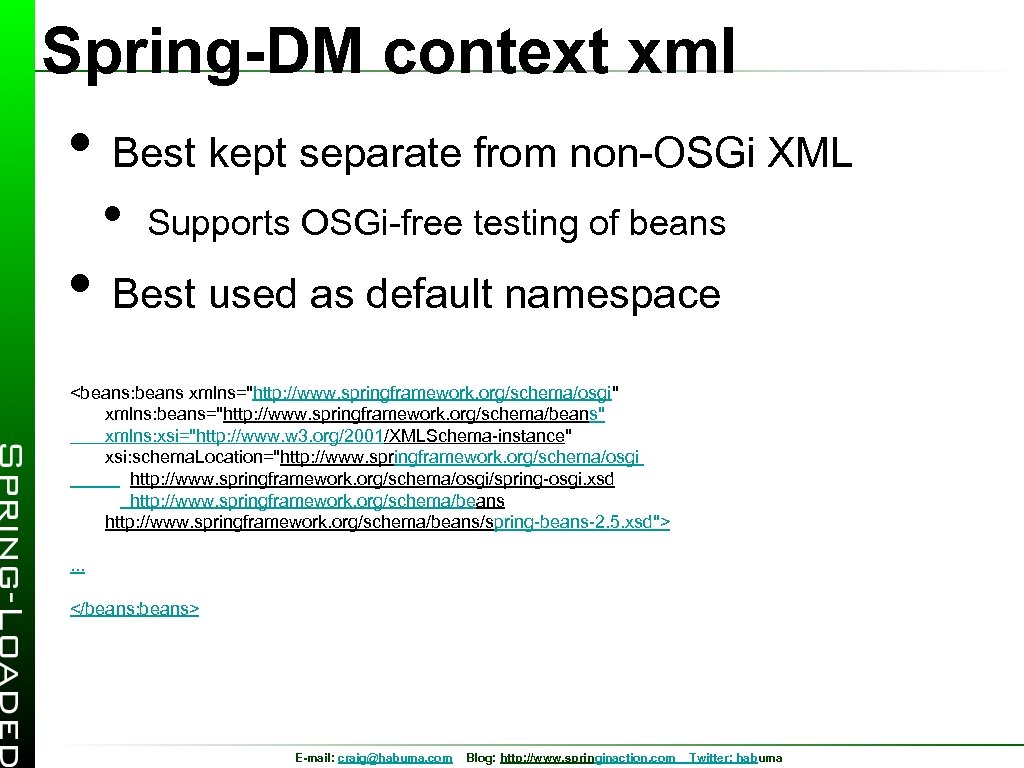
Spring-DM context xml • Best kept separate from non-OSGi XML • Supports OSGi-free testing of beans • Best used as default namespace <beans: beans xmlns="http: //www. springframework. org/schema/osgi" xmlns: beans="http: //www. springframework. org/schema/beans" xmlns: xsi="http: //www. w 3. org/2001/XMLSchema-instance" xsi: schema. Location="http: //www. springframework. org/schema/osgi/spring-osgi. xsd http: //www. springframework. org/schema/beans/spring-beans-2. 5. xsd">. . . </beans: beans> E-mail: craig@habuma. com Blog: http: //www. springinaction. com Twitter: habuma
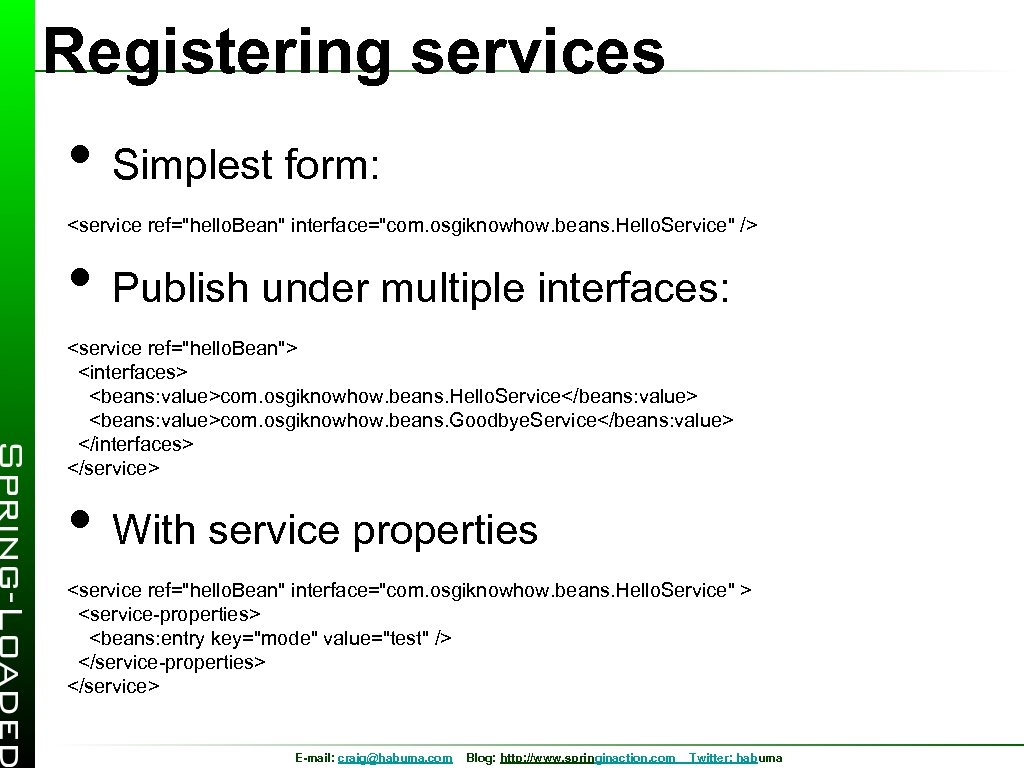
Registering services • Simplest form: <service ref="hello. Bean" interface="com. osgiknowhow. beans. Hello. Service" /> • Publish under multiple interfaces: <service ref="hello. Bean"> <interfaces> <beans: value>com. osgiknowhow. beans. Hello. Service</beans: value> <beans: value>com. osgiknowhow. beans. Goodbye. Service</beans: value> </interfaces> </service> • With service properties <service ref="hello. Bean" interface="com. osgiknowhow. beans. Hello. Service" > <service-properties> <beans: entry key="mode" value="test" /> </service-properties> </service> E-mail: craig@habuma. com Blog: http: //www. springinaction. com Twitter: habuma
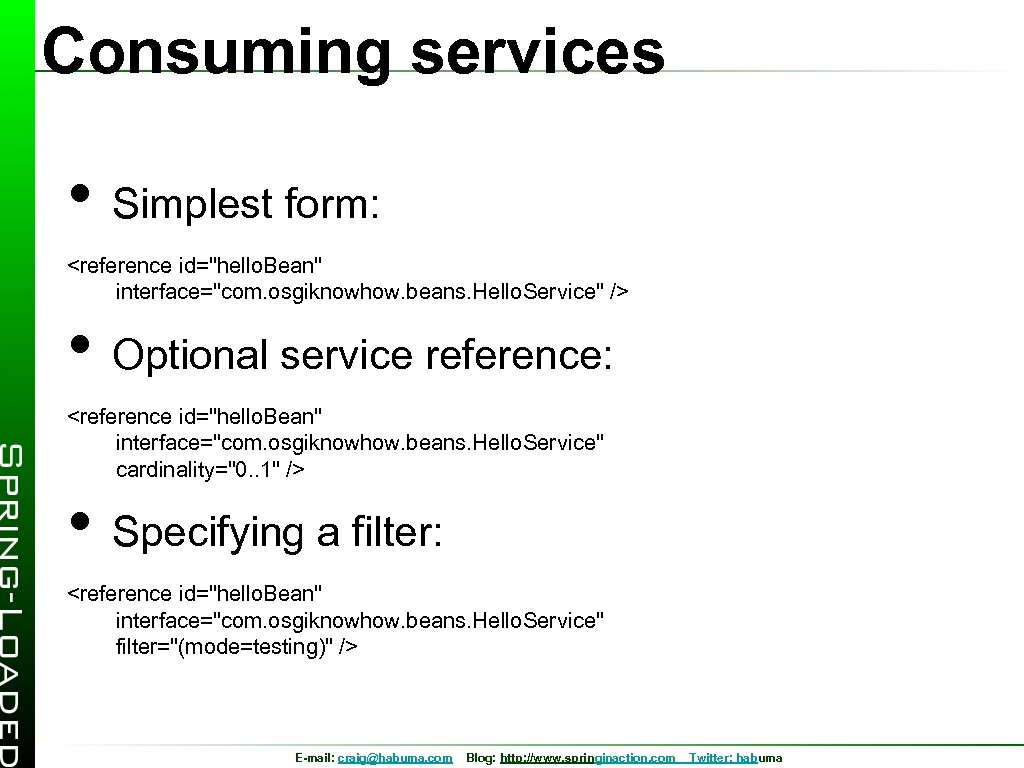
Consuming services • Simplest form: <reference id="hello. Bean" interface="com. osgiknowhow. beans. Hello. Service" /> • Optional service reference: <reference id="hello. Bean" interface="com. osgiknowhow. beans. Hello. Service" cardinality="0. . 1" /> • Specifying a filter: <reference id="hello. Bean" interface="com. osgiknowhow. beans. Hello. Service" filter="(mode=testing)" /> E-mail: craig@habuma. com Blog: http: //www. springinaction. com Twitter: habuma
Spring-DM and the web
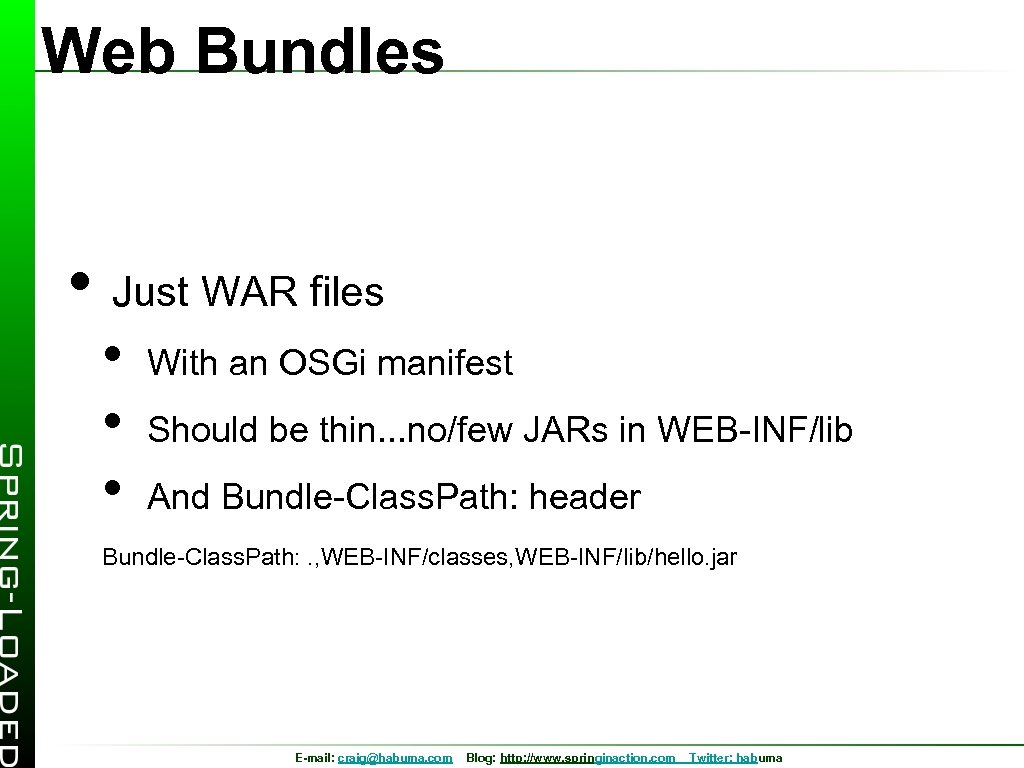
Web Bundles • Just WAR files • • • With an OSGi manifest Should be thin. . . no/few JARs in WEB-INF/lib And Bundle-Class. Path: header Bundle-Class. Path: . , WEB-INF/classes, WEB-INF/lib/hello. jar E-mail: craig@habuma. com Blog: http: //www. springinaction. com Twitter: habuma
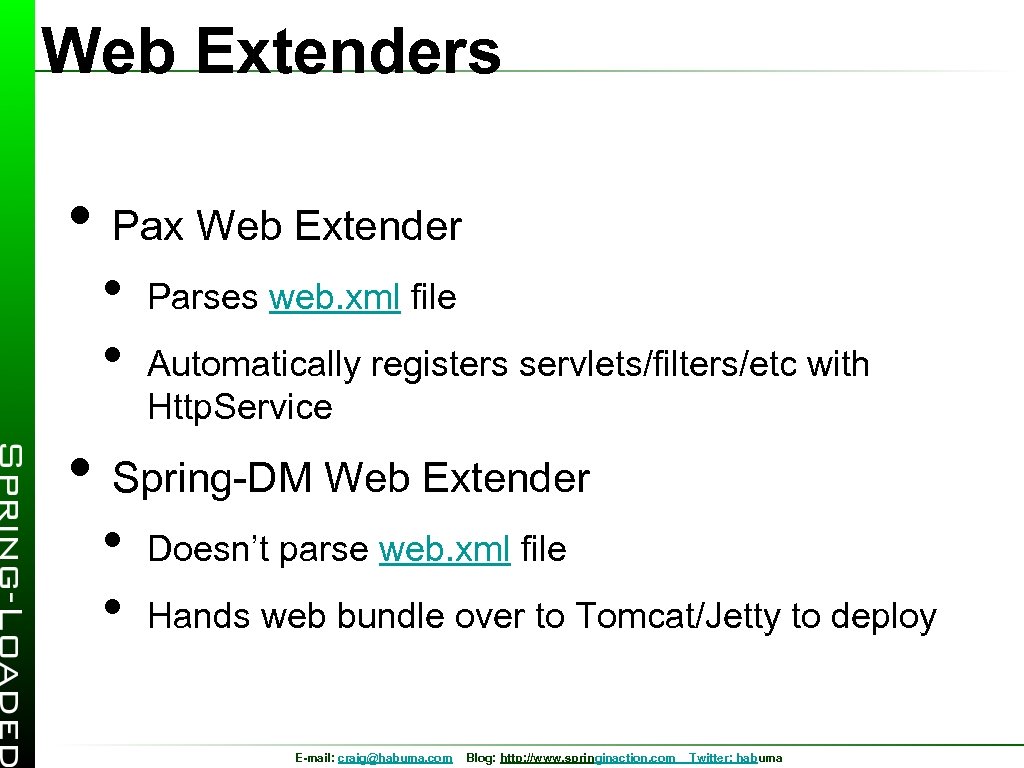
Web Extenders • Pax Web Extender • • Parses web. xml file Automatically registers servlets/filters/etc with Http. Service • Spring-DM Web Extender • • Doesn’t parse web. xml file Hands web bundle over to Tomcat/Jetty to deploy E-mail: craig@habuma. com Blog: http: //www. springinaction. com Twitter: habuma
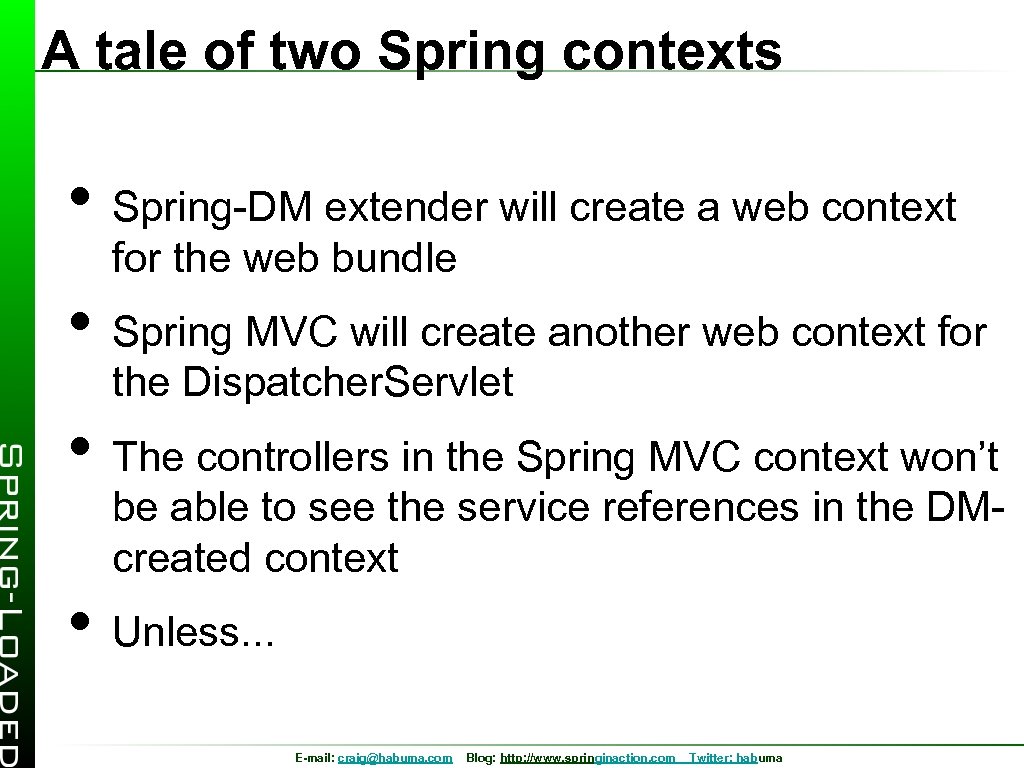
A tale of two Spring contexts • Spring-DM extender will create a web context for the web bundle • Spring MVC will create another web context for the Dispatcher. Servlet • The controllers in the Spring MVC context won’t be able to see the service references in the DMcreated context • Unless. . . E-mail: craig@habuma. com Blog: http: //www. springinaction. com Twitter: habuma
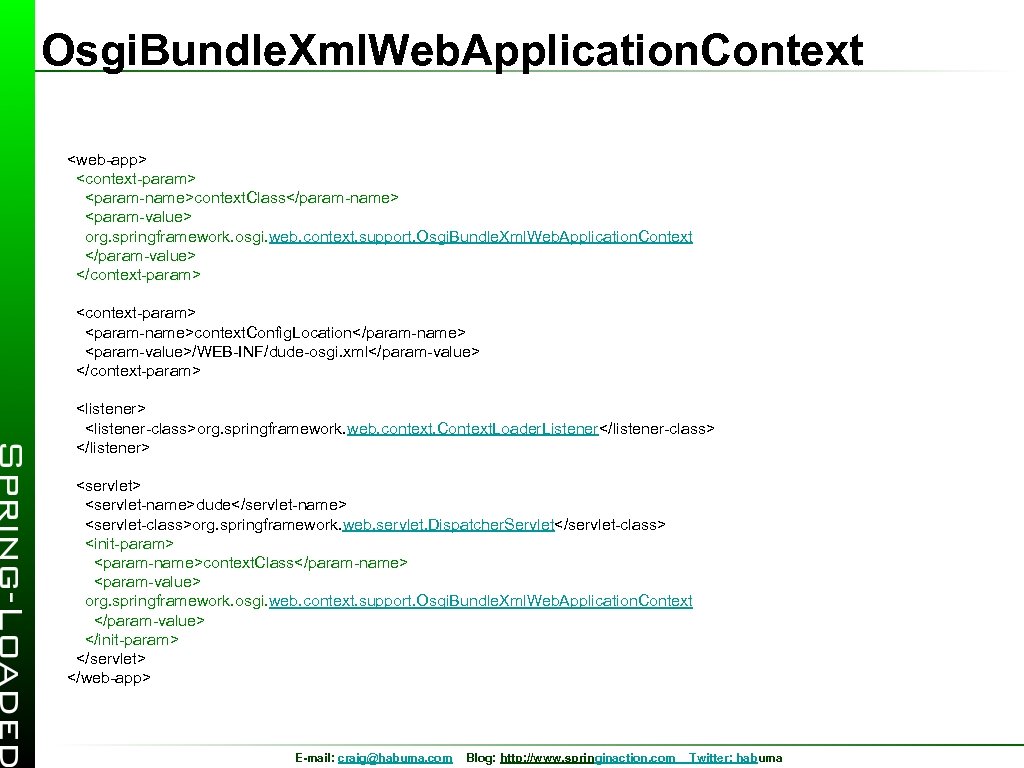
Osgi. Bundle. Xml. Web. Application. Context <web-app> <context-param> <param-name>context. Class</param-name> <param-value> org. springframework. osgi. web. context. support. Osgi. Bundle. Xml. Web. Application. Context </param-value> </context-param> <param-name>context. Config. Location</param-name> <param-value>/WEB-INF/dude-osgi. xml</param-value> </context-param> <listener-class>org. springframework. web. context. Context. Loader. Listener</listener-class> </listener> <servlet-name>dude</servlet-name> <servlet-class>org. springframework. web. servlet. Dispatcher. Servlet</servlet-class> <init-param> <param-name>context. Class</param-name> <param-value> org. springframework. osgi. web. context. support. Osgi. Bundle. Xml. Web. Application. Context </param-value> </init-param> </servlet> </web-app> E-mail: craig@habuma. com Blog: http: //www. springinaction. com Twitter: habuma
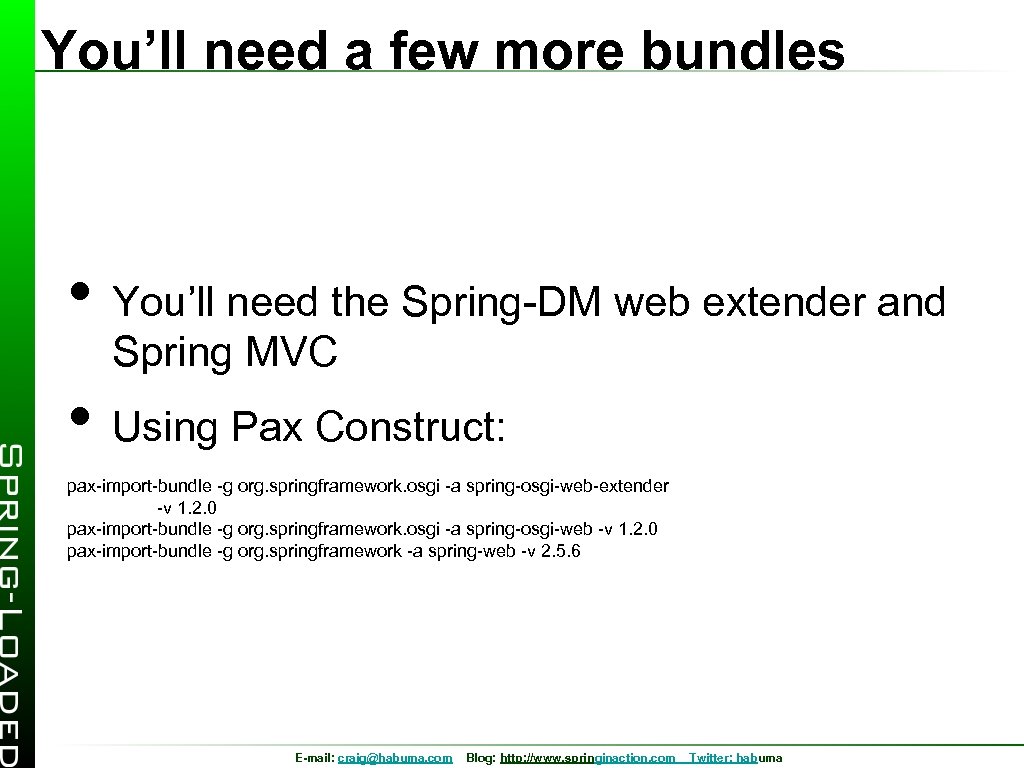
You’ll need a few more bundles • You’ll need the Spring-DM web extender and Spring MVC • Using Pax Construct: pax-import-bundle -g org. springframework. osgi -a spring-osgi-web-extender -v 1. 2. 0 pax-import-bundle -g org. springframework. osgi -a spring-osgi-web -v 1. 2. 0 pax-import-bundle -g org. springframework -a spring-web -v 2. 5. 6 E-mail: craig@habuma. com Blog: http: //www. springinaction. com Twitter: habuma

Blueprint Services
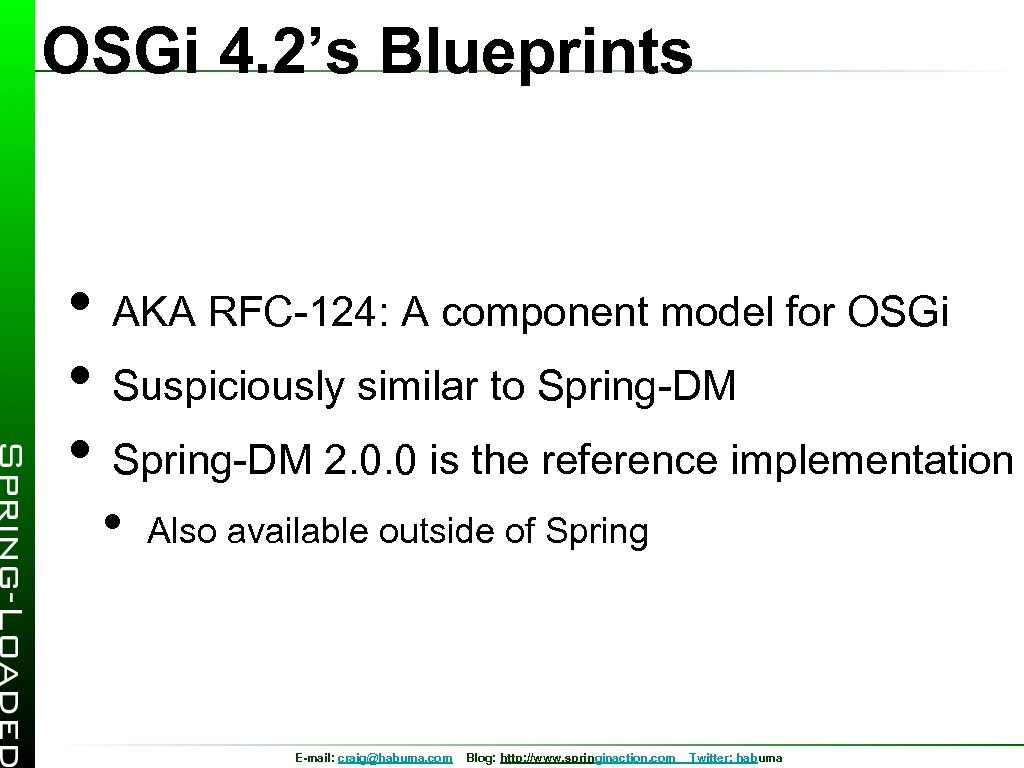
OSGi 4. 2’s Blueprints • AKA RFC-124: A component model for OSGi • Suspiciously similar to Spring-DM • Spring-DM 2. 0. 0 is the reference implementation • Also available outside of Spring E-mail: craig@habuma. com Blog: http: //www. springinaction. com Twitter: habuma
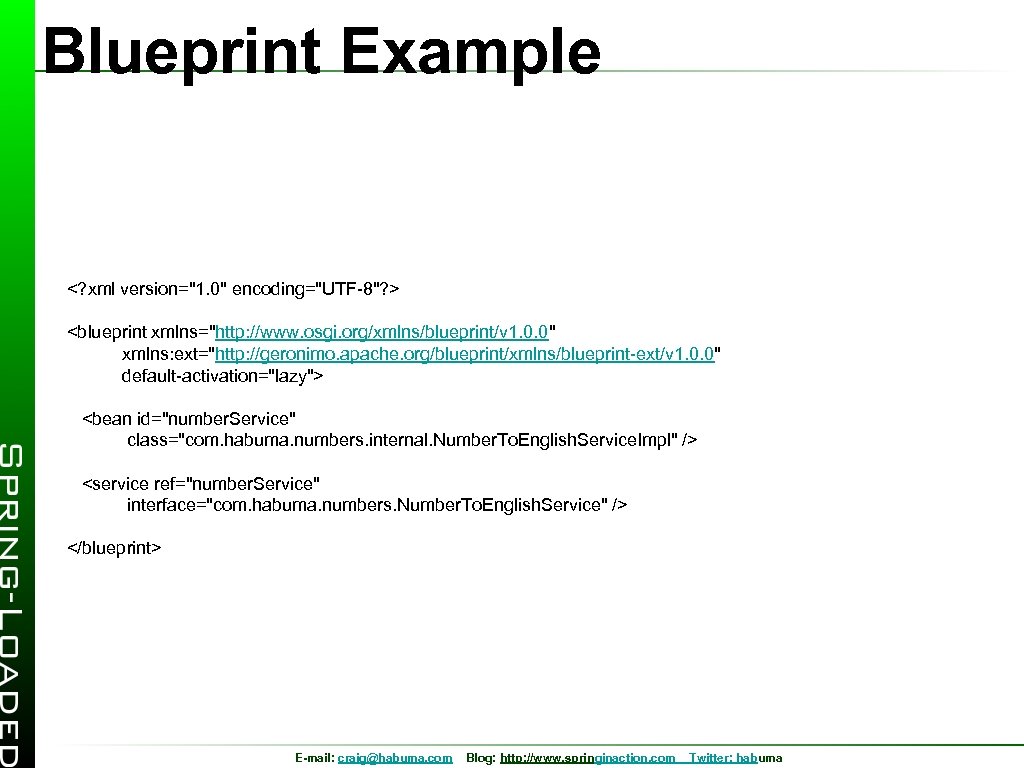
Blueprint Example <? xml version="1. 0" encoding="UTF-8"? > <blueprint xmlns="http: //www. osgi. org/xmlns/blueprint/v 1. 0. 0" xmlns: ext="http: //geronimo. apache. org/blueprint/xmlns/blueprint-ext/v 1. 0. 0" default-activation="lazy"> <bean id="number. Service" class="com. habuma. numbers. internal. Number. To. English. Service. Impl" /> <service ref="number. Service" interface="com. habuma. numbers. Number. To. English. Service" /> </blueprint> E-mail: craig@habuma. com Blog: http: //www. springinaction. com Twitter: habuma
So what? What did OSGi buy us?
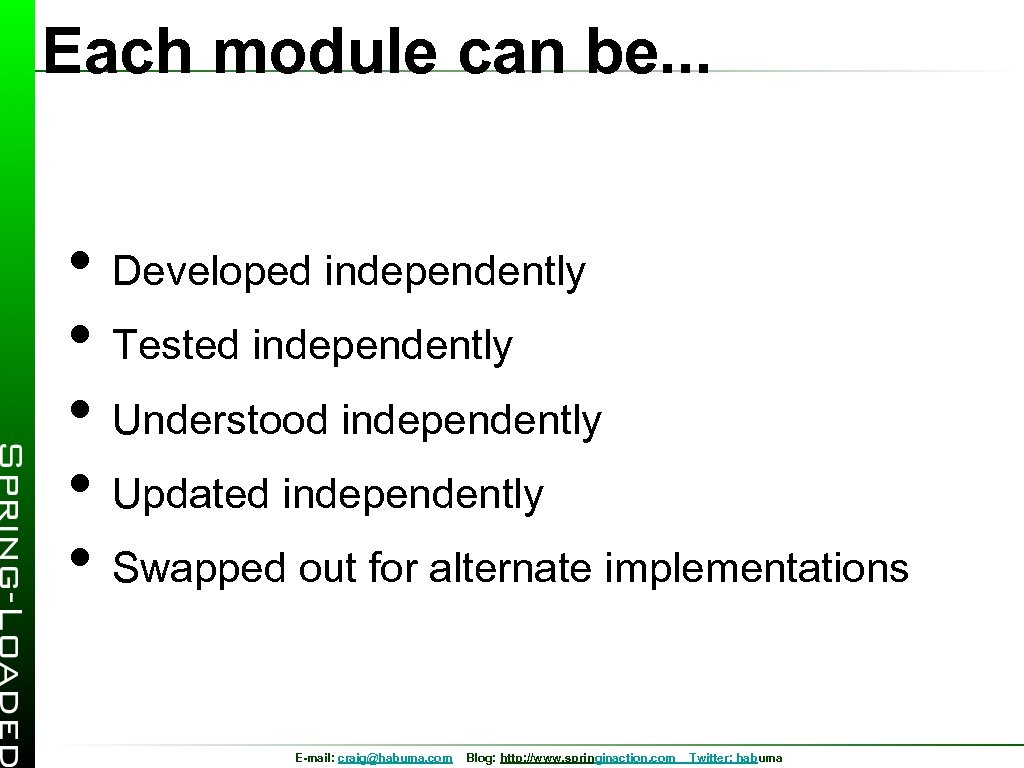
Each module can be. . . • Developed independently • Tested independently • Understood independently • Updated independently • Swapped out for alternate implementations E-mail: craig@habuma. com Blog: http: //www. springinaction. com Twitter: habuma
Moving to OSGi Or. . . what do I do with this WAR file I already have?
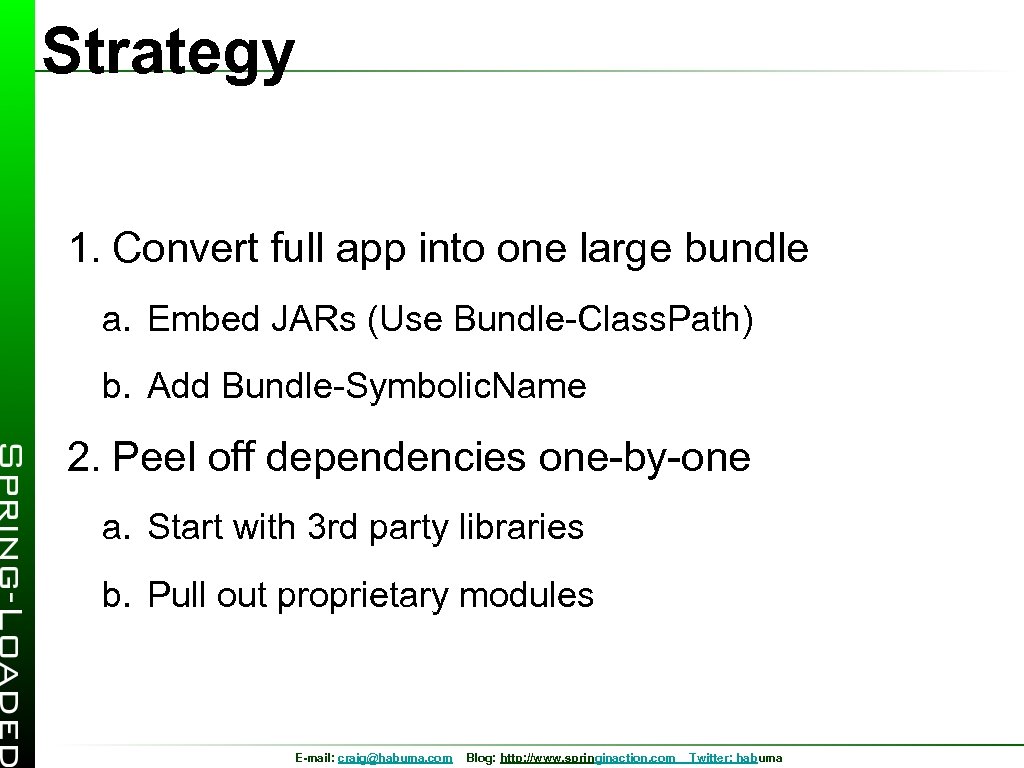
Strategy 1. Convert full app into one large bundle a. Embed JARs (Use Bundle-Class. Path) b. Add Bundle-Symbolic. Name 2. Peel off dependencies one-by-one a. Start with 3 rd party libraries b. Pull out proprietary modules E-mail: craig@habuma. com Blog: http: //www. springinaction. com Twitter: habuma
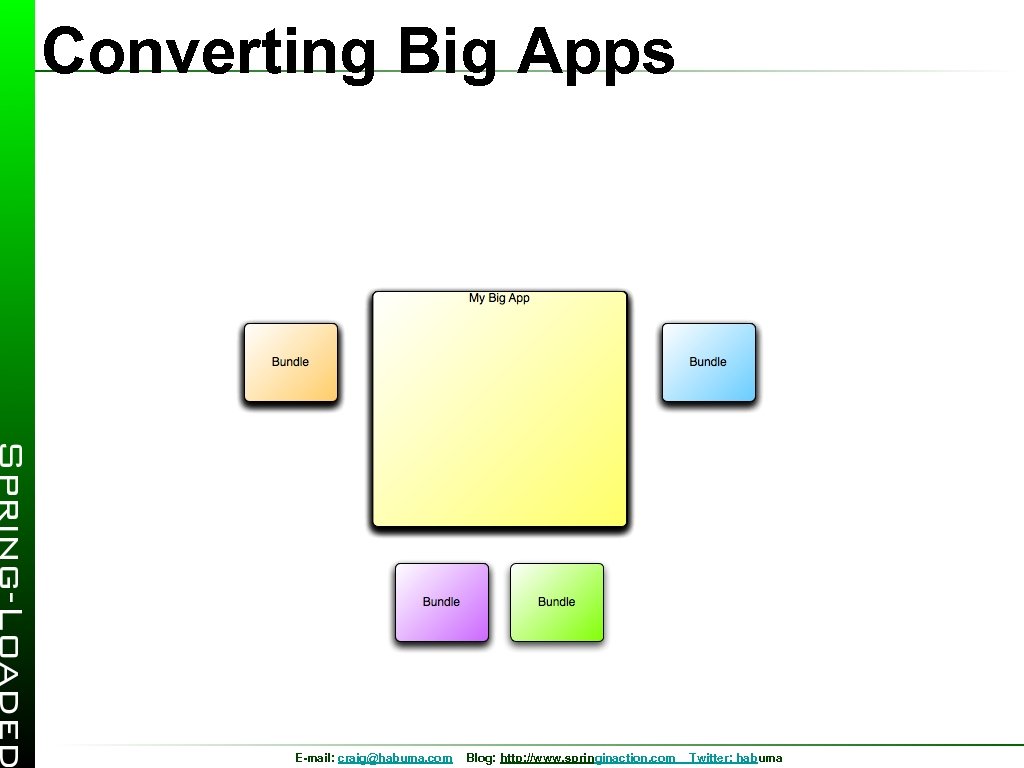
Converting Big Apps E-mail: craig@habuma. com Blog: http: //www. springinaction. com Twitter: habuma
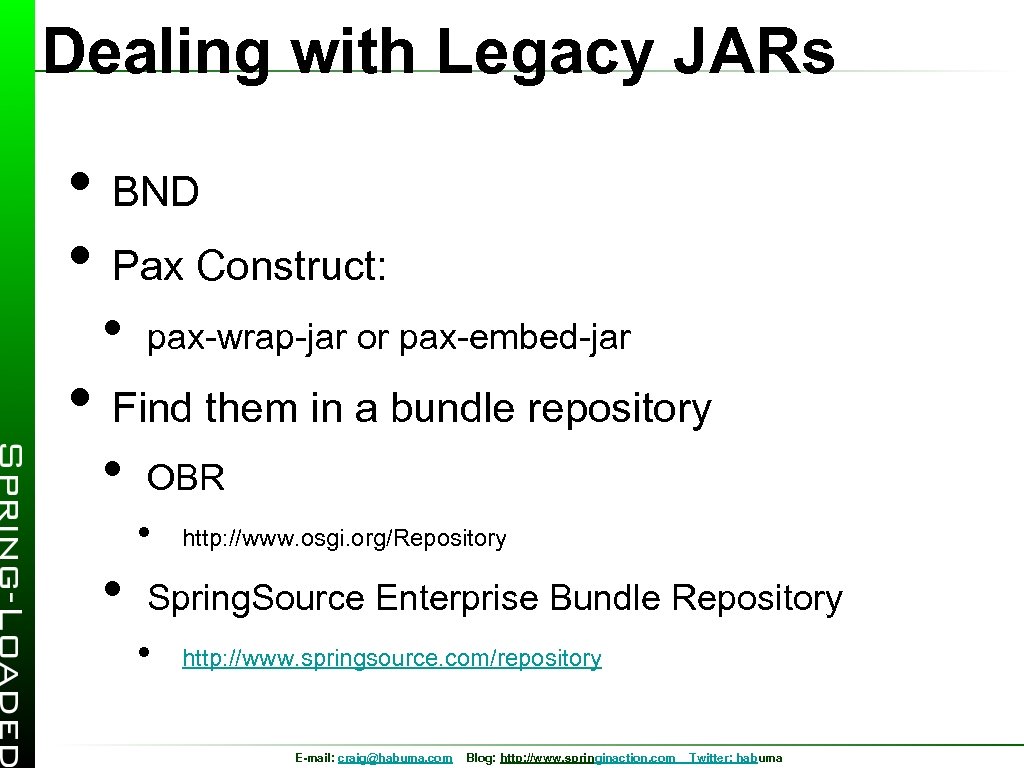
Dealing with Legacy JARs • BND • Pax Construct: • pax-wrap-jar or pax-embed-jar • OBR • Find them in a bundle repository • • http: //www. osgi. org/Repository Spring. Source Enterprise Bundle Repository • http: //www. springsource. com/repository E-mail: craig@habuma. com Blog: http: //www. springinaction. com Twitter: habuma
Скачать презентацию In Pieces Breaking down monolithic applications with Spring-DM
b8a6038793583f85d40fd7565ec59482.ppt