


 Скачать презентацию In Parkinson s disease STN stimulation alters pallidal coupling
73898fd4a30c9599b1f1a1d919d4a442.ppt
- Количество слайдов: 1
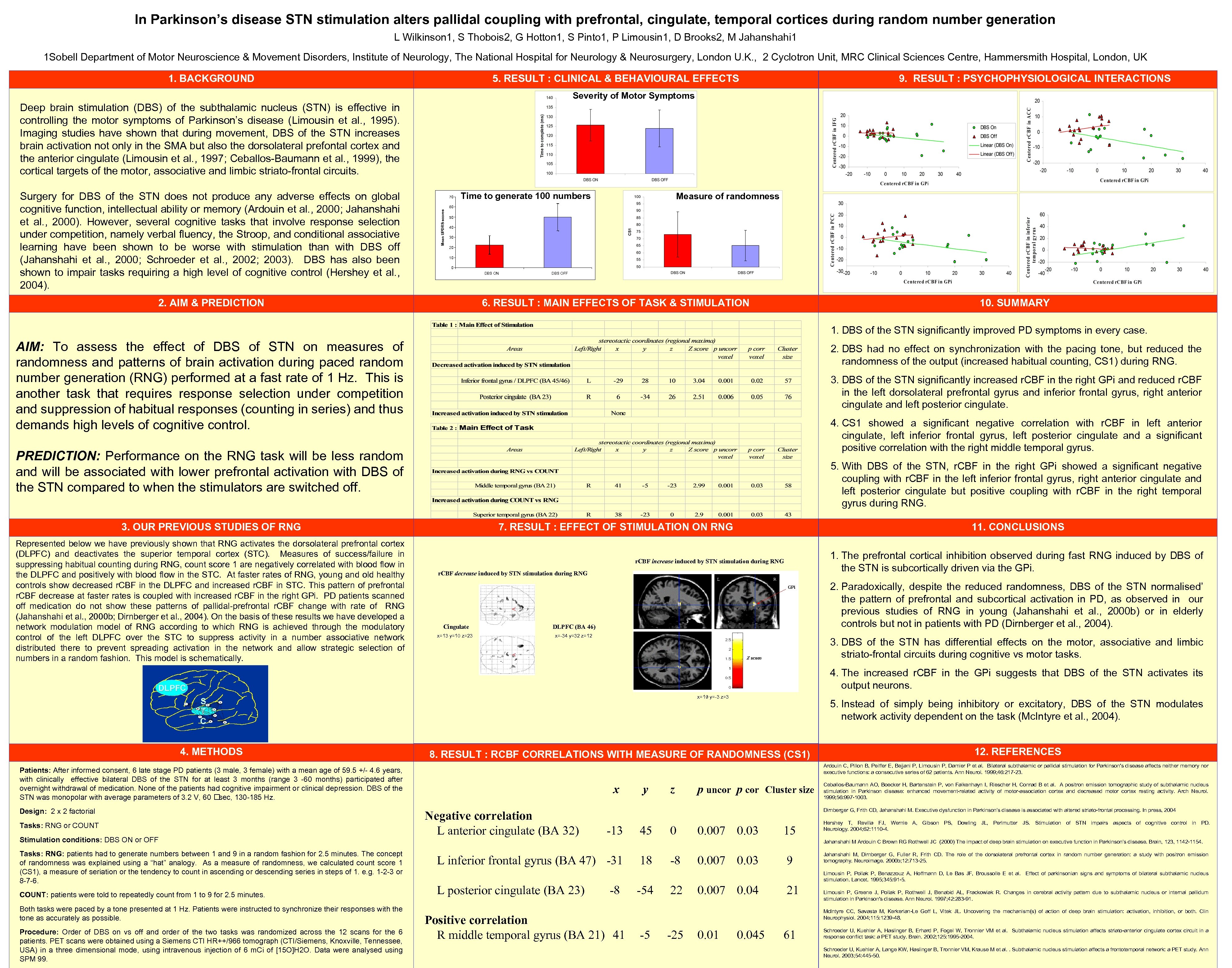 In Parkinson’s disease STN stimulation alters pallidal coupling with prefrontal, cingulate, temporal cortices during random number generation L Wilkinson 1, S Thobois 2, G Hotton 1, S Pinto 1, P Limousin 1, D Brooks 2, M Jahanshahi 1 1 Sobell Department of Motor Neuroscience & Movement Disorders, Institute of Neurology, The National Hospital for Neurology & Neurosurgery, London U. K. , 2 Cyclotron Unit, MRC Clinical Sciences Centre, Hammersmith Hospital, London, UK 1. BACKGROUND 5. RESULT : CLINICAL & BEHAVIOURAL EFFECTS 9. RESULT : PSYCHOPHYSIOLOGICAL INTERACTIONS Severity of Motor Symptoms Deep brain stimulation (DBS) of the subthalamic nucleus (STN) is effective in controlling the motor symptoms of Parkinson’s disease (Limousin et al. , 1995). Imaging studies have shown that during movement, DBS of the STN increases brain activation not only in the SMA but also the dorsolateral prefontal cortex and the anterior cingulate (Limousin et al. , 1997; Ceballos-Baumann et al. , 1999), the cortical targets of the motor, associative and limbic striato-frontal circuits. Time to generate 100 numbers 60 Time to generate 100 numbers Measure of randomness 70 Mean UPDRS scores Surgery for DBS of the STN does not produce any adverse effects on global cognitive function, intellectual ability or memory (Ardouin et al. , 2000; Jahanshahi et al. , 2000). However, several cognitive tasks that involve response selection under competition, namely verbal fluency, the Stroop, and conditional associative learning have been shown to be worse with stimulation than with DBS off (Jahanshahi et al. , 2000; Schroeder et al. , 2002; 2003). DBS has also been shown to impair tasks requiring a high level of cognitive control (Hershey et al. , 2004). 50 40 30 20 10 0 DBS ON 2. AIM & PREDICTION DBS OFF 6. RESULT : MAIN EFFECTS OF TASK & STIMULATION 10. SUMMARY 1. DBS of the STN significantly improved PD symptoms in every case. AIM: To assess the effect of DBS of STN on measures of randomness and patterns of brain activation during paced random number generation (RNG) performed at a fast rate of 1 Hz. This is another task that requires response selection under competition and suppression of habitual responses (counting in series) and thus demands high levels of cognitive control. 2. DBS had no effect on synchronization with the pacing tone, but reduced the randomness of the output (increased habitual counting, CS 1) during RNG. 3. DBS of the STN significantly increased r. CBF in the right GPi and reduced r. CBF in the left dorsolateral prefrontal gyrus and inferior frontal gyrus, right anterior cingulate and left posterior cingulate. 4. CS 1 showed a significant negative correlation with r. CBF in left anterior cingulate, left inferior frontal gyrus, left posterior cingulate and a significant positive correlation with the right middle temporal gyrus. PREDICTION: Performance on the RNG task will be less random and will be associated with lower prefrontal activation with DBS of the STN compared to when the stimulators are switched off. 5. With DBS of the STN, r. CBF in the right GPi showed a significant negative coupling with r. CBF in the left inferior frontal gyrus, right anterior cingulate and left posterior cingulate but positive coupling with r. CBF in the right temporal gyrus during RNG. 3. OUR PREVIOUS STUDIES OF RNG Represented below we have previously shown that RNG activates the dorsolateral prefrontal cortex (DLPFC) and deactivates the superior temporal cortex (STC). Measures of success/failure in suppressing habitual counting during RNG, count score 1 are negatively correlated with blood flow in the DLPFC and positively with blood flow in the STC. At faster rates of RNG, young and old healthy controls show decreased r. CBF in the DLPFC and increased r. CBF in STC. This pattern of prefrontal r. CBF decrease at faster rates is coupled with increased r. CBF in the right GPi. PD patients scanned off medication do not show these patterns of pallidal-prefrontal r. CBF change with rate of RNG (Jahanshahi et al. , 2000 b; Dirnberger et al. , 2004). On the basis of these results we have developed a network modulation model of RNG according to which RNG is achieved through the modulatory control of the left DLPFC over the STC to suppress activity in a number associative network distributed there to prevent spreading activation in the network and allow strategic selection of numbers in a random fashion. This model is schematically. 7. RESULT : EFFECT OF STIMULATION ON RNG 11. CONCLUSIONS 1. The prefrontal cortical inhibition observed during fast RNG induced by DBS of the STN is subcortically driven via the GPi. r. CBF increase induced by STN stimulation during RNG r. CBF decrease induced by STN stimulation during RNG Cingulate DLPFC (BA 46) x=13 y=10 z=23 2. Paradoxically, despite the reduced randomness, DBS of the STN normalised’ the pattern of prefrontal and subcortical activation in PD, as observed in our previous studies of RNG in young (Jahanshahi et al. , 2000 b) or in elderly controls but not in patients with PD (Dirnberger et al. , 2004). x=-34 y=32 z=12 3. DBS of the STN has differential effects on the motor, associative and limbic striato-frontal circuits during cognitive vs motor tasks. 4. The increased r. CBF in the GPi suggests that DBS of the STN activates its output neurons. DLPFC x=19 y=-3 z=3 S T C 4. METHODS 8. RESULT : RCBF CORRELATIONS WITH MEASURE OF RANDOMNESS (CS 1) Tasks: RNG or COUNT Stimulation conditions: DBS ON or OFF Tasks: RNG: patients had to generate numbers between 1 and 9 in a random fashion for 2. 5 minutes. The concept of randomness was explained using a “hat” analogy. As a measure of randomness, we calculated count score 1 (CS 1), a measure of seriation or the tendency to count in ascending or descending series in steps of 1. e. g. 1 -2 -3 or 8 -7 -6. COUNT: patients were told to repeatedly count from 1 to 9 for 2. 5 minutes. Both tasks were paced by a tone presented at 1 Hz. Patients were instructed to synchronize their responses with the tone as accurately as possible. Procedure: Order of DBS on vs off and order of the two tasks was randomized across the 12 scans for the 6 patients. PET scans were obtained using a Siemens CTI HR++/966 tomograph (CTI/Siemens, Knoxville, Tennessee, USA) in a three dimensional mode, using intravenous injection of 6 m. Ci of [15 O]H 2 O. Data were analysed using SPM 99. 12. REFERENCES Ardouin C, Pillon B, Peiffer E, Bejjani P, Limousin P, Damier P et al. Bilateral subthalamic or pallidal stimulation for Parkinson's disease affects neither memory nor executive functions: a consecutive series of 62 patients. Ann Neurol. 1999; 46: 217 -23. Patients: After informed consent, 6 late stage PD patients (3 male, 3 female) with a mean age of 59. 5 +/- 4. 6 years, with clinically effective bilateral DBS of the STN for at least 3 months (range 3 -60 months) participated after overnight withdrawal of medication. None of the patients had cognitive impairment or clinical depression. DBS of the STN was monopolar with average parameters of 3. 2 V, 60 sec, 130 -185 Hz. Design: 2 x 2 factorial 5. Instead of simply being inhibitory or excitatory, DBS of the STN modulates network activity dependent on the task (Mc. Intyre et al. , 2004). x Negative correlation L anterior cingulate (BA 32) y z p uncor p cor Cluster size Ceballos-Baumann AO, Boecker H, Bartenstein P, von Falkenhayn I, Riescher H, Conrad B et al. A positron emission tomographic study of subthalamic nucleus stimulation in Parkinson disease: enhanced movement-related activity of motor-association cortex and decreased motor cortex resting activity. Arch Neurol. 1999; 56: 997 -1003. Dirnberger G, Frith CD, Jahanshahi M. Executive dysfunction in Parkinson’s disease is associated with altered striato-frontal processing. In press, 2004 -13 45 0 0. 007 0. 03 15 Hershey T, Revilla FJ, Wernle A, Gibson PS, Dowling JL, Perlmutter JS. Stimulation of STN impairs aspects of cognitive control in PD. Neurology. 2004; 62: 1110 -4. Jahanshahi M Ardouin C Brown RG Rothwell JC (2000) The impact of deep brain stimulation on executive function in Parkinson’s disease. Brain, 123, 1142 -1154. L inferior frontal gyrus (BA 47) -31 18 -8 0. 007 0. 03 9 Jahanshahi M, Dirnberger G, Fuller R, Frith CD. The role of the dorsolateral prefrontal cortex in random number generation: a study with positron emission tomography. Neuroimage. 2000 b; 12: 713 -25. Limousin P, Pollak P, Benazzouz A, Hoffmann D, Le Bas JF, Broussolle E et al. Effect of parkinsonian signs and symptoms of bilateral subthalamic nucleus stimulation. Lancet. 1995; 345: 91 -5. L posterior cingulate (BA 23) -8 Positive correlation R middle temporal gyrus (BA 21) 41 -54 22 0. 007 0. 04 21 Limousin P, Greene J, Pollak P, Rothwell J, Benabid AL, Frackowiak R. Changes in cerebral activity pattern due to subthalamic nucleus or internal pallidum stimulation in Parkinson's disease. Ann Neurol. 1997; 42: 283 -91. Mc. Intyre CC, Savasta M, Kerkerian-Le Goff L, Vitek JL. Uncovering the mechanism(s) of action of deep brain stimulation: activation, inhibition, or both. Clin Neurophysiol. 2004; 115: 1239 -48. -5 -25 0. 01 0. 045 61 Schroeder U, Kuehler A, Haslinger B, Erhard P, Fogel W, Tronnier VM et al. Subthalamic nucleus stimulation affects striato-anterior cingulate cortex circuit in a response conflict task: a PET study. Brain. 2002; 125: 1995 -2004. Schroeder U, Kuehler A, Lange KW, Haslinger B, Tronnier VM, Krause M et al. . Subthalamic nucleus stimulation affects a frontotemporal network: a PET study. Ann Neurol. 2003; 54: 445 -50.