 Скачать презентацию In music the rhythm is usually produced by
The notion of rhythm.pptx
- Количество слайдов: 7



"In music, the rhythm is usually produced by making certain notes in a sequence stand out from others by being louder or longer or higher. . In speech, we find that syllables take the place of musical notes or beats, and in many languages the stressed syllables determine the rhythm. . "What does seem to be clear is that rhythm is useful to us in communicating: it helps us to find our way through the confusing stream of continuous speech, enabling us to divide speech into words or other units, to signal changes between topic or speaker, and to spot which items in the message are the most important. "
. Rhythm and Parallelism "Parallelism builds rhythm, and non -parallelism kills it. Imagine that Marc Antony had said: 'I came for the purpose of burying Caesar, not to praise him. ' Doesn't exactly roll off the tongue. "Inattentive writers muck up lists badly, throwing imbalanced cadences together and leaving their sentences scrambling. The elements of a list should echo each other in length, number of syllables, and rhythm. 'A government of the people, by the people, for the people' works. 'A government of the people, that the people created, for the people' doesn't. "
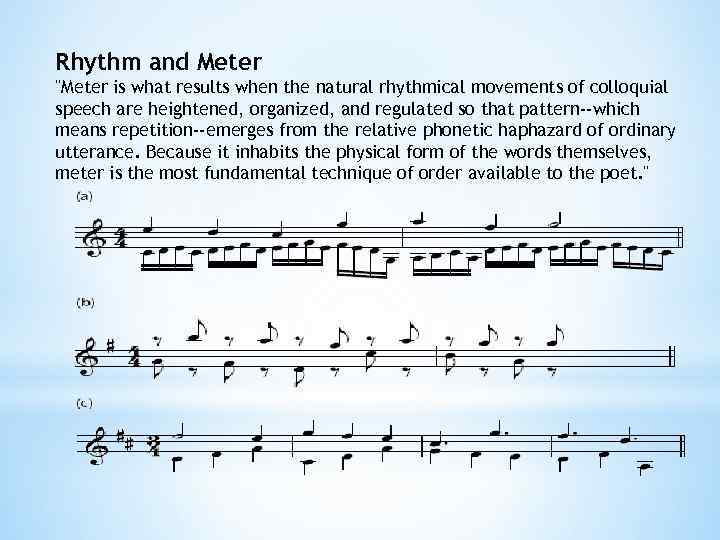
Rhythm and Meter "Meter is what results when the natural rhythmical movements of colloquial speech are heightened, organized, and regulated so that pattern--which means repetition--emerges from the relative phonetic haphazard of ordinary utterance. Because it inhabits the physical form of the words themselves, meter is the most fundamental technique of order available to the poet. "
Rhythm and Syllables "Pitch, loudness, and tempo combine to make up a language's expression of rhythm. Languages vary greatly in the way in which they make rhythmical contrasts. English uses stressed syllables produced at roughly regular intervals of time (in fluent speech) and separated by unstressed syllables-- a stress-timed rhythm which we can tap out in a 'tum-te-tum' way, as in a traditional line of poetry: The curfew tolls the knell of parting day. In French, the syllables are produced in a steady flow, resulting in a 'machine-gun' effect--a syllable-timed rhythm which is more like a 'rat-a-tat-atat. ' In Latin, it was the length of a syllable (whether long or short) which provided the basis of rhythm. In many oriental languages, it is pitch height.


 Скачать презентацию In music the rhythm is usually produced by
The notion of rhythm.pptx