


 Скачать презентацию In-house real-time PCRs are more sensitive than Respi
819d1f8cd51cd4c369f6619ec28f6a55.ppt
- Количество слайдов: 1
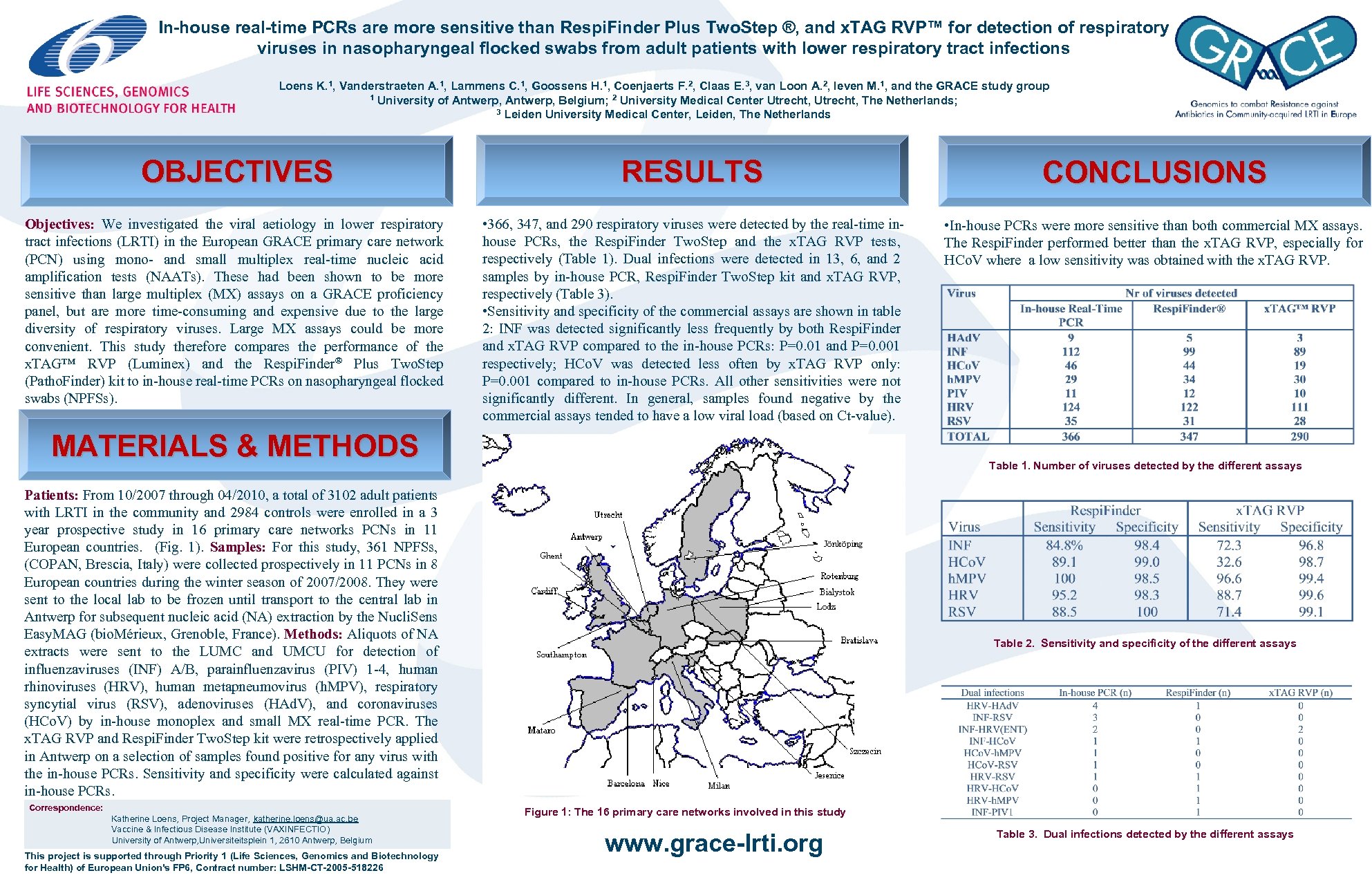 In-house real-time PCRs are more sensitive than Respi. Finder Plus Two. Step ®, and x. TAG RVP™ for detection of respiratory viruses in nasopharyngeal flocked swabs from adult patients with lower respiratory tract infections Loens K. 1, Vanderstraeten A. 1, Lammens C. 1, Goossens H. 1, Coenjaerts F. 2, Claas E. 3, van Loon A. 2, Ieven M. 1, and the GRACE study group 1 University of Antwerp, Belgium; 2 University Medical Center Utrecht, The Netherlands; 3 Leiden University Medical Center, Leiden, The Netherlands OBJECTIVES RESULTS CONCLUSIONS Objectives: We investigated the viral aetiology in lower respiratory tract infections (LRTI) in the European GRACE primary care network (PCN) using mono- and small multiplex real-time nucleic acid amplification tests (NAATs). These had been shown to be more sensitive than large multiplex (MX) assays on a GRACE proficiency panel, but are more time-consuming and expensive due to the large diversity of respiratory viruses. Large MX assays could be more convenient. This study therefore compares the performance of the x. TAG™ RVP (Luminex) and the Respi. Finder® Plus Two. Step (Patho. Finder) kit to in-house real-time PCRs on nasopharyngeal flocked swabs (NPFSs). • 366, 347, and 290 respiratory viruses were detected by the real-time inhouse PCRs, the Respi. Finder Two. Step and the x. TAG RVP tests, respectively (Table 1). Dual infections were detected in 13, 6, and 2 samples by in-house PCR, Respi. Finder Two. Step kit and x. TAG RVP, respectively (Table 3). • Sensitivity and specificity of the commercial assays are shown in table 2: INF was detected significantly less frequently by both Respi. Finder and x. TAG RVP compared to the in-house PCRs: P=0. 01 and P=0. 001 respectively; HCo. V was detected less often by x. TAG RVP only: P=0. 001 compared to in-house PCRs. All other sensitivities were not significantly different. In general, samples found negative by the commercial assays tended to have a low viral load (based on Ct-value). • In-house PCRs were more sensitive than both commercial MX assays. The Respi. Finder performed better than the x. TAG RVP, especially for HCo. V where a low sensitivity was obtained with the x. TAG RVP. MATERIALS & METHODS Table 1. Number of viruses detected by the different assays Patients: From 10/2007 through 04/2010, a total of 3102 adult patients with LRTI in the community and 2984 controls were enrolled in a 3 year prospective study in 16 primary care networks PCNs in 11 European countries. (Fig. 1). Samples: For this study, 361 NPFSs, (COPAN, Brescia, Italy) were collected prospectively in 11 PCNs in 8 European countries during the winter season of 2007/2008. They were sent to the local lab to be frozen until transport to the central lab in Antwerp for subsequent nucleic acid (NA) extraction by the Nucli. Sens Easy. MAG (bio. Mérieux, Grenoble, France). Methods: Aliquots of NA extracts were sent to the LUMC and UMCU for detection of influenzaviruses (INF) A/B, parainfluenzavirus (PIV) 1 -4, human rhinoviruses (HRV), human metapneumovirus (h. MPV), respiratory syncytial virus (RSV), adenoviruses (HAd. V), and coronaviruses (HCo. V) by in-house monoplex and small MX real-time PCR. The x. TAG RVP and Respi. Finder Two. Step kit were retrospectively applied in Antwerp on a selection of samples found positive for any virus with the in-house PCRs. Sensitivity and specificity were calculated against in-house PCRs. Correspondence: Katherine Loens, Project Manager, katherine. loens@ua. ac. be Vaccine & Infectious Disease Institute (VAXINFECTIO) University of Antwerp, Universiteitsplein 1, 2610 Antwerp, Belgium This project is supported through Priority 1 (Life Sciences, Genomics and Biotechnology for Health) of European Union's FP 6, Contract number: LSHM-CT-2005 -518226 Table 2. Sensitivity and specificity of the different assays Figure 1: The 16 primary care networks involved in this study www. grace-lrti. org Table 3. Dual infections detected by the different assays