


 Скачать презентацию In Disaster Medicine Training Charles Stewart MD EMDM
c68128cb813b20ea5c9d01d66c488d43.ppt
- Количество слайдов: 41
 In Disaster Medicine Training Charles Stewart MD EMDM
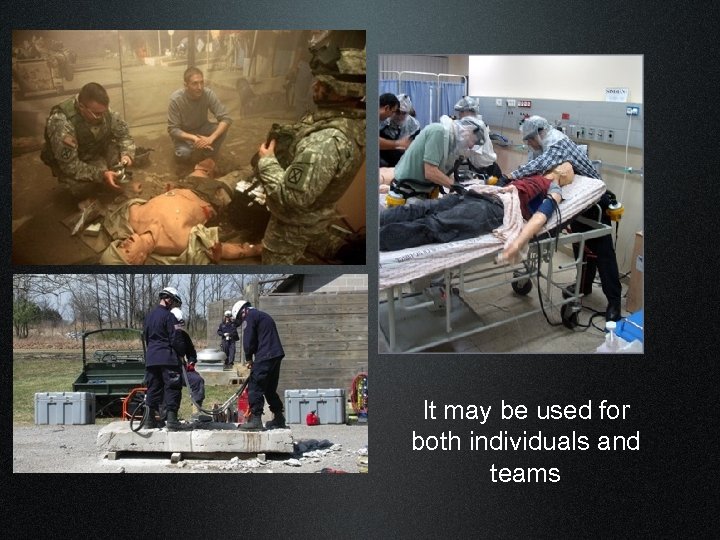 It may be used for both individuals and teams
 Simulation is a technique, not technology, to replace or amplify real experiences with guided experiences……. in an interactive fashion Gaba Qual Saf Health Care 2004; 13
 Medical Simulation Works! Doctors Trained On Patient Simulators exhibit Superior Skills Beth Israel Medical Centre New Virtual Reality Surgery Simulator hones Surgeons' Skills, Improves Patient Safety Oregon Health & Science University School of Medicine Clinical Simulation Technology Used To Improve Communication Of Medical Teams Washington University School of Medicine Science Daily
 Role Playing Task trainers Computer patient Manniquin simulators
 Benefit of Simulators • Student can practice key skills in a safe environment • Teacher can break down the task into components • Student can receive immediate feedback • Teacher can create the same situation to assess performance repeatedly
 Benefits of Simulators • Simulators are great for teaching and assessing: • Procedural skills • Treatment/interventions • Invasive monitoring • Allowing mistakes….
 Simulations in DM • Focus on medical management • Crisis resource management skills are reinforced • Increased complexity • Can be videotaped for review and reflection • “What will you do differently next time?
 Limitations • Not great for: • 2 -way communication skills • Treating the patient as a person • Representing family/staff/other team members
 Medical Simulation Hardware & Infrastructure Are NOT inexpensive….
 Medical Simulation Manpower and Training Are also NOT inexpensive….
 The “Usual” Training Model “SODOTO” • See One • Do One • Teach One
 SODOTO “SODOTO” • Often used in surgical training • Frequently used for procedures in other specialties.
 In Disaster Medicine • If you’ve seen three disasters of the same kind, • you are either in the wrong part of the world… • very unlucky… • Or both…. • So. Do. To doesn’t work well in this situation.
 ADLS – At the conclusion of this ADLS course the student will be able: ☺Identify the Critical Need to Be Prepared for Natural Disasters and Events involving: chemical, biological, nuclear, radiological, and explosive incidents. ☺Define “all-hazards: and list possible etiologies
 ADLS ☺Identify the components of the DISASTER paradigm and apply the paradigm using both the M. A. S. S. and the ID-me BDLS triage model ☺Meet the Acute Care needs of patients involved in either a public health emergency or a natural disaster ☺Rapidly and effectively become part of the public health system
 ADLS ☺Demonstrate the ability to participate in a coordinated, multidisciplinary, mass casualty incident using personal protective equipment ☺Demonstrate the use of elements of decontamination site selection and the operation of basic chemical and radiological detection.
 ADLS ☺Demonstrate the ability to operate within the Incident Command System and exercise leadership competencies related to emergency preparedness and response. So. . . How do we teach this?
 ADLS™ makes use of interactive scenarios and drills in which the participants treat simulated patients in a disaster. Through the use of high fidelity mannequins the student can gain experience in treating conditions that they would normally not treat even with years of experience.
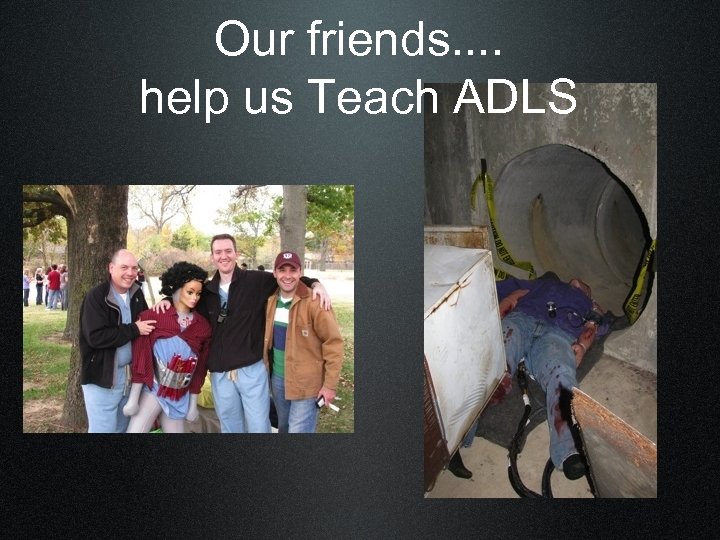 Our friends. . help us Teach ADLS
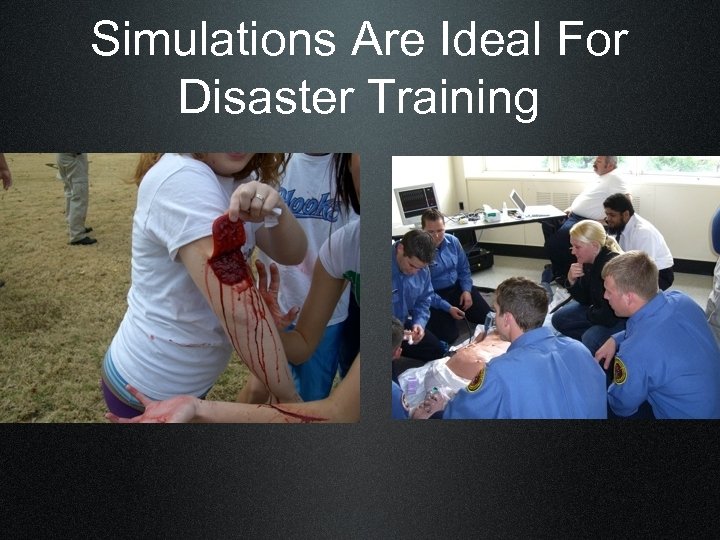 Simulations Are Ideal For Disaster Training
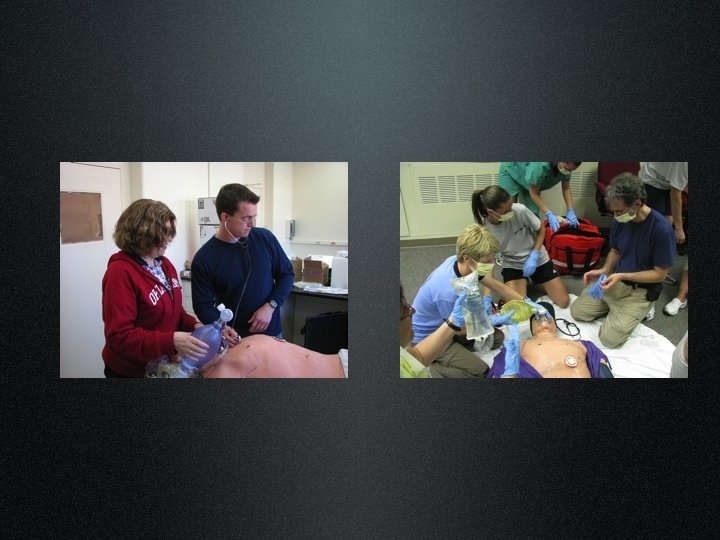
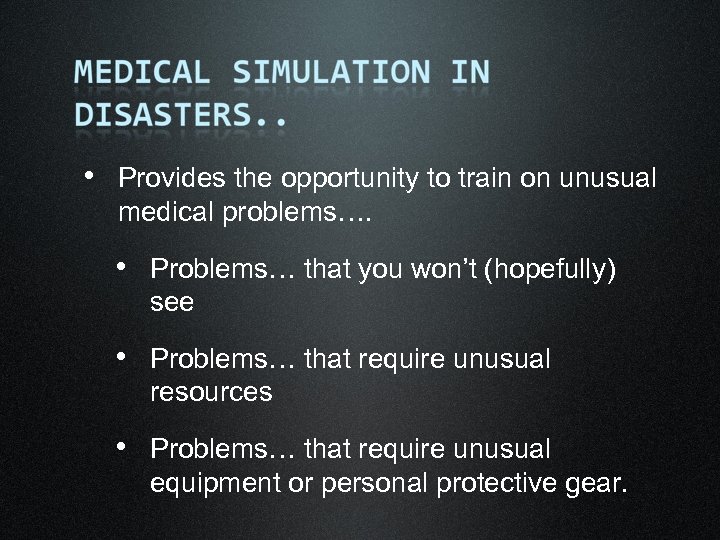 • Provides the opportunity to train on unusual medical problems…. • Problems… that you won’t (hopefully) see • Problems… that require unusual resources • Problems… that require unusual equipment or personal protective gear.
 Also provides a balance between the emotional load associated with the crisis experience and the professional lessons that can be learned.
 • Also…. • Provides professionals with the skills to cope competently with those mistakes that could not be prevented • Reduces occurrences of errors in real life
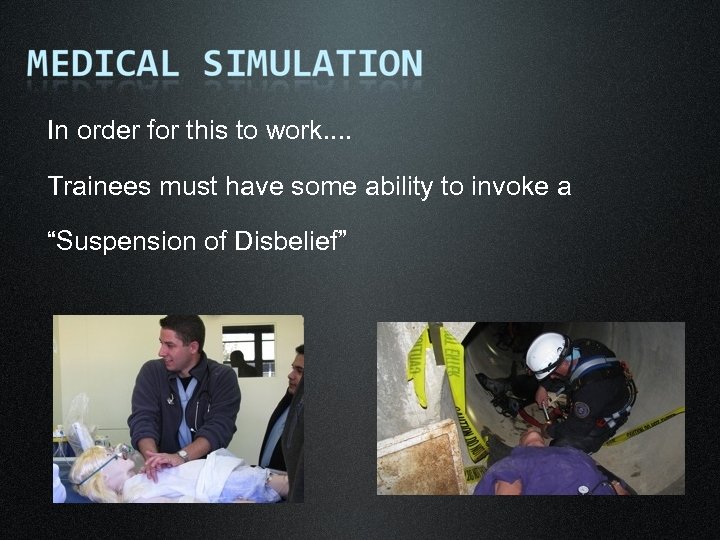 In order for this to work. . Trainees must have some ability to invoke a “Suspension of Disbelief”
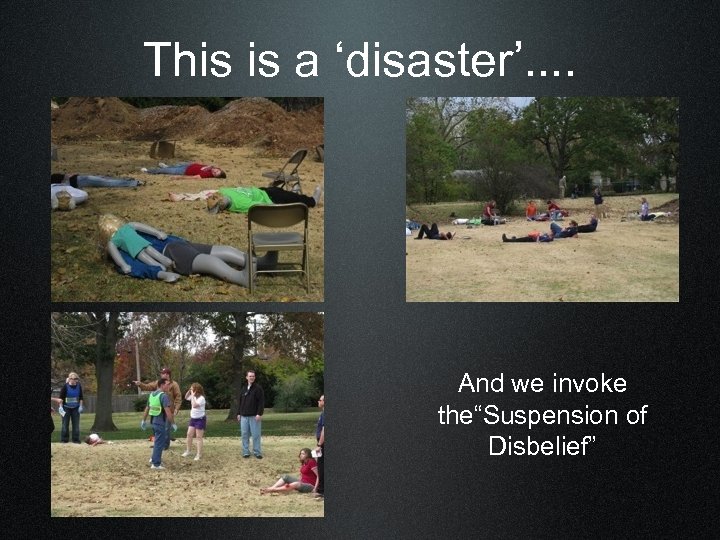 This is a ‘disaster’. . And we invoke the“Suspension of Disbelief”
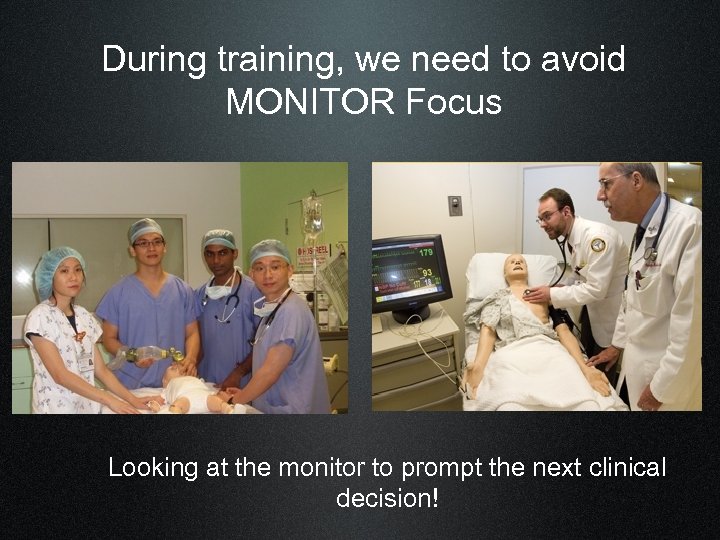 During training, we need to avoid MONITOR Focus Looking at the monitor to prompt the next clinical decision!
 Feedback • Students are asked how they thought the scenario went • Leading questions probe the students’ thought processes
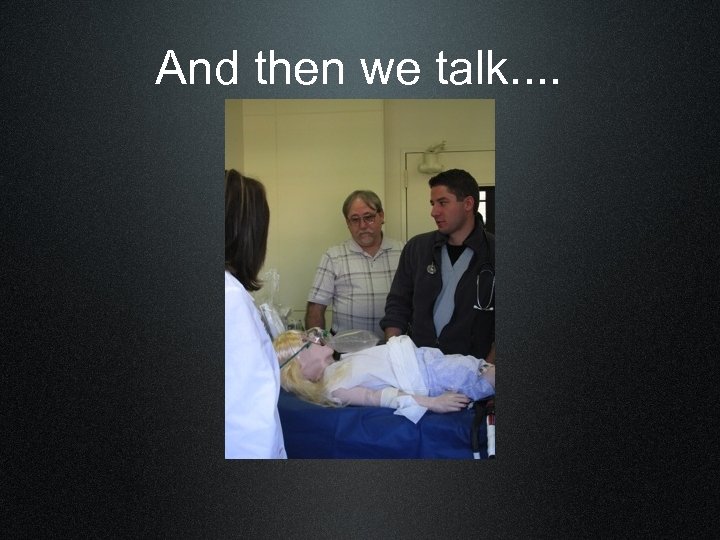 And then we talk. .
 A hidden benefit of feedback • The immediacy of the post simulation reflective learning process may provide trainees with snapshot of their abilities in certain clinical areas • For some = impetus for further self assessment/new learning in those areas that are perceived as being less than optimal or below expectation For some this =
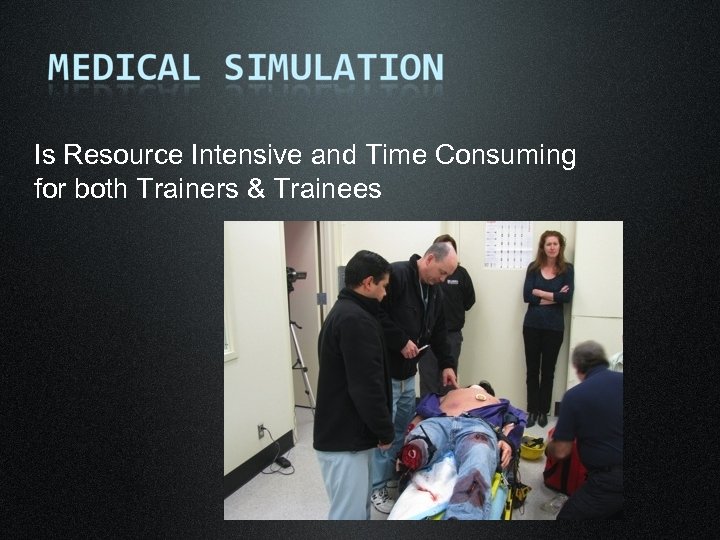 Is Resource Intensive and Time Consuming for both Trainers & Trainees
 Initial exposure raises awareness Repeated exposure to simulation improves performance High Impact But does will it translate into improved clinical outcomes?
 Reliability Validity Predictive validity
 2008 Academic Emergency Medicine Consensus Conference on the Science of Simulation • Objective methods and measures to demonstrate simulator training actually improves patient safety • Effective feedback of information from error reporting systems into simulation training to improve patient safety • Methods and outcome measures to demonstrate teamwork improves disaster response • ……………. .
 Other’s experiences. . . • Abrahamson SD, Canzian S, Brunet F. Using simulation for training and to change protocol during the outbreak of severe acute respiratory syndrome. Critical Care 2006; 10(R 3): • Schwid HA, Rooke GA, Ross BK, Sivarajan M. Use of a computerized advanced cardiac life support simulator improves retention of advanced cardiac life support guidelines better than a textbook review. Crit Care Med 1999; 27: 821 -824. • AND MANY MORE. .
 We’ve done this a few times. . . • Since the inception of OIDEM in 2006. . . • We’ve trained 133 students in Advanced Disaster Life Support in 4 classes per year. • But. . . we don’t just do ADLS for disaster training • We have bi-monthly simulation training sessions for our residents
 . . . • We’ve stated team training with nursing students in Emergency Procedures. • We help the Urban Search and Rescue Teams with their disaster exercises • We help with Advanced Trauma Life Support procedure training.
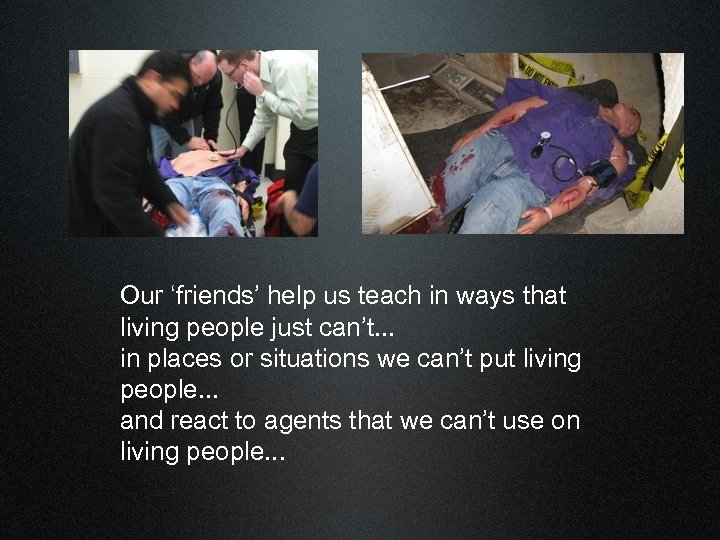 Our ‘friends’ help us teach in ways that living people just can’t. . . in places or situations we can’t put living people. . . and react to agents that we can’t use on living people. . .
 Thank you. .
 • Charles Stewart MD EMDM • Director of Research and Professor of Emergency Medicine Department of Emergency Medicine • Director, Oklahoma Institute for Disaster and Emergency Medicine • charles-e-stewart@ouhsc. edu