


 Скачать презентацию IN-Delegation Visit at UZH 7 May 2012 Internationally
c79817b6a73f2a0be2183c0e57982415.ppt
- Количество слайдов: 23
 IN-Delegation Visit at UZH, 7 May 2012 Internationally coordinated glacier monitoring and the data situation in the Hindu Kush Himalaya Region Michael Zemp World Glacier Monitoring Service, Department of Geography, University of Zurich, Switzerland
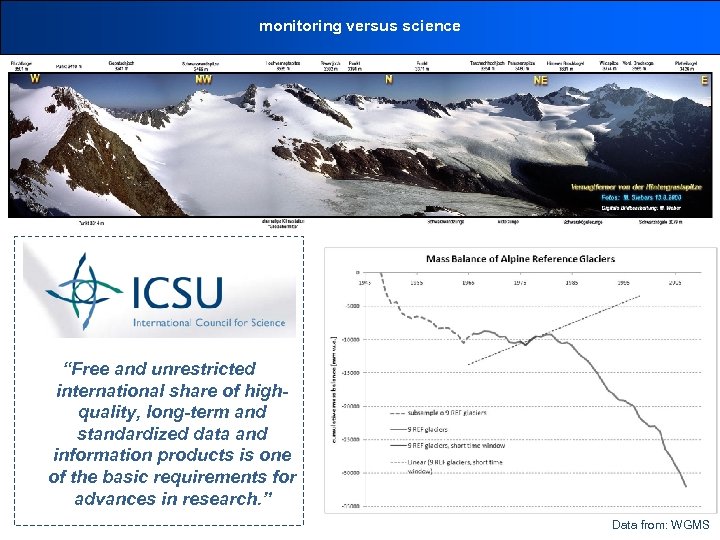 monitoring versus science “Free and unrestricted international share of highquality, long-term and standardized data and information products is one of the basic requirements for advances in research. ” Data from: WGMS
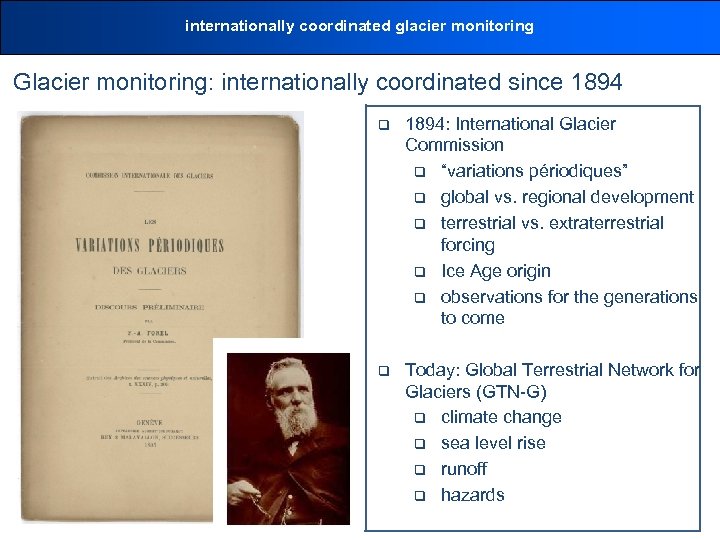 internationally coordinated glacier monitoring Glacier monitoring: internationally coordinated since 1894 q 1894: International Glacier Commission q “variations périodiques” q global vs. regional development q terrestrial vs. extraterrestrial forcing q Ice Age origin q observations for the generations to come q Today: Global Terrestrial Network for Glaciers (GTN-G) q climate change q sea level rise q runoff q hazards François-Alphonse Forel, 1841– 1912
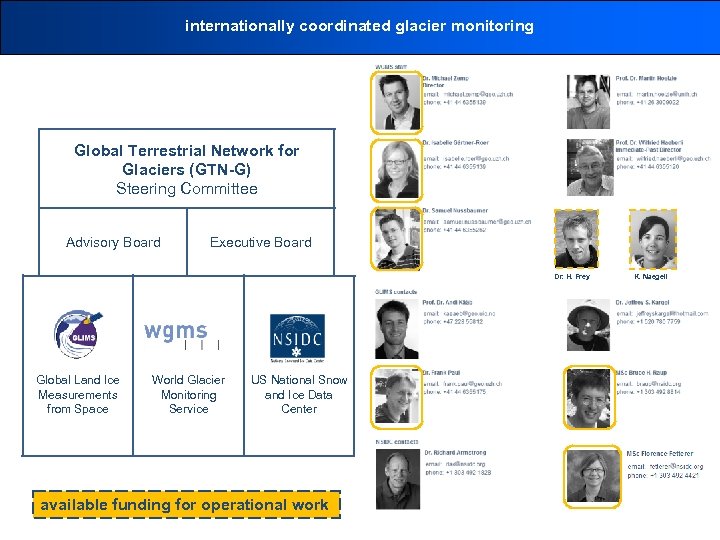 internationally coordinated glacier monitoring Global Terrestrial Network for Glaciers (GTN-G) Steering Committee Advisory Board Executive Board Dr. H. Frey Global Land Ice Measurements from Space World Glacier Monitoring Service US National Snow and Ice Data Center available funding for operational work K. Naegeli
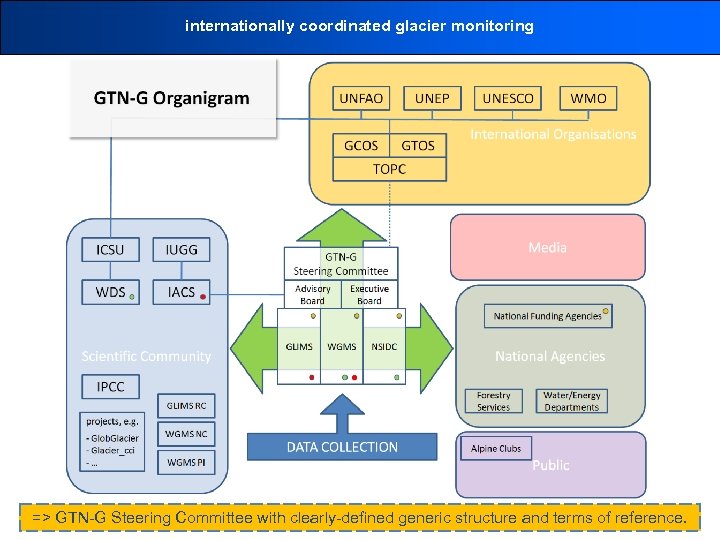 internationally coordinated glacier monitoring => GTN-G Steering Committee with clearly-defined generic structure and terms of reference.
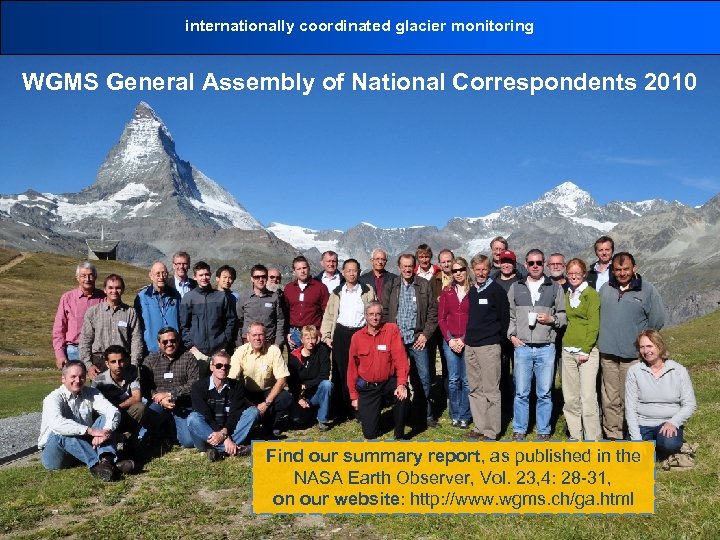 internationally coordinated glacier monitoring WGMS General Assembly of National Correspondents 2010 Find our summary report, as published in the NASA Earth Observer, Vol. 23, 4: 28 -31, on our website: http: //www. wgms. ch/ga. html
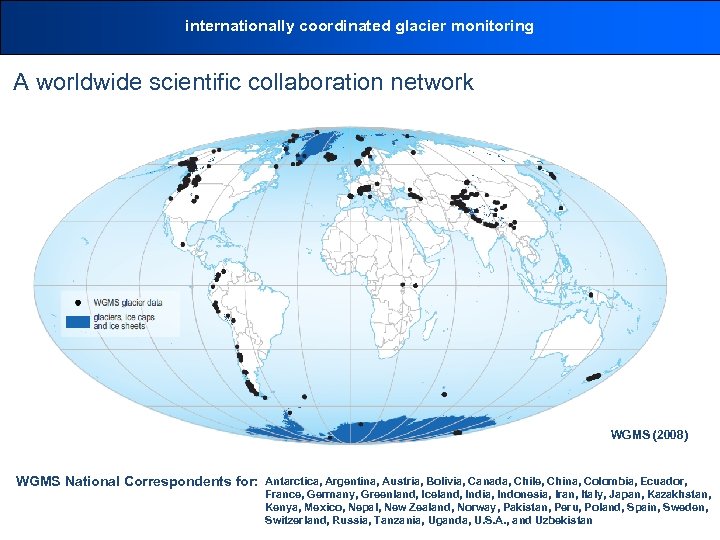 internationally coordinated glacier monitoring A worldwide scientific collaboration network WGMS (2008) WGMS National Correspondents for: Antarctica, Argentina, Austria, Bolivia, Canada, Chile, China, Colombia, Ecuador, France, Germany, Greenland, Iceland, India, Indonesia, Iran, Italy, Japan, Kazakhstan, Kenya, Mexico, Nepal, New Zealand, Norway, Pakistan, Peru, Poland, Spain, Sweden, Switzerland, Russia, Tanzania, Uganda, U. S. A. , and Uzbekistan
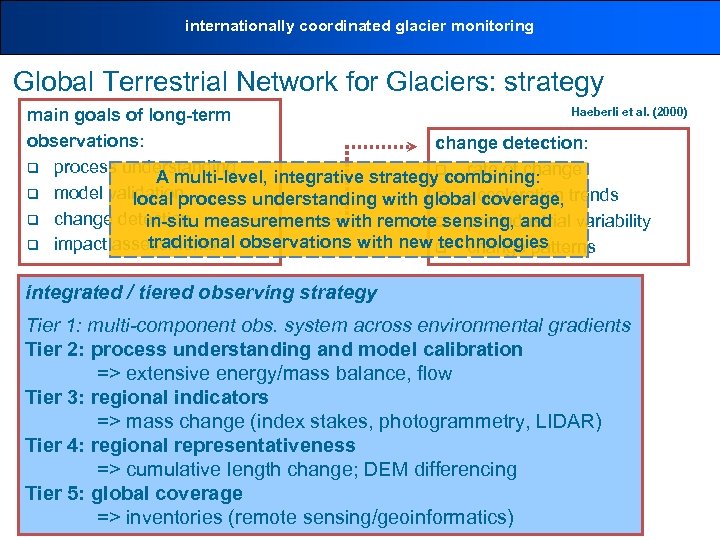 internationally coordinated glacier monitoring Global Terrestrial Network for Glaciers: strategy Haeberli et al. (2000) main goals of long-term observations: change detection: q process understanding q rate of change A multi-level, integrative strategy combining: q model validation q acceleration local process understanding with global coverage, trends q change detection measurements with remoteq pre-industrial variability in-situ sensing, and traditional observations with new q change patterns technologies q impact assessments integrated / tiered observing strategy Tier 1: multi-component obs. system across environmental gradients Tier 2: process understanding and model calibration => extensive energy/mass balance, flow Tier 3: regional indicators => mass change (index stakes, photogrammetry, LIDAR) Tier 4: regional representativeness => cumulative length change; DEM differencing Tier 5: global coverage => inventories (remote sensing/geoinformatics)
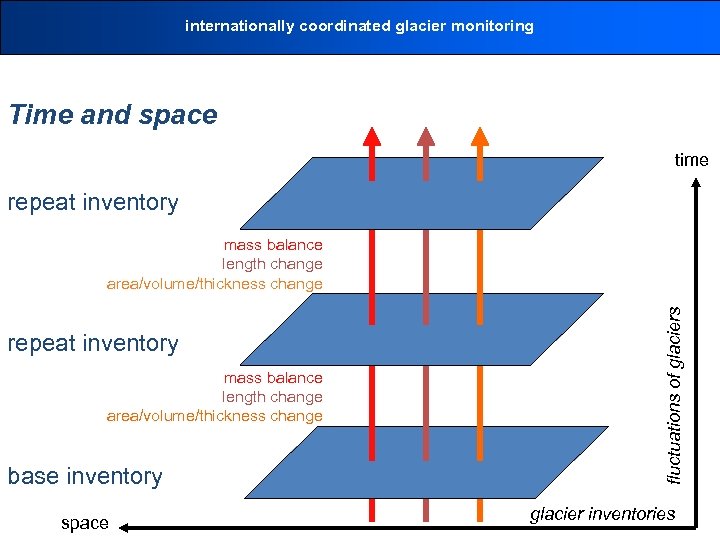 internationally coordinated glacier monitoring Time and space time repeat inventory mass balance length change area/volume/thickness change base inventory space fluctuations of glaciers mass balance length change area/volume/thickness change glacier inventories
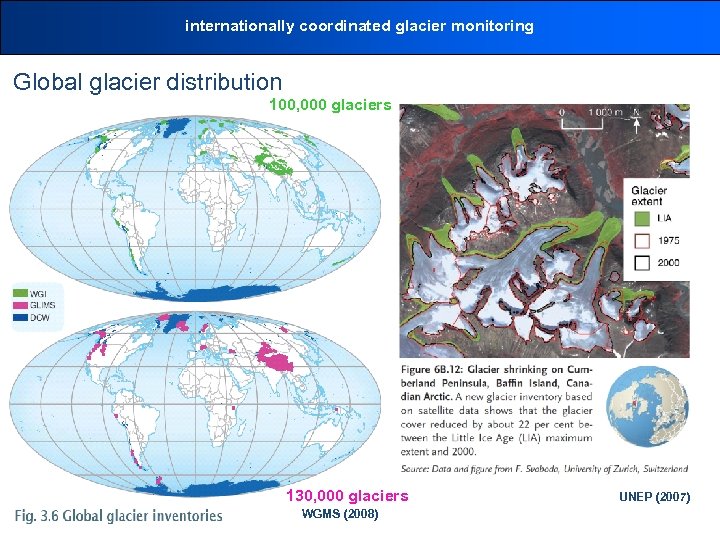 internationally coordinated glacier monitoring Global glacier distribution 100, 000 glaciers 130, 000 glaciers WGMS (2008) UNEP (2007)
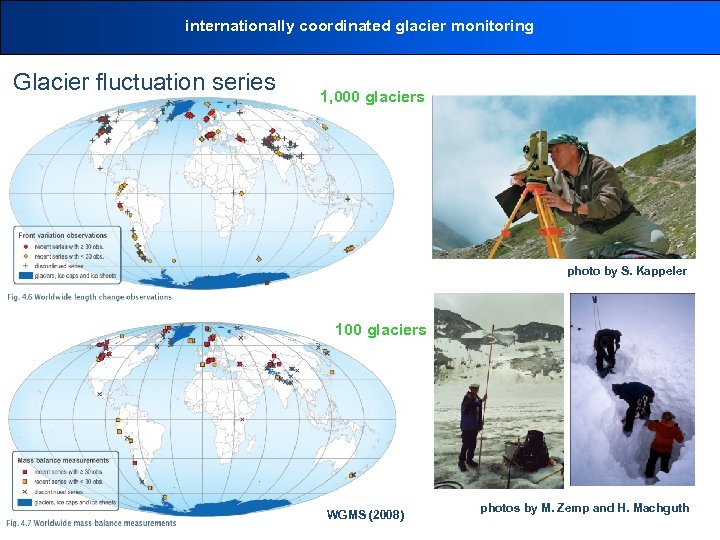 internationally coordinated glacier monitoring Glacier fluctuation series 1, 000 glaciers photo by S. Kappeler 100 glaciers WGMS (2008) photos by M. Zemp and H. Machguth
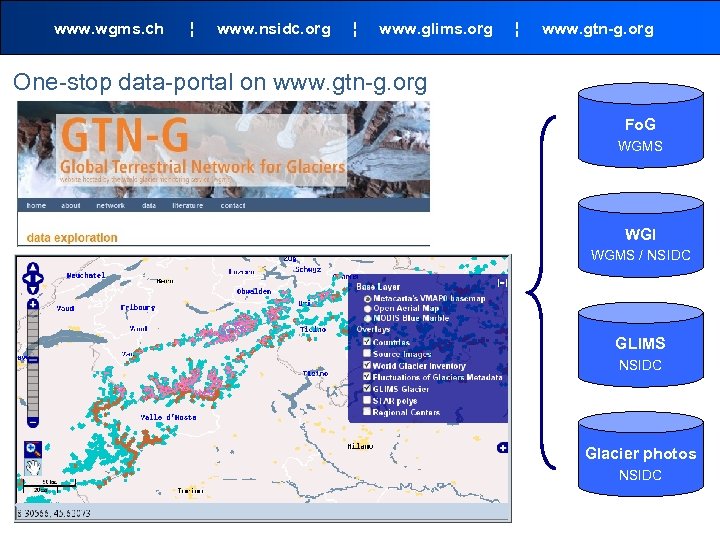 www. wgms. ch ¦ www. nsidc. org ¦ www. glims. org ¦ www. gtn-g. org One-stop data-portal on www. gtn-g. org Fo. G WGMS WGI WGMS / NSIDC GLIMS NSIDC Glacier photos NSIDC
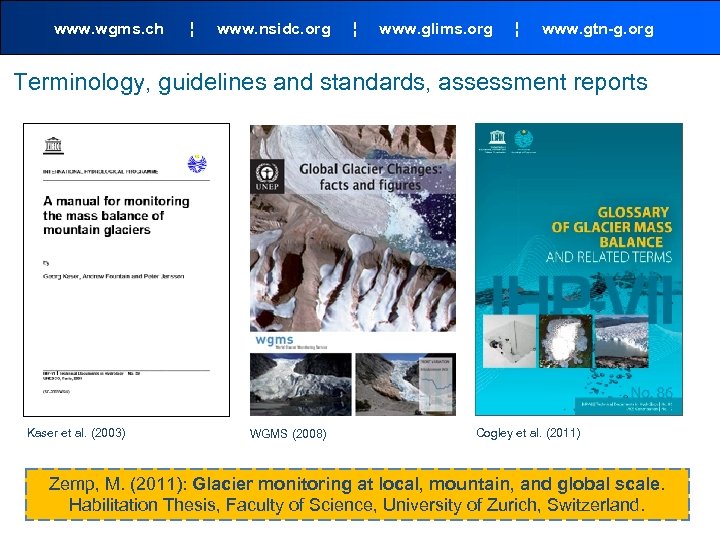 www. wgms. ch ¦ www. nsidc. org ¦ www. glims. org ¦ www. gtn-g. org Terminology, guidelines and standards, assessment reports Kaser et al. (2003) WGMS (2008) Cogley et al. (2011) Zemp, M. (2011): Glacier monitoring at local, mountain, and global scale. Habilitation Thesis, Faculty of Science, University of Zurich, Switzerland.
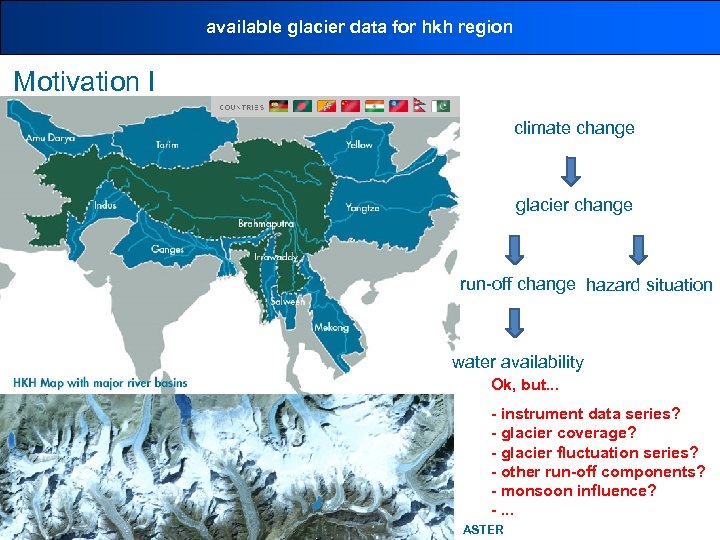 available glacier data for hkh region Motivation I climate change glacier change run-off change hazard situation water availability Ok, but. . . - instrument data series? - glacier coverage? - glacier fluctuation series? - other run-off components? - monsoon influence? -. . . ASTER
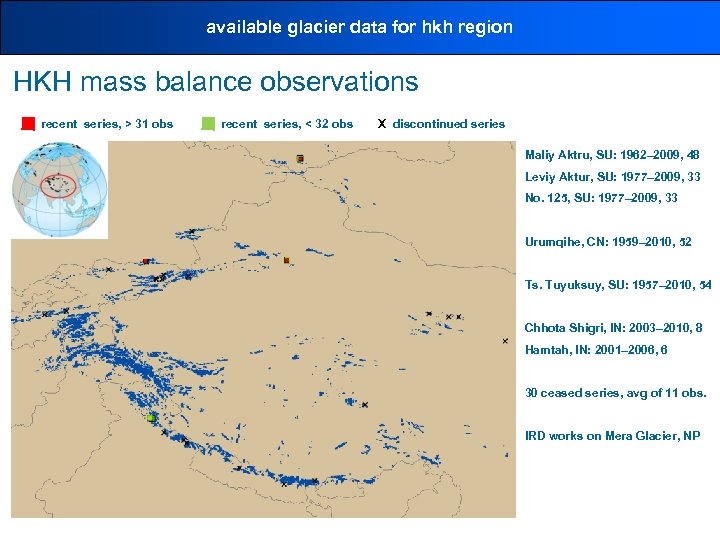 available glacier data for hkh region HKH mass balance observations recent series, > 31 obs recent series, < 32 obs X discontinued series Maliy Aktru, SU: 1962– 2009, 48 Leviy Aktur, SU: 1977– 2009, 33 No. 125, SU: 1977– 2009, 33 Urumqihe, CN: 1959– 2010, 52 Ts. Tuyuksuy, SU: 1957– 2010, 54 Chhota Shigri, IN: 2003– 2010, 8 Hamtah, IN: 2001– 2006, 6 30 ceased series, avg of 11 obs. IRD works on Mera Glacier, NP
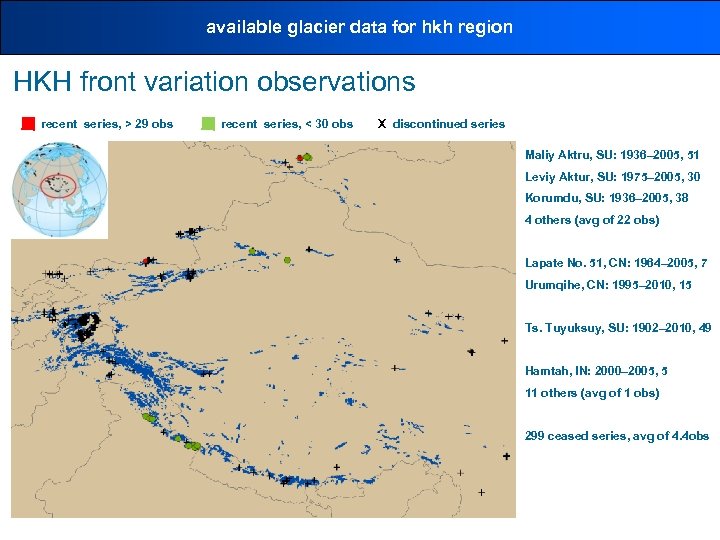 available glacier data for hkh region HKH front variation observations recent series, > 29 obs recent series, < 30 obs X discontinued series Maliy Aktru, SU: 1936– 2005, 51 Leviy Aktur, SU: 1975– 2005, 30 Korumdu, SU: 1936– 2005, 38 4 others (avg of 22 obs) Lapate No. 51, CN: 1964– 2005, 7 Urumqihe, CN: 1995– 2010, 15 Ts. Tuyuksuy, SU: 1902– 2010, 49 Hamtah, IN: 2000– 2005, 5 11 others (avg of 1 obs) 299 ceased series, avg of 4. 4 obs
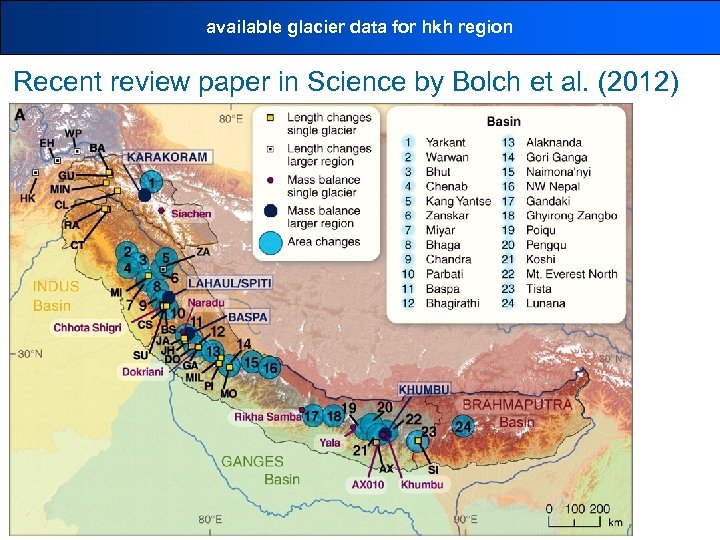 available glacier data for hkh region Recent review paper in Science by Bolch et al. (2012)
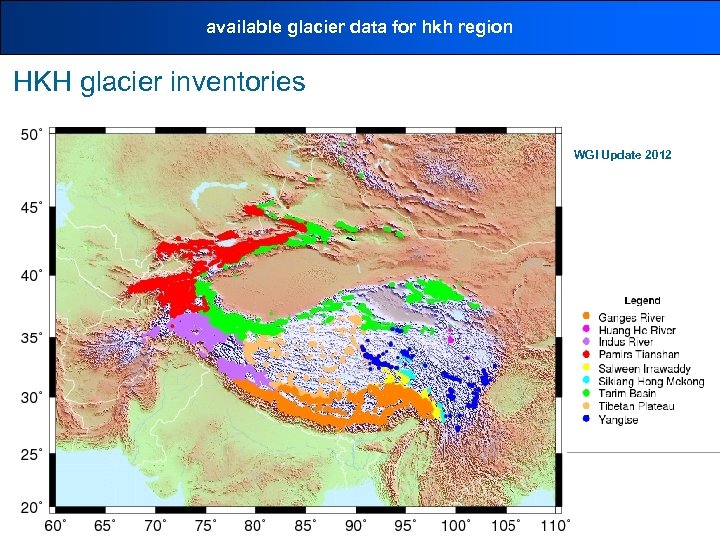 available glacier data for hkh region HKH glacier inventories ESRI‘s DCW World Glacier Inventory WGI Update 2012 until 2011 WGI, former SU, 1938 -1971 WGI, Buthan, 1978/82 WGI, China, 9999 WGI, Nepal, 1977/80 WGI, India, 1966/68 WGI, Pakistan, 1934/77 WGI, Afghanistan, 1959/60
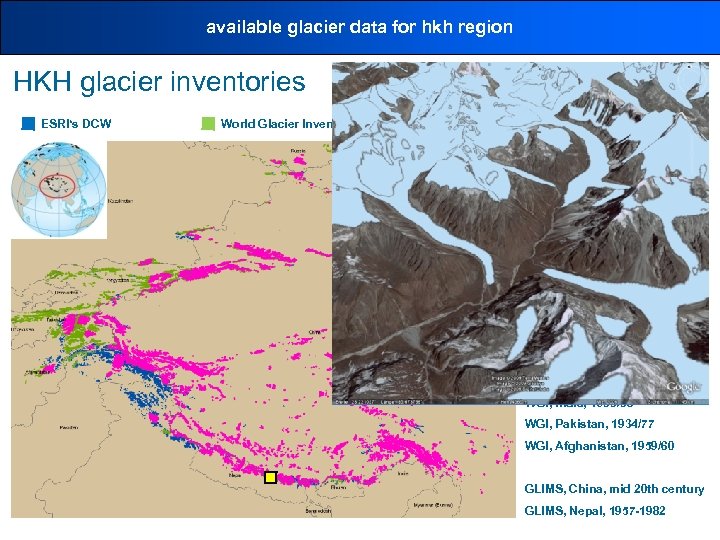 available glacier data for hkh region HKH glacier inventories ESRI‘s DCW World Glacier Inventory GLIMS WGI, former SU, 1938 -1971 WGI, Buthan, 1978/82 WGI, China, 9999 WGI, Nepal, 1977/80 WGI, India, 1966/68 WGI, Pakistan, 1934/77 WGI, Afghanistan, 1959/60 GLIMS, China, mid 20 th century GLIMS, Nepal, 1957 -1982
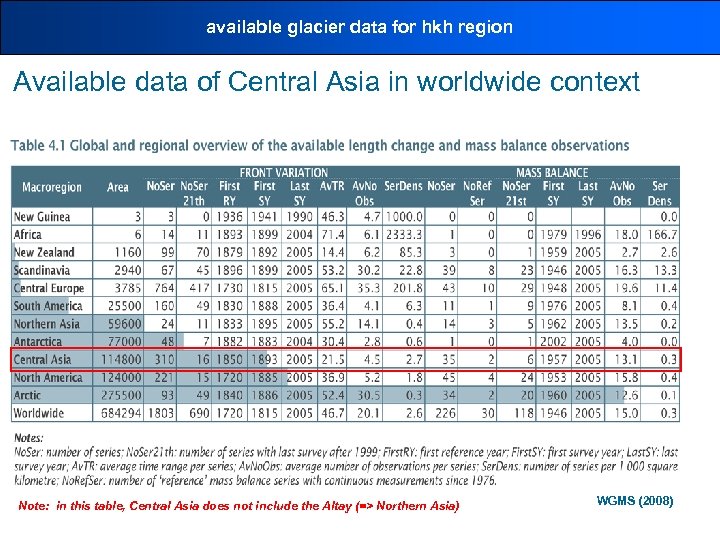 available glacier data for hkh region Available data of Central Asia in worldwide context Note: in this table, Central Asia does not include the Altay (=> Northern Asia) WGMS (2008)
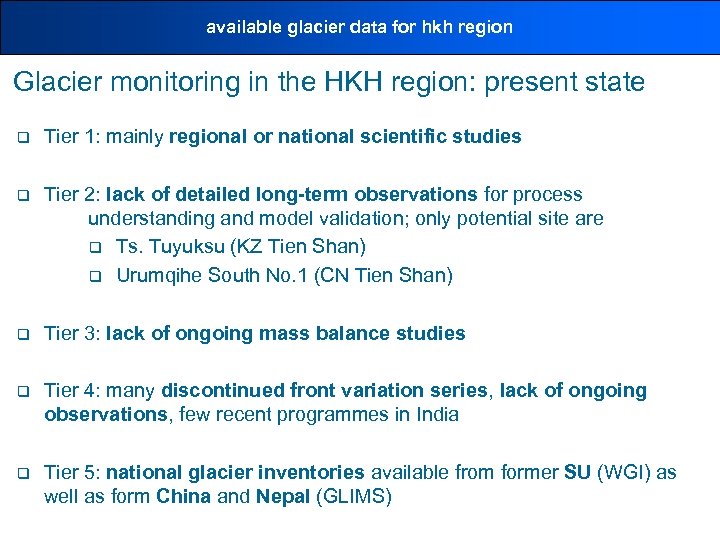 available glacier data for hkh region Glacier monitoring in the HKH region: present state q Tier 1: mainly regional or national scientific studies q Tier 2: lack of detailed long-term observations for process understanding and model validation; only potential site are q Ts. Tuyuksu (KZ Tien Shan) q Urumqihe South No. 1 (CN Tien Shan) q Tier 3: lack of ongoing mass balance studies q Tier 4: many discontinued front variation series, lack of ongoing observations, few recent programmes in India q Tier 5: national glacier inventories available from former SU (WGI) as well as form China and Nepal (GLIMS)
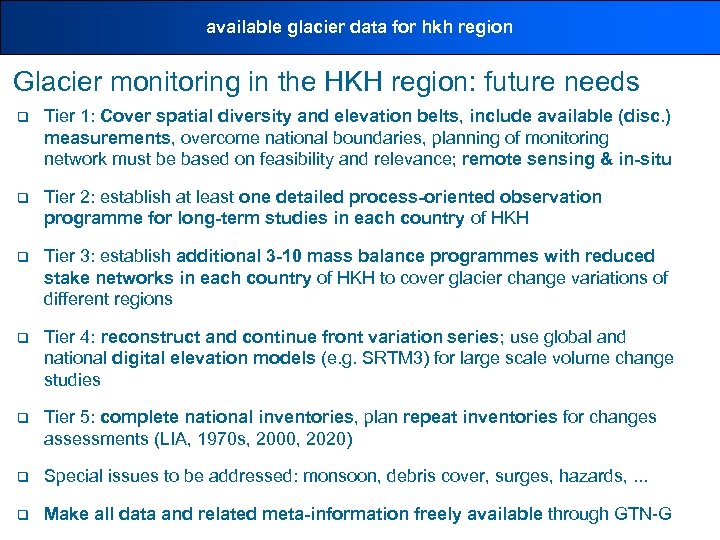 available glacier data for hkh region Glacier monitoring in the HKH region: future needs q Tier 1: Cover spatial diversity and elevation belts, include available (disc. ) measurements, overcome national boundaries, planning of monitoring network must be based on feasibility and relevance; remote sensing & in-situ q Tier 2: establish at least one detailed process-oriented observation programme for long-term studies in each country of HKH q Tier 3: establish additional 3 -10 mass balance programmes with reduced stake networks in each country of HKH to cover glacier change variations of different regions q Tier 4: reconstruct and continue front variation series; use global and national digital elevation models (e. g. SRTM 3) for large scale volume change studies q Tier 5: complete national inventories, plan repeat inventories for changes assessments (LIA, 1970 s, 2000, 2020) q Special issues to be addressed: monsoon, debris cover, surges, hazards, . . . q Make all data and related meta-information freely available through GTN-G
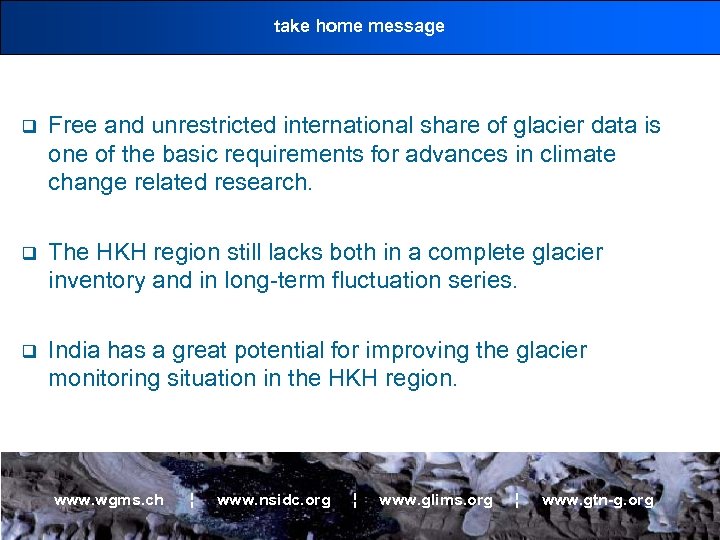 take home message q Free and unrestricted international share of glacier data is one of the basic requirements for advances in climate change related research. q The HKH region still lacks both in a complete glacier inventory and in long-term fluctuation series. q India has a great potential for improving the glacier monitoring situation in the HKH region. www. wgms. ch ¦ www. nsidc. org ¦ www. glims. org ¦ www. gtn-g. org