


 Скачать презентацию In all history nothing is so surpassing or
492904ff6afeade8fa0045ca7cc09b1c.ppt
- Количество слайдов: 12
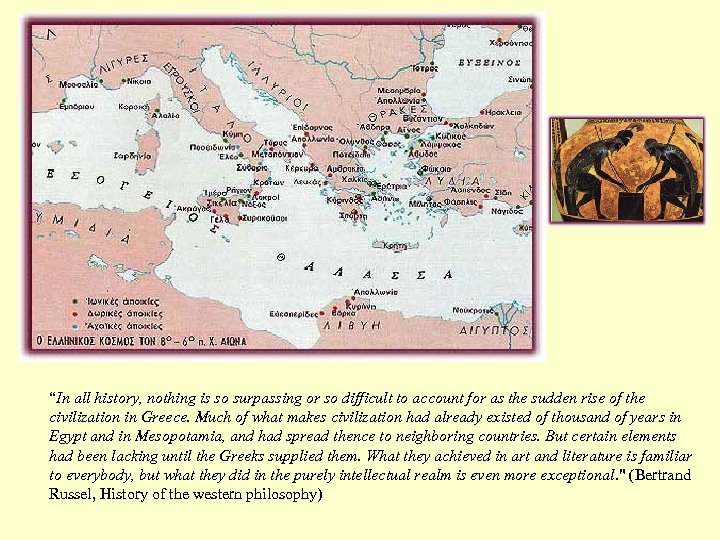 “In all history, nothing is so surpassing or so difficult to account for as the sudden rise of the civilization in Greece. Much of what makes civilization had already existed of thousand of years in Egypt and in Mesopotamia, and had spread thence to neighboring countries. But certain elements had been lacking until the Greeks supplied them. What they achieved in art and literature is familiar to everybody, but what they did in the purely intellectual realm is even more exceptional. " (Bertrand Russel, History of the western philosophy)
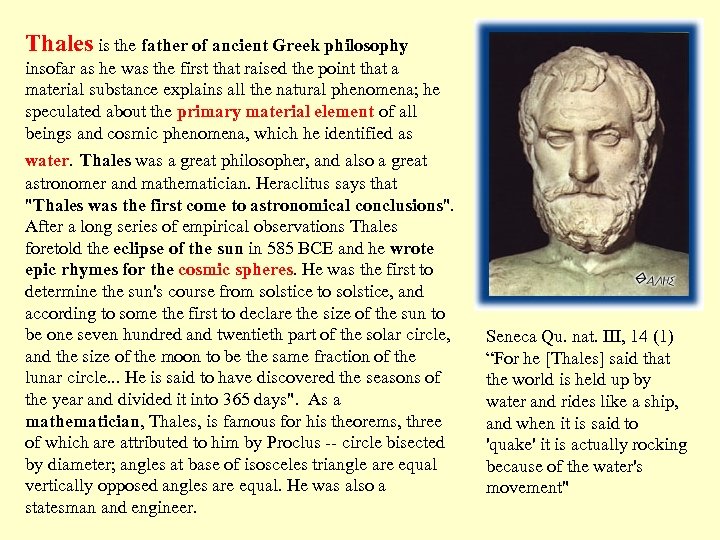 Thales is the father of ancient Greek philosophy insofar as he was the first that raised the point that a material substance explains all the natural phenomena; he speculated about the primary material element of all beings and cosmic phenomena, which he identified as water. Thales was a great philosopher, and also a great astronomer and mathematician. Heraclitus says that "Thales was the first come to astronomical conclusions". After a long series of empirical observations Thales foretold the eclipse of the sun in 585 BCE and he wrote epic rhymes for the cosmic spheres. He was the first to determine the sun's course from solstice to solstice, and according to some the first to declare the size of the sun to be one seven hundred and twentieth part of the solar circle, and the size of the moon to be the same fraction of the lunar circle. . . He is said to have discovered the seasons of the year and divided it into 365 days". As a mathematician, Thales, is famous for his theorems, three of which are attributed to him by Proclus -- circle bisected by diameter; angles at base of isosceles triangle are equal vertically opposed angles are equal. He was also a statesman and engineer. Seneca Qu. nat. III, 14 (1) “For he [Thales] said that the world is held up by water and rides like a ship, and when it is said to 'quake' it is actually rocking because of the water's movement"
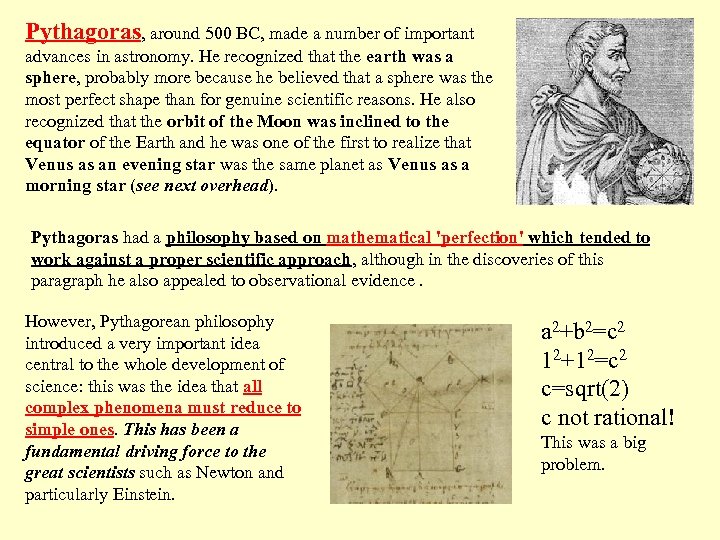 Pythagoras, around 500 BC, made a number of important advances in astronomy. He recognized that the earth was a sphere, probably more because he believed that a sphere was the most perfect shape than for genuine scientific reasons. He also recognized that the orbit of the Moon was inclined to the equator of the Earth and he was one of the first to realize that Venus as an evening star was the same planet as Venus as a morning star (see next overhead). Pythagoras had a philosophy based on mathematical 'perfection' which tended to work against a proper scientific approach, although in the discoveries of this paragraph he also appealed to observational evidence. However, Pythagorean philosophy introduced a very important idea central to the whole development of science: this was the idea that all complex phenomena must reduce to simple ones. This has been a fundamental driving force to the great scientists such as Newton and particularly Einstein. a 2+b 2=c 2 12+12=c 2 c=sqrt(2) c not rational! This was a big problem.
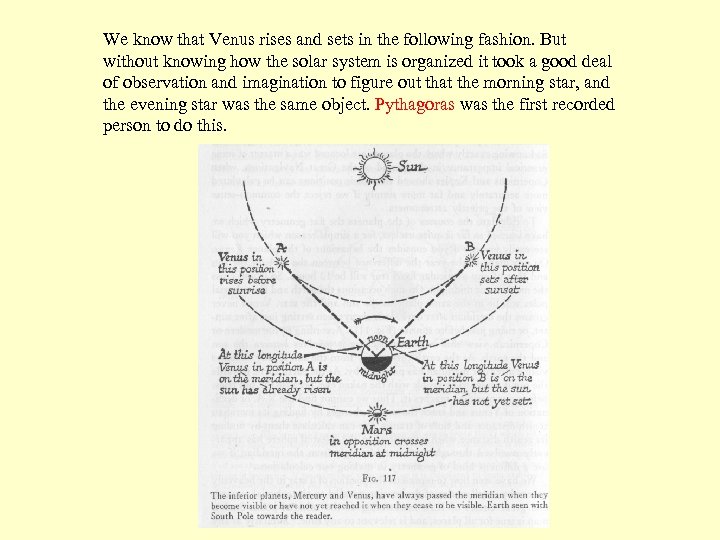 We know that Venus rises and sets in the following fashion. But without knowing how the solar system is organized it took a good deal of observation and imagination to figure out that the morning star, and the evening star was the same object. Pythagoras was the first recorded person to do this.
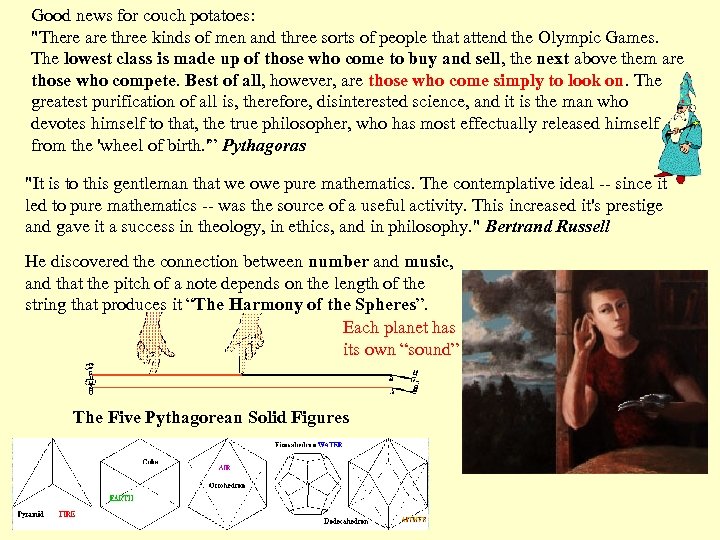 Good news for couch potatoes: "There are three kinds of men and three sorts of people that attend the Olympic Games. The lowest class is made up of those who come to buy and sell, the next above them are those who compete. Best of all, however, are those who come simply to look on. The greatest purification of all is, therefore, disinterested science, and it is the man who devotes himself to that, the true philosopher, who has most effectually released himself from the 'wheel of birth. '” Pythagoras "It is to this gentleman that we owe pure mathematics. The contemplative ideal -- since it led to pure mathematics -- was the source of a useful activity. This increased it's prestige and gave it a success in theology, in ethics, and in philosophy. " Bertrand Russell He discovered the connection between number and music, and that the pitch of a note depends on the length of the string that produces it “The Harmony of the Spheres”. Each planet has its own “sound” The Five Pythagorean Solid Figures
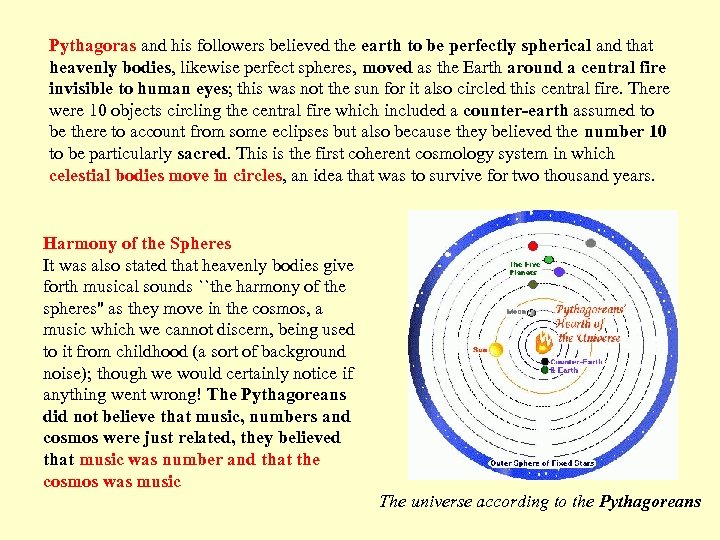 Pythagoras and his followers believed the earth to be perfectly spherical and that heavenly bodies, likewise perfect spheres, moved as the Earth around a central fire invisible to human eyes; this was not the sun for it also circled this central fire. There were 10 objects circling the central fire which included a counter-earth assumed to be there to account from some eclipses but also because they believed the number 10 to be particularly sacred. This is the first coherent cosmology system in which celestial bodies move in circles, an idea that was to survive for two thousand years. Harmony of the Spheres It was also stated that heavenly bodies give forth musical sounds ``the harmony of the spheres'' as they move in the cosmos, a music which we cannot discern, being used to it from childhood (a sort of background noise); though we would certainly notice if anything went wrong! The Pythagoreans did not believe that music, numbers and cosmos were just related, they believed that music was number and that the cosmos was music The universe according to the Pythagoreans
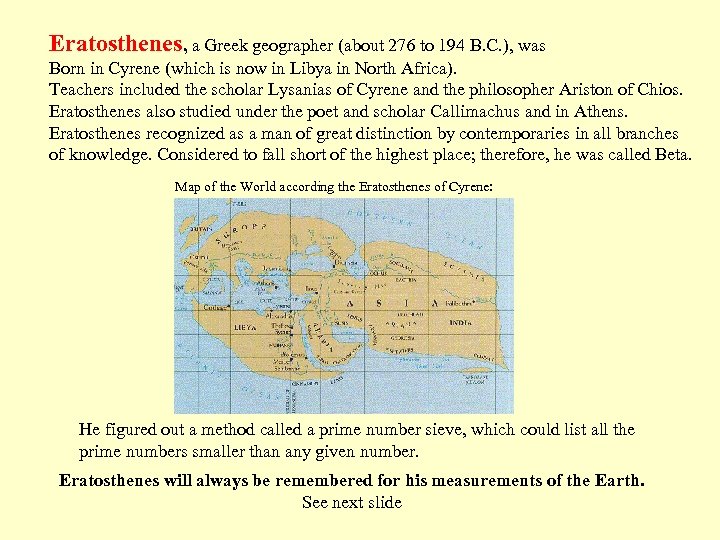 Eratosthenes, a Greek geographer (about 276 to 194 B. C. ), was Born in Cyrene (which is now in Libya in North Africa). Teachers included the scholar Lysanias of Cyrene and the philosopher Ariston of Chios. Eratosthenes also studied under the poet and scholar Callimachus and in Athens. Eratosthenes recognized as a man of great distinction by contemporaries in all branches of knowledge. Considered to fall short of the highest place; therefore, he was called Beta. Map of the World according the Eratosthenes of Cyrene: He figured out a method called a prime number sieve, which could list all the prime numbers smaller than any given number. Eratosthenes will always be remembered for his measurements of the Earth. See next slide
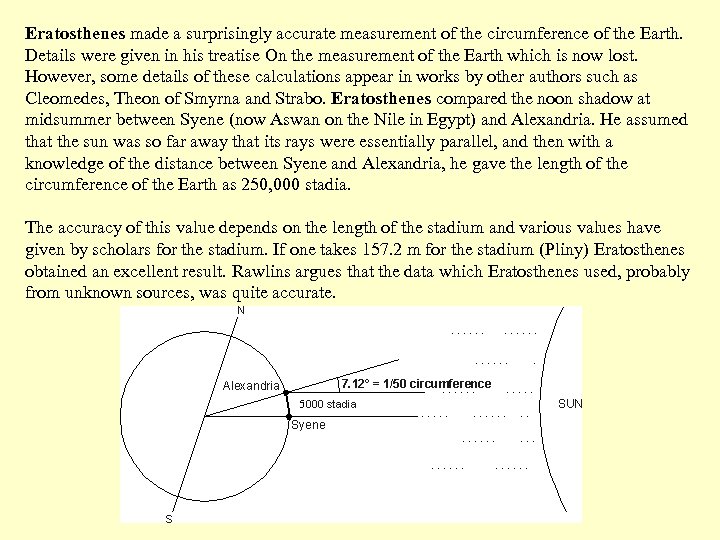 Eratosthenes made a surprisingly accurate measurement of the circumference of the Earth. Details were given in his treatise On the measurement of the Earth which is now lost. However, some details of these calculations appear in works by other authors such as Cleomedes, Theon of Smyrna and Strabo. Eratosthenes compared the noon shadow at midsummer between Syene (now Aswan on the Nile in Egypt) and Alexandria. He assumed that the sun was so far away that its rays were essentially parallel, and then with a knowledge of the distance between Syene and Alexandria, he gave the length of the circumference of the Earth as 250, 000 stadia. The accuracy of this value depends on the length of the stadium and various values have given by scholars for the stadium. If one takes 157. 2 m for the stadium (Pliny) Eratosthenes obtained an excellent result. Rawlins argues that the data which Eratosthenes used, probably from unknown sources, was quite accurate.
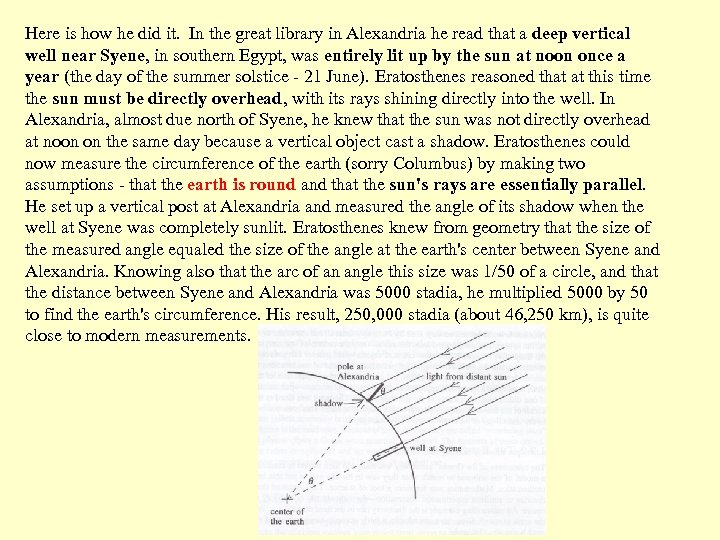 Here is how he did it. In the great library in Alexandria he read that a deep vertical well near Syene, in southern Egypt, was entirely lit up by the sun at noon once a year (the day of the summer solstice - 21 June). Eratosthenes reasoned that at this time the sun must be directly overhead, with its rays shining directly into the well. In Alexandria, almost due north of Syene, he knew that the sun was not directly overhead at noon on the same day because a vertical object cast a shadow. Eratosthenes could now measure the circumference of the earth (sorry Columbus) by making two assumptions - that the earth is round and that the sun's rays are essentially parallel. He set up a vertical post at Alexandria and measured the angle of its shadow when the well at Syene was completely sunlit. Eratosthenes knew from geometry that the size of the measured angle equaled the size of the angle at the earth's center between Syene and Alexandria. Knowing also that the arc of an angle this size was 1/50 of a circle, and that the distance between Syene and Alexandria was 5000 stadia, he multiplied 5000 by 50 to find the earth's circumference. His result, 250, 000 stadia (about 46, 250 km), is quite close to modern measurements.
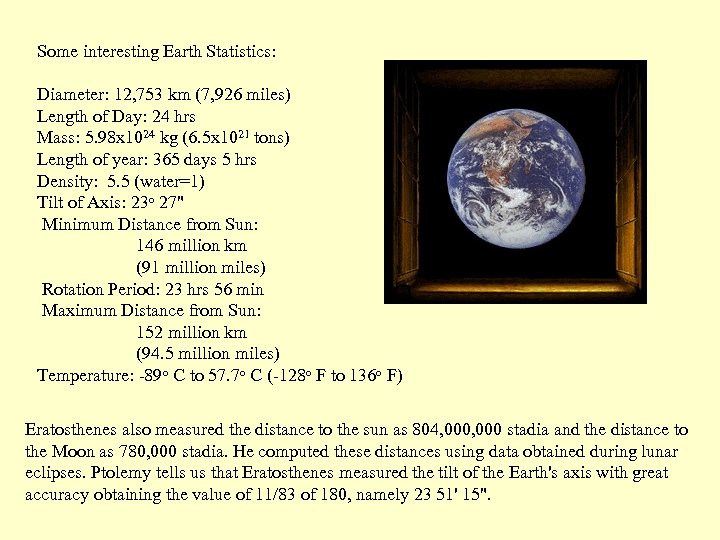 Some interesting Earth Statistics: Diameter: 12, 753 km (7, 926 miles) Length of Day: 24 hrs Mass: 5. 98 x 1024 kg (6. 5 x 10²¹ tons) Length of year: 365 days 5 hrs Density: 5. 5 (water=1) Tilt of Axis: 23 o 27" Minimum Distance from Sun: 146 million km (91 million miles) Rotation Period: 23 hrs 56 min Maximum Distance from Sun: 152 million km (94. 5 million miles) Temperature: -89 o C to 57. 7 o C (-128 o F to 136 o F) Eratosthenes also measured the distance to the sun as 804, 000 stadia and the distance to the Moon as 780, 000 stadia. He computed these distances using data obtained during lunar eclipses. Ptolemy tells us that Eratosthenes measured the tilt of the Earth's axis with great accuracy obtaining the value of 11/83 of 180, namely 23 51' 15".
 What can we say about the experiment? Well Although our idea of the exact value of the stadium (which was not the same at Athens, Alexandria or Rome) is fairly hazy, this puts the terrestrial circumference at 40. 000 km. The result is remarkable, although several errors were introduced in the calculations: - The distance between Alexandria and Syene is 729 km, not 800 km; - The two cities are not on the same meridian (the difference in longitude is 3 o); - Syene is not on the Tropic of Cancer (it is situated 55 km farther North); - The angular difference is not 7 o 12' but 7 o 5'. The most extraordinary thing is that the measurement rests on the estimated average speed of a caravan of camels (!): one can do better nowadays. Yet, in spite of all these flaws, it worked fine. So around 250 BC, Earth had at last a size!
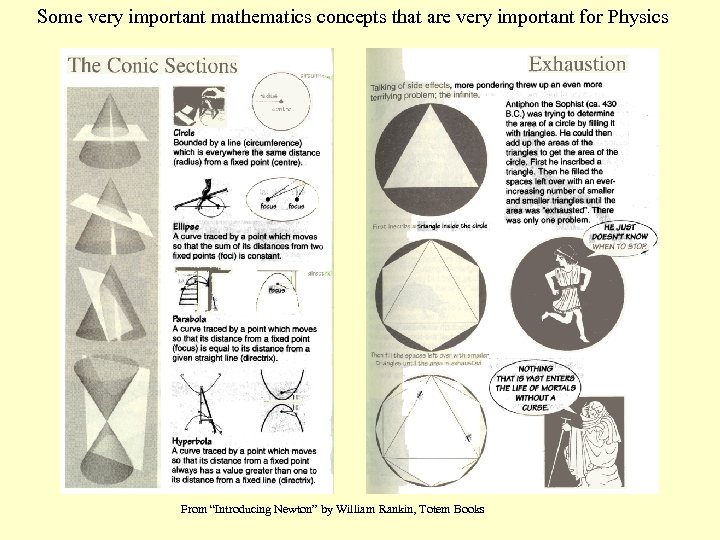 Some very important mathematics concepts that are very important for Physics From “Introducing Newton” by William Rankin, Totem Books