


 Скачать презентацию In 1860 the 18 year old Prince of
d0a9bbd8fc415a29c6fed7f2b443dab0.ppt
- Количество слайдов: 48
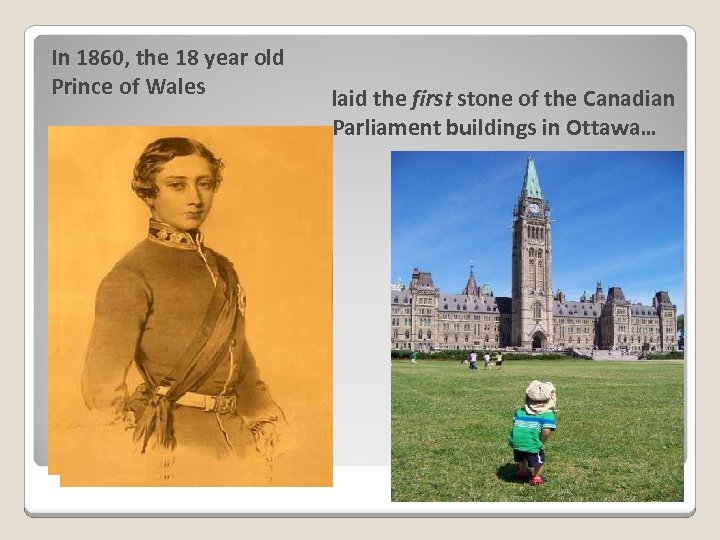 In 1860, the 18 year old Prince of Wales laid the first stone of the Canadian Parliament buildings in Ottawa…
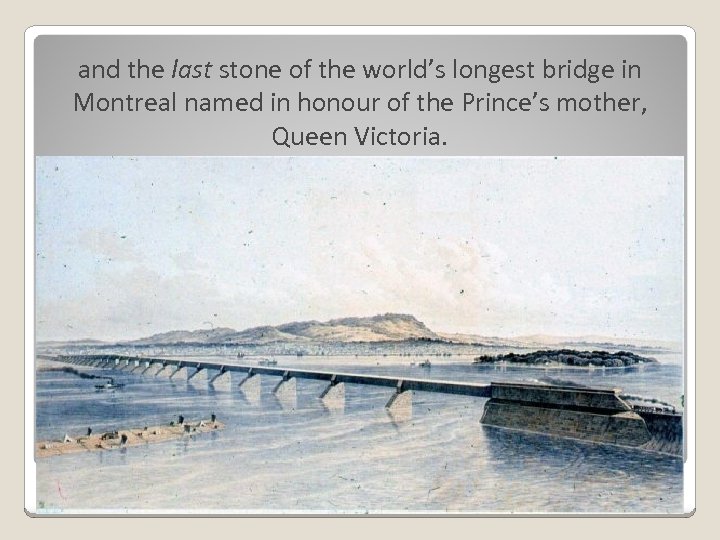 and the last stone of the world’s longest bridge in Montreal named in honour of the Prince’s mother, Queen Victoria.
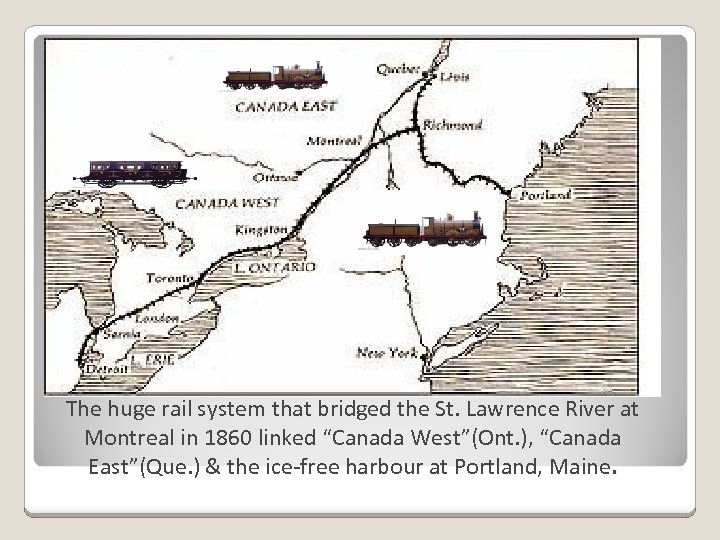 The huge rail system that bridged the St. Lawrence River at Montreal in 1860 linked “Canada West”(Ont. ), “Canada East”(Que. ) & the ice-free harbour at Portland, Maine.
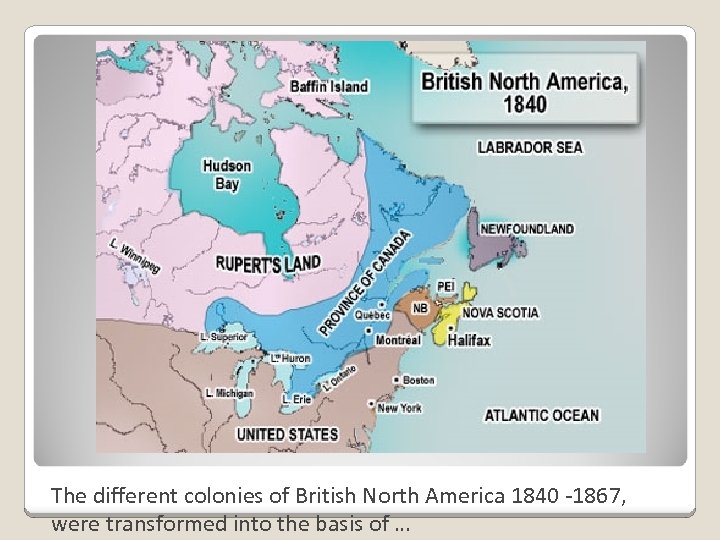 The different colonies of British North America 1840 -1867, were transformed into the basis of …
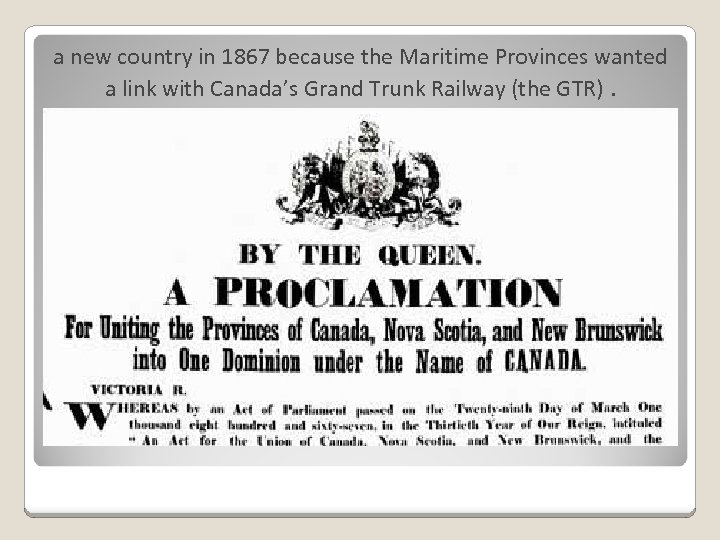 a new country in 1867 because the Maritime Provinces wanted a link with Canada’s Grand Trunk Railway (the GTR).
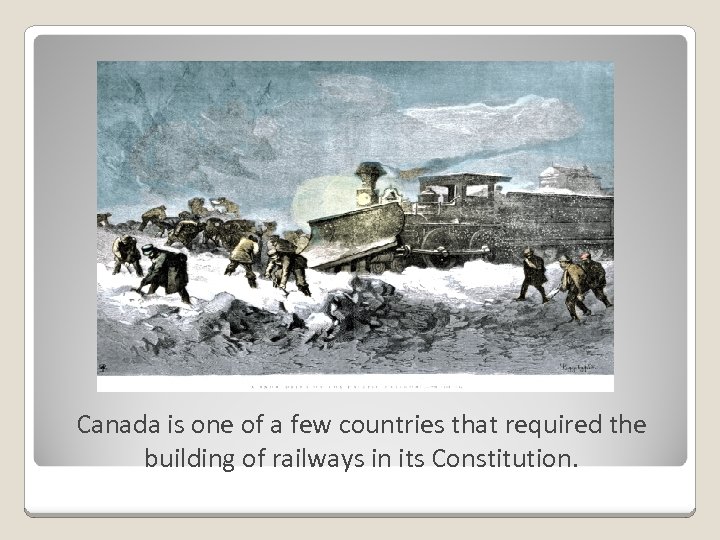 Canada is one of a few countries that required the building of railways in its Constitution.
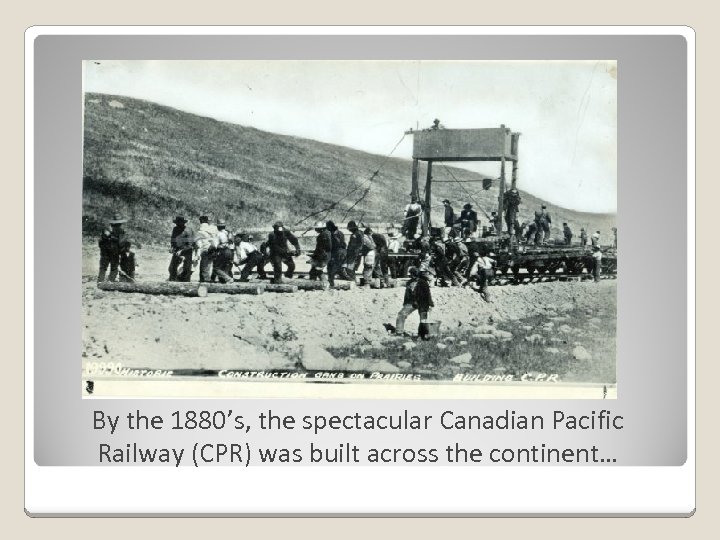 By the 1880’s, the spectacular Canadian Pacific Railway (CPR) was built across the continent…
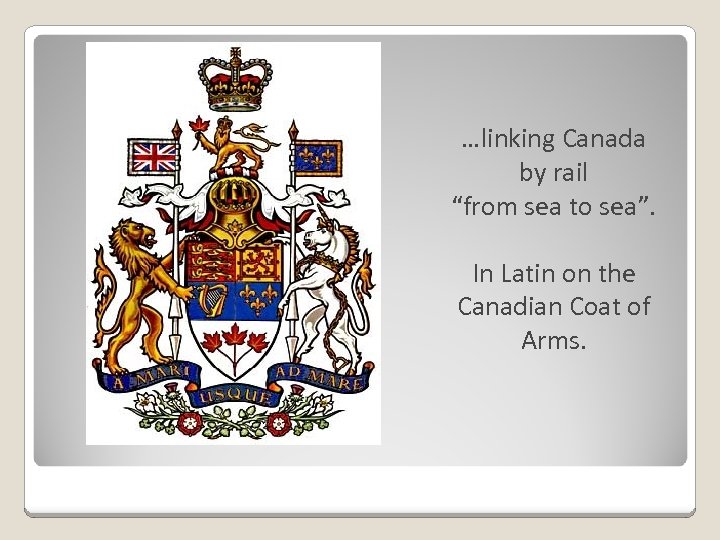 …linking Canada by rail “from sea to sea”. In Latin on the Canadian Coat of Arms.
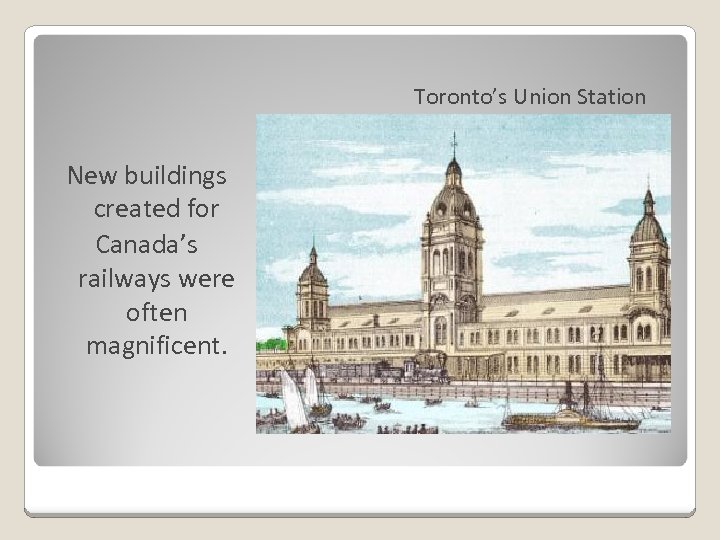 Toronto’s Union Station New buildings created for Canada’s railways were often magnificent.
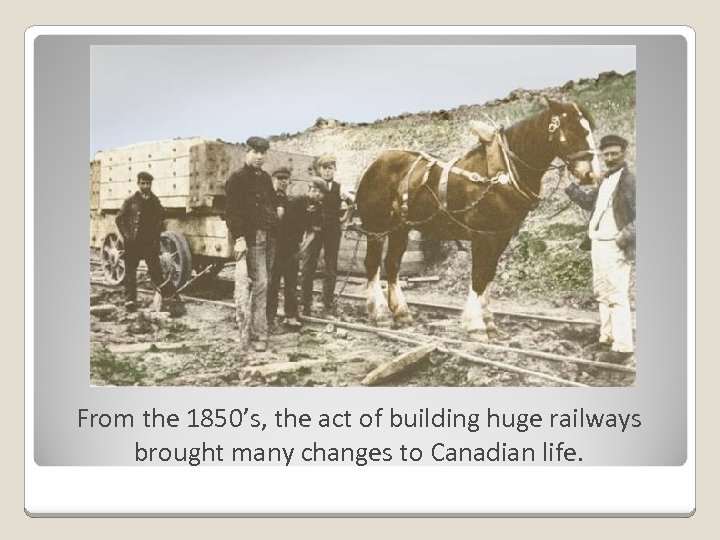 From the 1850’s, the act of building huge railways brought many changes to Canadian life.
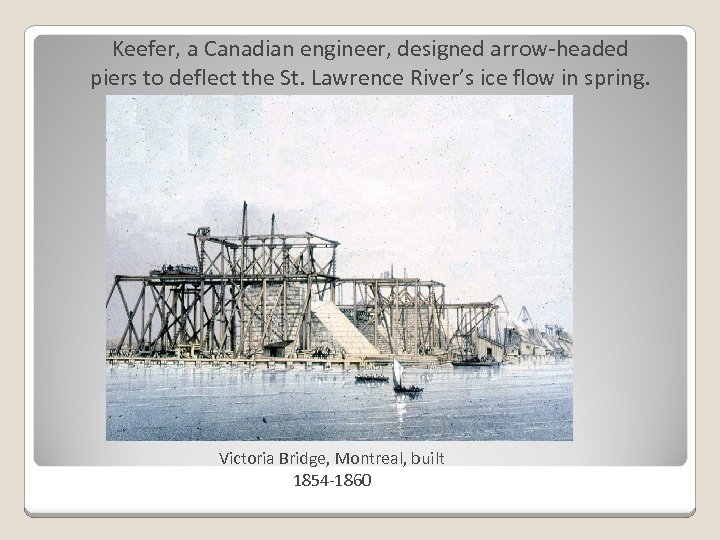 Keefer, a Canadian engineer, designed arrow-headed piers to deflect the St. Lawrence River’s ice flow in spring. Victoria Bridge, Montreal, built 1854 -1860
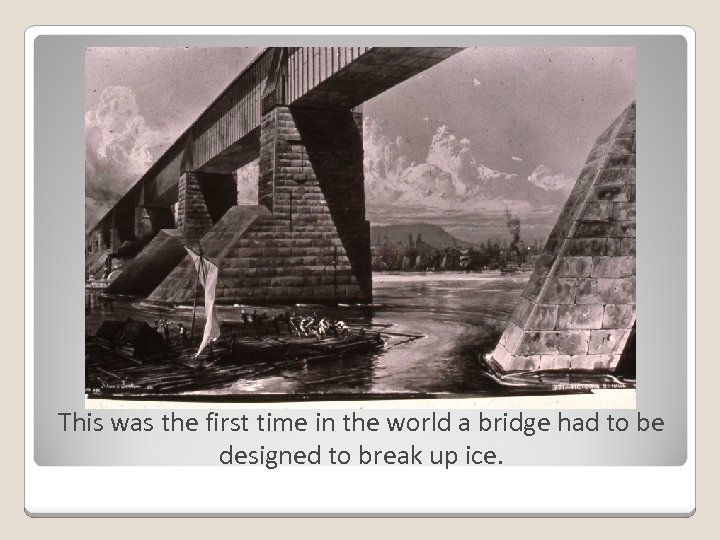 This was the first time in the world a bridge had to be designed to break up ice.
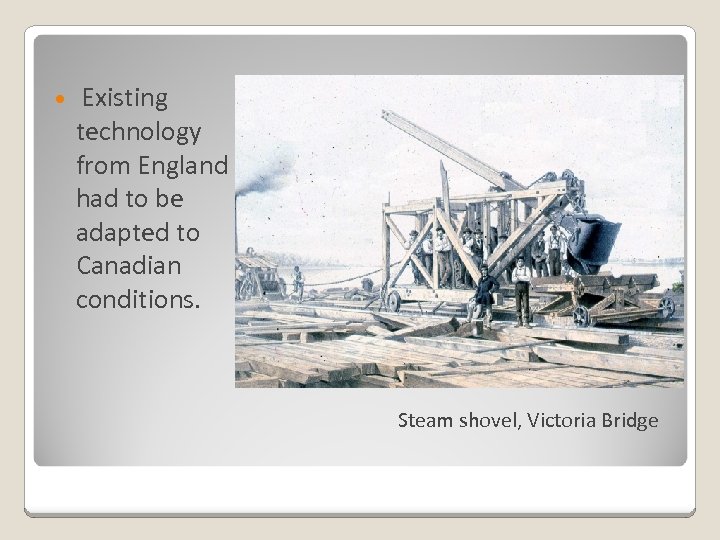 Existing technology from England had to be adapted to Canadian conditions. Steam shovel, Victoria Bridge
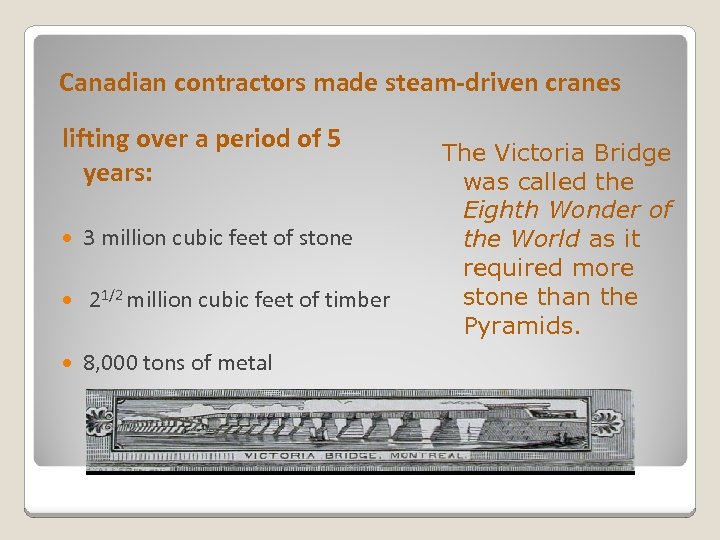 Canadian contractors made steam-driven cranes lifting over a period of 5 years: 3 million cubic feet of stone 21/2 million cubic feet of timber 8, 000 tons of metal The Victoria Bridge was called the Eighth Wonder of the World as it required more stone than the Pyramids.
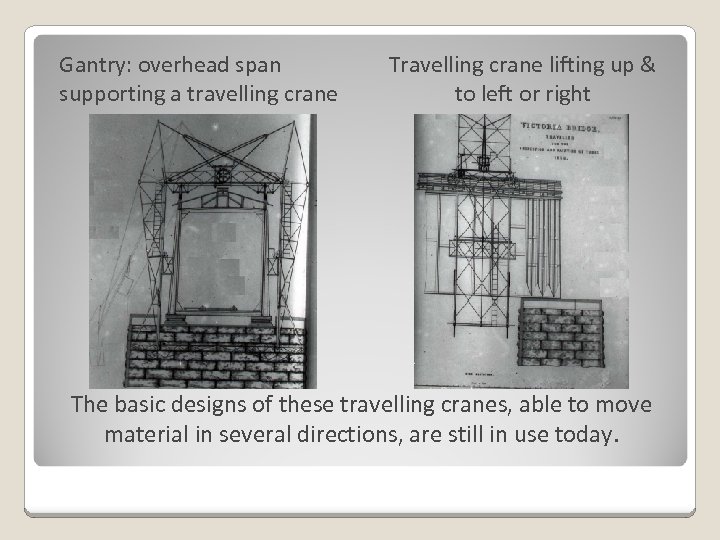 Gantry: overhead span supporting a travelling crane Travelling crane lifting up & to left or right The basic designs of these travelling cranes, able to move material in several directions, are still in use today.
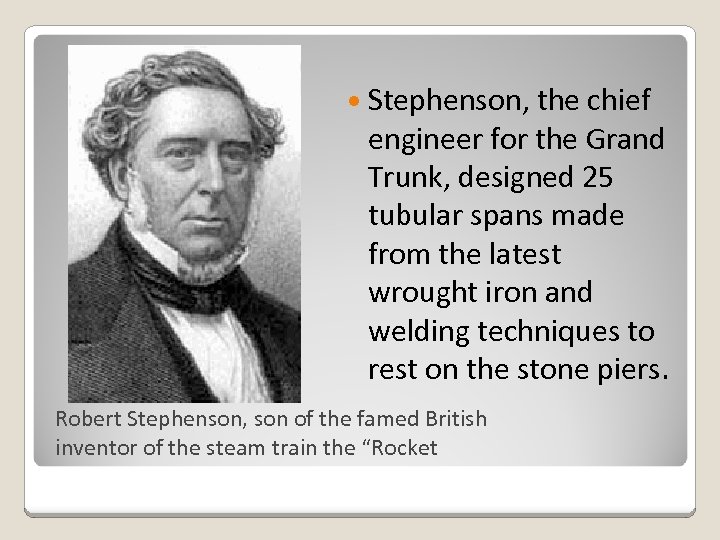 Stephenson, the chief engineer for the Grand Trunk, designed 25 tubular spans made from the latest wrought iron and welding techniques to rest on the stone piers. Robert Stephenson, son of the famed British inventor of the steam train the “Rocket
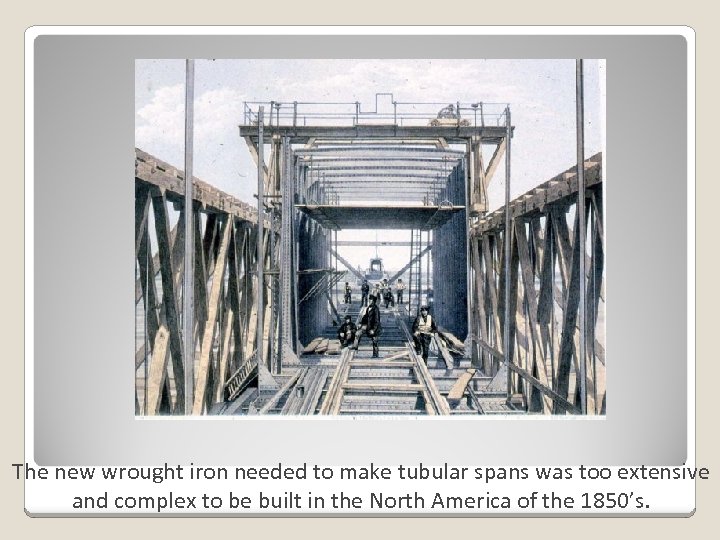 The new wrought iron needed to make tubular spans was too extensive and complex to be built in the North America of the 1850’s.
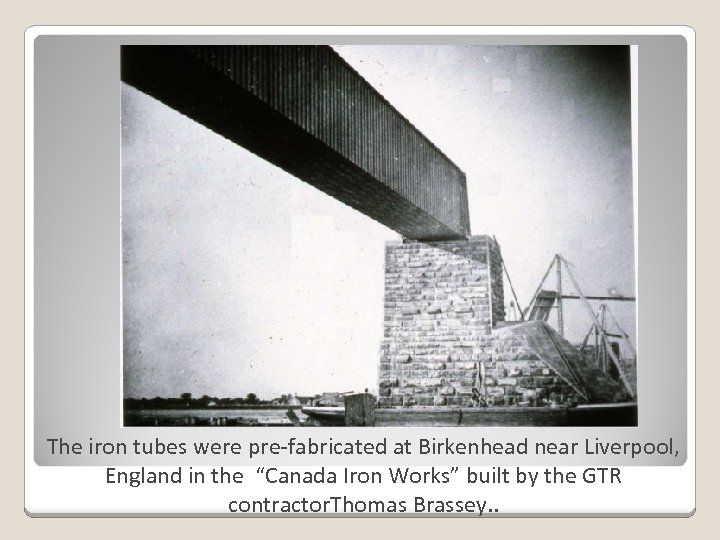 The iron tubes were pre-fabricated at Birkenhead near Liverpool, England in the “Canada Iron Works” built by the GTR contractor. Thomas Brassey. .
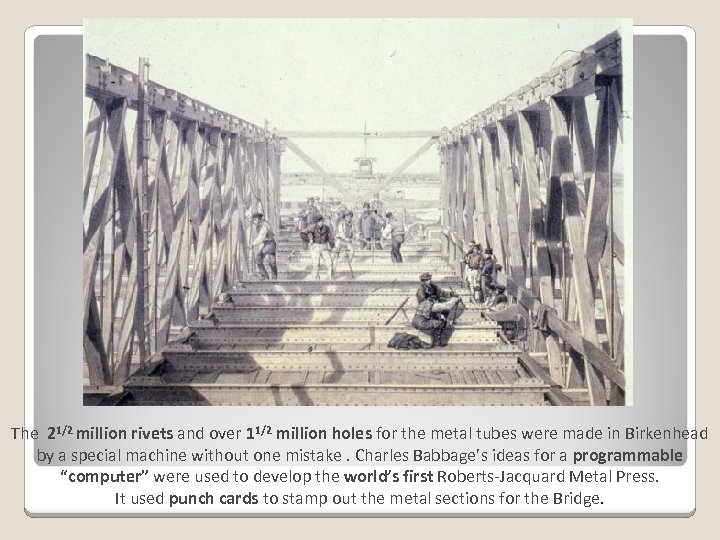 The 21/2 million rivets and over 11/2 million holes for the metal tubes were made in Birkenhead by a special machine without one mistake. Charles Babbage’s ideas for a programmable “computer” were used to develop the world’s first Roberts-Jacquard Metal Press. It used punch cards to stamp out the metal sections for the Bridge.
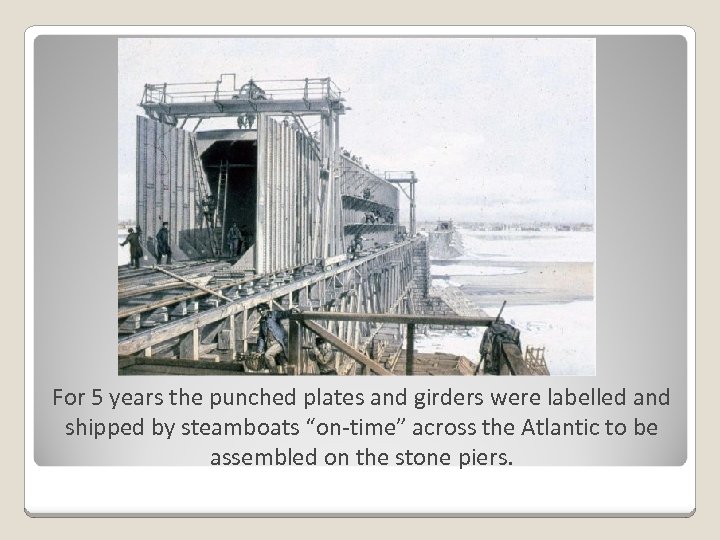 For 5 years the punched plates and girders were labelled and shipped by steamboats “on-time” across the Atlantic to be assembled on the stone piers.
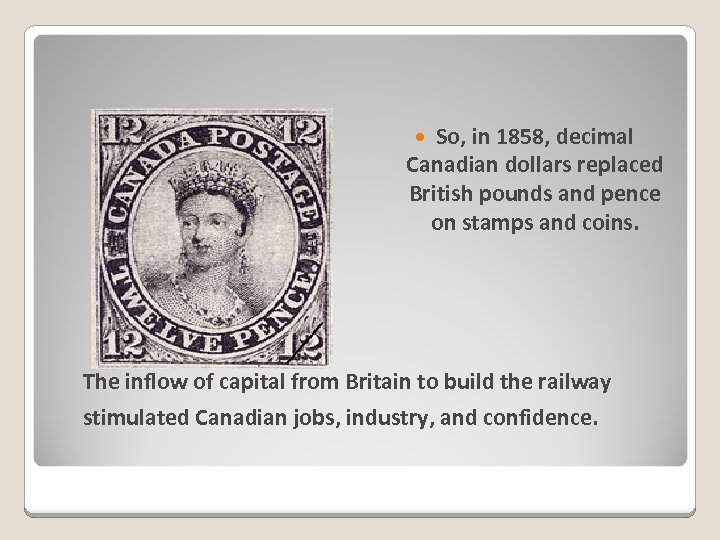 So, in 1858, decimal Canadian dollars replaced British pounds and pence on stamps and coins. The inflow of capital from Britain to build the railway stimulated Canadian jobs, industry, and confidence.
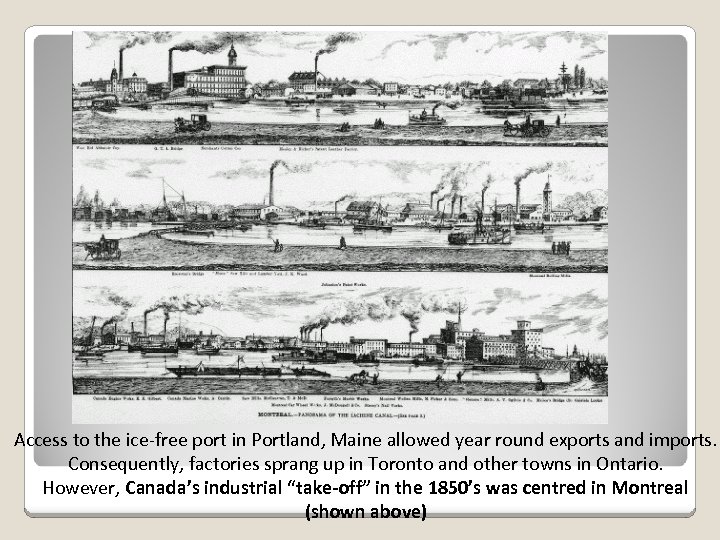 Access to the ice-free port in Portland, Maine allowed year round exports and imports. Consequently, factories sprang up in Toronto and other towns in Ontario. However, Canada’s industrial “take-off” in the 1850’s was centred in Montreal (shown above)
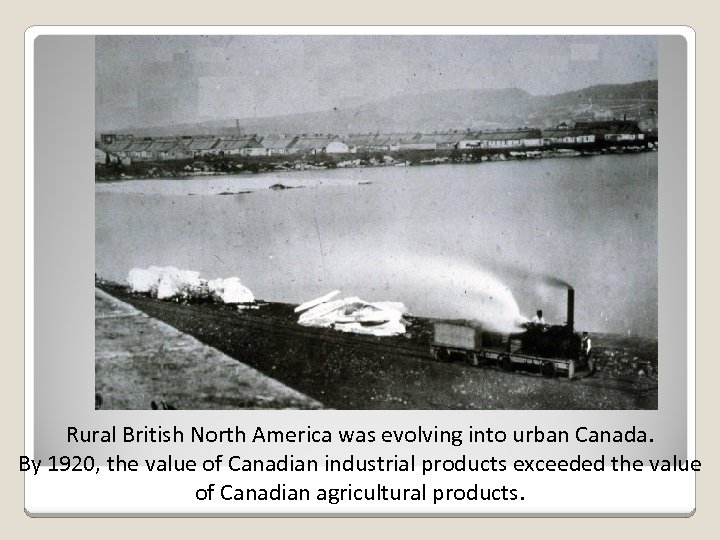 Rural British North America was evolving into urban Canada. By 1920, the value of Canadian industrial products exceeded the value of Canadian agricultural products.
 Railways themselves led to scientific innovation. For example, time was measured originally by each town at its high noon. Grand Trunk Railway Time-Table 1860 The trains will be run on Montreal time which is– 8½ mins. faster than Brockville time. 12 mins. faster than Kingston time. 14½ mins. faster than Belleville time. 23 mins. faster than Toronto time. A standard time for the world’s largest railway was needed.
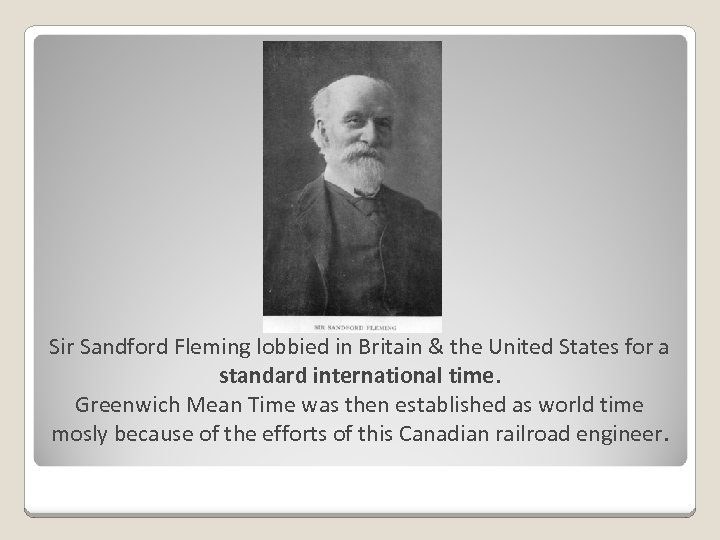 Sir Sandford Fleming lobbied in Britain & the United States for a standard international time. Greenwich Mean Time was then established as world time mosly because of the efforts of this Canadian railroad engineer.
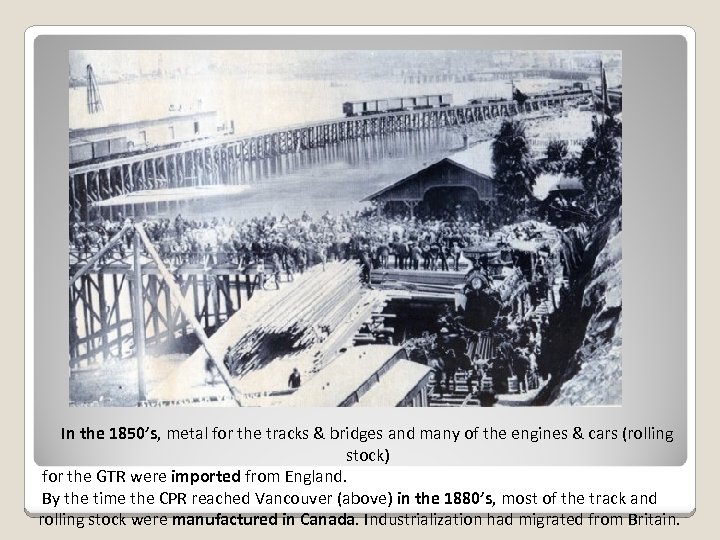 In the 1850’s, metal for the tracks & bridges and many of the engines & cars (rolling stock) for the GTR were imported from England. By the time the CPR reached Vancouver (above) in the 1880’s, most of the track and rolling stock were manufactured in Canada. Industrialization had migrated from Britain.
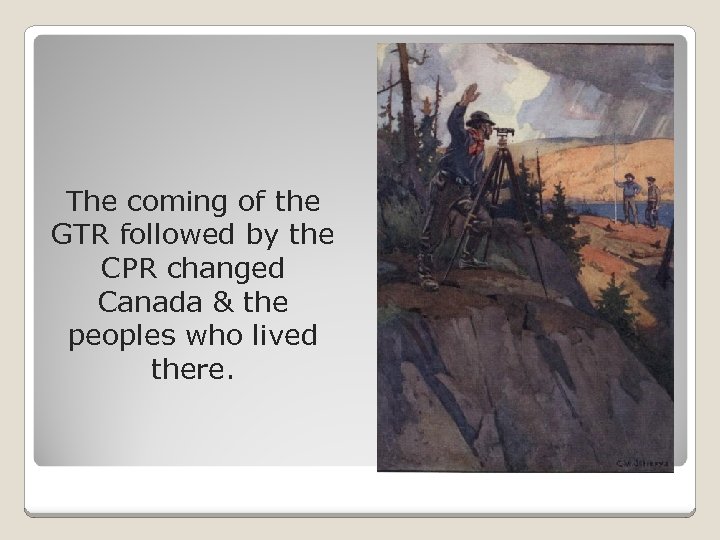 The coming of the GTR followed by the CPR changed Canada & the peoples who lived there.
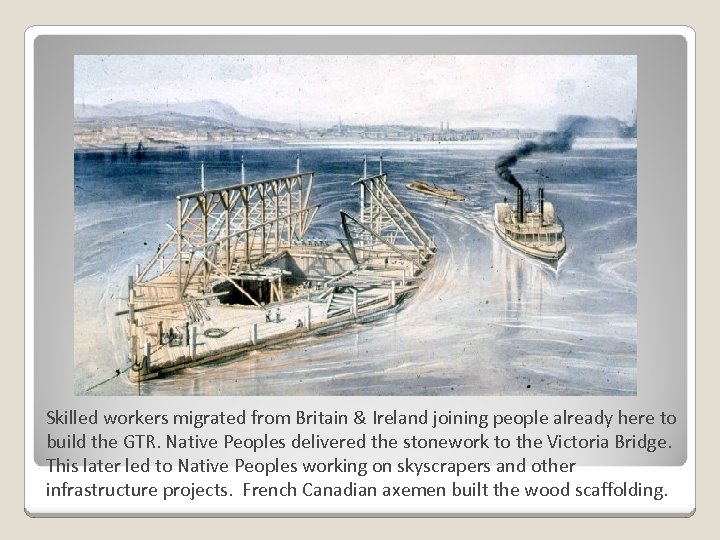 Skilled workers migrated from Britain & Ireland joining people already here to build the GTR. Native Peoples delivered the stonework to the Victoria Bridge. This later led to Native Peoples working on skyscrapers and other infrastructure projects. French Canadian axemen built the wood scaffolding.
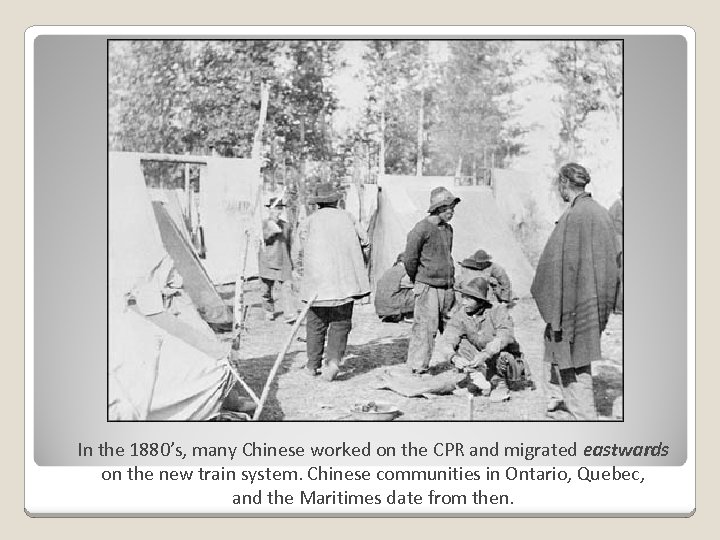 In the 1880’s, many Chinese worked on the CPR and migrated eastwards on the new train system. Chinese communities in Ontario, Quebec, and the Maritimes date from then.
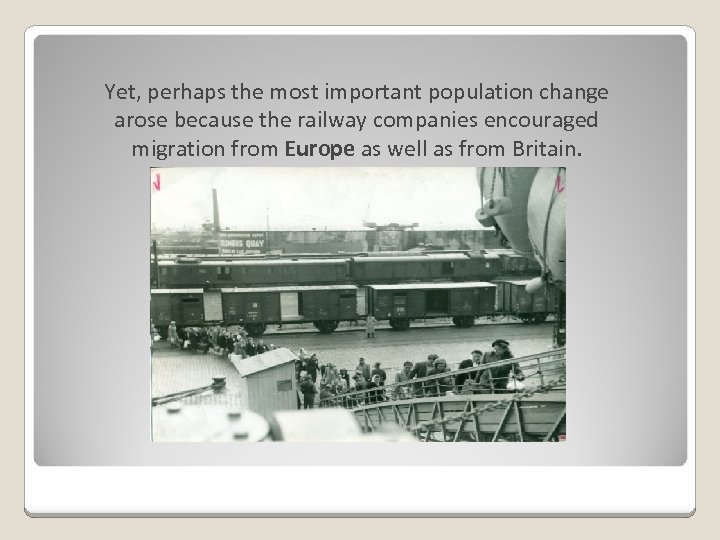 Yet, perhaps the most important population change arose because the railway companies encouraged migration from Europe as well as from Britain.
 Both the GTR and CPR printed books for their agents in Northern and Eastern Europe. Emigrants could buy tickets from there through to the prairies. This migration created Alberta and Saskatchewan.
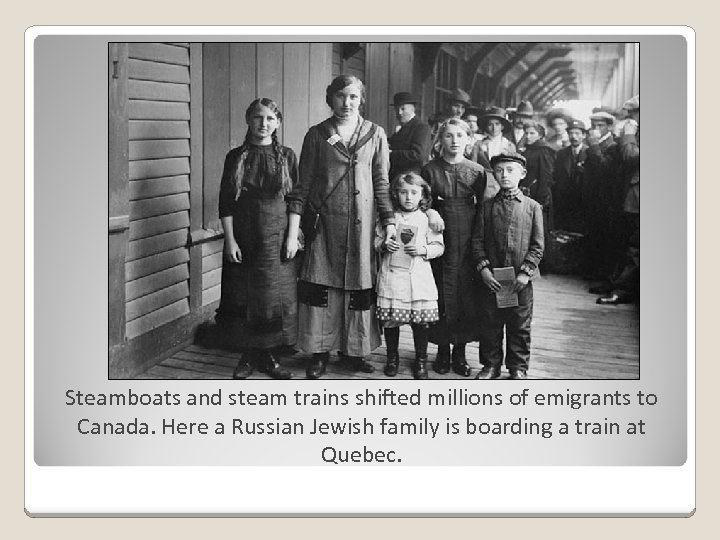 Steamboats and steam trains shifted millions of emigrants to Canada. Here a Russian Jewish family is boarding a train at Quebec.
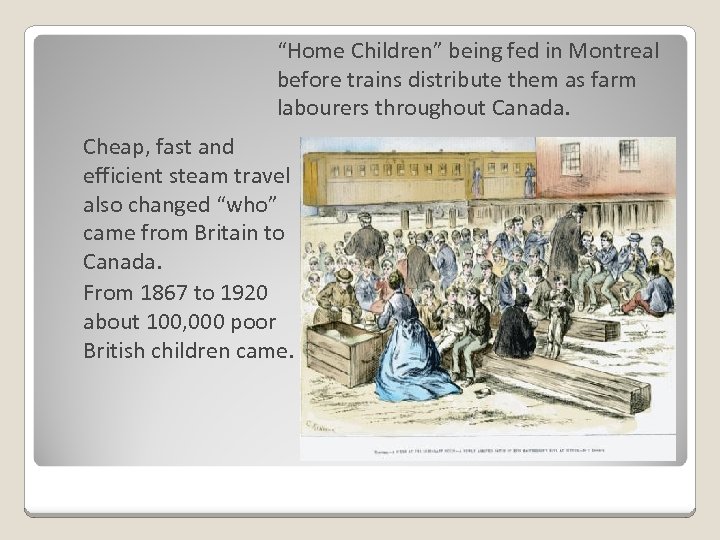 “Home Children” being fed in Montreal before trains distribute them as farm labourers throughout Canada. Cheap, fast and efficient steam travel also changed “who” came from Britain to Canada. From 1867 to 1920 about 100, 000 poor British children came.
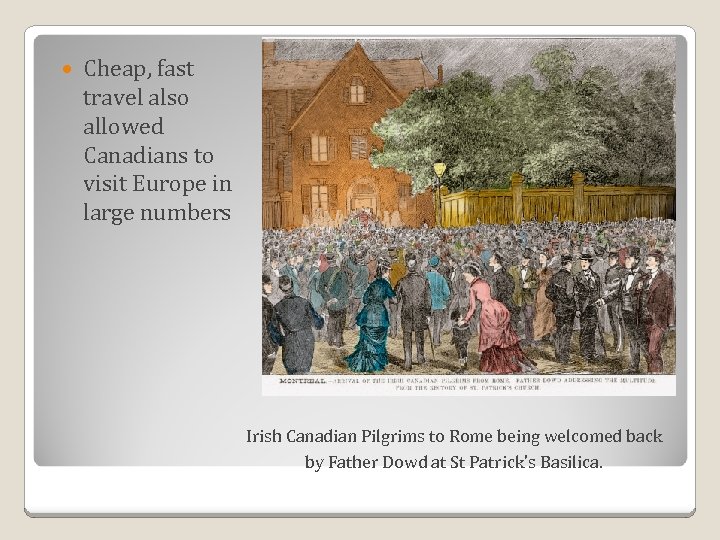 Cheap, fast travel also allowed Canadians to visit Europe in large numbers Irish Canadian Pilgrims to Rome being welcomed back by Father Dowd at St Patrick’s Basilica.
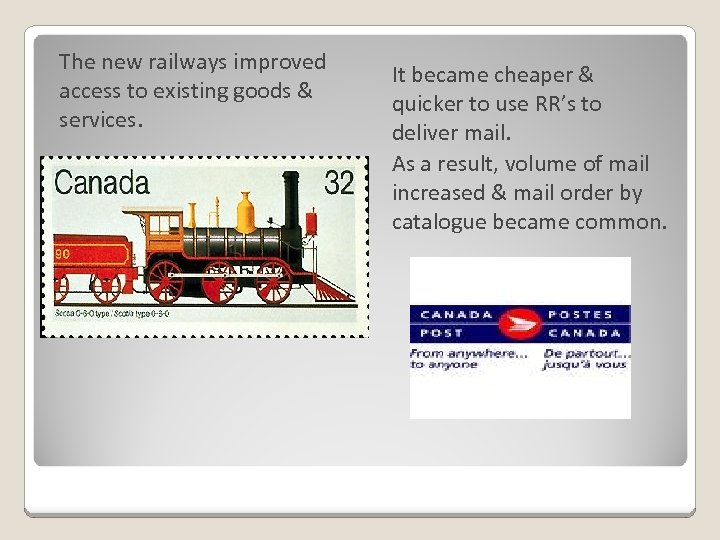 The new railways improved access to existing goods & services. It became cheaper & quicker to use RR’s to deliver mail. As a result, volume of mail increased & mail order by catalogue became common.
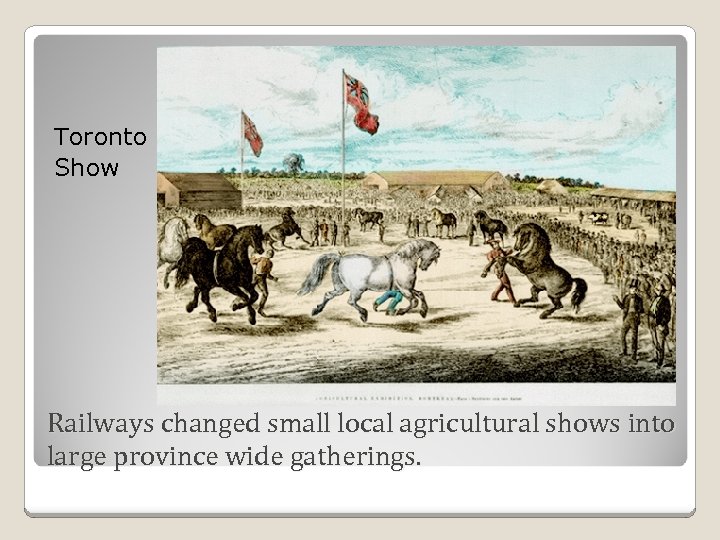 Toronto Show Railways changed small local agricultural shows into large province wide gatherings.
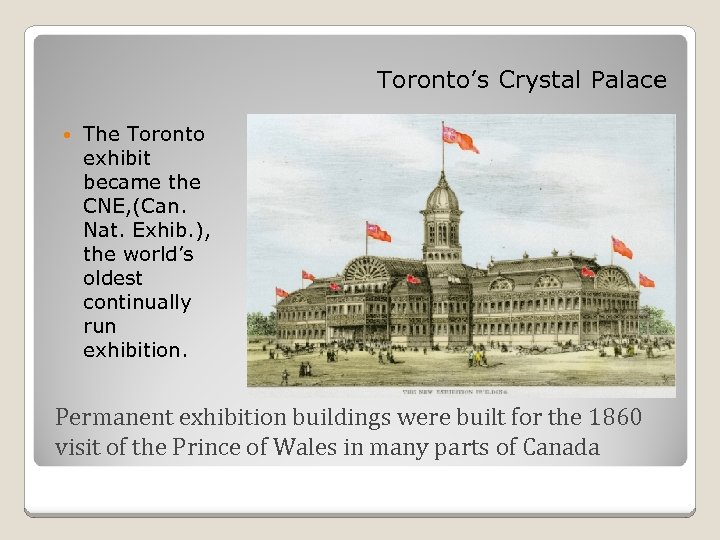 Toronto’s Crystal Palace The Toronto exhibit became the CNE, (Can. Nat. Exhib. ), the world’s oldest continually run exhibition. Permanent exhibition buildings were built for the 1860 visit of the Prince of Wales in many parts of Canada
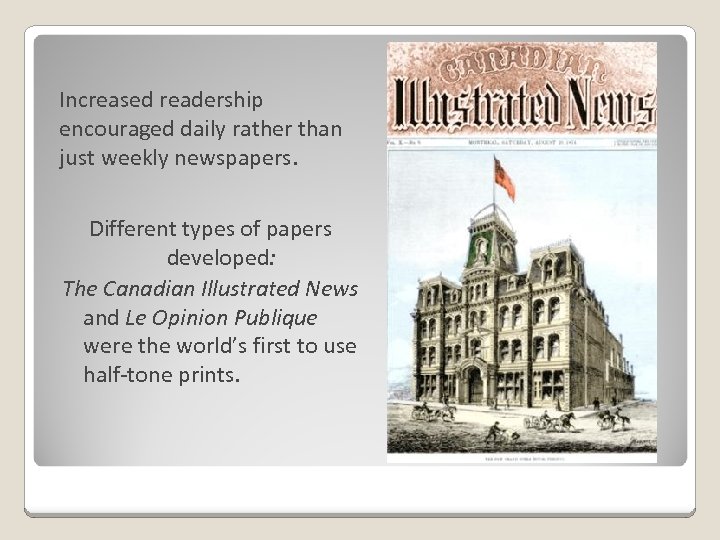 Increased readership encouraged daily rather than just weekly newspapers. Different types of papers developed: The Canadian Illustrated News and Le Opinion Publique were the world’s first to use half-tone prints.
 Press barons with enormous political power changed Canada to a media-driven democracy. The power of the press soared partly because trains quickly distributed the news in papers over a wide area.
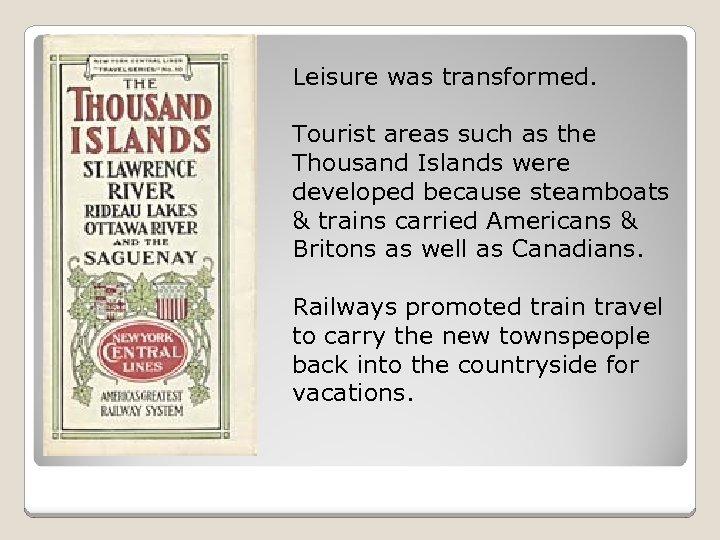 Leisure was transformed. Tourist areas such as the Thousand Islands were developed because steamboats & trains carried Americans & Britons as well as Canadians. Railways promoted train travel to carry the new townspeople back into the countryside for vacations.
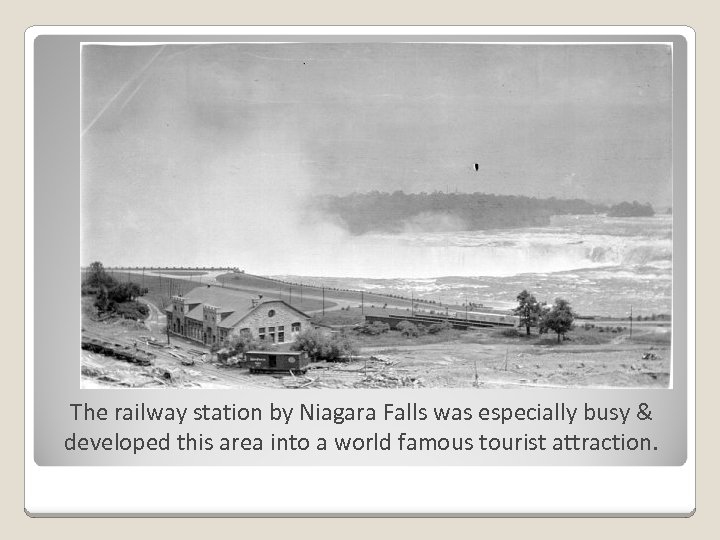 The railway station by Niagara Falls was especially busy & developed this area into a world famous tourist attraction.
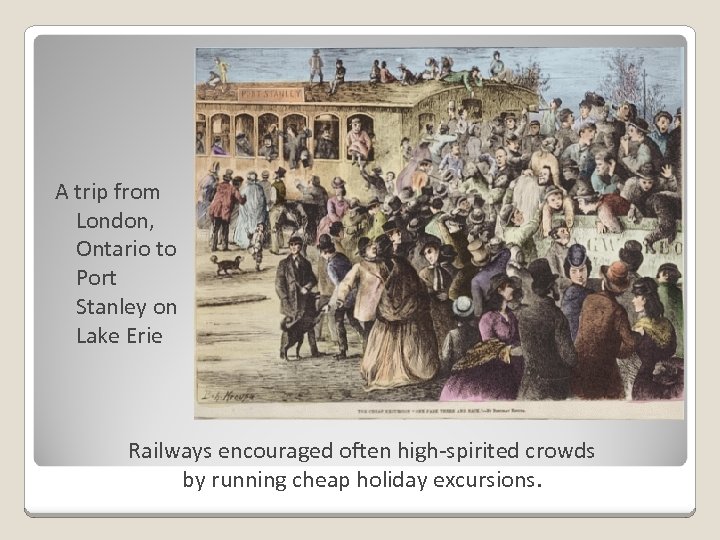 A trip from London, Ontario to Port Stanley on Lake Erie Railways encouraged often high-spirited crowds by running cheap holiday excursions.
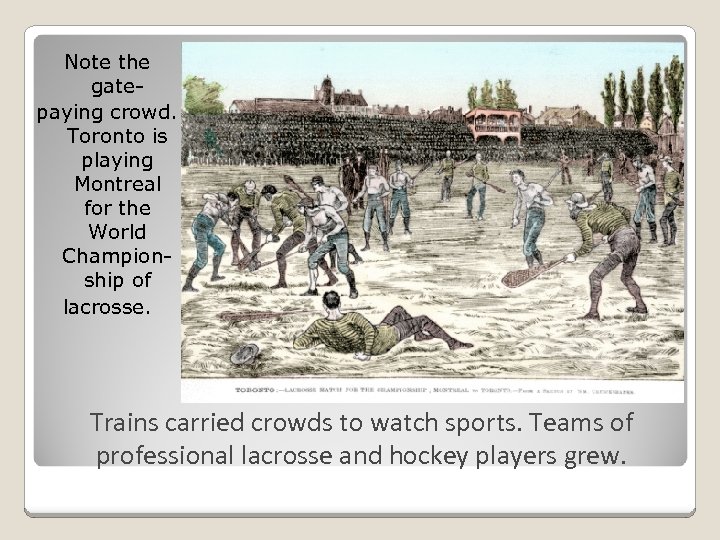 Note the gatepaying crowd. Toronto is playing Montreal for the World Championship of lacrosse. Trains carried crowds to watch sports. Teams of professional lacrosse and hockey players grew.
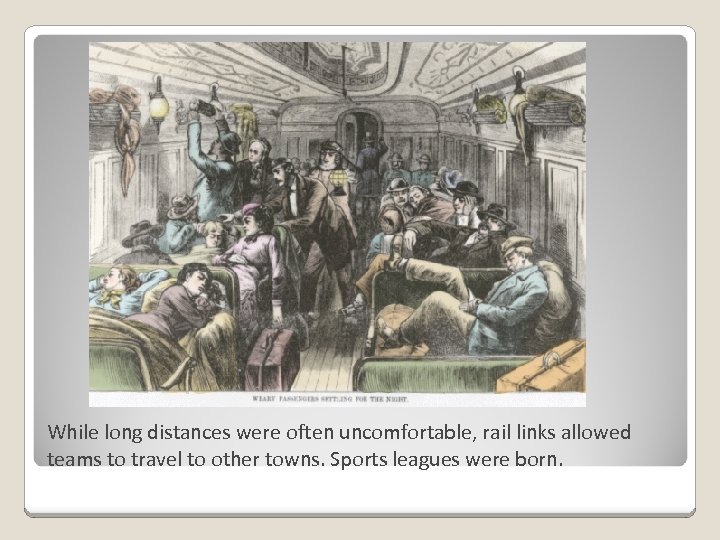 While long distances were often uncomfortable, rail links allowed teams to travel to other towns. Sports leagues were born.
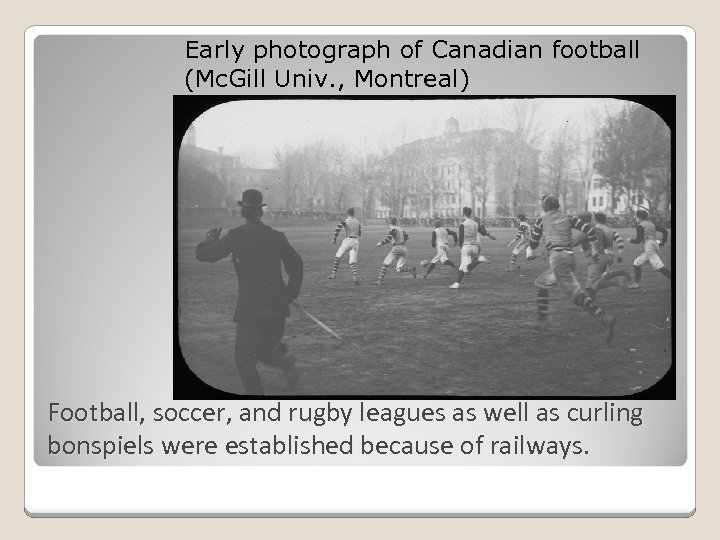 Early photograph of Canadian football (Mc. Gill Univ. , Montreal) Football, soccer, and rugby leagues as well as curling bonspiels were established because of railways.
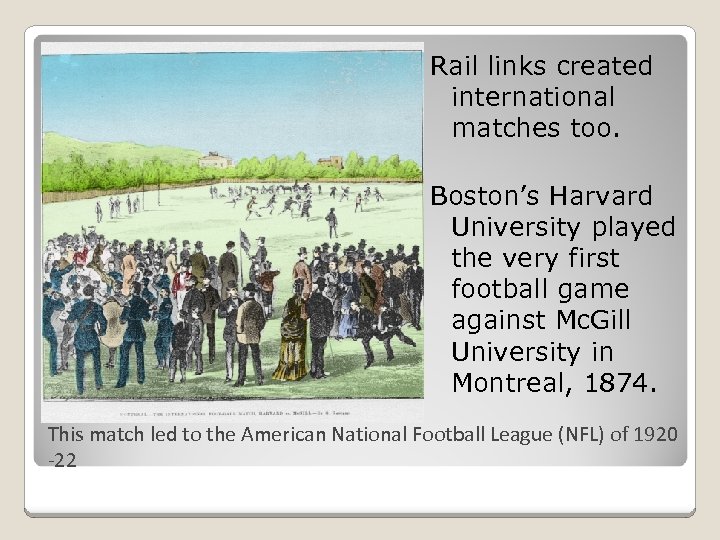 Rail links created international matches too. Boston’s Harvard University played the very first football game against Mc. Gill University in Montreal, 1874. This match led to the American National Football League (NFL) of 1920 -22
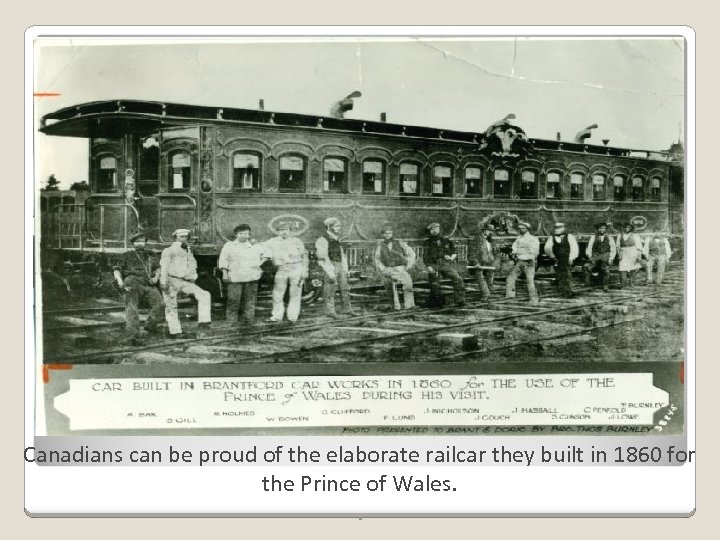 Canadians can be proud of the elaborate railcar they built in 1860 for the Prince of Wales. .
 ◦ Canadians can also be proud of the railways they built and that those railways shaped Canada.