 Скачать презентацию Imsimbi Breakfast Seminar 7 th November 2013 Understanding
b1449be8e00d6a7ea81b66d9effaa774.ppt
- Количество слайдов: 26




Imsimbi Breakfast Seminar 7 th November 2013 Understanding the New Grant Regulations T R A I N G 7 th November 2013 unleashing your potential
Focus on the New Regulations q Emphasis of the Minister is now on the delivery of quality training to achieve a skilled workforce Ø Shift in Levies from Quality to Quality q Inadvertently consequences Ø fail to address the needs of industry and commerce; and Ø The skills needs of individuals. 7 th November 2013 T R A I N G
Significant Changes q Regulate the portion of levies which SETA’s can use for administration q Reduce the mandatory grants from 50% to 20% of levy. q Increased Discretionary Grants from 20% to 50% of levy q Maximum Surplus Funds of 5% 7 th November 2013 T R A I N G
Significant Changes q Increased requirement for information contained in the Workplace Skills Plan q Sign-off by labour representatives q Create a framework within which expanded use is made of public education and training providers for the provision of skills development programmes 7 th November 2013 T R A I N G
The Need for a Grants Policy The purpose of the regulations: q Develop specific policies and procedures q Firstly, they provide a mandate q Secondly, act in a transparent and fair manner q Thirdly, how the SETA will allocate resources 7 th November 2013 T R A I N G
Understanding Mandatory and Discretionary Grants including Pivotal Grants Mandatory Grants: q provide data to their relevant SETA q Geared towards Ø Critical Skills Ø Important Skills Discretionary Grants: q Implementation of Sector Skills Plan q No employer entitlement 7 th November 2013 T R A I N G
Pivotal Programmes and Discretionary Grants q Pivotal programmes are derived from the SETA’s Sector Skills Plan Ø Priority occupations where supply challenges exist. Ø Critical skills required in the sector 7 th November 2013 T R A I N G
Crafting a SETA Policy q SETA grant policies must align themselves to not only the grant regulations but must as their objective ensure that both mandatory and discretionary grant applications are evaluated and approved in compliance with their policy in relation to: Ø The Skills Development Act No. 97 of 1998 Ø The Skills Development Levies Act of 1999 and their regulations. 7 th November 2013 T R A I N G
Key aspects of the mer. SETA policy Mandatory Grants: q Eligibility q Values q Deviations q Payments 7 th November 2013 T R A I N G
Key aspects of the mer. SETA policy Discretionary Grants: q Administration q Eligibility q Important considerations 7 th November 2013 T R A I N G
Allocation of Levies Discretionary Grants: q 49. 5% of total levies paid by the employer q At least 80% allocated to pivotal programmes q A maximum of 20% allocated to non pivotal programmes q Surplus funds, unclaimed mandatory grants, and interest and penalties to be transferred to discretionary funding 7 th November 2013 T R A I N G
Pivotal Programmes identified by the mer. SETA q Apprenticeships q Learnerships q Skills Programmes leading to a qualification q Work integrated learning q Workplace experience q Bursaries q R. P. L. q Public FET Graduates q Graduate Development (U. o. T and University Graduates) 7 th November 2013 T R A I N G
Grant Allocation – Pivotal Programmes The allocation of 80% pivotal programmes will be split: Ø 70% to those companies submitting a WSP / ATR Ø 30% to those non levy paying companies and other entities. Ø Where an organisation is spending more than 3% of their payroll on training the mer. SETA would consider allocating additional funding (beyond 49. 5% Maximum) 7 th November 2013 T R A I N G
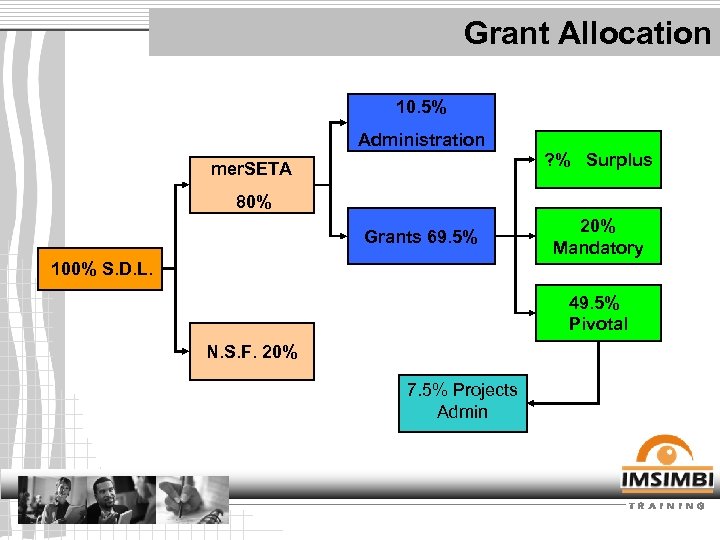
Grant Allocation 10. 5% Administration ? % Surplus mer. SETA 80% Grants 69. 5% 20% Mandatory 100% S. D. L. 49. 5% Pivotal N. S. F. 20% 7. 5% Projects Admin 7 th November 2013 T R A I N G
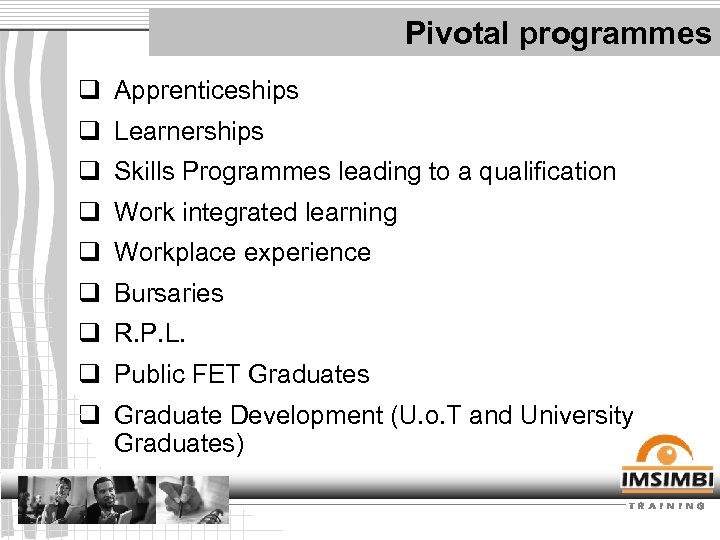
Pivotal programmes q Apprenticeships q Learnerships q Skills Programmes leading to a qualification q Work integrated learning q Workplace experience q Bursaries q R. P. L. q Public FET Graduates q Graduate Development (U. o. T and University Graduates) 7 th November 2013 T R A I N G
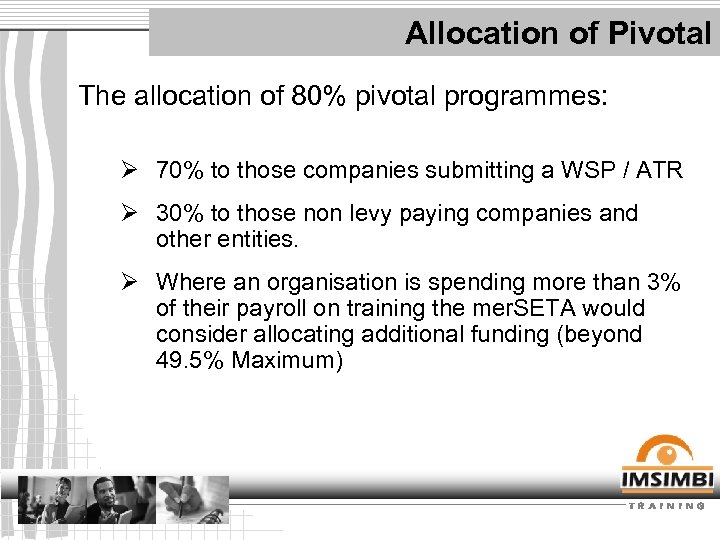
Allocation of Pivotal The allocation of 80% pivotal programmes: Ø 70% to those companies submitting a WSP / ATR Ø 30% to those non levy paying companies and other entities. Ø Where an organisation is spending more than 3% of their payroll on training the mer. SETA would consider allocating additional funding (beyond 49. 5% Maximum) 7 th November 2013 T R A I N G
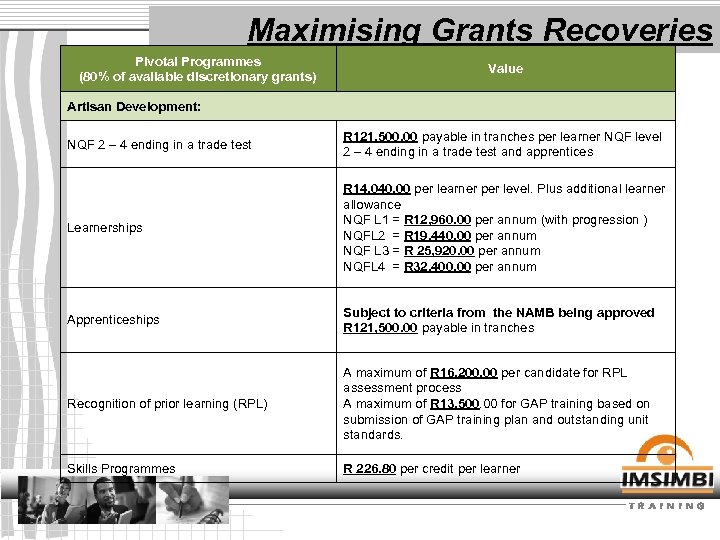
Maximising Grants Recoveries Pivotal Programmes (80% of available discretionary grants) Value Artisan Development: NQF 2 – 4 ending in a trade test R 121, 500. 00 payable in tranches per learner NQF level 2 – 4 ending in a trade test and apprentices Learnerships R 14, 040. 00 per learner per level. Plus additional learner allowance NQF L 1 = R 12, 960. 00 per annum (with progression ) NQFL 2 = R 19, 440. 00 per annum NQF L 3 = R 25, 920. 00 per annum NQFL 4 = R 32, 400. 00 per annum Apprenticeships Subject to criteria from the NAMB being approved R 121, 500. 00 payable in tranches Recognition of prior learning (RPL) A maximum of R 16, 200. 00 per candidate for RPL assessment process A maximum of R 13, 500. 00 for GAP training based on submission of GAP training plan and outstanding unit standards. Skills Programmes R 226. 80 per credit per learner 7 th November 2013 T R A I N G
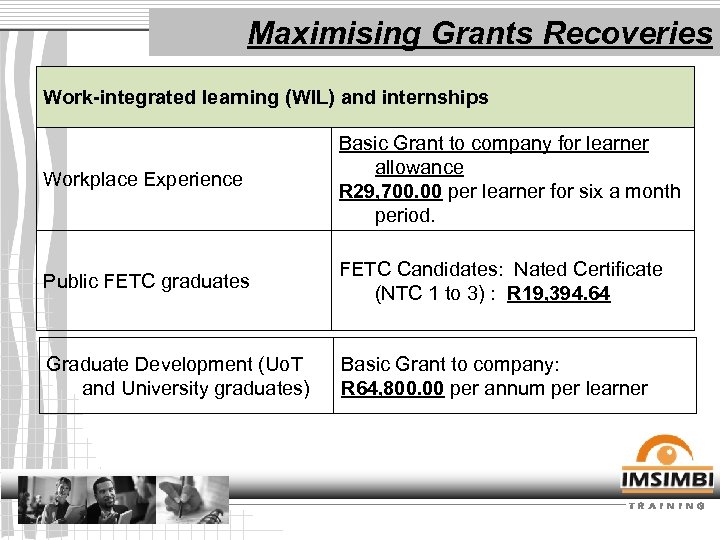
Maximising Grants Recoveries Work-integrated learning (WIL) and internships Workplace Experience Basic Grant to company for learner allowance R 29, 700. 00 per learner for six a month period. Public FETC graduates FETC Candidates: Nated Certificate (NTC 1 to 3) : R 19, 394. 64 Graduate Development (Uo. T and University graduates) Basic Grant to company: R 64, 800. 00 per annum per learner 7 th November 2013 T R A I N G
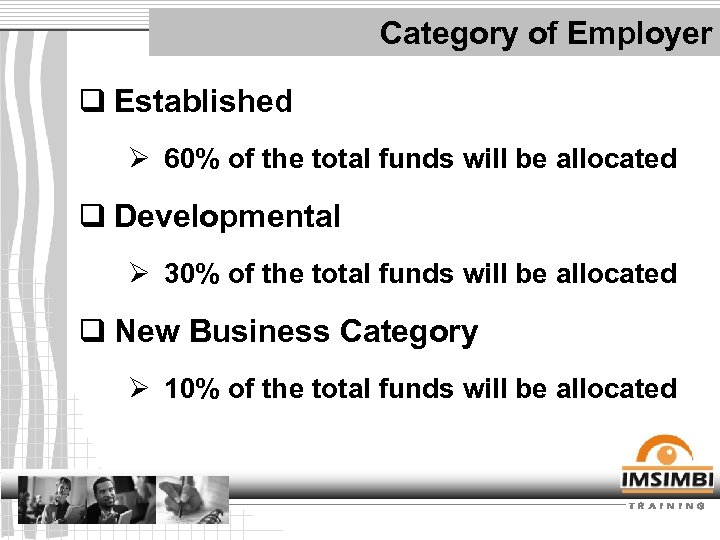
Category of Employer q Established Ø 60% of the total funds will be allocated q Developmental Ø 30% of the total funds will be allocated q New Business Category Ø 10% of the total funds will be allocated 7 th November 2013 T R A I N G
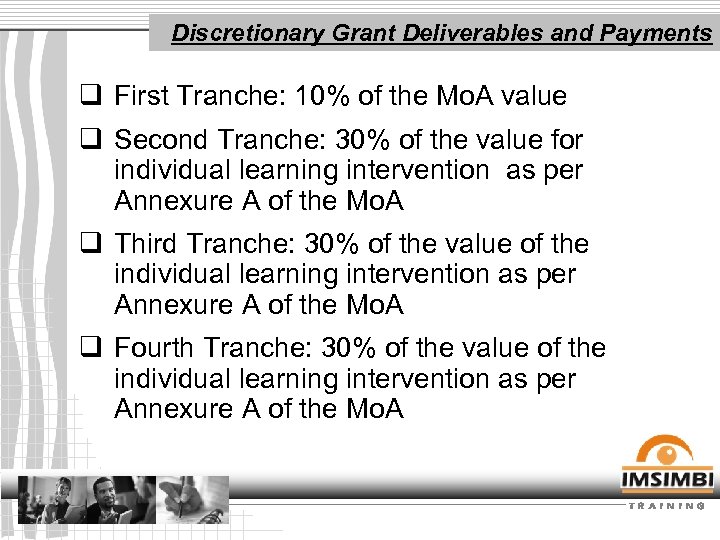
Discretionary Grant Deliverables and Payments q First Tranche: 10% of the Mo. A value q Second Tranche: 30% of the value for individual learning intervention as per Annexure A of the Mo. A q Third Tranche: 30% of the value of the individual learning intervention as per Annexure A of the Mo. A q Fourth Tranche: 30% of the value of the individual learning intervention as per Annexure A of the Mo. A 7 th November 2013 T R A I N G
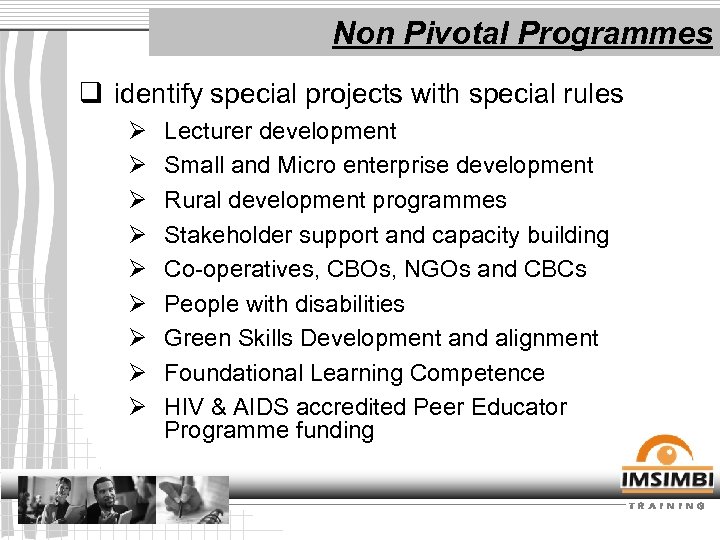
Non Pivotal Programmes q identify special projects with special rules Ø Ø Ø Ø Ø 7 th November 2013 Lecturer development Small and Micro enterprise development Rural development programmes Stakeholder support and capacity building Co-operatives, CBOs, NGOs and CBCs People with disabilities Green Skills Development and alignment Foundational Learning Competence HIV & AIDS accredited Peer Educator Programme funding T R A I N G
The Future: Moving Forward With the New Grant Regulation q Public training institutions will not be able to address all the skills needed for workplace performance. q Public institutions do not have the expertise needed to cover the wide range of specialised skills that are needed by stakeholders. q Make provision for funding programmes delivered by reputable private providers that have the necessary expertise in specialised fields. There are sufficient quality assurance mechanisms in place to identify sub standard private providers. q The Regulations may reduce employer participation in skills development even more so with the new BBB EE codes requiring 6% spend on training and the placement of learners post training with a further split between those on apprenticeships and learnerships. 7 th November 2013 T R A I N G
The Future: Moving Forward With the New Grant Regulation q The reduction in the mandatory grant will substantially reduce the incentive of small and even medium-sized employers to submit Workplace Skills Plans q Most skills employers require for workplace performance are not developed through discretionary grant programmes. q Engage your SETA q Understand their grant policies and what discretionary grant have been identified 7 th November 2013 T R A I N G
Added Influences q Medium Term Expenditure Framework Ø Minister of Finance applies expenditure ceilings q FET Infrastructure Development Ø DHET issues communication regarding compulsory FET infrastructure support from 21 SETA’s (R 1 billion) preferably once of payment before 30 th April 2014 7 th November 2013 T R A I N G
Added Influences q National Student Financial Aid Scheme Ø Shortfall of R 2. 6 billion Ø SETA’s requested to allocate funding for those students studying in their sector Ø R 60, 000 per student / R 20 m in current year 7 th November 2013 T R A I N G

Imsimbi Breakfast Seminar 7 th November 2013 Thank You Questions ? T R A I N G 7 th November 2013 unleashing your potential
Скачать презентацию Imsimbi Breakfast Seminar 7 th November 2013 Understanding
b1449be8e00d6a7ea81b66d9effaa774.ppt