


 Скачать презентацию IMS 9300 IS IM FUNDAMENTALS information systems development methodologies
6cb7062afa8ed87bfb7035ed1578e551.ppt
- Количество слайдов: 39
 IMS 9300 IS/IM FUNDAMENTALS information systems development methodologies www. sims. monash. edu. au
 This lecture’s objectives • Understand what we mean when we talk about information systems: – system concepts and components – understand the need for information systems – introduction to roles and tasks associated with building information systems www. sims. monash. edu. au/subjects/ims 9300 2
 A word about “Systems thinking” The application of formal systems theory and concepts to systems problem solving (the SIMS approach): • Helps us understand how systems are organised and how they work • Simplifies inherent system complexity • Useful to apply systems thinking to understanding of business organisations’ activities and their information systems www. sims. monash. edu. au/subjects/ims 9300 3
 Information Systems • The nature, purpose and makeup of computerised Information Systems • What you should know about Information Systems if you intend to develop, manage or work with them www. sims. monash. edu. au/subjects/ims 9300 4
 a “system” • An assembly of components that interact in an organised way to accomplish goals • e. g. river systems, nervous system, public transport system, legal system, education system, water supply system, elevator system, information system. www. sims. monash. edu. au/subjects/ims 9300 5
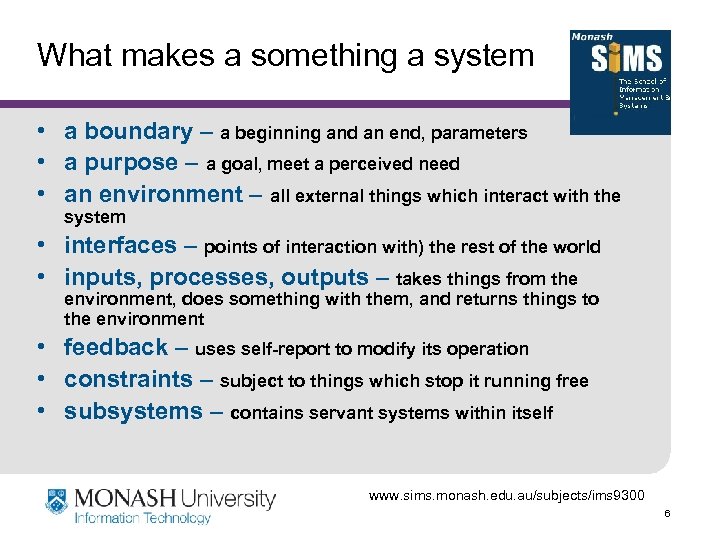 What makes a something a system • a boundary – a beginning and an end, parameters • a purpose – a goal, meet a perceived need • an environment – all external things which interact with the system • interfaces – points of interaction with) the rest of the world • inputs, processes, outputs – takes things from the environment, does something with them, and returns things to the environment • feedback – uses self-report to modify its operation • constraints – subject to things which stop it running free • subsystems – contains servant systems within itself www. sims. monash. edu. au/subjects/ims 9300 6
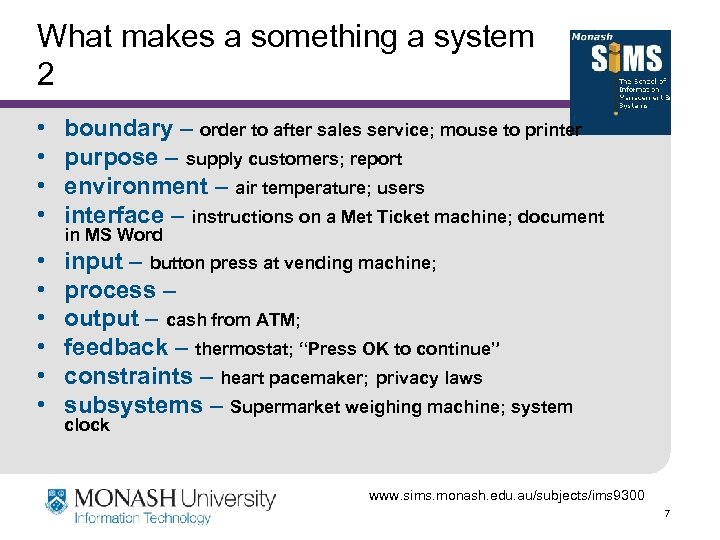 What makes a something a system 2 • • boundary – order to after sales service; mouse to printer purpose – supply customers; report environment – air temperature; users interface – instructions on a Met Ticket machine; document • • • input – button press at vending machine; process – output – cash from ATM; feedback – thermostat; “Press OK to continue” constraints – heart pacemaker; privacy laws subsystems – Supermarket weighing machine; system in MS Word clock www. sims. monash. edu. au/subjects/ims 9300 7
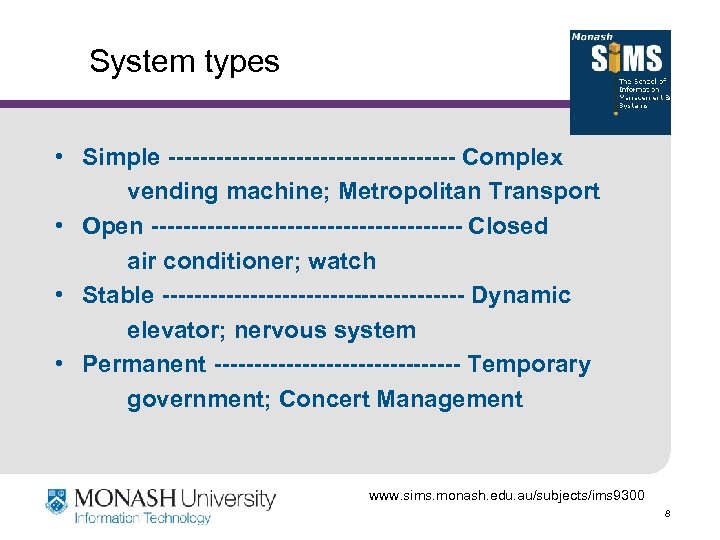 System types • Simple ------------------ Complex vending machine; Metropolitan Transport • Open -------------------- Closed air conditioner; watch • Stable ------------------- Dynamic elevator; nervous system • Permanent ---------------- Temporary government; Concert Management www. sims. monash. edu. au/subjects/ims 9300 8
 The “right” information • Useful information is essential if an organisation is to achieve its goals: accurate flexible simple accessible complete reliable timely secure economical relevant verifiable • An information system is designed to produce such information www. sims. monash. edu. au/subjects/ims 9300 9
 Business organisations are complex systems • Business organisations organise their activities and work practices into various systems because: – many different tasks must be done – different data are needed for different tasks – a single task is often done many times – complex processes must be coordinated – the environment changes constantly www. sims. monash. edu. au/subjects/ims 9300 10
 How can Information Systems help ? • Efficiency, reliability, economy, control • An Information System is a formal arrangement of people, data, processes • Integrated to – manage complexity – support and improve business operations – Support and improve the problem-solving and decision-making activities of managers. • It transforms Data into Information (Why are computers not mentioned? ) www. sims. monash. edu. au/subjects/ims 9300 11
 Computer-Based Information Systems • Information systems may or may not involve the use of computers • Computers significantly expand the potential of information systems because they: – are more reliable processors than humans – are faster than humans, and “tireless” – are easily replicated – are much more productive – have enormous memory capacity www. sims. monash. edu. au/subjects/ims 9300 12
 Information System Components Information system components include: • people - need the information, build the system, operate it and use it • data and information -the raw material which the system is set up to manage and distribute • machines (usually computers) - help manage and process the data and information • procedures - define how the information is to be input/stored/processed/ etc. – formal – specified, perpetual, expected – informal – unspecified, trivial, one-off www. sims. monash. edu. au/subjects/ims 9300 13
 Functions of an Information System Any information system performs four main functions: • data input - capturing information • data storage/retrieval - keeping information • data processing - transforming information • data output - displaying/presenting information www. sims. monash. edu. au/subjects/ims 9300 14
 Benefits of Information Systems A good information system ensures: • the right information • to the right degree of accuracy • when it is required • in the right format/layout • to the right people • in the most efficient way possible (Have you had to deal with an information system which did not work well? Which of these things was not present in that system? ) www. sims. monash. edu. au/subjects/ims 9300 15
 The Complexity of Information Systems Even small information systems can be very complex: • • • many components (lots of information) much interaction between components systems within systems (subsystems) the intangibility of information (hard to define) the subjective nature of information (interpretation) • differing needs of different system users www. sims. monash. edu. au/subjects/ims 9300 16
 Computer-based information systems • “unique” situations: customer enquiry system; ticket booking • generic business applications: payroll systems; inventory systems Types of information systems e. g. : – – – transaction processing systems, decision support systems, expert systems, executive information systems, geographical information systems www. sims. monash. edu. au/subjects/ims 9300 17
 Building Information Systems Activities involved in building computer -based information systems are: • identifying business information problems • analysing and describing information needs • designing solutions to meet those needs • acquiring/building new systems • implementing new systems www. sims. monash. edu. au/subjects/ims 9300 18
 System building players • • System owner/s System user/s Project leader (manager) Systems analyst/s Systems designer/s Systems builder/s IT vendor/s and consultant/s www. sims. monash. edu. au/subjects/ims 9300 19
 Building Information Systems: The Role of the Systems Analyst • to understand the system’s information needs – what information is needed? – for whom? – in what form? – when? • to describe the system’s information flows and processes • to identify problems, opportunities, constraints • to suggest possible system solutions www. sims. monash. edu. au/subjects/ims 9300 20
 Business Information System Problems and Opportunities • The need to build new information systems or change existing ones comes about because: – there are problems in the way in which existing systems operate or – changes in circumstances create opportunities to improve things by doing them differently or – new functions or activities are to be undertaken www. sims. monash. edu. au/subjects/ims 9300 21
 Business Information Processing Problems • Information problems occur when an organisation’s systems fail to meet its information and processing needs adequately. Some causes: – – – changing information needs business expansion cost pressures competitive pressures new business activities inefficiencies • Information processing problems can occur at any stage of the information processing cycle www. sims. monash. edu. au/subjects/ims 9300 22
 Business Information Processing Problems Characteristics • complex the number and variety of components and their interactions • non-standard many organisations have similar needs, but rarely are these identical solutions must be customised for specific circumstances • unstructured problems cannot easily be broken down into clearlydefined components with easily-identified connections between them www. sims. monash. edu. au/subjects/ims 9300 23
 Approaches to information systems development • early computer information systems development focused on automating functional tasks eg. TPS. Technician/ programmer as oracle • systems developer specialists oversee large new development projects). • as computer use became more widespread, maintenance and upgrade of existing applications has unexpected and undesirable effects • these problems led to awareness of the need for an overall accepted, standardised approach to system development (METHODOLOGIES) www. sims. monash. edu. au/subjects/ims 9300 24
 Some Approaches to Systems Development • Traditional Waterfall SDLC- formal approach which partitions development into distinct phases • Prototyping - an iterative process of building on a scaleddown solution, rapidly • Application Packages - purchase commercially available software • Joint Application Development (JAD) - a proscribed workshop approach in which users and builders work intensively together over a short period (days) to specify requirements and design a system • RAD - rapid application development using computerised techniques to specify system designs and build systems quickly www. sims. monash. edu. au/subjects/ims 9300 25
 Which Approach to Use? • Depends on: – nature of the problem – complexity of the problem – degree of standardisation of the problem – experience in solving this kind of problem – extent to which the problem can be structured into small self-contained parts www. sims. monash. edu. au/subjects/ims 9300 26
 Systems Development Lifecycle (SDLC) The concept of the systems development life cycle (SDLC) is an attempt at organizing and standardising system building. It provides: • a systematic and orderly approach to solving business information and processing problems • a means of managing, directing, monitoring and controlling the process of system building, including: – a description of the process - steps to be followed – deliverables - reports/programs/documentation/etc – milestones - dates of completion of steps or deliverables www. sims. monash. edu. au/subjects/ims 9300 27
 The Systems Development Lifecycle (SDLC): the waterfall model • it has several phases that define the progress of the development process • it is often adapted to suit the organisational, human and technical needs of organisations and system development projects • there are many variants of the SDLC. We will consider the traditional waterfall model as an example • perfectly suited to large-scale, “new” development, but a template for all scientific approaches to system development www. sims. monash. edu. au/subjects/ims 9300 28
 Benefits of SDLC • breaks the problem-solving process into manageable steps • identifies and defines everything which needs to be done, and how it should be done • identifies the resources needed in each step • identifies who will do each activity and when they will do it • provides a basis for project planning www. sims. monash. edu. au/subjects/ims 9300 29
 Principles of System Development • • get the owners and users involved use a problem-solving approach establish phases and activities establish standards for consistent development and documentation • justify systems as capital investments • don’t be afraid to cancel or revise project scope • divide and conquer • design systems for growth and change www. sims. monash. edu. au/subjects/ims 9300 30
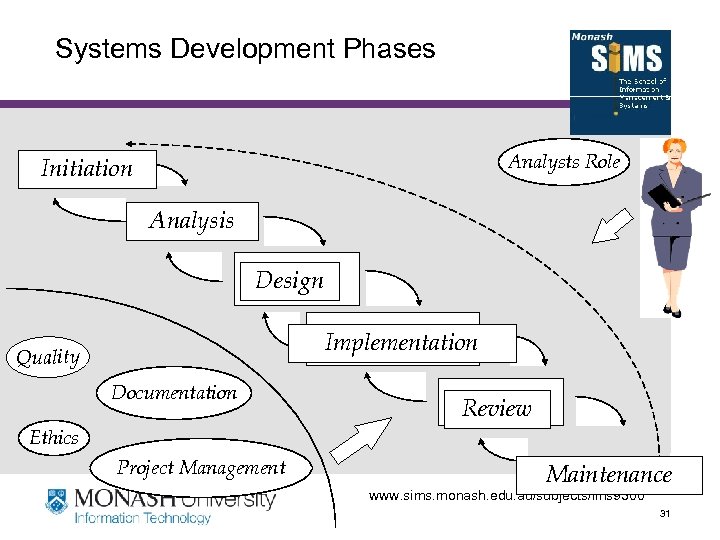 Systems Development Phases Analysts Role Initiation Analysis Design Implementation Quality Documentation Review Ethics Project Management Maintenance www. sims. monash. edu. au/subjects/ims 9300 31
 Quality • Quality is defined as fitness for purpose and concerns process and product. both • Error detection and correction in analysis and design is much cheaper than after the system is implemented. • Achieving quality requires that organisational structures, responsibilities, procedures, processes and resources for implementing quality management are in place. www. sims. monash. edu. au/subjects/ims 9300 32
 Project management – Select systems development methodology – Plan the project tasks – Estimate the resources and time required to complete individual phases of the project – Staff the project team – Organise and schedule the project effort(tasks/time/ people/technical resources) and therefore cost – Control the project development: direct the team, monitor progress, replan, restaff, reallocate resources www. sims. monash. edu. au/subjects/ims 9300 33
 Documentation – Various types of documentation must be produced throughout the SDLC – The data dictionary plays an important role during and after systems development: – A repository for information about and definitions of all “objects” identified during development – It supports and is maintained throughout the system lifecycle – It provides an important source for system documentation www. sims. monash. edu. au/subjects/ims 9300 34
 Professional ethics • Australian Computer Society (ACS) Code of Ethics for IT professionals • your reputation • your client's interests • confidentiality – the client’s own and their competitors' • impartiality • honesty www. sims. monash. edu. au/subjects/ims 9300 35
 Systems Development: The systems developer’s skills Systems developers require many different skills during the SDLC. Some of these are: • Interpersonal skills - to communicate effectively, facilitate groups, work in teams, manage expectations and change, deal with organisational politics • Analytical skills - to identify problems and determine solutions • Business knowledge - understanding of business systems • Technical skills and knowledge - to use the technology, and understand its potential and limitations • Management skills - to manage resources, projects, risk, and organisational change www. sims. monash. edu. au/subjects/ims 9300 36
 Who does Systems Development? • The organisation’s information technology department (in-house development) • End-user computing - development of systems by end-users with minimal assistance • Outsourcing - contracting development to external providers • IT consultants • Often a combination of the above www. sims. monash. edu. au/subjects/ims 9300 37
 Summary There is no such thing as a 'correct’, 'standard' development lifecycle approach to system development , because all information and processing problems are different and need different system development approaches. www. sims. monash. edu. au/subjects/ims 9300 38
 References • WHITTEN, J. L. , BENTLEY, L. D. and DITTMAN, K. C. (2001) 5 th ed. , Systems Analysis and Design Methods, Irwin/Mc. Graw-Hil. I, New York, NY. Chapter 1 and 3 • HOFFER, J. A. , GEORGE, J. F. and VALACICH (1999) 2 nd ed. , Modern Systems Analysis and Design, Benjamin/Cummings, Massachusetts. Chapter 1 • TURBAN, E. , RAINER, R. K. Jr. & POTTER, R. E. (2003) 2 ND ed. Introduction to Information Systems. John Wiley International Section 14 www. sims. monash. edu. au/subjects/ims 9300 39