 Скачать презентацию IMS 9043 IT in Organisations Organisational behavior
6920de3459dab6c3fcda81e0530cb8ed.ppt
- Количество слайдов: 43



IMS 9043 – IT in Organisations Organisational behavior and IS www. infotech. monash. edu. au 1
The IT Culture • important aspects include – concepts of the world and its problems • “everything looks like a nail to the man with a hammer” – – professional beliefs professional methodologies technical (insider) jargon professional standing and reputation • a faith in technical “solutions” www. infotech. monash. edu. au 2
The IT Credibility Equation • the IT culture and the failure of IT units to integrate with the rest of their organizations has been widely seen as a problem • IT staff have been portrayed as indifferent to people issues and unconcerned with the effects of the systems they build • on this basis, IT managers have a “credibility equation” to manage – the IT area is often simply not trusted www. infotech. monash. edu. au 3
Dealing with the problem • many leading IT theorists have argued that the major problem is a lack of understanding of technology and its impacts among business managers and staff • their recommended solution is better education for managers • is this appropriate? www. infotech. monash. edu. au 4
Organisational Politics • the art or science of government • activities associated with the exercise of power/ influence • war is “the continuation of politics by other means” (Clausewitz) • reaching a balance, based on the evaluation and resolution of competing priorities www. infotech. monash. edu. au 5
Organizational Politics (ctd) • organizational politics is about who gets to call the shots at the managerial level • it is allied with the pursuit and application of power • there is a widespread perception that IT professionals are politics-averse – they resent “wheeling and dealing” – they see politics as the art of the pragmatic rather than as leading to “best” solutions – politics can lead to irrational or unwarranted outcomes www. infotech. monash. edu. au 6
Organizational Politics (ctd) • viewed positively, playing politics is about resolving the problems which arise from differences in – perspective – values – attitudes www. infotech. monash. edu. au 7
Organisational Political Activities • negotiation • influence exercising/influence peddling/lobbying • back-room deals • coalition-building • managing the meeting – “I’ll ask Jack to comment on this” www. infotech. monash. edu. au 8
Information Technology and Organizational Politics • • • the transforming capacity of IT has been such as to place the IT professional above politics to a large extent the ability to understand apply the technology has provided a natural power base - therefore there has been no real need to “play politics” in the past the reality is that IT decisions inevitably have political aspects to them, some of which may be foreseen, but some which will be unforeseen – changes to the existing balance of power – new power bases & disable others – can be seen to be strengthening the IT power base at the expense of other organizational units www. infotech. monash. edu. au 9
Change • a number of factors can create resistance to change – – – fear uncertainty conservatism existing comfort level loss of skill base outsourcing has been described as “the revenge of the business manager” • a political approach may be the only way to succeed in implementing technology-based change www. infotech. monash. edu. au 10
Aversion to Politics • • • an aversion to organizational politics is counter-productive for IT managers and professional staff they must participate in organizational politics if they wish to exercise significant influence on directions changes in recent years have reduced the power of IT areas – – outsourcing increased IT-literacy among business managers and staff the scarcity of examples of IT-enabled successes internet-commerce initiatives have often been pushed by business units (making IT staff the reactionaries) www. infotech. monash. edu. au 11
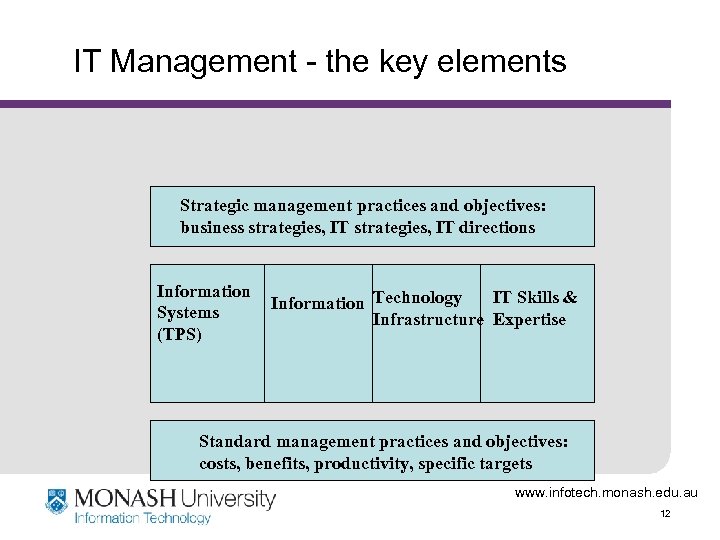
IT Management - the key elements Strategic management practices and objectives: business strategies, IT directions Information Systems (TPS) IT Skills & Information Technology Infrastructure Expertise Standard management practices and objectives: costs, benefits, productivity, specific targets www. infotech. monash. edu. au 12
Information Systems in Organizations • transaction processing systems – corporate databases • functional information systems – see Porter’s Value Chain model: production/operation, marketing, human resources, accounting, finance www. infotech. monash. edu. au 13
Transaction Processing Systems (TPS) • their significance is often missed against the “glitter” of more spectacular activities • TPS are still organizationally critical and are less understood than they used to be – their operations account for 60%+ of the IT budget in most organizations – TPS handle the basic processes required for the capture, validation, and storage of most corporate data – an effective TPS structure is critical to new initiatives such as internet-commerce – replacement strategies are very poorly dealt with in the literature - introduction of a new TPS requires a major commitment www. infotech. monash. edu. au 14
TPS - Characteristics • • • high volume optimized for accuracy and throughput deal with standard (routinized) processes reliable “manage” the contents of large databases run continuously (throughout the normal hours of business and often 24 hours a day) www. infotech. monash. edu. au 15
TPS - Organizational Positives • TPS – are organizational “workhorses” - they handle standardized routine processes – are the result of significant organizational investments of time and money – save hiring large numbers of staff – are (usually) extremely reliable and efficient – manage the vast bulk of organizations’ business data – help define the organization’s image www. infotech. monash. edu. au 16
TPS - Organizational Negatives • TPS – may no longer solve the “right” problem (the legacy systems issue) – if “standalone”, can inhibit organizations from being flexible and innovative – are where problems (eg. GST) will be most difficult to solve – are usually poorly documented and understood – are difficult and expensive to replace – help define the organization’s image – may run on old technology – may have been developed in an old programming language www. infotech. monash. edu. au 17
“Legacy” Systems • the legacy systems concept was introduced to refer specifically to outdated TPS – but virtually every TPS is at least a little out of date from the moment it is installed, so there is a need for balance www. infotech. monash. edu. au 18
Functional Information Systems • inventory management – corporate databases • quality control – information about quality of incoming raw materials; semi-finished and finished products • Material requirements planning – information about quality of incoming raw materials; semi-finished and finished products www. infotech. monash. edu. au 19
Functional Information Systems ctd. “Front-end” (Customer Interface) Systems • • these are important because? it’s easiest to answer this by contrasting an effective system with some common negative comments (and experiences) – – “I’m sorry, the system won’t let me do that” “I’m sorry, the system has no record of that” “I’m sorry, you don’t appear to be registered” “I’m sorry, the system is down and I can’t help you” – some of these responses may be due to “back-end” problems as we shall see later in the course, but some are because of front-end inadequacies www. infotech. monash. edu. au 20
Functional Information Systems ctd. MIS/DSS/EIS/Data Warehouses • these systems are important but are almost never mission critical • this is because they are usually not fundamental to operations – ie the organization can continue to function quite adequately without them – substitute processes (sometimes manual) are usually able to be activated – quite often it is possible to wait for the problems to be fixed • their organizational implications are to be discussed in a later lecture www. infotech. monash. edu. au 21
Outsourcing and TPS • many of the most difficult outsourcing issues revolve around TPS – maintenance – enhancements – support – replacement www. infotech. monash. edu. au 22
ERP and TPS • the ERP industry likewise revolves around TPS – an ERP package replaces existing TPS – ERP packages are effective because they provide highly reliable “vanilla” solutions to standard business process problems www. infotech. monash. edu. au 23
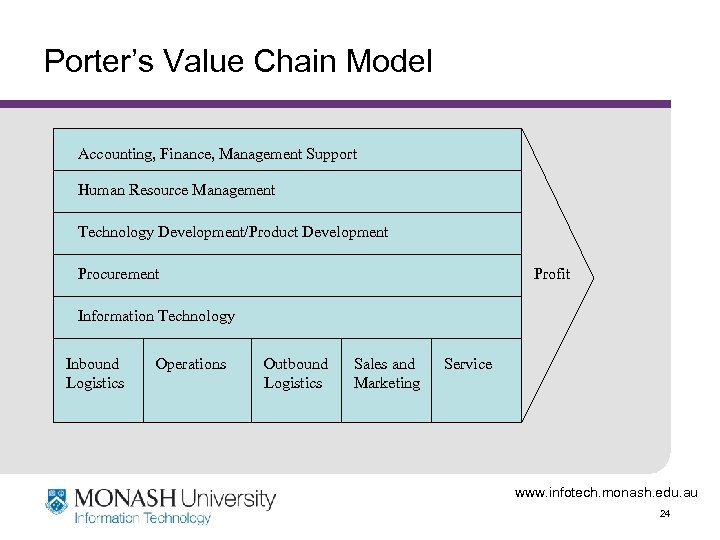
Porter’s Value Chain Model Accounting, Finance, Management Support Human Resource Management Technology Development/Product Development Procurement Profit Information Technology Inbound Logistics Operations Outbound Logistics Sales and Marketing Service www. infotech. monash. edu. au 24
The Value Chain Model • the “value chain” model is important in IT management because – an organization’s aim is to add value at each point in the chain and with each support function – information is created by activities in all parts of the model – the application of IT is therefore critical throughout the model > the information generated can facilitate the smooth running of the organization > the better information is managed the more efficient the organization > the information generated (and the processes used) may be a source of competitive advantage www. infotech. monash. edu. au 25
Information Systems Integration • a key question in IS is that of “integrated systems” • an integrated systems structure works off – – standard data structures data definitions process definitions business rules www. infotech. monash. edu. au 26
IS Integration and the Outside World • integration is of increasing importance because of its implications for dealing with the outside world – customers > personal and corporate, electronic, international – suppliers – staff – government • integrated systems facilitate all these interactions www. infotech. monash. edu. au 27
Integrated Systems • systems integration facilitates – – – effective CAM (customer asset management) effective SCM (supply chain management) effective sales-based marketing campaigns innovative “fly-buys” concepts effective internet-commerce applications www. infotech. monash. edu. au 28
CRM and its Support by IT § Customer relationship management (CRM): An enterprise wide effort to acquire and retain customers, often supported by IT. www. infotech. monash. edu. au 29
Type of CRM Operational CRM: activities involving customer services, order management, invoice /billing and sale/marketing automation and management. Analytical CRM: activities that capture, store, extract , process, interpret, and report customer data a corporate. user. Collaboration CRM: deals with all the necessary communication coordination and collaboration between vendors and customers. www. infotech. monash. edu. au 30
Supply Chain & Value Chain Definitions SUPPLY CHAIN flow of materials, information, payments, and services from raw material suppliers, through factories and warehouses, to the end customers. SUPPLY CHAIN MANAGEMENT (SCM) to plan, organize, and coordinate all the supply chain’s activities. www. infotech. monash. edu. au 31
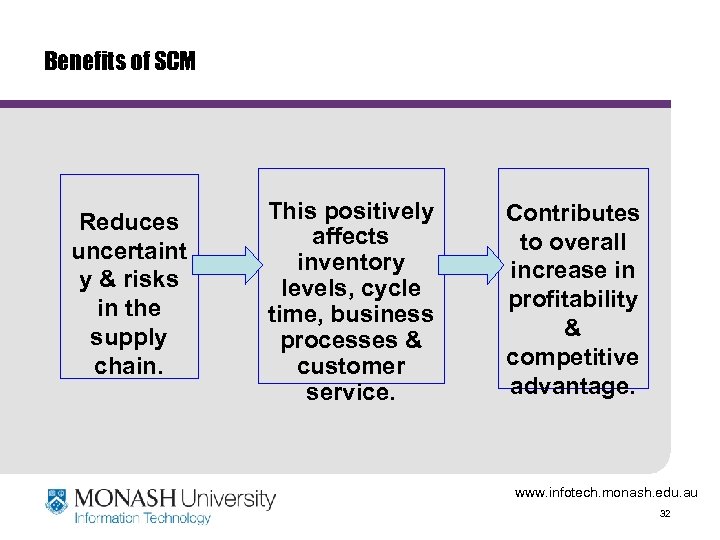
Benefits of SCM Reduces uncertaint y & risks in the supply chain. This positively affects inventory levels, cycle time, business processes & customer service. Contributes to overall increase in profitability & competitive advantage. www. infotech. monash. edu. au 32
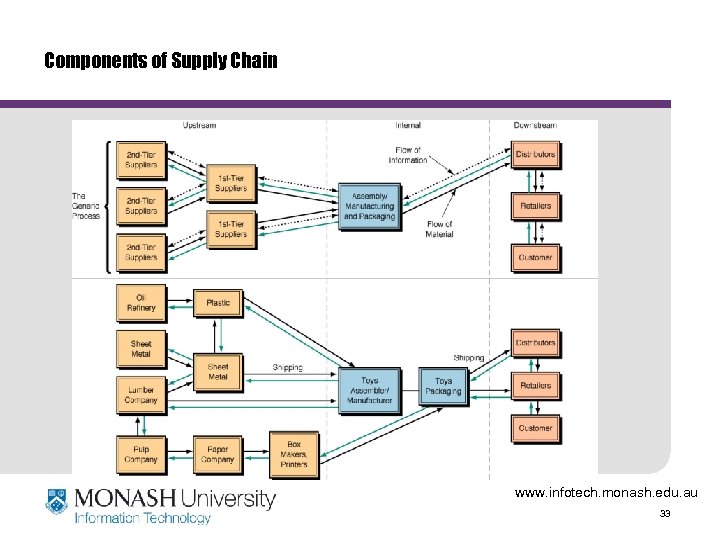
Components of Supply Chain www. infotech. monash. edu. au 33
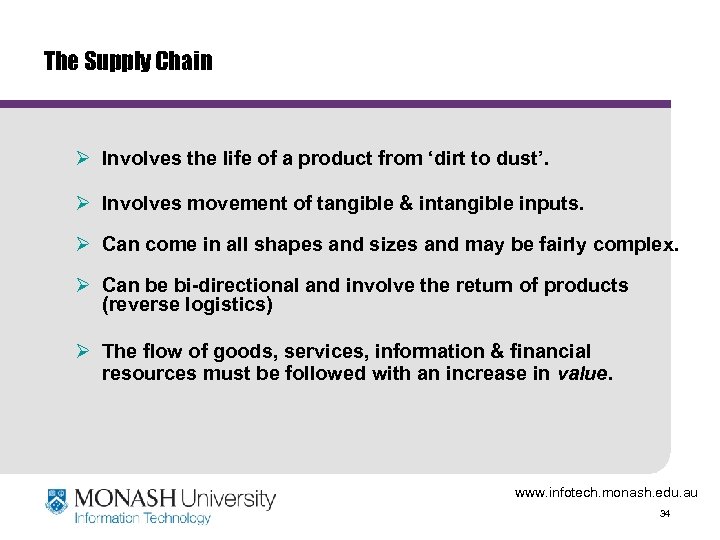
The Supply Chain Ø Involves the life of a product from ‘dirt to dust’. Ø Involves movement of tangible & intangible inputs. Ø Can come in all shapes and sizes and may be fairly complex. Ø Can be bi-directional and involve the return of products (reverse logistics) Ø The flow of goods, services, information & financial resources must be followed with an increase in value. www. infotech. monash. edu. au 34
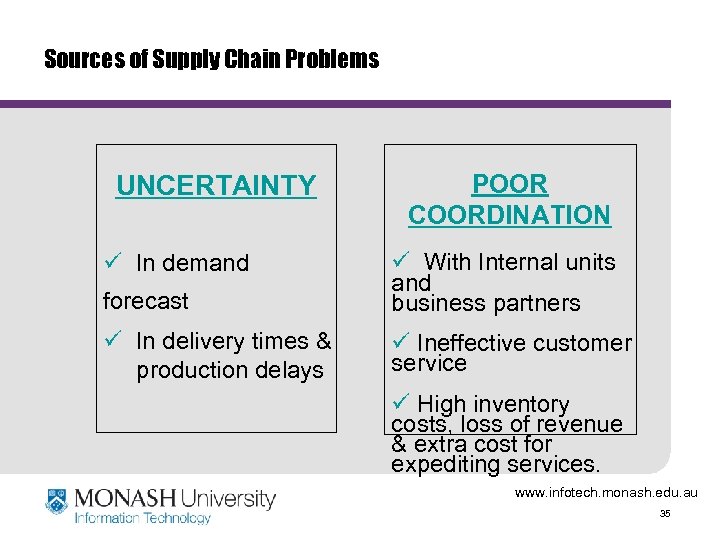
Sources of Supply Chain Problems UNCERTAINTY POOR COORDINATION forecast ü With Internal units and business partners ü In delivery times & production delays ü Ineffective customer service ü In demand ü High inventory costs, loss of revenue & extra cost for expediting services. www. infotech. monash. edu. au 35
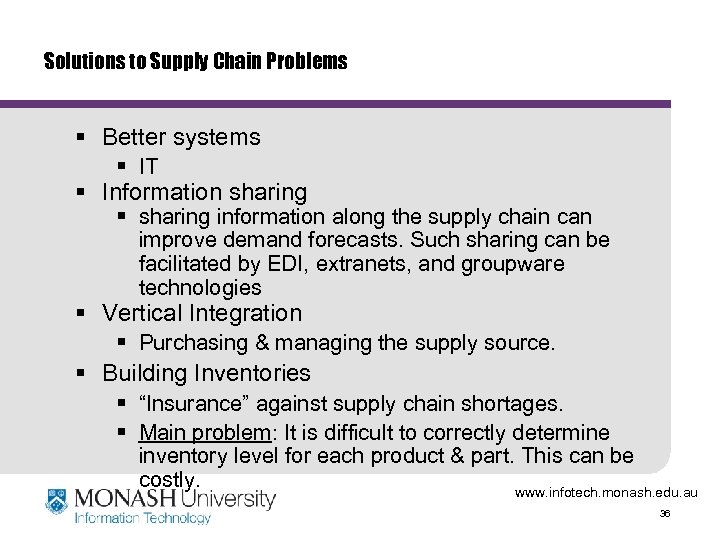
Solutions to Supply Chain Problems § Better systems § IT § Information sharing § sharing information along the supply chain can improve demand forecasts. Such sharing can be facilitated by EDI, extranets, and groupware technologies § Vertical Integration § Purchasing & managing the supply source. § Building Inventories § “Insurance” against supply chain shortages. § Main problem: It is difficult to correctly determine inventory level for each product & part. This can be costly. www. infotech. monash. edu. au 36
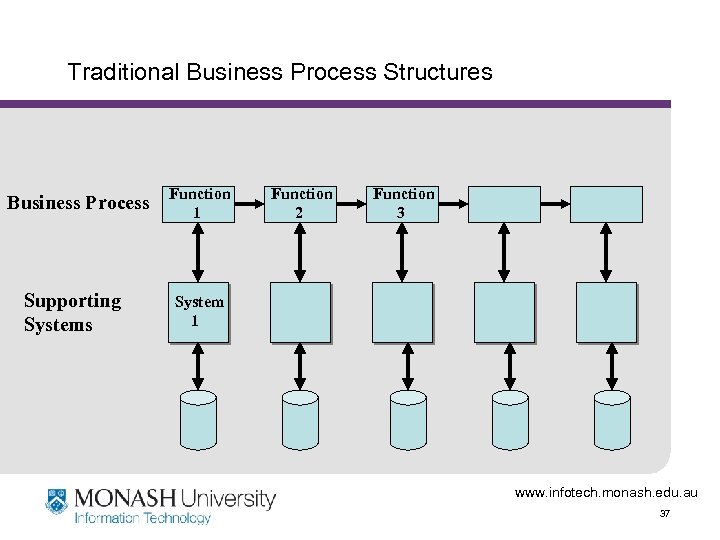
Traditional Business Process Structures Business Process Supporting Systems Function 1 Function 2 Function 3 System 1 www. infotech. monash. edu. au 37
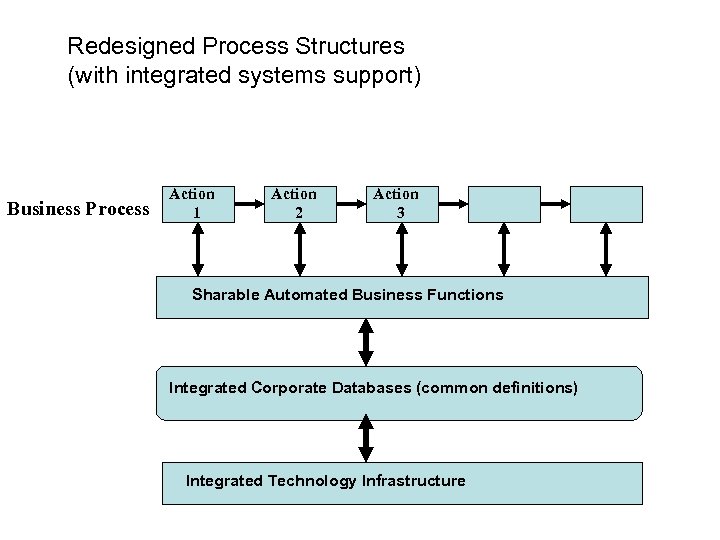
Redesigned Process Structures (with integrated systems support) Business Process Action 1 Action 2 Action 3 Sharable Automated Business Functions Integrated Corporate Databases (common definitions) Integrated Technology Infrastructure
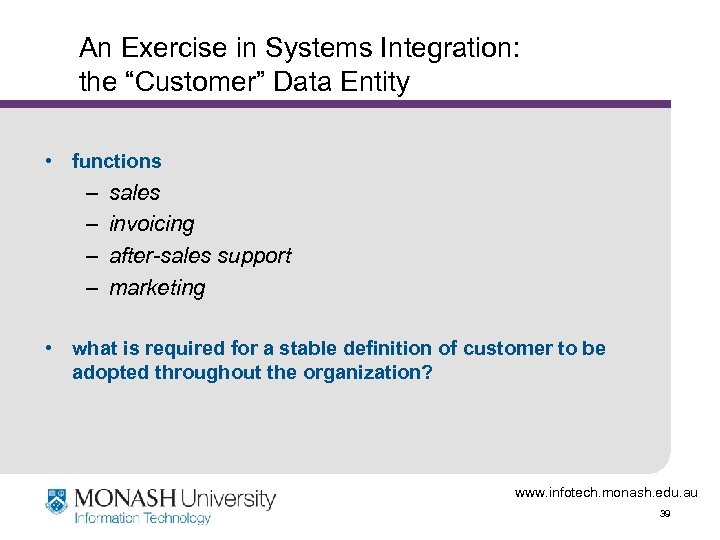
An Exercise in Systems Integration: the “Customer” Data Entity • functions – – sales invoicing after-sales support marketing • what is required for a stable definition of customer to be adopted throughout the organization? www. infotech. monash. edu. au 39
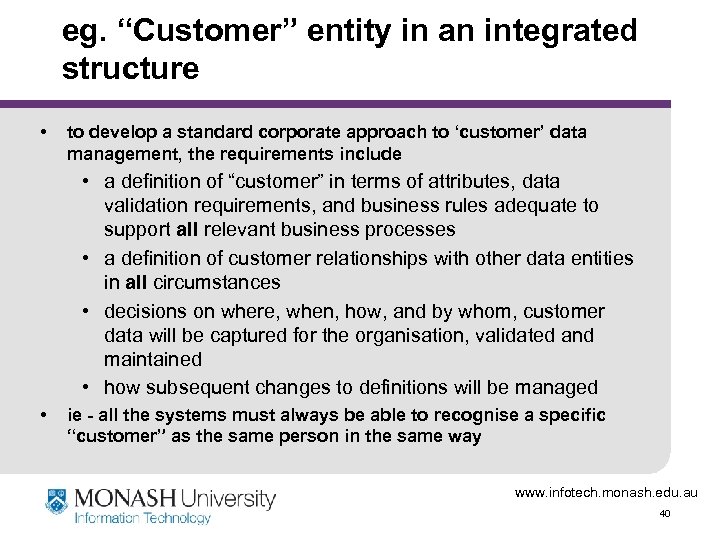
eg. “Customer” entity in an integrated structure • to develop a standard corporate approach to ‘customer’ data management, the requirements include • a definition of “customer” in terms of attributes, data validation requirements, and business rules adequate to support all relevant business processes • a definition of customer relationships with other data entities in all circumstances • decisions on where, when, how, and by whom, customer data will be captured for the organisation, validated and maintained • how subsequent changes to definitions will be managed • ie - all the systems must always be able to recognise a specific “customer” as the same person in the same way www. infotech. monash. edu. au 40
Benefits of Systems Integration • standardized work practices/processes – – – – simplified training requirements easier introduction of new staff to the organization interchangeable staff standard customer interface simplified management processes simplified change management reduced system redundancy economies of scale www. infotech. monash. edu. au 41
Benefits of Systems Integration • standardized data structures and definitions – – – reliable data consistent management information consistent reporting formats and processes “single-point” system changes improved communications www. infotech. monash. edu. au 42
References • Turban, Leidner, Mc. Lean & Wetherbe. Chapter 6 • Turban, Rainer, Potter: Introduction to Information Technology. Chapter 8 www. infotech. monash. edu. au 43
Скачать презентацию IMS 9043 IT in Organisations Organisational behavior
6920de3459dab6c3fcda81e0530cb8ed.ppt