


 Скачать презентацию IMS 2805 — Systems Design and Implementation Lecture
2d8fc2820b2ef5592529c0ec78d8530b.ppt
- Количество слайдов: 28
 IMS 2805 - Systems Design and Implementation Lecture 12 Post-implementation: Maintenance and review 1
 References § HOFFER, J. A. , GEORGE, J. F. and VALACICH (2002) 3 rd ed. , Modern Systems Analysis and Design, Prentice-Hall, New Jersey, Chap 18 § HOFFER, J. A. , GEORGE, J. F. and VALACICH (2005) 4 th ed. , Modern Systems Analysis and Design, Prentice-Hall, New Jersey, Chap 16 § WHITTEN, J. L. , BENTLEY, L. D. and DITTMAN, K. C. (2001) 5 th ed. , Systems Analysis and Design Methods, Irwin/Mc. Graw-Hil. I, New York, NY. Chapters 16, 17 2
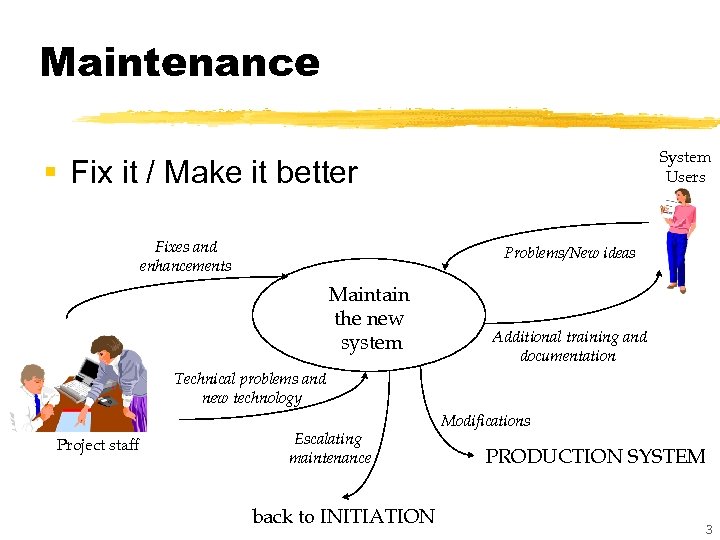 Maintenance System Users § Fix it / Make it better Fixes and enhancements Problems/New ideas Maintain the new system Additional training and documentation Technical problems and new technology Project staff Escalating maintenance back to INITIATION Modifications PRODUCTION SYSTEM 3
 Transition to Maintenance § Most organisations have formal procedures set up § A "maintenance" section is responsible! § Procedures should be set up to request maintenance § Owners of the new system must be informed of relevant procedures 4
 Transition to Maintenance § “Once the product has passed its acceptance test, it is handed over to the client. any changes after the client has accepted the product constitute maintenance. ” Schach, 1993 § Maintenance can be up to 75% of IS department budget 5
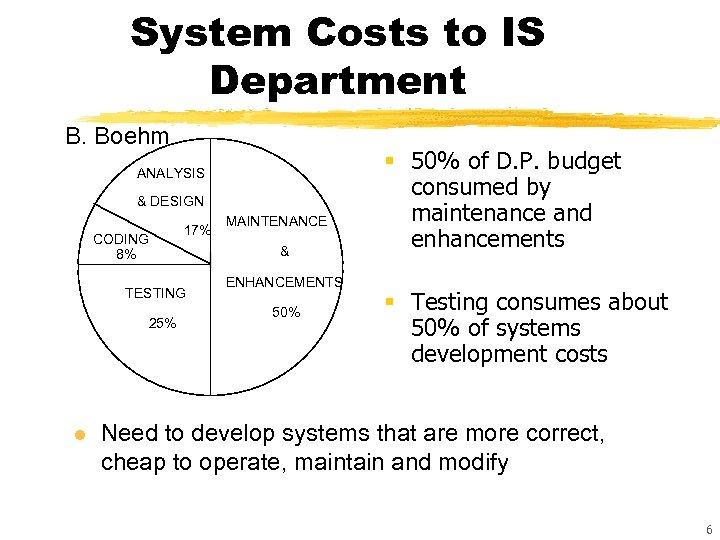 System Costs to IS Department B. Boehm ANALYSIS & DESIGN CODING 8% 17% TESTING 25% l MAINTENANCE & ENHANCEMENTS 50% § 50% of D. P. budget consumed by maintenance and enhancements § Testing consumes about 50% of systems development costs Need to develop systems that are more correct, cheap to operate, maintain and modify 6
 What is Maintenance § Maintenance is NOT just bug-fixing! § 4 types of maintenance § Corrective maintenance § Adaptive maintenance § Perfective maintenance § Preventative maintenance § If the cost of maintenance is too high consider other options: § new development, purchase a software package, re-engineer/modify 7
 Corrective Maintenance § Corrects analysis, design and implementation errors § most corrective problems arise soon after installation or after major system changes § should have been isolated and corrected during development § professional practice during development should minimise the need (but will not remove it completely) § adds little or no value - focus on removing defects rather than adding anything new § accounts for up to 75% of all maintenance activity 8
 Corrective Maintenance § Can be the most expensive kind of maintenance § costs of functions not working correctly § having to undo what has been developed § Requires immediate attention § typically urgent, interfere with normal operations § Needs skilled maintenance staff to ensure rapid diagnosis of errors and their correction § must have or quickly develop high level of familiarity with the system § software tools for diagnosis 9
 Adaptive Maintenance § To satisfy changes in the environment, changing business needs or new user requirements § changes in tax laws, takeovers and mergers, new OS, etc § new type of report, new class of customer etc. § Less urgent - changes occur over time § Adaptive maintenance is inevitable, does add value § Maintenance staff need strong analysis and design skills as well as programming skills § changes often require a complete SDLC § also need good understanding of the system 10
 Preventative Maintenance § Pay now or pay more later § defects or potential problems found and corrected before they cause any damage § reduce chance of future system failure § eg expand number of records beyond needs, standardise formats across platforms § A natural by-product of maintenance work identify and fix any potential problems noted while fixing other errors 11
 Preventative Maintenance § Ideally have periodic (monthly / half-yearly / annual) reviews of system to uncover and anticipate problems - lower priority § Often ignored because § too few resources § fear of recrimination - why wasn’t it done properly the first time? § no way of accounting for the cost of the effort 12
 Perfective Maintenance § To enhance performance, maintainability, usability § adds desired features rather than required § better run times, faster transaction processing § To meet user requirements not previously recognised or given high priority § missed in development or not known about § considered unimportant 13
 Perfective Maintenance § Legacy systems (old systems running for at least 10 years) are likely candidates for perfective maintenance § May involve technical systems specialists as well as general maintenance staff § network specialist to change network design for improved performance 14
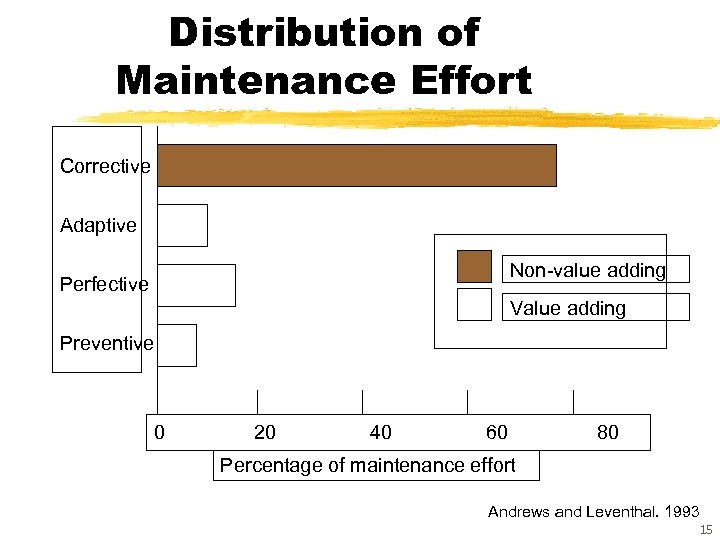 Distribution of Maintenance Effort Corrective Adaptive Non-value adding Perfective Value adding Preventive 0 20 40 60 80 Percentage of maintenance effort Andrews and Leventhal. 1993 15
 Costs of Maintenance § There are many factors or cost elements affecting the ‘maintainability’ of a system § Maintainability § the ease with which software can be understood, corrected, adapted and enhanced § Low maintainability results in uncontrollable maintenance expenses 16
 Cost Elements of Maintenance § The following factors affect ‘maintainability’ § Defects § Customers § Documentation § Personnel § Tools § Software structure § Defects, customers and documentation have a significant effect on maintainabilty 17
 Cost Elements of Maintenance § Defects § the number of latent or unknown errors existing after system installation § influences most maintenance costs, drives all other cost factors § few errors --> low maintenance costs § Customers § the number of customers/users of system § more customers, more maintenance effort/cost § greater need for high maintainability 18
 Cost Elements of Maintenance § Documentation § quality of system documentation § exponential effect on maintenance costs § Personnel § quality of maintenance personnel § highly skilled programmers, typically not original programmers, to quickly understand carefully change system § separate from development? in-house? dedicated end-user support? 19
 Cost Elements of Maintenance § Tools § appropriate automated development tools § programming tools, code generators, debuggers, hardware, CASE, diagnostics, etc § reverse engineering for no documentation § Software structure § quality of software structure and maintainability § formalisation of code, comments, versioning § structure charts, OO 20
 Measuring Maintenance Effectiveness § There is a need to measure maintenance § understand quality of development/maintenance effort § We measure the following factors § number of failures § time between each failure § type of failure § Mean Time Between Failures (MTBF) § calculated using number of failures and time between each failure, widely used measure of quality 21
 Maintenance Life Cycle § Software Maintenance Life Cycle (SMLC) § receive a Maintenance Request § transform the Maintenance Request to a Change (analysis) § specify the Change (design) § develop the Change (code) 22
 Maintenance Life Cycle § Software Maintenance Life Cycle (SMLC) § § § test the Change train users and run an acceptance test convert and release to operations update the documentation conduct a Post-Maintenance Review Chapin, 1988 23
 Change Management Systems § Overall goal is to manage change effectively § Organisations implement change management systems in an attempt to reduce the confusion and complexity of developing and maintaining systems 24
 Change Management Systems § The aims of change management systems are § § § restrict access to production source and object code reduce errors being introduced into production single version of source and object code in production improve quality and reliability of software increase security and control increase software productivity 25
 Maintenance § It is important to realise that adaptive, perfective, and preventive maintenance can lead to corrective maintenance if not carefully designed and implemented § Occasionally system failure is inevitable! 26
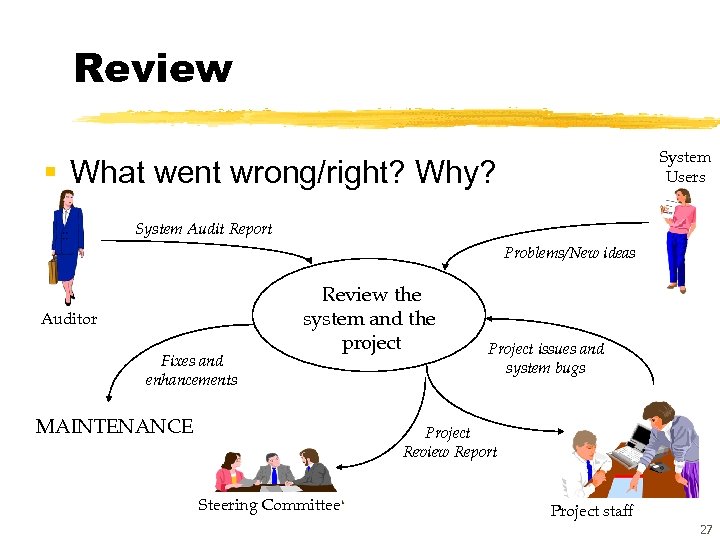 Review System Users § What went wrong/right? Why? System Audit Report Problems/New ideas Auditor Fixes and enhancements Review the system and the project MAINTENANCE Project issues and system bugs Project Review Report Steering Committee Project staff 27
 Post Implementation Review § A PIR analyses what went right and wrong with a project. It is conducted 2 to 6 months after conversion by a team which includes user reps, development staff, internal auditors and sometimes external consultants development team is not in charge § look at original requirements and objectives § evaluate how well they were met § compare costs of development and operation against original estimates (maintenance costs ? ? ) § compare original and actual benefits § new system reviewed to see whether more of original or additional benefits can be realised 28