 Скачать презентацию Improving Use Case Based Requirements Using Formally Grounded
f3ed74dabf242f39c05e1ce277d9874d.ppt
- Количество слайдов: 27



Improving Use Case Based Requirements Using Formally Grounded Specifications* C. Choppy G. Reggio LIPN DISI Université Paris XIII France Università di Genova Italy * Extended version with full case study in the CD
The Problem NEED produce (capture and specify) “GOOD” requirements – both clear and precise – to provide a sound basis to the overall development – to avoid errors that will be difficult and costly to correct further on (if possible)
HOW ? (1) • Use USE CASES – use case = • description of interactions between the system under discussion and external actors, related to the goal of one particular actor • description is textual (“familiar”, easy to read) and sums up a set of scenarios (sequences of interactions between system and actors) – quite successful • easy to use and informal • easily give an idea of the system that can be discussed with the client • a lot of freedom in what should include a use case description, and how it should be written – however • “use cases are wonderful but confusing'' (Cockburn 2000) • use cases are often imprecise, and used terms are vague or ambiguous
HOW ? (2) • Use formal specifications – lead to precise, unambiguous descriptions – but difficult to use and impractical in quite a number of cases – hard to write/read such specifications – hard to start with formal specifications while still working on the requirements (thus, trying to understand what is the problem about)
HOW ? (3) • combine advantages of use cases and of formal specifications – improving use case based requirements by developing a companion Formally Grounded specification [Choppy. Reggio 2003] • written in a “visual” notation (diagrams and text) • with a formal counterpart written in the logical-algebraic CASL-LTL specification language • produced following a systematic method, arising questions on all the aspects of the specified system – resulting in • requirement validation, writing the Formally Grounded specification leads to thoroughly check that requirements • improved requirements (requirements may be updated) • improved use case based requirement specification • a formal specification available formal analysis
Case study: Auction System • Online auction system to allow to buy/sell goods • Innovative because it guarantees that bid placed are solvent • Users must first enroll and log on for each session, then they are able to sell, buy, or browse the available auctions • Customers have credit with the system used as security on each bid; and can increase it by asking the system to debit a certain amount from their credit card, and when sell • A customer that wishes to sell initiates an auction by informing the system of the goods to auction with …. • Customers that wish to follow an auction must first join the auction, then them may make a bid, or post a message • Bidders are allowed to place their bids until the auction closes, and place bids across as many auctions as they please
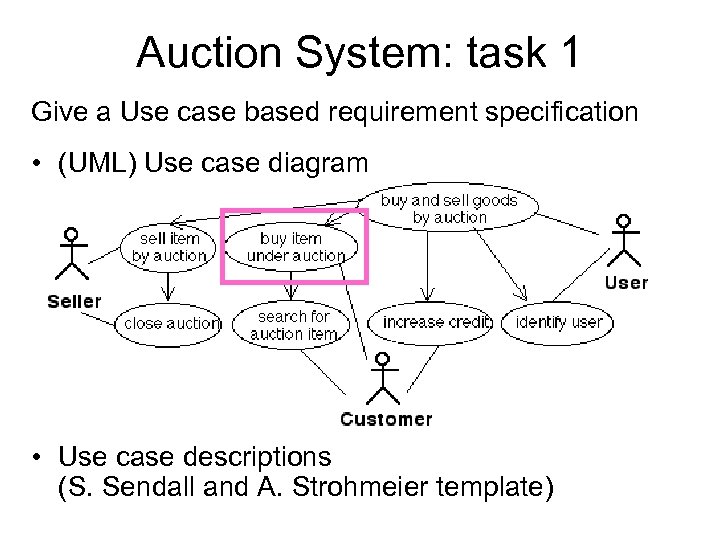
Auction System: task 1 Give a Use case based requirement specification • (UML) Use case diagram • Use case descriptions (S. Sendall and A. Strohmeier template)
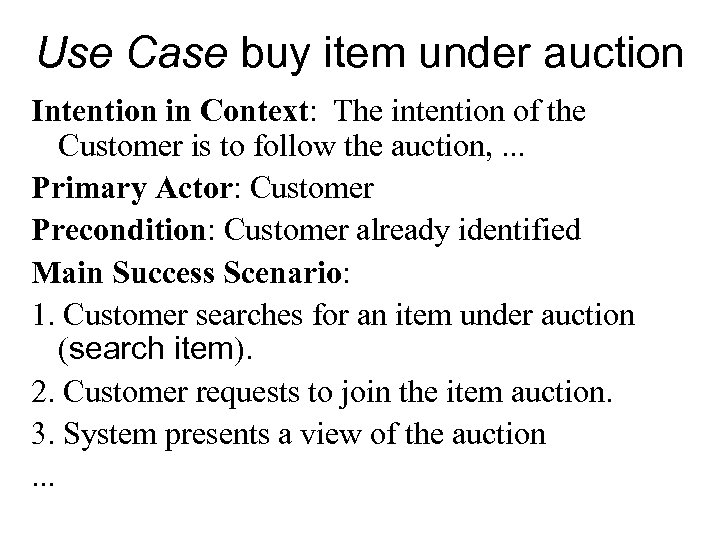
Use Case buy item under auction Intention in Context: The intention of the Customer is to follow the auction, . . . Primary Actor: Customer Precondition: Customer already identified Main Success Scenario: 1. Customer searches for an item under auction (search item). 2. Customer requests to join the item auction. 3. System presents a view of the auction. . .
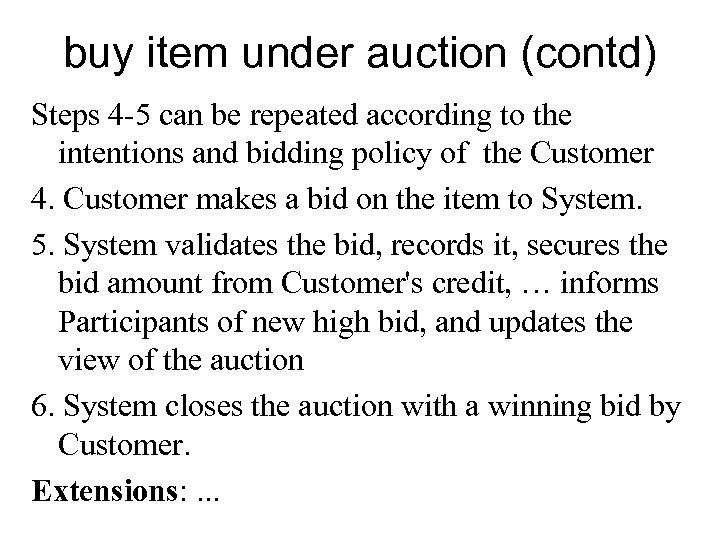
buy item under auction (contd) Steps 4 -5 can be repeated according to the intentions and bidding policy of the Customer 4. Customer makes a bid on the item to System. 5. System validates the bid, records it, secures the bid amount from Customer's credit, … informs Participants of new high bid, and updates the view of the auction 6. System closes the auction with a winning bid by Customer. Extensions: . . .
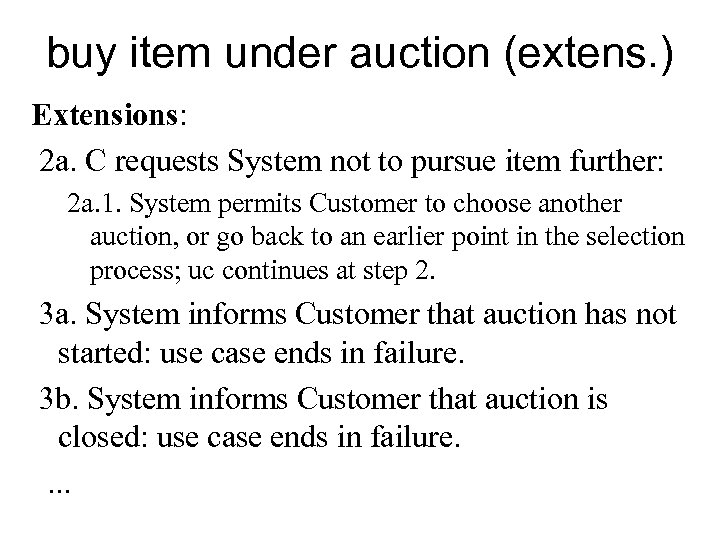
buy item under auction (extens. ) Extensions: 2 a. C requests System not to pursue item further: 2 a. 1. System permits Customer to choose another auction, or go back to an earlier point in the selection process; uc continues at step 2. 3 a. System informs Customer that auction has not started: use case ends in failure. 3 b. System informs Customer that auction is closed: use case ends in failure. .
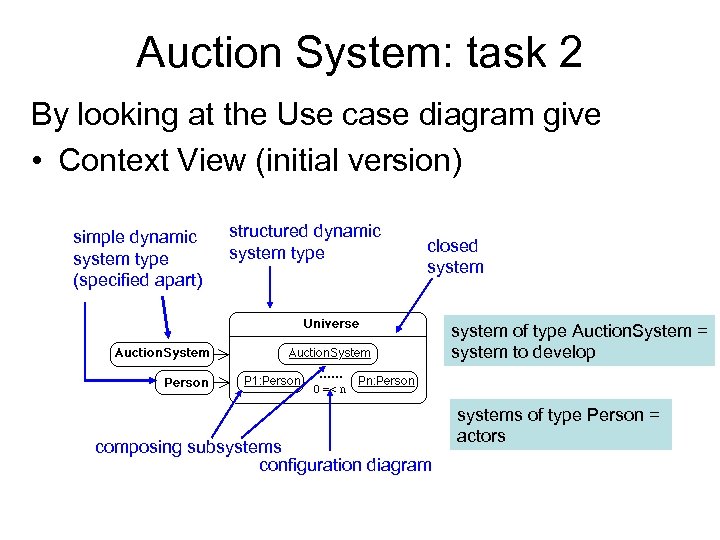
Auction System: task 2 By looking at the Use case diagram give • Context View (initial version) simple dynamic system type (specified apart) structured dynamic system type closed system of type Auction. System = system to develop composing subsystems configuration diagram systems of type Person = actors
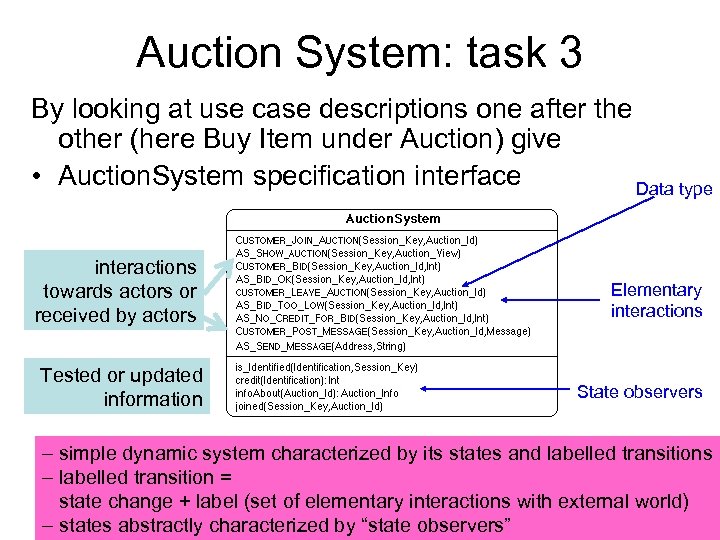
Auction System: task 3 By looking at use case descriptions one after the other (here Buy Item under Auction) give • Auction. System specification interface Data type interactions towards actors or received by actors Tested or updated information Elementary interactions State observers – simple dynamic system characterized by its states and labelled transitions – labelled transition = state change + label (set of elementary interactions with external world) – states abstractly characterized by “state observers”
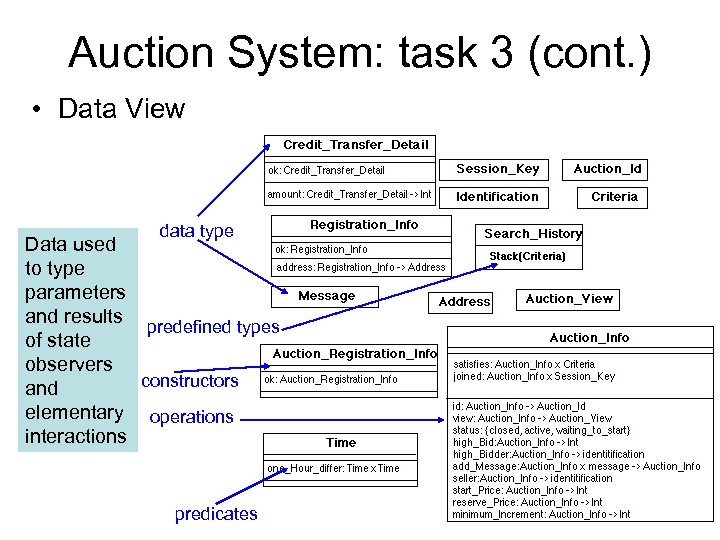
Auction System: task 3 (cont. ) • Data View data type Data used to type parameters and results predefined types of state observers constructors and elementary operations interactions predicates
Auction System: task 4 • find the properties about Auction. System by filling “forms” generated by the elementary interactions and state observers found in the previous task systematically covering “all” its aspects based on a many-sorted, first-order, CTL*-style temporal logic with edge formulae • In the meantime – previous diagrams may be modified – new state observers may be added (thus the forms to be filled may be updated consequently) – original use case based requirement specification may be modified to reflect the better insights on the Auction. System gained while looking for properties Auction System: task 5
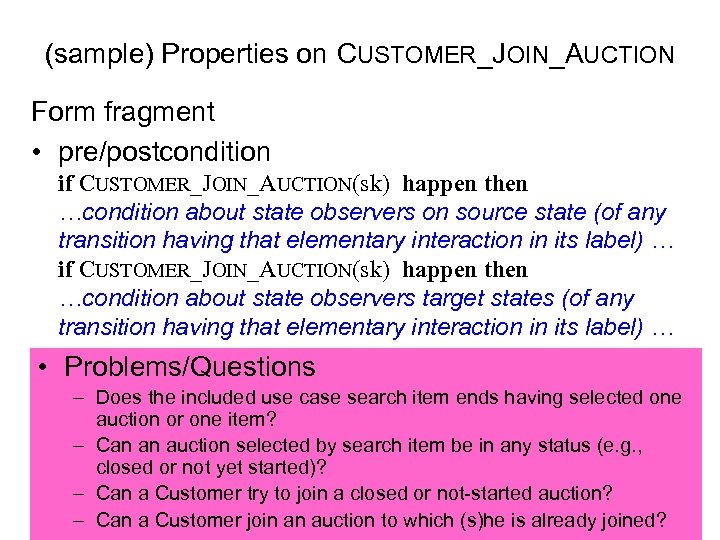
(sample) Properties on CUSTOMER_JOIN_AUCTION Form fragment • pre/postcondition if CUSTOMER_JOIN_AUCTION(sk) happen then …condition about state observers on source state (of any transition having that elementary interaction in its label) … if CUSTOMER_JOIN_AUCTION(sk) happen then …condition about state observers target states (of any transition having that elementary interaction in its label) … • Problems/Questions – Does the included use case search item ends having selected one auction or one item? – Can an auction selected by search item be in any status (e. g. , closed or not yet started)? – Can a Customer try to join a closed or not-started auction? – Can a Customer join an auction to which (s)he is already joined?
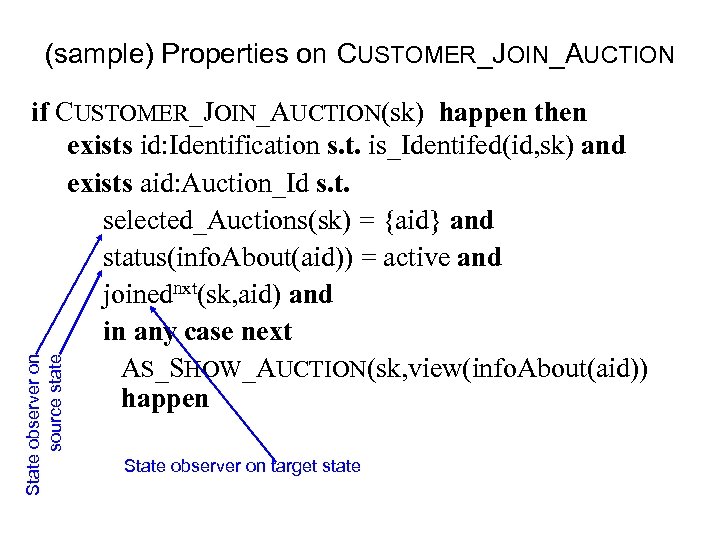
(sample) Properties on CUSTOMER_JOIN_AUCTION State observer on source state if CUSTOMER_JOIN_AUCTION(sk) happen then exists id: Identification s. t. is_Identifed(id, sk) and exists aid: Auction_Id s. t. selected_Auctions(sk) = {aid} and status(info. About(aid)) = active and joinednxt(sk, aid) and in any case next AS_SHOW_AUCTION(sk, view(info. About(aid)) happen State observer on target state
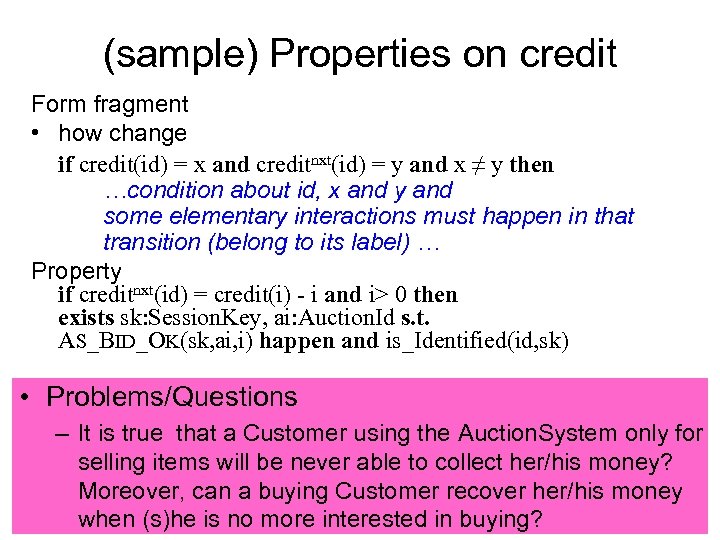
(sample) Properties on credit Form fragment • how change if credit(id) = x and creditnxt(id) = y and x ≠ y then …condition about id, x and y and some elementary interactions must happen in that transition (belong to its label) … Property if creditnxt(id) = credit(i) - i and i> 0 then exists sk: Session. Key, ai: Auction. Id s. t. AS_BID_OK(sk, ai, i) happen and is_Identified(id, sk) • Problems/Questions – It is true that a Customer using the Auction. System only for selling items will be never able to collect her/his money? Moreover, can a buying Customer recover her/his money when (s)he is no more interested in buying?
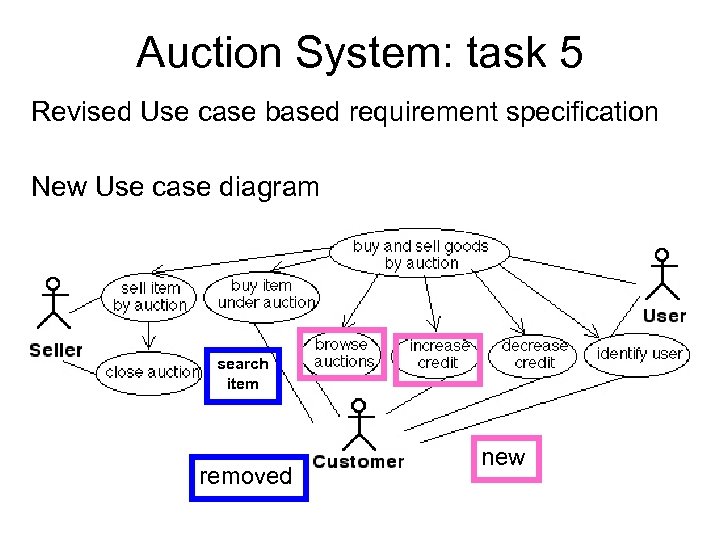
Auction System: task 5 Revised Use case based requirement specification New Use case diagram search item removed new
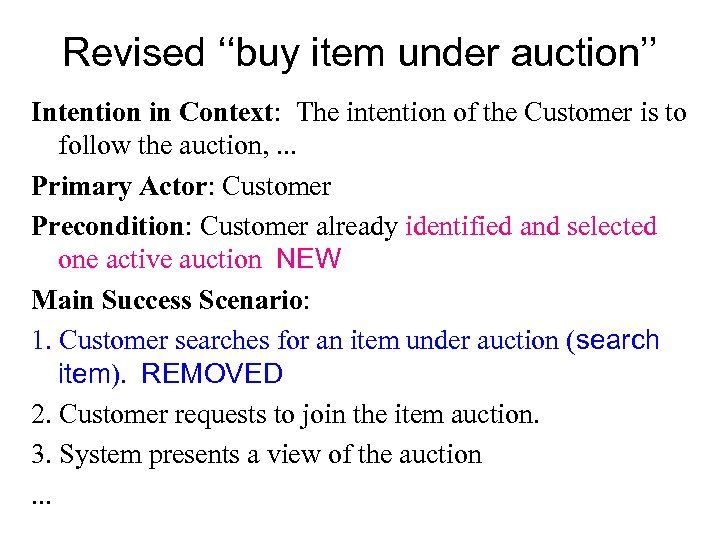
Revised ‘‘buy item under auction’’ Intention in Context: The intention of the Customer is to follow the auction, . . . Primary Actor: Customer Precondition: Customer already identified and selected one active auction NEW Main Success Scenario: 1. Customer searches for an item under auction (search item). REMOVED 2. Customer requests to join the item auction. 3. System presents a view of the auction. . .
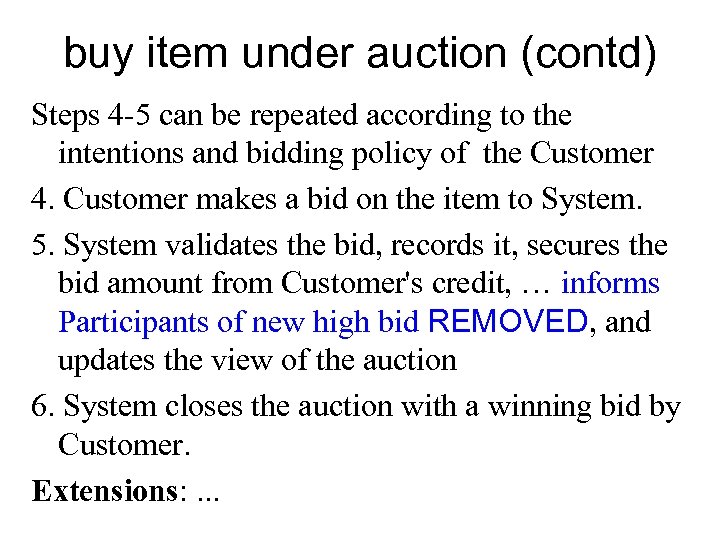
buy item under auction (contd) Steps 4 -5 can be repeated according to the intentions and bidding policy of the Customer 4. Customer makes a bid on the item to System. 5. System validates the bid, records it, secures the bid amount from Customer's credit, … informs Participants of new high bid REMOVED, and updates the view of the auction 6. System closes the auction with a winning bid by Customer. Extensions: . . .
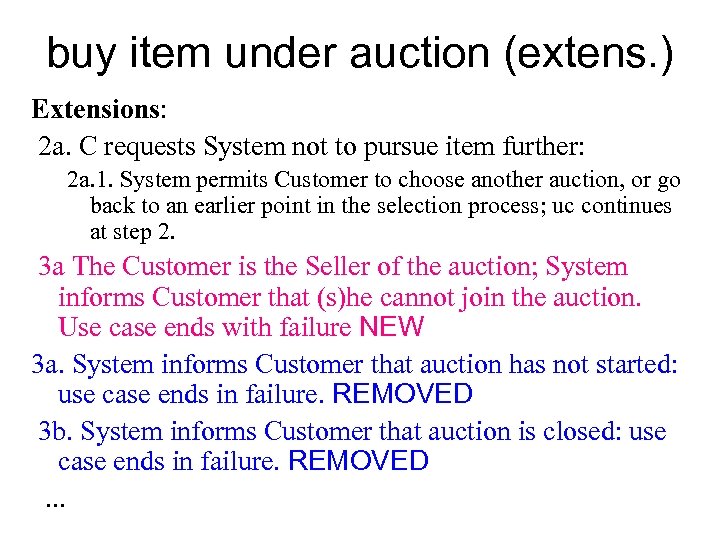
buy item under auction (extens. ) Extensions: 2 a. C requests System not to pursue item further: 2 a. 1. System permits Customer to choose another auction, or go back to an earlier point in the selection process; uc continues at step 2. 3 a The Customer is the Seller of the auction; System informs Customer that (s)he cannot join the auction. Use case ends with failure NEW 3 a. System informs Customer that auction has not started: use case ends in failure. REMOVED 3 b. System informs Customer that auction is closed: use case ends in failure. REMOVED. . .
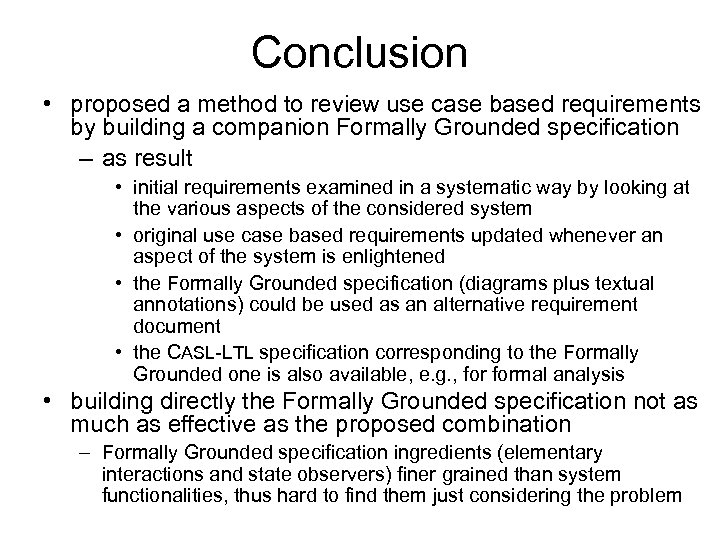
Conclusion • proposed a method to review use case based requirements by building a companion Formally Grounded specification – as result • initial requirements examined in a systematic way by looking at the various aspects of the considered system • original use case based requirements updated whenever an aspect of the system is enlightened • the Formally Grounded specification (diagrams plus textual annotations) could be used as an alternative requirement document • the CASL-LTL specification corresponding to the Formally Grounded one is also available, e. g. , formal analysis • building directly the Formally Grounded specification not as much as effective as the proposed combination – Formally Grounded specification ingredients (elementary interactions and state observers) finer grained than system functionalities, thus hard to find them just considering the problem
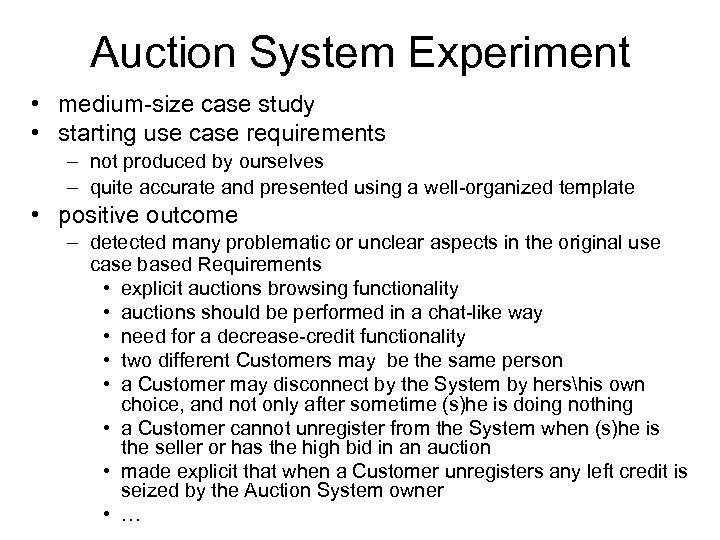
Auction System Experiment • medium-size case study • starting use case requirements – not produced by ourselves – quite accurate and presented using a well-organized template • positive outcome – detected many problematic or unclear aspects in the original use case based Requirements • explicit auctions browsing functionality • auctions should be performed in a chat-like way • need for a decrease-credit functionality • two different Customers may be the same person • a Customer may disconnect by the System by hershis own choice, and not only after sometime (s)he is doing nothing • a Customer cannot unregister from the System when (s)he is the seller or has the high bid in an auction • made explicit that when a Customer unregisters any left credit is seized by the Auction System owner • …
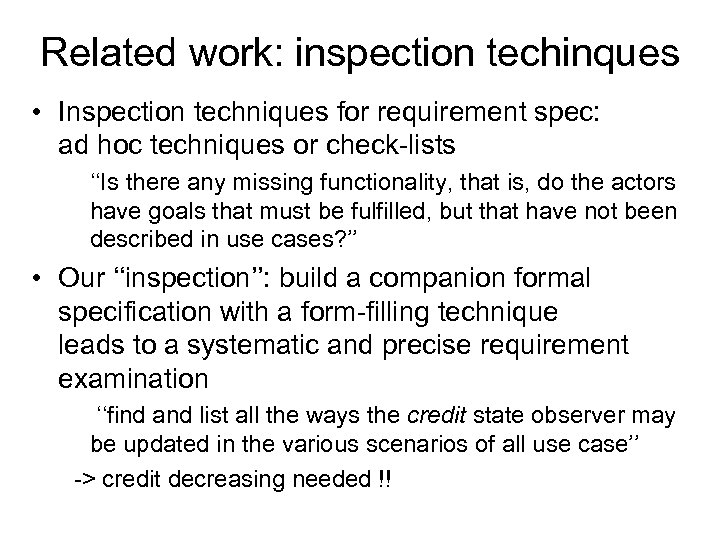
Related work: inspection techinques • Inspection techniques for requirement spec: ad hoc techniques or check-lists ‘‘Is there any missing functionality, that is, do the actors have goals that must be fulfilled, but that have not been described in use cases? ’’ • Our ‘‘inspection’’: build a companion formal specification with a form-filling technique leads to a systematic and precise requirement examination ‘‘find and list all the ways the credit state observer may be updated in the various scenarios of all use case’’ -> credit decreasing needed !!
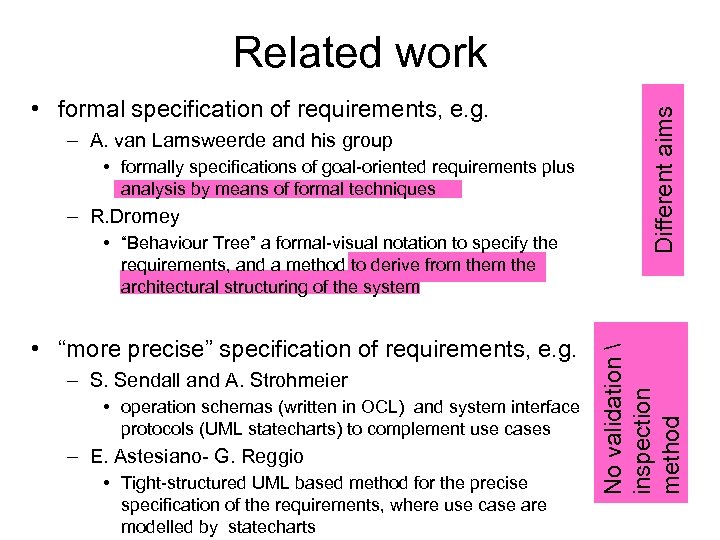
– A. van Lamsweerde and his group • formally specifications of goal-oriented requirements plus analysis by means of formal techniques – R. Dromey • “Behaviour Tree” a formal-visual notation to specify the requirements, and a method to derive from the architectural structuring of the system • “more precise” specification of requirements, e. g. – S. Sendall and A. Strohmeier • operation schemas (written in OCL) and system interface protocols (UML statecharts) to complement use cases – E. Astesiano- G. Reggio • Tight-structured UML based method for the precise specification of the requirements, where use case are modelled by statecharts No validation inspection method • formal specification of requirements, e. g. Different aims Related work

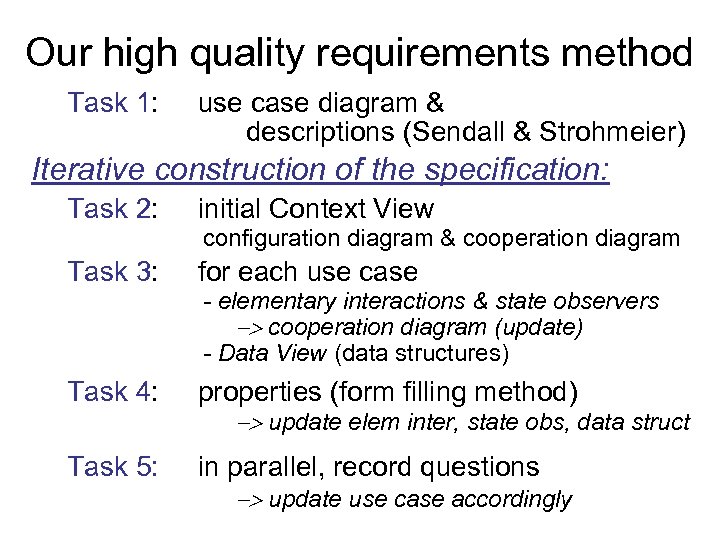
Our high quality requirements method Task 1: use case diagram & descriptions (Sendall & Strohmeier) Iterative construction of the specification: Task 2: initial Context View configuration diagram & cooperation diagram Task 3: for each use case - elementary interactions & state observers -> cooperation diagram (update) - Data View (data structures) Task 4: properties (form filling method) Task 5: in parallel, record questions -> update elem inter, state obs, data struct -> update use case accordingly
Скачать презентацию Improving Use Case Based Requirements Using Formally Grounded
f3ed74dabf242f39c05e1ce277d9874d.ppt