 Скачать презентацию Improving the Research Innovation Ecosystem by R
72c25b242e6faa343fb578a7cbf02446.ppt
- Количество слайдов: 20



Improving the Research & Innovation Ecosystem by R. Chidambaram Principal Scientific Adviser to Govt. of India & DAE-Homi Bhabha Professor, Bhabha Atomic Research Centre, Mumbai, India Lecture in the INAE Seminar on “Towards a Better Innovation Ecosystem”, New Delhi, September 21, 2012.
Research & Innovation Ecosystem An Ecosystem, in biology, is a community of organisms interacting with one another and with the environment. And there are functional aspects of the system – energy flows within the system; utilization of the natural resources in the system; its sustainability; etc. We have to context of Ecosystem. paraphrase these aspects in the Research and Innovation R. Chidambaram
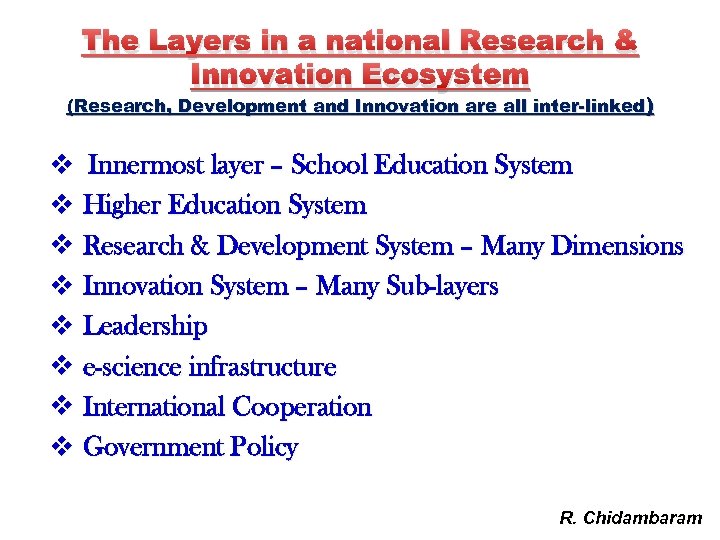
The Layers in a national Research & Innovation Ecosystem (Research, Development and Innovation are all inter-linked ) v Innermost layer – School Education System v Higher Education System v Research & Development System – Many Dimensions v Innovation System – Many Sub-layers v Leadership v e-science infrastructure v International Cooperation v Government Policy R. Chidambaram
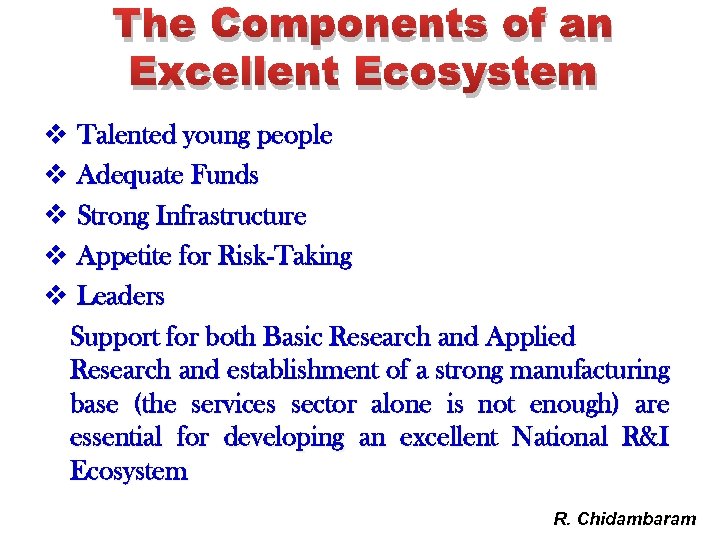
The Components of an Excellent Ecosystem v Talented young people v Adequate Funds v Strong Infrastructure v Appetite for Risk-Taking v Leaders Support for both Basic Research and Applied Research and establishment of a strong manufacturing base (the services sector alone is not enough) are essential for developing an excellent National R&I Ecosystem R. Chidambaram
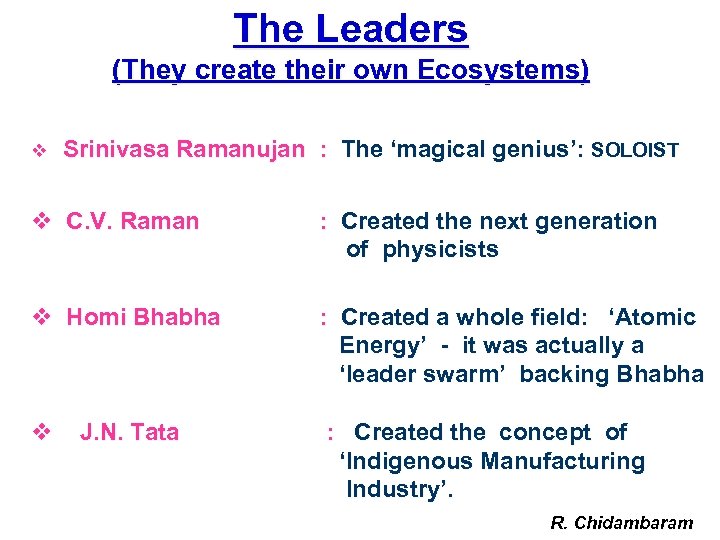
The Leaders (They create their own Ecosystems) v Srinivasa Ramanujan : The ‘magical genius’: SOLOIST v C. V. Raman : Created the next generation of physicists v Homi Bhabha : Created a whole field: ‘Atomic Energy’ - it was actually a ‘leader swarm’ backing Bhabha v : Created the concept of ‘Indigenous Manufacturing Industry’. J. N. Tata R. Chidambaram
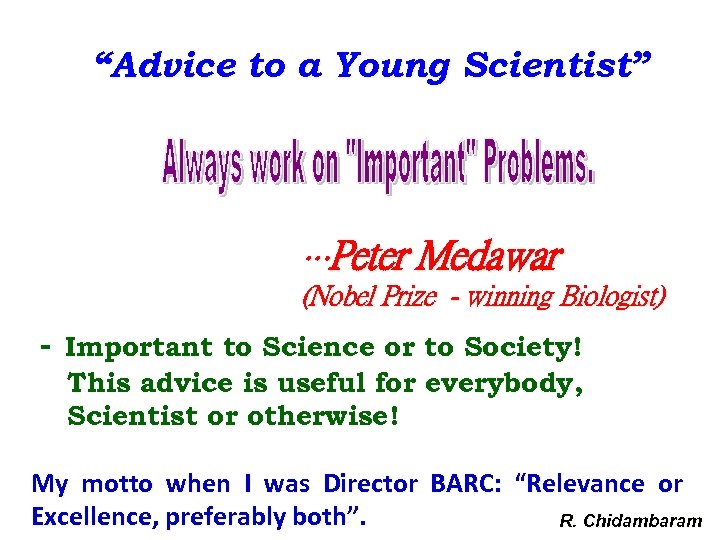
“Advice to a Young Scientist” …Peter Medawar (Nobel Prize - winning Biologist) - Important to Science or to Society! This advice is useful for everybody, Scientist or otherwise! My motto when I was Director BARC: “Relevance or Excellence, preferably both”. R. Chidambaram
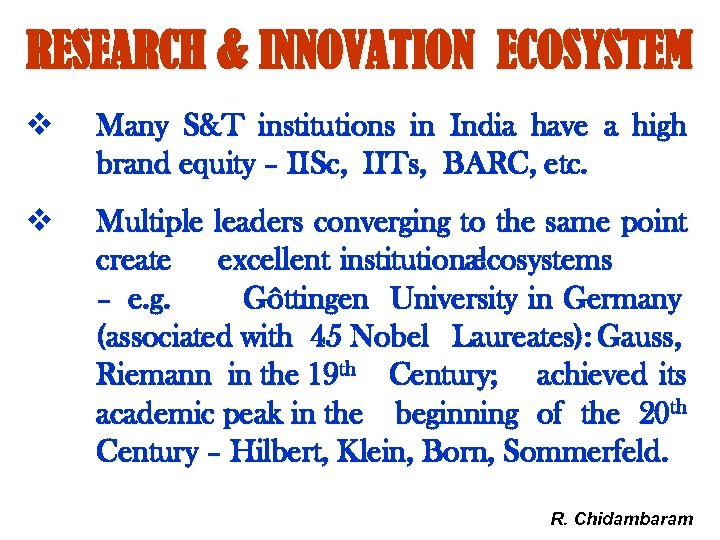
RESEARCH & INNOVATION ECOSYSTEM v Many S&T institutions in India have a high brand equity – IISc, IITs, BARC, etc. v Multiple leaders converging to the same point create excellent institutional ecosystems – e. g. Gôttingen University in Germany (associated with 45 Nobel Laureates): Gauss, Riemann in the 19 th Century; achieved its academic peak in the beginning of the 20 th Century – Hilbert, Klein, Born, Sommerfeld. R. Chidambaram
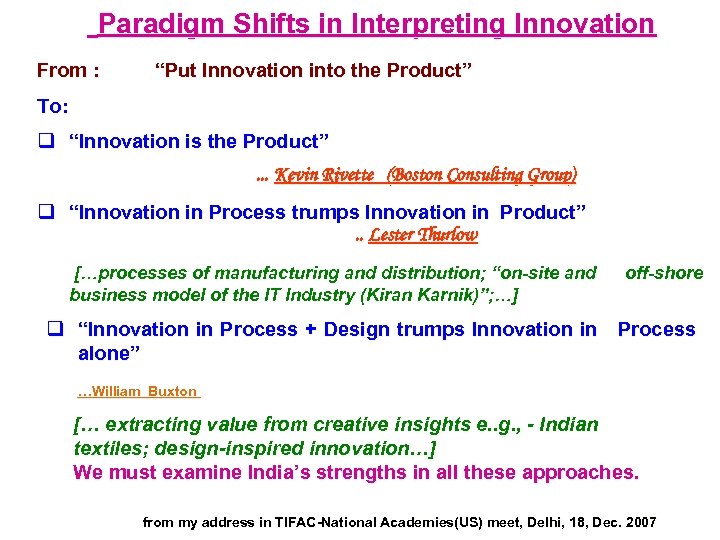
Paradigm Shifts in Interpreting Innovation From : “Put Innovation into the Product” To: q “Innovation is the Product”. . . Kevin Rivette (Boston Consulting Group) q “Innovation in Process trumps Innovation in Product”. . Lester Thurlow […processes of manufacturing and distribution; “on-site and business model of the IT Industry (Kiran Karnik)”; …] off-shore q “Innovation in Process + Design trumps Innovation in Process alone” …William Buxton [… extracting value from creative insights e. . g. , - Indian textiles; design-inspired innovation…] We must examine India’s strengths in all these approaches. from my address in TIFAC-National Academies(US) meet, Delhi, 18, Dec. 2007
“The Many Dimensions of Indian Innovation” ‘Because India is so large and so diverse and because change is occurring at such a rapid pace, it is impossible to talk about a single innovation policy. Conditions vary widely among technologies, among industries and among regions. For example, India is on par with global leaders in some technologies (nuclear power, space), well behind in other sectors (productivity of small and medium enterprises), and in a position to leapfrog into global leadership in some areas (tools for rural development)’. from Chidambaram, “Indian Innovation: Action on Many Fronts”, In “Issues in Science and Technology” Special Issue on ‘Global Tour of Innovation Policy’, National Academy(US), Volume XXIV, No. 1 Fall 2007, pp. 59 -62.
Collaborative Innovation The concept of collaborative. Innovation – we normally associate innovativeconcept creation with individuals – is based on the idea of “swarm creativity” and transcends International borders. Collaborative Innovation. Networks(COINS) are cyberteamsenabled by the Web to share knowledge “directlyand not through hierarchies. ” “Collaborative Innovation ” was theme of the January 2008 Davos meetingof the World Economic. Forum which I attendedas a member of the Faculty. But I would like to suggest that we should also think of altruistic. Collaborative. Innovation while tacklingthe problems of pandemic diseases Climate Change threat and Cyber security, without worrying about IPR issues. from my address in the Science and Technology in Society Forum Kyoto, October, 2009
The Large Hadron Collider Model (Knowledge Diffusion through International R&D Collaboration) The world’s largest accelerator has been built in the Centre for European Nuclear Research(CERN) in Geneva – a more than 4 Billion U. S. Dollars machine. Under an agreement signed in 1996 when I was Chairman AEC, India contributed 40 Million U. S. Dollars – worth hitech equipment like a thousand superconducting sextuple magnets, etc. and advanced ‘grid’ software. Half of this contribution has been put into an ‘India Fund’ which will support Indian scientists who will work with the Accelerator. Indian scientist groups are also participating in the construction and experimentation with two giant Detector systems – CMS and Alice – TIFR and VECC/SINP lead the Indian teams for these two experiments (post-script: CMS was one of the 2 detectors involved in providing the recent experimental evidence on the Higgs Boson). Collaboration with CERN has helped in nucleating the presently fast growing e-Research Infrastructure in India. R. Chidambaram
Raman Effect and the Higgs Boson v For discovering the Raman Effect, a physicist was enough, with a few students. v To look for the Higgs Boson, we have the multibillion dollar precision – engineered Large Hadron Collider and teams involving hundreds of scientists , across international borders --- studying the data from various detectors. And we need an e-science infrastructure. v So the way we do science has changed and the ecosystem must adjust to this fact R. Chidambaram
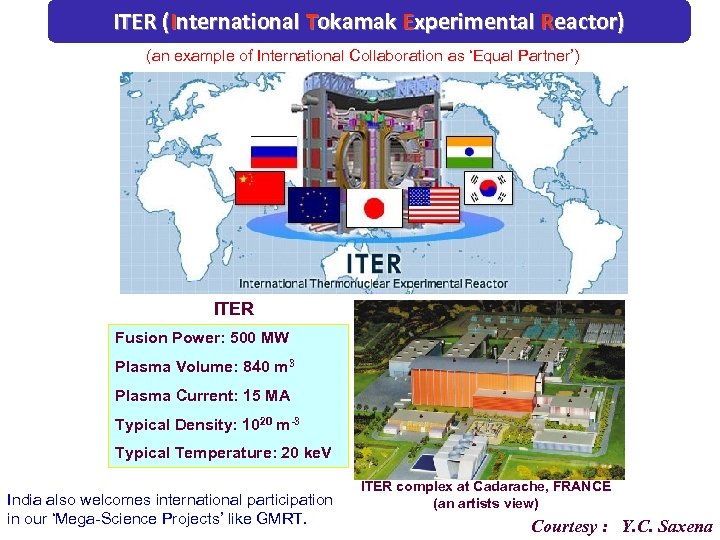
ITER (International Tokamak Experimental Reactor) (an example of International Collaboration as ‘Equal Partner’) Joint Venture of 7 parties ITER Fusion Power: 500 MW Plasma Volume: 840 m 3 Plasma Current: 15 MA Typical Density: 1020 m-3 Typical Temperature: 20 ke. V India also welcomes international participation in our ‘Mega-Science Projects’ like GMRT. ITER complex at Cadarache, FRANCE (an artists view) Courtesy : Y. C. Saxena
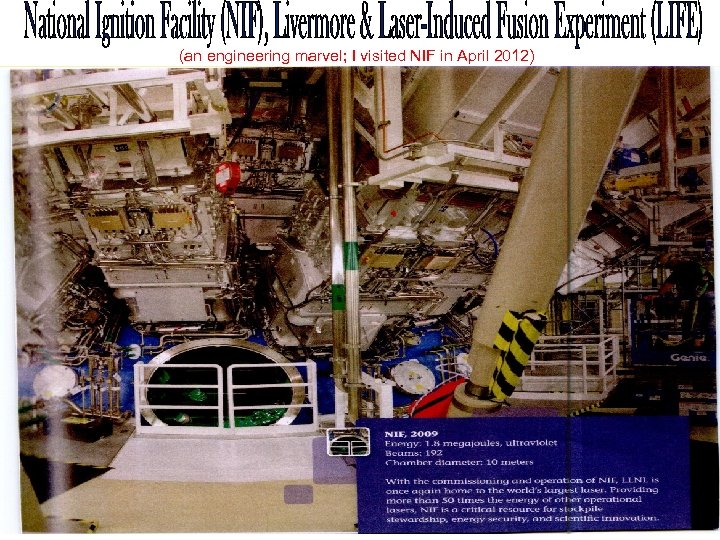
(an engineering marvel; I visited NIF in April 2012)
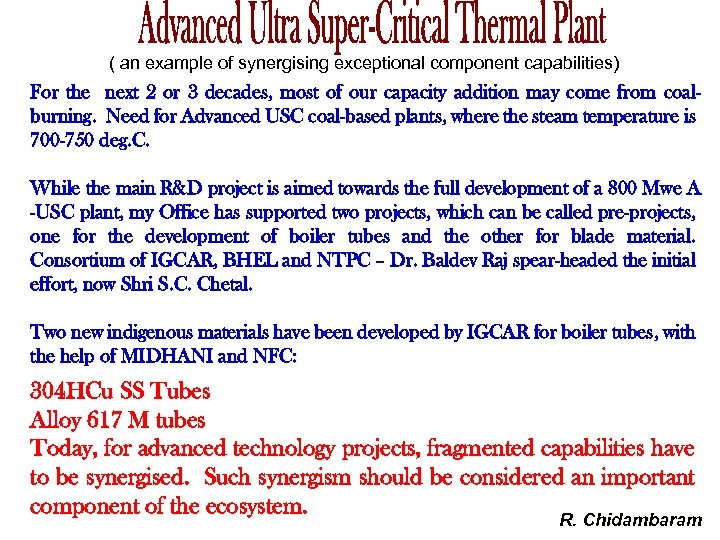
( an example of synergising exceptional component capabilities) For the next 2 or 3 decades, most of our capacity addition may come from coalburning. Need for Advanced USC coal-based plants, where the steam temperature is 700 -750 deg. C. While the main R&D project is aimed towards the full development of a 800 Mwe A -USC plant, my Office has supported two projects, which can be called pre-projects, one for the development of boiler tubes and the other for blade material. Consortium of IGCAR, BHEL and NTPC – Dr. Baldev Raj spear-headed the initial effort, now Shri S. C. Chetal. Two new indigenous materials have been developed by IGCAR for boiler tubes, with the help of MIDHANI and NFC: 304 HCu SS Tubes Alloy 617 M tubes Today, for advanced technology projects, fragmented capabilities have to be synergised. Such synergism should be considered an important component of the ecosystem. R. Chidambaram
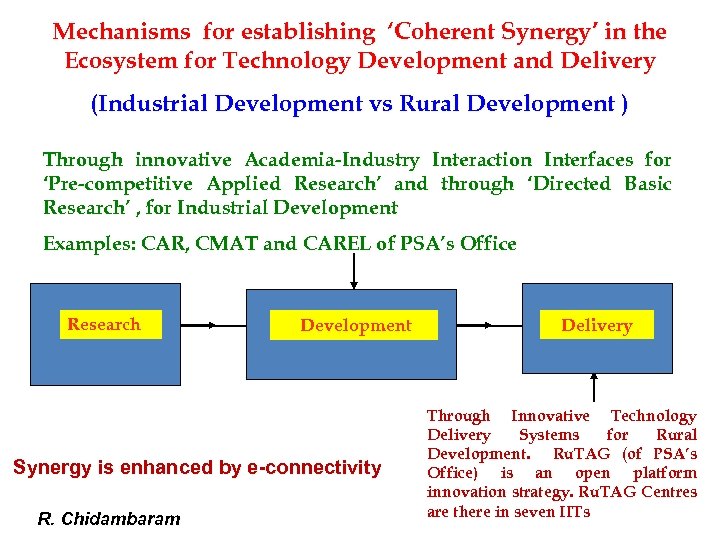
Mechanisms for establishing ‘Coherent Synergy’ in the Ecosystem for Technology Development and Delivery (Industrial Development vs Rural Development ) Through innovative Academia-Industry Interaction Interfaces for ‘Pre-competitive Applied Research’ and through ‘Directed Basic Research’ , for Industrial Development Examples: CAR, CMAT and CAREL of PSA’s Office Research Development Synergy is enhanced by e-connectivity R. Chidambaram Delivery Through Innovative Technology Delivery Systems for Rural Development. Ru. TAG (of PSA’s Office) is an open platform innovation strategy. Ru. TAG Centres are there in seven IITs
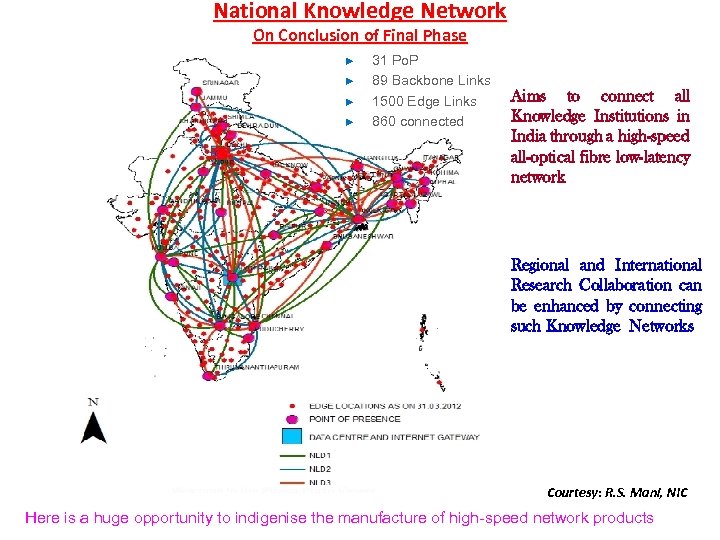
National Knowledge Network On Conclusion of Final Phase ► ► 31 Po. P 89 Backbone Links 1500 Edge Links 860 connected Aims to connect all Knowledge Institutions in India through a high-speed all-optical fibre low-latency network Regional and International Research Collaboration can be enhanced by connecting such Knowledge Networks Courtesy: R. S. Mani, NIC Here is a huge opportunity to indigenise the manufacture of high-speed network products
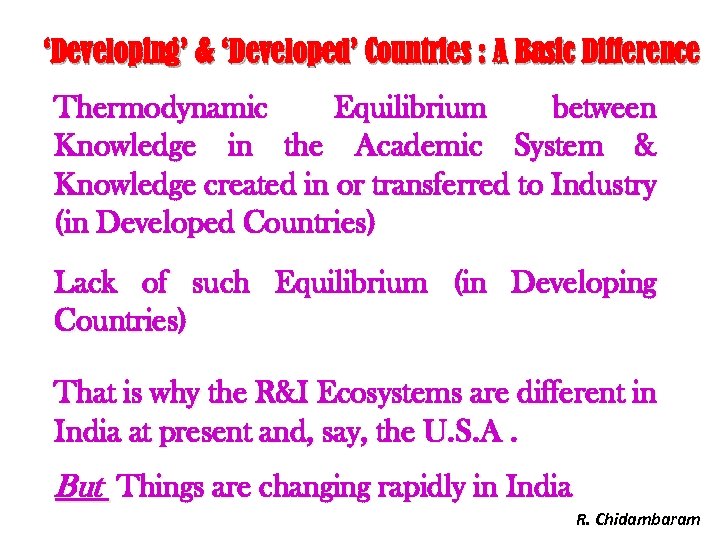
‘Developing’ & ‘Developed’ Countries : A Basic Difference Thermodynamic Equilibrium between Knowledge in the Academic System & Knowledge created in or transferred to Industry (in Developed Countries) Lack of such Equilibrium (in Developing Countries) That is why the R&I Ecosystems are different in India at present and, say, the U. S. A. But Things are changing rapidly in India R. Chidambaram
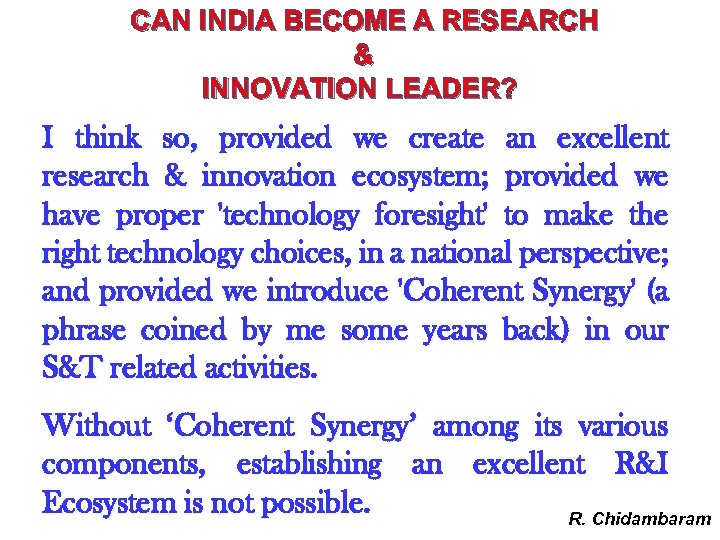
CAN INDIA BECOME A RESEARCH & INNOVATION LEADER? I think so, provided we create an excellent research & innovation ecosystem; provided we have proper 'technology foresight' to make the right technology choices, in a national perspective; and provided we introduce 'Coherent Synergy' (a phrase coined by me some years back) in our S&T related activities. Without ‘Coherent Synergy’ among its various components, establishing an excellent R&I Ecosystem is not possible. R. Chidambaram
 Скачать презентацию Improving the Research Innovation Ecosystem by R
72c25b242e6faa343fb578a7cbf02446.ppt