 Скачать презентацию Improving the Public Expenditure Outcomes of the NREGS
667e1385ff6fbf5962599293248a7b97.ppt
- Количество слайдов: 12



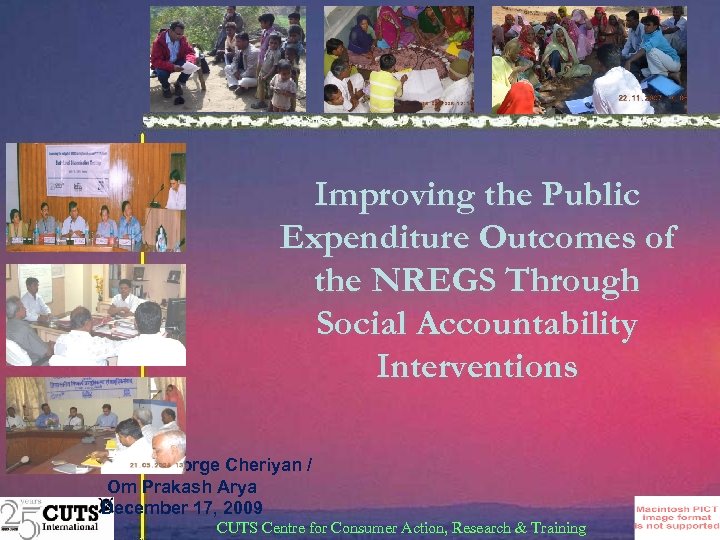
Improving the Public Expenditure Outcomes of the NREGS Through Social Accountability Interventions Presenters: George Cheriyan / Om Prakash Arya December 17, 2009 CUTS Centre for Consumer Action, Research & Training
Context • NREGA enacted on August 25, 2005 & based on this NREGS stared as pilot in 200 most backward districts on Feb. 2, 2006 • Government had plan to scale up NREGS in whole country based on pilot results • Huge public money was to be incurred after scaling up and proper utilization was a concern • NREGA significantly shows Commitment to transparency and accountability and gives citizen a central role at every stage • Accountability tools like Social Audit & RTI Act are integrated in the NREGA 2 CUTS Centre for Consumer Action, Research & Training
Context… • Implementation in letter and spirit was a challenge • Government was very keen to get feedback from the field to amend the loopholes in guideline while scaling up • Problem: Unavailability of feedback from wage seekers/ villagers on the implementation • Accountability Intervention: Citizen’s Assessment of implementation of NREGS in Sirohi district of Rajasthan • Process & Tools: CRC was used for getting user feedback on the implementation (Q n Q) and CSC to extract accountability and responsiveness from service providers. 3 CUTS Centre for Consumer Action, Research & Training
Summary of Process of change • State and District administration were informed about the project since its beginning • Collection of feedback through CRC and its strategic dissemination at various levels and creation of a platform for interface between wage seekers and service providers through CSC • This intervention has led to a series of -Behavior changes among NREGS stakeholderswage seekers, field supervisors, local government -Institutional changes at various levels of government CUTS Centre for Consumer Action, Research & Training 4
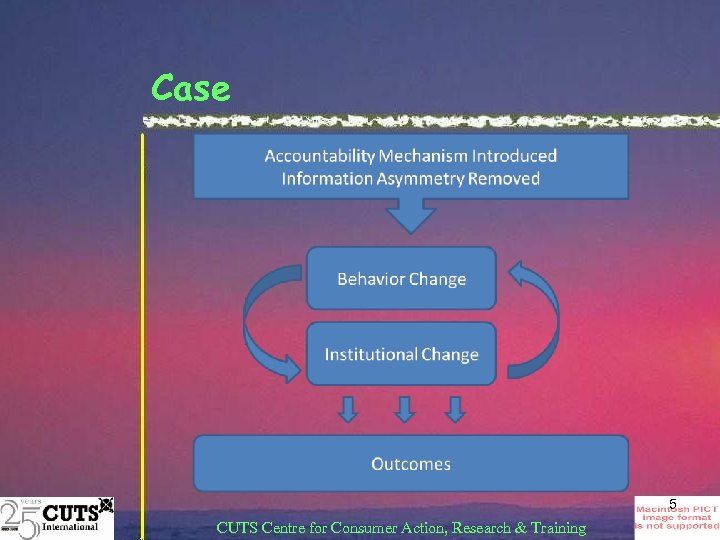
Case 5 CUTS Centre for Consumer Action, Research & Training
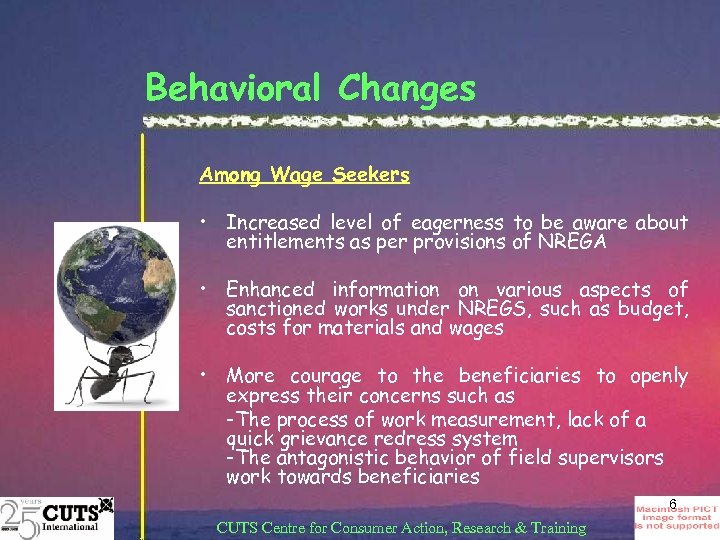
Behavioral Changes Among Wage Seekers • Increased level of eagerness to be aware about entitlements as per provisions of NREGA • Enhanced information on various aspects of sanctioned works under NREGS, such as budget, costs for materials and wages • More courage to the beneficiaries to openly express their concerns such as -The process of work measurement, lack of a quick grievance redress system -The antagonistic behavior of field supervisors work towards beneficiaries 6 CUTS Centre for Consumer Action, Research & Training
Behavioral Changes Among Wage Seekers • Wage seekers also openly questioned service providers about these concerns which was a substantial behavior shift on the part of them • Realization about the need to participate in the decision making process and as result increased participation in the meetings of Gram Shabha 7 CUTS Centre for Consumer Action, Research & Training
Behavioral Changes Among Service Providers • Lower local government functionaries and elected representatives understood for the first time that they were also considered as ‘service providers’ and had clear responsibilities under NREGS • Local government and field supervisors were sensitized towards problems in NREGS Service delivery and develop more responsive management processes and systems • Realization of the fact that the service providers are answerable to their actions and decisions, and hence has to be accountable to the people 8 CUTS Centre for Consumer Action, Research & Training
Institutional Changes • Increased initiatives to recruit and train female field supervisors • Removal of intermediary agency between the government and contractual staff • Establishment of Task Force to explore more comprehensive and effective possibilities of convergence with NREGA • Broadened scope for social accountability approaches in other government departments • Regular open training for NREGS beneficiaries and capacity building of field supervisors on work measurement standards 9 CUTS Centre for Consumer Action, Research & Training
Limitations • Weak Institutions and Procedures • Low capacity of civil society, media and rural people • Inconsistent strategies • Overlapping roles and responsibilities • Significantly skill shortage • File is on move 10 CUTS Centre for Consumer Action, Research & Training
Overall Investment • The NREGS budget for Sirohi was Rs 757 million (about US$18 million) for the year 2007– 08 • CUTS’ accountability intervention costs approximately Rs 1. 26 million (US$30, 000) which represents less than 1 percent of the total district budget for NREGS in Sirohi • The cost to do one CSC, on one of the selected service deliveries in a Garm Panchayat, was only Rs. 15, 000 (US$ 357) • In the absence of an institutionalized social audit process, a small investment in an accountability intervention can precipitate a series of behavior and institutional changes to improve the implementation of large-scale, national flagship welfare schemes like NREGS 11 CUTS Centre for Consumer Action, Research & Training
Thank You ! 12 CUTS Centre for Consumer Action, Research & Training
Скачать презентацию Improving the Public Expenditure Outcomes of the NREGS
667e1385ff6fbf5962599293248a7b97.ppt