 Скачать презентацию IMPROVING THE PRODUCTIVITY AND SUSTAINABILITY OF CROP SYSTEMS
85df51e9ff5f0683eb419f3c857aa732.ppt
- Количество слайдов: 43



IMPROVING THE PRODUCTIVITY AND SUSTAINABILITY OF CROP SYSTEMS ON FRAGILE SLOPES IN THE HIGHLANDS OF SOUTH CHINA ---Focusing on Soil Conservation Yunnan Agricultural University on behalf of the project teams
Presentation outline • Where we are from and why soil conservation • What we have done • What we are doing now
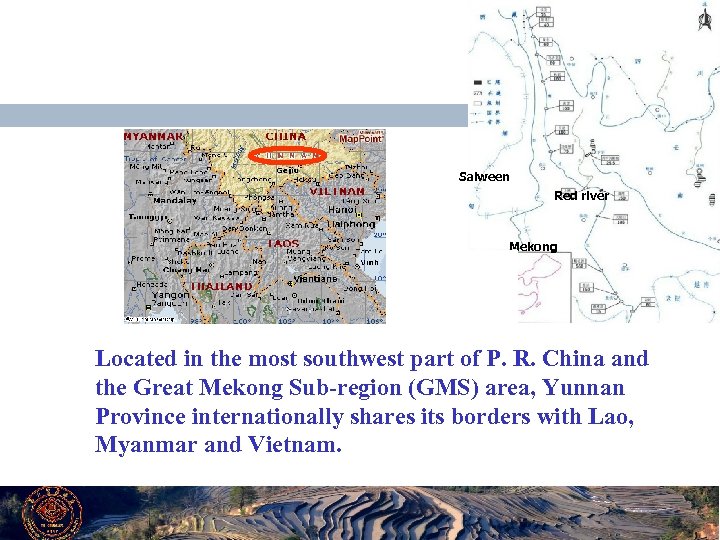
Salween Red river Mekong Located in the most southwest part of P. R. China and the Great Mekong Sub-region (GMS) area, Yunnan Province internationally shares its borders with Lao, Myanmar and Vietnam.
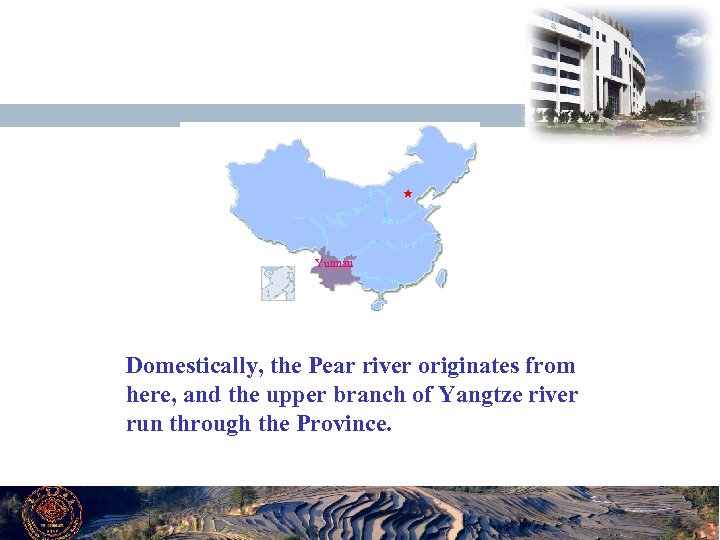
Yunnan Domestically, the Pear river originates from here, and the upper branch of Yangtze river run through the Province.

Landform An total area of 0. 394 million Km 2, 94% of which are mountainous areas. The land with slopes <8 , 8 -15 , 15 -25 and >25 are 8. 87, 13. 71, 37. 42 and 39. 28% of the total land area.

Rainfall Intense convectional storms, embedded within the general southerly summer monsoonal airflow during the cropping season, makes erosion more pronounced. Distinct dry and wet season, the monsoon season is from May to October, 80 -85% rain felt in this period of time.

Agriculture activities Agriculture Yunnan is an agriculture province, and the total population is 49 million. Only 6. 8% of Yunnan’s land area can be used for agricultural activities. Most people in Yunnan depend very heavily on arable cropping agriculture. The practice of cultivating steep slopes is the norm.

From 1988 -1990, research on ploughing depths, cultivation directions and intercropping on soil erosion and maize yield was carried out at runoff/erosion plots in Yunnan Agricultural University

• Contour cultivation reduced runoff and soil loss and thus conserved soil organic matter and nutrients and water. In turn, this increased maize yield by 17. 6% compared with up-down slope cultivation. • Intercropping (with potato) and shallow ploughing (7 cm) were also effective, they increased maize yield by 23. 0% and 10. 0% compared to monoculture and deep ploughing (20 cm), respectively (Liu et al. , 1991).

1993 -96 cropping seasons data suggested the average rank order of treatment effectiveness in diminishing erosion rates was: 1) straw mulch, 2) intercropping, 3) no tillage, 4) polythene mulch and 5) conventional tillage.

Research from 1997 -2000 confirmed the suitability of straw mulch and contour cultivation as soil conservation measures. Data from the 1997, 1998 and 1999 seasons confirm that straw mulch and contour cultivation significantly decreased soil erosion rates and suggested a possible additive interaction between contour cultivation and straw mulch, which increases in effectiveness on steeper slopes.

Further progress towards general recommendations required full evaluation of the applicability and effectiveness of techniques developed in plot studies to actual field conditions. This work was conducted in Wang Jia Catchment. The project (sustainable highland agriculture in Southeast Asia: SHASEA) funded by the European Union.

IMPROVING THE PRODUCTIVITY AND SUSTAINABILITY OF CROP SYSTEMS ON FRAGILE SLOPES IN THE HIGHLANDS OF SOUTH CHINA AND THAILAND The University of Wolverhampton, U. K. The Macaulay Land Use Research Institute, Aberdeen, U. K. The National University of Ireland (Galway), Ireland Gembloux Agricultural University, Belgium Yunnan Agricultural University, P. R. China The Government of Kedu Township, P. R. China Chiang Mai University, Thailand

Work Package 1 Background agricultural and environmental assessment of Wang Jia Catchment. Work Package 2 Implementation and evaluation of modified and novel cropping systems for wheat, maize and soybean in the catchment. Work Package 3 Evaluation of the socioeconomic impact of the changed cropping practices. Work Package 4 Comparative scientific evaluation of the cropping techniques in the highlands of Northern Thailand. Work Package 5 Dissemination of project outcomes and establishment of training programmes for best practice in high land rural development. Source: http: //www. wlv. ac. uk/science/environment/SHASEA/


Catchment scale Soil erosion rate is reduced from 29428 t/km 2 in 1998 to 919 t/km 2 in 2002. The loss of N, P 2 O 5 and K 2 O is reduced by 39. 1 t per year at catchment level.

In summary, where the risk of soil erosion is high, the INCOPLAST technique is recommended. Where the priority is to increase maize yields on sloping land, contour planting with polythene mulch is recommended. Where straw and polythene are not available, simple contour cultivation is recommended.

BORASSUS (Proposal No: FP 6 - 510745 ) Sustainable development of rural economies and agriculture: using geotextiles as a potential soil conservation technique

Partner 1: The University of Wolverhampton Partner 2: Catholic University of Leuven Partner 3: Hungarian Academy of Sciences Partner 4: Lithuanian Institute of Agriculture Partner 5: Agricultural Research Council Partner 6: Federal University of Rio de Janeiro Partner 7: Yunnan Agricultural University Partner 8: Chiang Mai University Partner 9: Hanoi Agricultural University Partner 10: University of The Gambia


CK Wheat Straw Mat Polythene Mulch Palm-leaf Mat

Effect of different treatments on runoff, soil loss and crop yield Items No mulch Polythene Wheat straw Palm-leaf mat mulch Runoff (m 3/ha) 930. 70± 53. 94 b 897. 50± 46. 31 b 586. 52± 39. 75 a 571. 08± 35. 61 a Reduced by (%) Soil loss (t/ha) 0 9. 68 41 42. 5 2. 77± 0. 20 b 2. 46± 0. 22 b 1. 29± 0. 14 a 1. 54± 0. 19 a 0 11. 2 53. 4 44. 4 Reduced by (%) Theoretical yield Actual yield 8. 45± 0. 87 a 10. 71± 0. 79 b 9. 59± 0. 68 ab 10. 08± 0. 82 ab 8. 82± 0. 91 a 11. 48± 1. 32 b 10. 06± 0. 86 ab 10. 40± 0. 87 ab Increase (%) 30. 2 14. 1 17. 9

• In the field runoff plots experiment, results indicated that rice straw geo-textile could effectively reduces surface runoff and conserves soil and water. • Rice straw mat mulch could be beneficial to hold and regulate soil moisture and is of better capability of regulation of soil temperature and improve crops (maize, tobacco and grass) growth. • Results from Experiment of water absorption rates and decomposition rates of fibres showed that rice straw mat is of almost same soil erosion control effects, and is more durable, better water holding capacity in comparison with mats made of jute fibre and palm leaves under subtropical region.

Supported by the fowllowling foundations: • National Natural Science Foundation of China (No. 3136006, 41461059, 41661063); Doctoral Fund of Ministry of Education of China (No. 20125302110001); Agricultural Foundation on public welfare industry of China (No. 201503119 -03 -03); National Science and Technique Foundation for the rural development of China(No. 2015 BAD 06 B 04); Strategic Consulting Foundation of Chinese Academy of engineering of China (No. 2013 -XZ-24) • Maize//Potato, Maize//Soybean, Maize//Chili, and Maize//Grass; Main crops Aboveground, underground and nutrient leaching •

Regulation of Maize-potato Intercropping on Soil Erosion in Uplands——Field experiment No ridging High ridging Design of the field experiment with three cropping patterns (Sole maize and potato, intercropping) and two tillages (CK, high ridging) in 2015 Sole maize Sole potato Intercropping

Regulation of Maize-potato Intercropping on Soil Erosion in Uplands——Simulation experiment in house Experiment design Rainfall intensities: 40 and 80 mm/h Two During time: 30 and 60 min Three cropping patterns: sole maize, sole potato, intercropping

Sediment in simulation experiment

Maize-chilli intercropping strategy was investigated to be the most acceptable to farmers in spite of high costs in the practices, and the area of spreading is nearly 1, 066 ha in hill region, Yanshan, Yunnan. Slope angles of 10º with 30 m 2 (10 m × 3 m) runoff plot and three replications. Maize (Zea mays L. ), Chillis (Capsicum annuum L. ), and Setaria grass (Setaria anceps Stapf ex Massesy)

Results —Runoff SM: sole maize SC: sole chilli MCI: maize-chilli intercropping MGI: maize-grass intercropping Sole Influence of cropping system on runoff (mean±SE). The different lower-case letters indicate a significant difference between treatments at P < 0. 05.

Results —Sediment SM: sole maize SC: sole chilli MCI: maize-chilli intercropping MGI: maize-grass intercropping Influence of cropping system on sediment (mean±SE). The different lower-case letters indicate a significant difference between treatments at P < 0. 05.

Results— Crop Production Treatments Crop SM MCI MGI SC MCI MGI 2007 maize 7675± 48 a maize 7260± 46 a maize 7200± 50 a F-statistic 1. 33 P-value 0. 333 chilli 7361± 50 a chilli 3225± 73 b grass 4545± 60 c F-statistic 26. 55 P-value 0. 000 SM: sole maize SC: sole chilli MCI: maize-chilli intercropping MGI: maize-grass intercropping Yield/ Biomass (kg ha-1) 2008 2009 2010 8681± 28 a 10110± 29 a 14802± 252 a 4645± 46 b 8792± 34 b 11175± 241 b 8625± 34 a 10635± 91 a 14836± 93 a 11. 12 7. 47 11. 71 0. 010 0. 023 0. 015 6435± 42 a 1839± 18 b 13636± 88 a 4425± 55 b 1506± 74 b 7046± 61 c 3792± 51 c 4524± 77 a 10144± 80 b 10. 48 16. 05 7. 64 0. 011 0. 000 0. 050 mean 10315± 63 a 7968± 41 b 10324± 76 a 6. 75 0. 016 7318± 61 a 4050± 37 c 5751± 58 b 9. 54 0. 021 Maize, chilli, grass economic yield on cropping pattern (mean±SE), 2007 -2010. The different lower-case letters indicate a significant difference at P < 0. 05.

Results —Economic income SM: sole maize SC: sole chilli MCI: maize-chilli intercropping MGI: maize-grass intercropping Total amount(US $) Treatments 2007 2008 2009 2010 mean SM 1984± 31 a 2384± 52 a 2426± 54 bc 3552± 136 a SC 2973± 54 b 2599± 87 ab 754± 41 a 5455± 150 c 2900 b MCI 3183± 63 bc 2929± 89 c 2727± 77 c 5571± 121 c 3603 c MGI 2058± 45 a 2542± 14 ab 2726± 153 c 3966± 39 b 2826 ab F-statistic 12. 96 4. 50 12. 12 18. 58 6. 46 P-value 0. 003 0. 010 0. 001 0. 008 2587 a Maize, chilli, grass economic income on cropping pattern (mean±SE), 2007 -2010. The different lower-case letters indicate a significant difference at P < 0. 05.

• • • Intercropping can effectively integrate the economic and ecological benefits in hilly areas. Maize-chilli intercropping is an eco-economic system to reduce the soil erosion and develop economic benefits under different natural rainfall conditions. Cash crop in intercropping is needed for promoting the poor adoption of multi-cropping system and soil conservation practice, which is widely accepted by local farmers due to high benefits.

Relationship between load and displacement in 10 cm soil depth under different planting patterns

Relationship between the critical point of load(F 1, F 2, F 3) and the density of crop root under different planting patterns Cropping pattern Root density F 1 F 2 F 3 kg/m³ Sole maize 1. 00 k. N 0. 31 k. N 1. 16 k. N 2. 67 Intercropping maize 2. 33 0. 76 1. 84 2. 92 Sole soybean 0. 63 0. 29 1. 69 2. 27 Intercropping soybean 1. 08 0. 41 1. 9 2. 76 Bare land 0 0. 21 1. 08 2. 15

Croppin g pattern Water-stable aggregate(%) >5 mm 5~2 mm 2 ~1 mm 1~0. 5 mm 0. 5~0. 2 mm <0. 25 mm soil antierodibility ( %) MS 4. 88± 3. 37 c 15. 36± 1. 35 b 9. 56± 2. 04 b 8. 38± 2. 38 b 1. 48± 3. 06 b 60. 36± 2. 38 a 59. 72± 4. 15 b MIS 23. 5± 3. 0 5 a 16. 28± 1. 19 a 15. 68± 1. 03 a 13. 24± 1. 05 a 5. 56± 2. 25 a 25. 74± 3. 13 c 73. 06± 2. 18 a MM 9. 32± 2. 84 b 15. 34± 1. 07 b 14. 96± 1. 58 a b 11. 52± 3. 18 a b 5. 36± 1. 87 a 43. 5± 2. 58 b 51. 75± 3. 57 a b Water-stable aggregate of different planting patterns at crop harvest stage

Treatment > 2 mm 1 mm-2 mm < 1 mm MS 10. 67± 1. 59 a 7. 13± 0. 85 a 82. 03± 6. 55 a MM 15. 49± 0. 61 b 7. 34± 0. 25 a 77. 85± 3. 02 a MIS 19. 62± 1. 36 c 9. 82± 1. 23 b 70. 48± 6. 25 a

Monitoring of nutrient loss 18 3. 48± 2. 84 25. 73± 7. 96 38. 00± 6. 48 Open field vegetables 3 18 2. 97± 2. 68 55. 15± 27. 15 72. 63± 34. 95 4 18 1. 43± 0. 34 16. 46± 8. 32 22. 63± 10. 95 3 18 3. 05± 2. 14 25. 82± 9. 28 35. 88± 9. 27 Open field vegetables 3 18 1. 59± 0. 80 55. 25± 25. 88 67. 25± 27. 22 Greenhouse vegetable 4 18 2. 49± 1. 39 21. 39± 15. 77 30. 42± 20. 61 Bare land 0 -100 cm 3 Bare land 0 -40 cm Monitoring times Greenhouse vegetable 0 -20 cm Land use pattern Average concentration(mg/L) Monitoring point Bare land Soil depth 3 18 1. 05± 0. 24 14. 10± 4. 26 19. 68± 6. 20 Open field vegetables 3 18 0. 96± 0. 20 29. 16± 10. 6 35. 40± 10. 60 Greenhouse vegetable 4 18 0. 83± 0. 14 14. 27± 7. 48 20. 64± 10. 34 NH 4+-N NO 3--N TN

Thank you for your attention!
Скачать презентацию IMPROVING THE PRODUCTIVITY AND SUSTAINABILITY OF CROP SYSTEMS
85df51e9ff5f0683eb419f3c857aa732.ppt