


 Скачать презентацию Improving the Position of Tanzanian Avocado Processors in
9477de540ee0439731cd5dcb4fa48ebe.ppt
- Количество слайдов: 26
 Improving the Position of Tanzanian Avocado Processors in the Global Value Chain: The role of functional upgrading and Innovation BY Heric Thomas- STIPRO
 Background • This paper is an extension of the study conducted by STIPRO in 2016 on types of Leaning and Upgrading Opportunities available among avocado farmers participating in GVCs • The current study intended to fill in the gaps identified by the above study • So I will briefly talk about the previous conceptual framework • After that I will connect the conceptual framework with the correct study
 Introduction: Reflection from GVC Concepts § In Global Value Chains (GVCs), activities are carried out by different firms/producers that form part of the network located in different countries (Pietrobelli & Rabellotti (2011) § The firm that coordinates all different activities performed by other actors in the network is called a lead firm; § Lead firm- either be a buyer or a manufacturing firm
 Participation of Small Producers in GVCs ü local producers from developing countries that are GVC are expected to improve their capabilities in production, processing, packaging and distribution ü This is because, the lead firm sets the standards related to production and products quality ü In order to meet the standards, small producers need to learn through interacting with buyers (Lead firm) ü Interaction through training and explicit technology transfer by the buyer often generate learning activities (Nadvi & Schmitz, 1999; Schmitz & Knorringa, 2001; Gereffi, Humphrey & Sturgeon, 2005; Giuliani et al. , 2005) that improve producers capabilities
 Challenges Facing Small Producers in GVCs § Challenges caused by structural arrangements in GVCs § Gereffi et al (2005) argued that the governance structure adopted by the lead firm affects the type of learning mechanism that occurs within GVCs § Small producers can then find themselves being either in market, modular, relational, captive or in hierarchy governance system
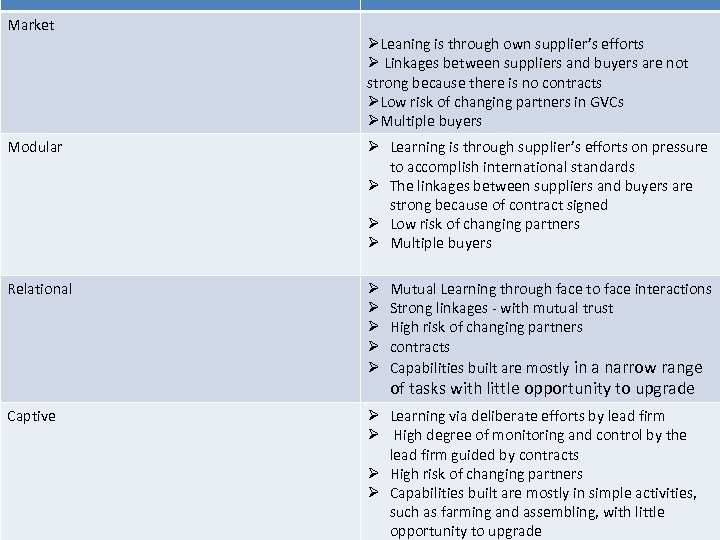 Market ØLeaning is through own supplier’s efforts Ø Linkages between suppliers and buyers are not strong because there is no contracts ØLow risk of changing partners in GVCs ØMultiple buyers Modular Ø Learning is through supplier’s efforts on pressure to accomplish international standards Ø The linkages between suppliers and buyers are strong because of contract signed Ø Low risk of changing partners Ø Multiple buyers Relational Ø Ø Ø Mutual Learning through face to face interactions Strong linkages - with mutual trust High risk of changing partners contracts Capabilities built are mostly in a narrow range of tasks with little opportunity to upgrade Captive Ø Learning via deliberate efforts by lead firm Ø High degree of monitoring and control by the lead firm guided by contracts Ø High risk of changing partners Ø Capabilities built are mostly in simple activities, such as farming and assembling, with little opportunity to upgrade
 How to Shift from Captive and Relational to Modular and Market Networks § The small producers who are in captive and relational networks have high risk § The buyer tends to monopolize the business, set price and at the same can decide to not buy products, contracts signed are not fair § Networks such as modular and market have no risk to small producers § It has been argued that to move away from captive and rational networks to modular and market networks, small producers must under go “Functional upgrading”Ø Add value of the products, or acquiring superior functions such as processing activities and abandoning the current low-value functions such as farming and assembling Ø Adding value or acquisition of superior functions, small producers will improve their position in GVCs
 How to Shift from Captive and Relational to Modular and Market Networks? § So what to do and how in order to under go Functional upgrading? § Order to upgrade into higher position in the value chain, capacity building among small producers on activities such as processing is required (Pietrobelli and Rabellotti, 2011) § This requires an Agricultural Innovation System (AIS) with strong interactions among the actors that will allow the diffusion of information, technology and resources that are significant for building capabilities of small producers, making them capable of shifting to higher activities in GVCs such as processing (Gereffi & Fernandez-Stark, 2011)
 Objectives of the Study § § § This takes us to 2016, where STIPRO conducted a study entitled: “Are there any opportunities for learning and upgrading for Tanzanian farmers with Hass avocado variety for export to European super markets ? ’’ One of the aspects analyzed was the types of learning and upgrading opportunities that were available for participants in the GVCs It was found out that the smallholder farmers operated within a captive value chain which was characterized by a high degree of monitoring and control by the Lead firm called Africado Capacity building imparted by Africado to smallholder farmers concentrated mainly on learning about new production practices It was observed that if farmers remain focused on the production of avocado without upgrading into other higher activities, such as processing, there will be no sustainability of farmers in GVCs For instance, if Africado sourced avocados from other suppliers apart from farmers in Kilimanjaro, then the market of avocado produced by
 Objectives of the Study Cont…. § § Ø Ø Capacity building among smallholder farmers in order to upgrade into higher position in the value chain such as processing of avocado into other products such as avocado oil appeared to be required in order to change the governing system (Captive) As such, there was a limited level of knowledge and understanding about initiatives that have been taken by actors in AIS to support functional upgrading such as avocado processing Consequently, in May 2017, STIPRO Carried out a study titled “Improving the Position of Tanzanian Avocado Processors in the Global Value Chain: The role of functional upgrading and Innovation” The specific objectives were as follows: To identify the key actors in the avocado production value chain; To find out the factors limiting avocado farmers in Moshi to move further along the value chain beyond production; To find out stakeholders’ strength in avocado processing; and To provide policy recommendations for the sustainability of smallholder farmers’ production in GVCs
 Study Design and Methodology § Key informants/stakeholders, who were involved in the value chain of avocado production § Case study from one processor § One technique of data collection was used, namely, indepth interviews with key informants and processor using a set of guiding questions § The information obtained was supplemented by information collected from secondary sources, such as reports and publications that were produced by the various actors within the avocado production system § Actors involved- SIDO, TEMDO, AVOMERU GROUP, MVIWAPASI, CAMARTEC, TBS, TFDA, AFRICADO, USAID, NORFUND, TWENDE INCUBATOR AND FARMERS
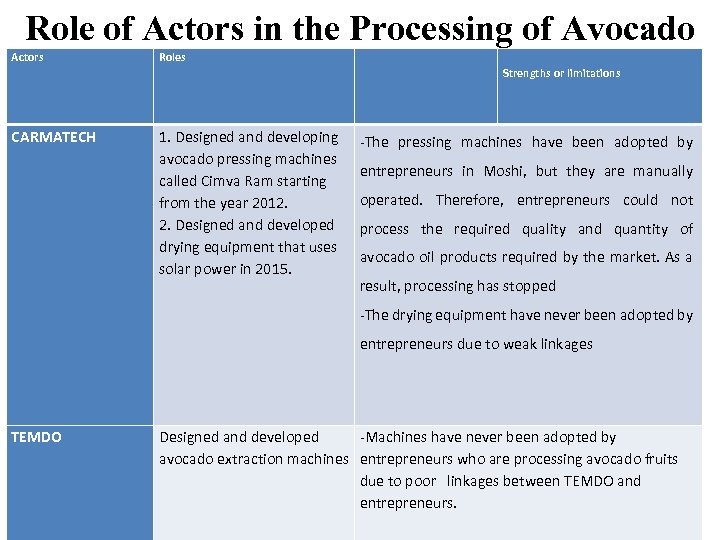 Role of Actors in the Processing of Avocado Actors Roles Strengths or limitations CARMATECH 1. Designed and developing avocado pressing machines called Cimva Ram starting from the year 2012. 2. Designed and developed drying equipment that uses solar power in 2015. -The pressing machines have been adopted by entrepreneurs in Moshi, but they are manually operated. Therefore, entrepreneurs could not process the required quality and quantity of avocado oil products required by the market. As a result, processing has stopped -The drying equipment have never been adopted by entrepreneurs due to weak linkages TEMDO Designed and developed -Machines have never been adopted by avocado extraction machines entrepreneurs who are processing avocado fruits due to poor linkages between TEMDO and entrepreneurs.
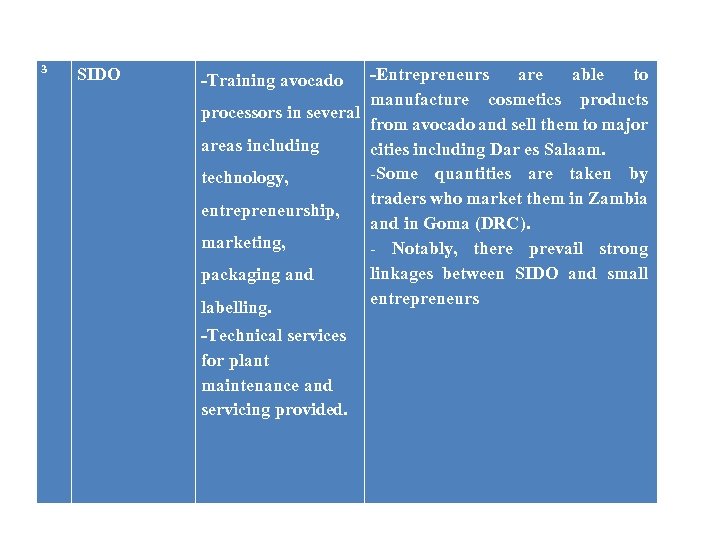 3 SIDO -Entrepreneurs are able to manufacture cosmetics products processors in several from avocado and sell them to major areas including cities including Dar es Salaam. -Some quantities are taken by technology, traders who market them in Zambia entrepreneurship, and in Goma (DRC). marketing, - Notably, there prevail strong linkages between SIDO and small packaging and entrepreneurs labelling. -Training avocado -Technical services for plant maintenance and servicing provided.
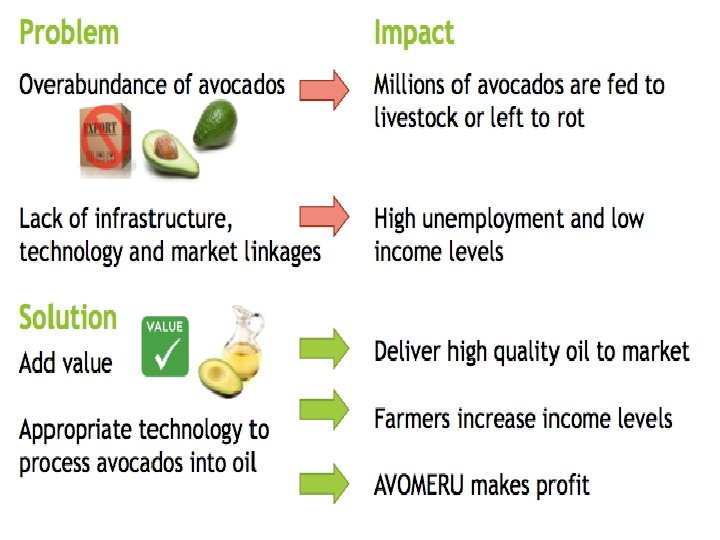
 The Case of AVOMERO Group in Meru District • A field study conducted through visiting some avocado processing plants in Meru District, Arusha Region, led to accessing of very interesting information. • A person known as Mr. Jesse J. Olyjange had taken some initiatives to set up an avocado processing plant in the district. • His idea was largely stimulated after he attended training of entrepreneurship and product design at MIT in the USA in 2012 where problem solving skills were imparted. • The training demanded trainees to come up with a problem solving idea from their communities. • Consequently, he perceived avocado processing as one of the problems constraining avocado farmers in Meru District and then graphically presented his idea as follows:
 § The idea attracted a number of actors, such as the International Development Innovation Network (IDIN), in MIT, which immediately undertook several initiatives to support it § The main reason would be because IDIN empowers a diverse, global network of innovators to design, develop and disseminate low-cost technologies in order to alleviate poverty § The idea of avocado processing was presented at IDIN to compete with other ideas § The idea won the competition and then a link was established to a local innovation centre in Tanzania known as Accelerating Innovation through Social Entrepreneurship (AISE) located in Arusha § The innovation centre incubated this business idea (avocado processing)
 § AISE started to develop the idea first by looking for products in Arusha super markets contained avocado oil. § AISE searched for information about companies that produce avocado oil globally and the countries in which they operate § Thereafter, AISE communicated with those companies, requesting them to consider being supplied with avocado oil from Arusha. § Some other companies were international such as the Albert International Distributors, Minneapolis Mineotal and Johnson and Tomson in USA. § The companies requested to be informed about the amount of avocado oil which could be supplied to them annually. § Consequently, AISE was informed that there was a high demand of avocado oil both in local and international markets.
 § Thereafter, AISE asked where to get processing technologies, technologies for quality control, storage and packaging? Who is going to fund the project? § AISE linked the idea to funders, such as USAID, IDIN and COSTECH, requesting them for funding to support designing and buying of machines. § The USAID agreed and provided USD 25, 000, IDIN provided USD 27, 720 and COSTECH provided Tshs 15 million. § Those funds were then used for designing and setting up a processing plant in Meru District § Whereas some of the machines were fabricated locally by private engineers, others were imported from China. § The machines installed were those of pressing, filtering and pasteurizing.
 § The processing of avocados started in 2015 in a village called Leguruki in Meru District, under the registered company called AVOMERU Group Limited § In terms of quality control, the samples are currently being sent to Nelson Mandela Institute of Science and Technology, KAIST Korea and MIT § In terms of packaging, the company has contacts with Kenya based companies called GIS and General Plastic, both being located in Nairobi § The packing materials are either in milliliters, ranging from 250, 350 to 750 mills or in litres, ranging from 3, 5 to 200 litres
 • In February 2016, the AVOMERO Group Limited signed oil delivery contracts with Chief Executive Officers of JOMA, Gladys Beauty and Albert International Distributors • Avomero Group is currently processing the avocados into oil, which is then sold to earlier on mentioned companies • Lessson From AVOMERU • There is no tight control and monitoring by the above companies, • The governance structure is modular • There is no risk of changing the buyers • The freedom to operate is high • Multiple buyers • In GVCs if buyer gives you skills, he/she will control you, • Local firms improve their position in GVCs once they make their own investments in acquiring knowledge in order to upgrade into higher position in the value chain
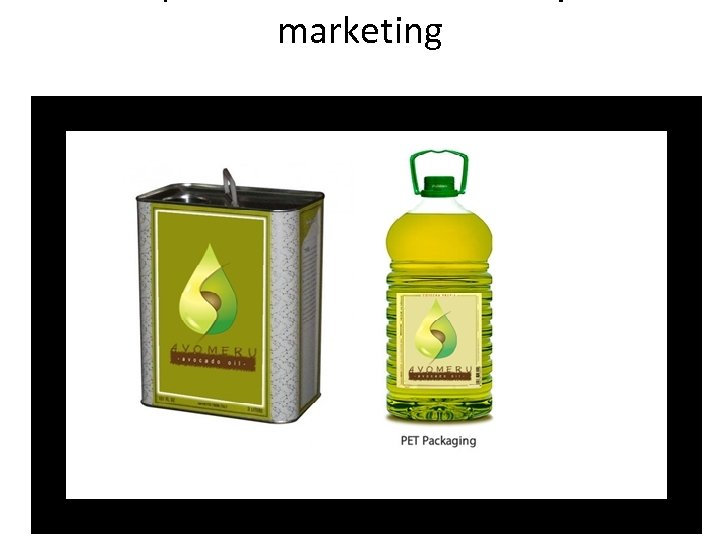 marketing
 Challenges § Lack of adequate raw materials for processing with 17 -25% oil content, which mostly is of the Hass variety § Only a few farmers have adopted this variety § Lack of advanced extraction machines - Processors employed people to peel the avocado skin and remove the seed by using hands § Lack of affordable packaging materials § Processors had earlier tried to contact KIOO Company Limited, a company producing bottles in Tanzania, but bottles were too expensive
 Concluding remarks • The findings have shown that various actors in the AIS have played major roles towards supporting functional upgrading and innovation such processing of avocados into products with higher market value such oil and cosmetics like hair and skin lotion. • The roles played were in the provision of technology/knowledge in processing (e. g. SIDO, TEMDO, and CARMATEC) and financial support (COSTECH, USAID, IDIN); buying of the avocado oil (both local and international companies); provision of packaging materials (GIS in Kenya); testing of the oil quality (MIT, NMIST, KAIST Korea); incubating the avocado processing idea (AISE, SIDO); provision of raw material (farmers); provision of quality standards (TBS and TFDA) and of marketing services (trade fairs)
 Concluding remarks § However, there are still challenges that need to be addressed by the actors in the AIS, which are access to advanced technology, raw materials and packaging § If the challenges are addressed properly, chances of diffusing the available knowledge in avocado processing by the AVOMERU Group within the Tanzanian AIS will be increased (scaling up ) § Being in network, other areas such as Kilimanjaro can learn about avocado processing capabilities, such as oil production, manufacturing of avocado oil-based cosmetic products (e. g. hair and skin lotion) including other entrepreneurship skills such as labeling, grading, packaging and marketing § As a consequence of this leaning, many more avocado producers, who are in the captive value chain will change to modular or market, thus ensuring sustainability
 Conclusion § Therefore, as long as the governing structure of the captive value chain and relation networks are more with producers who are in developing countries, efforts to change from captive to modular and market will be through strengthening of the AIS, which will in turn support competence building of the small producers to perform functional upgrading activities and innovation
 Thank you for your attention