


 Скачать презентацию Improving Service Investing in Infrastructure 777 North Capitol Street
e2b2e496fae0363843b07c132e67383d.ppt
- Количество слайдов: 40
 Improving Service—Investing in Infrastructure 777 North Capitol Street, NE 1 st Floor Wednesday, June 13, 2007 6: 30 pm – 9: 00 pm 1
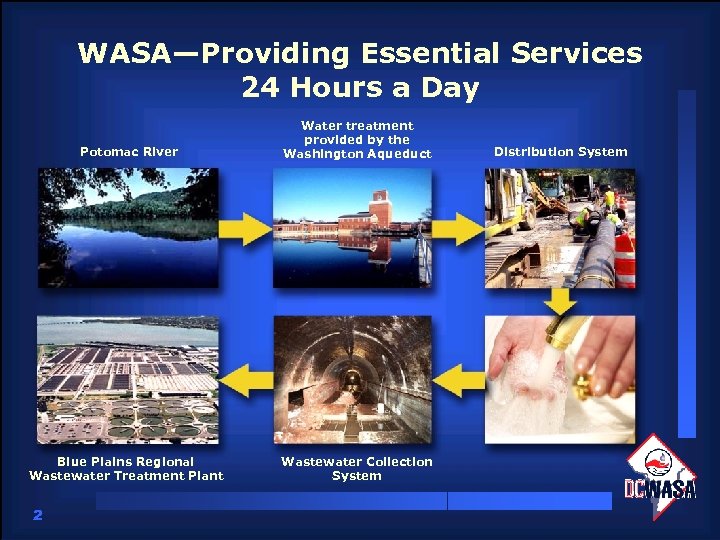 WASA—Providing Essential Services 24 Hours a Day Potomac River Water treatment provided by the Washington Aqueduct Blue Plains Regional Wastewater Treatment Plant Wastewater Collection System 2 Distribution System
 WASA Facts 3
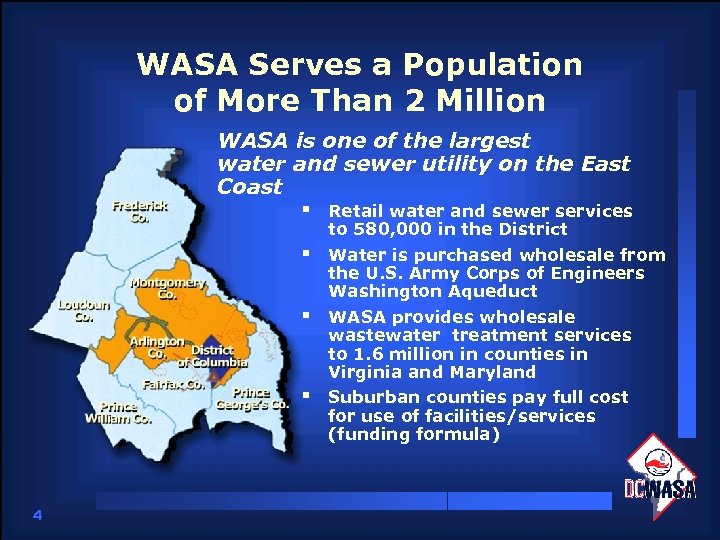 WASA Serves a Population of More Than 2 Million WASA is one of the largest water and sewer utility on the East Coast § Retail water and sewer services § § § 4 to 580, 000 in the District Water is purchased wholesale from the U. S. Army Corps of Engineers Washington Aqueduct WASA provides wholesale wastewater treatment services to 1. 6 million in counties in Virginia and Maryland Suburban counties pay full cost for use of facilities/services (funding formula)
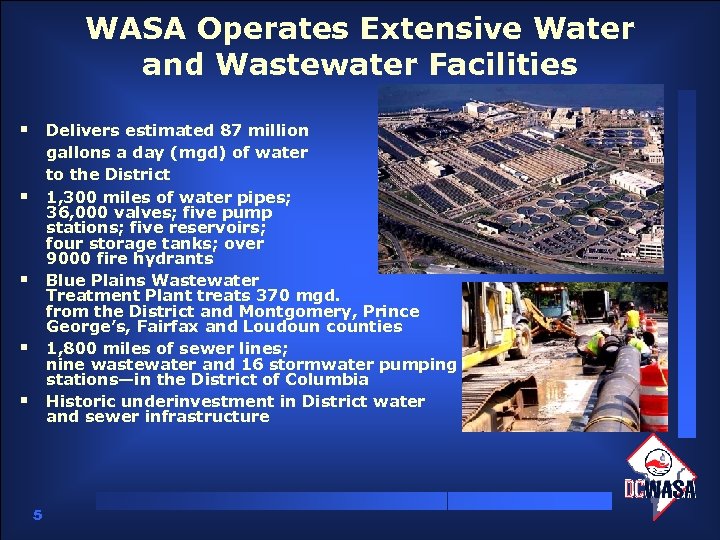 WASA Operates Extensive Water and Wastewater Facilities § Delivers estimated 87 million gallons a day (mgd) of water to the District 1, 300 miles of water pipes; 36, 000 valves; five pump stations; five reservoirs; four storage tanks; over 9000 fire hydrants Blue Plains Wastewater Treatment Plant treats 370 mgd. from the District and Montgomery, Prince George’s, Fairfax and Loudoun counties 1, 800 miles of sewer lines; nine wastewater and 16 stormwater pumping stations—in the District of Columbia Historic underinvestment in District water and sewer infrastructure § § 5
 WASA is a Regional Water and Sewer Authority § Created in 1996 as an independent § agency of District government (by the District and Congress) Board of Directors— 11 principal members ü Six (6) from District of Columbia (have ü rate-setting authority) Five (5) members from suburban counties § Board has adopted a policy of gradual § 6 and predictable rate increases Money from ratepayers pays for maintenance and improvements of District system
 Financial and Operational Overview 7
 Financial Overview Then— 1996 ü Virtually no cash in the bank ü No bond rating; never issued debt ü Over $35 million in delinquent accounts ü Over 1, 500 authorized positions ü Over 15% of total payroll spent on overtime ü Lost revenue due to inaccurate readings Now— 2007 ü Six months operating cash reserves ü AA- bond rating ü Delinquent accounts reduced to $7. 8 million ü Authorized positions reduced to 1, 128 (26% decrease) ü Overtime reduced to 7% of total payroll ü Automated Meter Reading (AMR); real-time, accurate readings 8
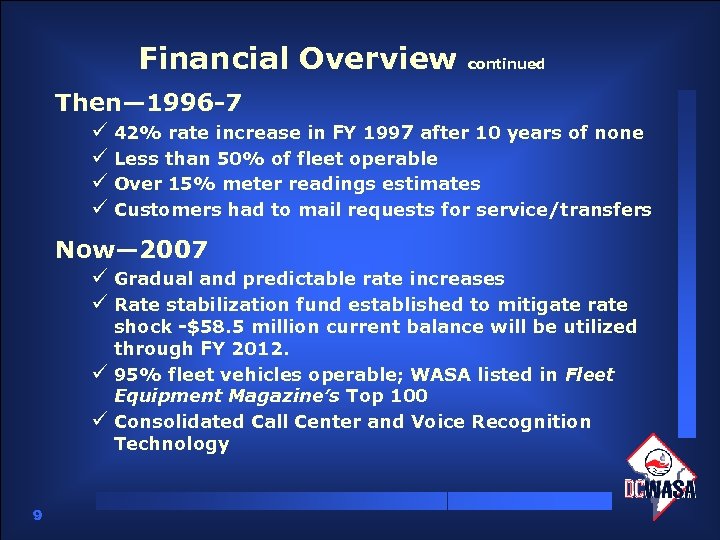 Financial Overview continued Then— 1996 -7 ü 42% rate increase in FY 1997 after 10 years of none ü Less than 50% of fleet operable ü Over 15% meter readings estimates ü Customers had to mail requests for service/transfers Now— 2007 ü Gradual and predictable rate increases ü Rate stabilization fund established to mitigate rate shock -$58. 5 million current balance will be utilized through FY 2012. ü 95% fleet vehicles operable; WASA listed in Fleet Equipment Magazine’s Top 100 ü Consolidated Call Center and Voice Recognition Technology 9
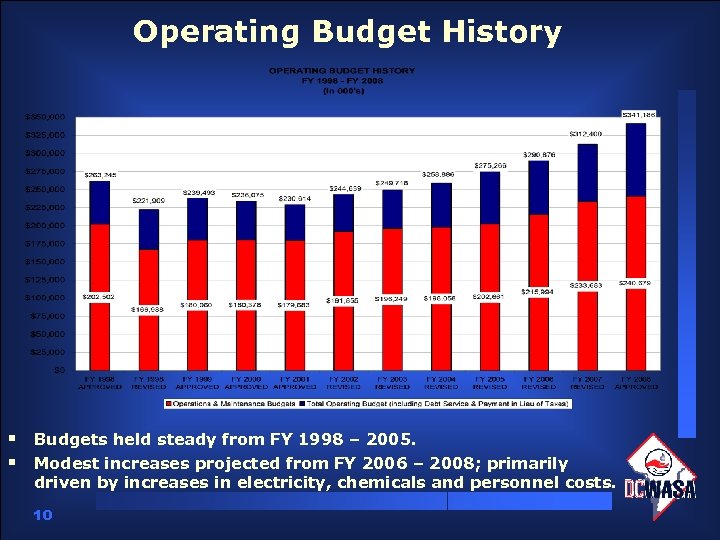 Operating Budget History § Budgets held steady from FY 1998 – 2005. § Modest increases projected from FY 2006 – 2008; primarily driven by increases in electricity, chemicals and personnel costs. 10
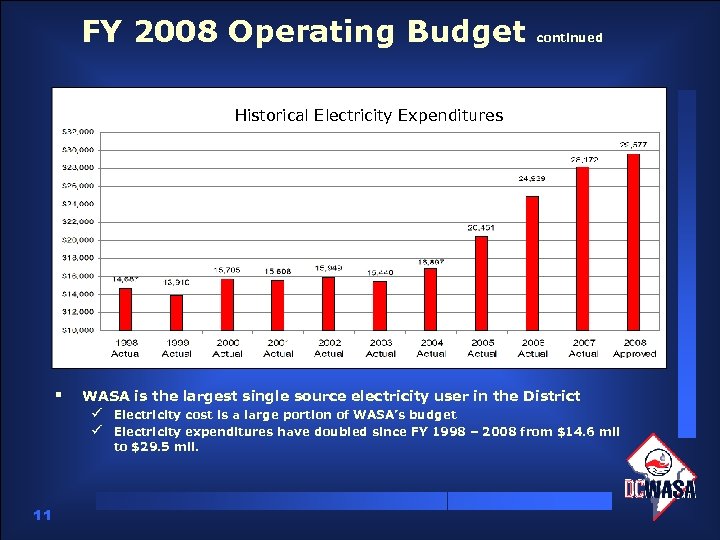 FY 2008 Operating Budget continued Historical Electricity Expenditures § WASA is the largest single source electricity user in the District ü Electricity cost is a large portion of WASA’s budget ü Electricity expenditures have doubled since FY 1998 – 2008 from $14. 6 mil to $29. 5 mil. 11
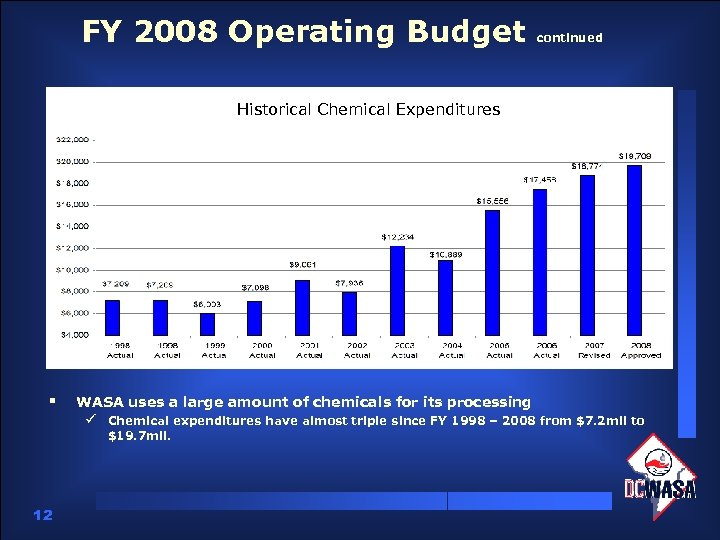 FY 2008 Operating Budget continued Historical Chemical Expenditures § WASA uses a large amount of chemicals for its processing ü Chemical expenditures have almost triple since FY 1998 – 2008 from $7. 2 mil to $19. 7 mil. 12
 FY 2008 Budgets 13
 FY 2008 Operating Budget • • $20. 7 million or 34% of increase is for increased debt service costs for WASA’s capital program § 14 $29 million projected increase in net expenditures • FY 2007 - $304. 4 m • FY 2008 - $332. 8 m $6. 6 million and $1. 1 million or 3% and 6% are for increases in O&M and PILOT/ROW costs respectively
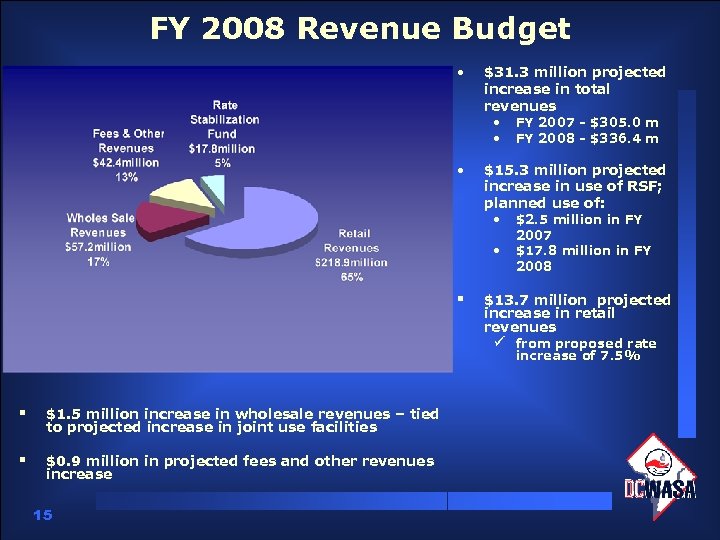 FY 2008 Revenue Budget • $31. 3 million projected increase in total revenues • FY 2007 - $305. 0 m • FY 2008 - $336. 4 m • $15. 3 million projected increase in use of RSF; planned use of: • $2. 5 million in FY • § 2007 $17. 8 million in FY 2008 $13. 7 million projected increase in retail revenues ü from proposed rate increase of 7. 5% § $1. 5 million increase in wholesale revenues – tied to projected increase in joint use facilities § $0. 9 million in projected fees and other revenues increase 15
 Rate Making Process 16
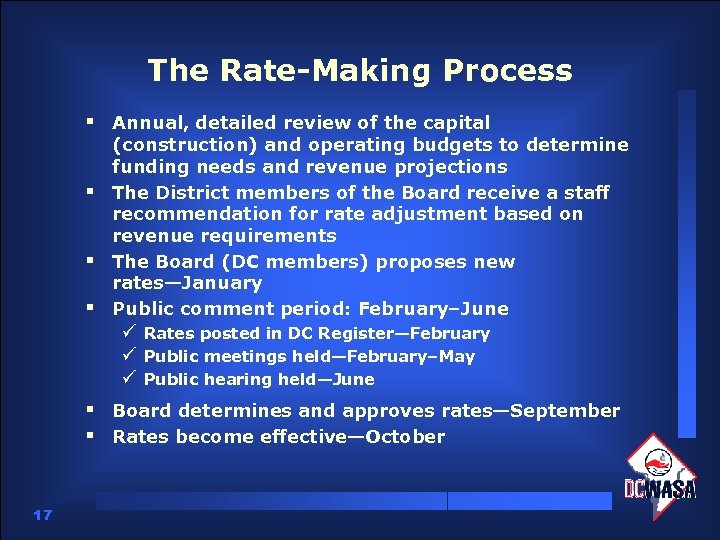 The Rate-Making Process § Annual, detailed review of the capital § § § (construction) and operating budgets to determine funding needs and revenue projections The District members of the Board receive a staff recommendation for rate adjustment based on revenue requirements The Board (DC members) proposes new rates—January Public comment period: February–June ü Rates posted in DC Register—February ü Public meetings held—February–May ü Public hearing held—June § Board determines and approves rates—September § Rates become effective—October 17
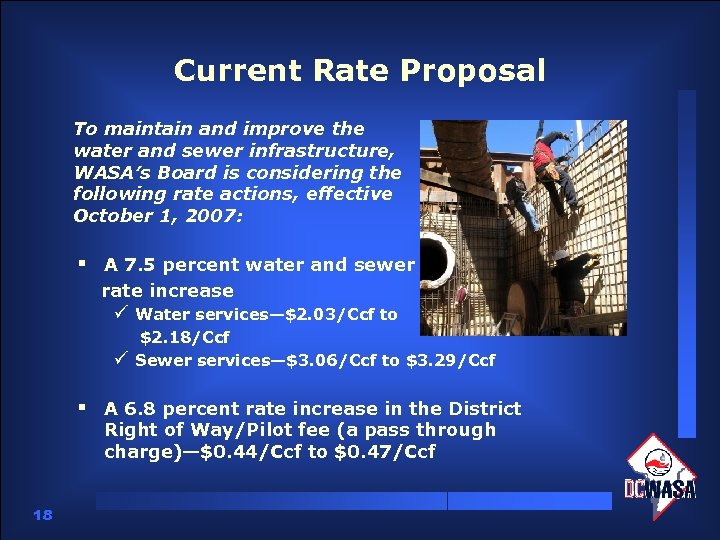 Current Rate Proposal To maintain and improve the water and sewer infrastructure, WASA’s Board is considering the following rate actions, effective October 1, 2007: § A 7. 5 percent water and sewer rate increase ü Water services—$2. 03/Ccf to ü $2. 18/Ccf Sewer services—$3. 06/Ccf to $3. 29/Ccf § A 6. 8 percent rate increase in the District Right of Way/Pilot fee (a pass through charge)—$0. 44/Ccf to $0. 47/Ccf 18
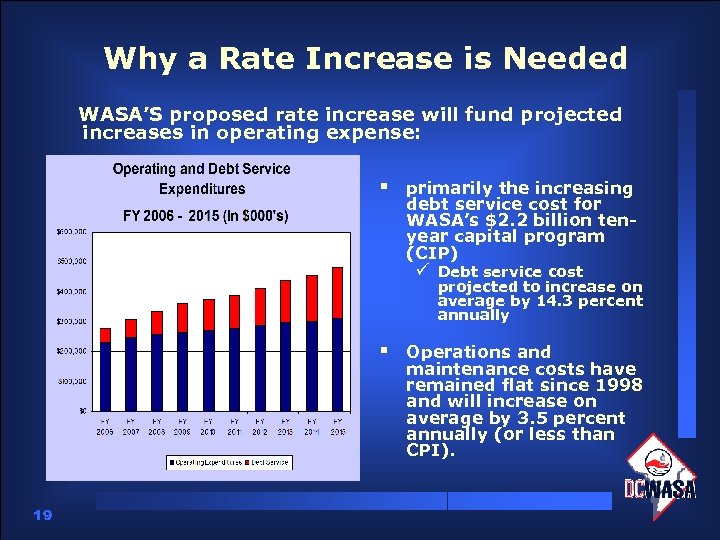 Why a Rate Increase is Needed WASA’S proposed rate increase will fund projected increases in operating expense: § primarily the increasing debt service cost for WASA’s $2. 2 billion tenyear capital program (CIP) ü Debt service cost projected to increase on average by 14. 3 percent annually § Operations and maintenance costs have remained flat since 1998 and will increase on average by 3. 5 percent annually (or less than CPI). 19
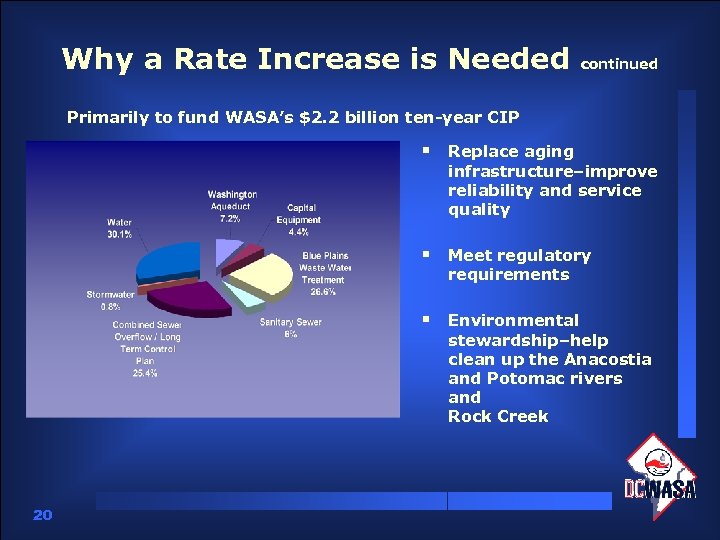 Why a Rate Increase is Needed continued Primarily to fund WASA’s $2. 2 billion ten-year CIP § Replace aging infrastructure–improve reliability and service quality § Meet regulatory requirements § Environmental stewardship–help clean up the Anacostia and Potomac rivers and Rock Creek 20
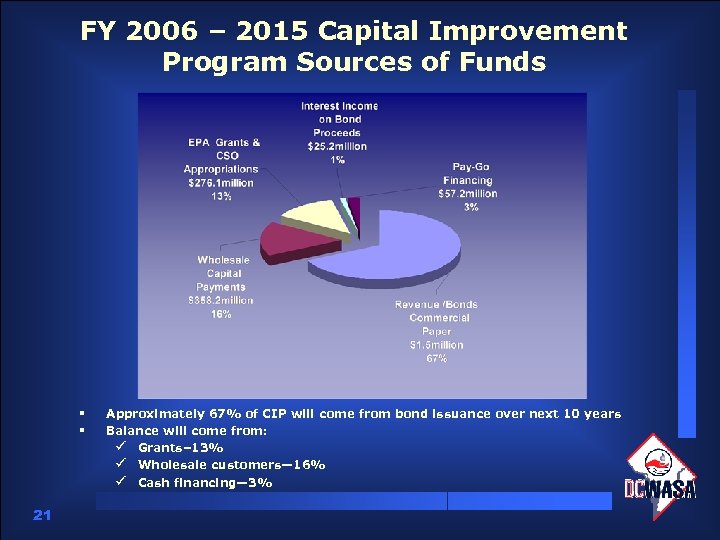 FY 2006 – 2015 Capital Improvement Program Sources of Funds § § 21 Approximately 67% of CIP will come from bond issuance over next 10 years Balance will come from: ü Grants– 13% ü Wholesale customers— 16% ü Cash financing— 3%
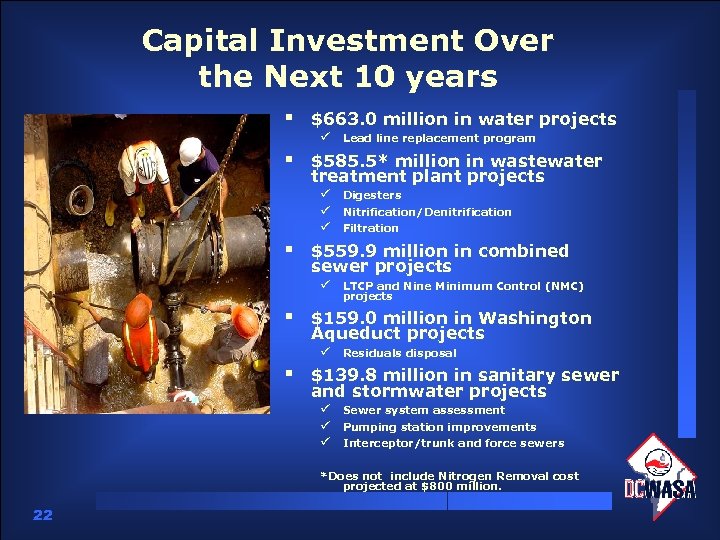 Capital Investment Over the Next 10 years § $663. 0 million in water projects ü Lead line replacement program § $585. 5* million in wastewater treatment plant projects ü Digesters ü Nitrification/Denitrification ü Filtration § $559. 9 million in combined sewer projects ü LTCP and Nine Minimum Control (NMC) projects § $159. 0 million in Washington Aqueduct projects ü Residuals disposal § $139. 8 million in sanitary sewer and stormwater projects ü Sewer system assessment ü Pumping station improvements ü Interceptor/trunk and force sewers *Does not include Nitrogen Removal cost projected at $800 million. 22
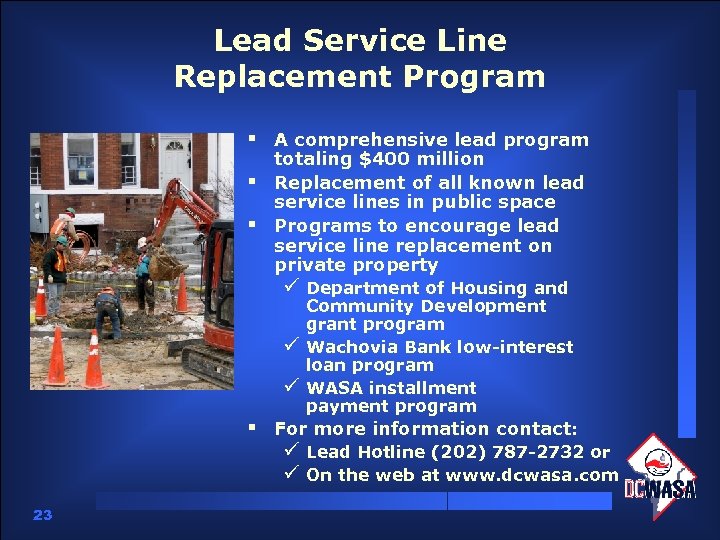 Lead Service Line Replacement Program § A comprehensive lead program § § totaling $400 million Replacement of all known lead service lines in public space Programs to encourage lead service line replacement on private property ü Department of Housing and ü ü Community Development grant program Wachovia Bank low-interest loan program WASA installment payment program § For more information contact: ü Lead Hotline (202) 787 -2732 or ü On the web at www. dcwasa. com 23
 Potential Rates Impact of Eliminating the Lead Service Line Replacement (LSR) Program § Between FY 2008 – 2015 the authority plans to spend approximately $300 million for Lead Service line Replacements. ü WASA’s board is considering the financial impact of continuing or modifying the program. • Elimination of the LSR program will lower projected rate increases by an estimated 6. 9%* to 7. 9%* over an eight year period (FY 2008 – 2015). • Modification of the LSR program with planned disbursements of $35 m – $50 m for LSR tied to water infrastructure improvement projects will lower projected rates increases by an estimated 6. 6%* to 7. 0%* over an eight year period (FY 2008 – 2015). ü In order to accommodate the LSR program several water infrastructure projects were deferred and may need to be reconsidered if the LSR program is eliminated or modified. * Current financial plan projects a cumulative rate increase of 79% over the 10 year period (from FY 2006 – FY 2015) 24
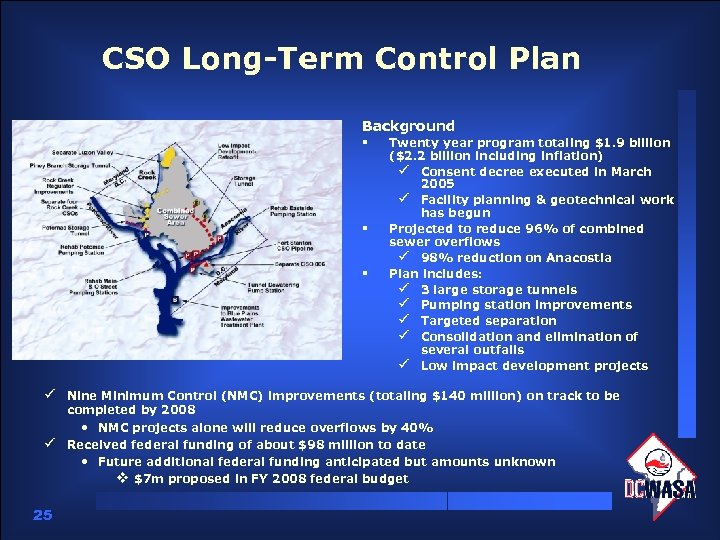 CSO Long-Term Control Plan Background § § § Twenty year program totaling $1. 9 billion ($2. 2 billion including inflation) ü Consent decree executed in March 2005 ü Facility planning & geotechnical work has begun Projected to reduce 96% of combined sewer overflows ü 98% reduction on Anacostia Plan includes: ü 3 large storage tunnels ü Pumping station improvements ü Targeted separation ü Consolidation and elimination of several outfalls ü Low impact development projects ü Nine Minimum Control (NMC) improvements (totaling $140 million) on track to be ü 25 completed by 2008 • NMC projects alone will reduce overflows by 40% Received federal funding of about $98 million to date • Future additional federal funding anticipated but amounts unknown v $7 m proposed in FY 2008 federal budget
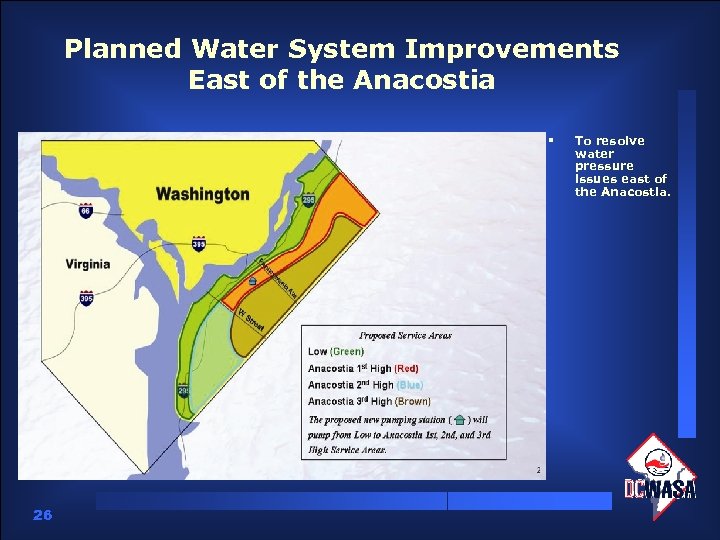 Planned Water System Improvements East of the Anacostia § 26 To resolve water pressure issues east of the Anacostia.
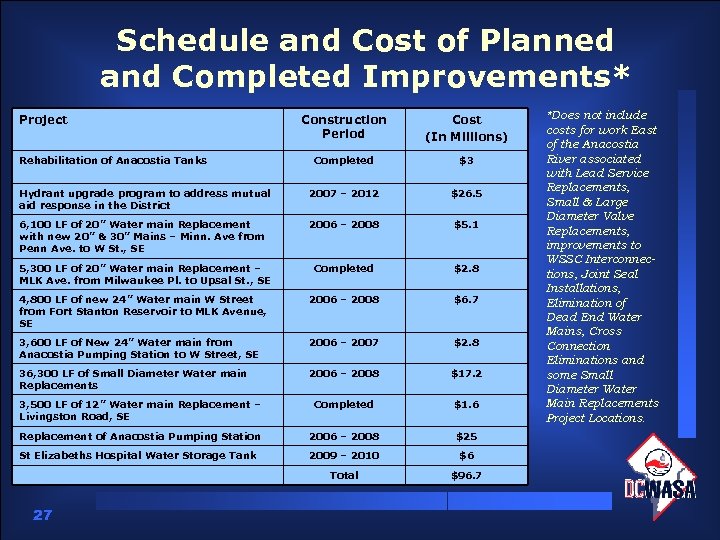 Schedule and Cost of Planned and Completed Improvements* Project Construction Period Cost (In Millions) Completed $3 Hydrant upgrade program to address mutual aid response in the District 2007 – 2012 $26. 5 6, 100 LF of 20” Water main Replacement with new 20” & 30” Mains – Minn. Ave from Penn Ave. to W St. , SE 2006 – 2008 $5. 1 5, 300 LF of 20” Water main Replacement – MLK Ave. from Milwaukee Pl. to Upsal St. , SE Completed $2. 8 4, 800 LF of new 24” Water main W Street from Fort Stanton Reservoir to MLK Avenue, SE 2006 – 2008 $6. 7 3, 600 LF of New 24” Water main from Anacostia Pumping Station to W Street, SE 2006 – 2007 $2. 8 36, 300 LF of Small Diameter Water main Replacements 2006 – 2008 $17. 2 3, 500 LF of 12” Water main Replacement – Livingston Road, SE Completed $1. 6 Replacement of Anacostia Pumping Station 2006 – 2008 $25 St Elizabeths Hospital Water Storage Tank 2009 – 2010 $6 Total $96. 7 Rehabilitation of Anacostia Tanks 27 *Does not include costs for work East of the Anacostia River associated with Lead Service Replacements, Small & Large Diameter Valve Replacements, improvements to WSSC Interconnections, Joint Seal Installations, Elimination of Dead End Water Mains, Cross Connection Eliminations and some Small Diameter Water Main Replacements Project Locations.
 New Baseball District Improvements § Improvements required to water and sewer infrastructure around the new baseball district estimated at approximately $20 million § Cost of improvements would not be passed on to water and sewer customers ü City is exploring the following options for financing these costs • Special assessment District • Developer charges 28
 Projected Rate Adjustments 29
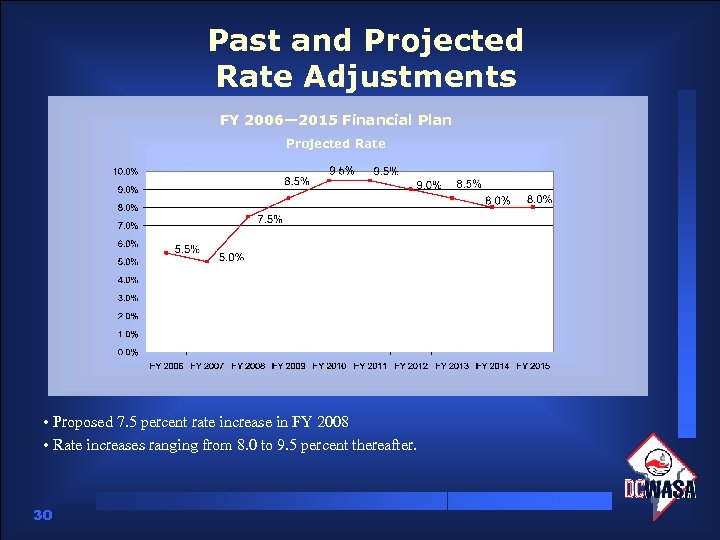 Past and Projected Rate Adjustments FY 2006— 2015 Financial Plan Projected Rate • Proposed 7. 5 percent rate increase in FY 2008 • Rate increases ranging from 8. 0 to 9. 5 percent thereafter. 30
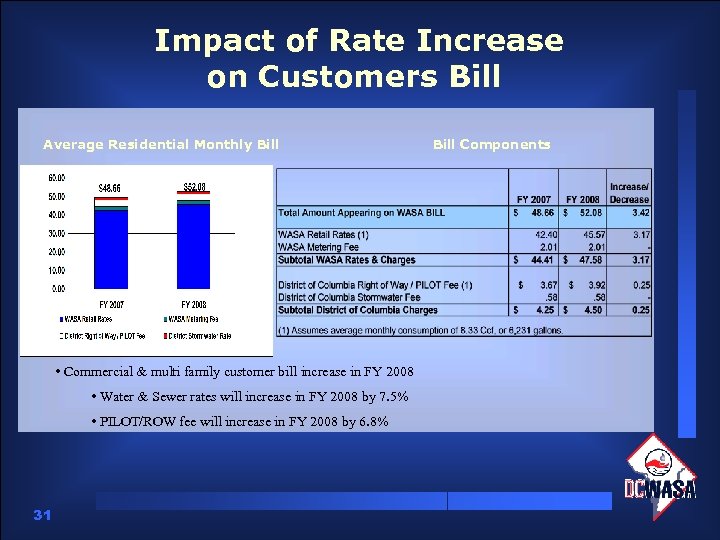 Impact of Rate Increase on Customers Bill Average Residential Monthly Bill • Commercial & multi family customer bill increase in FY 2008 • Water & Sewer rates will increase in FY 2008 by 7. 5% • PILOT/ROW fee will increase in FY 2008 by 6. 8% 31 Bill Components
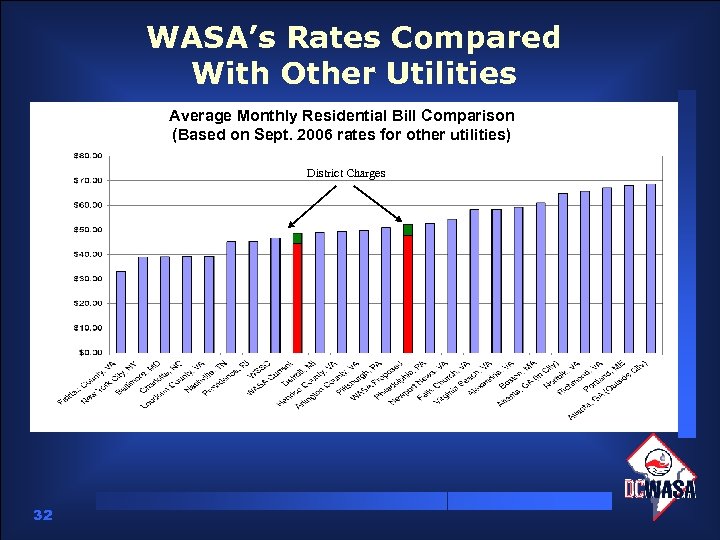 WASA’s Rates Compared With Other Utilities Average Monthly Residential Bill Comparison (Based on Sept. 2006 rates for other utilities) District Charges 32
 Impact of Allocating Some of the PILOT to WASA's Wholesale Customers ü Since FY 1997 the District has assessed WASA a Payment In Lieu Of Taxes § WASA’s board is considering the impact of allocating a portion of this bill to Wholesale customers (surrounding jurisdictions). § Using the current indirect cost allocation methodology. ü The FY 2008 amount is $13. 3 million ü Currently this amount is included as a separate line item on the retail (DC) customer bill. ü FY 2008 proposed rate for this fee is $0. 47/Ccf ü An estimated 24% of total PILOT may be allocated to wholesale customers. ü resulting in a projected rate reduction of approximately 14. 25%* over the remaining eight years of the ten year plan. * Current financial plan projects a cumulative rate increase of 79% over the 10 year period (from FY 2006 – FY 2015) 33
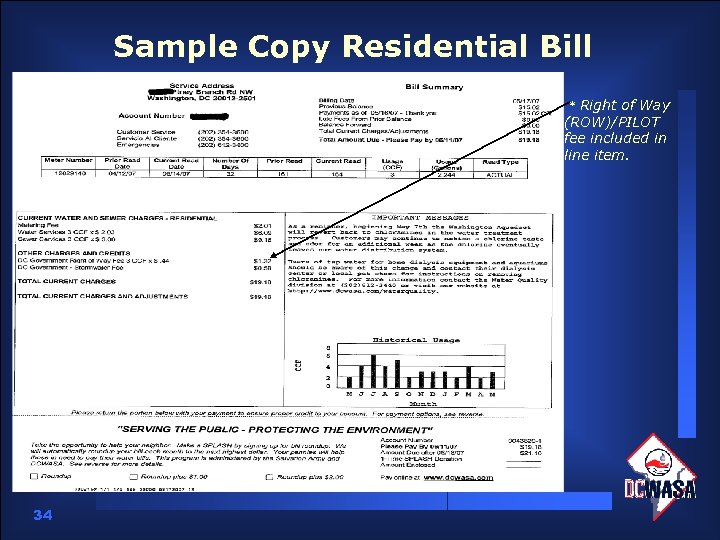 Sample Copy Residential Bill * Right of Way (ROW)/PILOT fee included in line item. 34
 Customer Service Improvements 35
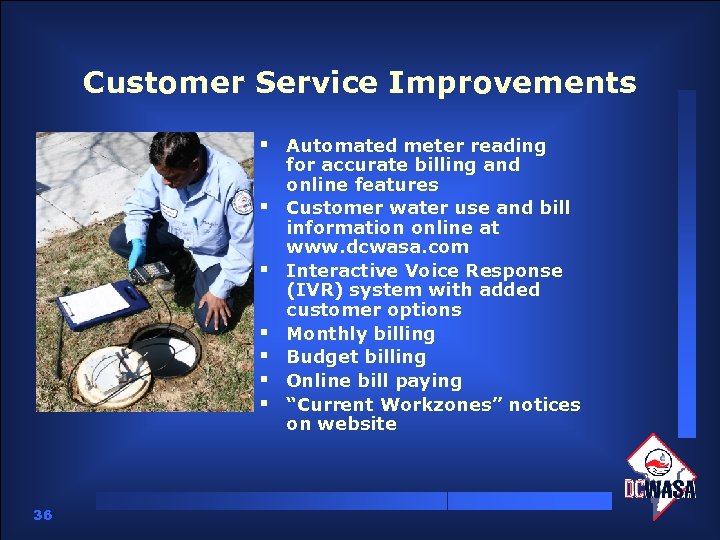 Customer Service Improvements § Automated meter reading § § § 36 for accurate billing and online features Customer water use and bill information online at www. dcwasa. com Interactive Voice Response (IVR) system with added customer options Monthly billing Budget billing Online bill paying “Current Workzones” notices on website
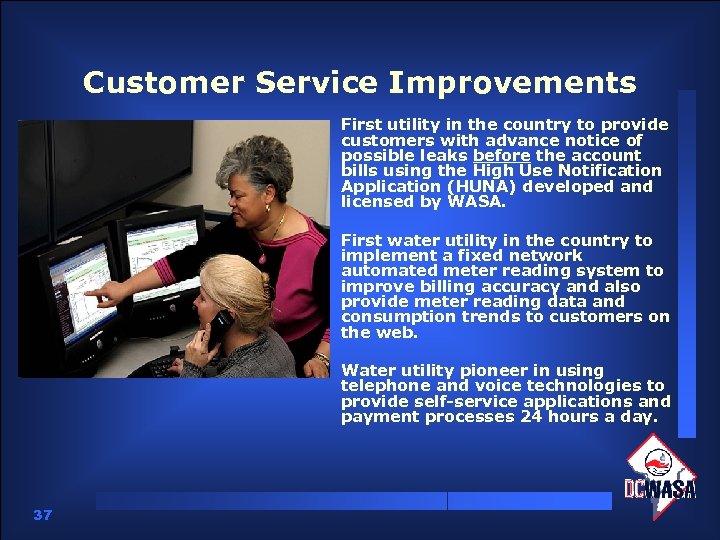 Customer Service Improvements First utility in the country to provide customers with advance notice of possible leaks before the account bills using the High Use Notification Application (HUNA) developed and licensed by WASA. First water utility in the country to implement a fixed network automated meter reading system to improve billing accuracy and also provide meter reading data and consumption trends to customers on the web. Water utility pioneer in using telephone and voice technologies to provide self-service applications and payment processes 24 hours a day. 37
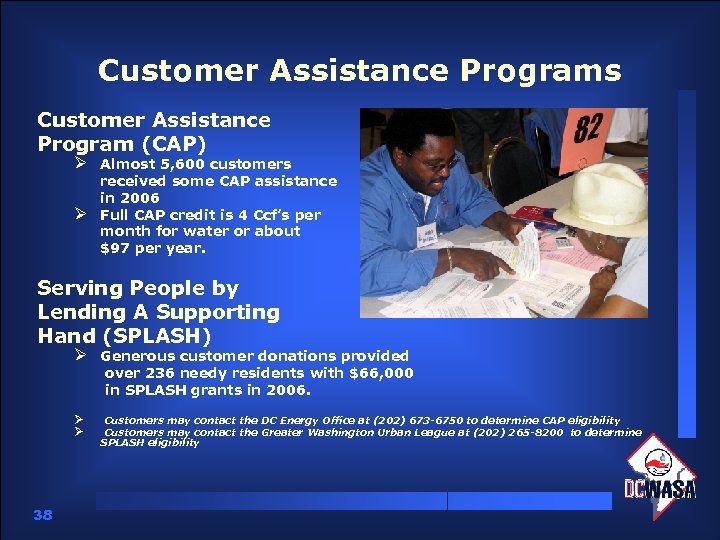 Customer Assistance Programs Customer Assistance Program (CAP) Ø Almost 5, 600 customers Ø received some CAP assistance in 2006 Full CAP credit is 4 Ccf’s per month for water or about $97 per year. Serving People by Lending A Supporting Hand (SPLASH) Ø Generous customer donations provided over 236 needy residents with $66, 000 in SPLASH grants in 2006. Ø Ø 38 Customers may contact the DC Energy Office at (202) 673 -6750 to determine CAP eligibility Customers may contact the Greater Washington Urban League at (202) 265 -8200 to determine SPLASH eligibility
 Contact Information 39
 Ways to Provide Input on Rate Increase Proposal § Contact WASA with your comments ü E-mail at info@dcwasa. com ü Fax WASA at (202) 787 -2795 ü Mail to Board Secretary at 5000 Overlook Ave. , SW, Washington, DC 20032 40