 Скачать презентацию Improving Service Accessibility for Least Advantaged Clients NGO
d38c55bb01c7076ba107aa95c622a464.ppt
- Количество слайдов: 14



Improving Service Accessibility for Least Advantaged Clients NGO Service Delivery Program House NE (N), Road 88, Gulshan-2, Dhaka-1212
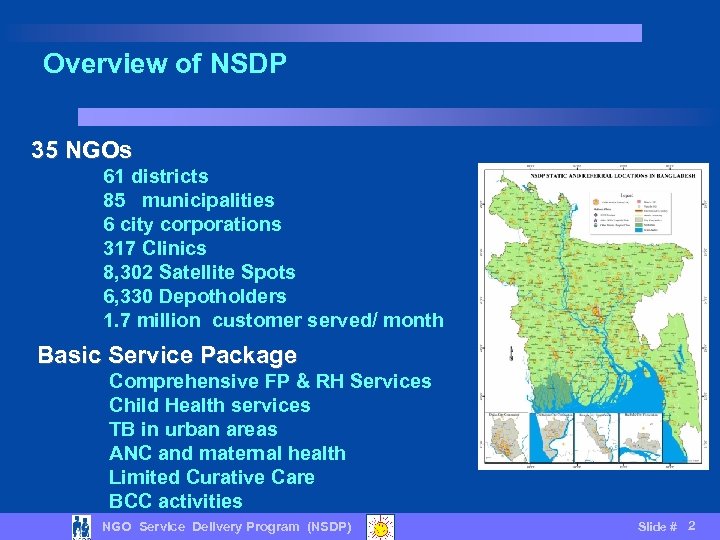
Overview of NSDP 35 NGOs 61 districts 85 municipalities 6 city corporations 317 Clinics 8, 302 Satellite Spots 6, 330 Depotholders 1. 7 million customer served/ month Basic Service Package Comprehensive FP & RH Services Child Health services TB in urban areas ANC and maternal health Limited Curative Care BCC activities NGO Service Delivery Program (NSDP) Slide # 2
Study Objectives • To identify least advantaged clients (poorest of the poor) • To isolate and understand barriers they face in accessing services • To design ways to overcome barriers • To improve communication between the poor and NGO service providers NGO Service Delivery Program (NSDP) Slide # 3
Methodology • Participatory Rural/Urban Appraisal applied with women – Social Mapping – Wealth Ranking – Venn Diagram • Meeting with Stakeholders • Study Coverage: – 8 NGOs – 24 Static Clinics – 826 Satellite Clinics spots NGO Service Delivery Program (NSDP) Slide # 4
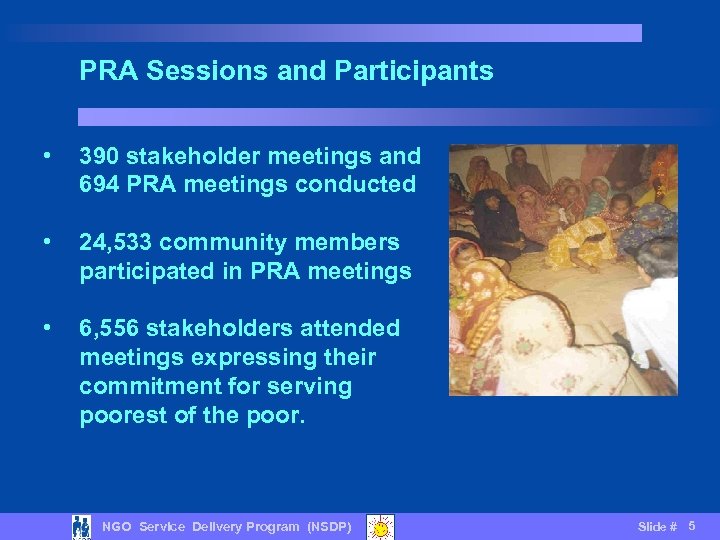
PRA Sessions and Participants • 390 stakeholder meetings and 694 PRA meetings conducted • 24, 533 community members participated in PRA meetings • 6, 556 stakeholders attended meetings expressing their commitment for serving poorest of the poor. NGO Service Delivery Program (NSDP) Slide # 5
Who are poorest of the poor Poor community members identified context specific indicators in PRA session: • • • Rural Day laborers Depend on food collected door to door Cannot eat twice in a day No education Little income above expenditure NGO Service Delivery Program (NSDP) Urban • No land • Begging • Suffers from untreated diseases • Works as house maid • No work no food Slide # 6
Barriers • Services: – Limited range of services – inadequate number of satellite clinics and – limited hours • Information: Not informed about availability and types of services • Poverty: – High service charge and price of medicine – No free treatment NGO Service Delivery Program (NSDP) • Quality of service: – Diseases not cured – Incorrect treatment • Providers’ behavior: – Poor are neglected – Not allowed to speak • Proximity: – Distance of clinic – Clinic staff don't visit remote areas Slide # 7
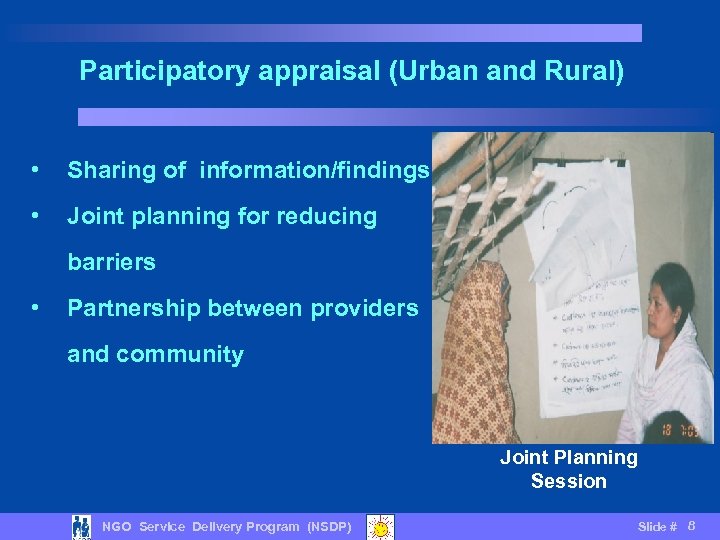
Participatory appraisal (Urban and Rural) • Sharing of information/findings • Joint planning for reducing barriers • Partnership between providers and community Joint Planning Session NGO Service Delivery Program (NSDP) Slide # 8
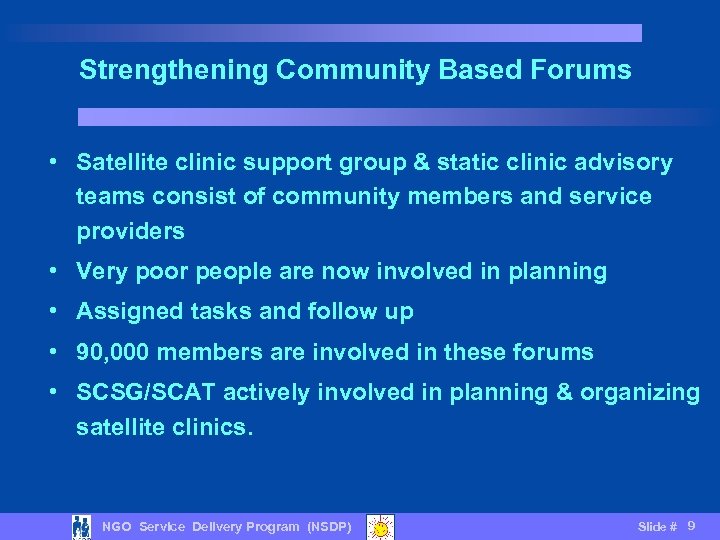
Strengthening Community Based Forums • Satellite clinic support group & static clinic advisory teams consist of community members and service providers • Very poor people are now involved in planning • Assigned tasks and follow up • 90, 000 members are involved in these forums • SCSG/SCAT actively involved in planning & organizing satellite clinics. NGO Service Delivery Program (NSDP) Slide # 9
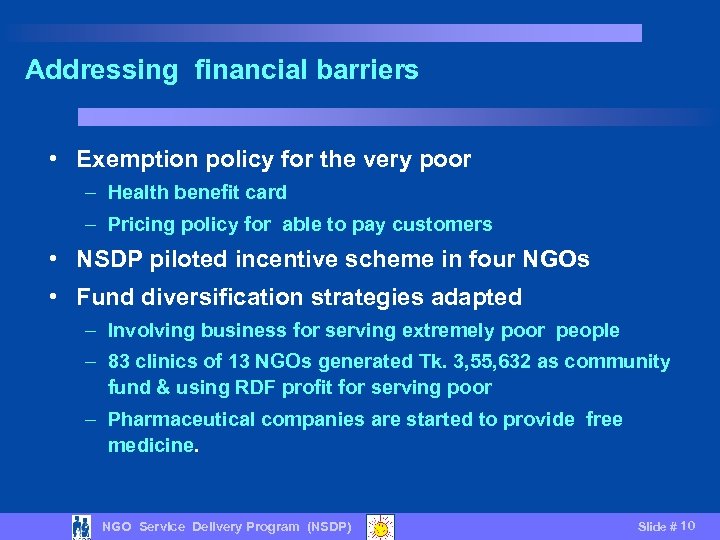
Addressing financial barriers • Exemption policy for the very poor – Health benefit card – Pricing policy for able to pay customers • NSDP piloted incentive scheme in four NGOs • Fund diversification strategies adapted – Involving business for serving extremely poor people – 83 clinics of 13 NGOs generated Tk. 3, 55, 632 as community fund & using RDF profit for serving poor – Pharmaceutical companies are started to provide free medicine. NGO Service Delivery Program (NSDP) Slide # 10
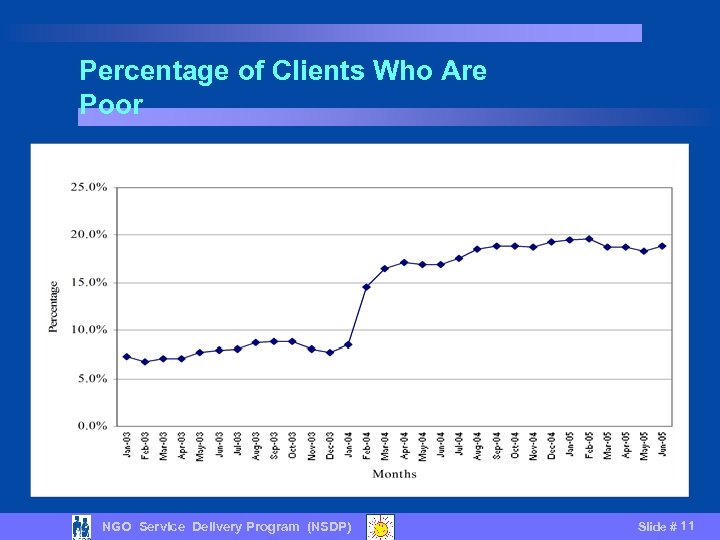
Percentage of Clients Who Are Poor NGO Service Delivery Program (NSDP) Slide # 11
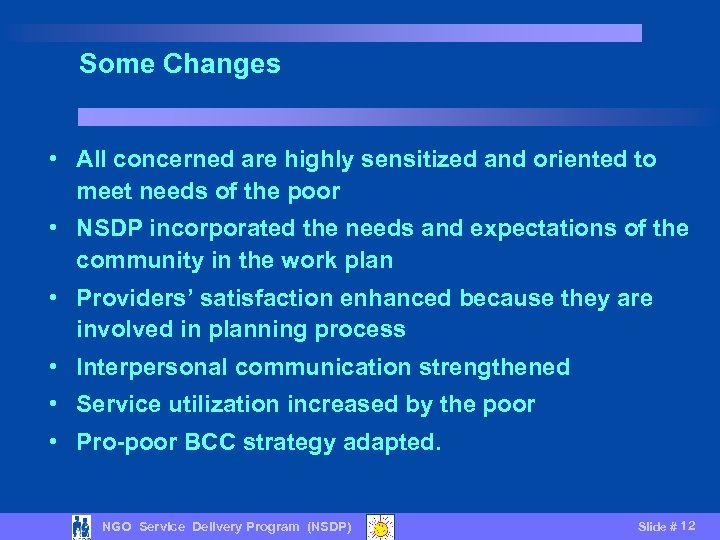
Some Changes • All concerned are highly sensitized and oriented to meet needs of the poor • NSDP incorporated the needs and expectations of the community in the work plan • Providers’ satisfaction enhanced because they are involved in planning process • Interpersonal communication strengthened • Service utilization increased by the poor • Pro-poor BCC strategy adapted. NGO Service Delivery Program (NSDP) Slide # 12
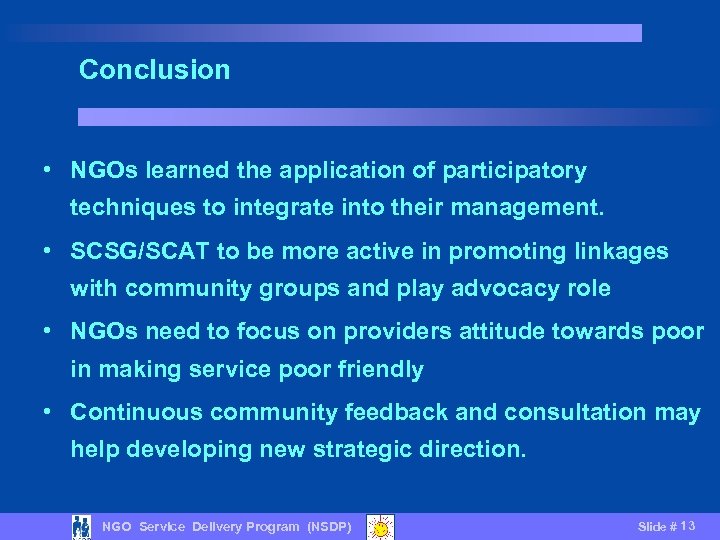
Conclusion • NGOs learned the application of participatory techniques to integrate into their management. • SCSG/SCAT to be more active in promoting linkages with community groups and play advocacy role • NGOs need to focus on providers attitude towards poor in making service poor friendly • Continuous community feedback and consultation may help developing new strategic direction. NGO Service Delivery Program (NSDP) Slide # 13

Thank You
Скачать презентацию Improving Service Accessibility for Least Advantaged Clients NGO
d38c55bb01c7076ba107aa95c622a464.ppt