


 Скачать презентацию Improving Psychological Care After Stroke Dr Steve Margison
0a34f744d4183d8b369800d6023b53b1.ppt
- Количество слайдов: 16
 Improving Psychological Care After Stroke Dr Steve Margison Consultant Clinical Neuropsychologist South Devon Healthcare NHS Foundation Trust

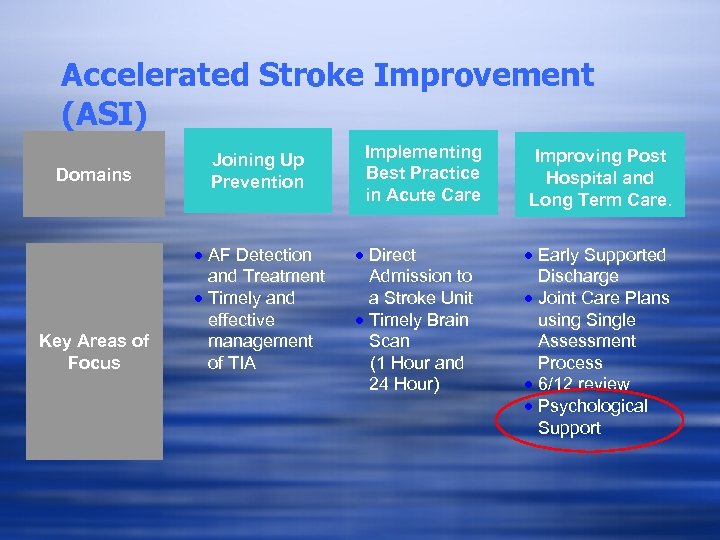 Accelerated Stroke Improvement (ASI) Domains Joining Up Prevention Key Areas of Focus · AF Detection and Treatment · Timely and effective management of TIA Implementing Best Practice in Acute Care · Direct Admission to a Stroke Unit · Timely Brain Scan (1 Hour and 24 Hour) Improving Post Hospital and Long Term Care. · Early Supported Discharge · Joint Care Plans using Single Assessment Process · 6/12 review · Psychological Support
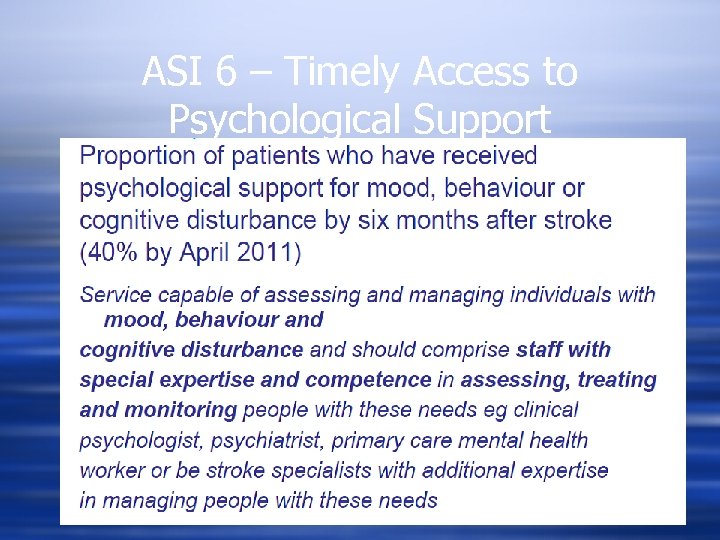 ASI 6 – Timely Access to Psychological Support
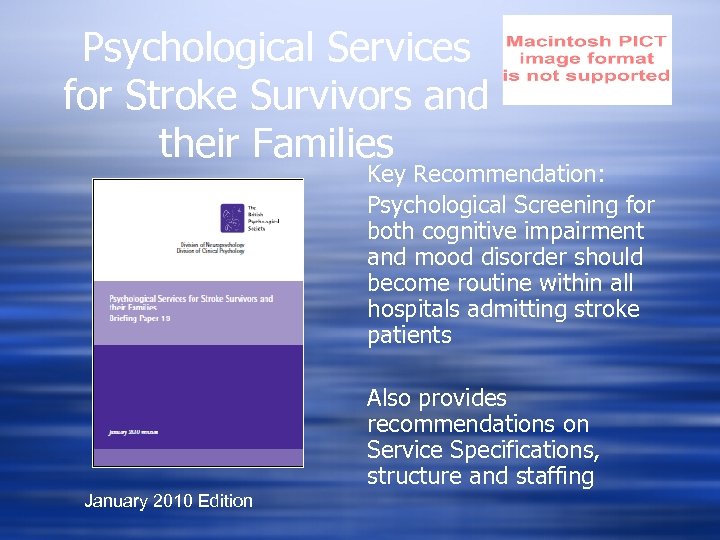 Psychological Services for Stroke Survivors and their Families Key Recommendation: Psychological Screening for both cognitive impairment and mood disorder should become routine within all hospitals admitting stroke patients Also provides recommendations on Service Specifications, structure and staffing January 2010 Edition
 How do we know who to be concerned about? w West et al (Stroke, 2010, 41, 1723 -1727) w Investigated trajectory of psychological symptoms and their impact on functional recovery. w 444 patient assessed at 2 -6 weeks, then followed up at 9, 13, 26 & 52 weeks. w Used GHQ to look at psychological symptoms and modified Barthel Index for function.
 West et al (2010) w Strong association between trajectory of psychological symptoms and functional outcome. w Four ‘classes’ or groups of patients identified based on GHQ. w Groups show a gradual decrease in psychological distress over time. w “Cluster 37” scored above the WHO threshold for 1 st 3 months and continued to have problems.
 West et al (2010) w “Cluster 37” had more pre-morbid depression. w Higher dep. <-> poorer Barthel scores; but there was wide variation in this group. w One high score does not predict poorer outcome but trajectory does seem to. w Poorer functional outcome actually associated with: w Psychological symptoms w More severe disability early on w Age
 How to assess? w Depression and distress are not the same. w Measures of depression are similar in content - don’t produce different results. w Ask questions as well as doing questionnaires e. g. previous problems? w It matters more that we ask and do something with the results.
 What should we do with patients who are depressed? On a Stroke Unit or Ward w Keep relevant notes w Watchful waiting w Refer to mental health professional e. g. psychiatric liaison. w Consider anti-depressant medication w (Kneebone et al, British Journal of Occupational Therapy, February 2010) w Pass on your concerns on discharge.
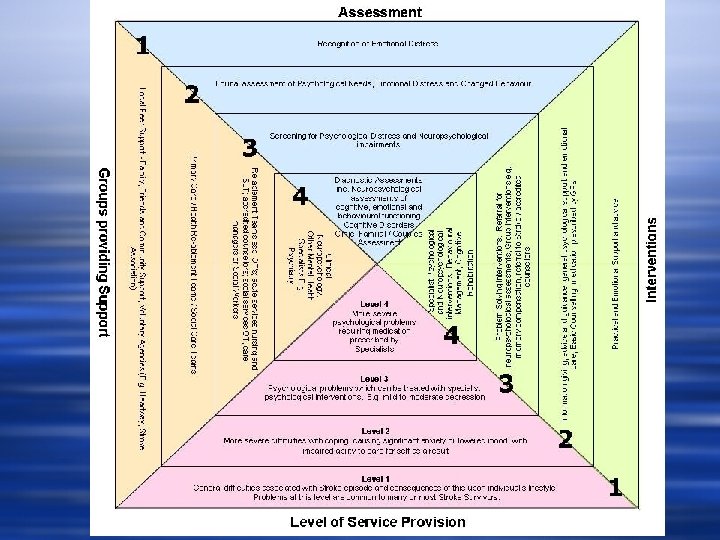
 What should we do with patients who are depressed? w Stepped care suggests interventions based on need not one size fits all. w ‘Sub-threshold’ problems are everyone’s responsibility - all staff and peer support? w Mild-moderate problems should be dealt with by designated staff - Stroke Ward, Rehab, Re. Ablement etc. w Severe or persistent problems need to be managed by specialist services - Mental Health professionals.
 What should we do with patients who are depressed? Cochrane review w Anti-depressants are most effective if used for people who are moderately to severely depressed (15%). w Cognitive behaviour therapy isn’t useful. BUT there is significant criticism of the Cochrane review which points out that it was based on a study with poor protocols for doing CBT. In reality IAPT services will be important.
 What could we do in Stroke Services. w Brief interventions that are strong on engagement and acceptability are important. w Activity Scheduling w Problem Solving w Active Listening w Motivational Interviewing? w Staff need supervision and training.
 South Devon w Devising a stepped care model. w Engaging the stakeholders. w Working with resources we have. w Training as many staff as possible to be aware of psychological issues. w Agreeing which assessment, when, by whom. w Exploring referral pathways.
 Some things to remember. w Not all psychological disorder post stroke arises from the stroke. At least half of all depression post-stroke arises from depression before stroke (Prof. Allan House, Liaison Psychiatrist). w Mental and physical health needs should be of equal importance. w Targeting interventions isn’t possible without on-going monitoring. w Do something to get started.