


 Скачать презентацию Improving Outcomes for Children who Live in High
a0b8a8d4c8cd571ae365bd6eced70436.ppt
- Количество слайдов: 33
 Improving Outcomes for Children who Live in High Risk Families Di Jerwood
 High Risk Families • Domestic Abuse • Substance Misuse • Parental Mental Ill Health
 Multiple Adversities • Abuse & neglect are often a feature of a range of family difficulties and problems • Often compounded by poverty, house moves & eviction • Cumulative harm • A wicked problem • Reconceptualisation Bunting & Toner (2012); Devaney & Spratt (2009)
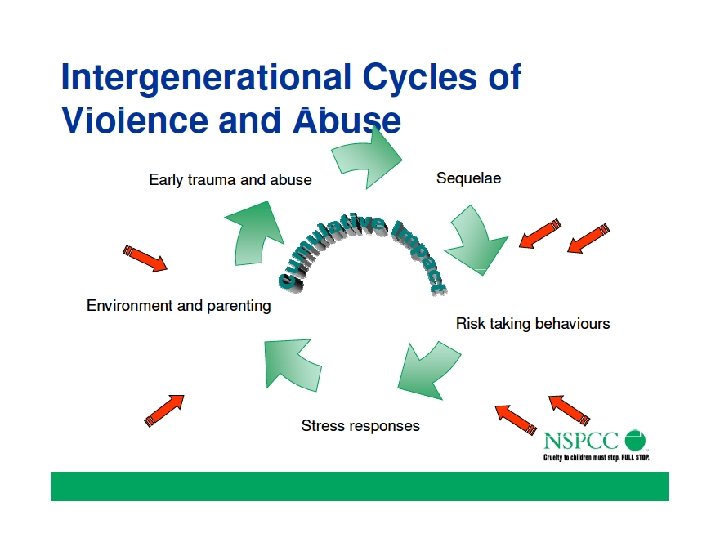
 The ACE Study (Adverse Childhood Experiences) • Adverse Childhood Experiences & their relationship to Adult Health and Well-Being – Child abuse & neglect – Growing up with domestic violence, substance abuse, mental illness, crime. – 18. 000 participants – 10 year study Anda, R. , & Felliti, V. , (2010) The Adverse Childhood Experiences (ACE) Study: www. acestudy/org
 Adverse Childhood Experiences determine the likelihood of the ten most common causes of death in the United States Top 10 Risk Factors: • • • smoking, severe obesity, physical inactivity, depression, suicide attempt, alcoholism, illicit drug use, injected drug use, 50+ sexual partners, history of STD (sexually transmitted disease).
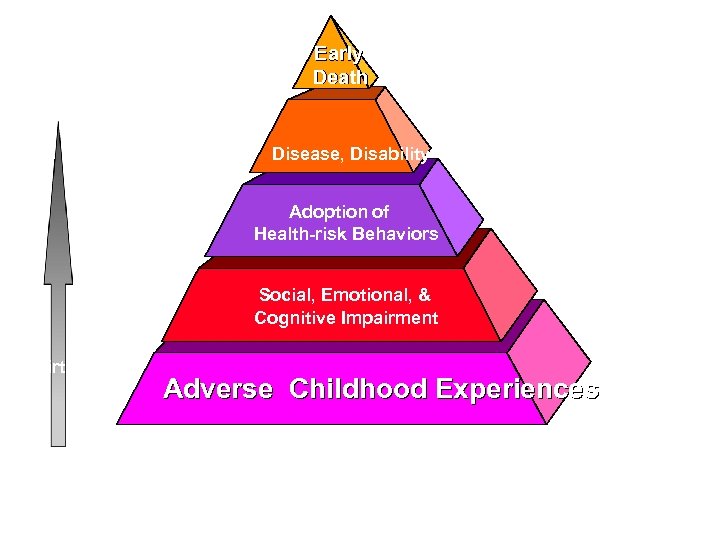 Death Early Death Disease, Disability Adoption of Health-risk Behaviors Social, Emotional, & Cognitive Impairment Birth Adverse Childhood Experiences The Influence of Adverse Childhood Experiences Throughout Life
 Some findings so far… • Increased risk of lung cancer • More auto immune disease • Increased prescription drug use
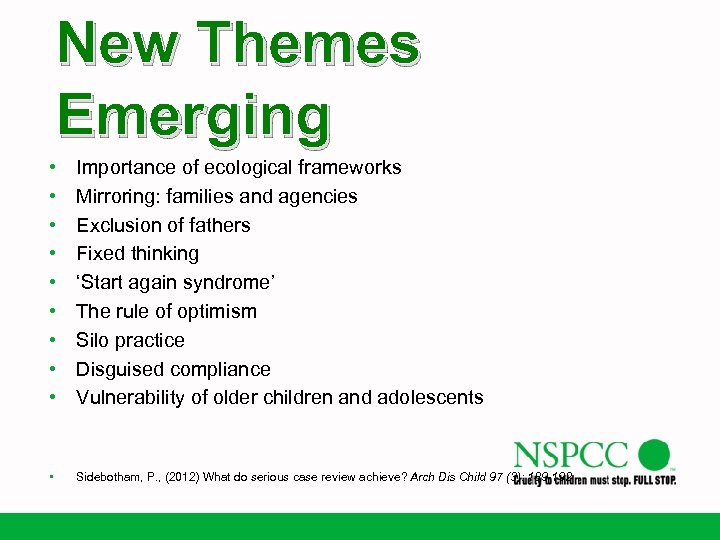 New Themes Emerging • • • Importance of ecological frameworks Mirroring: families and agencies Exclusion of fathers Fixed thinking ‘Start again syndrome’ The rule of optimism Silo practice Disguised compliance Vulnerability of older children and adolescents • Sidebotham, P. , (2012) What do serious case review achieve? Arch Dis Child 97 (3): 189 -192
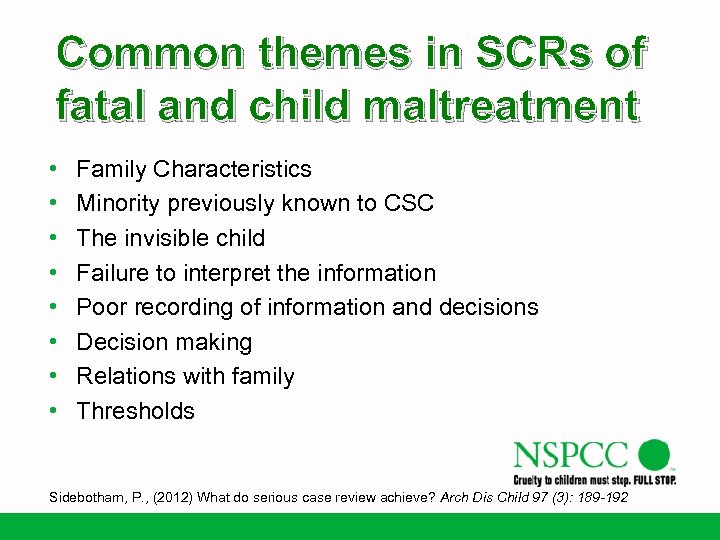 Common themes in SCRs of fatal and child maltreatment • • Family Characteristics Minority previously known to CSC The invisible child Failure to interpret the information Poor recording of information and decisions Decision making Relations with family Thresholds Sidebotham, P. , (2012) What do serious case review achieve? Arch Dis Child 97 (3): 189 -192
 Domestic Abuse • Domestic abuse is a major issue and accounts for 25% of all recorded violent crime (police statistics) • On average 2 women a week are killed in England Wales by partners - ex partners ( home office) • 24. 8% 18 to 24 yr. olds witnessed DV at some time during childhood
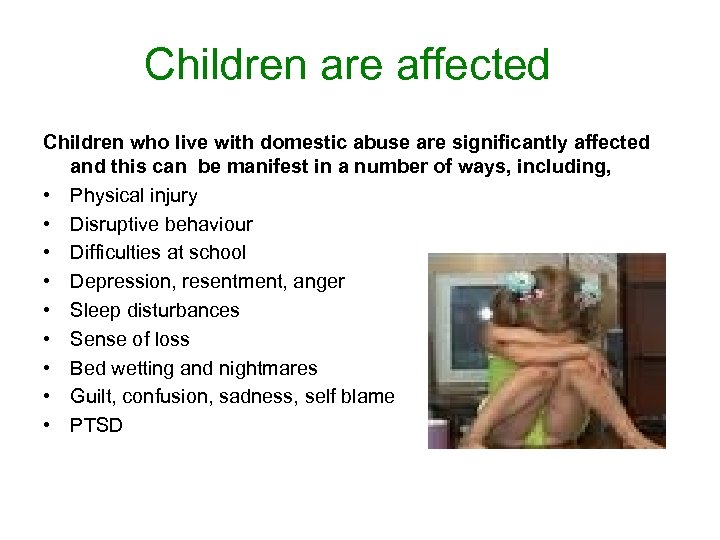 Children are affected Children who live with domestic abuse are significantly affected and this can be manifest in a number of ways, including, • Physical injury • Disruptive behaviour • Difficulties at school • Depression, resentment, anger • Sleep disturbances • Sense of loss • Bed wetting and nightmares • Guilt, confusion, sadness, self blame • PTSD
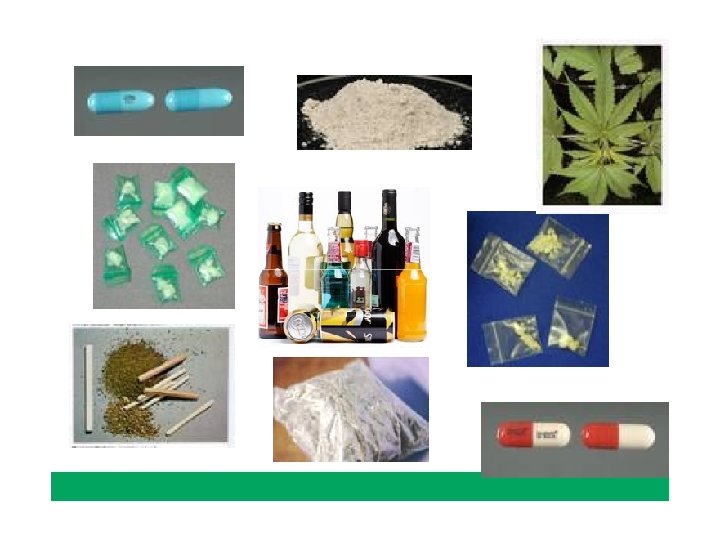
 Drug and Alcohol Related Problems • • 300, 000 children in the UK (Scotland 59, 600) Conflation of ‘substances’ 1100 children pa die as a direct result Children four times more likely to develop a dependency • Prevalent in cases of DA and child protection • Strong links between alcohol and violence • Little evidence that substance use alone is a risk factor • • SG Statistics (2011); Best (2011) Scottish Drug Recovery Consortium; ACMD 2007; Forrester and Harwin (2008)
 Problem Substance Misuse • Effects on Parents • Physical Ailments (e. g. infections, injuries) • Psychological impairments – Withdrawal symptoms – Psychoses – Serious memory lapses Most short lived Manifestation: mental health; psychological impact of drug; selfexpectations; personality; type, dosage, admin method
 Children are affected • • Neglect Physical abuse, sexual abuse etc Exposure to dodgy adults Unstable and violent environment Feel second to drugs Exposure to noxious hazards Criminality Health issues
 Mental Illness: Scale of the Problem • About on in four adults is affected by mental illness • Most cases will be mild or short lived • Sometimes severe (e. g. schizophrenia or manic depression) • Many more live with long term personality disorder or long term depression • 40 -60% of people with a severe mental illness have children • Around a third of children subject to CPP (CPR NI & Scotland) • The Psychiatrist (2003) 27: 117 -118
doi: 10. 1192/pb. 27. 3. 117
Mental Illness: Scale of the Problem • About on in four adults is affected by mental illness • Most cases will be mild or short lived • Sometimes severe (e. g. schizophrenia or manic depression) • Many more live with long term personality disorder or long term depression • 40 -60% of people with a severe mental illness have children • Around a third of children subject to CPP (CPR NI & Scotland) • The Psychiatrist (2003) 27: 117 -118
doi: 10. 1192/pb. 27. 3. 117
 Parental Mental Illness • Effects on Parents Employment Income Relationship strain Links to substance misuse ad violence
 Parental Mental Illness: Effects on Children • • • Separations Insecure relationships Neglect Maltreatment Carer role Upset , frightened, ashamed Bullied Hear unkind things Risk of mental illness Revenge Killing
 What a challenge!!
 Children’s Voices • What children say about living with parental substance misuse
 FEDUP (Family Environment Drug using Parents) • A family approach to supporting children who live with parental substance misuse • Group work programme with children • Individual work with parents • Come together for safety planning
 Family SMILES Simplifying Mental Illness plus Life Enhancement Skills) • Based on the Erica Pitman Programme • Twin track programme working with children and their parents to reduce the risk of harm to children who live with parental mental ill health.
 Evaluation FED UP & Family SMILES : Summary of findings so far
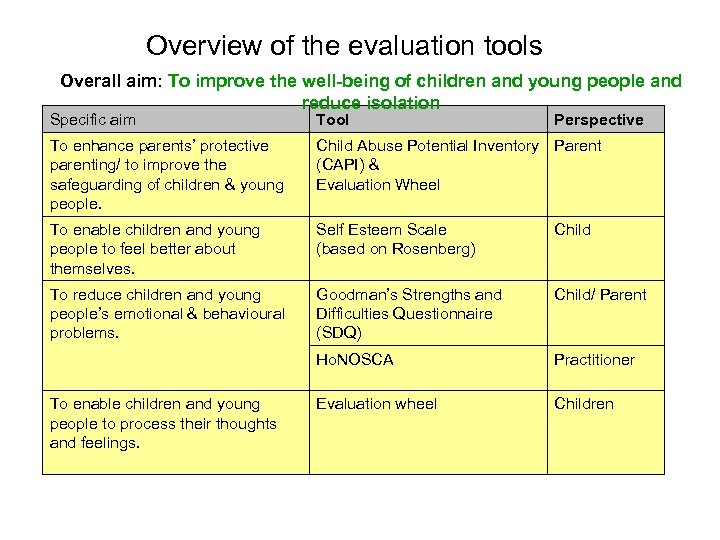 Overview of the evaluation tools Overall aim: To improve the well-being of children and young people and reduce isolation Specific aim Tool To enhance parents’ protective parenting/ to improve the safeguarding of children & young people. Child Abuse Potential Inventory Parent (CAPI) & Evaluation Wheel To enable children and young people to feel better about themselves. Self Esteem Scale (based on Rosenberg) Child To reduce children and young people’s emotional & behavioural problems. Goodman’s Strengths and Difficulties Questionnaire (SDQ) Child/ Parent Ho. NOSCA Practitioner Evaluation wheel Children To enable children and young people to process their thoughts and feelings. Perspective
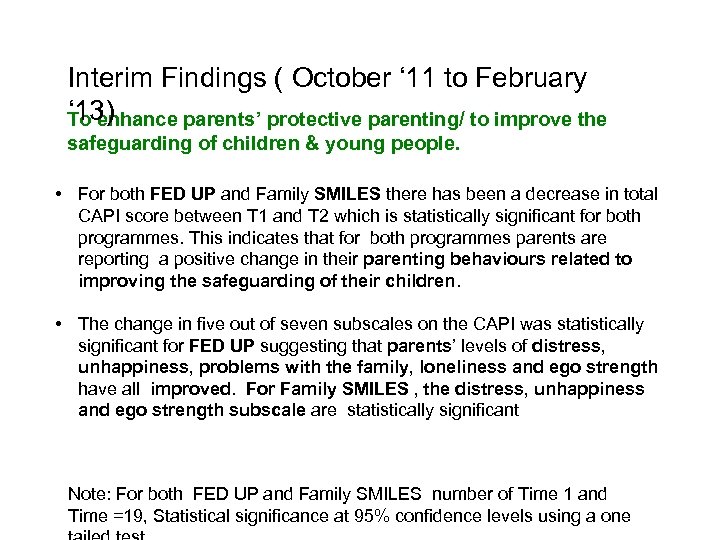 Interim Findings ( October ‘ 11 to February ‘ 13) To enhance parents’ protective parenting/ to improve the safeguarding of children & young people. • For both FED UP and Family SMILES there has been a decrease in total CAPI score between T 1 and T 2 which is statistically significant for both programmes. This indicates that for both programmes parents are reporting a positive change in their parenting behaviours related to improving the safeguarding of their children. • The change in five out of seven subscales on the CAPI was statistically significant for FED UP suggesting that parents’ levels of distress, unhappiness, problems with the family, loneliness and ego strength have all improved. For Family SMILES , the distress, unhappiness and ego strength subscale are statistically significant Note: For both FED UP and Family SMILES number of Time 1 and Time =19, Statistical significance at 95% confidence levels using a one
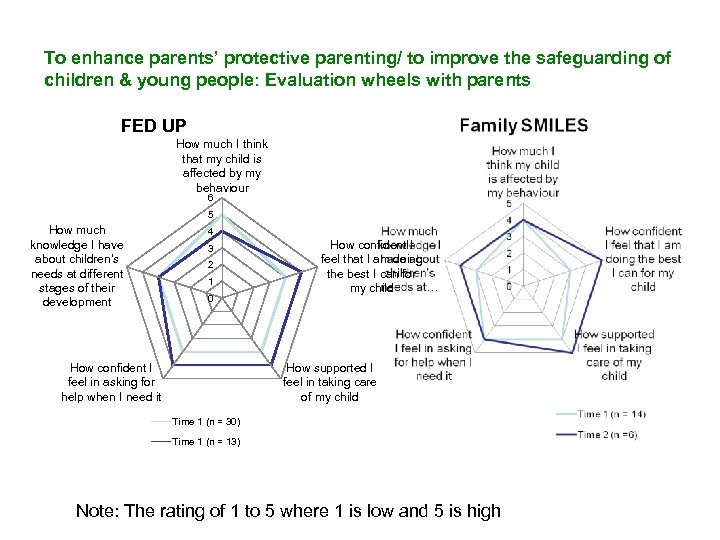 To enhance parents’ protective parenting/ to improve the safeguarding of children & young people: Evaluation wheels with parents FED UP How much I think that my child is affected by my behaviour 6 5 How much knowledge I have about children's needs at different stages of their development 4 3 2 1 0 How confident I feel in asking for help when I need it How confident I feel that I am doing the best I can for my child How supported I feel in taking care of my child Time 1 (n = 30) Time 1 (n = 13) Note: The rating of 1 to 5 where 1 is low and 5 is high
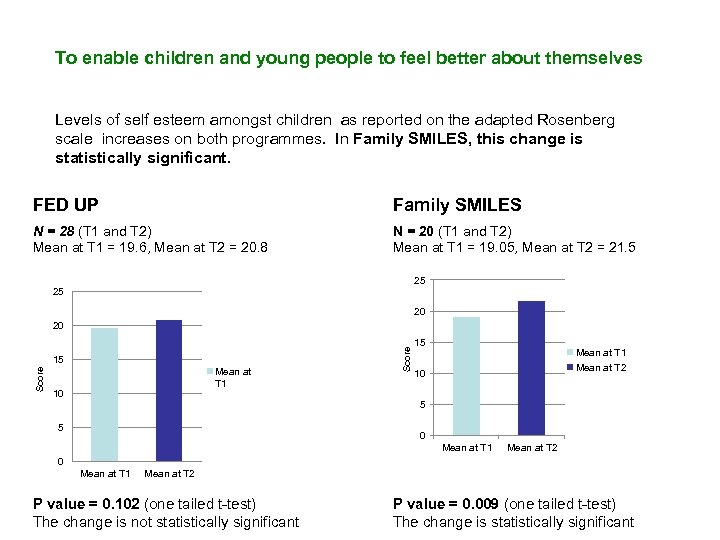 To enable children and young people to feel better about themselves Levels of self esteem amongst children as reported on the adapted Rosenberg scale increases on both programmes. In Family SMILES, this change is statistically significant. FED UP Family SMILES N = 28 (T 1 and T 2) Mean at T 1 = 19. 6, Mean at T 2 = 20. 8 N = 20 (T 1 and T 2) Mean at T 1 = 19. 05, Mean at T 2 = 21. 5 25 25 20 Score 15 Mean at T 1 10 Score 20 15 Mean at T 1 Mean at T 2 10 5 5 0 Mean at T 1 Mean at T 2 P value = 0. 102 (one tailed t-test) The change is not statistically significant P value = 0. 009 (one tailed t-test) The change is statistically significant
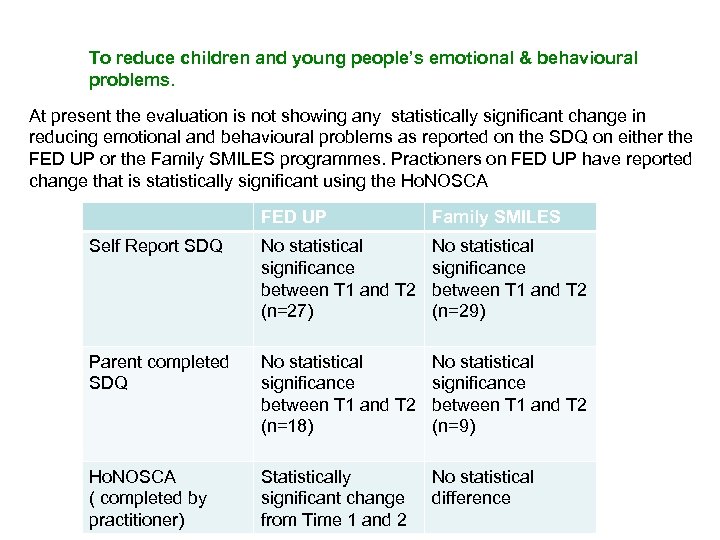 To reduce children and young people’s emotional & behavioural problems. At present the evaluation is not showing any statistically significant change in reducing emotional and behavioural problems as reported on the SDQ on either the FED UP or the Family SMILES programmes. Practioners on FED UP have reported change that is statistically significant using the Ho. NOSCA FED UP Family SMILES Self Report SDQ No statistical significance between T 1 and T 2 (n=27) No statistical significance between T 1 and T 2 (n=29) Parent completed SDQ No statistical significance between T 1 and T 2 (n=18) No statistical significance between T 1 and T 2 (n=9) Ho. NOSCA ( completed by practitioner) Statistically significant change from Time 1 and 2 No statistical difference
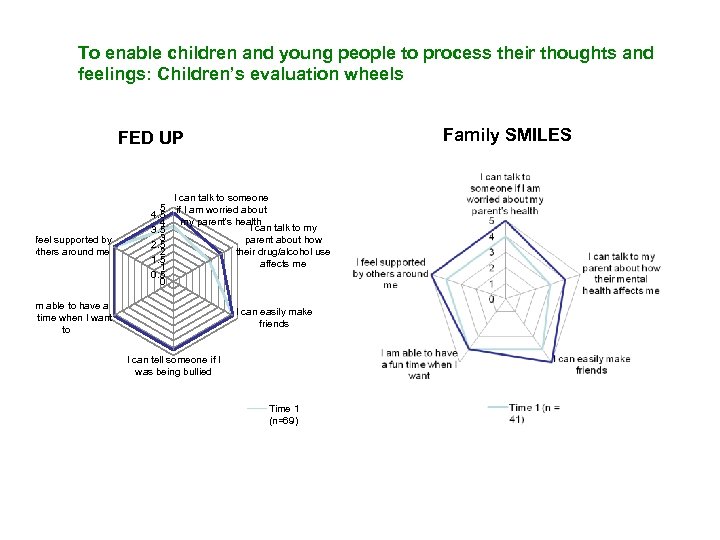 To enable children and young people to process their thoughts and feelings: Children’s evaluation wheels Family SMILES FED UP I feel supported by others around me 5 4 3. 5 3 2. 5 2 1. 5 1 0. 5 0 I can talk to someone if I am worried about my parent's health I can talk to my parent about how their drug/alcohol use affects me I am able to have a fun time when I want to I can easily make friends I can tell someone if I was being bullied Time 1 (n=69)
 The world is a dangerous place to live. Not because of the people who are evil, but because of the people who don’t do anything about it (Albert Einstein)
 Thank You for Listening Di Jerwood djerwood@nspcc. org. uk Acknowledgements Professor Julie Taylor Dr. Prakash Fernandes