


 Скачать презентацию Improving farmers livelihoods through multistakeholder innovation platforms for
8a2c11d2d99c1d68e77d808c84d0a274.ppt
- Количество слайдов: 21
 Improving farmers livelihoods through multistakeholder innovation platforms for linking smallholder farmers to research, extension and business in Central Mozambique Dr. Nelson Mango (CIAT) Dr. Eduardo Joaquim (IIAM)
 Project goal To improve the livelihoods of 10, 000 smallholder farm families in Mozambique directly through at least a 30% increase in productivity of selected cereal, legume and high value crops and a 50% increase in incomes while sustaining the natural resource base.
 Purpose To improve linkages between research, extension and NGOs in Mozambique and to build the capacity of research and extension staff in participatory approaches for working with farmer groups to improve access to technical innovations and emerging market opportunities
 Project approach The project uses an Innovation Platform approach to build capacity of research and extension staff to apply participatory approaches for working with farmers.
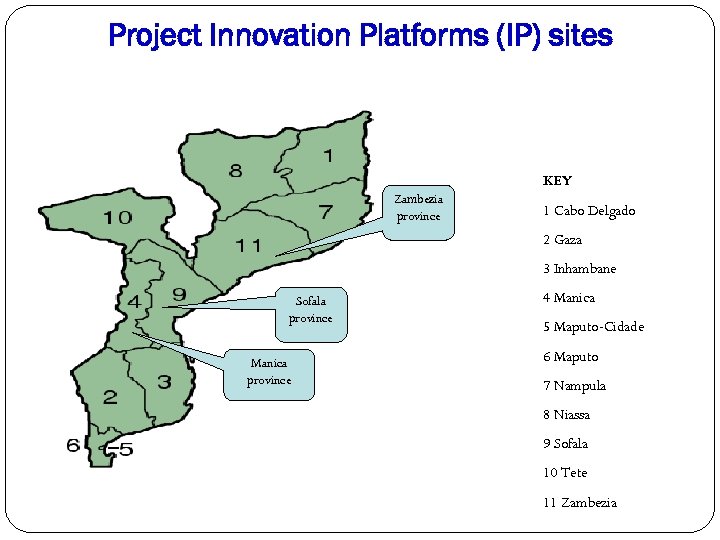 Project Innovation Platforms (IP) sites KEY Zambezia province 1 Cabo Delgado 2 Gaza 3 Inhambane Sofala province Manica province 4 Manica 5 Maputo-Cidade 6 Maputo 7 Nampula 8 Niassa 9 Sofala 10 Tete 11 Zambezia
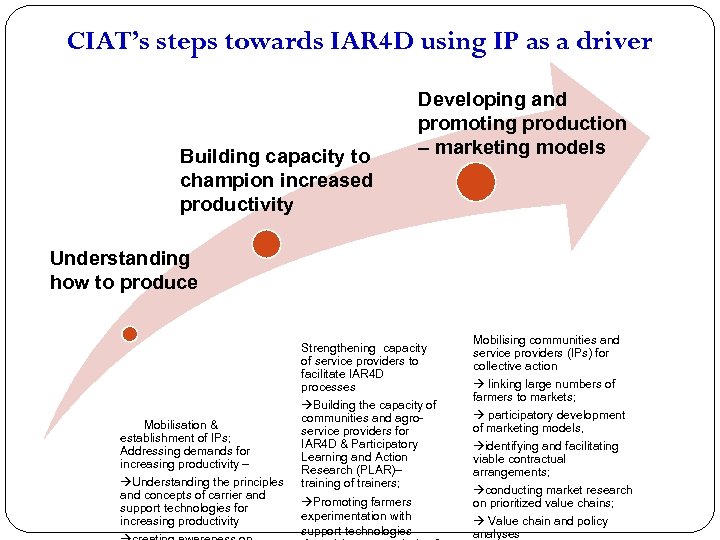 CIAT’s steps towards IAR 4 D using IP as a driver Building capacity to champion increased productivity Developing and promoting production – marketing models Understanding how to produce Mobilisation & establishment of IPs; Addressing demands for increasing productivity – Understanding the principles and concepts of carrier and support technologies for increasing productivity Strengthening capacity of service providers to facilitate IAR 4 D processes Building the capacity of communities and agroservice providers for IAR 4 D & Participatory Learning and Action Research (PLAR)– training of trainers; Promoting farmers experimentation with support technologies Mobilising communities and service providers (IPs) for collective action linking large numbers of farmers to markets; participatory development of marketing models, identifying and facilitating viable contractual arrangements; conducting market research on prioritized value chains; Value chain and policy analyses
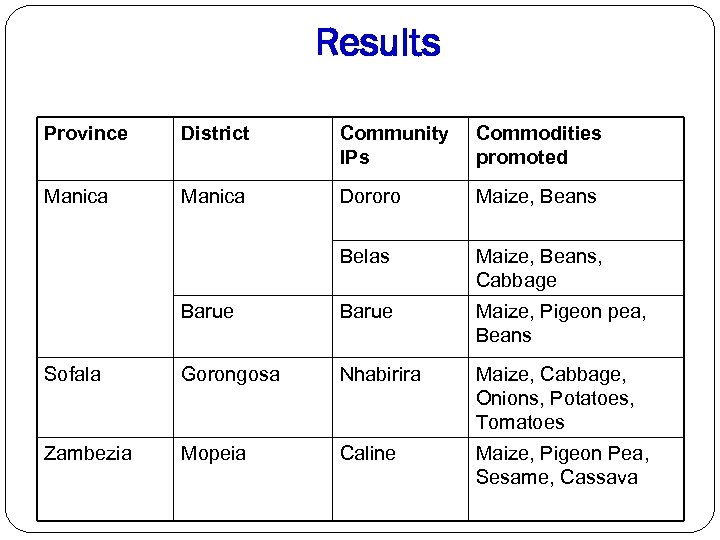 Results Province District Community IPs Commodities promoted Manica Dororo Maize, Beans Belas Maize, Beans, Cabbage Barue Maize, Pigeon pea, Beans Sofala Gorongosa Nhabirira Maize, Cabbage, Onions, Potatoes, Tomatoes Zambezia Mopeia Caline Maize, Pigeon Pea, Sesame, Cassava
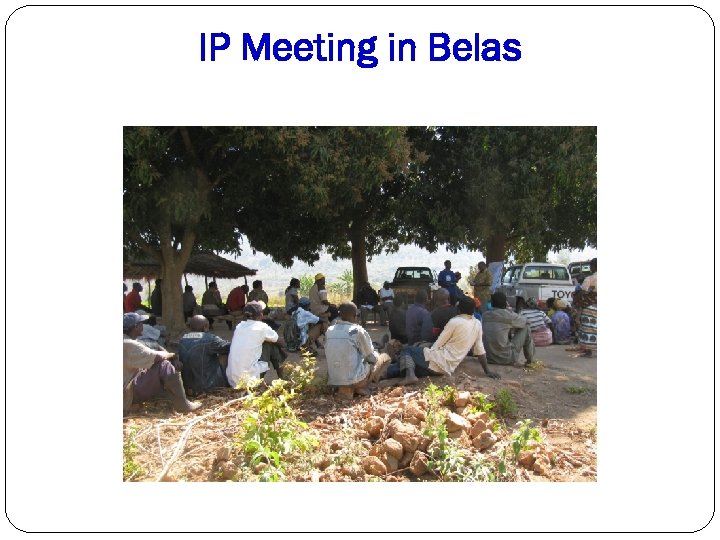 IP Meeting in Belas
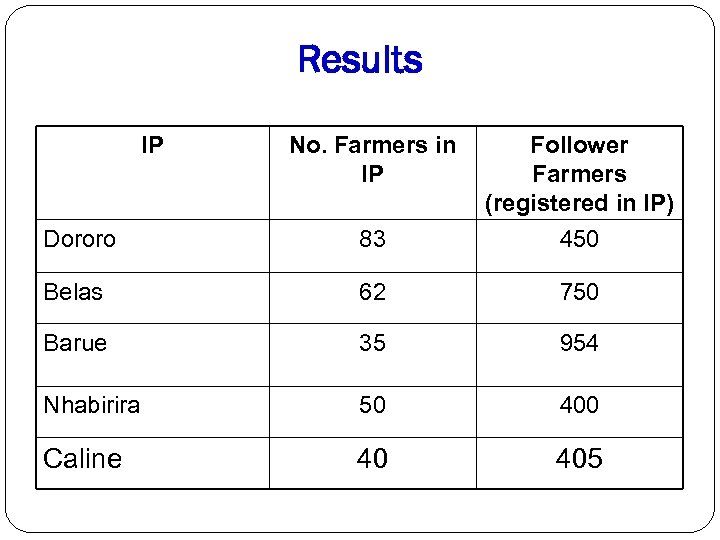 Results IP No. Farmers in IP Dororo 83 Follower Farmers (registered in IP) 450 Belas 62 750 Barue 35 954 Nhabirira 50 400 Caline 40 405
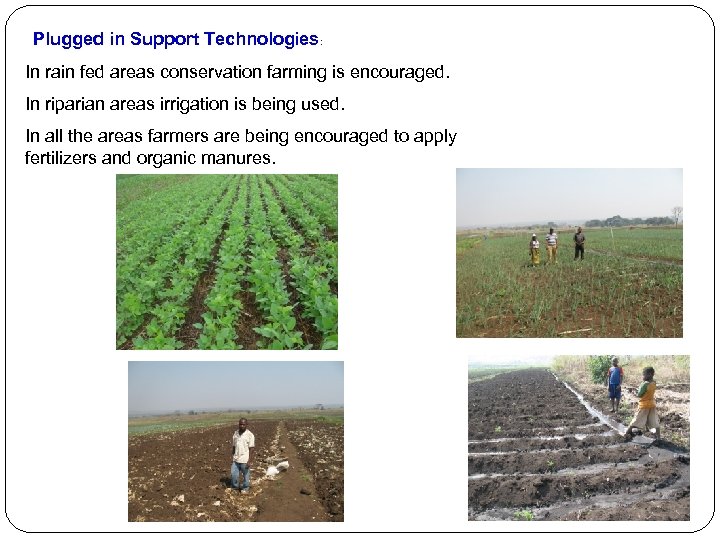 Plugged in Support Technologies: In rain fed areas conservation farming is encouraged. In riparian areas irrigation is being used. In all the areas farmers are being encouraged to apply fertilizers and organic manures.
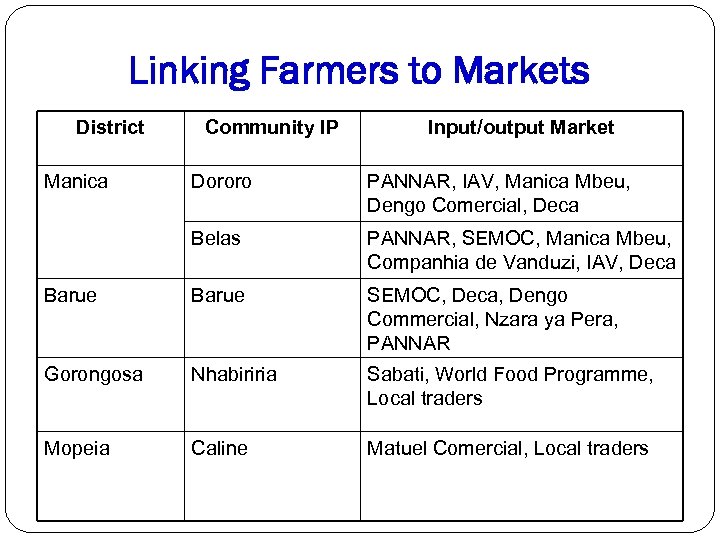 Linking Farmers to Markets District Manica Community IP Input/output Market Dororo PANNAR, IAV, Manica Mbeu, Dengo Comercial, Deca Belas PANNAR, SEMOC, Manica Mbeu, Companhia de Vanduzi, IAV, Deca Barue SEMOC, Deca, Dengo Commercial, Nzara ya Pera, PANNAR Gorongosa Nhabiriria Sabati, World Food Programme, Local traders Mopeia Caline Matuel Comercial, Local traders
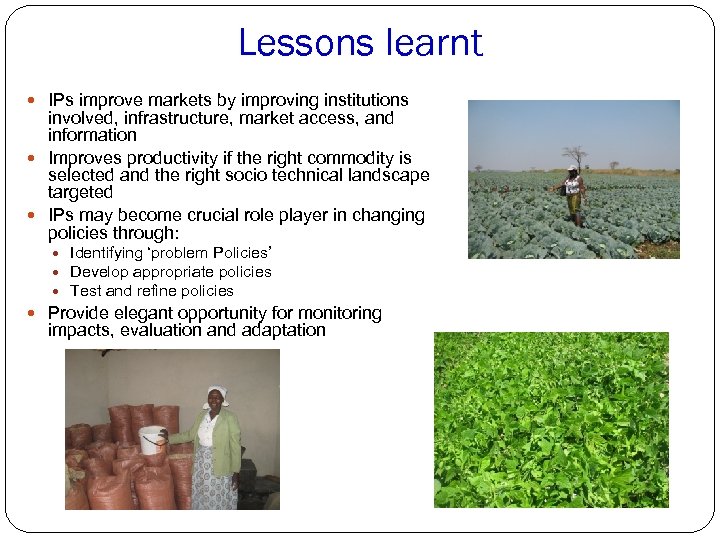 Lessons learnt IPs improve markets by improving institutions involved, infrastructure, market access, and information Improves productivity if the right commodity is selected and the right socio technical landscape targeted IPs may become crucial role player in changing policies through: Identifying ‘problem Policies’ Develop appropriate policies Test and refine policies Provide elegant opportunity for monitoring impacts, evaluation and adaptation
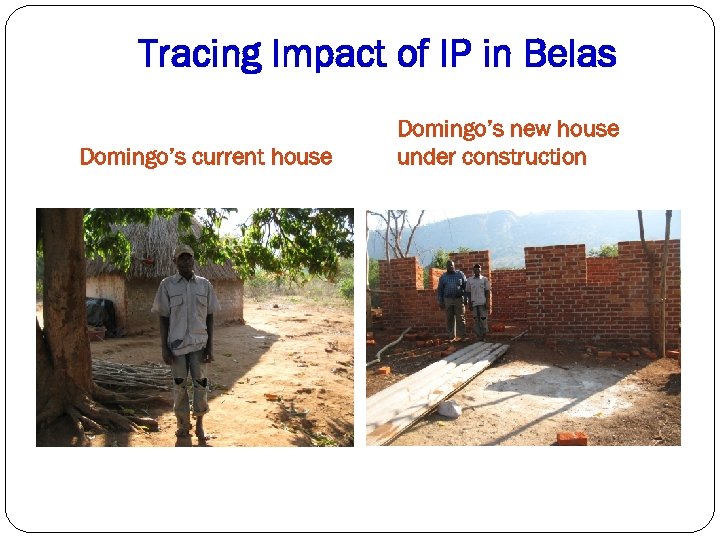 Tracing Impact of IP in Belas Domingo’s current house Domingo’s new house under construction
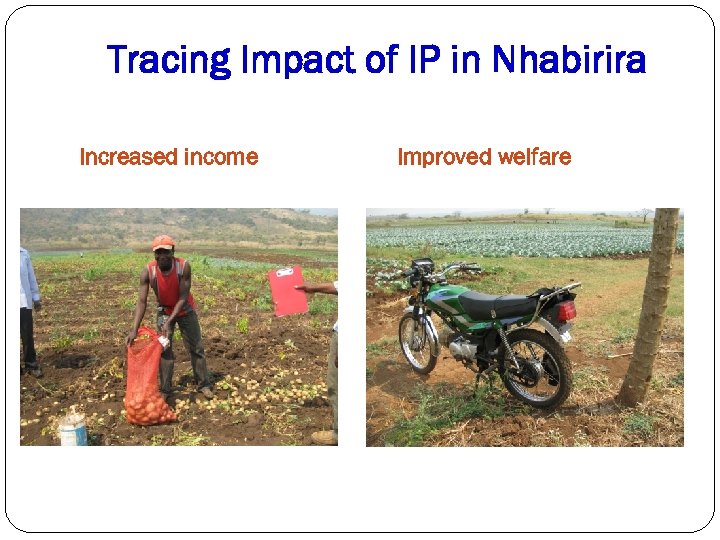 Tracing Impact of IP in Nhabirira Increased income Improved welfare
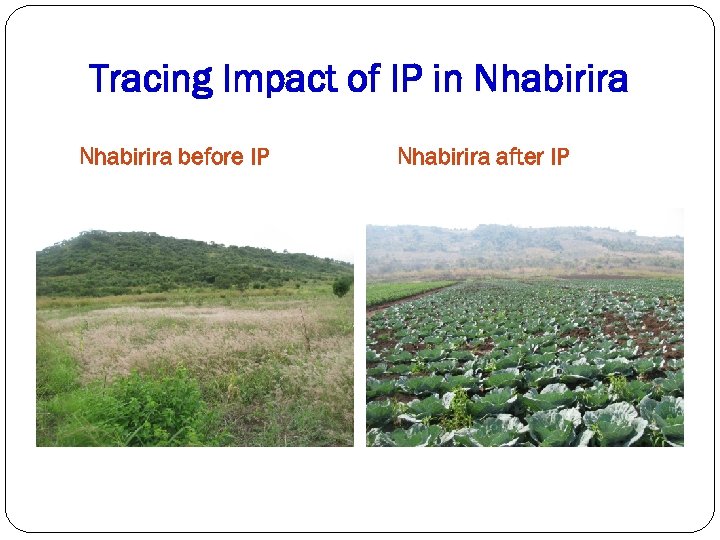 Tracing Impact of IP in Nhabirira before IP Nhabirira after IP
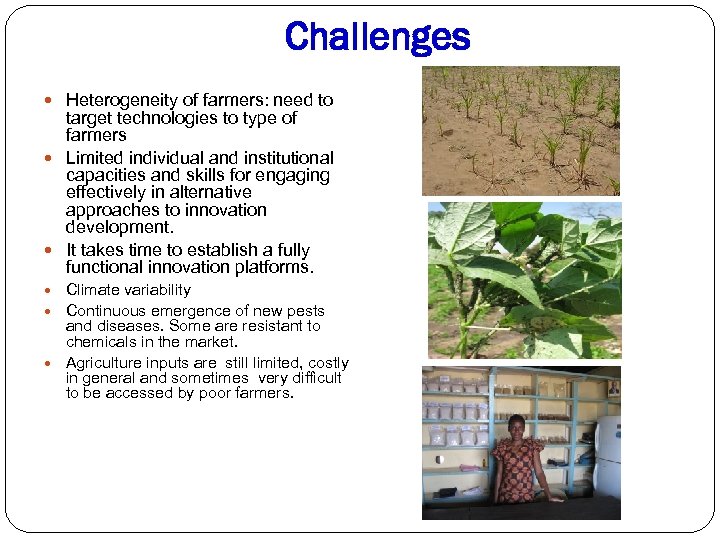 Challenges Heterogeneity of farmers: need to target technologies to type of farmers Limited individual and institutional capacities and skills for engaging effectively in alternative approaches to innovation development. It takes time to establish a fully functional innovation platforms. Climate variability Continuous emergence of new pests and diseases. Some are resistant to chemicals in the market. Agriculture inputs are still limited, costly in general and sometimes very difficult to be accessed by poor farmers.
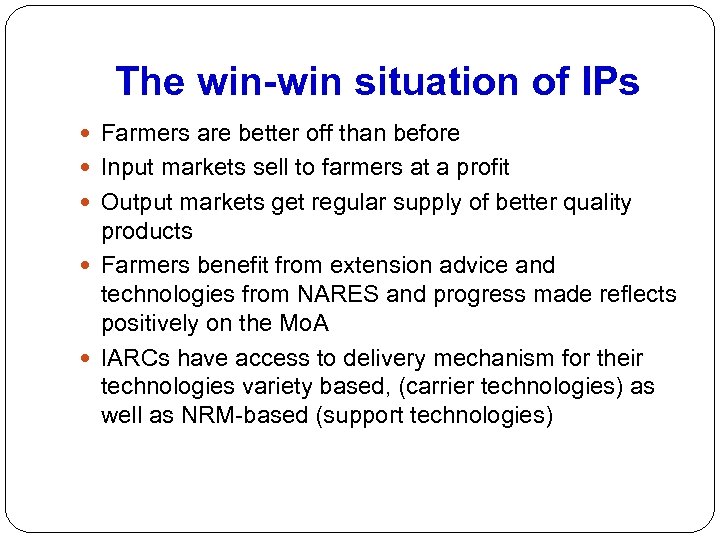 The win-win situation of IPs Farmers are better off than before Input markets sell to farmers at a profit Output markets get regular supply of better quality products Farmers benefit from extension advice and technologies from NARES and progress made reflects positively on the Mo. A IARCs have access to delivery mechanism for their technologies variety based, (carrier technologies) as well as NRM-based (support technologies)
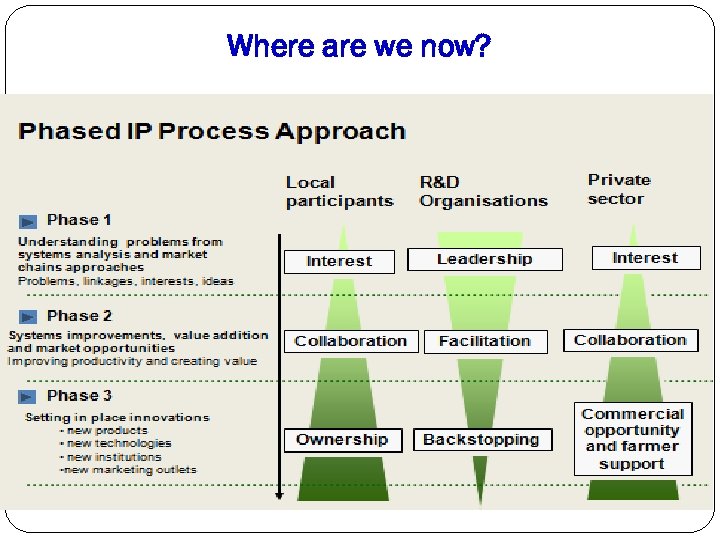 Where are we now?
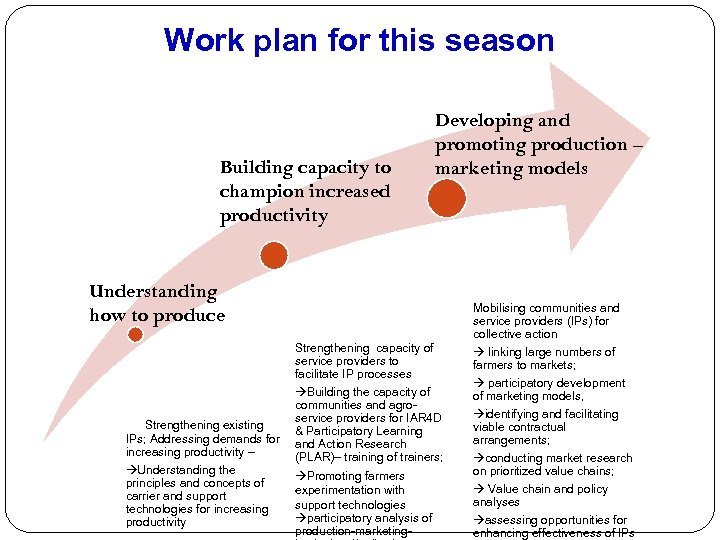 Work plan for this season Building capacity to champion increased productivity Developing and promoting production – marketing models Understanding how to produce Strengthening existing IPs; Addressing demands for increasing productivity – Understanding the principles and concepts of carrier and support technologies for increasing productivity Strengthening capacity of service providers to facilitate IP processes Building the capacity of communities and agroservice providers for IAR 4 D & Participatory Learning and Action Research (PLAR)– training of trainers; Promoting farmers experimentation with support technologies participatory analysis of production-marketing- Mobilising communities and service providers (IPs) for collective action linking large numbers of farmers to markets; participatory development of marketing models, identifying and facilitating viable contractual arrangements; conducting market research on prioritized value chains; Value chain and policy analyses assessing opportunities for enhancing effectiveness of IPs
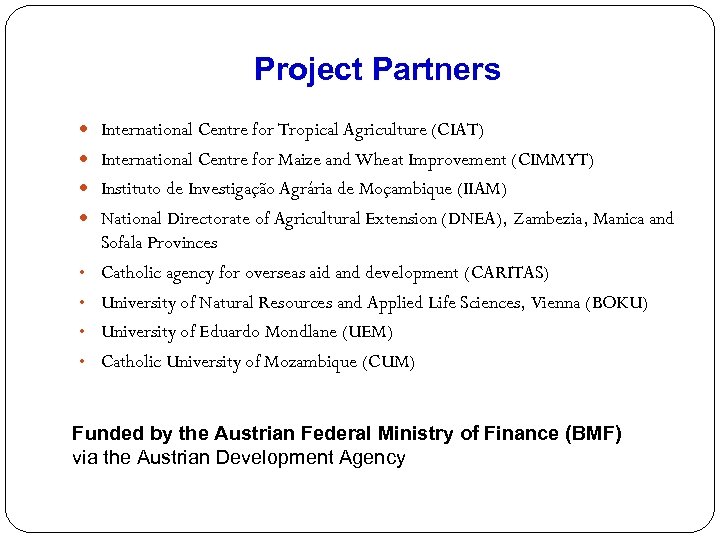 Project Partners International Centre for Tropical Agriculture (CIAT) International Centre for Maize and Wheat Improvement (CIMMYT) Instituto de Investigação Agrária de Moçambique (IIAM) National Directorate of Agricultural Extension (DNEA), Zambezia, Manica and • • Sofala Provinces Catholic agency for overseas aid and development (CARITAS) University of Natural Resources and Applied Life Sciences, Vienna (BOKU) University of Eduardo Mondlane (UEM) Catholic University of Mozambique (CUM) Funded by the Austrian Federal Ministry of Finance (BMF) via the Austrian Development Agency
 Obrigado pela atenção prestada