


 Скачать презентацию Improving data quality for ICP-MS in high throughput
b46d586bcaa5878a9007b1eee3d7fa90.ppt
- Количество слайдов: 1
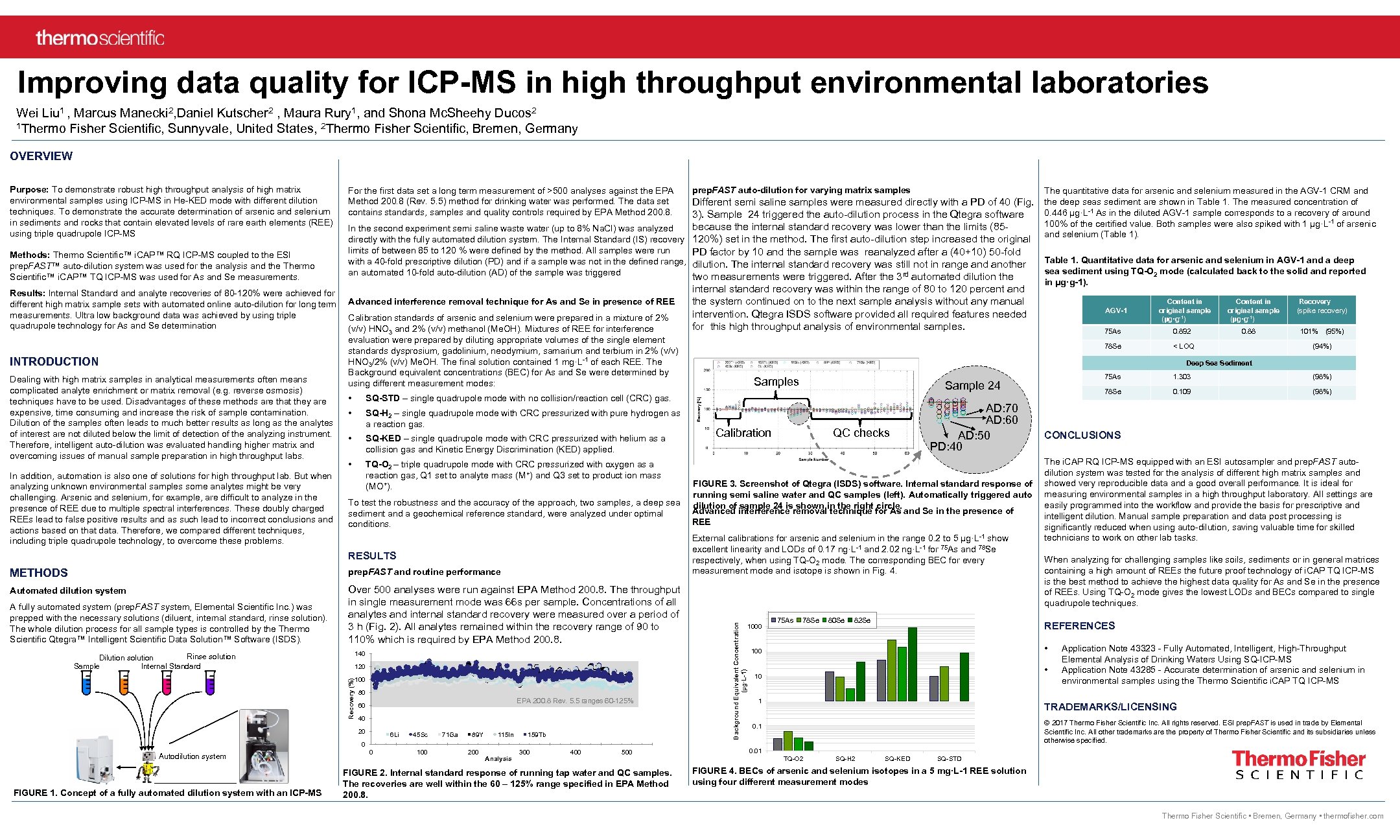 Improving data quality for ICP-MS in high throughput environmental laboratories Wei Liu 1 , Marcus Manecki 2, Daniel Kutscher 2 , Maura Rury 1, and Shona Mc. Sheehy Ducos 2 1 Thermo Fisher Scientific, Sunnyvale, United States, 2 Thermo Fisher Scientific, Bremen, Germany OVERVIEW Methods: Thermo Scientific™ i. CAP™ RQ ICP-MS coupled to the ESI prep. FAST™ auto-dilution system was used for the analysis and the Thermo Scientific™ i. CAP™ TQ ICP-MS was used for As and Se measurements. Results: Internal Standard analyte recoveries of 80 -120% were achieved for different high matrix sample sets with automated online auto-dilution for long term measurements. Ultra low background data was achieved by using triple quadrupole technology for As and Se determination INTRODUCTION Dealing with high matrix samples in analytical measurements often means complicated analyte enrichment or matrix removal (e. g. reverse osmosis) techniques have to be used. Disadvantages of these methods are that they are expensive, time consuming and increase the risk of sample contamination. Dilution of the samples often leads to much better results as long as the analytes of interest are not diluted below the limit of detection of the analyzing instrument. Therefore, intelligent auto-dilution was evaluated handling higher matrix and overcoming issues of manual sample preparation in high throughput labs. In addition, automation is also one of solutions for high throughput lab. But when analyzing unknown environmental samples some analytes might be very challenging. Arsenic and selenium, for example, are difficult to analyze in the presence of REE due to multiple spectral interferences. These doubly charged REEs lead to false positive results and as such lead to incorrect conclusions and actions based on that data. Therefore, we compared different techniques, including triple quadrupole technology, to overcome these problems. For the first data set a long term measurement of >500 analyses against the EPA Method 200. 8 (Rev. 5. 5) method for drinking water was performed. The data set contains standards, samples and quality controls required by EPA Method 200. 8. evaluation were prepared by diluting appropriate volumes of the single element standards dysprosium, gadolinium, neodymium, samarium and terbium in 2% (v/v) HNO 3/2% (v/v) Me. OH. The final solution contained 1 mg·L-1 of each REE. The Background equivalent concentrations (BEC) for As and Se were determined by using different measurement modes: • • SQ-H 2 – single quadrupole mode with CRC pressurized with pure hydrogen as a reaction gas. • SQ-KED – single quadrupole mode with CRC pressurized with helium as a collision gas and Kinetic Energy Discrimination (KED) applied. • TQ-O 2 – triple quadrupole mode with CRC pressurized with oxygen as a reaction gas, Q 1 set to analyte mass (M+) and Q 3 set to product ion mass (MO+). To test the robustness and the accuracy of the approach, two samples, a deep sea sediment and a geochemical reference standard, were analyzed under optimal conditions. Automated dilution system Over 500 analyses were run against EPA Method 200. 8. The throughput in single measurement mode was 66 s per sample. Concentrations of all analytes and internal standard recovery were measured over a period of 3 h (Fig. 2). All analytes remained within the recovery range of 90 to 110% which is required by EPA Method 200. 8. 140 Rinse solution Dilution solution Sample Internal Standard Recovery (%) 120 100 80 EPA 200. 8 Rev. 5. 5 ranges 60 -125% 60 40 20 6 Li 45 Sc 71 Ga 89 Y 115 In 159 Tb 0 0 100 200 Analysis 300 400 500 FIGURE 2. Internal standard response of running tap water and QC samples. The recoveries are well within the 60 – 125% range specified in EPA Method 200. 8. < LOQ (94%) Deep Sea Sediment Samples Calibration QC checks AD: 70 AD: 60 AD: 50 PD: 40 FIGURE 3. Screenshot of Qtegra (ISDS) software. Internal standard response of running semi saline water and QC samples (left). Automatically triggered auto dilution of sample 24 is shown in the right circle. Advanced interference removal technique for As and Se in the presence of REE 1000 75 As 78 Se 80 Se 82 Se 1. 303 (98%) 78 Se Sample 24 External calibrations for arsenic and selenium in the range 0. 2 to 5 μg·L-1 show excellent linearity and LODs of 0. 17 ng·L-1 and 2. 02 ng·L-1 for 75 As and 78 Se respectively, when using TQ-O 2 mode. The corresponding BEC for every measurement mode and isotope is shown in Fig. 4. prep. FAST and routine performance FIGURE 1. Concept of a fully automated dilution system with an ICP-MS 78 Se SQ-STD – single quadrupole mode with no collision/reaction cell (CRC) gas. METHODS Autodilution system The quantitative data for arsenic and selenium measured in the AGV-1 CRM and the deep seas sediment are shown in Table 1. The measured concentration of 0. 446 μg·L-1 As in the diluted AGV-1 sample corresponds to a recovery of around 100% of the certified value. Both samples were also spiked with 1 μg·L-1 of arsenic and selenium (Table 1). Different semi saline samples were measured directly with a PD of 40 (Fig. 3). Sample 24 triggered the auto-dilution process in the Qtegra software because the internal standard recovery was lower than the limits (85 In the second experiment semi saline waste water (up to 8% Na. Cl) was analyzed directly with the fully automated dilution system. The Internal Standard (IS) recovery 120%) set in the method. The first auto-dilution step increased the original limits of between 85 to 120 % were defined by the method. All samples were run PD factor by 10 and the sample was reanalyzed after a (40+10) 50 -fold Table 1. Quantitative data for arsenic and selenium in AGV-1 and a deep with a 40 -fold prescriptive dilution (PD) and if a sample was not in the defined range, dilution. The internal standard recovery was still not in range and another sea sediment using TQ-O 2 mode (calculated back to the solid and reported an automated 10 -fold auto-dilution (AD) of the sample was triggered two measurements were triggered. After the 3 rd automated dilution the in μg·g-1). internal standard recovery was within the range of 80 to 120 percent and Content in Recovery Advanced interference removal technique for As and Se in presence of REE the system continued on to the next sample analysis without any manual AGV-1 original sample (spike recovery) intervention. Qtegra ISDS software provided all required features needed Calibration standards of arsenic and selenium were prepared in a mixture of 2% (μg·g-1) for this high throughput analysis of environmental samples. (v/v) HNO 3 and 2% (v/v) methanol (Me. OH). Mixtures of REE for interference 75 As 0. 892 0. 88 101% (95%) RESULTS A fully automated system (prep. FAST system, Elemental Scientific Inc. ) was prepped with the necessary solutions (diluent, internal standard, rinse solution). The whole dilution process for all sample types is controlled by the Thermo Scientific Qtegra™ Intelligent Scientific Data Solution™ Software (ISDS). prep. FAST auto-dilution for varying matrix samples Background Equivalent Concentration (µg·L-1) Purpose: To demonstrate robust high throughput analysis of high matrix environmental samples using ICP-MS in He-KED mode with different dilution techniques. To demonstrate the accurate determination of arsenic and selenium in sediments and rocks that contain elevated levels of rare earth elements (REE) using triple quadrupole ICP-MS 0. 109 (98%) CONCLUSIONS The i. CAP RQ ICP-MS equipped with an ESI autosampler and prep. FAST autodilution system was tested for the analysis of different high matrix samples and showed very reproducible data and a good overall performance. It is ideal for measuring environmental samples in a high throughput laboratory. All settings are easily programmed into the workflow and provide the basis for prescriptive and intelligent dilution. Manual sample preparation and data post processing is significantly reduced when using auto-dilution, saving valuable time for skilled technicians to work on other lab tasks. When analyzing for challenging samples like soils, sediments or in general matrices containing a high amount of REEs the future proof technology of i. CAP TQ ICP-MS is the best method to achieve the highest data quality for As and Se in the presence of REEs. Using TQ-O 2 mode gives the lowest LODs and BECs compared to single quadrupole techniques. REFERENCES • 100 • 10 1 Application Note 43323 - Fully Automated, Intelligent, High-Throughput Elemental Analysis of Drinking Waters Using SQ-ICP-MS Application Note 43285 - Accurate determination of arsenic and selenium in environmental samples using the Thermo Scientific i. CAP TQ ICP-MS TRADEMARKS/LICENSING © 2017 Thermo Fisher Scientific Inc. All rights reserved. ESI prep. FAST is used in trade by Elemental Scientific Inc. All other trademarks are the property of Thermo Fisher Scientific and its subsidiaries unless otherwise specified. 0. 1 0. 01 TQ-O 2 SQ-H 2 SQ-KED SQ-STD FIGURE 4. BECs of arsenic and selenium isotopes in a 5 mg·L-1 REE solution using four different measurement modes Thermo Fisher Scientific • Bremen, Germany • thermofisher. com