 Скачать презентацию Improving Data Access through Standards-based Metadata and Web
e9db2216b96e49e6034b516972f1c82f.ppt
- Количество слайдов: 22



Improving Data Access through Standards-based Metadata and Web Map Services Access to Natural Hazards Data • • Susan Mc. Lean Director, World Data Center for Solid Earth Geophysics, Boulder • • NOAA’s National Geophysical Data Center Kelly Stroker, Colorado Institute for Research in the Environmental Sciences • • Susan. Mc. Lean@noaa. gov Kelly. Stroker@noaa. gov 20 th CODATA International Conference – October 2006 NOAA / NGDC / WDC for SEG, Boulder
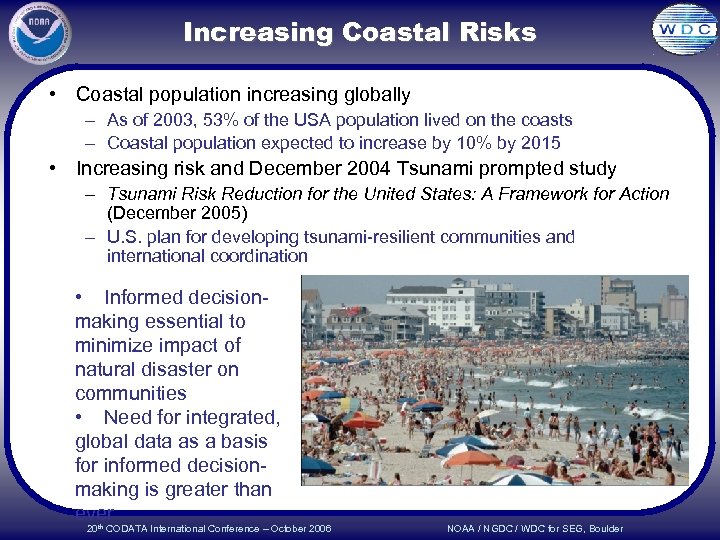
Increasing Coastal Risks • Coastal population increasing globally – As of 2003, 53% of the USA population lived on the coasts – Coastal population expected to increase by 10% by 2015 • Increasing risk and December 2004 Tsunami prompted study – Tsunami Risk Reduction for the United States: A Framework for Action (December 2005) – U. S. plan for developing tsunami-resilient communities and international coordination • Informed decisionmaking essential to minimize impact of natural disaster on communities • Need for integrated, global data as a basis for informed decisionmaking is greater than ever 20 th CODATA International Conference – October 2006 NOAA / NGDC / WDC for SEG, Boulder
GEOSS and the WDC The Global Earth Observation System of Systems – GEO 2006 Disaster-related Task: Promote and facilitate free and unrestricted exchange of all Earth observation data relevant to tsunami early warning systems. – Seeks to meet the need for timely, quality long-term global information – Facilitates exchange of data and information – Improves decision-makers’ abilities to address pressing policy issues The World Data Center System – The WDC for Solid Earth Geophysics, Boulder has responsibility for global tsunami data and the ability to deliver integrated access to these data 20 th CODATA International Conference – October 2006 NOAA / NGDC / WDC for SEG, Boulder
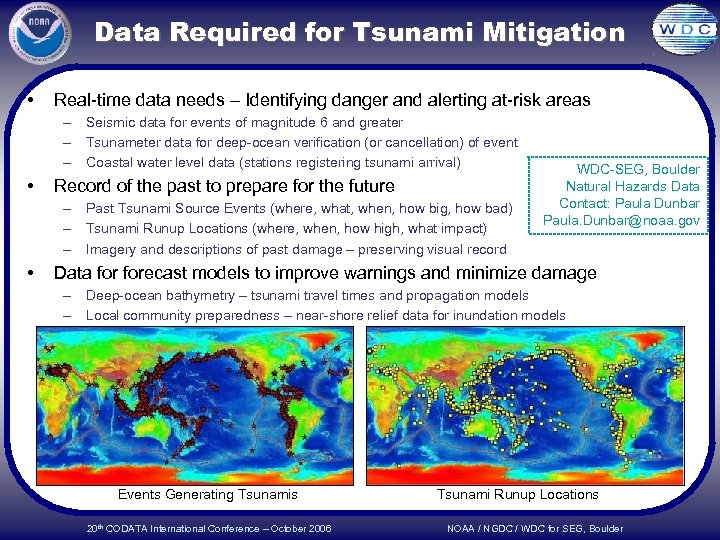
Data Required for Tsunami Mitigation • Real-time data needs – Identifying danger and alerting at-risk areas – Seismic data for events of magnitude 6 and greater – Tsunameter data for deep-ocean verification (or cancellation) of event – Coastal water level data (stations registering tsunami arrival) • Record of the past to prepare for the future – Past Tsunami Source Events (where, what, when, how big, how bad) – Tsunami Runup Locations (where, when, how high, what impact) – Imagery and descriptions of past damage – preserving visual record • WDC-SEG, Boulder Natural Hazards Data Contact: Paula Dunbar Paula. Dunbar@noaa. gov Data forecast models to improve warnings and minimize damage – Deep-ocean bathymetry – tsunami travel times and propagation models – Local community preparedness – near-shore relief data for inundation models Events Generating Tsunamis 20 th CODATA International Conference – October 2006 Tsunami Runup Locations NOAA / NGDC / WDC for SEG, Boulder
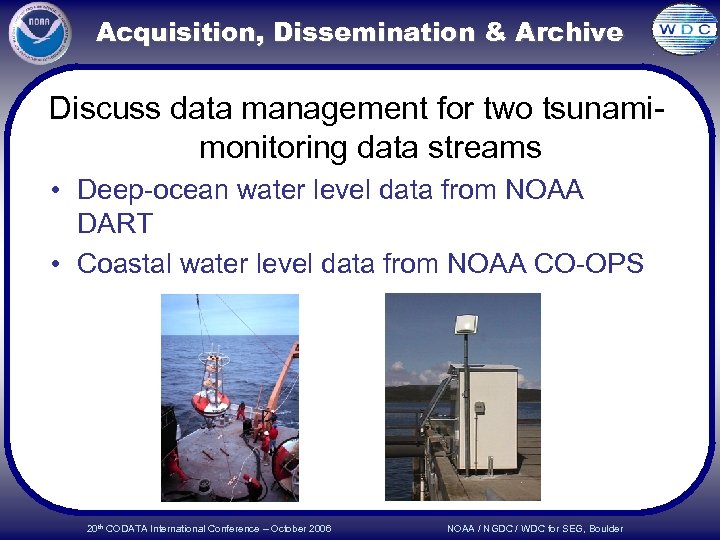
Acquisition, Dissemination & Archive Discuss data management for two tsunamimonitoring data streams • Deep-ocean water level data from NOAA DART • Coastal water level data from NOAA CO-OPS 20 th CODATA International Conference – October 2006 NOAA / NGDC / WDC for SEG, Boulder
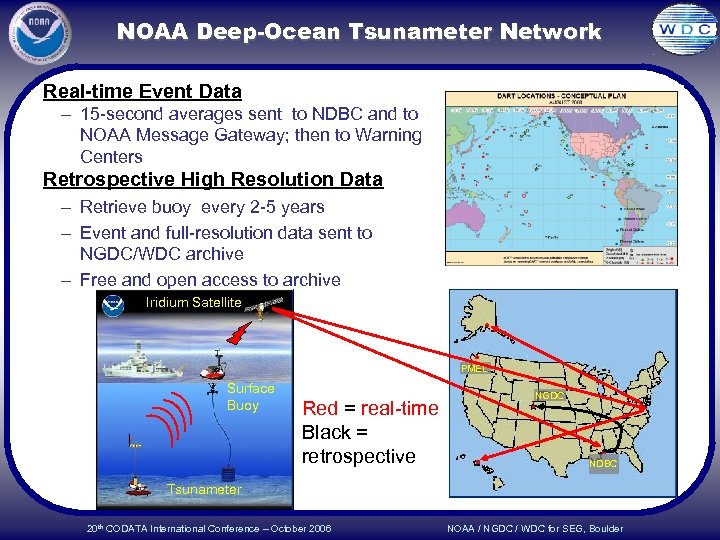
NOAA Deep-Ocean Tsunameter Network Real-time Event Data – 15 -second averages sent to NDBC and to NOAA Message Gateway; then to Warning Centers Retrospective High Resolution Data – Retrieve buoy every 2 -5 years – Event and full-resolution data sent to NGDC/WDC archive – Free and open access to archive Iridium Satellite PMEL Surface Buoy Red = real-time Black = retrospective NGDC NDBC Tsunameter 20 th CODATA International Conference – October 2006 NOAA / NGDC / WDC for SEG, Boulder
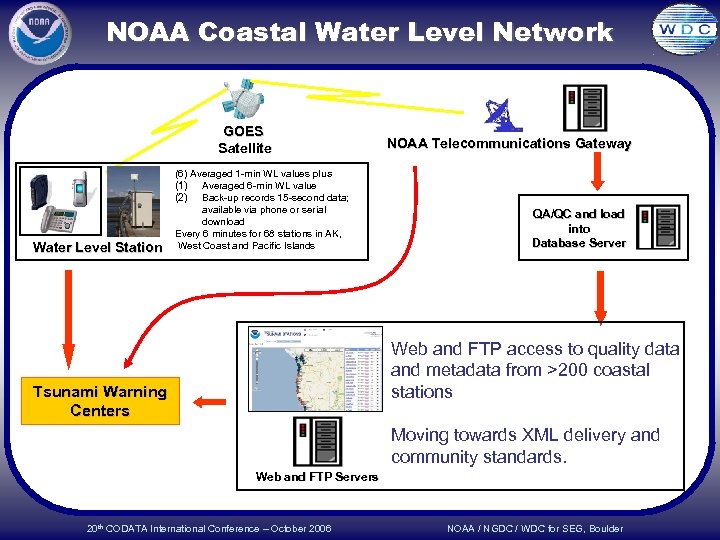
NOAA Coastal Water Level Network GOES Satellite Water Level Station (6) Averaged 1 -min WL values plus (1) Averaged 6 -min WL value (2) Back-up records 15 -second data; available via phone or serial download Every 6 minutes for 68 stations in AK, West Coast and Pacific Islands NOAA Telecommunications Gateway QA/QC and load into Database Server Web and FTP access to quality data and metadata from >200 coastal stations Tsunami Warning Centers Moving towards XML delivery and community standards. Web and FTP Servers 20 th CODATA International Conference – October 2006 NOAA / NGDC / WDC for SEG, Boulder
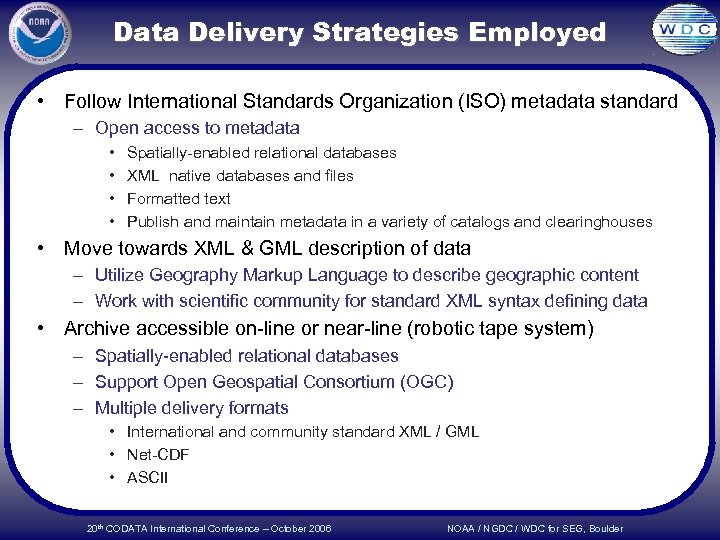
Data Delivery Strategies Employed • Follow International Standards Organization (ISO) metadata standard – Open access to metadata • • Spatially-enabled relational databases XML native databases and files Formatted text Publish and maintain metadata in a variety of catalogs and clearinghouses • Move towards XML & GML description of data – Utilize Geography Markup Language to describe geographic content – Work with scientific community for standard XML syntax defining data • Archive accessible on-line or near-line (robotic tape system) – Spatially-enabled relational databases – Support Open Geospatial Consortium (OGC) – Multiple delivery formats • International and community standard XML / GML • Net-CDF • ASCII 20 th CODATA International Conference – October 2006 NOAA / NGDC / WDC for SEG, Boulder
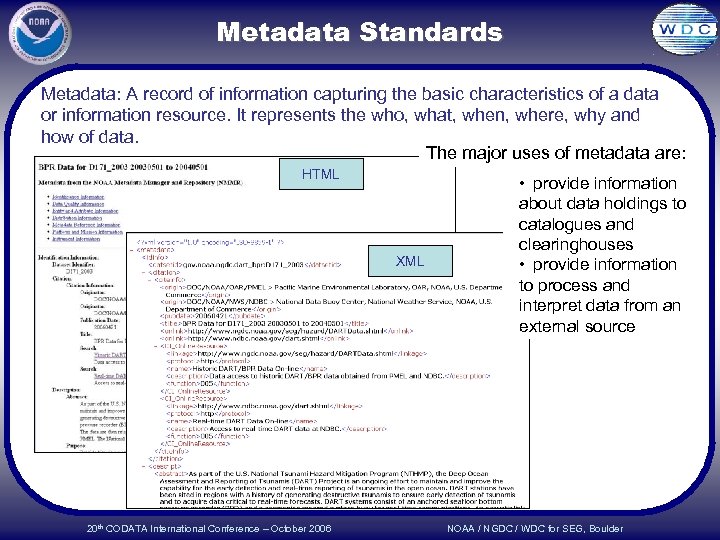
Metadata Standards Metadata: A record of information capturing the basic characteristics of a data or information resource. It represents the who, what, when, where, why and how of data. The major uses of metadata are: HTML XML 20 th CODATA International Conference – October 2006 • provide information about data holdings to catalogues and clearinghouses • provide information to process and interpret data from an external source NOAA / NGDC / WDC for SEG, Boulder
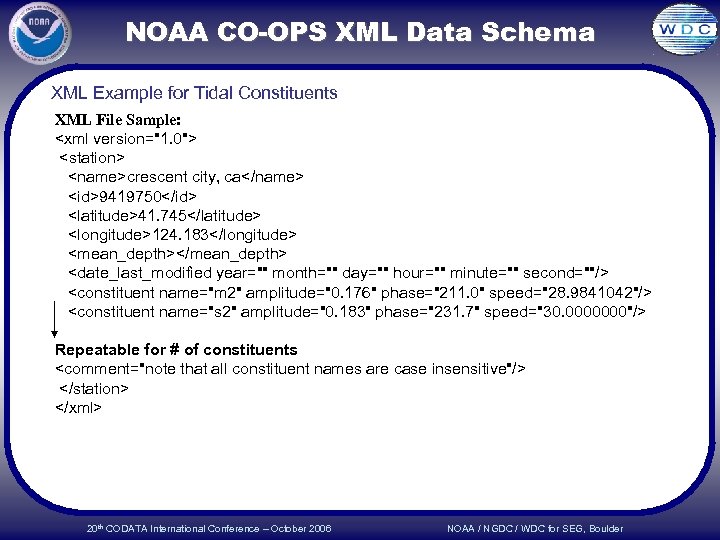
NOAA CO-OPS XML Data Schema XML Example for Tidal Constituents XML File Sample: <xml version="1. 0"> <station> <name>crescent city, ca</name> <id>9419750</id> <latitude>41. 745</latitude> <longitude>124. 183</longitude> <mean_depth></mean_depth> <date_last_modified year="" month="" day="" hour="" minute="" second=""/> <constituent name="m 2" amplitude="0. 176" phase="211. 0" speed="28. 9841042"/> <constituent name="s 2" amplitude="0. 183" phase="231. 7" speed="30. 0000000"/> Repeatable for # of constituents <comment="note that all constituent names are case insensitive"/> </station> </xml> 20 th CODATA International Conference – October 2006 NOAA / NGDC / WDC for SEG, Boulder
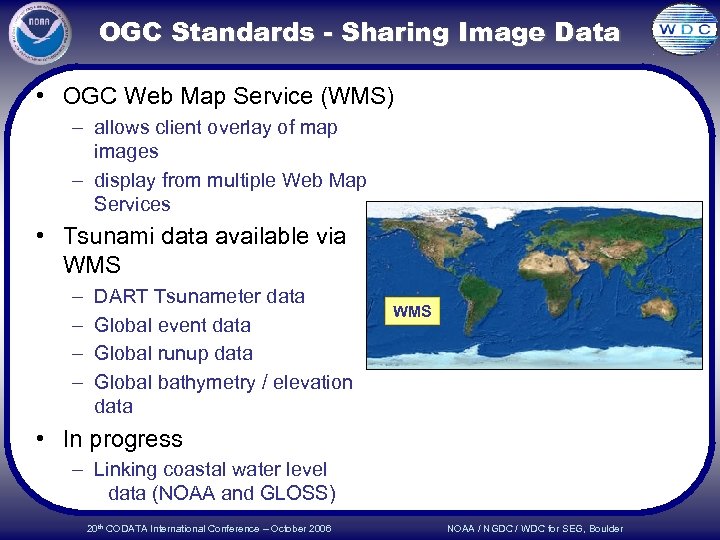
OGC Standards - Sharing Image Data • OGC Web Map Service (WMS) – allows client overlay of map images – display from multiple Web Map Services • Tsunami data available via WMS – – DART Tsunameter data Global event data Global runup data Global bathymetry / elevation data WMS • In progress – Linking coastal water level data (NOAA and GLOSS) 20 th CODATA International Conference – October 2006 NOAA / NGDC / WDC for SEG, Boulder
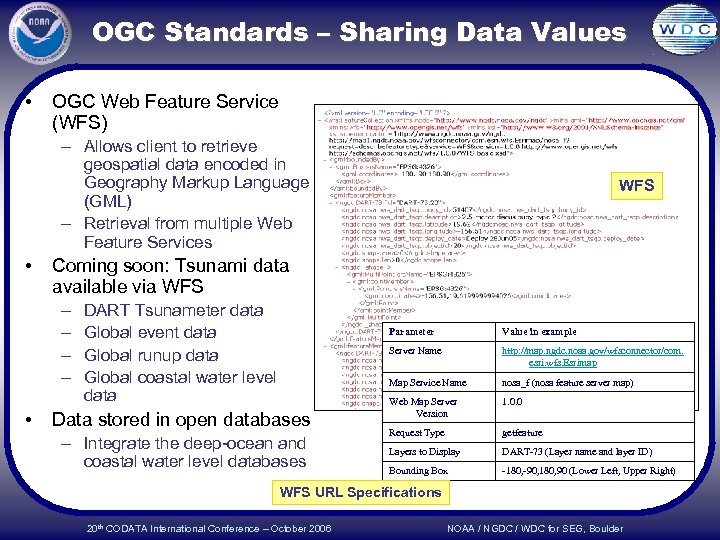
OGC Standards – Sharing Data Values • OGC Web Feature Service (WFS) – Allows client to retrieve geospatial data encoded in Geography Markup Language (GML) – Retrieval from multiple Web Feature Services • Coming soon: Tsunami data available via WFS – – • WFS DART Tsunameter data Global event data Global runup data Global coastal water level data Parameter Server Name – Integrate the deep-ocean and coastal water level databases http: //map. ngdc. noaa. gov/wfsconnector/com. esri. wfs. Esrimap Map Service Name Data stored in open databases Value in example nosa_f (nosa feature server map) Web Map Server Version 1. 0. 0 Request Type getfeature Layers to Display DART-73 (Layer name and layer ID) Bounding Box -180, -90, 180, 90 (Lower Left, Upper Right) WFS URL Specifications 20 th CODATA International Conference – October 2006 NOAA / NGDC / WDC for SEG, Boulder
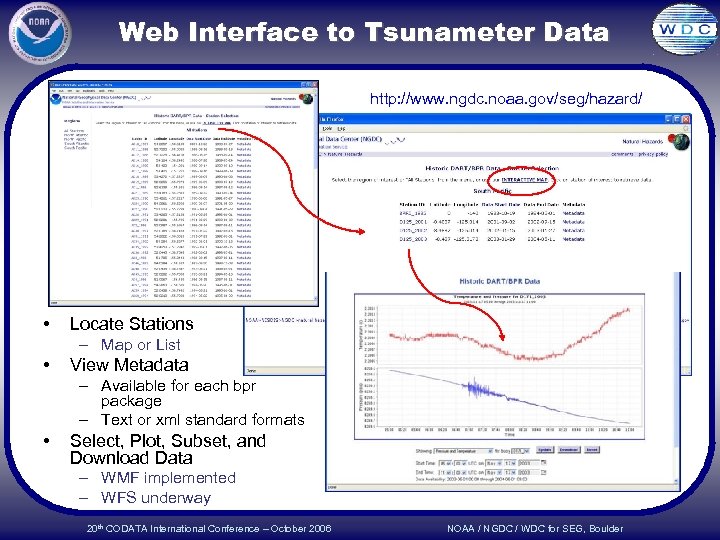
Web Interface to Tsunameter Data http: //www. ngdc. noaa. gov/seg/hazard/ • Locate Stations – Map or List • View Metadata – Available for each bpr package – Text or xml standard formats • Select, Plot, Subset, and Download Data – WMF implemented – WFS underway 20 th CODATA International Conference – October 2006 NOAA / NGDC / WDC for SEG, Boulder
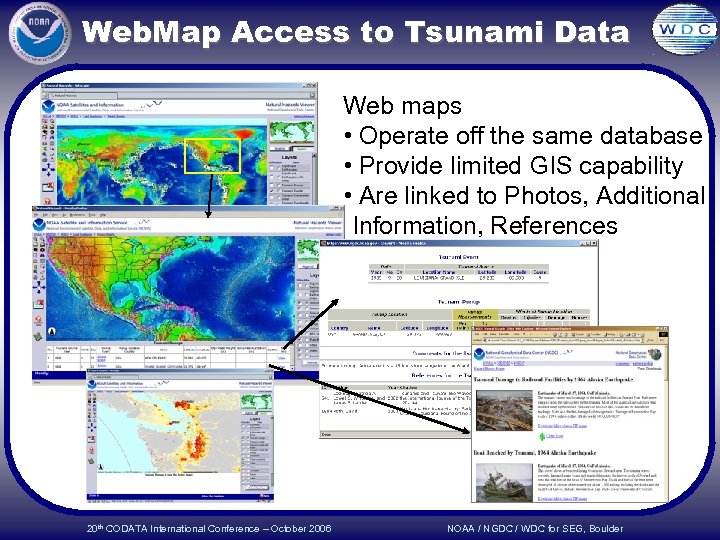
Web. Map Access to Tsunami Data Web maps • Operate off the same database • Provide limited GIS capability • Are linked to Photos, Additional Information, References 20 th CODATA International Conference – October 2006 NOAA / NGDC / WDC for SEG, Boulder
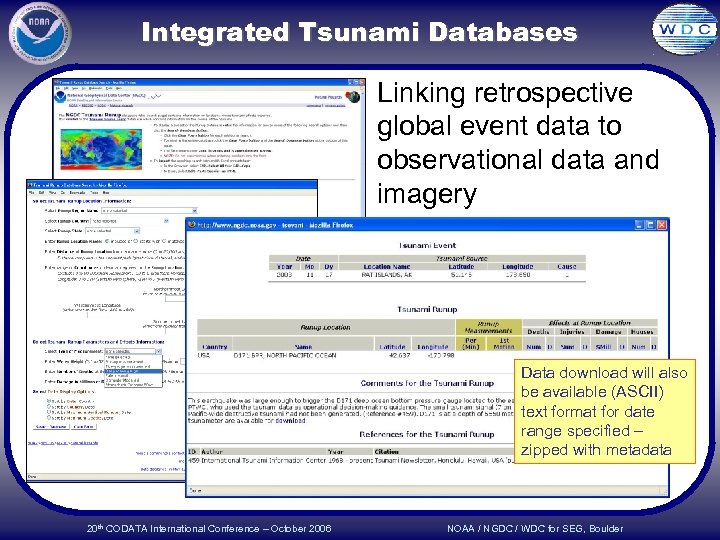
Integrated Tsunami Databases Linking retrospective global event data to observational data and imagery Data download will also be available (ASCII) text format for date range specified – zipped with metadata 20 th CODATA International Conference – October 2006 NOAA / NGDC / WDC for SEG, Boulder
Opportunities and Requirements • Increasing need to look at “multi-hazard” – Need to describe and provide data for multidisciplinary use – Data need to be better described to aid non-expert users • Advances in web access to databases and GIS technologies – Enable powerful search and display options – Enable integration of data - supporting GEOSS goals • Improved collaboration on sea-level data exchange and archive – Closer community collaboration and exchange of data – Participate in data / metadata format discussion • Continued improvement in global past event database – Partnerships with regional experts in Asia – Review, document sources, add content • Rescue tsunami source material (catalogs) – Scan catalogs and provide PDF online – Entire document or – Abstract and citation if under copyright 20 th CODATA International Conference – October 2006 NOAA / NGDC / WDC for SEG, Boulder
Summary • Global Science increasing demands – High-quality multi-disciplinary data for decision making – Well-documented data in standard formats • Data Strategies Employed – Follow International Standards Organization (ISO) metadata standard – Open access to metadata • Spatially-enabled relational databases • XML native databases and files • Publish and maintain metadata in a variety of catalogs and clearinghouses – Move towards GML & XML Community Standard description of data • Utilize Geography Markup Language to describe geographic content • Work with scientific community for standard XML syntax defining data – Archive accessible on-line or near-line (robotic tape system) • Spatially-enabled relational databases • Support Open Geospatial Consortium (OGC) • Multiple delivery formats 20 th CODATA International Conference – October 2006 NOAA / NGDC / WDC for SEG, Boulder
Thank you! 20 th CODATA International Conference – October 2006 NOAA / NGDC / WDC for SEG, Boulder
XML GML • XML is the rules governing markup of data • Defined method of describing content, when used with a schema or dtd, enables others to read • GML is XML “dialect” with well-defined rules and syntax • GML enables developers to read and understand all documents following standard • Analogy: – XML is the arabic alphabet – XML documents could be in French, German, or English and still be valid. Users need to know “dialect” to understand – GML is a dialect with well defined dictionary describing what each element means 20 th CODATA International Conference – October 2006 NOAA / NGDC / WDC for SEG, Boulder
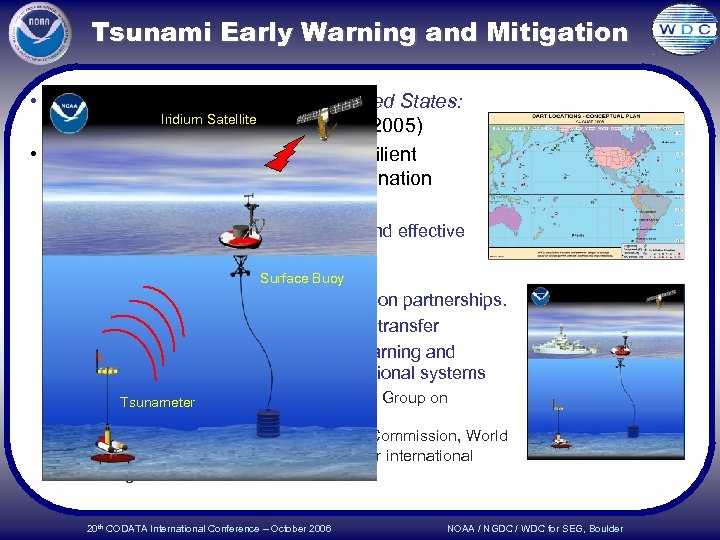
Tsunami Early Warning and Mitigation • Tsunami Risk Reduction for the United States: Iridium Satellite A Framework for Action (December 2005) • U. S. plan for developing tsunami-resilient communities and international coordination – Determining the threat – Extending observations and timely and effective warnings for all states, territories and commonwealths Surface Buoy – Promoting preparedness and mitigation partnerships. – Supporting research and technology transfer – Establishing a global multi-hazard warning and mitigation system of regional and national systems • Supporting tasks of the GEO Working Group on Tsunameter Tsunami Activities, UNESCO-Intergovernmental Ocean Commission, World Meteorological Organization and other international organizations 20 th CODATA International Conference – October 2006 NOAA / NGDC / WDC for SEG, Boulder
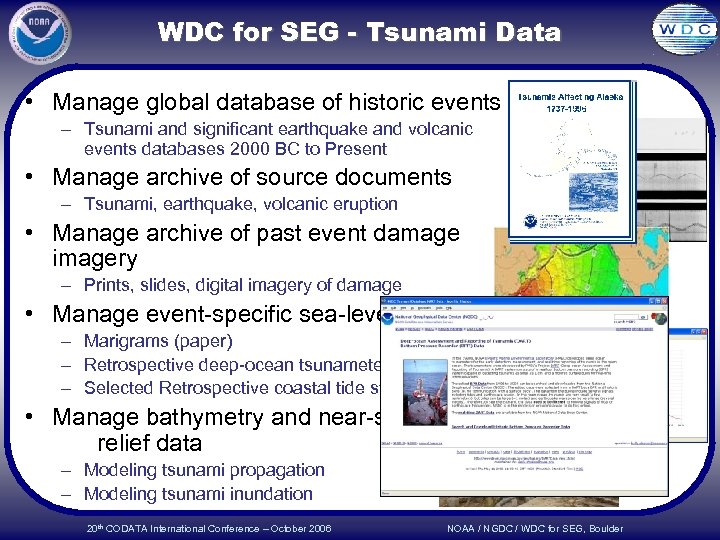
WDC for SEG - Tsunami Data • Manage global database of historic events – Tsunami and significant earthquake and volcanic events databases 2000 BC to Present • Manage archive of source documents – Tsunami, earthquake, volcanic eruption • Manage archive of past event damage imagery – Prints, slides, digital imagery of damage • Manage event-specific sea-level data – Marigrams (paper) – Retrospective deep-ocean tsunameter data – Selected Retrospective coastal tide station • Manage bathymetry and near-shore relief data – Modeling tsunami propagation – Modeling tsunami inundation 20 th CODATA International Conference – October 2006 NOAA / NGDC / WDC for SEG, Boulder
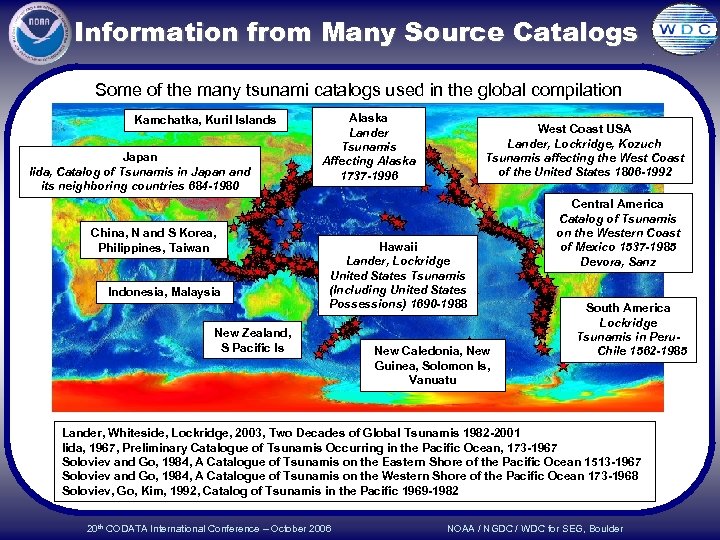
Information from Many Source Catalogs Some of the many tsunami catalogs used in the global compilation Kamchatka, Kuril Islands Japan Iida, Catalog of Tsunamis in Japan and its neighboring countries 684 -1980 China, N and S Korea, Philippines, Taiwan Indonesia, Malaysia Alaska Lander Tsunamis Affecting Alaska 1737 -1996 West Coast USA Lander, Lockridge, Kozuch Tsunamis affecting the West Coast of the United States 1806 -1992 Hawaii Lander, Lockridge United States Tsunamis (Including United States Possessions) 1690 -1988 New Zealand, S Pacific Is New Caledonia, New Guinea, Solomon Is, Vanuatu Central America Catalog of Tsunamis on the Western Coast of Mexico 1537 -1985 Devora, Sanz South America Lockridge Tsunamis in Peru. Chile 1562 -1985 Lander, Whiteside, Lockridge, 2003, Two Decades of Global Tsunamis 1982 -2001 Iida, 1967, Preliminary Catalogue of Tsunamis Occurring in the Pacific Ocean, 173 -1967 Soloviev and Go, 1984, A Catalogue of Tsunamis on the Eastern Shore of the Pacific Ocean 1513 -1967 Soloviev and Go, 1984, A Catalogue of Tsunamis on the Western Shore of the Pacific Ocean 173 -1968 Soloviev, Go, Kim, 1992, Catalog of Tsunamis in the Pacific 1969 -1982 20 th CODATA International Conference – October 2006 NOAA / NGDC / WDC for SEG, Boulder
Скачать презентацию Improving Data Access through Standards-based Metadata and Web
e9db2216b96e49e6034b516972f1c82f.ppt