 Скачать презентацию Improvement of cavity performance by T-mapping X-ray-mapping optical inspection
205a80988e6cf4d0bfb95b116b1fcdb0.ppt
- Количество слайдов: 25



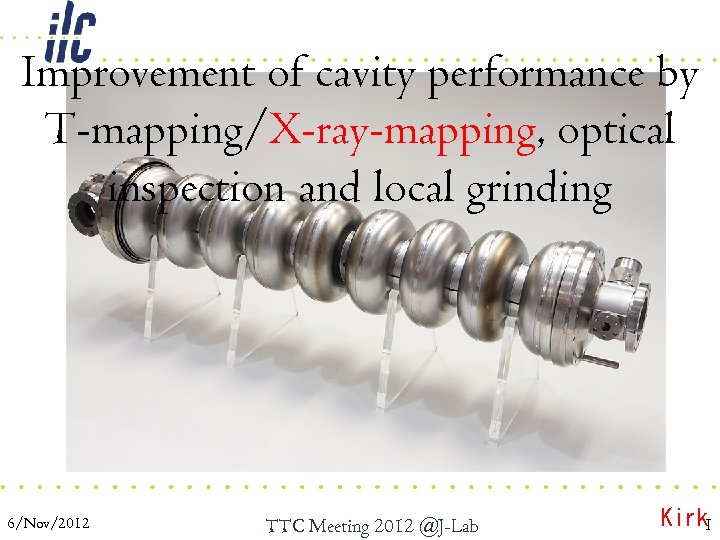
Improvement of cavity performance by T-mapping/X-ray-mapping, optical inspection and local grinding 6/Nov/2012 TTC Meeting 2012 @J-Lab Kirk 1
Outline p Introduction p List of Measured (Fabricating) Cavity p Sequence of Cavity Process at STF p Recent Cavity Performance p 3 Important Items for Evaluation and Improvement p Examples of Effect of Local Grinding Technique p Summary 6/Nov/2012 TTC Meeting 2012 @J-Lab 2
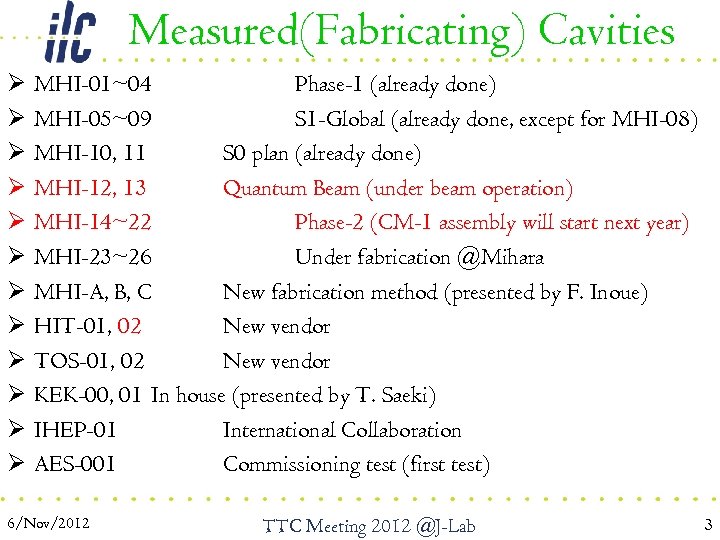
Measured(Fabricating) Cavities Ø Ø Ø MHI-01~04 Phase-1 (already done) MHI-05~09 S 1 -Global (already done, except for MHI-08) MHI-10, 11 S 0 plan (already done) MHI-12, 13 Quantum Beam (under beam operation) MHI-14~22 Phase-2 (CM-1 assembly will start next year) MHI-23~26 Under fabrication @Mihara MHI-A, B, C New fabrication method (presented by F. Inoue) HIT-01, 02 New vendor TOS-01, 02 New vendor KEK-00, 01 In house (presented by T. Saeki) IHEP-01 International Collaboration AES-001 Commissioning test (first test) 6/Nov/2012 TTC Meeting 2012 @J-Lab 3
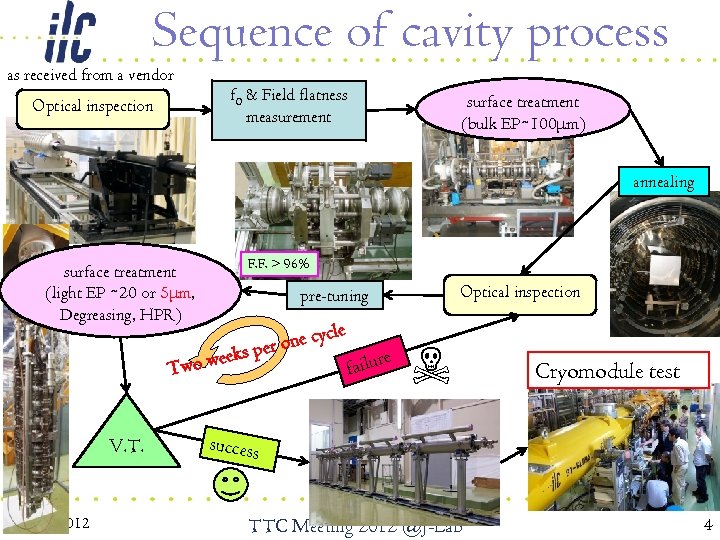
Sequence of cavity process as received from a vendor f 0 & Field flatness measurement Optical inspection surface treatment (bulk EP∼ 100μm) annealing F. F. > 96% surface treatment (light EP ∼ 20 or 5μm, Degreasing, HPR) eek Two w V. T. 6/Nov/2012 Optical inspection pre-tuning cle cy er one sp e failur ☠ Cryomodule test success TTC Meeting 2012 @J-Lab 4
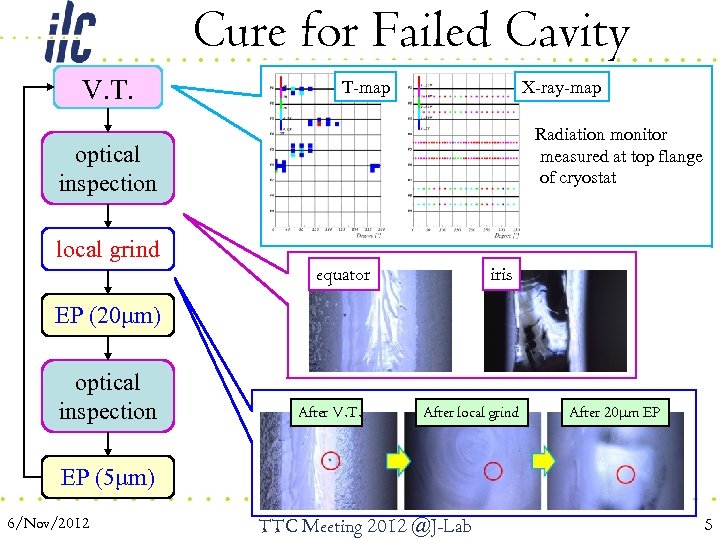
Cure for Failed Cavity V. T. T-map X-ray-map Radiation monitor measured at top flange of cryostat optical inspection local grind equator iris EP (20μm) optical inspection After V. T. After local grind After 20μm EP EP (5μm) 6/Nov/2012 TTC Meeting 2012 @J-Lab 5
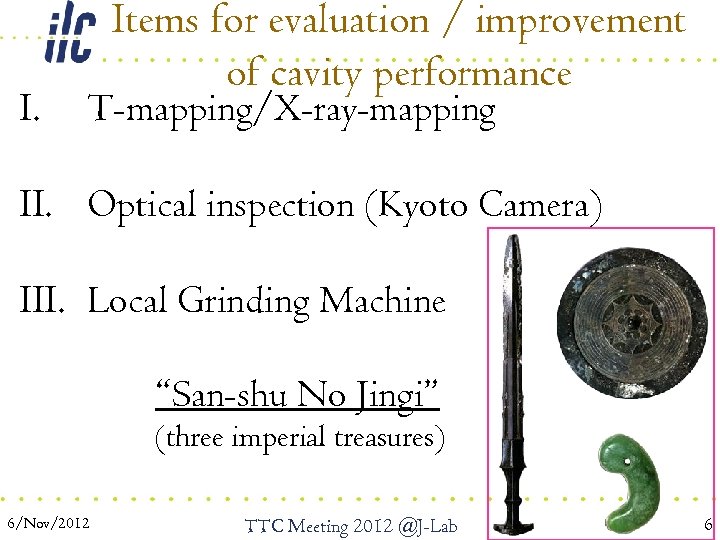
I. Items for evaluation / improvement of cavity performance T-mapping/X-ray-mapping II. Optical inspection (Kyoto Camera) III. Local Grinding Machine “San-shu No Jingi” (three imperial treasures) 6/Nov/2012 TTC Meeting 2012 @J-Lab 6
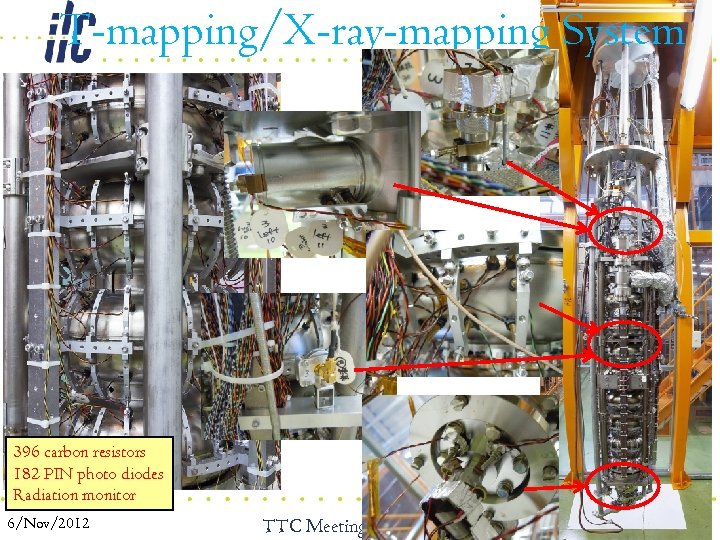
T-mapping/X-ray-mapping System 396 carbon resistors 182 PIN photo diodes Radiation monitor 6/Nov/2012 TTC Meeting 2012 @J-Lab 7
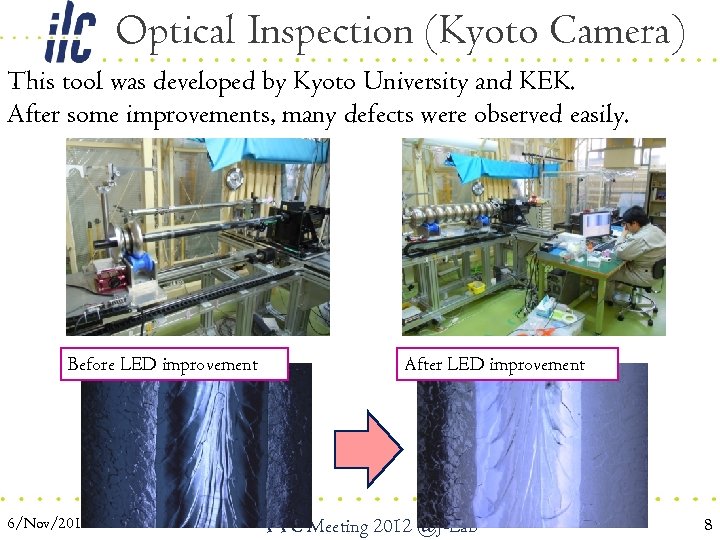
Optical Inspection (Kyoto Camera) This tool was developed by Kyoto University and KEK. After some improvements, many defects were observed easily. Before LED improvement 6/Nov/2012 After LED improvement TTC Meeting 2012 @J-Lab 8
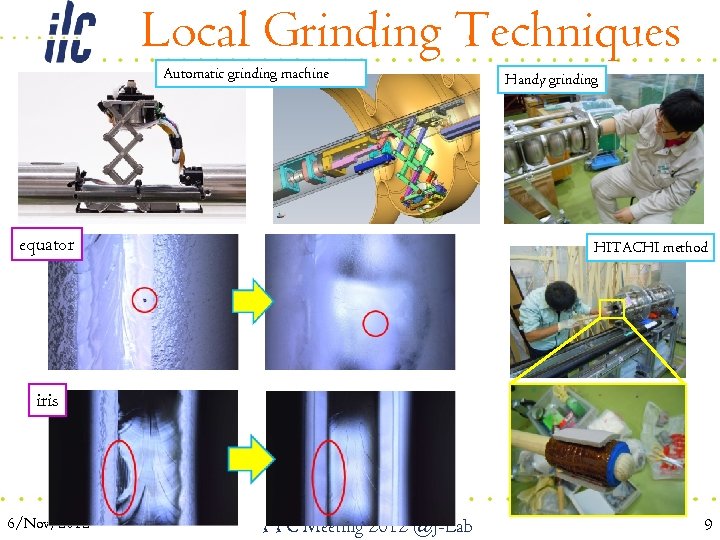
Local Grinding Techniques Automatic grinding machine equator Handy grinding HITACHI method iris 6/Nov/2012 TTC Meeting 2012 @J-Lab 9
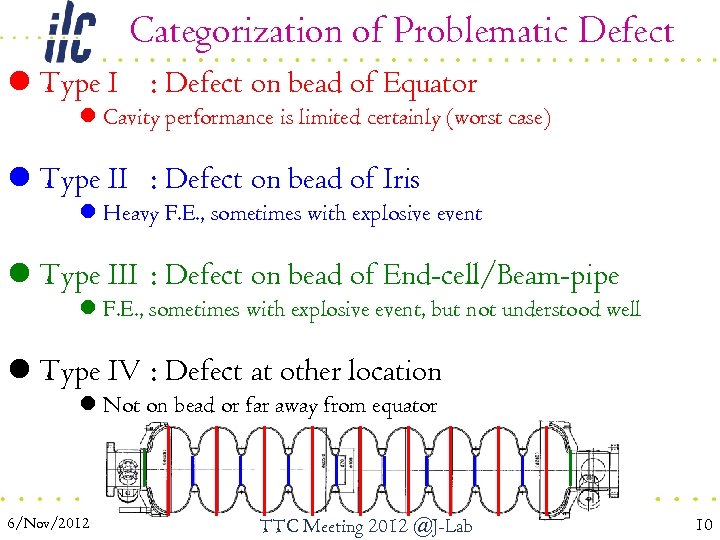
Categorization of Problematic Defect l Type I : Defect on bead of Equator l Cavity performance is limited certainly (worst case) l Type II : Defect on bead of Iris l Heavy F. E. , sometimes with explosive event l Type III : Defect on bead of End-cell/Beam-pipe l F. E. , sometimes with explosive event, but not understood well l Type IV : Defect at other location l Not on bead or far away from equator 6/Nov/2012 TTC Meeting 2012 @J-Lab 10
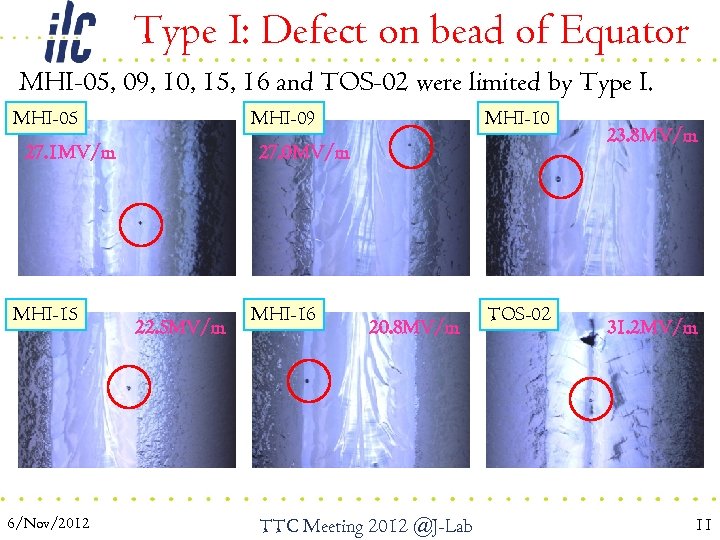
Type I: Defect on bead of Equator MHI-05, 09, 10, 15, 16 and TOS-02 were limited by Type I. MHI-05 MHI-09 27. 1 MV/m MHI-15 6/Nov/2012 MHI-10 27. 0 MV/m 22. 5 MV/m MHI-16 20. 8 MV/m TTC Meeting 2012 @J-Lab TOS-02 23. 8 MV/m 31. 2 MV/m 11
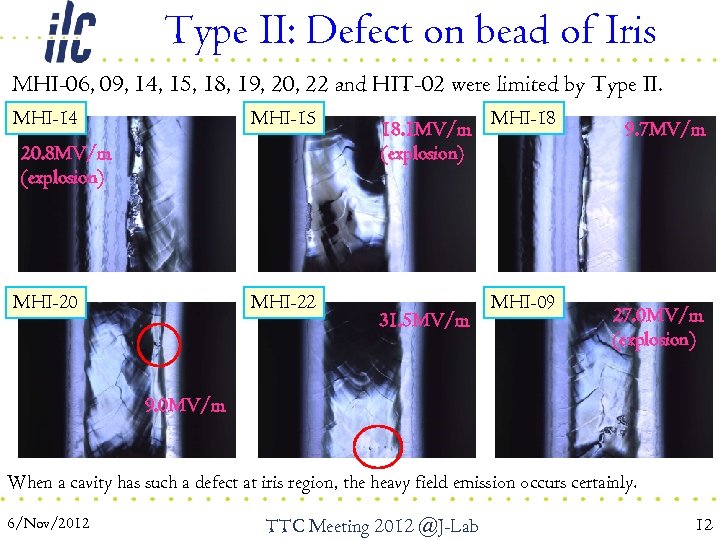
Type II: Defect on bead of Iris MHI-06, 09, 14, 15, 18, 19, 20, 22 and HIT-02 were limited by Type II. MHI-14 MHI-15 20. 8 MV/m (explosion) MHI-20 MHI-22 18. 1 MV/m (explosion) 31. 5 MV/m MHI-18 MHI-09 9. 7 MV/m 27. 0 MV/m (explosion) 9. 0 MV/m When a cavity has such a defect at iris region, the heavy field emission occurs certainly. 6/Nov/2012 TTC Meeting 2012 @J-Lab 12
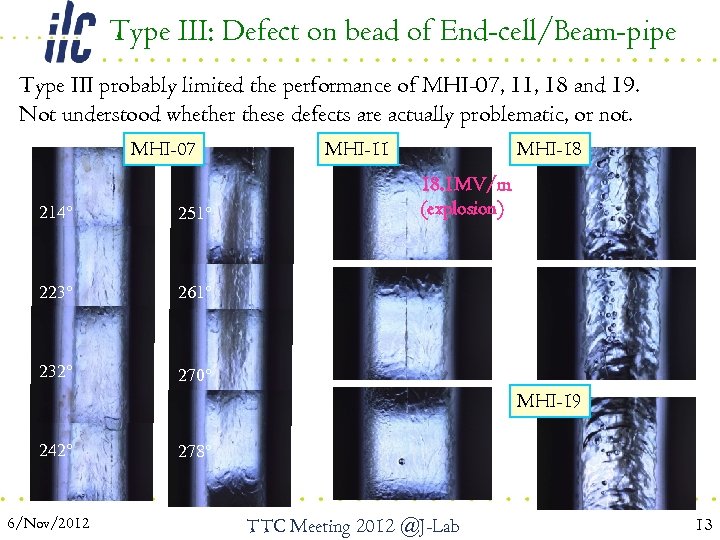
Type III: Defect on bead of End-cell/Beam-pipe Type III probably limited the performance of MHI-07, 11, 18 and 19. Not understood whether these defects are actually problematic, or not. MHI-07 214° 251° 223° MHI-18 18. 1 MV/m (explosion) 261° 232° MHI-11 270° MHI-19 242° 6/Nov/2012 278° TTC Meeting 2012 @J-Lab 13
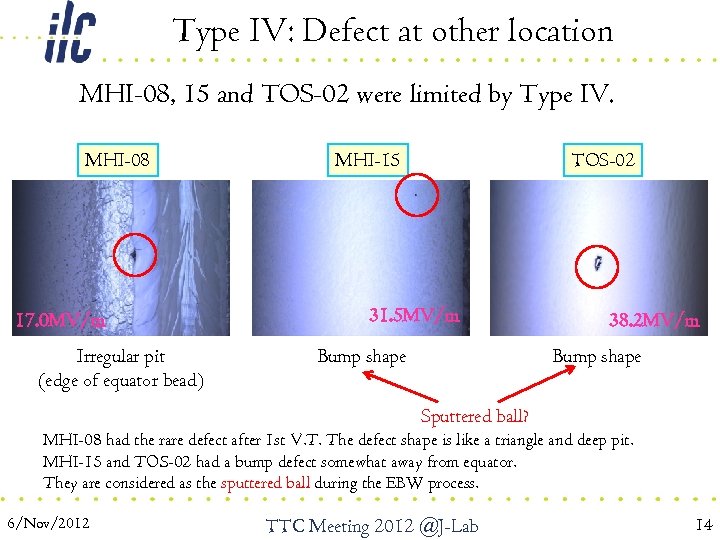
Type IV: Defect at other location MHI-08, 15 and TOS-02 were limited by Type IV. MHI-08 17. 0 MV/m Irregular pit (edge of equator bead) MHI-15 TOS-02 31. 5 MV/m Bump shape 38. 2 MV/m Bump shape Sputtered ball? MHI-08 had the rare defect after 1 st V. T. The defect shape is like a triangle and deep pit. MHI-15 and TOS-02 had a bump defect somewhat away from equator. They are considered as the sputtered ball during the EBW process. 6/Nov/2012 TTC Meeting 2012 @J-Lab 14
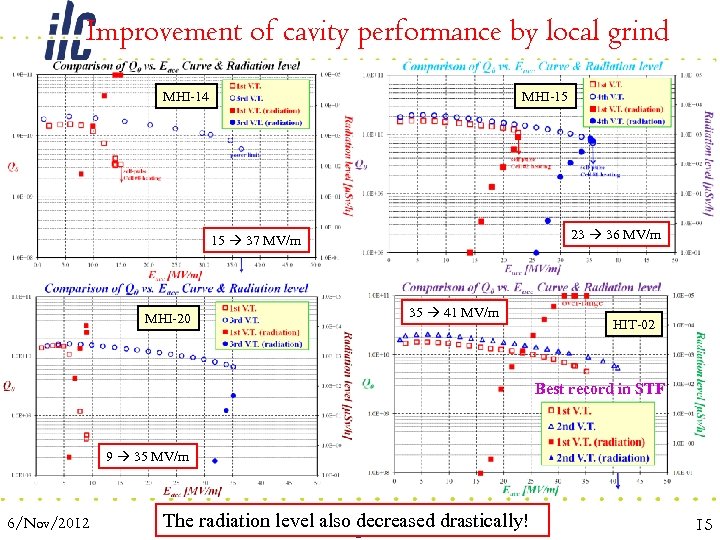
Improvement of cavity performance by local grind MHI-14 MHI-15 23 36 MV/m 15 37 MV/m MHI-20 35 41 MV/m HIT-02 Best record in STF 9 35 MV/m 6/Nov/2012 The radiation level also decreased drastically! TTC Meeting 2012 @J-Lab 15
![Summary of Effect of Local Grind at STF Cavity Change of Gradient [MV/m] Location](https://present5.com/presentation/205a80988e6cf4d0bfb95b116b1fcdb0/image-16.jpg "Summary of Effect of Local Grind at STF Cavity Change of Gradient [MV/m] Location")
Summary of Effect of Local Grind at STF Cavity Change of Gradient [MV/m] Location of problematic defect grind method Limit cause in last V. T. MHI#8 16 27 (1 st 2 nd) #2 equator (edge) by machine Cell #2 heating (other location) MHI#10 26 20 (2 nd 3 rd) #1 & #9 equator (on bead) by hand & machine Cell #1 heating (other new defect) MHI#14 13 >37 @π (2 nd 3 rd) iris #8 -#9 (edge) by hand Power limit 23 >33 (1 st 2 nd) #2 equator (on bead) by machine Cell #9 heating (new defect) 29 >36 (2 nd 3 rd) #9 equator (on bead) by machine Cell #9 heating due to heavy F. E. (new defect) 18 >36 @π (3 rd 4 th) iris #3 -#4 (edge) iris #7 -#8 (edge) iris #8 -#9 (edge) by hand & by machine 21 >34 #1 equator (on bead) by machine MHI#15 MHI#16 6/Nov/2012 TTC Meeting 2012 @J-Lab Power limit HOM #2 pre-heating (transient state) 16
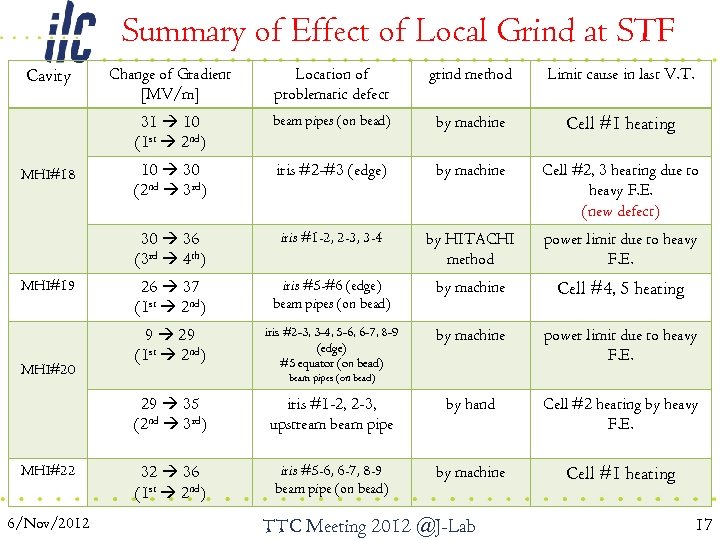
Summary of Effect of Local Grind at STF MHI#19 MHI#20 Location of problematic defect grind method Limit cause in last V. T. beam pipes (on bead) by machine Cell #1 heating 10 30 (2 nd 3 rd) iris #2 -#3 (edge) by machine Cell #2, 3 heating due to heavy F. E. (new defect) 30 36 (3 rd 4 th) MHI#18 Change of Gradient [MV/m] 31 10 (1 st 2 nd) Cavity iris #1 -2, 2 -3, 3 -4 by HITACHI method power limit due to heavy F. E. 26 37 (1 st 2 nd) iris #5 -#6 (edge) beam pipes (on bead) by machine Cell #4, 5 heating 9 29 (1 st 2 nd) iris #2 -3, 3 -4, 5 -6, 6 -7, 8 -9 (edge) #5 equator (on bead) by machine power limit due to heavy F. E. beam pipes (on bead) 29 35 (2 nd 3 rd) MHI#22 6/Nov/2012 iris #1 -2, 2 -3, upstream beam pipe by hand Cell #2 heating by heavy F. E. 32 36 (1 st 2 nd) iris #5 -6, 6 -7, 8 -9 beam pipe (on bead) by machine Cell #1 heating TTC Meeting 2012 @J-Lab 17
![Summary of Effect of Local Grind at STF Cavity Change of Gradient [MV/m] Location](https://present5.com/presentation/205a80988e6cf4d0bfb95b116b1fcdb0/image-18.jpg "Summary of Effect of Local Grind at STF Cavity Change of Gradient [MV/m] Location")
Summary of Effect of Local Grind at STF Cavity Change of Gradient [MV/m] Location of problematic defect grind method Limit cause in last V. T. TOS#2 31 >38 (1 st 2 nd) #7 equator (on bead) by machine Cell #7 heating TOS#2 38 >39 (1 st 2 nd) #8 away from equator by machine Cell #8 heating HIT#2 >35 >41 (1 st 2 nd) Every iris beam pipes by HITACHI method Power limit with heavy field emission (Not on bead) The local grinding technique is very important for the improvement of cavity performance!! 6/Nov/2012 TTC Meeting 2012 @J-Lab 18
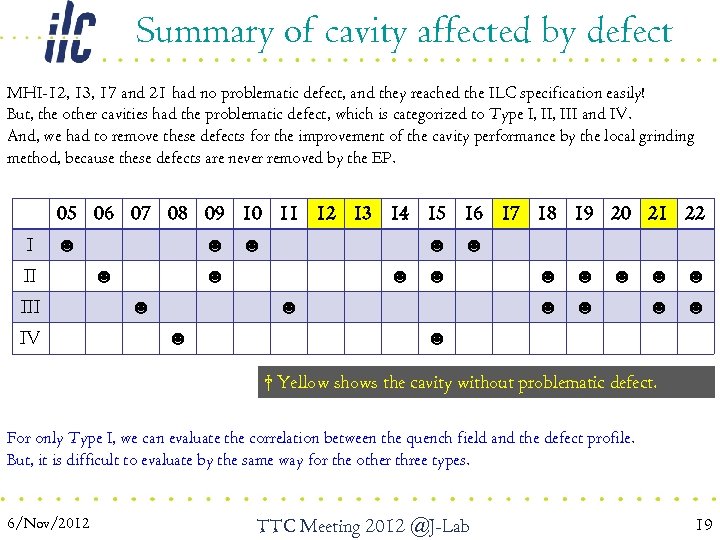
Summary of cavity affected by defect MHI-12, 13, 17 and 21 had no problematic defect, and they reached the ILC specification easily! But, the other cavities had the problematic defect, which is categorized to Type I, III and IV. And, we had to remove these defects for the improvement of the cavity performance by the local grinding method, because these defects are never removed by the EP. 05 06 07 08 09 10 11 12 13 14 15 16 17 18 19 20 21 22 I ☻ II IV ☻ ☻ ☻ ☻ ☻ ☻ † Yellow shows the cavity without problematic defect. For only Type I, we can evaluate the correlation between the quench field and the defect profile. But, it is difficult to evaluate by the same way for the other three types. 6/Nov/2012 TTC Meeting 2012 @J-Lab 19
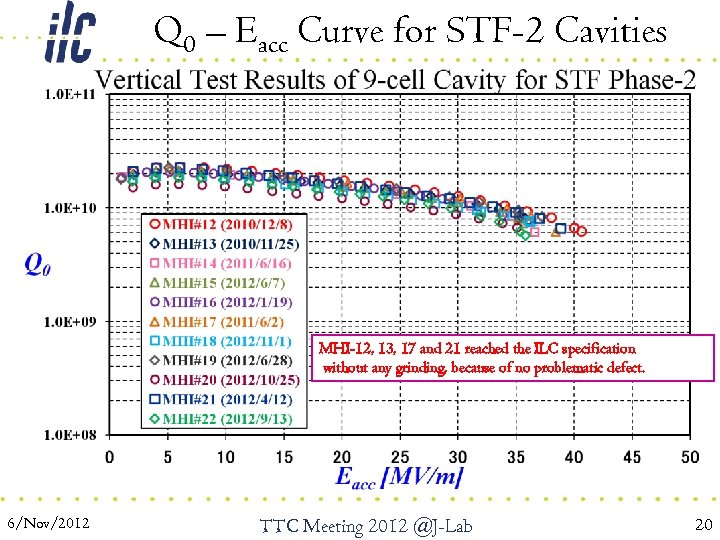
Q 0 – Eacc Curve for STF-2 Cavities MHI-12, 13, 17 and 21 reached the ILC specification without any grinding, because of no problematic defect. 6/Nov/2012 TTC Meeting 2012 @J-Lab 20
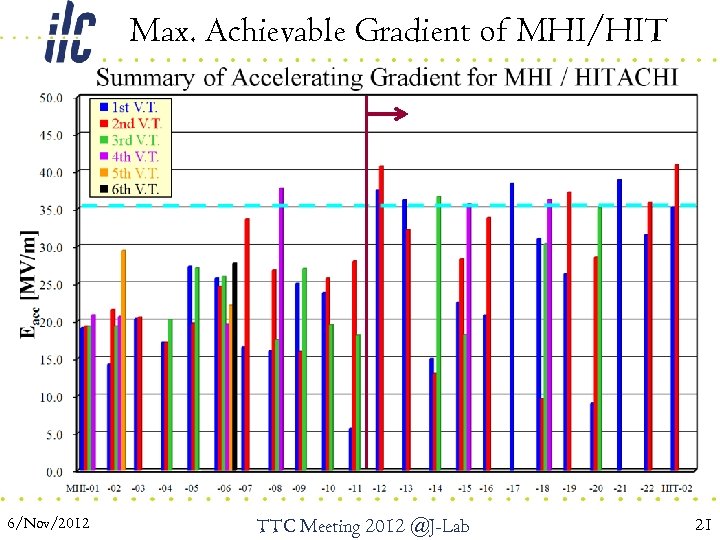
Max. Achievable Gradient of MHI/HIT 6/Nov/2012 TTC Meeting 2012 @J-Lab 21
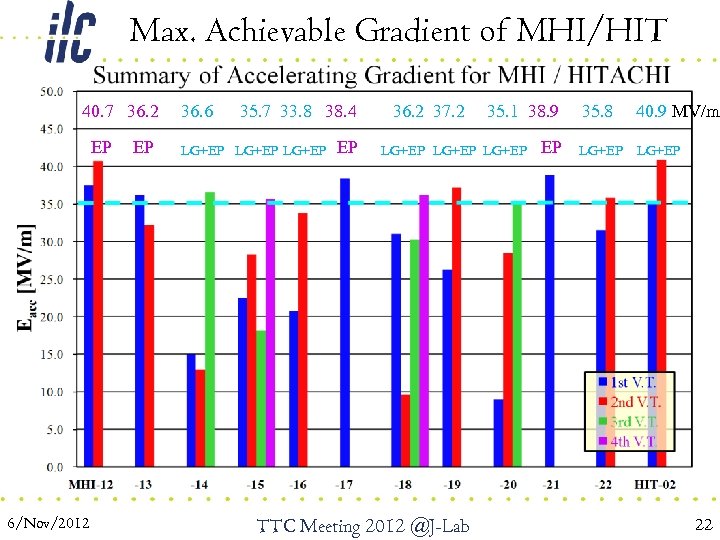
Max. Achievable Gradient of MHI/HIT 40. 7 36. 2 EP 6/Nov/2012 EP 36. 6 35. 7 33. 8 38. 4 LG+EP EP 36. 2 37. 2 35. 1 38. 9 LG+EP TTC Meeting 2012 @J-Lab EP 35. 8 40. 9 MV/m LG+EP 22
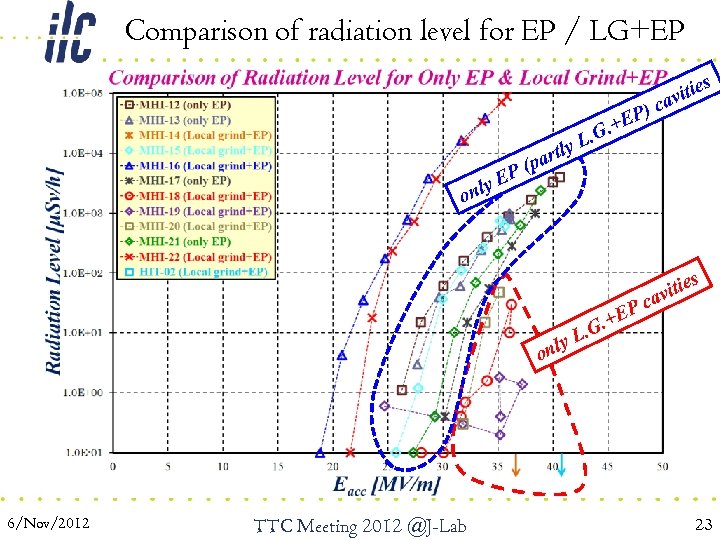
Comparison of radiation level for EP / LG+EP es ) P. +E ti avi c . G y onl ( EP L tly ar p s e viti a Pc E y onl 6/Nov/2012 TTC Meeting 2012 @J-Lab +. G. L 23
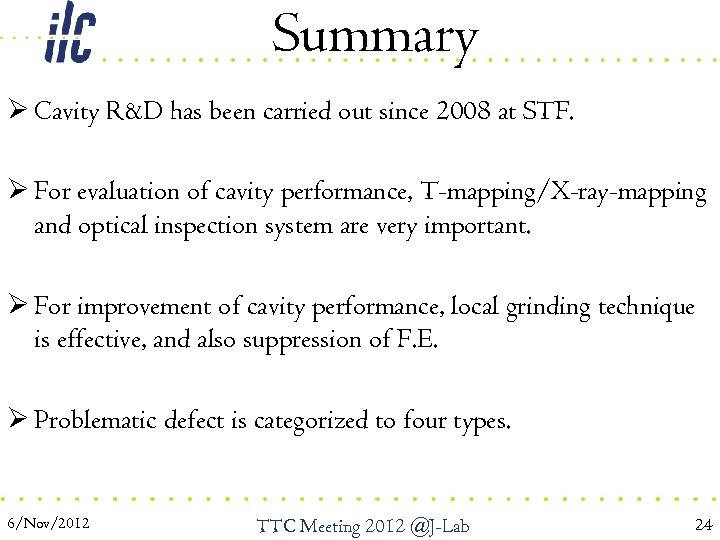
Summary Ø Cavity R&D has been carried out since 2008 at STF. Ø For evaluation of cavity performance, T-mapping/X-ray-mapping and optical inspection system are very important. Ø For improvement of cavity performance, local grinding technique is effective, and also suppression of F. E. Ø Problematic defect is categorized to four types. 6/Nov/2012 TTC Meeting 2012 @J-Lab 24

Thank you for your attention 6/Nov/2012 TTC Meeting 2012 @J-Lab 25
Скачать презентацию Improvement of cavity performance by T-mapping X-ray-mapping optical inspection
205a80988e6cf4d0bfb95b116b1fcdb0.ppt