 Скачать презентацию Improved donor cooperation and collaboration with partner countries
48806e9192f71d724481ecd4721a52f2.ppt
- Количество слайдов: 13



Improved donor cooperation and collaboration with partner countries for pro -poor growth in rural areas by Christoph Kohlmeyer BMZ, Co-Chair of the Global Donor Platform IFAD Governing Council, Rome, February 16 th 2006 2
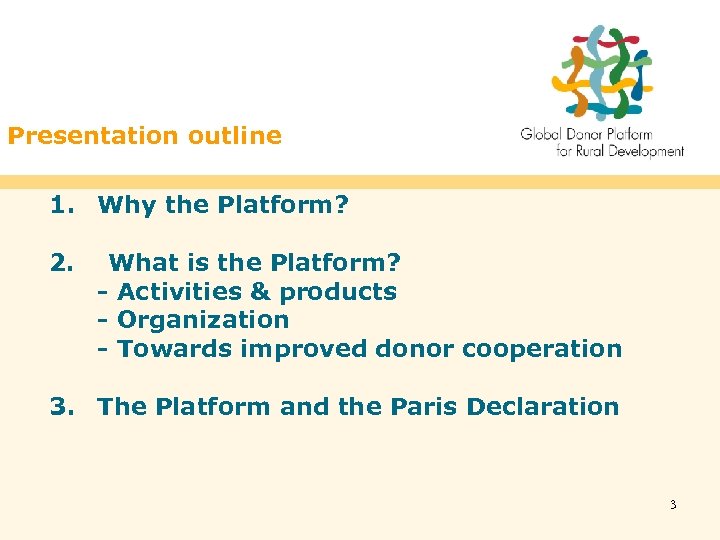
Presentation outline 1. Why the Platform? 2. What is the Platform? - Activities & products - Organization - Towards improved donor cooperation 3. The Platform and the Paris Declaration 3
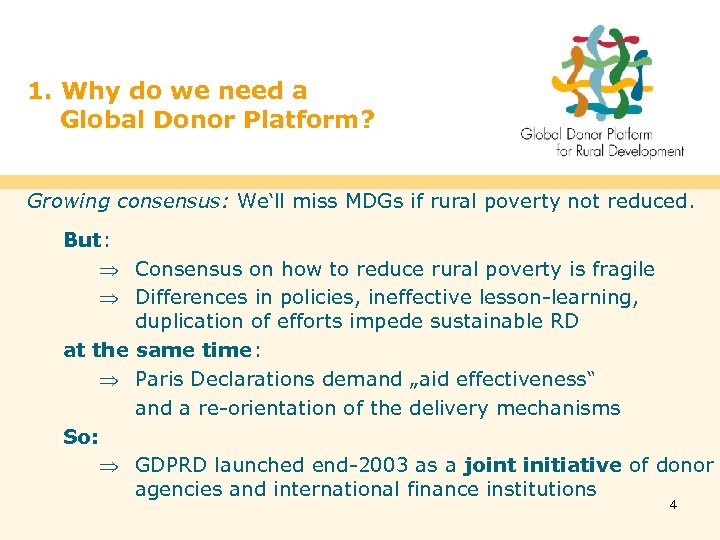
1. Why do we need a Global Donor Platform? Growing consensus: We‘ll miss MDGs if rural poverty not reduced. But: Þ Consensus on how to reduce rural poverty is fragile Þ Differences in policies, ineffective lesson-learning, duplication of efforts impede sustainable RD at the same time: Þ Paris Declarations demand „aid effectiveness“ and a re-orientation of the delivery mechanisms So: Þ GDPRD launched end-2003 as a joint initiative of donor agencies and international finance institutions 4
2. What is the Platform? Þ A communication and facilitation mechanism between donors, partner countries, high-level policy dialogue, and national development frameworks Þ A learning network between countries as well as between donor head-offices and field staff Þ Ultimate objective: Reduce poverty and enhance economic growth in rural areas in developing countries through improved donor cooperation, collaboration & coordinated dialogue with partner countries 5
Activities and products (1) Three pillars: Pillar 1 Advocate needs/opportunities of rural poor Product: : “The role of agriculture in achieving the MDGs”, donor pamphlet & narrative paper Key messages: Agricultural growth = Best avenue to pro-poor growth. No other way to better employ existing resources & create enough jobs GDPRD promotes its messages through its Focal Points at donor agencies, in conferences and through broad media 6
Activities & products (2) Pillar 2 Promote shared learning Products: • Platform website to share donor experiences and documents (www. rdxxl. org) • Online Forum to facilitate drafting joint policies (e. g. Joint Donor Rural Concept) • Rural Focus of PRSPs (led by IFAD, with other members) • Lessons learnt from in-country facilitation services (Pillar 3) Facilitate donor understanding of what RD means today and how to jointly implement it with partner countries 7
Activities & products (3) Pillar 3: Foster H&A efforts in RD at country level Products: • Build a global community of practice for PBAs and link existing regional networks: e. g. RUTA/Central America, Hub/West Africa, Africa Forum. • Technical & financial support to donor harmonisation & alignment, based on jointly drafted, long-term action plans in pilot countries Tanzania, Burkina Faso, Cambodia, Nicaragua Documenting lessons learned from “real-life” donor cooperation, identifying knowledge gaps about Paris Declaration and 8 bottlenecks in donor cooperation
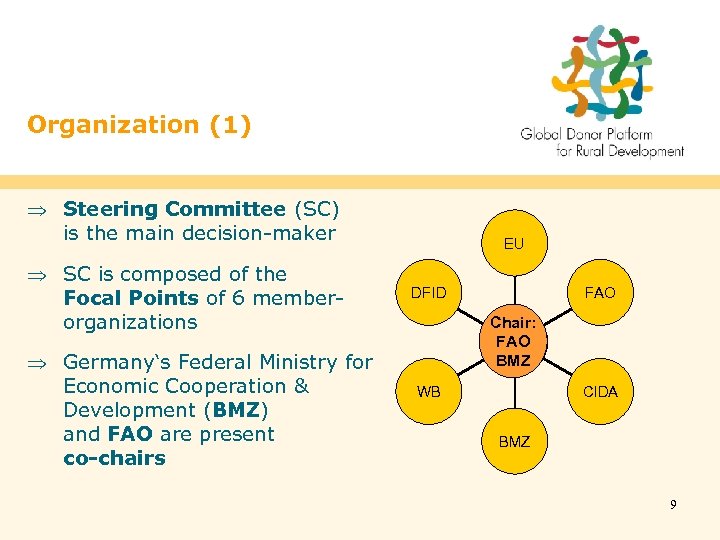
Organization (1) Þ Steering Committee (SC) is the main decision-maker Þ SC is composed of the Focal Points of 6 memberorganizations Þ Germany‘s Federal Ministry for Economic Cooperation & Development (BMZ) and FAO are present co-chairs EU DFID FAO Chair: Chai: FAO BMZ WB CIDA BMZ 9
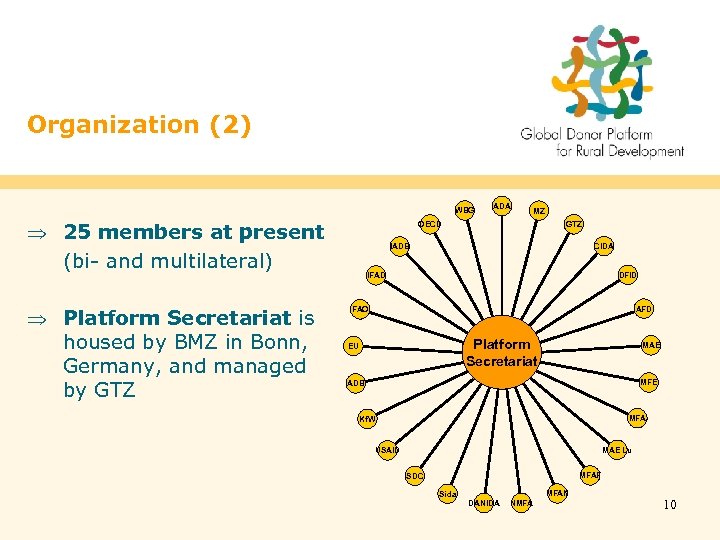
Organization (2) WBG Þ 25 members at present (bi- and multilateral) Þ Platform Secretariat is housed by BMZ in Bonn, Germany, and managed by GTZ ADA MZ GTZ OECD CIDA IADB DFID IFAD AFD FAO Platform Secretariat EU MAE MFE ADB MFA Kf. W MAE Lu USAID MFAF SDC MFAN Sida DANIDA NMFA 10
Towards improved donor cooperation In-country facilitation: Platform acts as “external and independent facilitator” in the coordination processes between donors and partners as they work to set up the new modes of delivery for better harmonisation & alignment in development aid (PBAs, SWAps, budget support etc). The Platform • moderates the joint development of a road map between donors and partners • functions as honest broker in the coordination processes • helps create an atmosphere of trust and transparency 11
3. GDPRD and the Paris Declaration Þ Providing a global learning network on how to implement the Paris Declaration in agricultural and rural programmes; close cooperation with regional and other sector initiatives Þ GDPRD works with Learning Network on Programme- Based Approaches to help monitor implementation of Paris Declaration (with the Joint Venture on Monitoring the Paris Declaration, hosted by the OECD/DAC) Raise respective country profile through dissemination of ‘pioneer work’ in the translation of harmonization & alignment principles into practice in the rural sector 12
Thank you very much for your attention! Christoph. Kohlmeyer@bmz. bund. de or platform@bmz. bund. de 13
Скачать презентацию Improved donor cooperation and collaboration with partner countries
48806e9192f71d724481ecd4721a52f2.ppt