 Скачать презентацию Improve Your Business Enhance Your Value Joseph L
8be415b6b0de65a842000286a673c235.ppt
- Количество слайдов: 15



Improve Your Business, Enhance Your Value Joseph L. Petrelli, ACAS, MAAA, FCA Demotech, Inc. National Settlement Services and Compliance Summit Panelists: Joseph Piernock, Carl Grimes & Joseph Petrelli June 2011
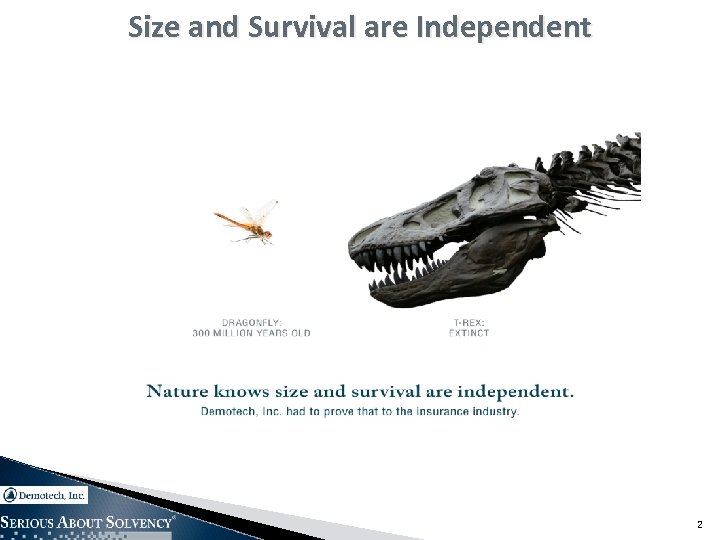
Size and Survival are Independent 2
WHY DEMOTECH, INC. Publisher of Performance of Title Insurance Companies: Includes all publicly traded Title underwriters and most of the regional and local Title underwriters Demotech has been reviewing and rating Title underwriters since 1992 Demotech was the first company to review and rate the entire industry Leading provider of Title industry financial data Reputation and experience in the industry is unmatched Proprietary benchmark data and analysis An independent appreciation of the value proposition of Title insurance 3
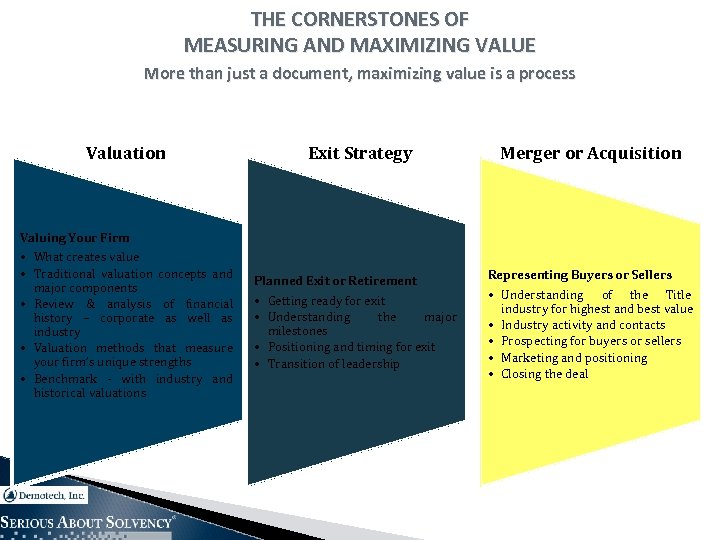
THE CORNERSTONES OF MEASURING AND MAXIMIZING VALUE More than just a document, maximizing value is a process Valuation Valuing Your Firm • What creates value • Traditional valuation concepts and major components • Review & analysis of financial history – corporate as well as industry • Valuation methods that measure your firm’s unique strengths • Benchmark - with industry and historical valuations Exit Strategy Merger or Acquisition Planned Exit or Retirement • Getting ready for exit • Understanding the major milestones • Positioning and timing for exit • Transition of leadership Representing Buyers or Sellers • Understanding of the Title industry for highest and best value • Industry activity and contacts • Prospecting for buyers or sellers • Marketing and positioning • Closing the deal

VALUING THE TITLE AGENCY Enhancing the value of your agency 5
There are Several Types Of Agency Owners Which Are You? Get me out now for the most money I am electing to keep working and do not care (yet) about exiting I am sticking around to exit at a later date for a higher value I am ready and prepared to exit I am not ready and need information to begin to plan my exit 6
VALUATION FOR WHAT PURPOSE? Retirement Exit ◦ Planned ◦ Urgent and unplanned Estate planning Managerial transition Employee stock ownership Personal or professional matter such as a bankruptcy, divorce, litigation, etc. 7
VALUATION FOR WHO? Owner / operator buyer Strategic buyer Financial buyer Other third party 8
How Value Might Be Viewed All Buyers Profitability Growth rates Industry niche Competitive advantage Management Comparables Financial markets Customer concentration Regulatory landscape Technology Operational processes Strategic Buyers Operational synergies Complementary marketing, sales and distribution Expansion of customer base Horizontal or vertical integration Corporate/Institutional Buyers Fund culture Fund charter Exit mechanism Financing Existing portfolio of clients
COMMON METHODOLOGIES Recent comparables Valuations and models in use ◦ Private company comparables are recent sales of “like” companies; the preferred yardstick for all valuations if you are “like” everyone else ◦ Public company comparables are typically not applicable to privately-held firms ◦ The discounted cash flow analysis extrapolates value by projecting forward gross profits and net cash flows and discounts them back to current periods ◦ Leveraged buy out model, used primarily by financial buyers, who are constructing financial models to calculate how much debt a business can carry yet produce a financial breakeven Gross revenue valuation – a multiple of gross revenues EBITDA valuation – a multiple of the adjusted bottom line Gross profit valuation – values the company on gross profits Documentation of Add-Backs 10
Demotech’s Thoughts on Why It May Not Be As Bad As It Seems Title insurance is a monoline product Can not write or produce anything else Always a need for low loss ratio business
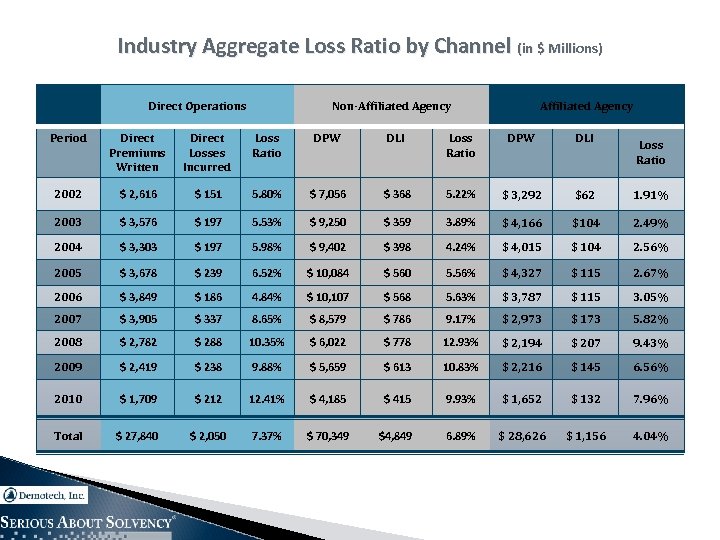
Industry Aggregate Loss Ratio by Channel (in $ Millions) Direct Operations Non-Affiliated Agency Period Direct Premiums Written Direct Losses Incurred Loss Ratio DPW DLI 2002 $ 2, 616 $ 151 5. 80% $ 7, 056 $ 368 5. 22% $ 3, 292 $62 1. 91% 2003 $ 3, 576 $ 197 5. 53% $ 9, 250 $ 359 3. 89% $ 4, 166 $104 2. 49% 2004 $ 3, 303 $ 197 5. 98% $ 9, 402 $ 398 4. 24% $ 4, 015 $ 104 2. 56% 2005 $ 3, 678 $ 239 6. 52% $ 10, 084 $ 560 5. 56% $ 4, 327 $ 115 2. 67% 2006 $ 3, 849 $ 186 4. 84% $ 10, 107 $ 568 5. 63% $ 3, 787 $ 115 3. 05% 2007 $ 3, 905 $ 337 8. 65% $ 8, 579 $ 786 9. 17% $ 2, 973 $ 173 5. 82% 2008 $ 2, 782 $ 288 10. 35% $ 6, 022 $ 778 12. 93% $ 2, 194 $ 207 9. 43% 2009 $ 2, 419 $ 238 9. 88% $ 5, 659 $ 613 10. 83% $ 2, 216 $ 145 6. 56% 2010 $ 1, 709 $ 212 12. 41% $ 4, 185 $ 415 9. 93% $ 1, 652 $ 132 7. 96% Total $ 27, 840 $ 2, 050 7. 37% $ 70, 349 $4, 849 6. 89% $ 28, 626 $ 1, 156 4. 04% Loss Ratio
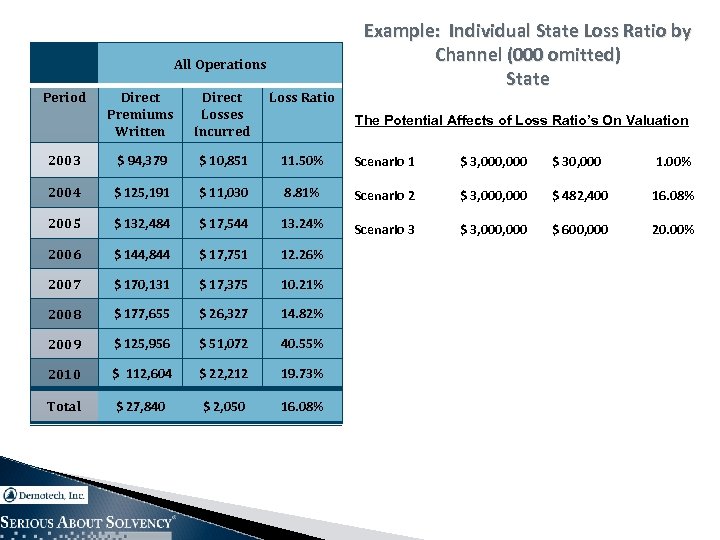
All Operations Period Example: Individual State Loss Ratio by Channel (000 omitted) State Direct Premiums Written Direct Losses Incurred Loss Ratio 2003 $ 94, 379 $ 10, 851 11. 50% Scenario 1 $ 3, 000 $ 30, 000 1. 00% 2004 $ 125, 191 $ 11, 030 8. 81% Scenario 2 $ 3, 000 $ 482, 400 16. 08% 2005 $ 132, 484 $ 17, 544 13. 24% Scenario 3 $ 3, 000 $ 600, 000 20. 00% 2006 $ 144, 844 $ 17, 751 12. 26% 2007 $ 170, 131 $ 17, 375 10. 21% 2008 $ 177, 655 $ 26, 327 14. 82% 2009 $ 125, 956 $ 51, 072 40. 55% 2010 $ 112, 604 $ 22, 212 19. 73% Total $ 27, 840 $ 2, 050 16. 08% The Potential Affects of Loss Ratio’s On Valuation
Rules of the Exit Ramp Start the Process Early ◦ 3 -5 years before the sale is not uncommon ◦ Put your Investment Memorandum on the shelf and update it annually Get Your House in Order ◦ Financials, operations, contracts, leases, patents, trademarks, etc. ◦ Make sure that everything is assignable to the buyer ◦ Be prepared for extensive due diligence Buyer’s Point of View ◦ Buyer cares about stable revenue streams and potential for growth ◦ Understand your potential buyer’s point of view, interest, and motivations 14
![Rules of the Exit Ramp [continued] Make Yourself Less Central to the Business’s Success](https://present5.com/presentation/8be415b6b0de65a842000286a673c235/image-15.jpg "Rules of the Exit Ramp [continued] Make Yourself Less Central to the Business’s Success")
Rules of the Exit Ramp [continued] Make Yourself Less Central to the Business’s Success ◦ If all of the key decisions revolve around you, the value of the company maybe limited and, therefore, the business is less attractive to a buyer ◦ Identify or hire key staff to be leveraged as internal resources Remain Focused on Running and Growing Your Business ◦ Outsource the sales process so that you do not endanger relationships with key clients, employees, or partners whose departure could threaten a transaction or the internal operations of your business Get Professional Assistance ◦ Valuation, due diligence, and the marketing of your business ◦ Without competent advisors, you decrease your chances of selling your business at its maximum price 15
Скачать презентацию Improve Your Business Enhance Your Value Joseph L
8be415b6b0de65a842000286a673c235.ppt