 Скачать презентацию Imposex levels in Hydrobia ulvae Pennant 1777 to
f34a7be144a05f16db6ce6d243237547.ppt
- Количество слайдов: 1



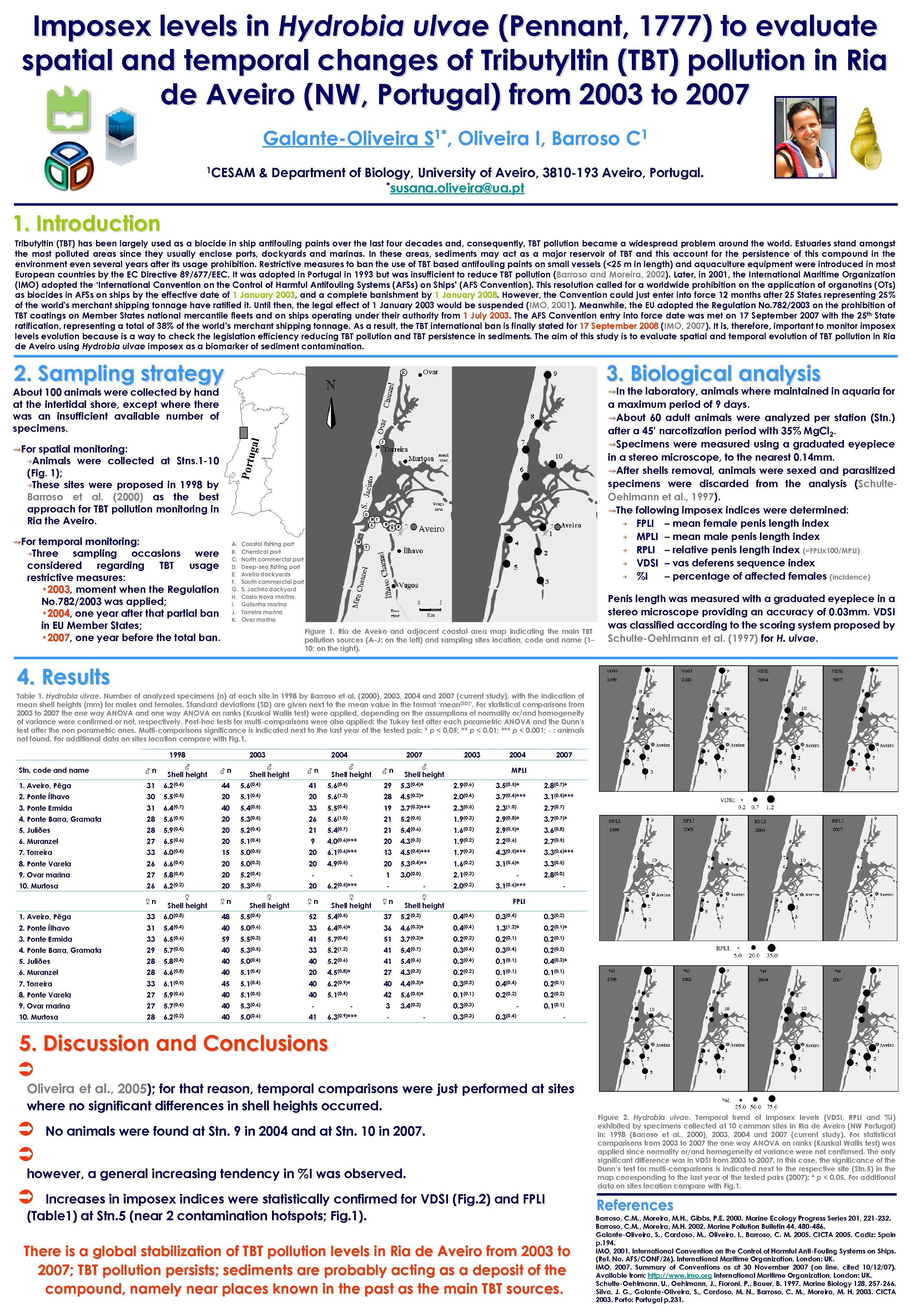
Imposex levels in Hydrobia ulvae (Pennant, 1777) to evaluate spatial and temporal changes of Tributyltin (TBT) pollution in Ria de Aveiro (NW, Portugal) from 2003 to 2007 Galante-Oliveira 1 CESAM 1*, S Oliveira I, Barroso 1 C & Department of Biology, University of Aveiro, 3810 -193 Aveiro, Portugal. *susana. oliveira@ua. pt 1. Introduction Tributyltin (TBT) has been largely used as a biocide in ship antifouling paints over the last four decades and, consequently, TBT pollution became a widespread problem around the world. Estuaries stand amongst the most polluted areas since they usually enclose ports, dockyards and marinas. In these areas, sediments may act as a major reservoir of TBT and this account for the persistence of this compound in the environment even several years after its usage prohibition. Restrictive measures to ban the use of TBT based antifouling paints on small vessels (<25 m in length) and aquaculture equipment were introduced in most European countries by the EC Directive 89/677/EEC. It was adopted in Portugal in 1993 but was insufficient to reduce TBT pollution (Barroso and Moreira, 2002). Later, in 2001, the International Maritime Organization 89/677/EEC (IMO) adopted the ‘International Convention on the Control of Harmful Antifouling Systems (AFSs) on Ships’ (AFS Convention). This resolution called for a worldwide prohibition on the application of organotins (OTs) as biocides in AFSs on ships by the effective date of 1 January 2003, and a complete banishment by 1 January 2008. However, the Convention could just enter into force 12 months after 25 States representing 25% 2003 2008 of the world's merchant shipping tonnage have ratified it. Until then, the legal effect of 1 January 2003 would be suspended (IMO, 2001). Meanwhile, the EU adopted the Regulation No. 782/2003 on the prohibition of TBT coatings on Member States national mercantile fleets and on ships operating under their authority from 1 July 2003. The AFS Convention entry into force date was met on 17 September 2007 with the 25 th State 2003 ratification, representing a total of 38% of the world’s merchant shipping tonnage. As a result, the TBT international ban is finally stated for 17 September 2008 (IMO, 2007). It is, therefore, important to monitor imposex levels evolution because is a way to check the legislation efficiency reducing TBT pollution and TBT persistence in sediments. The aim of this study is to evaluate spatial and temporal evolution of TBT pollution in Ria de Aveiro using Hydrobia ulvae imposex as a biomarker of sediment contamination. 2. Sampling strategy 3. Biological analysis ⇝In the laboratory, animals where maintained in aquaria for a maximum period of 9 days. ⇝About 60 adult animals were analyzed per station (Stn. ) after a 45’ narcotization period with 35% Mg. Cl 2. ⇝Specimens were measured using a graduated eyepiece in a stereo microscope, to the nearest 0. 14 mm. ⇝After shells removal, animals were sexed and parasitized specimens were discarded from the analysis (Schulte. Oehlmann et al. , 1997). ⇝The following imposex indices were determined: → FPLI – mean female penis length index → MPLI – mean male penis length index → RPLI – relative penis length index (=FPLIx 100/MPLI) → VDSI – vas deferens sequence index → %I – percentage of affected females (incidence) gal About 100 animals were collected by hand at the intertidal shore, except where there was an insufficient available number of specimens. Portu ⇝For spatial monitoring: →Animals were collected at Stns. 1 -10 (Fig. 1); →These sites were proposed in 1998 by Barroso et al. (2000) as the best approach for TBT pollution monitoring in Ria the Aveiro. ⇝For temporal monitoring: →Three sampling occasions were considered regarding TBT usage restrictive measures: ▸ 2003, moment when the Regulation 2003 No. 782/2003 was applied; ▸ 2004, one year after that partial ban 2004 in EU Member States; ▸ 2007, one year before the total ban. 2007 A. B. C. D. E. F. G. H. I. J. K. Coastal fishing port Chemical port North commercial port Deep-sea fishing port Aveiro dockyards South commercial port S. Jacinto dockyard Costa Nova marina Gafanha marina Torreira marina Ovar marina Figure 1. Ria de Aveiro and adjacent coastal area map indicating the main TBT pollution sources (A–J; on the left) and sampling sites location, code and name (1– 10; on the right). Penis length was measured with a graduated eyepiece in a stereo microscope providing an accuracy of 0. 03 mm. VDSI was classified according to the scoring system proposed by Schulte-Oehlmann et al. (1997) for H. ulvae. 4. Results Table 1. Hydrobia ulvae. Number of analyzed specimens (n) at each site in 1998 by Barroso et al. (2000), 2003, 2004 and 2007 (current study), with the indication of mean shell heights (mm) for males and females. Standard deviations (SD) are given next to the mean value in the format ‘mean(SD)’. For statistical comparisons from 2003 to 2007 the one way ANOVA and one way ANOVA on ranks (Kruskal Wallis test) were applied, depending on the assumptions of normality or/and homogeneity of variance were confirmed or not, respectively. Post-hoc tests for multi-comparisons were also applied: the Tukey test after each parametric ANOVA and the Dunn’s test after the non parametric ones. Multi-comparisons significance is indicated next to the last year of the tested pair: * p < 0. 05; ** p < 0. 01; *** p < 0. 001; - : animals not found. For additional data on sites location compare with Fig. 1. 1998 ♂ Shell height 2003 ♂ Shell height 2007 * 1. Aveiro, Pêga 31 6. 2(0. 4) 44 5. 6(0. 4) 41 5. 6(0. 4) 29 5. 3(0. 4)* 2. 9(0. 6) 3. 5(0. 5)* 2. 8(0. 7)* 2. Ponte Ílhavo 30 5. 5(0. 5) 20 5. 1(0. 4) 20 5. 6(1. 3) 28 4. 5(0. 2)* 2. 0(0. 4) 3. 7(0. 4)*** 3. 1(0. 5)*** 3. Ponte Ermida 31 6. 4(0. 7) 40 5. 4(0. 5) 33 5. 5(0. 4) 19 3. 7(0. 3)*** 2. 3(0. 5) 2. 3(1. 0) 2. 7(0. 7) 4. Ponte Barra, Gramata 28 5. 6(0. 5) 20 5. 3(0. 5) 26 5. 6(1. 0) 21 5. 2(0. 5) 1. 9(0. 3) 2. 9(0. 8)* 3. 7(0. 7)* 5. Juliões 28 5. 9(0. 4) 20 5. 2(0. 4) 21 5. 4(0. 7) 21 5. 4(0. 6) 1. 6(0. 2) 2. 9(0. 5)* 3. 6(0. 8) 6. Muranzel 27 6. 5(0. 6) 20 5. 1(0. 4) 9 4. 0(0. 6)*** 20 4. 3(0. 3) 1. 9(0. 2) 2. 2(0. 6) 2. 7(0. 5) 7. Torreira 33 6. 0(0. 4) 15 5. 0(0. 5) 20 6. 1(0. 6)*** 13 4. 5(0. 4)*** 1. 7(0. 3) 4. 3(0. 5)*** 3. 3(0. 6)*** 8. Ponte Varela 26 6. 6(0. 4) 20 5. 0(0. 3) 20 4. 9(0. 5) 20 5. 3(0. 4)** 1. 6(0. 2) 3. 1(0. 6)* 3. 3(0. 5) 9. Ovar marina 27 5. 8(0. 4) 20 5. 2(0. 4) - 1 3. 0(0. 0) 2. 1(0. 3) - 2. 8(0. 0) 10. Murtosa 26 6. 2(0. 2) 20 5. 3(0. 5) 20 ♀n ♀ Shell height 6. 2(0. 5)*** ♀ Shell height ♀n ♂n 2004 ♂n ♀ Shell height ♂n 2003 Stn. code and name ♀n ♂n 2004 - - ♀n MPLI 2. 0(0. 2) ♀ Shell height 3. 1(0. 6)*** - FPLI 1. Aveiro, Pêga 33 6. 0(0. 8) 48 5. 5(0. 4) 52 5. 4(0. 5) 37 5. 2(0. 3) 0. 4(0. 4) 0. 3(0. 2) 2. Ponte Ílhavo 31 5. 4(0. 4) 40 5. 0(0. 6) 33 6. 4(0. 6)* 36 4. 6(0. 3)* 0. 4(0. 4) 1. 3(1. 2)* 0. 2(0. 1)* 3. Ponte Ermida 33 6. 5(0. 6) 59 5. 5(0. 3) 41 5. 7(0. 4) 51 3. 7(0. 3)* 0. 2(0. 2) 0. 2(0. 1) 4. Ponte Barra, Gramata 29 5. 7(0. 5) 40 5. 3(0. 5) 33 5. 2(1. 2) 41 5. 4(0. 7) 0. 3(0. 4) 0. 2(0. 2) 5. Juliões 28 5. 8(0. 4) 40 5. 0(0. 4) 40 5. 2(0. 6) 41 5. 4(0. 6) 0. 3(0. 4) 0. 1(0. 1) 0. 4(0. 3)* 6. Muranzel 28 6. 6(0. 8) 40 5. 1(0. 4) 20 4. 5(0. 8)* 27 4. 3(0. 3) 0. 2(0. 2) 0. 1(0. 1) 7. Torreira 33 6. 1(0. 5) 45 5. 1(0. 4) 40 6. 2(0. 9)* 40 4. 4(0. 3)* 0. 3(0. 3) 0. 4(0. 4) 0. 2(0. 1) 8. Ponte Varela 27 5. 9(0. 6) 40 5. 1(0. 5) 40 5. 1(0. 4) 42 5. 6(0. 5)* 0. 1(0. 1) 0. 2(0. 2) 9. Ovar marina 27 5. 7(0. 4) 40 5. 3(0. 6) - 3 3. 4(0. 3) 0. 3(0. 3) 10. Murtosa 28 6. 2(0. 2) 40 5. 0(0. 6) 41 6. 3(0. 9)*** - - 0. 3(0. 3) - 0. 1(0. 1) 0. 3(0. 4) - 5. Discussion and Conclusions Ü Oliveira et al. , 2005); for that reason, temporal comparisons were just performed at sites where no significant differences in shell heights occurred. Ü Ü No animals were found at Stn. 9 in 2004 and at Stn. 10 in 2007. however, a general increasing tendency in %I was observed. Ü Increases in imposex indices were statistically confirmed for VDSI (Fig. 2) and FPLI (Table 1) at Stn. 5 (near 2 contamination hotspots; Fig. 1). There is a global stabilization of TBT pollution levels in Ria de Aveiro from 2003 to 2007; TBT pollution persists; sediments are probably acting as a deposit of the compound, namely near places known in the past as the main TBT sources. Figure 2. Hydrobia ulvae. Temporal trend of imposex levels (VDSI, RPLI and %I) exhibited by specimens collected at 10 common sites in Ria de Aveiro (NW Portugal) in: 1998 (Barroso et al. , 2000), 2003, 2004 and 2007 (current study). For statistical comparisons from 2003 to 2007 the one way ANOVA on ranks (Kruskal Wallis test) was applied since normality or/and homogeneity of variance were not confirmed. The only significant difference was in VDSI from 2003 to 2007. In this case, the significance of the Dunn’s test for multi-comparisons is indicated next to the respective site (Stn. 5) in the map corresponding to the last year of the tested pairs (2007): * p < 0. 05. For additional data on sites location compare with Fig. 1. References Barroso, C. M. , Moreira, M. H. , Gibbs, P. E. 2000. Marine Ecology Progress Series 201, 221 -232. Barroso, C. M. , Moreira, M. H. 2002. Marine Pollution Bulletin 44, 480 -486. Galante-Oliveira, S. , Cardoso, M. , Oliveira, I. , Barroso, C. M. 2005. CICTA 2005. Cadiz: Spain p. 194. IMO, 2001. International Convention on the Control of Harmful Anti-Fouling Systems on Ships. (Ref. No. AFS/CONF/26). International Maritime Organization, London: UK. IMO, 2007. Summary of Conventions as at 30 November 2007 (on line, cited 10/12/07). Available from: http: //www. imo. org International Maritime Organization, London: UK. Schulte-Oehlmann, U. , Oehlmann, J. , Fioroni, P. , Bauer, B. 1997. Marine Biology 128, 257 -266. Silva, J. G. , Galante-Oliveira, S. , Cardoso, M. N. , Barroso, C. M. , Moreira, M. H. 2003. CICTA 2003. Porto: Portugal p. 231.
Скачать презентацию Imposex levels in Hydrobia ulvae Pennant 1777 to
f34a7be144a05f16db6ce6d243237547.ppt