 Скачать презентацию IMPLICIT MODEL OF ATTITUDE MEASURES Measure Attitude Behavior
497f1a901e79ed9fd8ac92cf1c9e7e2c.ppt
- Количество слайдов: 37



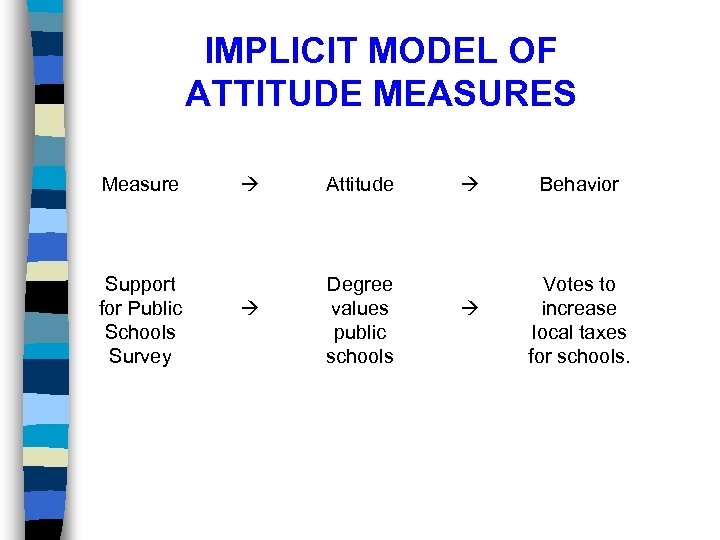
IMPLICIT MODEL OF ATTITUDE MEASURES Measure Attitude Behavior Support for Public Schools Survey Degree values public schools Votes to increase local taxes for schools.
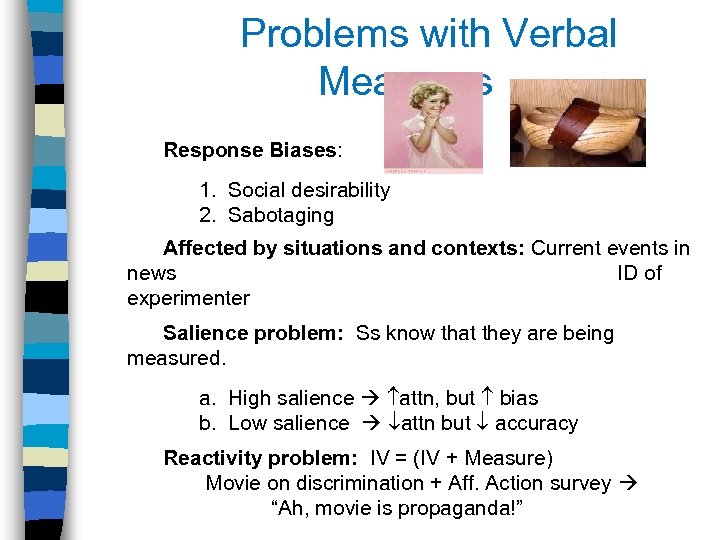
Problems with Verbal Measures Response Biases: 1. Social desirability 2. Sabotaging Affected by situations and contexts: Current events in news ID of experimenter Salience problem: Ss know that they are being measured. a. High salience attn, but bias b. Low salience attn but accuracy Reactivity problem: IV = (IV + Measure) Movie on discrimination + Aff. Action survey “Ah, movie is propaganda!”
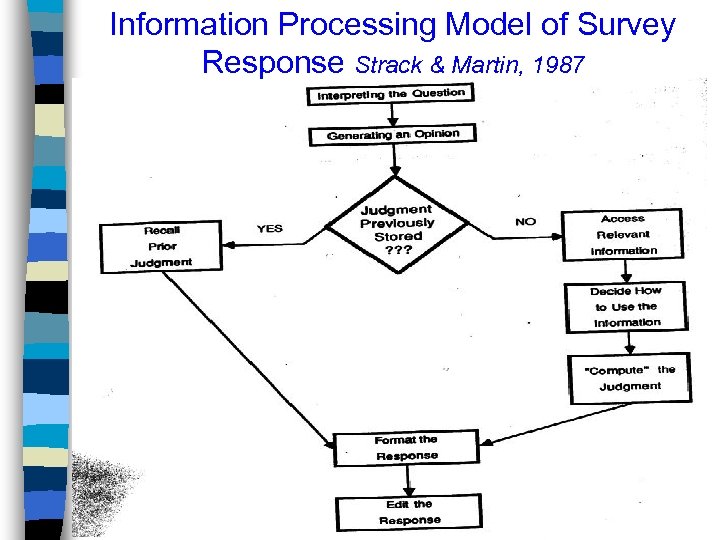
Information Processing Model of Survey Response Strack & Martin, 1987
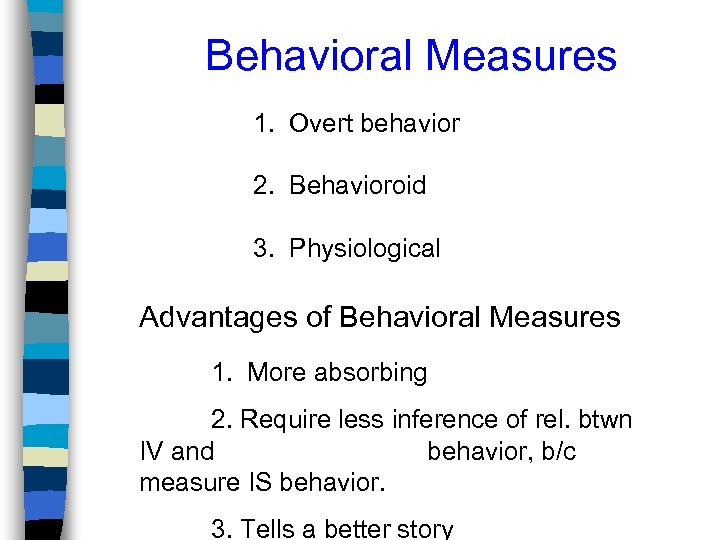
Behavioral Measures 1. Overt behavior 2. Behavioroid 3. Physiological Advantages of Behavioral Measures 1. More absorbing 2. Require less inference of rel. btwn IV and behavior, b/c measure IS behavior. 3. Tells a better story
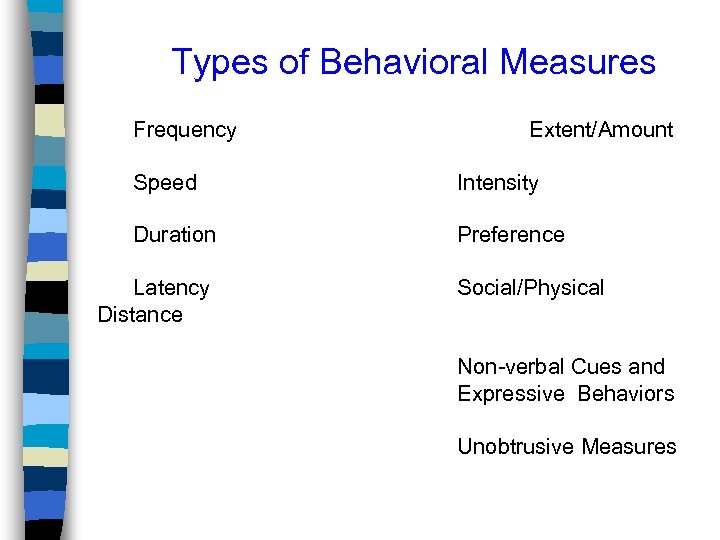
Types of Behavioral Measures Frequency Speed Duration Latency Distance Extent/Amount Intensity Preference Social/Physical Non-verbal Cues and Expressive Behaviors Unobtrusive Measures
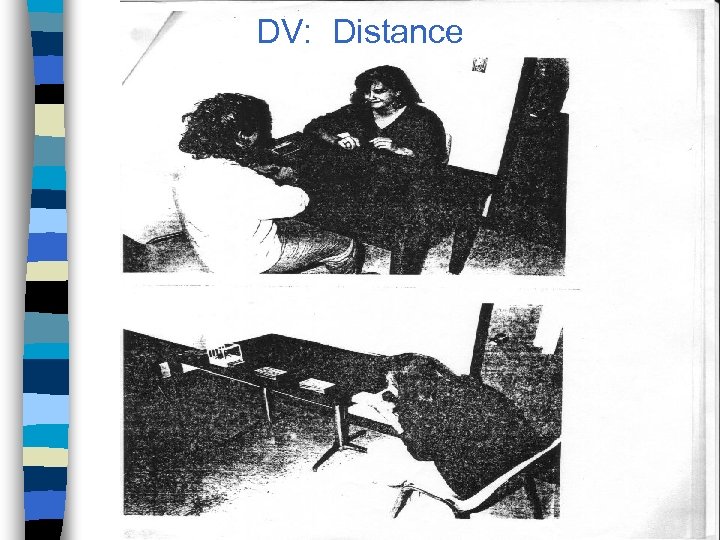
DV: Distance
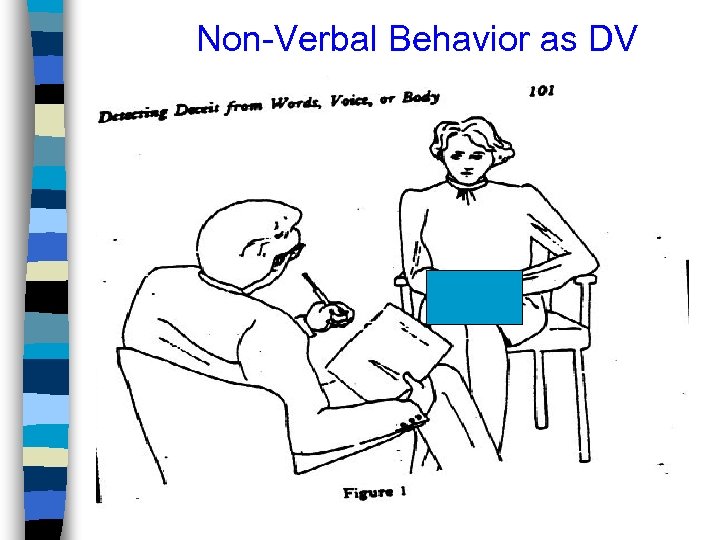
Non-Verbal Behavior as DV
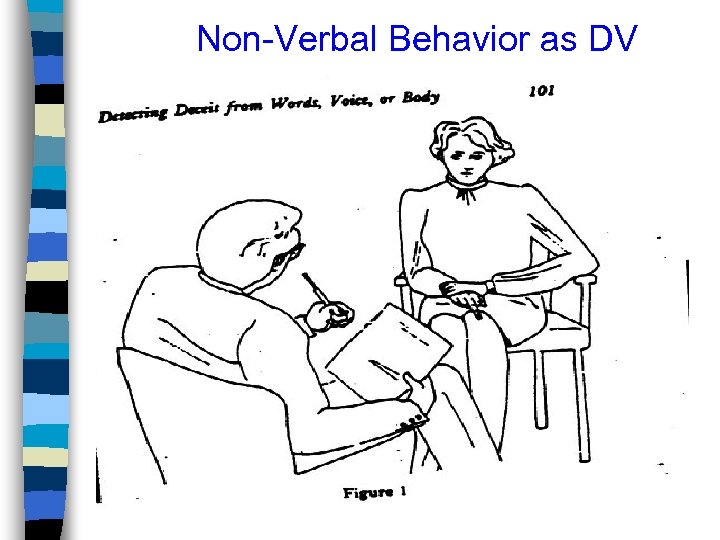
Non-Verbal Behavior as DV
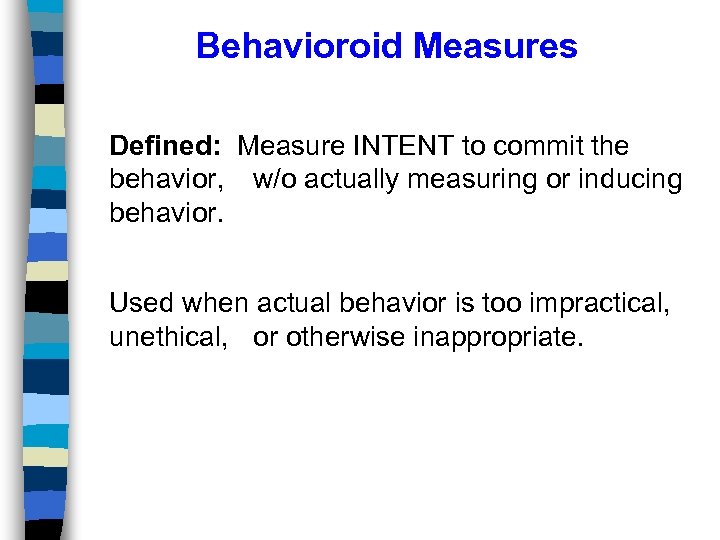
Behavioroid Measures Defined: Measure INTENT to commit the behavior, w/o actually measuring or inducing behavior. Used when actual behavior is too impractical, unethical, or otherwise inappropriate.
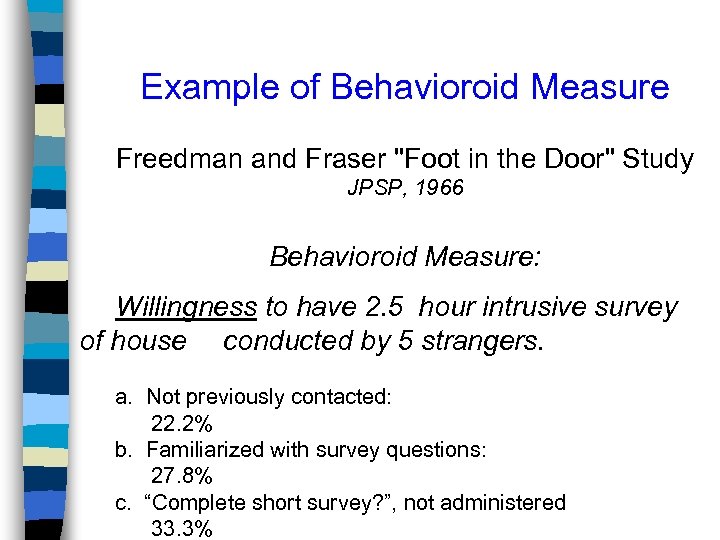
Example of Behavioroid Measure Freedman and Fraser "Foot in the Door" Study JPSP, 1966 Behavioroid Measure: Willingness to have 2. 5 hour intrusive survey of house conducted by 5 strangers. a. Not previously contacted: 22. 2% b. Familiarized with survey questions: 27. 8% c. “Complete short survey? ”, not administered 33. 3%
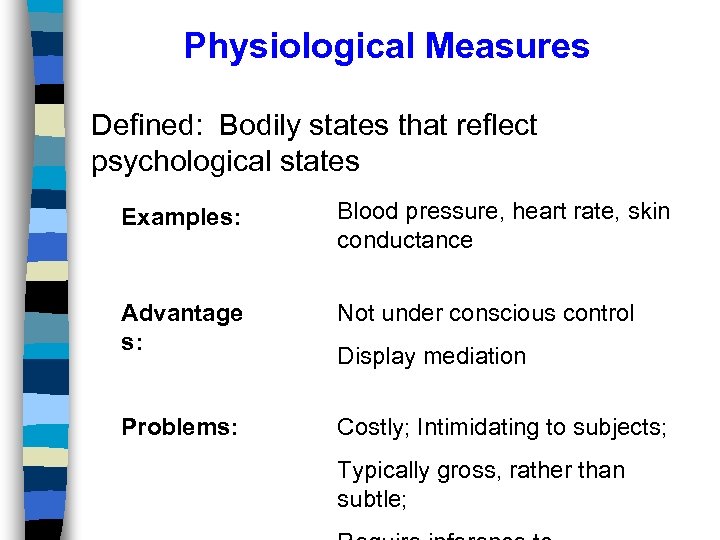
Physiological Measures Defined: Bodily states that reflect psychological states Examples: Blood pressure, heart rate, skin conductance Advantage s: Not under conscious control Problems: Costly; Intimidating to subjects; Display mediation Typically gross, rather than subtle;
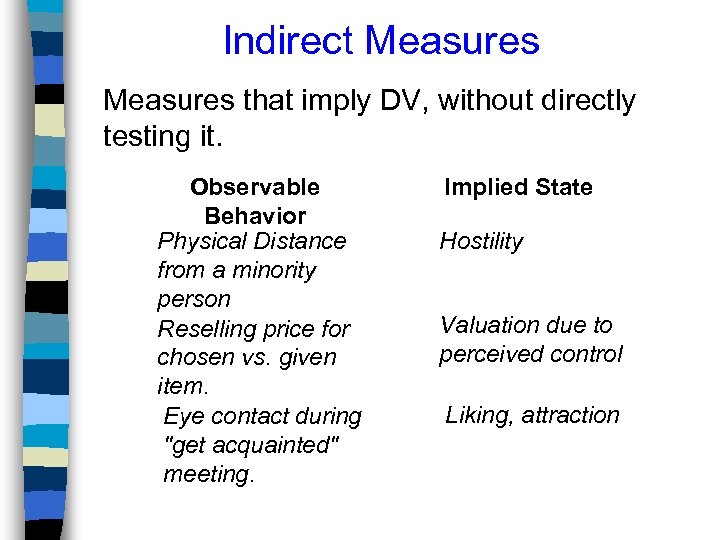
Indirect Measures that imply DV, without directly testing it. Observable Behavior Physical Distance from a minority person Reselling price for chosen vs. given item. Eye contact during "get acquainted" meeting. Implied State Hostility Valuation due to perceived control Liking, attraction
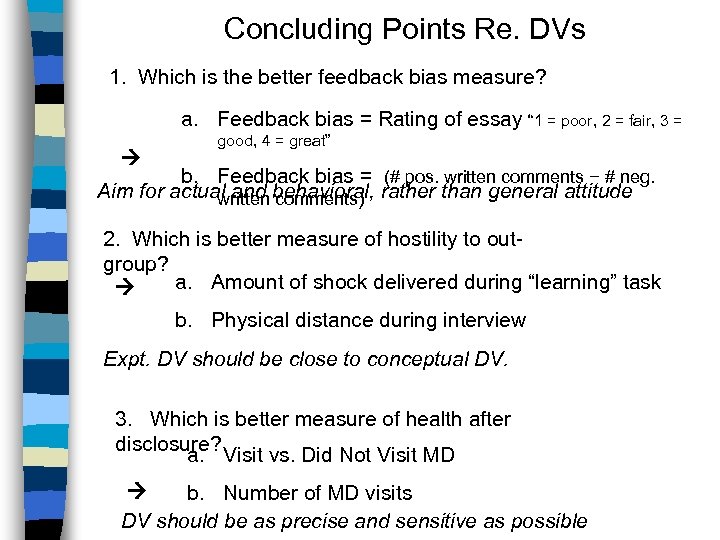
Concluding Points Re. DVs 1. Which is the better feedback bias measure? a. Feedback bias = Rating of essay “ 1 = poor, 2 = fair, 3 = good, 4 = great” b. Feedback bias = (# pos. written comments − # neg. Aim for actual and behavioral, rather than general attitude written comments) 2. Which is better measure of hostility to outgroup? a. Amount of shock delivered during “learning” task b. Physical distance during interview Expt. DV should be close to conceptual DV. 3. Which is better measure of health after disclosure? a. Visit vs. Did Not Visit MD b. Number of MD visits DV should be as precise and sensitive as possible
Experimental Designs Class 10
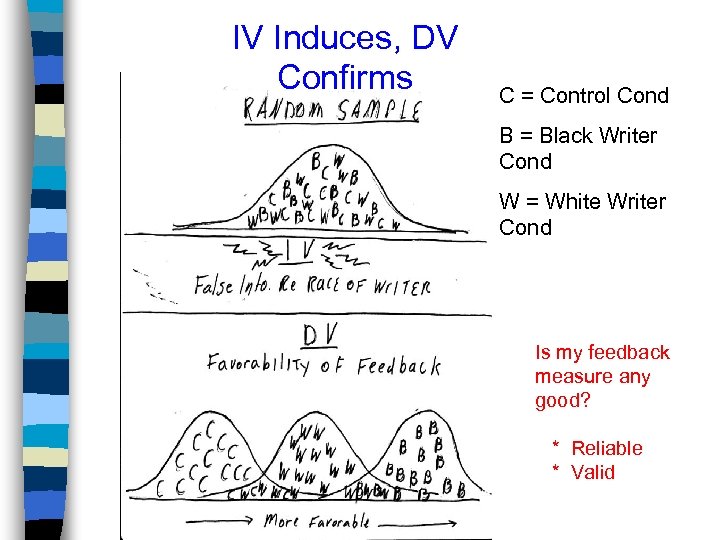
IV Induces, DV Confirms C = Control Cond B = Black Writer Cond W = White Writer Cond Is my feedback measure any good? * Reliable * Valid
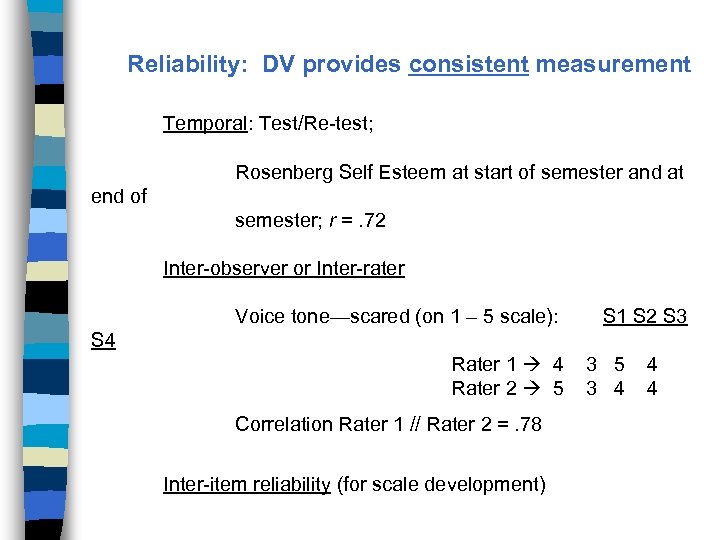
Reliability: DV provides consistent measurement Temporal: Test/Re-test; Rosenberg Self Esteem at start of semester and at end of semester; r =. 72 Inter-observer or Inter-rater Voice tone—scared (on 1 – 5 scale): S 1 S 2 S 3 S 4 Rater 1 4 3 5 4 Rater 2 5 3 4 4 Correlation Rater 1 // Rater 2 =. 78 Inter-item reliability (for scale development)
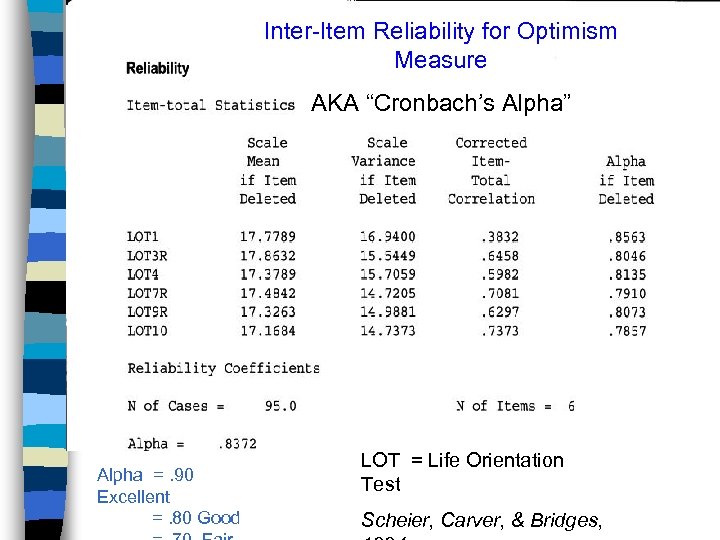
Inter-Item Reliability for Optimism Measure AKA “Cronbach’s Alpha” SPSS Reliability Output Alpha =. 90 Excellent =. 80 Good LOT = Life Orientation Test Scheier, Carver, & Bridges,
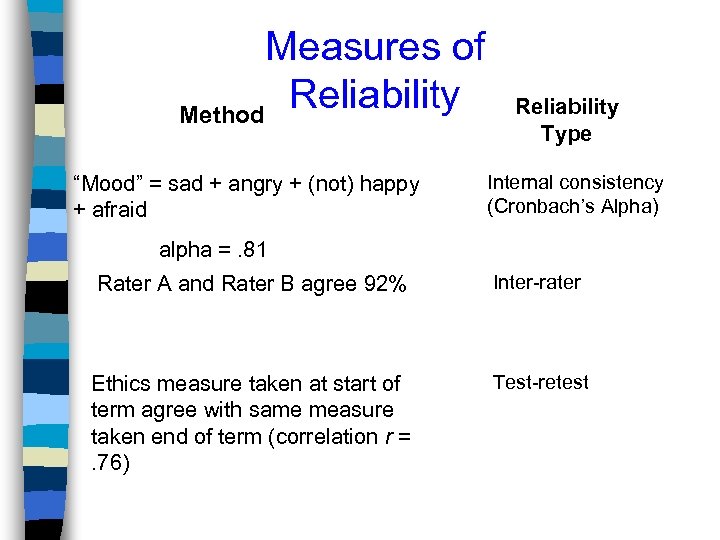
Measures of Reliability Method “Mood” = sad + angry + (not) happy + afraid Reliability Type Internal consistency (Cronbach’s Alpha) alpha =. 81 Rater A and Rater B agree 92% Inter-rater Ethics measure taken at start of term agree with same measure taken end of term (correlation r = . 76) Test-retest
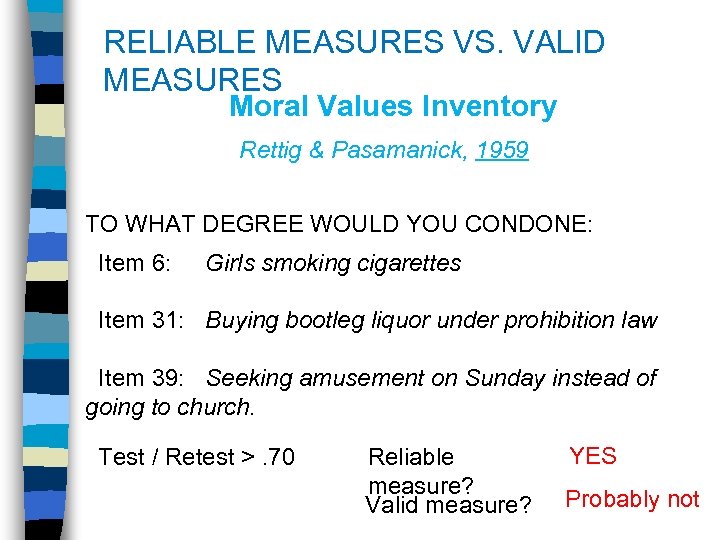
RELIABLE MEASURES VS. VALID MEASURES Moral Values Inventory Rettig & Pasamanick, 1959 TO WHAT DEGREE WOULD YOU CONDONE: Item 6: Girls smoking cigarettes Item 31: Buying bootleg liquor under prohibition law Item 39: Seeking amusement on Sunday instead of going to church. Test / Retest >. 70 Reliable measure? Valid measure? YES Probably not
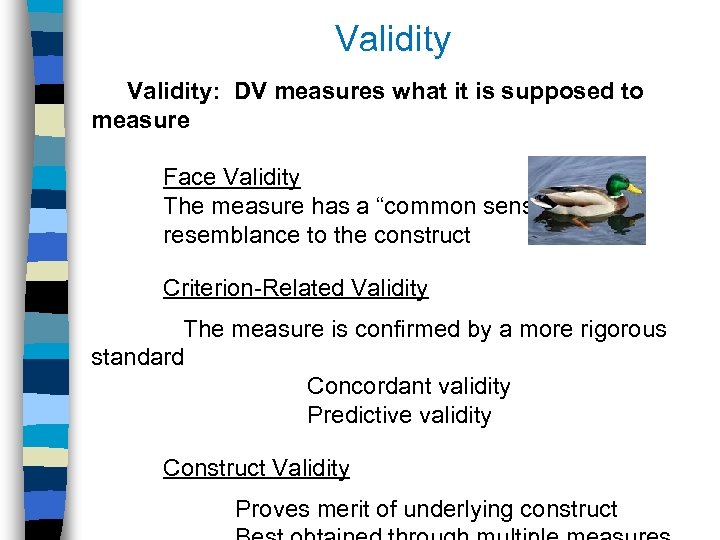
Validity: DV measures what it is supposed to measure Face Validity The measure has a “common sense” resemblance to the construct Criterion-Related Validity The measure is confirmed by a more rigorous standard Concordant validity Predictive validity Construct Validity Proves merit of underlying construct
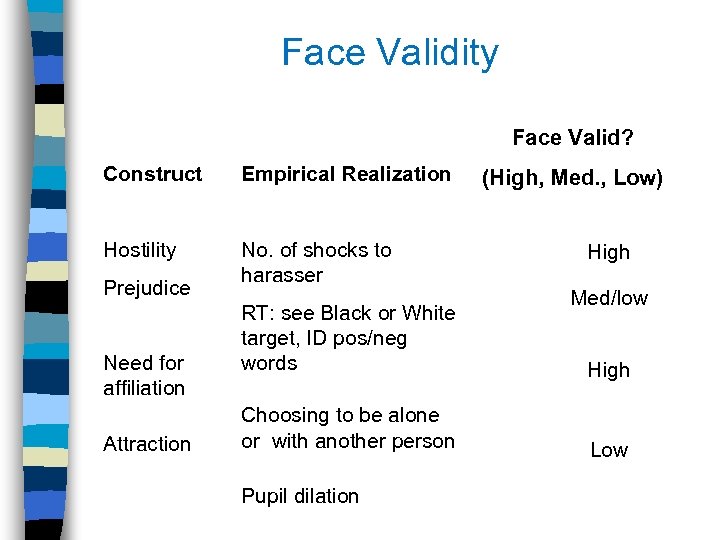
Face Validity Face Valid? Construct Empirical Realization Hostility No. of shocks to harasser Prejudice Need for affiliation Attraction RT: see Black or White target, ID pos/neg words Choosing to be alone or with another person Pupil dilation (High, Med. , Low) High Med/low High Low
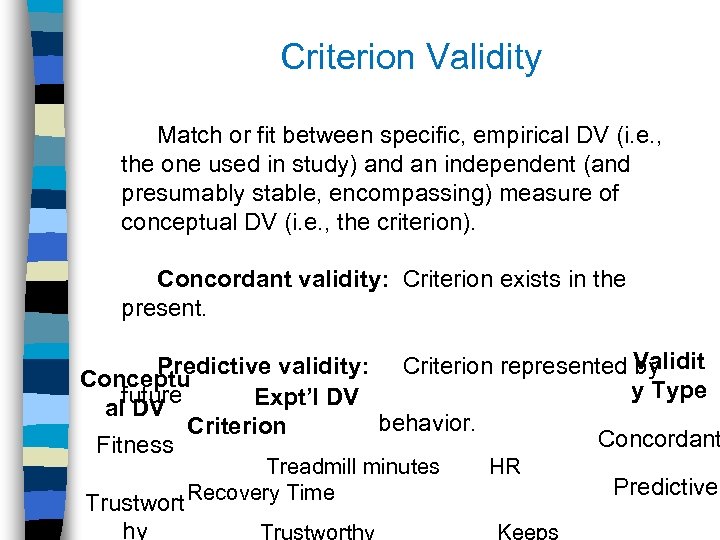
Criterion Validity Match or fit between specific, empirical DV (i. e. , the one used in study) and an independent (and presumably stable, encompassing) measure of conceptual DV (i. e. , the criterion). Concordant validity: Criterion exists in the present. Validit Predictive validity: Criterion represented by Conceptu y Type future Expt’l DV al DV behavior. Criterion Concordant Fitness Treadmill minutes HR Trustwort Recovery Time hy Trustworthy Keeps Predictive
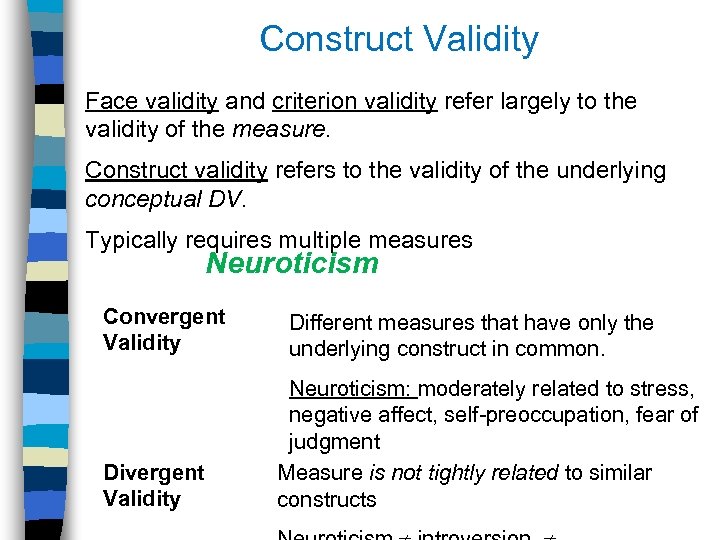
Construct Validity Face validity and criterion validity refer largely to the validity of the measure. Construct validity refers to the validity of the underlying conceptual DV. Typically requires multiple measures Neuroticism Convergent Validity Different measures that have only the underlying construct in common. Neuroticism: moderately related to stress, negative affect, self-preoccupation, fear of judgment Measure is not tightly related to similar constructs
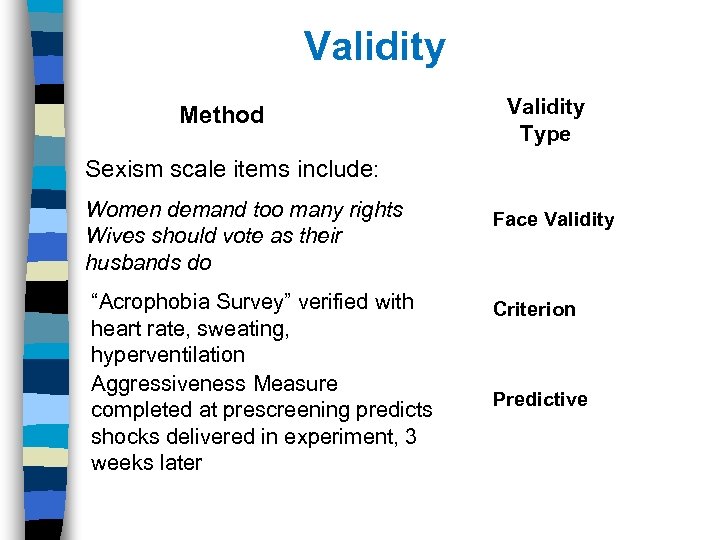
Validity Method Validity Type Sexism scale items include: Women demand too many rights Wives should vote as their husbands do “Acrophobia Survey” verified with heart rate, sweating, hyperventilation Aggressiveness Measure completed at prescreening predicts shocks delivered in experiment, 3 weeks later Face Validity Criterion Predictive
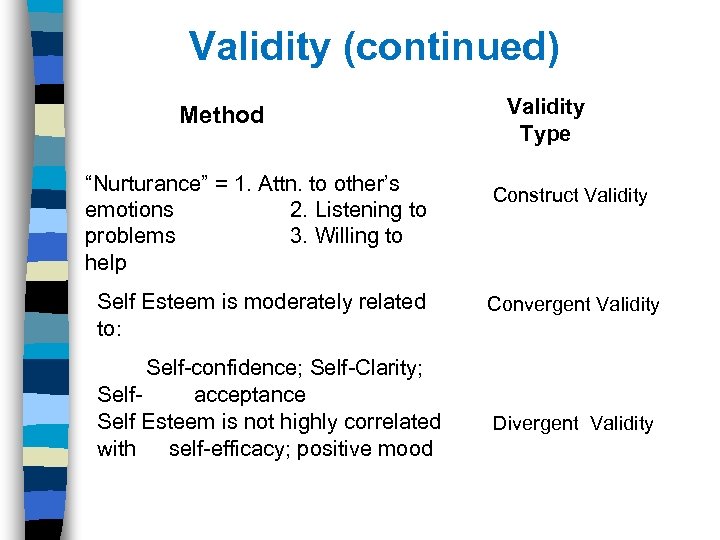
Validity (continued) Method “Nurturance” = 1. Attn. to other’s emotions 2. Listening to problems 3. Willing to help Self Esteem is moderately related to: Self-confidence; Self-Clarity; Self- acceptance Self Esteem is not highly correlated with self-efficacy; positive mood Validity Type Construct Validity Convergent Validity Divergent Validity
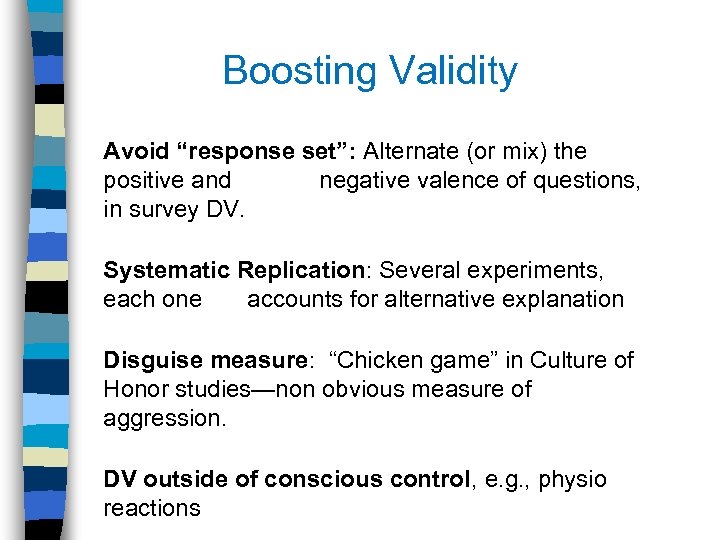
Boosting Validity Avoid “response set”: Alternate (or mix) the positive and negative valence of questions, in survey DV. Systematic Replication: Several experiments, each one accounts for alternative explanation Disguise measure: “Chicken game” in Culture of Honor studies—non obvious measure of aggression. DV outside of conscious control, e. g. , physio reactions
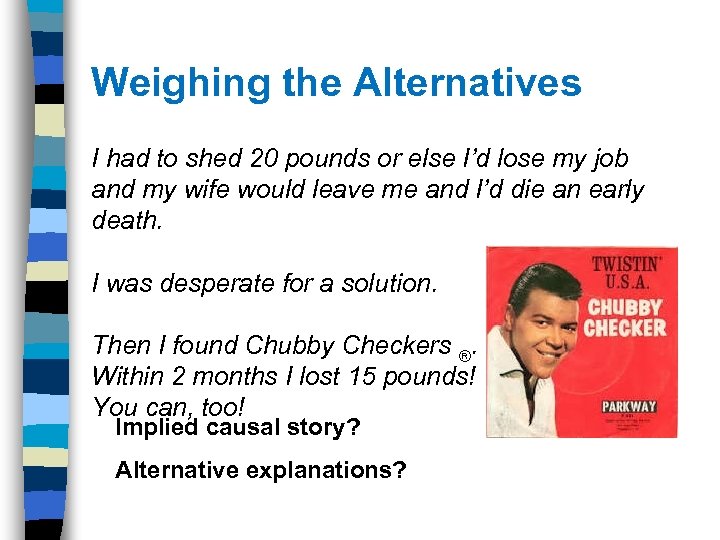
Weighing the Alternatives I had to shed 20 pounds or else I’d lose my job and my wife would leave me and I’d die an early death. I was desperate for a solution. Then I found Chubby Checkers ®. Within 2 months I lost 15 pounds! You can, too! Implied causal story? Alternative explanations?
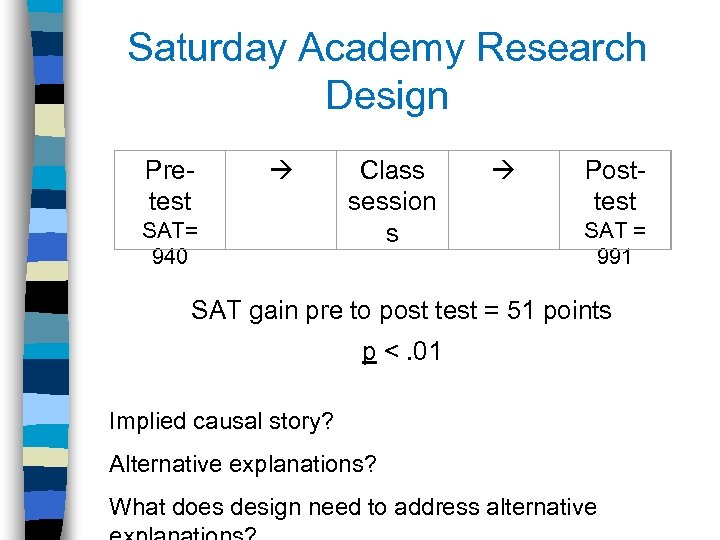
Saturday Academy Research Design Pretest SAT= 940 Class session s Posttest SAT = 991 SAT gain pre to post test = 51 points p <. 01 Implied causal story? Alternative explanations? What does design need to address alternative
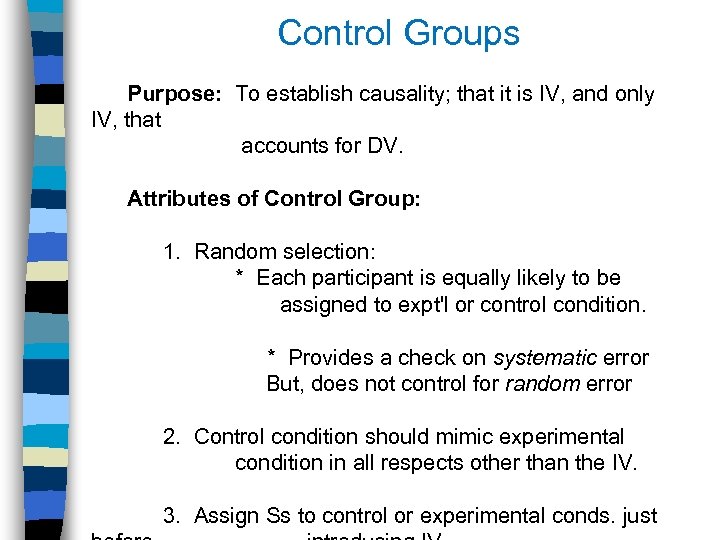
Control Groups Purpose: To establish causality; that it is IV, and only IV, that accounts for DV. Attributes of Control Group: 1. Random selection: * Each participant is equally likely to be assigned to expt'l or control condition. * Provides a check on systematic error But, does not control for random error 2. Control condition should mimic experimental condition in all respects other than the IV. 3. Assign Ss to control or experimental conds. just
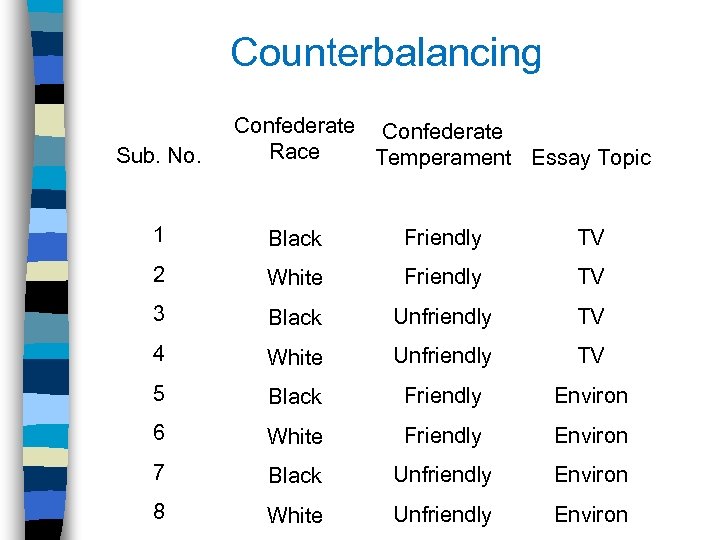
Counterbalancing Sub. No. Confederate Race Temperament Essay Topic 1 Black Friendly TV 2 White Friendly TV 3 Black Unfriendly TV 4 White Unfriendly TV 5 Black Friendly Environ 6 White Friendly Environ 7 Black Unfriendly Environ 8 White Unfriendly Environ
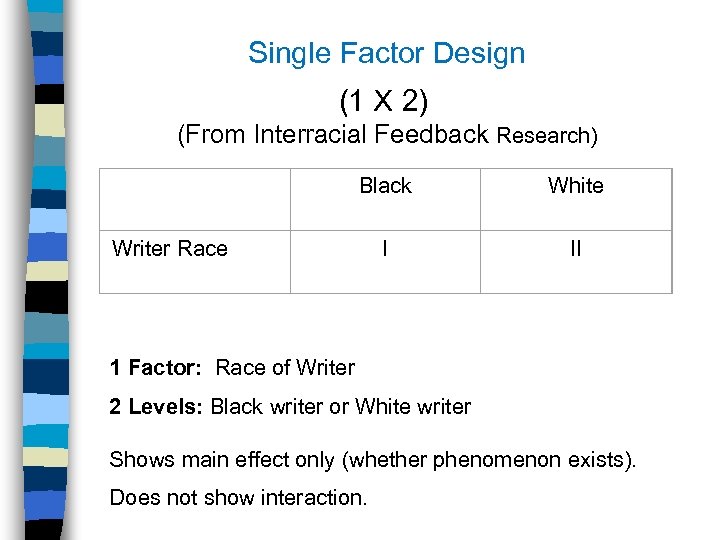
Single Factor Design (1 X 2) (From Interracial Feedback Research) Black White I II Writer Race 1 Factor: Race of Writer 2 Levels: Black writer or White writer Shows main effect only (whether phenomenon exists). Does not show interaction.
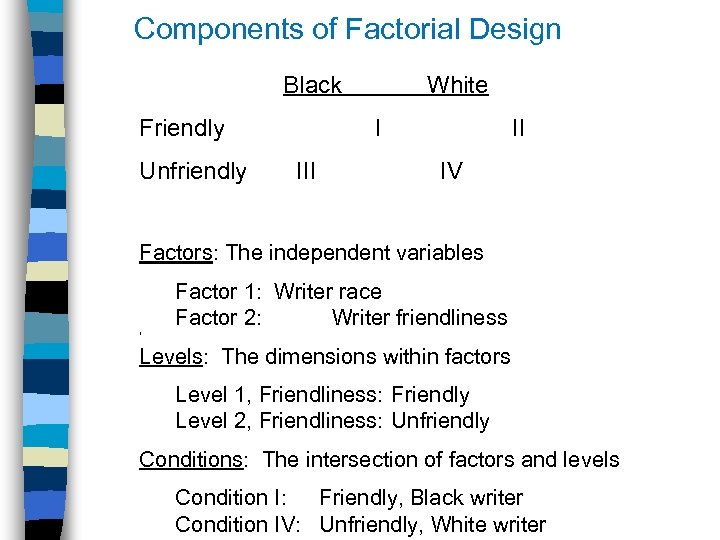
Components of Factorial Design Black Friendly Unfriendly White I II IV Factors: The independent variables Factor 1: Writer race Factor 2: Writer friendliness ‘ Levels: The dimensions within factors Level 1, Friendliness: Friendly Level 2, Friendliness: Unfriendly Conditions: The intersection of factors and levels Condition I: Friendly, Black writer Condition IV: Unfriendly, White writer
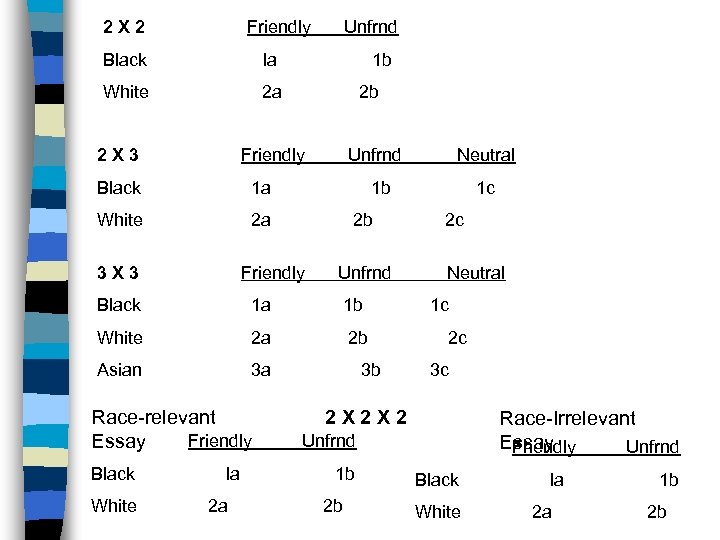
2 X 2 Friendly Unfrnd Black Ia 1 b White 2 a 2 b 2 X 3 Friendly Unfrnd Neutral Black 1 a 1 b 1 c White 2 a 3 X 3 Friendly Unfrnd Neutral Black 1 a 1 b White 2 a 2 b 2 c Asian 3 a 3 b 3 c 2 b 2 c 1 c 2 X 2 X 2 Race-relevant Essay Friendly Unfrnd Race-Irrelevant Essay Friendly Unfrnd Black Ia 1 b White 2 a 2 b
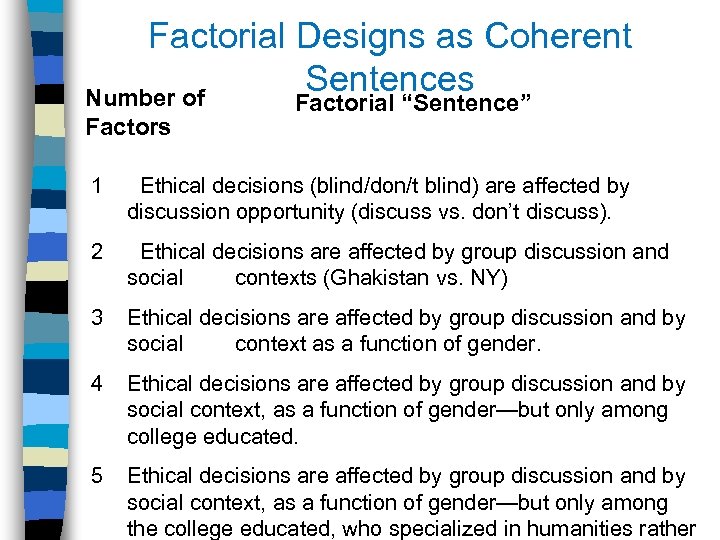
Factorial Designs as Coherent Sentences Number of Factors Factorial “Sentence” 1 Ethical decisions (blind/don/t blind) are affected by discussion opportunity (discuss vs. don’t discuss). 2 Ethical decisions are affected by group discussion and social contexts (Ghakistan vs. NY) 3 Ethical decisions are affected by group discussion and by social context as a function of gender. 4 Ethical decisions are affected by group discussion and by social context, as a function of gender—but only among college educated. 5 Ethical decisions are affected by group discussion and by social context, as a function of gender—but only among the college educated, who specialized in humanities rather
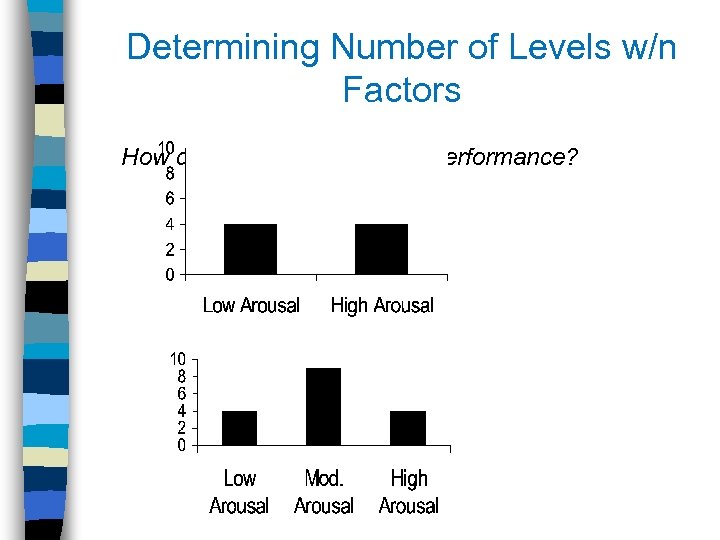
Determining Number of Levels w/n Factors How does arousal affect test performance?
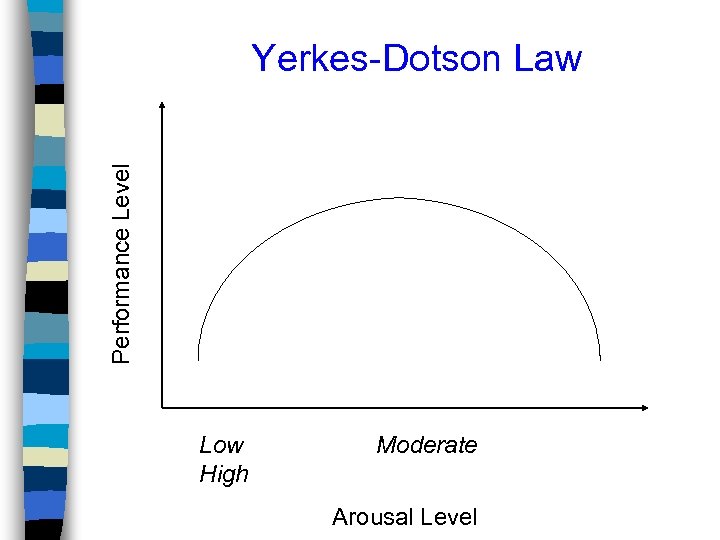
Performance Level Yerkes-Dotson Law Low High Moderate Arousal Level
 Скачать презентацию IMPLICIT MODEL OF ATTITUDE MEASURES Measure Attitude Behavior
497f1a901e79ed9fd8ac92cf1c9e7e2c.ppt