 Скачать презентацию Implementing the FRBR Conceptual Model in the Variations
2a14c08edc1d4e656c4c851e2470daab.ppt
- Количество слайдов: 32



Implementing the FRBR Conceptual Model in the Variations Music Discovery System Jenn Riley and Alex Berry …with thanks to Paul Mc. Elwain and the rest of the V/FRBR Project Team DLP Brown Bag Series October 28, 2009
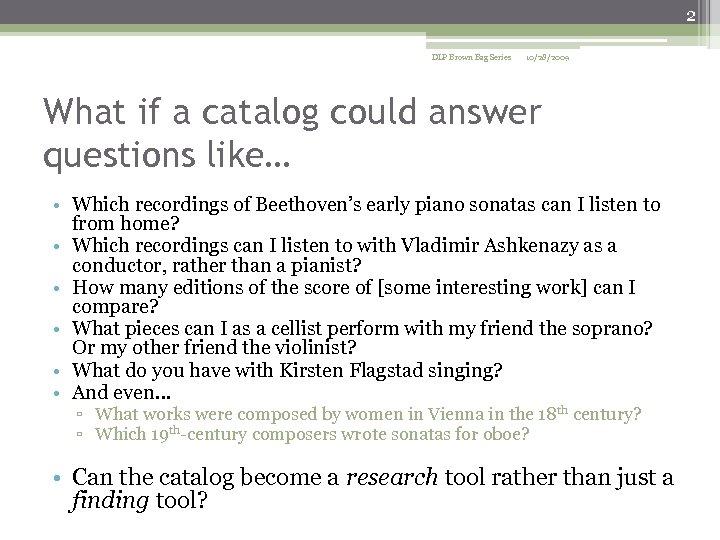
2 DLP Brown Bag Series 10/28/2009 What if a catalog could answer questions like… • Which recordings of Beethoven’s early piano sonatas can I listen to from home? • Which recordings can I listen to with Vladimir Ashkenazy as a conductor, rather than a pianist? • How many editions of the score of [some interesting work] can I compare? • What pieces can I as a cellist perform with my friend the soprano? Or my other friend the violinist? • What do you have with Kirsten Flagstad singing? • And even… ▫ What works were composed by women in Vienna in the 18 th century? ▫ Which 19 th-century composers wrote sonatas for oboe? • Can the catalog become a research tool rather than just a finding tool?
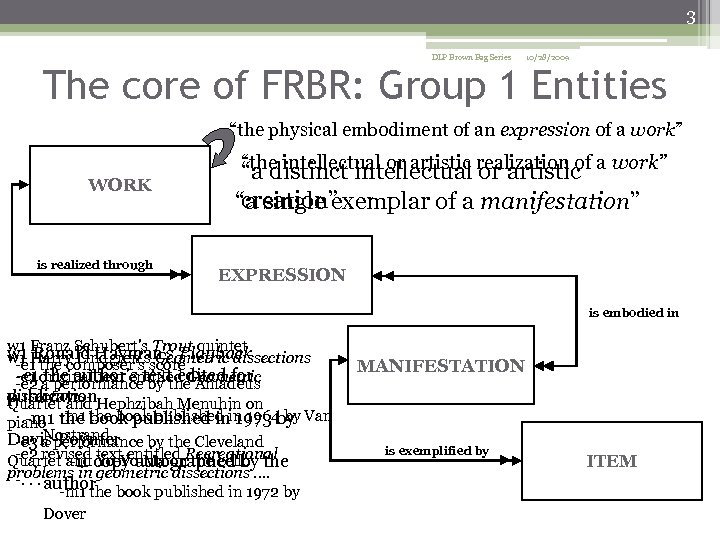
3 DLP Brown Bag Series 10/28/2009 The core of FRBR: Group 1 Entities “the physical embodiment of an expression of a work” WORK is realized through “the intellectual or artistic realization of a work” “a distinct intellectual or artistic creation” “a single exemplar of a manifestation” EXPRESSION is embodied in w 1 Franz Schubert's Trout quintet w 1 Harry Lindgren's Geometric dissections w 1 Ronald Hayman's Playback -e 1 the composer's score -e 1 the author's by the Amadeus -e 1 a performancetext edited for -e 2 original text entitled Geometric dissections publication. Hephzibah Menuhin on Quartet and -m 1 the book published 1973 by piano -m 1 book published inin 1964 by Van Nostrand Davis-Poynter by the Cleveland -e 3 a performance -e 2 revised text entitled Recreational Quartet and copy autographed by the -i 1 Yo-Yo Ma on the cello problems in geometric dissections. . -. . . author. -m 1 the book published in 1972 by Dover MANIFESTATION is exemplified by ITEM
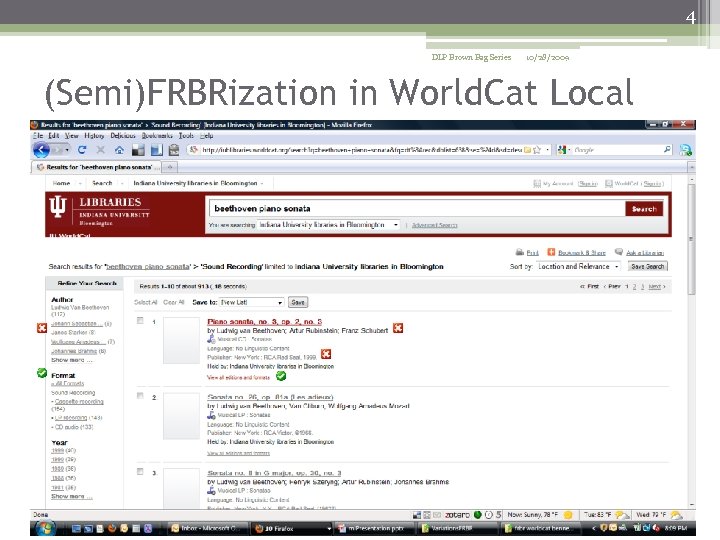
4 DLP Brown Bag Series 10/28/2009 (Semi)FRBRization in World. Cat Local
5 DLP Brown Bag Series 10/28/2009 Basics of the V/FRBR project • Funded by an Institute of Museum and Library Services National Leadership Grant ▫ October 1, 2008 - September 30, 2011 ▫ $481, 987 from IMLS; $482, 572 contributed by IU ▫ Staff from DLP, Music Library, and Tech Services are contributing some of their time to the project • In “Demonstration” category ▫ Primary mission: provide a model for other FRBRized catalogs ▫ Secondary mission: provide a useful and sustainable discovery system for music at IU
6 DLP Brown Bag Series 10/28/2009 Project staff • Jenn Riley, Metadata Librarian, Digital Library Program (Principal Investigator) • Jon Dunn, Associate Director for Technology, Digital Library Program • Mark Notess, Development Manager, Digital Library Program • Paul Mc. Elwain, Programmer/Analyst, Variations/FRBR Project • Alex Berry, Programmer/Analyst, Variations/FRBR Project • Phil Ponella, Director, Cook Music Library • Michelle Dalmau, Digital Projects and Usability Librarian, Digital Library Program • Julie Hardesty, Usability and Interface Specialist, Digital Library Program • Brian Wheeler, System Administrator, Digital Library Program • Ralph Papakhian, Head, Technical Services, Cook Music Library • Keith Cochran, Associate Director/Music Collection Development Librarian, Cook Music Library • Spencer Anspach, Library Systems Analyst/Programmer, Technical Services
7 DLP Brown Bag Series 10/28/2009 Most visible goal: FRBRize Variations • Provide a public and concrete testbed for FRBR ▫ with real data ▫ in a production environment ▫ as a response to the call in the LC WG on the Future of Bibliographic Control report • Follow through on long-standing vision for improved Variations searching • Provide a sustainable path for Variations metadata outside of IUCAT
8 DLP Brown Bag Series 10/28/2009 Other project goals • To provide an openly-accessible web search interface to FRBRized data in Variations for all scores and recordings in the music library, for community analysis; • To make supporting data, including data model documentation and FRBRized data, available to the community for analysis; and • To apply innovative, evidence-based interface design techniques to Variations cataloging and search interfaces to make the most of the FRBR-compliant data model.
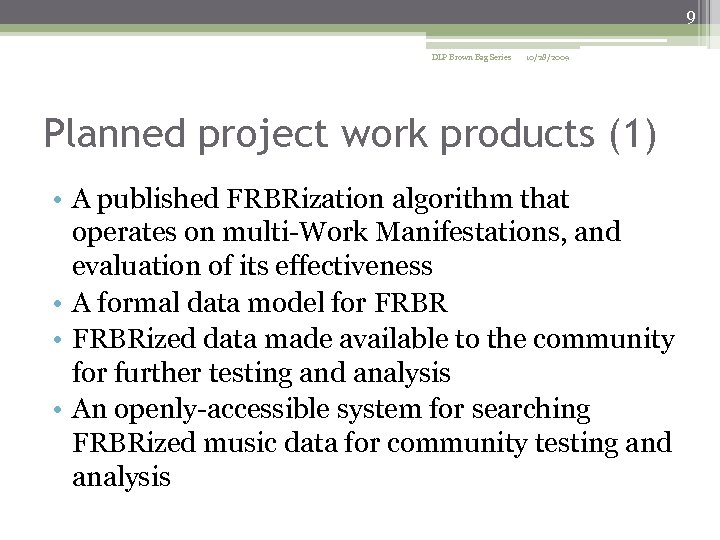
9 DLP Brown Bag Series 10/28/2009 Planned project work products (1) • A published FRBRization algorithm that operates on multi-Work Manifestations, and evaluation of its effectiveness • A formal data model for FRBR • FRBRized data made available to the community for further testing and analysis • An openly-accessible system for searching FRBRized music data for community testing and analysis
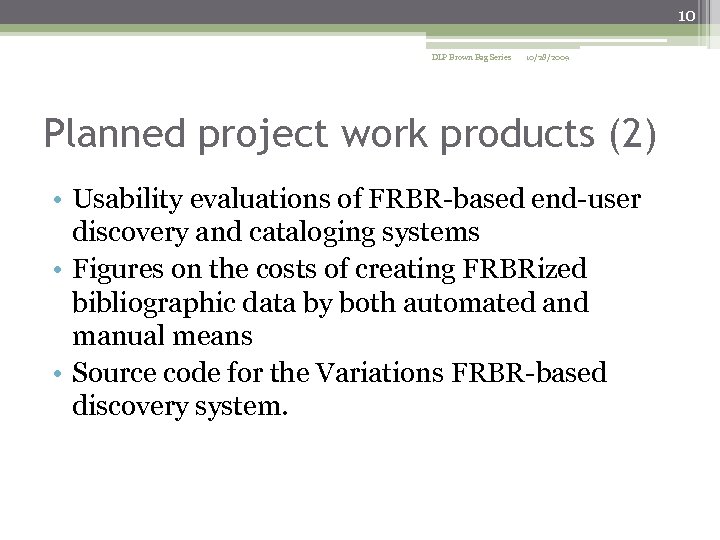
10 DLP Brown Bag Series 10/28/2009 Planned project work products (2) • Usability evaluations of FRBR-based end-user discovery and cataloging systems • Figures on the costs of creating FRBRized bibliographic data by both automated and manual means • Source code for the Variations FRBR-based discovery system.
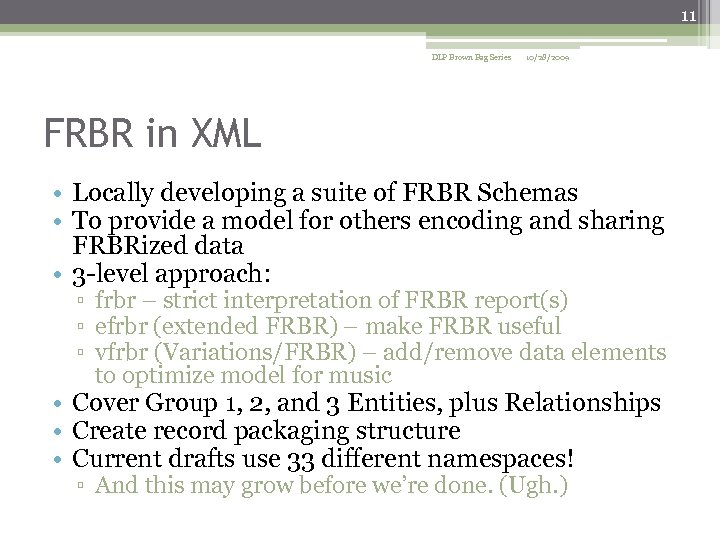
11 DLP Brown Bag Series 10/28/2009 FRBR in XML • Locally developing a suite of FRBR Schemas • To provide a model for others encoding and sharing FRBRized data • 3 -level approach: ▫ frbr – strict interpretation of FRBR report(s) ▫ efrbr (extended FRBR) – make FRBR useful ▫ vfrbr (Variations/FRBR) – add/remove data elements to optimize model for music • Cover Group 1, 2, and 3 Entities, plus Relationships • Create record packaging structure • Current drafts use 33 different namespaces! ▫ And this may grow before we’re done. (Ugh. )
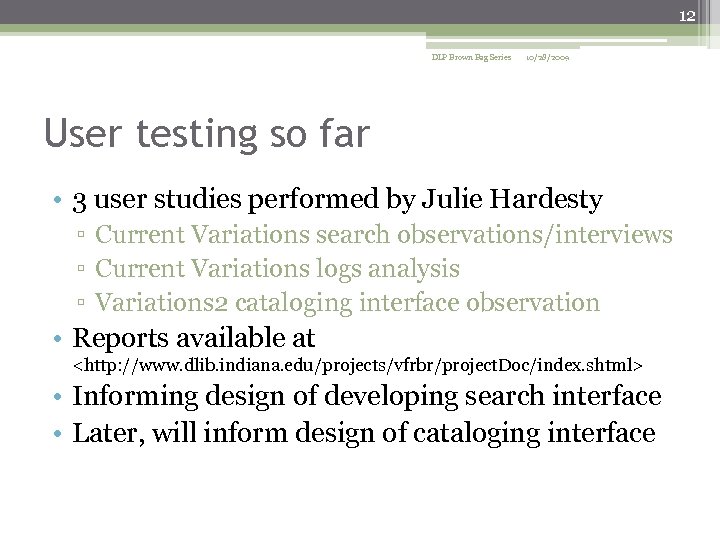
12 DLP Brown Bag Series 10/28/2009 User testing so far • 3 user studies performed by Julie Hardesty ▫ Current Variations search observations/interviews ▫ Current Variations logs analysis ▫ Variations 2 cataloging interface observation • Reports available at <http: //www. dlib. indiana. edu/projects/vfrbr/project. Doc/index. shtml> • Informing design of developing search interface • Later, will inform design of cataloging interface
13 DLP Brown Bag Series Implementation Details • Flow of Data Into Our System • Search UI Design • Technologies Used 10/28/2009
14 DLP Brown Bag Series 10/28/2009 Flow of Data Into Our System • Primary Source: MARC Bib and Authority Files • Processed by FRBRization logic creating Java objects • Objects persisted and indexed for use
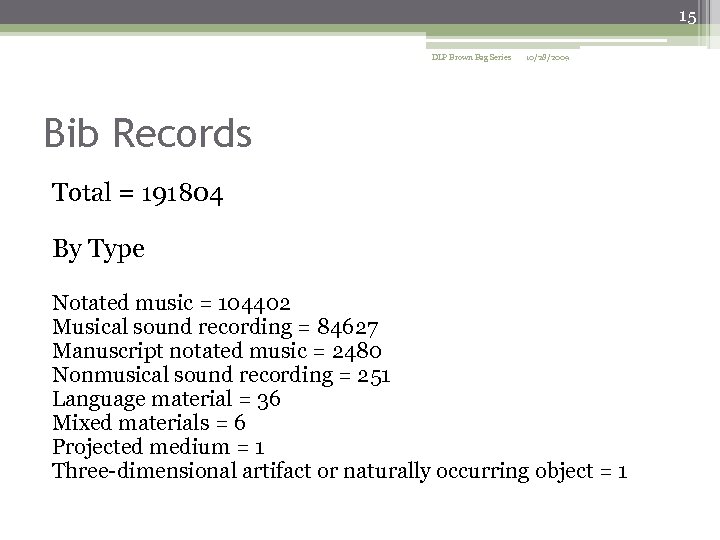
15 DLP Brown Bag Series 10/28/2009 Bib Records Total = 191804 By Type Notated music = 104402 Musical sound recording = 84627 Manuscript notated music = 2480 Nonmusical sound recording = 251 Language material = 36 Mixed materials = 6 Projected medium = 1 Three-dimensional artifact or naturally occurring object = 1
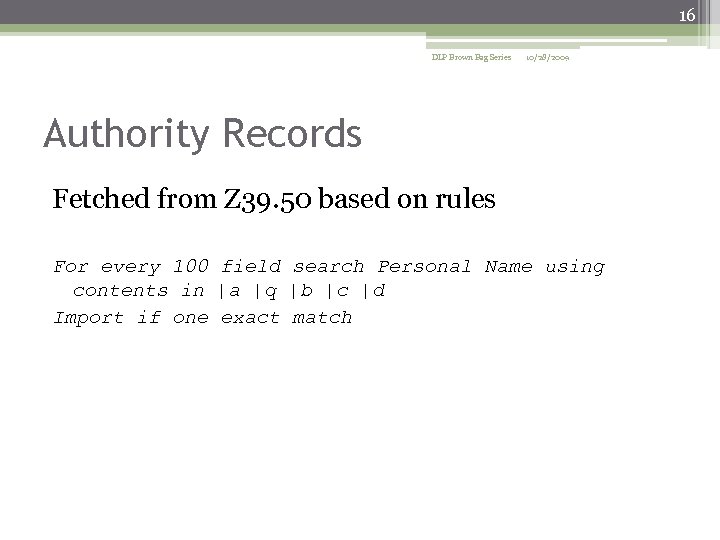
16 DLP Brown Bag Series 10/28/2009 Authority Records Fetched from Z 39. 50 based on rules For every 100 field search Personal Name using contents in |a |q |b |c |d Import if one exact match
17 DLP Brown Bag Series 10/28/2009 Potential Secondary Source of Data Music. Brainz • Useful for instances where we can't create any works from a record • Helps us get around parsing contents notes for popular music
18 DLP Brown Bag Series 10/28/2009 FRBRization • Continued effort from previous Variations grants • Attempts to create FRBR records from MARC records • Contains work identification algorithm and mapping rules • Geared specifically for music • Only uses a small subset of FRBR
19 DLP Brown Bag Series 10/28/2009 Work Identification Algorithm Uses clues in MARC bib records to pull out works • Presence of fields, subfields, and indicators • Values of subfields compared to Collective Title and Forms lists If the value in 240 |a equals the phrase "Chamber Music" do not identify 240 as a work
20 DLP Brown Bag Series 10/28/2009 Example mapping rules Work from Authority record • Uniform Title 100, 111 |t |m |n |r • Instrumentation 100, 111, 130 |m -- make separate entries from each string delimited by comma; do not include (x); map value inside () to number
21 DLP Brown Bag Series 10/28/2009 Results of FRBRization • Java objects representing FRBR entities with attributes and relations • Stored in a relational database and indexed for retrieval • Used for VFRBR search
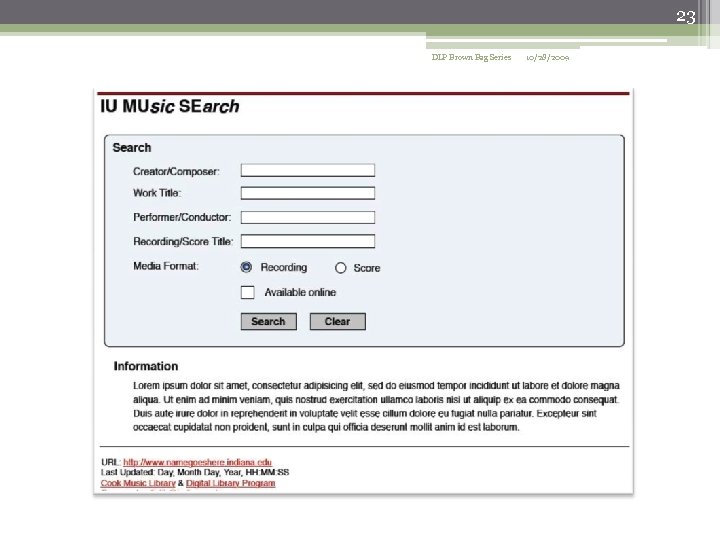
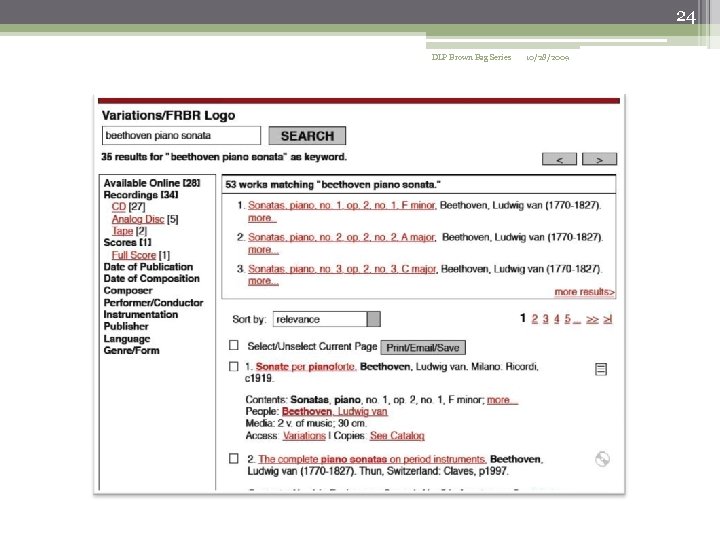
22 DLP Brown Bag Series 10/28/2009 Search UI Design The following slides were developed by Julie Hardesty during a series a meetings involving the VFRBR UI design team.
23 DLP Brown Bag Series 10/28/2009
24 DLP Brown Bag Series 10/28/2009
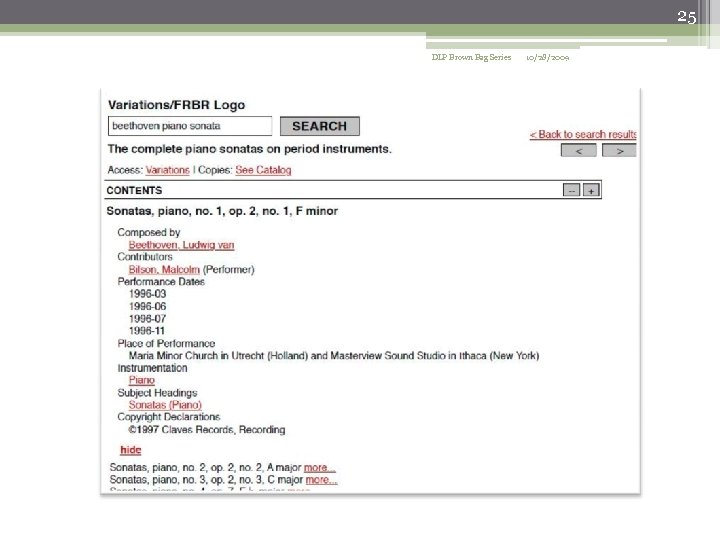
25 DLP Brown Bag Series 10/28/2009
26 DLP Brown Bag Series 10/28/2009 Technologies Used in Search UI • • Hibernate Solr Wicket j. Query
27 DLP Brown Bag Series 10/28/2009 Hibernate • Object-relational mapping framework for Java • Well established in industry • Works with a wide variety of databases
28 DLP Brown Bag Series 10/28/2009 Solr • A search server built on top of the popular Lucene library • Use HTTP requests to index data and query index • Uses simple XML documents throughout • Enables search interfaces instead of just acting as a full text index
29 DLP Brown Bag Series 10/28/2009 Wicket • Component based web application framework • Supports reuse at various granularities • Uses XHTML templates that are manipulated via Java code (no JSP)
30 DLP Brown Bag Series 10/28/2009 j. Query • Cross browser Java. Script library • Makes interaction between JS, CSS, and XHTML easier
31 DLP Brown Bag Series 10/28/2009 Current status of work • • Project programmers hired April 2009 XML schemas will be released “soon” Software development taking “agile” approach Starting to process extract of 191, 804 IUCAT music library score and recording records • Will have a discovery interface for people to look at “soon” • Will start work on cataloging tool later this fall
32 DLP Brown Bag Series 10/28/2009 To stay informed • These presentation slides: http: //www. dlib. indiana. edu/~jenlrile/presentations/bbfall 09/vfrbr. pptx • Project home page: http: //www. dlib. indiana. edu/project/vfrbr • Subscribe to project RSS feed from the home page • Talk to a member of our project team! jenlrile@indiana. edu berry 3@indiana. edu pbmcelwa@indiana. edu Others listed on project home page
Скачать презентацию Implementing the FRBR Conceptual Model in the Variations
2a14c08edc1d4e656c4c851e2470daab.ppt