


 Скачать презентацию Implementing MLP speaker Thomas Lindgren Fredrik Linder
316b5739ab4afae7327bfac9870ebf40.ppt
- Количество слайдов: 22
 Implementing MLP speaker Thomas Lindgren / Fredrik Linder / Magnus Eklund Cell. Point AB
 Location services • Distinctive feature of mobile services • Measurements from network collected in a location server (spec: 03. 71) • Clients access information via HTTP/XML interface to server • Clients are portals, resellers, operators, … which then provide info to end-users
 Standardization • Standardized info format from mobile net => location server • Plethora of protocols for accessing info location server => client • Location interoperability forum (LIF) founded to bring some order – Equipment manufacturers, operators, … – Mobile Location Protocol (MLP) = unifier
 The MLP Protocol • Mobile Location Protocol 3. 0. 0 based on HTTP/1. 1 and XML – About half a dozen DTDs define data • Many features – – Desired accuracy, max age, … Presentation coordinate system Varying geometric shapes in reply Multitude of data formats • ”Every feature is optional”
 SIMPL 2 and MLP • SIMPL 2 developed by Cellpoint as an MLP compatible protocol – Removed some features • Zoning, triggering • Still had to signal that features not supported – Added some features • CLPT-specific extensions for charging records • Many changes in MLP and SIMPL 2 during development – Fourteen SIMPL 2 draft specifications prior to release • Seven released during May-June
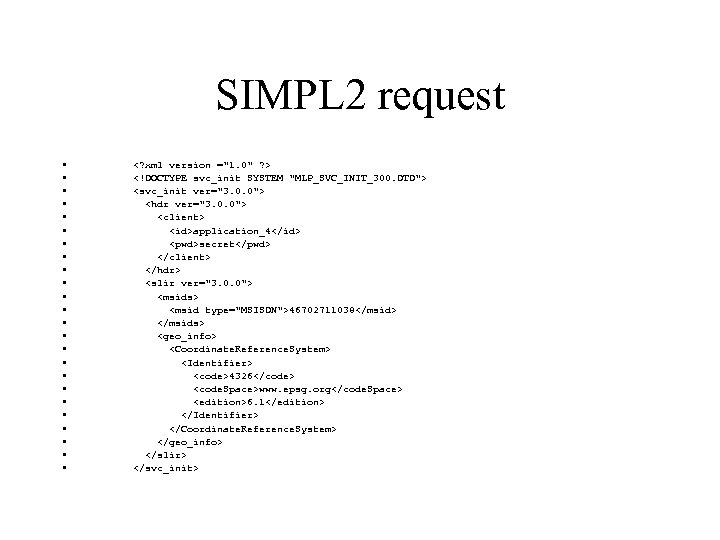 SIMPL 2 request • • • • • •
 4326
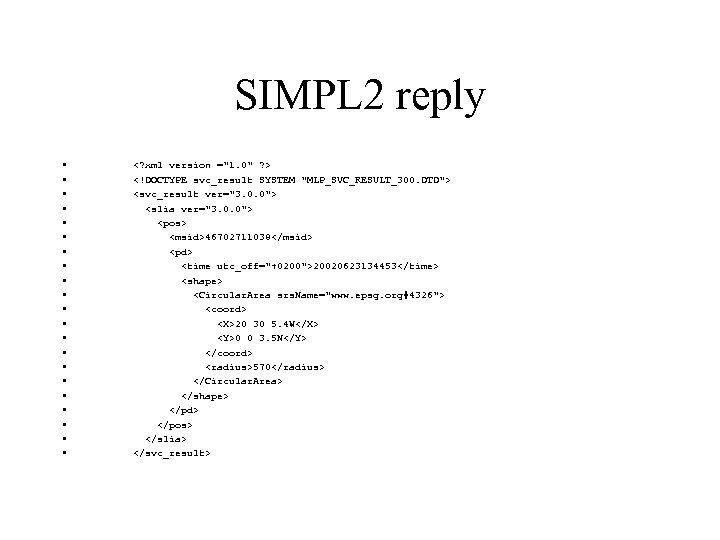 SIMPL 2 reply • • • • • •
 Implementing MLP • Integrate inets and xmerl • Act as server (MLS) • Act as proxy (MLB) – Must still handle all of MLP for proxying non-CLPT location servers • Thoroughly validate all incoming data – Requests and replies • Translate external internal format • Dispatch to other server or compute location
 The bad part • Aggressive dev schedule (5 -6 months x 3 people) – Goal: Release soon after MLP specification is finalized • Specification mutates quickly – – Major and minor syntax and feature changes Data formats Error codes Specification bug fixes • Only protocol syntax specified, not semantics – Semantics sometimes unclear
 The first-half score • Unsatisfactory code – Specification changes => patch upon patch • Unsatisfactory testing – Hard for developers to test such a big protocol – Hard for QA to know what worked in a given release • Time spent on reacting to trouble reports and specification changes – Release date approaching, but not release
 Second-half kickoff • We needed to get bugs and changes under control – Code must become easy to change • Esp. XML validation – Code must have high quality before QA begins • Fixing bugs via QA too slow and unhappy for us and QA • Must quickly resolve arguments about TRs – Many specification changes => many arguments about what was valid => lost time
 Abstraction • Get rid of records in crucial places – – – Use abstract data types instead Encapsulate data representation in module Can check that data are consistent when created Operations are named => legible code, intention clear (Programming 101 …) • Why weren’t ADTs used already? – Record notation more convenient (e. g. , pattern match) – Records already provide representation independence (sort of)
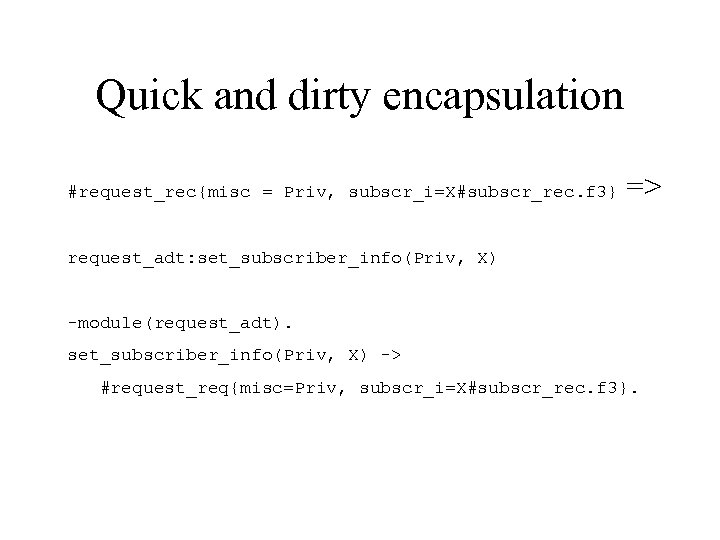 Quick and dirty encapsulation #request_rec{misc = Priv, subscr_i=X#subscr_rec. f 3} => request_adt: set_subscriber_info(Priv, X) -module(request_adt). set_subscriber_info(Priv, X) -> #request_req{misc=Priv, subscr_i=X#subscr_rec. f 3}.
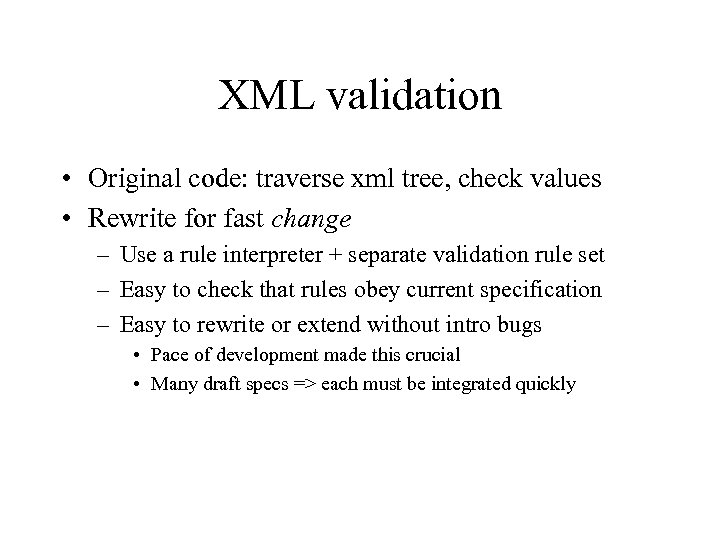 XML validation • Original code: traverse xml tree, check values • Rewrite for fast change – Use a rule interpreter + separate validation rule set – Easy to check that rules obey current specification – Easy to rewrite or extend without intro bugs • Pace of development made this crucial • Many draft specs => each must be integrated quickly
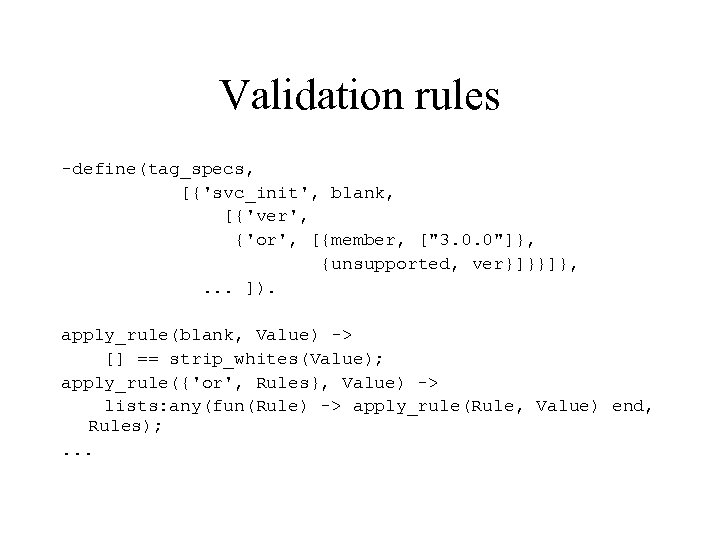 Validation rules -define(tag_specs, [{'svc_init', blank, [{'ver', {'or', [{member, ["3. 0. 0"]}, {unsupported, ver}]}}]}, . . . ]). apply_rule(blank, Value) -> [] == strip_whites(Value); apply_rule({'or', Rules}, Value) -> lists: any(fun(Rule) -> apply_rule(Rule, Value) end, Rules); . . .
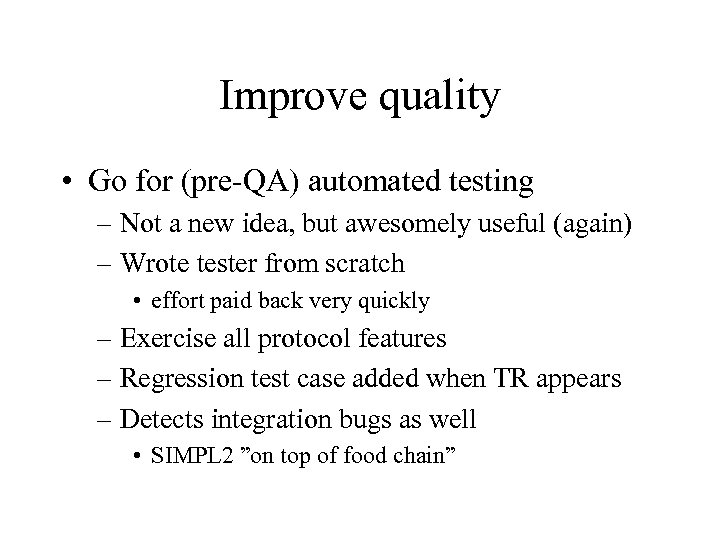 Improve quality • Go for (pre-QA) automated testing – Not a new idea, but awesomely useful (again) – Wrote tester from scratch • effort paid back very quickly – Exercise all protocol features – Regression test case added when TR appears – Detects integration bugs as well • SIMPL 2 ”on top of food chain”
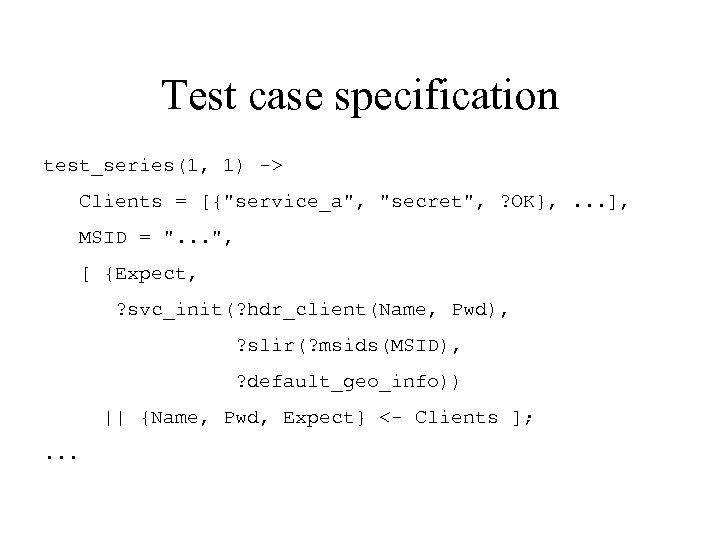 Test case specification test_series(1, 1) -> Clients = [{"service_a", "secret", ? OK}, . . . ], MSID = ". . . ", [ {Expect, ? svc_init(? hdr_client(Name, Pwd), ? slir(? msids(MSID), ? default_geo_info)) || {Name, Pwd, Expect} <- Clients ]; . . .
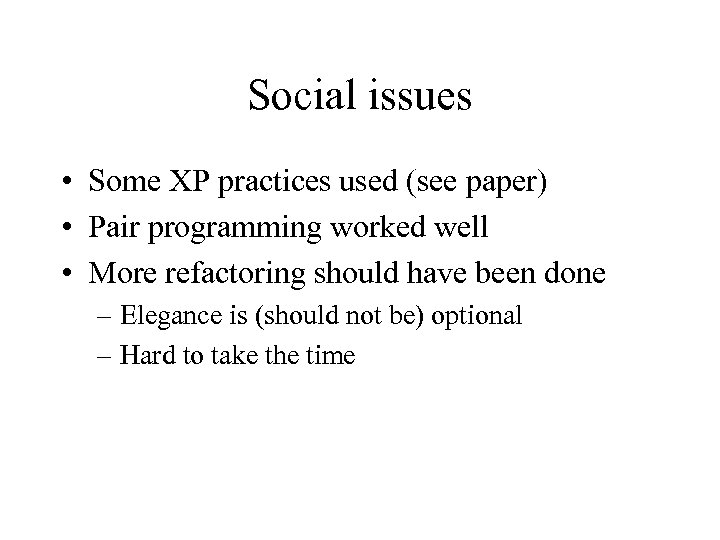 Social issues • Some XP practices used (see paper) • Pair programming worked well • More refactoring should have been done – Elegance is (should not be) optional – Hard to take the time
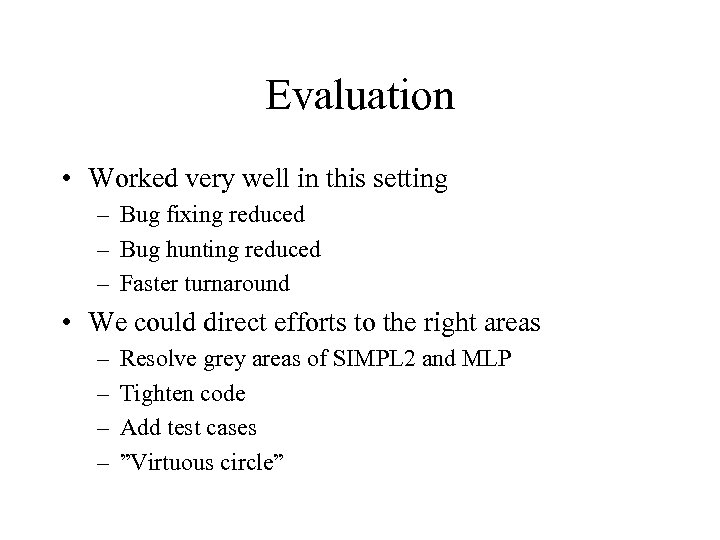 Evaluation • Worked very well in this setting – Bug fixing reduced – Bug hunting reduced – Faster turnaround • We could direct efforts to the right areas – – Resolve grey areas of SIMPL 2 and MLP Tighten code Add test cases ”Virtuous circle”
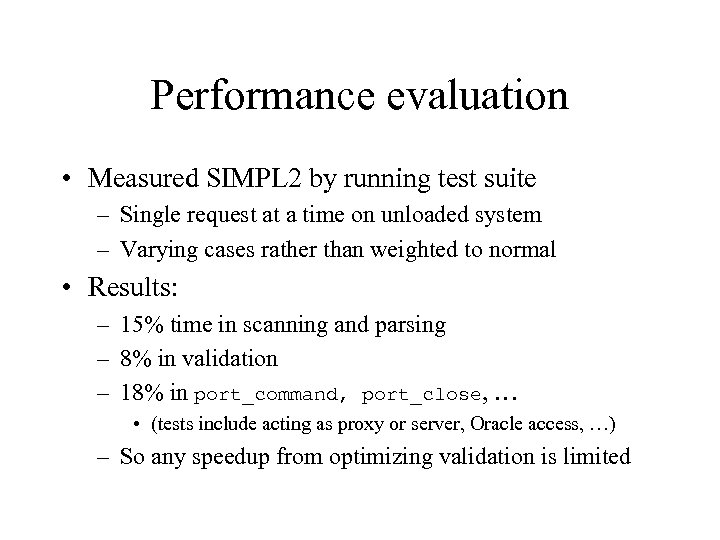 Performance evaluation • Measured SIMPL 2 by running test suite – Single request at a time on unloaded system – Varying cases rather than weighted to normal • Results: – 15% time in scanning and parsing – 8% in validation – 18% in port_command, port_close, … • (tests include acting as proxy or server, Oracle access, …) – So any speedup from optimizing validation is limited
 Future work • Extend data driven design – Rule-driven translation from/to internal format? • Generate a validating XML parser given a validation spec? – Extend xmerl
 Final score • ADTs > Records • Data driven design (= validation rules) reduce complexity • Automated testing • XP-practices (pair programming) • SIMPL 2 released to customer same week as final MLP specification was released • Another grisprotokoll bites the dust